Category Archives: Celebrity

Banking on Sherlock

When Abbey National opened their grand Art Deco headquarters at Nos 219-229 Baker Street in 1932, they didn’t quite know what they were getting into. Because it sat in the spot where 221b should be, the new building almost immediately began receiving letters addressed to Sherlock Holmes. When Arthur Conan Doyle chose an address for Holmes, he deliberately picked 221b because the Baker Street numbering did not go that high. But after renumbering, and with the arrival of Abbey House, Holmes’s address suddenly came into solid existence.

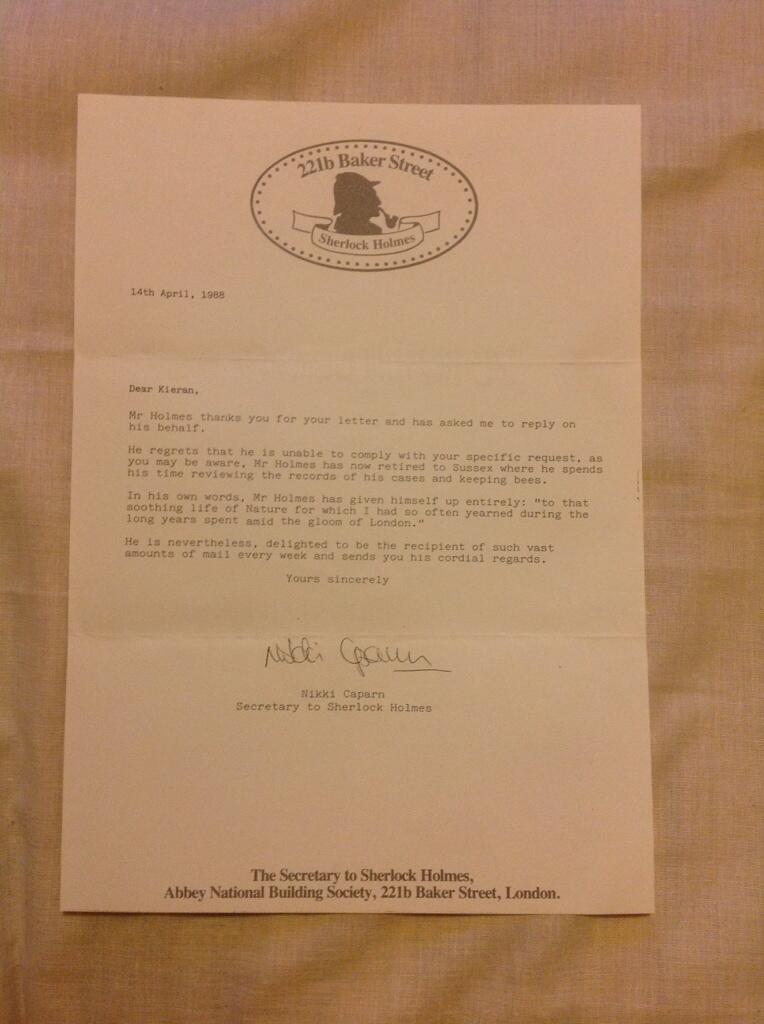
While many banks might have ignored this accident of geography, Abbey embraced it. Over the years, they really threw themselves into the business of celebrating the fictive biography of the world’s greatest detective. They installed a plaque (now lost), they published books and, after a while, they employed a letter writer, somebody whose job was to respond to all the letters addressed to Sherlock, acting more or less as his personal secretary.

In 1989, the New York Times interviewed Nikki Caparn, who then had that responsibility, and she described how she had received letters asking Sherlock to solve Watergate, or locate some missing homework. ‘Many people don’t ask for anything in particular,’ she said. ‘They just want to know what Mr Holmes is doing now or where he is and they hope he is well. And many people know he’s not real and write tongue in cheek. But some people haven’t worked it out. Mr Holmes would be 136 years old now, so it’s unlikely that he’d still be living here.’

Here is one such response from around exactly that time, sent to Kieran (@hail_tothechimp on Twitter), who had written to Sherlock to ask him about his most difficult case. Ms Caparn clearly does not feel equipped to respond to such a difficult and controversial query, so plays a straight bat with her standard response.

BOb2ZThCcAAIQBZ

Abbey have since moved from Baker Street and are owned by Spanish giants Santander, and I don’t know what has happened to their vast archive of letters. However, Abbey also created something for Sherlock Holmes fans that is definitely still standing. In 1951, the bank put together a Sherlock Holmes exhibition for the Festival of Britain at Abbey House. The Spectator said the Festival ‘was unlikely to show anything nearer perfection in its way than the reconstruction by the Marylebone Public Libraries Committee of Sherlock Holmes’s room in Baker Street.’

The review continues that ‘everything is here for the student of Holmes—violin, hypodermic syringe, revolvers, handcuffs’ and provides not just ‘a shrine for the connoisseurs of Holmes but a deep pleasure for the student of the late Victorian period’. The Spectator concluded that ‘when the Festival has subsided, this charming reconstruction is preserved for the enjoyment of posterity.’

Which it was. In 1957, the brewer Whitbread purchased the entire exhibition and put it on display in a pub, the Northumberland Arms, which it renamed the Sherlock Holmes and opened as what was surely one of London’s first theme pubs. The pub is located in Charing Cross, a key location in many Holmes stories, and the exhibition is still standing exactly as it was installed, preserving to this day behind glass in an upstairs room a slice of 1950s Britain in the shape of a fictional Victorian living room.


Selling ‘psychedelic marmite’ in Ladbroke Grove with the rock ‘n’ roll doctor


Before he met Gram Parsons and became country and western singer Hank Wangford, Sam Hutt was an avowed member of the sixties counterculture as well as a qualified doctor. Like many on the scene, he managed to combine his two lives for a brief period when he and two other doctors ran a practice prescribing marijuana to junkies. Hutt, incidentally, was one of the signatories of Steve Abrams pro-pot advert in The Times.  I spoke to him recently, and he explained how it all came about:

‘I qualified as a doctor and didn’t know what the fuck to do. I didn’t like doctors, I didn’t like medical students, I didn’t like working in hospitals and I didn’t want to do general practice. Then I heard this guy, Ian Dunbar, had a place in Ladbroke Grove. I found this out from Bernie Greenwood, who was the only doctor I really liked and was also a musician, playing saxophone and keyboards.


So we both joined in. Ian had this practice on the crest of the hill in Ladbroke Grove. There’s a church and right opposite is the church building and we had the top floor. Ian’s big thing was to help people who were on heroin. He’d discovered that doctors could still prescribe cannabis, ironically in tincture form, which means in alcoholic solution. Ian prescribed it to people who were coming off smack, not because it replaces the heroin – it doesn’t – but as a way of getting high. That’s counter to the usual treatment of heroin, which is to use methadone. The rationalisation for methadone, which can kill you if you overdose on it, is that you don’t get high. It doesn’t make you feel good, whereas heroin makes you feel good.

It seemed to me this was a Presbyterian attitude – if you like something, it must be bad for you. So they switch you on to something you don’t like. Ian went counter to that, offering them something that let them get out of it, just in a different way to heroin. People often switch between heroin and alcohol as alcohol is much closer to heroin than cannabis is. Cannabis doesn’t achieve wipe out, it doesn’t achieve oblivion, which both heroin and alcohol do.

So me, Ian and Bernie set up this hippie practice and as a political act, we prescribed cannabis. In the 60s, smoking a joint was a political act, it was you saying you were a freak, a part of an alternative society, not a straight. And you didn’t touch alcohol because it would kill you. Our ethos was that we wouldn’t prescribe speed: uppers or downers. If that’s what you wanted you had to go to the straight doctors in pin-stripe suits in Harley Street. They’ll give you bucketloads. So I’m not a grocer, but I will prescribe you cannabis. They closed that law down in 1973. We were seeing all sorts of people but when we got our first cheque from the National Health it was for £11. That’s for three doctors after six months work. Even then, £11 wasn’t much. So we had to support ourselves by making it a private prescription charging a couple of quid a time.

We got the cannabis from William Ransom & Son. They were the company in Hertfordshire that had a government license to extract cannabis from the plant. They made it into this sticky thick stuff, like a psychedelic marmite. That would then be dissolved in alcohol to make a tincture. The extract was much stronger than the tincture, you could get very, very stoned.

That practice was eventually closed by the police, because they didn’t like junkies being treated like you and me, they wanted to lock them up. I continued being a rock and roll doctor. I went on tour with Family and I shared a house with Jenny Fabian and Roger Chapman before, through Keith Richards, I met Gram Parsons and discovered country music.’


Gilbert & George and David Bowie at the Marquee, 1968/9

Should you be fortunate enough to attend the superb David Bowie exhibition at the V&A this spring, one of the first thing you will see is a video of the artists Gilbert & George performing their ‘Singing Sculpture‘. The intention, I think, is to draw a connection between Bowie and conceptual art, but there is another facet of the relationship between David Bowie and Gilbert & George that goes unmentioned: they both played gigs at the Marquee.

I have an article in the current issue of Uncut about the Marquee club. It mainly focuses on The Who, and while asking around about people who may have seen Townshend and Co perform at the Marquee I received an intriguing email from the writer Jonathon Green, who recalled a show at the Marquee in 1968. ‘They were holding auditions and some pals of mine who had a band tried their luck. Unsuccessfully. Naturally we friends tipped up to cheer. But the weird moment of the evening was when this pair of blokes appeared and, saying nothing, sat for some minutes on either side of a table that they placed centre stage. The two blokes, it transpired, though I must admit I can longer recall when I made this discovery, were Gilbert and George.’

Astonishingly, it seems London artists Gilbert & George did play the Marquee at least once – as they mention here – and possibly even twice. Because as well as the evening Green recalls they also played a show there in early 1969, when they were supported by Audience (who later played on the soundtrack to cult suedehead film Bronco Bullfrog).

I asked two members of Audience about their show with Gilbert & George. Sadly, G&G themselves did not respond to repeated queries about their Marquee days.

Trevor Williams: ‘It was an audition night for us, but I’m not sure what they were doing there unless it was to audition an act they were planning to perform later at the Marquee. It was our first live gig but their act basically consisted of them sitting at a table on two chairs facing each other. They were in suits and their faces were painted gold or silver and one told the other stories while the other said nothing. These were very macabre little stories one of which involved a dwarf committing suicide in the bath and the water getting pinker and pinker but never got red because there’s not enough blood in a dwarf.

They were really nice, pleasant, social guys. I don’t remember how they were received but it was an era when anything went and people enjoyed anything off the wall. I’ve no idea how many people were there although somebody once told me that Germaine Greer was in the audience that night.’

Howard Werth: We first encountered Gilbert & George at the back of the Marquee when these two tweed besuited gentlemen with metallic gold heads and hands, in the style of shop window dummies of a gentlemen outfitters, poked their heads into our van politely asking where the entrance to the Marquee was. We were getting ready to audition as were they. Their act consisted of them both seated with one of them (Gilbert I believe) relating a rather strange tale involving dwarves whilst the other one (George) listened intently, chin on fist. I remember Germaine Greer backstage who was trying to get members of another audition band to retrieve some of their equipment they’d left at her flat in the Pheasantry in the Kings road. We shortly after did a gig at the Lyceum with Gilbert & George, I believe they were about to leave Central St Martins art school around that time.’

So there we have it. In an alternative universe perhaps Gilbert & George gave up art and continued their life in music, while David Bowie, fed up of playing bottom of the bill at the Marquee, jacked in the pop trade and threw himself wholeheartedly into the curious world of conceptual art.

The Special London Bridge Special

This sensational slice of ham and song was made in 1972 to celebrate the purchase of London Bridge by an American theme park. It features a bizarre cast that includes Tom Jones, Rudolf Nureyev, The Carpenters, Kirk Douglas, Charlton Heston and Terry-Thomas and is basically the film the Olympic opening ceremony could have been.

It’s all here, but watch the intro especially, featuring Tom Jones singing his way round various London landmarks before engaging in a small slice of double entendre on a No 13 bus.

Death and collecting

The Wellcome Collection is currently showing a typically absorbing exhibition titled Death, but it’s not really about that at all. It features work from a private collection, that of Richard Harris, and largely consists of skulls and skeletons, many of which are actually rather lifelike.

In fact, despite its arresting title, this is in many senses a rather squeamish, clean exhibition. There’s no dying, no decomposition, no pain, little mourning or God. There are no worms eating dead bodies, no cancer destroying live ones. It’s not even particularly morbid. It’s more about one man’s obsession with the human skeleton, stripped of flesh and cleansed of blood, sinew and memory, as portrayed by a number of very beautiful works of art over the centuries. If you want a more gruesome, more real, idea of death, try the Museum of London’s Doctors, Dissection and Medicine Men.

Collection owner Richard Harris stands in front of a work my Mexican artist Marcos Raya called Family Portrait : Wedding  at the 'Death: A Self-portrait' exhibition at the Wellcome Collection on November 14, 2012 in London, England. The exhibition showcases 300 works from a unique collection by Richard Harris, a former antique print dealer from Chicago, devoted to the iconography of death. The display highlights art works, historical artifacts, anatomical illustrations and ephemera from around the world and opens on November 15, 2012 until February 24, 2013.

It is tempting to speculate why Harris is so fascinated with his particular idea of death – why so clinical? Why so safe? – but it’s also ultimately rather pointless. In his excellent essay on collecting, Unpacking My Library, Walter Benjamin noted that ‘‘Collectors, like artists, operate out of unconscious motives, and so we cannot be known to ourselves.’ A collection can be about anything, and may reflect a personal interest or a psychological flaw, but the reasons behind their creation are rarely as interesting as you may hope.

What is intriguing about Harris’s love for skulls is that collections are often built as a defence against death itself, a way for the collector to claim mortality for himself in the form of something that will exist after he no longer does so (even if most collections end up being broken by families who lack the passion or obsession to keep them intact). Collections are also about memory, a way for the collector to freeze a moment in time. Every item represents a second, an hour, a week, a month – however long it took to locate and acquire – in the collector’s life that he can look at and recollect for years to come.

A collection is also about surrounding yourself with cool things that you like, although whether this ever makes the serious collector happy is a moot point. In his study of the collecting impulse, To Have And To Hold, Phillip Blom astutely notes that ‘For every collector, the most important object is the next one’, an acknowledgement that the collector will never be satisfied by what they have, as their next acquisition could be the big one, the one that completes the collection, or sends it off in an exciting new direction. This will never happen, of course, locking the collector in a spiral of anticipation and disappointment.

All of this is true whatever is being collected, whether it’s sick bags from aeroplanes, James Bond first editions or things that might be haunted. And just about anything can be collected, if you have the right kind of imagination. My friend Carl Williams, who deals in the counterculture, talks about his idea of collecting around ‘the sullen gaze’, that look of cruel insolence and careless superiority perfected by William Burroughs but which can be traced to many others, putting arresting flesh on Harris’s ambivalent skull.


Pot in Hyde Park and the death of Stephen Abrams

Steve Abrams, a key member of the London 1960s counterculture, died last week. Abrams was principally responsible for the above advert, which ran in The Times in July 24 1967 declaring that ‘The law against marijuana is immoral in principle and unworkable in practice’.

The advert was paid for by Paul McCartney and was signed by numerous celebrities, including all four Beatles, Francis Crick, Graham Greene, David Dimbleby, Jonathan Miller, Brian Walden and many others.

Abrams told Jonathon Green in ‘Days In The Life‘ that ‘After the ad came out  a friend of mine got on the train and delighted at each stop in watching people opening their copy of The Times and their expressions of disbelief. So wonderful was this that when he got to Victoria he took another train back and did it again just to watch.’

It is less well known that Abrams was also involved in Timothy Leary’s experiments with psilocybin, taking the drug at Harvard for Leary in 1961. Abrams then described his experience as ‘very pleasant’, giving him ‘tremendous insight’ even if it was ‘somewhat alien’, and he was ‘very eager’ to try it again, which he most certainly did.

After the  The Times advert, Abrams co-organised a pro-pot rally at Hyde Park in 1967. Everybody got very high, including guest Allen Ginsberg, who wore a virulent psychedelic shirt given to him the day before McCartney and was warned by police for disturbing the peace by playing his harmonium.

Beats in London

When Ned Polsky wrote Hustlers, Beats And Others his pioneering sociological study of the Beat subculture as it was in 1960, he was scathing of their literary value. ‘Most beat literature is poor when it is not godawful,’ he opined. ‘And this is certainly true of its best-publicised examples, which have been surpassed by even the minor Victorians: James Thomson’s poetic howl of urban despair, The City of Dreadful Night, is greater by far than anything Ginsberg offers, and in on-the-road literature the genuine gusto of George Borrow is preferable to the faked-up fervour of Kerouac.’

Stinging stuff – and that faked-up charge must have hurt – but times change, and while the Beats are still an acquired taste, one can’t image George Borrow being the subject of a special exhibition at the British Library, as is currently the case with Jack Kerouac.

On The Road: Jack Kerouac’s Manuscript Scroll is a small but welcome look at the basics of Beatery, offering an overview of the main protagonists – Kerouac, Burroughs, Ginsberg, Corso (the only one Polsky rates) – and trying to explain where they fitted within the American literary tradition. The exhibition is illustrated by photographs, many of the American landscape as explored in On The Road, but also of the writers themselves. I particularly liked this shot of William Burroughs, dressed like a fugitive Nazi, hand shielding eyes from the sun as he stares back with clinical impassivity. Burroughs is possibly the most photogenic writer there has ever been.

The main exhibit, though, is the extraordinary scroll on which Kerouac wrote a key draft for On The Road. You do not have to like the book – and I don’t, particularly – to appreciate the sheer thrilling insanity of this object, 120 feet of closely typed pages, filled with ‘spontaneous prose’ and occasional pencil marks. I have never seen a manuscript like it.

Kerouac’s second novel has been described as the book that ‘started
a whole new youth culture of which drugs were an accepted part’, so sodden is it in dope and speed. It was based on a series of road trips Kerouac took with
Neal Cassady (the pair are reinvented as Sal Paradise and Dean Moriarty respectively) between 1947 and 1950, and most of the characters are based on Kerouac’s friends. Mythology states that it was written in a three-week
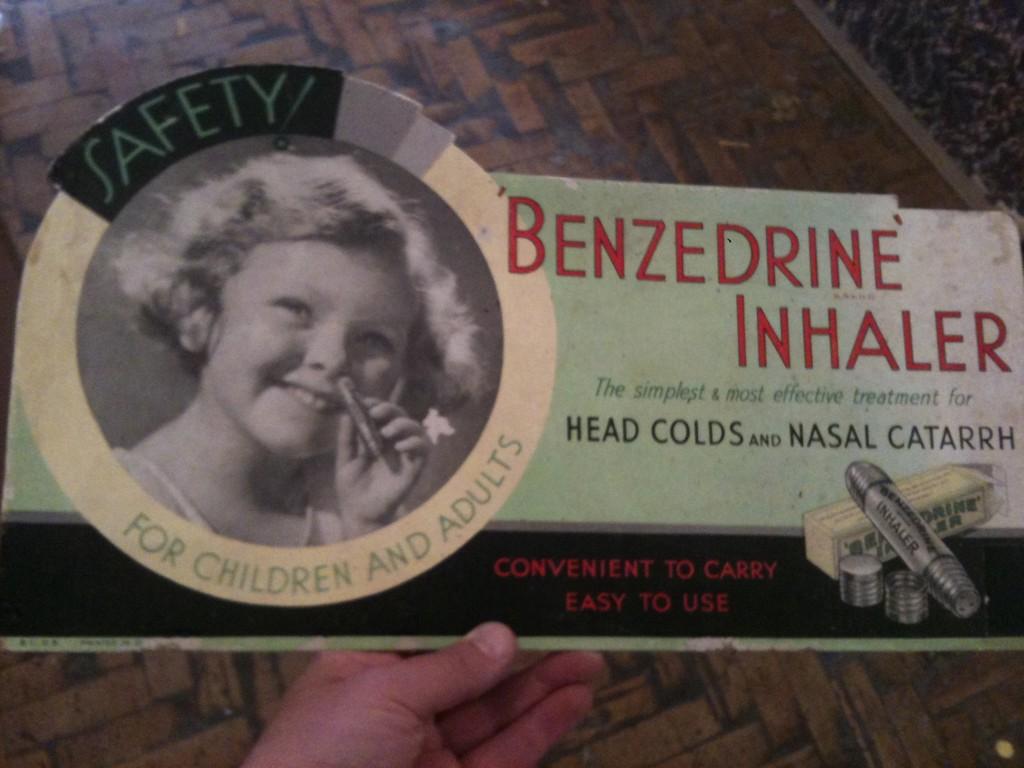
splurge fuelled by coffee and Benzedrine, but Kerouac actually began it as early as 1948, when he also came up with the title. He spent a while searching for a voice, but eventually settled upon a stream-of-consciousness, jazzy, impressionistic style. This was inspired by a 40,000-word letter written to him Cassady, a charismatic sociopath described by his biographer as ‘a slim hipped hedonist who could throw a football seventy yards, do fifty chin-ups at a clip and masturbate six times a day’. Cassady was trouble; he was also said to have ‘one of the greatest minds I’ve ever known’, by a friend of writer Ken Kesey.

Kerouac sat down to write his famous ‘scroll’ draft on 2 April 1951 on a 120-feet sheet of paper that had belonged to Bill Cannastra, a wild-living friend who had been decapitated after sticking his head out of a New York train window.
Kerouac spent many years rewriting the manuscript as he tried to find a publisher, and it was eventually brought out by Viking in September 1957 – Kerouac belatedly considered renaming it Rock and Roll Road
to catch the spirit of the time – and immediately received an ecstatic review in the New York Times, which claimed it was ‘the most important utterance yet made by the generation Kerouac himself named years ago as Beat’.

On The Road is one of the most important books of the post-War era, but it’s questionable how much it influenced English culture given that it is such a specifically American book on such an American topic written in the American vernacular. London was more taken by Burroughs and Ginsberg, both of whom would spend extensive time in the city while Kerouac only visited for a few days in the 1940s when serving in the Navy. By 1959, Barry Miles, Jeff Nuttall, Michael Horovitz and the rest of the British counterculture scene were soon discussing, publishing, imitating and eulogising the Beat poets. 

Being more of a philistine, though, I prefer the exploitation stuff. Tony Hancock frequently mocked Beatnik culture, notably in The Poetry Society.

Hancock: You see, Sidney, we are a collection of kindred spirits who are all revolting against the Establishment.

Bill: How long have you been at it?

Hancock: Three days.

I also like Colin Wilson’s often sardonic but hugely charismatic novel, Adrift In Soho, which has that time-honoured plot of a young ingenue coming to London and getting drawn into a curious sub-culture, in this case the Beats. It is apparently currently being made into a film.

But the pull of the Beats, that desire to be different, was probably best expressed by Hancock again, in the opening scenes to his film, The Rebel. ‘Where are we going?’ It’s what Kerouac was asking, and it’s what Hancock wanted to know as well. Well, where?

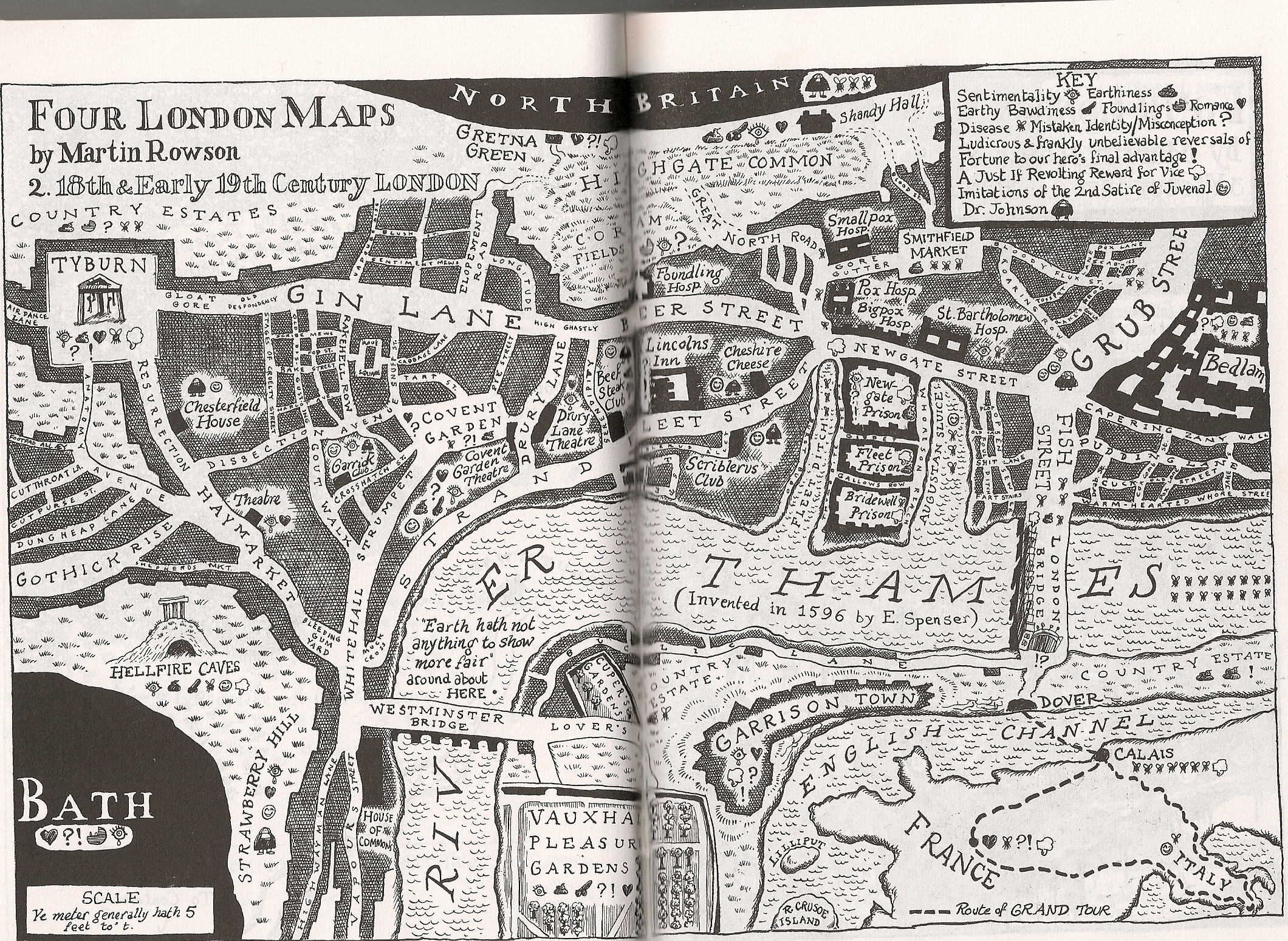
Four literary London maps

These four maps of literary London were drawn by Martin Rowson for the rather wonderful 1999 London issue of Granta magazine.

Chaucer’s London

Georgian London

Victorian London

Modern London

Peter Hitchens on drugs and the moral, opium-eating, Victorians

Peter Hitchens is a very clever man. I’m sure he’s also sincere – I can’t believe British newspapers would employ somebody to say stupid and provocative things just to get attention, after all – but judging by the interviews he’s conducted for his new book about drugs, The War We Never Fought, he’s a little bit daft.

Hitchens theory is that there has never been a war on drugs. ‘Drug-taking was, in effect, decriminalised by the Misuse of Drugs Act 1971,’ is how Decca Aitkenhead paraphrases. Instead, he harks back to the golden age of the Victorians, when there was ‘increasing self-imposed moral conduct’ (Hitchens’ words.)

Where to begin with this nonsense? Well, let’s just stick to the last bit, those morally virtuous Victorians. In a sense, he’s right: the Victorians didn’t take illegal drugs. That’s because they were too busy snaffling down the legal ones – things like opium, cocaine and cannabis – which were available to just about anybody who needed them until 1868, and then over the counter from chemists until 1926. This was the golden age of drug-taking in Britain, with opium being consumed on a scale we could scarcely now believe.

Victorian London was awash with opium, not in semi-mythologised Chinese opium-smoking dens in Limehouse (of which there were very few), but in pubs, chemists, general stores and markets, where it was sold in bottles, powders, pills, lozenges, on plasters, in sweets and much else besides. The centre of trade was in Mincing Lane, London, where 90 per cent of transactions occurred. It was most commonly taken as laudanum, a tincture of opium and red wine, with saffron and cinnamon.

This was not thrill seeking. In the days before aspirin, opium was one of the few reliable painkillers available to Victorians, especially especially fever and diarrhoea, but also malaria, smallpox, syphilis and TB. And it was effective as well. As anybody who has taken codeine or morphine will confirm, opiates have a tendency to block you right up – something that was particularly helpful when the next cholera or dysentery epidemic was just around the corner.

However, opium was also used on children, particularly when teething, in specially formulated sweet concoctions like Godfrey’s Cordial and Mrs Winslow’s Soothing Syrup, and thus surely led to the deaths of many by overdose. It also, believes the drug’s historian Martin Booth in Opium: A History, ‘provided an escape from the misery and vicissitudes of working-class life.’ This was especially the case in the Fens, where ‘many never take their beer without dropping a piece of opium into it.’

Because of these two factors, opium was belatedly seen as a physical and spiritual danger, and Victorian abstinence advocates put it right up there with alcohol and tobacco as serious threats to British life. What’s interesting, though, is the way – anecdotally at least – users were able to effectively and relatively painlessly self-medicate, living normal decent lives despite their addiction, without resorting to crime. This is true for the working classes, it’s true of the famous opium-eating writers like Coleridge, Shelly, Keats, Collins and De Quincey, and it’s also true of the many great statesmen – the sort of people who shaped the British Empire so beloved by Peter Hitchens – who took the drug. You see, because opium was the only halfway reliable painkiller around, everybody took it – including people like William Wilberforce, the great Christian abolitionist, and William Gladstone, who popped some in his coffee before speaking in Parliament to improve his rhetorical powers – even if not all of them became addicted.

In later years, opium – and especially its stronger derivatives morphine and heroin – began to be used by those simply seeking a pathway to an altered consciousness, a shortcut perhaps to the sort of transcendent mystical experience some people get from religion. In doing so, they were merely following pattern taken by mankind in all civilisations since the dawn of time, however much Hitchens may wish that weren’t the case.

As restrictions were introduced – for opium, not alcohol and tobacco – drug-use declined massively and by 1960 there were less than 100 registered heroin addicts in the UK. They received their drugs from doctors, cheap and undiluted, and were largely able to enjoy a normal existence (at least in comparison with their criminalised counterparts in America). However, as drug use increased in the 1960s, restrictions were imposed, culminating with Hitchens hated Misuse of Drugs Acts in 1971, after which drug supply passed almost completely into the hands of the criminal and use immediately rocketed. A far cry indeed from those morally virtuous days of the 1850s, when Britain’s great and good could simply pick up a bottle of premium laudanum from their nearest general store and retreat into blissful opium dreams.

Wellcome to London: how Henry Wellcome ‘hoovered up the world’ and left it on the Euston Road

Wisconsin, 1858. A five-year-old boy is playing near his frontier home when a strange stone catches his eye. He takes it to his father, who examines the flint carefully before deciding that it was a prehistoric tool made thousands of years before to cut meat. It probably meant as much to its creator as the railway did to modern humans. ‘That excited my imagination and never was forgotten,’ wrote Henry Wellcome years later, after he had grown up, moved to London and accumulated one of the largest collections of scientific paraphernalia that has ever been gathered by a single individual.

Wellcome established his pharmaceutical company, Wellcome-Burroughs, in 1880, making a mint selling pills to an English public that had previously taken medicine in the form of powder or syrup. This fortune sits in the Wellcome Trust, which was established 76 years ago and is now worth £14 billion, making it one of the world’s largest charitable foundations. Next door to the Wellcome Trust HQ on Euston Road, a short walk from St Pancras, sits the Wellcome Collection, a museum that houses some of the million or so objects collected by Wellcome in his lifetime. Here is Napoleon Bonaparte’s toothbrush, ancient sex aids, Chinese torture chairs lined with blades, boxes of false eyes, human skeletons and paintings by Van Gogh. It is one of the most extraordinary collections in the world, a throwback to a time when wealthy individuals would hoover up the weird and wonderful of the world for their personal collections, but executed on a scale few could compete with.

Ken Arnold is the Wellcome’s Head of Public Programmes. ‘This is the last great non-connoisseurs collection,’ he says. ‘Our usual concept of a collector is somebody who carefully decides whether something is authentic and then forks out a huge amount of money for it. Wellcome had an “other-end-of-the-telescope” approach. He saw everything through medical-tinted spectacles and wanted to own anything that would illuminate that fascination.’

Wellcome collected everything: paintings, engravings, photographs, models, sculptures, manuscripts, books, periodicals, pamphlets, letters, prescriptions, diplomas, medical instruments, archaeological finds, skeletons, skin, hospital equipment, advertisements, drugs, remedies, food, plants, microscope slides, charms, amulets, ceremonial paraphernalia, costumes, medals, coins and furniture. He bought entire shops, contents, fixtures and fittings, acquiring enough to recreate an entire street. He bought others collections, picked up human skulls from African battlefields and returned from one typical trip abroad with 44 packing cases of material. If something wasn’t available, he had an artist make a reproduction. Teams of buyers were finding him items right up until his death in 1936. His reach was broad and their brief was wide.

‘Wellcome had deep pockets and no bureaucrats telling him what he could bring home so he had none of our moral, financial or logistical concerns,’ says Arnold. ‘He hoovered up the world, and left us with this extraordinarily unwieldy and undisciplined collection.’ Although Wellcome amassed an immense collection, he was frugal with his money. ‘He was very wealthy, but he would send employees to auctions dressed down so they didn’t look too rich, and would set up fake companies so people wouldn’t know it was his money,’ says Ross MacFarlane, research officer at the Wellcome Library.

A chippy self-made American, Wellcome could never become part of the British establishment – although he was awarded both a knighthood and the French Legion d’honneur – and a desire to be taken seriously may have prompted his determination to create a museum of ‘the art and science and healing’. This opened in 1913 in South Kensington, before it moved to Wigmore Street and closing in 1932. When Wellcome died, the collection was put into storage or dispersed.

‘The British Museum has 40,000 objects, the Science Museum has more than 100,000, the Pitt-Rivers in Oxford has 30,000 items and there are bits in almost every museum in the UK,’ says Arnold. The Wellcome Trust has since taken a similarly philanthropic approach, funding wings in numerous UK museums, galleries and academic institutions.

In 2007, the Wellcome Collection opened. It is a modern, classy space, with a cafe and bookshop, as well as a gallery that hosts thought-provoking exhibitions that use art and science to explore topics such as Skin, Sleep and Brains. Their next exhibition, Death, promises to be particularly fascinating and challenging.

The Wellcome dares to be different: while most museums take an unfamiliar topic and wring all the knowledge out of it like a damp dishcloth, the Wellcome looks at something familiar and turns it inside out, using contemporary art and scientific research to make visitors question what they think they already implicitly understand. Their ability to do this can be traced back to Henry Wellcome himself.


‘We feel free to interpret the material Wellcome collected,’ says MacFarlane. ‘Because although we know when something was bought and what it cost, we don’t always know how it got to the auction.’ Arnold expands on this: ‘He didn’t talk about his philosophy. There’s enough to get an idea of why he was collecting, but there’s not so much that we feel we have to conform to his beliefs. He once said ‘Never tell anybody what you are planning to do until you have done it.’ That sounds like a good idea to me…’

So the Wellcome eschews blockbuster shows – which Arnold describes as ‘a depressingly greedy way to conduct exhibitions’ – and takes pride in imaginative live events. ‘We never try to be definitive,’ says Arnold. ‘There’s always more to discover. And we don’t want to be po-faced. Science is either deadly serious or fun with pink fluffy letters – and between these two unpalatable positions is a yawning chasm that can be filled with smart and sophisticated entertainment.’

Of course, the Wellcome is helped by having a lot of money in its coffers. ‘We are much more privileged that most other organisations. We are wealthy and we don’t have to satisfy civil servants, corporate sponsors or shareholders. But that attitude comes from the Wellcome Trust itself: science is a risk-taking business and there is a sense we are allowed to be experimental.’

MacFarlane finishes that thought, ‘When we take the directors an idea, they’ll often want to give it a go, and that’s a bit like how Wellcome collected. It’s a great position to be in.’

Wellcome Collection, 183 Euston Road, NW1 2BE. Admission free. The Wellcome’s next exhibition is Death, from November 15.