Category Archives: Books

William Burroughs and the strange demise of London’s first espresso bar

In 1953, a momentous event occurred in Soho. London’s first proper coffee shop – one equipped with a Gaggia coffee machine – opened at 29 Frith Street. This was a place where teenagers too young for pubs could come and gather, and it is said by some that the introduction of this coffee bar prompted the youth culture explosion that soon changed social life in Britain forever.

The Moka was an instant success, selling over a thousand cups of coffee a day. The author John Sutherland recalls, ‘the Gaggia machine, a great burbling, wheezing, spluttering monster, would grudgingly excrete some bitter caffeinated essence.  It would be swamped with steamed-milk foam and dusted with chocolate to form its ‘cappuccino’ hood… Glass cups and brown sugar (lots of it) were de rigueur.  Frankly, 50s espresso was no taste thrill.  But it felt smart as hell.’

By 1972, coffee bars where everywhere and the teenage revolution was firmly established. At this time, the author of ‘Naked Lunch’, former junkie and all-round Beat legend William S Burroughs was living in London, quietly going about his business in St James’s. He lived in Dalmeny Court, Duke Street, and loved the plush gentlemen’s shops of the area, not to mention the ‘Dilly Boys‘, young make prostitutes who hustled for clients outside the Regent Palace Hotel.

Although Burroughs was fond of the finer things in life – he got his shoes from John Lobb, hat from Locke’s and bought most of his food in Fortnum and Mason’s – he did at some point stumble into the Moka Bar, and was not impressed by what he found.

Burroughs at this time was getting sick of London – sick of the licensing laws, sick of the crap food and small drinks, sick of the weather, the terrible service and sexual hypocrisy. He was also sick of the Moka, which he believed responsible for an ‘outrageous and unprovoked discourtesy and poisonous cheesecake’.

Burroughs decided to mount a sound-and-image attack. He had previously launched one of these against the Church of Scientology, of which he had been a member, turning up at their headquarters at 37 Fitzroy Street every day, taking photographs and making sound recordings. He believed that ‘as soon as you start recording a situation and playing them back on the street, you are creating a new reality’ and that repeated exposure to such an attack would lead to ‘accidents, fires and removals’. After a few weeks, the Scientologists did indeed move, round the corner to 68 Tottenham Court Road.

On August 3, 1972, Burroughs turned his attention to the Moka. He would stand outside every day taking photos and making recordings by tape, and then return the next day to play the previous days recordings. Burroughs was convinced he was winning. ‘They are seething in there,’ he said. ‘I have them and they know it.’

On October 30, 1972, the Moka Bar closed.

Walking London: rivers and tubes

‘What a bounteous banquet of costly viands is spread before an ardent-minded, grateful-spirited Perambulator!’ Old Humphrey’s Walks In London

‘One must perambulate early and late in all weathers, to know a little about London’. The London Perambulator

London is a gift for those who wander. Sometimes you can pick a new area and just stroll wherever the whim strikes you; sometimes you can take a different route between two familiar destinations. Either way, you’ll find your appreciation of the city is inordinately increased.

There is a healthy industry in London walking – M@ recently compiled a list of his ten favourite for the Guardian – but if you need something cheaper and more challenging, you can always take a self-guided walk over a longer distance. I once walked the Thames from St Paul’s to Hampton Court on a Sunday afternoon, criss-crossing bridges and sticking as close to the river as possible. It was particularly satisfying to see how easy it is to walk on the river bank – the only place I had to take a significant detour was around the ever-weird Chelsea Harbour.

In a similar vein, a couple of books have recently come out on the theme of London walking. Walk The Lines is about Mark Mason‘s decision to walk every tube line in London, above ground, an overall distance of 403 miles that takes him everywhere from Amersham in the north-west and Epping in the far east to Morden in the deep south.

Mason enjoys discovering new parts of the city and peppers his book with brilliant London trivia but is at his best when writing about the pleasure walking can provide. As he writes, ‘Once you’ve caught the bug, you feel an urge to plan your walks, be it thematically, geographically or by some other means. There must be a raison d’être for your ramble.’ This, he thinks, taps into a similar mentality to that of a collector: ‘It’s not about studying, about observing or noting. It’s about collecting. About claiming the city’s greatness, or at least some small part of it, for yourself.’

Mason’s book is a fun read, but you couldn’t very well use it to walk the tube lines yourself, even if you were lunatic enough to want to do so. Tom Bolton’s London’s Lost Rivers, however, bills itself as ‘A Walker’s Guide’ and is a terrific mix of history, topography and practicality. It maps – astonishingly diligently – the courses of eight of London’s buried rivers, so walkers can follow them for themselves, pointing out items of interest they can see along the way while also offering some historical context about the subterranean rivers.

Along with Nicholas Barton’s The Lost Rivers of London, it’s essential for any fan of buried rivers (Diamond Geezer says much the same here). The atmospheric Polaroid photographs by SF Said are a nice touch, as is the introduction by the great Londonphile Chris Fowler. Highly recommended.

This Charming Man: Edward Lovett at the Wellcome Collection

I have a small piece in the Independent about the fascinating  Edward Lovett, whose collection of lucky charms, collated around 100 years ago, has just gone on display at the Wellcome Collection.

Lovett, who lived in Croydon, was a banker and self-taught folklorist who was interested in those items that everyday Londoners kept about their person in aid of good fortune or to ward off bad luck. He would travel to the East End and docks to purchase samples of these lucky charms, which could be anything from a dead mole in a bag to a copy of the Lord’s Prayer written in careful handwriting in a spiral on a tiny scrap of paper dated 1872.

Many of the owners would claim not be superstitious, but then explain in hushed tones how a certain coin or nut or shoe had saved them from disaster; numerous items were from soldiers who had taken them to the Western Front in the First World War.

It is an extraordinary and humble collection, but one that grew so vast that Lovett’s wife eventually left him in despair in 1925. At around this time he wrote a marvellous book – Magic In Modern Love – in which he chronicled some of the items from his collection, but in a delightfully haphazard way, rarely bothering to say exactly where he bought them or when or from whom.

Felicity Powell, the artist who is curating the exhibition for the Wellcome, says, ‘He was not the most diligent of reporters. The labelling is often non-existent, which gives the items real mystery. Sometimes you can’t even be sure what they were for so you have this open space in which to speculate.’

Because Lovett was mainly collecting from the docks around east London, the collection gives a real perspective on London as a trading city that used the river to connect with the wider world. ‘There are objects from all over the world,’ says Powell, ‘There’s even an Inuit paddle.  It all came through London and into the hands of dockers and hawkers. We don’t know if these originally belonged to immigrants or natives. We don’t even know if he was collecting authentic objects. Did the people selling them see him coming?’

Lovett died in 1933 and much of his curious collection was absorbed by the Wellcome and the Pitt-Rivers Museum. It is rarely seen by the public. The exhibition at the Wellcome Collection runs until February 26, 2012.

Hell W10: the film that killed the Clash?

In 1983, just as the band were starting to fall apart, The Clash decided to make a film. But stung by their experiences on the strange but compelling Rude Boy, they decided to make it themselves. They called it Hell W10, filmed it on 16mm silent black and white film, and made the plot up as they went along. The result, understandably, was somewhat bizarre.

‘Let’s make a film!’ said Mick Jones in 2005. ‘We had no other agenda there than that. Everyone put in their time without thinking about it. That was what we did on our time off; we worked! It was totally Joe [Strummer]’s idea. He directed it, he shot it, he did it. And then it was gone. It didn’t even come out!’

Strummer believed the film was lost forever. In 1987, when it looked like he might carve out a new career for himself in the film world, he told an interviewer, ‘I have directed a film myself, a black and white 16mm silent movie and it was a disaster. Luckily the laboratory that held all the negative went bankrupt and destroyed all the stock, so the world can breathe again. I shot without a script. God knows what it was about. I’m the only other one that knew, and I’m not telling.’

In 2002, the film was rediscovered on video tape and re-edited by long-time Clash collaborator Don Letts, who added a fine Clash soundtrack over the top. It is a strange piece indeed, a gangster tale that follows Earl, a musician and small-time hood played by Paul Simonon, who falls foul of the local crime boss called Socrates, ‘The Lord of Ladbroke Grove’, played with some relish by Mick Jones, resplendent in white tux (‘You wanna end up as a pillar in a Canning Town flyover?’ he threatens one lackey). Strummer gives himself a cameo as a corrupt and racist policeman. It’s a cross between The Harder The Come and some of the pulp London crime novels of the 1950s (many of which have been republished by London Books).

Hell W10 also features some cracking period photography of Notting Hill, Paddington and Ladbroke Grove, and weighs in at almost 50 minutes, which suggests it must have taken quite some time to film.

What makes it particularly fascinating is that it was filmed just as the band were starting to go belly up; Topper Headon had already been kicked out for drug abuse, while Simonon and Jones were barely speaking, making their feud in the film a little too close to the truth. Things came to a head within weeks of Hell W10 being made, with Jones sacked from the band in September 1983.

In Letts’s documentary, Westway To The World, both Jones and Strummer confess that the band had simply spent too much time in each other’s company and should have taken a break; if they had done so, hotheads may have had time to cool. Instead, they made a film. Perhaps if they’d had a summer holiday in 1983 rather than fool around with a camera, the band of Jones, Strummer and Simonon might have lasted another few years. Still, it looks like they had fun making it.

Was it worth it? Watch and decide, this is the first of five parts.

Curiocity: London unfolded

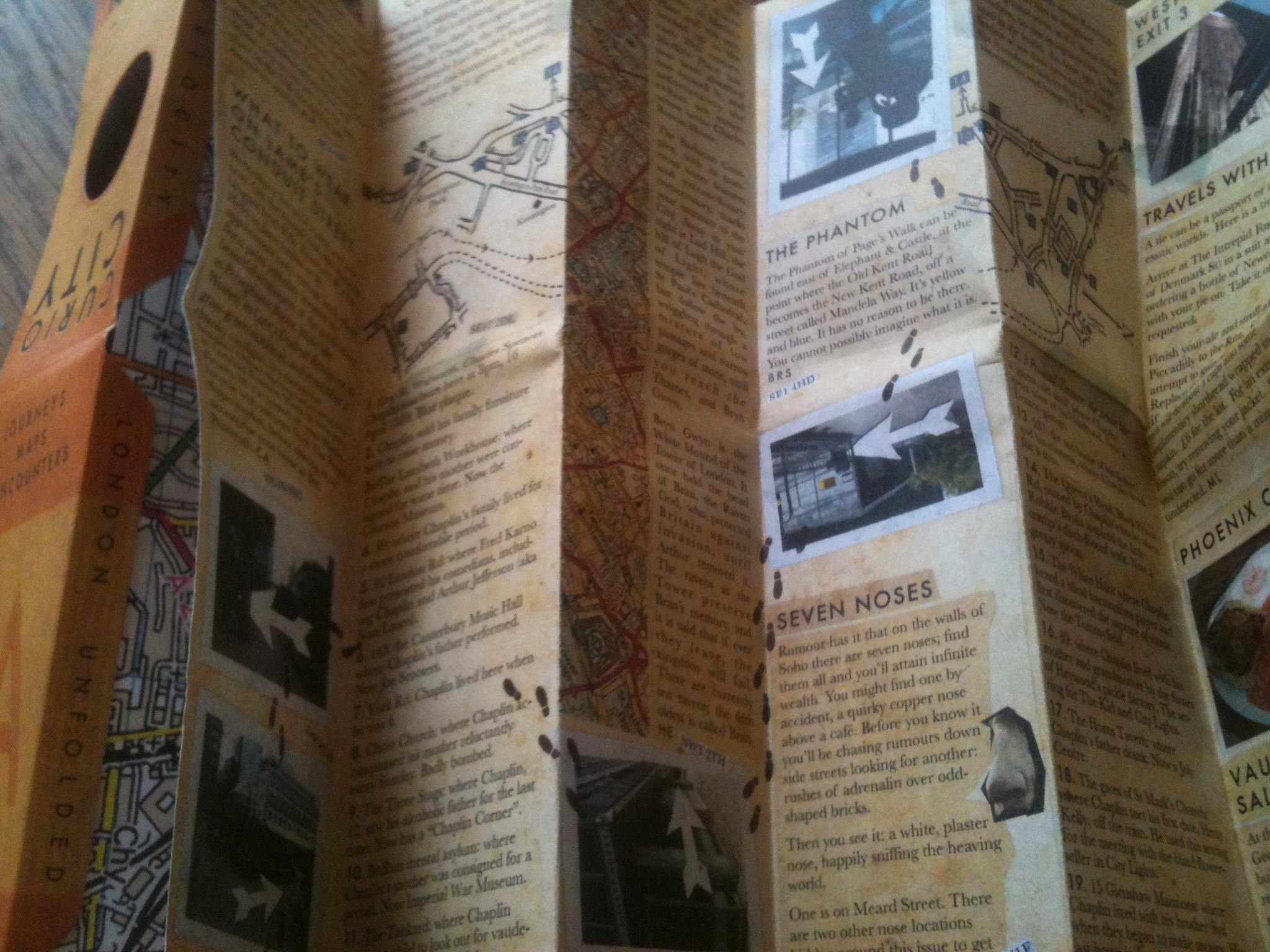
Another day, another London-themed map-related projected. Curiocity is a rather lovely tiny ‘mapazine’, that combines a magazine with a map and folds up into a cute – and curious –  little package that costs just £2.

One side features a stack of London-related trivia, including a loosely-mapped Charlie Chaplin walk around Lambeth, a ley-lines walk from Parliament Hill to Tower Hill and a ‘route’ from Hampstead tube to the mixed bathing ponds written out ransom note-style and snaking over five columns. There’s loads more, including bits on the Seven Noses of Soho and a game involving pigeons. It’s witty and it’s whimsical, both of which are obviously very good things indeed.

On the reverse is an entirely unusable but rather interesting map showing the history of London’s orbital road networks, a fascinating story which can be studied in detail here or in even more detail here.

Curiocity is available in a few choice London locations, including Stanfords, the London Review of Books Bookshop, the ICA and the Wellcome. It also has a website and is a more than welcome addition to the London publications landscape.

London riots and football hooliganism

‘People were determined to smash and destroy. Windows were being smashed and the looters saw their chance. A road sign went straight through the middle of the window. Two people moved in with cardboard boxes and filled them with jumpers. These would be highly resaleable. [Others] were concentrating on the jewellers’ shops and a good few were looted. People who were probably  law-abiding citizens at any other time just went berserk. The faces of people as they went into a smashed shop and grabbed goods were amazing; all signs of reason had disappeared from their eyes. One guy came out of a shop with his eyes rolled up, his tongue hanging from an open mouth and breathing heavily. His trip into the shop had been a physical experience, and he was beginning to smile. He had dared and won. In a very short space of time, the streets had been transformed into a madhouse. Sirens blared out and police vans screeched around the streets.’

Was this Tottenham last Saturday? Brixton on Sunday? Battersea or Croydon on Monday? Manchester on Tuesday? Surely it must be from one of those occasions this week when England was forced to confront the reality of a ‘sub-educated, feral underclass’ in a post-Thatcher ‘something-for-nothing society’ (as Andrew Roberts so colourfully described it).

Well, actually no. This was way back in 1983, in tiny Luxembourg, where England fans went on a smashing and looting spree after failing to qualify for the European Championships. Football hooliganism was approaching its nadir after a 20 year spiral that had almost destroyed the national sport and left the authorities baffled at how to control it.

Mob looting by football supporters dates back to at least 1976, when Liverpool supporters descended in large groups to rob shops in St Etienne, where they were watching a European Cup tie. It soon became assimilated into the away trip –  usually while being escorted back to the station, away supporters would smash up city centres, fight the police and, if the opportunity arose, loot goods from shops: a jeweller here, a clothes shop there. Whatever could be easily lifted and carried back home.

In Colin Ward’s classic account of terrace culture ‘Steaming In’ (from which the above passage also came), he describes Chelsea fans after a game in Luton: ‘The trip back to the town station saw the mass destruction of the town centre. Shops were looted and a train was set on fire… It was said that one guy who didn’t like football but had a fetish about smashing shop windows went along to have a good night out. Nutters often tag along with football crowds just for the buzz.’

The past week’s violence certainly seemed unprecedented – and in some ways it was – but there are significant parallels with the way overwhelmingly young football fans routinely behaved in the 1970s and 1980s. There’s the casual disregard for other people’s property, the mania of the crowd, the opportunist thieving and violence, the loose organisation into gangs, the sheer thrill of anarchy, the speed of movement and the power of being able to catch the police wrong-footed.

The fear is that mass lootings will become a commonplace event, another part of our lives, as criminal gangs realise what they can get away with if there are enough of them around and as long as the law and lawmakers remain clueless at how to respond. It certainly took the authorities a long time to get a handle on how to police football, but the experience has now been completely transformed, partly because of tough sentences for hooligans, partly because of the disasters at Heysel and Hillsborough but also because the football establishment itself realised it had to change the way it regarded football supporters if the behaviour of fans was to improve.

When I watched a small group of 20 or 30 kids terrorise Hackney in broad daylight on Monday afternoon while the police stood and watched, my first instinct was that they would never have let a bunch of football supporters behave like that these days. There are always lessons to be learnt from the past, if you look in the right places.

London bricks

‘The bricks – laid Flemish bond, headers and stretchers alternating – were all old London stock bricks, but of many kinds and colours: rust red, beige, grey, brown, nearly black. Here and there were yellow ones – malm bricks made with an admixture of clay and chalk. The cumulative effect was pleasing – the variety gave texture, interest and warmth to the surface of the wall. The eye approved the range of colour, the uneven look, the way in which each brick differed from its neighbour and yet was in subtle harmony. But, more that that, to look at it was to see the way in which this wall arose from the ashes of many buildings. Studying it, Matthew saw in his mind’s eye warehouses and churches, factories and shops, terrace houses like this one, blasted to the ground perhaps on some furnace night of 1940. He thought of how the city lifts again and again from its own decay, thrusting up from its own detritus, from the sediment of brick dust, rubble, wood splinters, rusted iron, potsherds, coins and bones. He thought of himself, living briefly on top of this pile, inheriting its physical variety and, above all, the clamour of its references. The thought sustained him, in some curious way, as he sat at his desk in the flat which was not yet a home, or as he moved through days and through the city, from Finsbury to Docklands to Covent Garden to Lincoln’s Inn.

Penelope Lively in ‘City Of The Mind’ (1991, Andre Deutsch).

Nature: an apology

I was born in Epsom, one of those places on the fringe of London that mark the very boundary of the city, the point at which tarmac gives way to soil. As the picture below shows, just a few hundred yards from my road, Hookfield, the country begins in all its greenness.

This never much interested me in my youth. I was always more attracted by town than country. Nature passed me by. When I moved into the city proper, I took little notice in the pike or herons I saw from my boat on Regent’s Canal, or the ring-necked parakeets and woodpeckers I later found in Brockwell Park. If somebody told me they saw a badger in Regent’s Park or a cormorant on the Thames, I cared not a jot. And who needed peace and still when you had Hampstead Heath or Richmond Park nearby, even if I rarely actually bothered to go there.

A month in the Scottish Highlands changed that. For the first time I was able to observe hedgehogs, adders, shrews, woodmice, weasels, deer and eagles in the wild, and see traces of badgers, pine martens and wildcats. The sheer scale of the country was extraordinary, from the peaks of the Munros, to the endlessly unfolding glens. It was eye-opening and life-affirming.

Returning to London was difficult. I had previously viewed the city’s numerous parks as pastoral paradises. Now they seemed liked scratty scraps of green, a sad imitation of the real thing. The battering noise, smell and greyness of London was overwhelming.

But nature is still here, if we look for it. It’s there in the foxhole that occasionally appears at the bottom of my garden. It’s there in the resilient, remarkable weeds and visiting birds, as lovingly chronicled in Richard Mabey’s essential London wildlife book ‘The Unofficial Countryside‘. It’s there in Tales Of The City, the blog of Mel Harrison, in which she charts encounters with owls, snowflakes and brambles. It’s there in Herb Lester’s Untamed London map, which records those places ‘where nature still runs wild in the big city.

As I walked home from taking my daughter to nursery this week, along the horrible, traffic-clogged hill that takes cars from Herne Hill to Camberwell, I heard a faint, familiar sound as I passed a bus stop. It was the chirruping of a grasshopper. I stopped and looked and found it on a hedge. It looked at me, quite unmoved, before continuing to sing (or stridulate) defiantly. We gazed at each other for a minute, while commuters bustled past on foot and in car, and then quietly, and more contentedly, I went about my way.


London, JFK and Profumo

As fans of conspiracy theories know, there is always a connection if you look hard enough, and the one between JFK and the Profumo Scandal is particularly intriguing.

The connection is called Mariella, or Maria, Novotny. Different sources give her different places of birth – London, Sheffield, Prague – but most agree that she was really called Stella Capes. She almost certainly wasn’t the niece of former Czech President Antonin Novotny as she claimed, nor had she spent four years in a Soviet camp. But what’s undeniable is that she lived quite the life.

It was Novotny who hosted the infamous Man In The Mask orgy in an apartment in Hyde Park Square in December 1961, where various members of high society consorted with glamorous woman such as Mandy Rice-Davies and Christine Keeler. Novotny, who called the party The Feast of Peacocks after what had been served for dinner (she also cooked badger), spent much of the evening wearing a corset in bed with a whip and six men. Stephen Ward, the mysterious society osteopath, was there wearing socks and nothing else. Everybody else – among them actors, MPs and judges – was naked except for a man wearing a gimp mask, who was tied between two pillars and whipped by everybody on entry. There has been much speculation as to his identity, with names including minor royalty and Cabinet Ministers, but he has never been named.

The Feast Of The Peacocks became public knowledge after featuring in Lord Denning’s 1963 report into the security implications of the Profumo Scandal. This was written in the wake of Conservative Minister John Profumo’s resignation from the Cabinet following revelations regarding his relationship with Keeler and Keeler’s relationship with Soviet naval attach Eugene Ivanov.

This was not the first political scandal Novotny was at the centre of. Wherever she was born, she had moved to London in 1958 to become a model, and was soon performing as a topless dancer in Soho.

In 1960, she married. Her husband, Horace ‘Hod’ Dibben was in his 50s and moved in serious company. He ran the Black Sheep Club in Piccadilly and knew both the Duke of Kent and the Krays. He was a sado-masochist and a friend of Stephen Ward. Through Hod, Novotny met Harry Towers, a mysterious and sinister figure, who persuaded her to go to New York for some modelling work.

Novotny was soon operating as a prostitute in New York, with Towers as her pimp. Before long Towers had introduced her to Peter Lawford, the film star and John F Kennedy’s brother-in-law whose main responsibility was to find willing women for the insatiable President.  Novotny was soon sleeping with JFK. On one occasion she and fellow prostitute Suzy Chang were asked to dress as nurses, with JFK the patient.

In May 1961, Novotny was deported from the US, returning to London on the Queen Mary where she began hosting her memorable parties. Guests are said to include everybody from Bobby Moore to Felix Topolski. She was also introduced by Ward to both Ivanov and Profumo before Keeler, but nothing developed from this. Novotny believed she had been used to ‘get’ JFK and was wary of the same thing happening again. Keeler was not so smart.

When the Profumo Scandal broke, JFK was said to be fascinated by it, demanding to be kept informed of ongoing events, at least in part because of his own tenuous connection. Robert McNamara, the US Defence Secretary, knew all about the President’s dalliances with this prostitute who claimed to be from Eastern Europe and said ‘he felt like he was sitting on a bomb’. On June 23, one American newspaper even hinted at the President’s involvement, until his brother Robert Kennedy forcefully intervened and the story was dropped. Nobody picked it up and the President took his secret to the grave.

What to make of this? Some believe the fact Novotny was connected to JFK and Profumo was no coincidence and here you could go down a rabbit warren of theories and counter-accusations. One argument is that Novotny was part of a honey trap operation, run by Lyndon Johnson’s office by Towers and Ward with the assistance of the sex-obsessed FBI, aimed at blackmailing powerful men in Britain and America. Others claim it was a KGB sting – Novotny claimed Czech heritage and Chang was Chinese – and Towers was using his women to try to infiltrate the United Nations. Still others  say Ward and Towers were working for MI5 to entrap Ivanov. Conspiracy journal Lobster has more. This stuff could drive you insane.

Novotny later worked for the police in same capacity, and was used to help bring down gangster Charles Taylor. She died of an overdose in 1983. Some, including Christine Keeler, claim it was murder. Novotny had attempted to write a book about her life shortly before her death, but mysterious things kept happening to her and the ghostwriter, causing them to nervously end the project. After her death, her house was burgled and her diaries disappeared.

She did write a book in 1971. It is a fictionalised account of her adventures called King’s Road and one of the worst books I’ve ever read. You can get it on Amazon for 14p.

The City of London’s secret zoo

My piece on the extraordinary Animal Reception Centre (ARC) at Heathrow – where all animals entering the UK have their passports stamped – appeared in last week’s Independent on Sunday.

One of the great things about the ARC is that by a quirk of administration it is run from Guildhall by the City of London Corporation. As Rob Quest, the facility’s manager, told me, ‘The City is responsible for the import of all animals in Greater London. That’s because in 1965 when the LCC broke up, the City still had a veterinary department because of Smithfield Market so they were deemed the best people to run the border control. They built this place after there was a rabies outbreak in Camberley in 1969 (Fritz, a black-and-white terrier, was released from quarantine early and bit two people) and it was decided we needed somewhere secure for animals to be checked.’

The City still runs the centre today, one of a number of non-Square Mile outposts that includes Epping Forest and Hampstead Heath. For more on the City’s more traditional oddities, check out David Long’s new book Hidden City.