Tag Archives: London

Secret London: inside the Black Museum

I first read about the Black Museum when I was a boy, a macabre museum run by the police filled with artefacts taken from their most gruesome cases. I always wanted to visit, but the museum was out of bounds to the public. When I was at Time Out, I asked the Met to let me write about the museum and after some badgering – and to my great surprise – they finally agreed. The result was not quite what I expected. There is an interesting coda to this piece. Upon publication, the press officer phoned me to say how disappointed they were with the tone of the article; at exactly the same time, the Curator sent me an email saying the piece was the best description of the museum he had read. Make of that what you will…

The Curator pulls open a drawer full of shotguns. ‘Which of these are real and which are replicas?’ he asks. I nervously peer inside.
‘Too late,’ he says. ‘You’re dead.’

Welcome to the Black Museum, the Met Police’s private memorial to  London’s worst crimes. The public isn’t allowed inside, and after a half-hour tour, I wish I hadn’t been either.

The Black Museum (renamed the Crime Museum after complaints from officers in areas with large ethnic minority populations) has been one of the world’s most macabre and inaccessible museums for over a century, acquiring a certain infamy among hardcore Londonphiles and the sort of people who spend their spare time reading ‘The World’s Greatest Serial Killers’.

The museum is closed to the public but, after repeated requests, The Curator has allowed Time Out inside, albeit under duress that he makes no attempt to disguise. From his office in Scotland Yard’s Room 101 (and who says the police have no sense of humour?), where the walls are covered in police badges from forces around the world and shelves stuffed with books such as, er, ‘The World’s Greatest Serial Killers’, The Curator – two parts John Thaw to one part librarian – lays down the law. He doesn’t want to be named or photographed, and if the piece results in people phoning him up to try to get access to the museum, well, he’ll hold me responsible.

Ground rules established, The Curator unlocks the door, and the tour begins. The Crime Museum has been at Scotland Yard since 1874, moving with the Met from Whitehall to Victoria Embankment in 1890 and then Victoria Street in 1967. It was set up by Inspector Neame after an 1869 law allowed the police to retain prisoners’ property for ‘instructional purposes’. Neame felt it was important that police officers could see the tools of the criminals’ trade – a function the museum still fulfils today – and gradually built up the museum’s collection.

In 1877, a reporter from the Observer was refused entry and wrote about Scotland Yard’s ‘black museum’. The name stuck, and the museum became a popular destination for Victorian celebs: Gilbert and Sullivan, Sir Arthur Conan Doyle, Harry Houdini and Laurel and Hardy all had a ghoulish gander.

The room we enter has been mocked up to resemble the original Whitehall museum, with a false fireplace and sash window. The first thing you see is a hangman’s noose, followed by a desk covered with knives and guns, and a chest of drawers topped with a glass case containing submachine guns. An opening leads from this ante-chamber into the museum proper.

We start at the gun drawer. As well as rifles and replica rifles, it contains walking sticks, umbrellas, flick knives and other random bits of metal. The Curator asks me to guess which of these items are guns, pauses for a heartbeat, before stabbing with his finger: shotgun, shotgun, pistol, shotgun, pistol. They’re all guns, the walking stick and umbrella, even the flick knife. And all have been used on London streets. He takes out a walking stick, demonstrates how quickly and easily it converts into a gun and back again, and shuts the drawer firmly.

The Curator is enjoying himself, less begrudging by the minute. He picks up a sword and hands it to me. As I take it by the scabbard, he pulls off the hilt, which is a short, detachable, vicious blade, and imitates gutting me with it, which, he says, is exactly what happened to the police officer who first encountered this duplicitous double-weapon. It’s called the Cop Killer, he says. And, just like that, any lingering sense of fun wafts out the window.

The point of this drawer, The Curator explains, is to show new coppers the dangers they face from disguised weapons (the walking-stick gun et al were legal until 1959).  The inference is clear: anything is a potential weapon.

The Curator is passionate about the museum’s purpose and happiest when discussing the history of crime. Everything that comes into the museum, he emphasises, is for teaching purposes, and not just for cadets. Senior officers come here for briefings and lectures to discover historical parallels of contemporary cases.

We move into a large room with the fusty atmosphere of a regional museum. Display cases that mark out a mazy circuit of London’s criminal history. One of the first is on serial killer Dennis Nilsen, who boiled the flesh of his victims on his stove before poured their fat down his drains. I look at the Nilsen display. It’s a badly stained cooker topped by a battered aluminium cooking pot. I feel sick.

The rest of the tour passes in a blur. There’s a display on officers killed in the line of duty; the protective apron used by John Haigh, the Acid Bath Murderer; vials of poison; forensic photographs; blood-stained weapons; a crossbow used by the Krays; a ketchup bottle from the Great Train Robbery (‘I can’t talk about that,’ says The Curator cryptically); evidence related to Crippen, Christie and cannibalism; explosives used by Fenian terrorists; the IRA rocket launcher that fired at the MI6 building in 2000; and the tiny ricin-loaded pellet pulled out of Georgi Markov’s leg, where it had been inserted with an umbrella.

It’s a tough tour, not because of any individual items (Nilsen’s cooking pot excepted) but through the accumulated weight of otherwise anodyne objects that collectively represent the many horrible things people have done to each other. It’s a chilling, unsettling experience that sits somewhere between the self-chosen prurience of reading a book about Fred West and the necessary horror of the Imperial War Museum’s Holocaust gallery.

The Curator reassures me that visitors, police officers included, regularly faint during tours, but this is clearly a museum that has been designed by the police, for the police. That point is underlined by one of the last displays, a huge pile of weapons taken from demonstrators at an anti-Vietnam War march in 1968, a so-called peace march comments The Curator, as well as riot shields from Brixton, melted by petrol bombs, and Broadwater Farm, peppered by bulletholes. This is what you are up against, the display says. Trust nobody.

The result is a museum that works on two levels: one is the straightforward practical side that allows policemen to see and handle real evidence and learn how it was used to solve cases, while the other, possibly more important, is psychological, showing the police what the people out there will do to them, and each other, given half a chance. In so doing, it validates the Met’s instinctive suspicion – as embodied by The Curator – of outsiders, the public, the people they protect and serve.

I leave the Crime Museum in a sober mood, sure of only one thing: having tried so hard to get inside, I’m in no hurry to return.

Pussyfoot Johnson and the London mob

My review of Ink And The Bottle, an exhibition about cartoons and alcohol, appears in the Independent.

One of the cartoons at the gallery is based on the story of William ‘Pussyfoot’ Johnson, an American who was active in the temperance movement and came to London on Nov 13, 1919 to give a talk.

Johnson was leader of the Anti-Saloon League and after success in America, he headed to the Old World to spread the anti-drinking word. He argued, ‘There is more bootlegging and more moonshining in Europe than in the whole United States.’

He may have been right. This temperance movement map from 1886 attempted to show the scale of the problem by depicting all of London’s pubs in its ‘Modern Plague of London’ map.

Pussyfoot earned his nickname for his habit of amending laws by stealth, and this did not go down well with the London mob. As one anti-temperance advocate told the New York Times, ‘You know how the majority of Englishmen look upon prohibition and Mr Johnson’s activities? The thought of not being able to have the well-known pint of bitter fills them with horror. The war was terrible enough but it was something that happened before. There have always been wars. Taking away the drinks is attacking the divine rights of the Britisher. I can tell you they don’t like it!’

They certainly didn’t, and decided to do something about it. While Johnson was speaking at Essex Hall, he was captured by medical students from nearby King’s College who dragged him out the buildin, poured a bottle of beer over his head and marched him around the West End chanting ribald songs. It was noted that the police ‘seemed lacking in sympathy with the missionary’.

Johnson was hauled hatless on a stretcher around Regent’s Street, Leicester Square and Oxford Street while the students chanted ‘What won the war? Rum!’ and ‘We’ve got Pussyfoot meow, send him back to America’.

Such larks, what fun and games!

And so what if Johnson lost his right eye in the incident? The lesson was learnt. Not many people have tried to take the Britisher’s beer away from him since.

Room for improvement

Writer, Londonphile and intimidatingly prolific blogger Christopher Fowler recently noted my post on the London terraced house on his own excellent blog, adding intriguingly that:

‘Looking into the subject a bit more, I found that the terraced rooms and gardens are all percentages of those [9th century] measurements, making everything look neat and tidy even when it’s not.’

His recommended related reading on the subject is Harry Mount‘s ‘A Lust for Window Sills: A Lover’s Guide to British Buildings from Portcullis to Pebble Dash’.

Book of the dead dull: against blockbuster exhibitions

A new British Museum exhibition opens this week and it’s already a guaranteed success. But that doesn’t mean it’s any good.

I went to the press view of the Egyptian Book Of The Dead and afterwards felt much the same as I do after every British Museum exhibition: overwhelmed and underimpressed. But I knew that all the big reviewers would give it a knee-jerk five stars – and sure, enough, before I’d even got home, the first suitably awestruck review was in. Meh.

So why was I so bored, and am I on my own with this? Well, the exhibits are undoubtedly important and fascinating – papyrus and artefacts taken from Egyptian tombs, many dating back more than 3,000 years, which together tell the story of the Egyptian belief in the afterlife. But, gawd, ain’t there a lot of it? And why does the exhibition space look so bloody boring?

The British Museum has an incredible talent at taking something potentially fascinating and kicking all the life out of it through stuffy, unimaginative presentation and a conviction that more is better – and getting away with it every time.

At Book Of The Dead we get acres – and I really mean acres – of stuffy captions and endless cases containing aged papyrus covered in hieroglyphs, with only the odd gaudy mummy case by way of variation. After seeing the first room, I felt I’d seen it all and would have had a more enjoyable experience sitting down with a cup of a tea and reading a good book on the subject. But I still had another dozen rooms to trudge round. Exhibitions are meant to bring a topic to life, but this was deadening. And I was lucky enough to be there when it was relatively empty – for the average punter, it must be chaos.

I’m not sure I’m entirely out on my own here – on my way into the exhibition I bumped into a friend coming out, and he said much the same thing, as did Time Out Art on Twitter. But the British Museum’s methods clearly convince most of the reviewers and they certainly draw the crowds; these are, after all, two of the constituents museums most need to impress.

As a lover of museums, though, I cannot help feel that the BM is doing the art of exhibitions a disservice. There is none of the thoughtful wit of the Imperial War Museum, or the layered smarts of the Wellcome Collection, or the sheer intellectual depth of the British Library, all three of whom have new exhibitions opening next week that will not get anything like the attention of the BM.

The British Museum make museum-going into something worthy rather than fun. My fear is that thousands of people will push through heaving crowds to see this exhibition drawn by fawning publicity and out of a sense of duty, before emerging battered and bored, vowing to never visit another museum until the next blockbuster rolls into town. That really would be a shame.

A common little London house

There is nothing special about this house, other than that I live in it. It is one of hundreds of thousands of almost identical houses built in the second half of the nineteenth century for a London population that was expanding at a ferocious rate.

This was the Great Wen that William Cobbett warned about. In ‘London: The Biography’, Ackroyd quotes ‘an observer perched on top of Primrose Hill in 1862, who looked at the growing city and noted that, “the metropolis has thrown out its arms and embraced us, not yet with a stifling clutch, but with ominous closeness.”‘

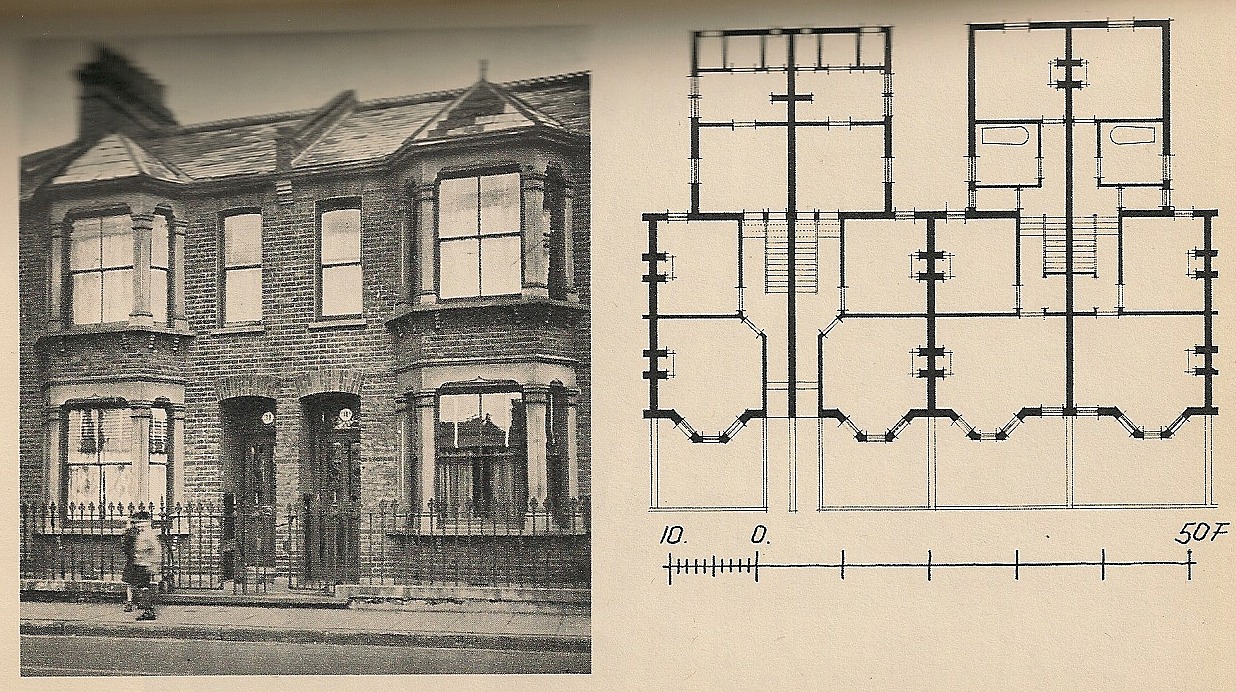
In ‘London: The Unique City’, Steen Eiler Rasmussen’s classic book about London architecture, he writes about houses just like this: ‘From railroads intersecting the suburbs of London we see interminable rows of these swarthy little houses with all their protruding little kitchen-wings. It is the most compact type imaginable for a street house.’ He includes a picture and plan of these houses. Look, it’s almost indentical to mine.

There is a reason for this ‘interminable’ consistency in London housing, and like most things in this country, it is to do with class. Rasmussen explains that in London, because the class system ensured people of the same social strata would invariably live alongside each other, segregated from those richer or poorer than themselves , it was ‘possible to standardise domestic houses: as people living in the same street have the same requirements all the houses can be absolutely uniform.’

This isn’t quite true of my street – at one end there are grand five storey double-fronted detached houses, which would have been for the very rich with domestic servents, and at the other end there are two-storey railway terraces, with every possible permutation in between. This would have meant unavoidable mixing of the classes and was the result of the street having been built over a number of years, starting with the posh end near the park and ending with the common end near the station. But it is certainly true that London houses of the era are near identical.

Rasmussen also knew the exact width of of my new house – 16 foot 6 inches. He writes, ‘the common little house of which there have been built thousands and thousands is only sixteen feet six inches broad. It has probably been the ordinary size of a site since the Middle Ages… but it is difficult to get information as to how typical houses were built in former days.’ After reading this, I measured the front of my house and he was right. Now everywhere I look, from Brixton to Holloway, I see 16 foot 6 inch house fronts. Try it yourself.

So why is this? For an answer, I turned to English Heritage’s photographic collection ‘Lost London’, in which Philip Davies explains exactly why London’s houses of a certain era are all exactly the same size. He writes of ‘a secret ingredient which conferred an innate harmony on the city, and which influenced everything from the layout of an entire neighbourhood to the size of a window pane – the Imperial system of measures.’

Davies continues. ‘Neighbourhoods were laid out by surveyors who used acres, furlongs, rods and chains – measurements which had been in common usage for marking out arable land since the ninth century. An acre was the length of a furlong (660ft) and its width was one chain (66ft). For shorter lengths a perch, a pole or a rod were used. There were four rods to one chain and a London workman’s house had a frontage of one rod – 16 ft 6 in – so entire districts were created based on endogenous proportional relationships.’

As this website explains, when a landowner wished to build a series of houses for his agricultural labourers on an acre of land, the surveyor could go out with his rod and immediately estimate how many houses there was room for.

So the size of the house in which I live in the twenty-first century was decided by a scale of measurement that dates back to the Dark Ages. For those who find London’s overall sense of scale overwhelming, this internal and very visible consistency might at least provide some comfort.

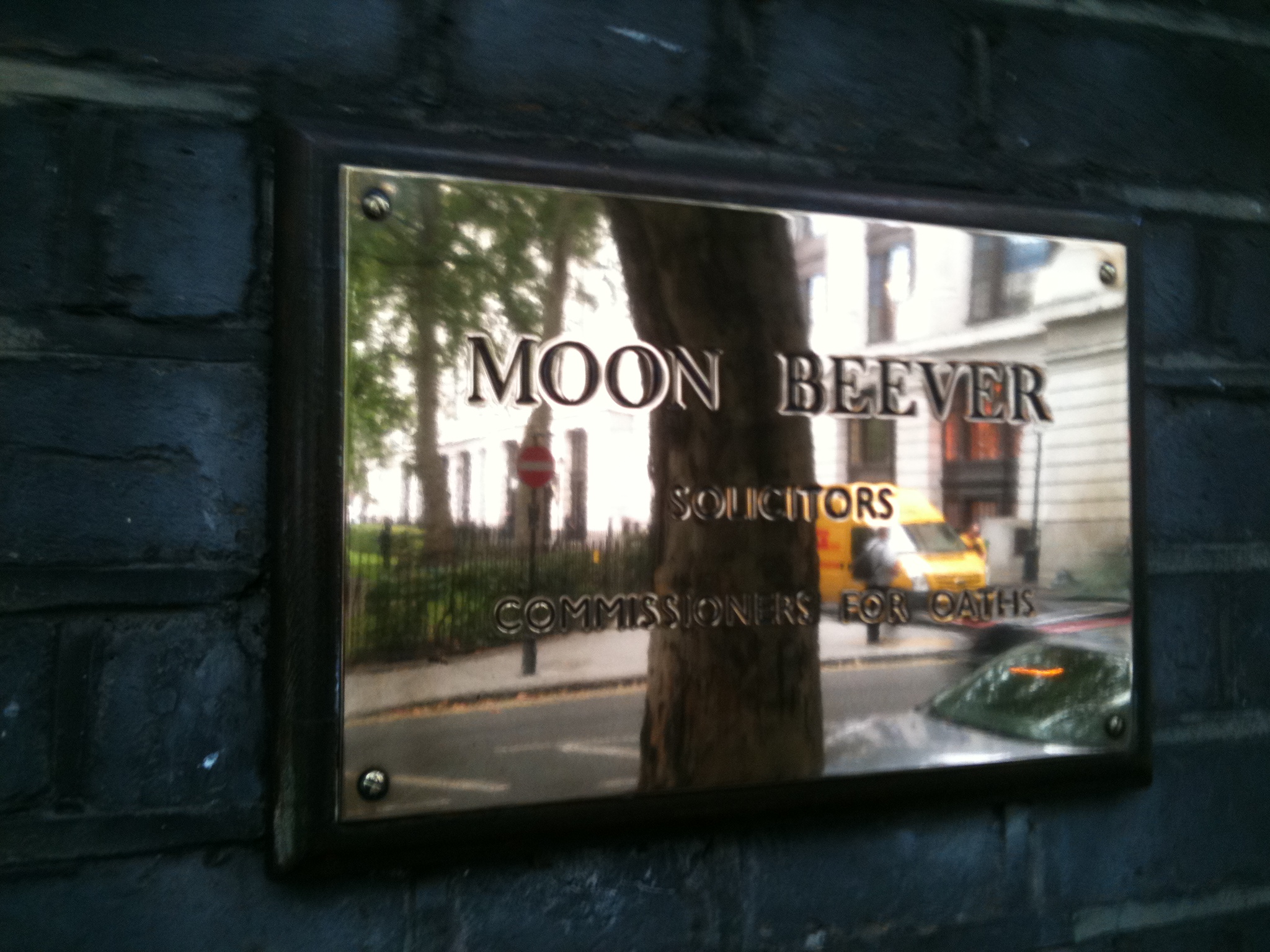
Great nameplates of London

This is probably mine. What’s your favourite? What do you mean, you don’t have one?

Why is there no London monument for the Blitz?

‘When I reached the end of Milk Street, I looked out towards Moorfields across an area of devastation so final and complete that the memory of it will always rise in my mind whenever I hear the word Blitz. There is a savagery, a fury and a hideous wickedness about the ruins of London – and of Berlin also – that chills the heart.’

From HV Morton’s ‘In Search of London’

The Blitz began on September 7th, 1940, seventy years ago today, when London was attacked by 300 German bombers. It lasted three months as London was bombed for 57 consecutive nights. Between September 7 and May 11, 1941, 18,800 tonnes of high explosive was dropped on Holborn, the City, Westminster, Shoreditch, Southwark and Stepney. Up to 20,000 Londoners were killed, many thousands were wounded and 3.5 million houses were damaged or destroyed.

And yet, astonishingly, London – a city of a thousand statues – still does not have a single worthwhile monument to the citizens who suffered the Blitz.

The story of the Blitz is a familiar one – see this wonderful propaganda film for an emotional contemporary look at London under attack – and while the ‘Blitz Spirit’ narrative can be trite and over-mythologised, there was undoubtedly some truth to it. Londoners had to deal with the Blitz in part because they had no other choice, but there is evidence that Londoners did more than just survive, they almost relished the battering they received. As  Humphrey Jennings wrote at the time, Londoners were ‘secretly delighted with the privilege of holding up Hitler’, while Phillip Ziegler said in ‘London At War’ that ‘Londoners made a deliberate attempt to seem nonchalant and unafraid’.

Peter Ackroyd suggests that Londoners might have been able to cope because of spiritual kinship with the destruction of the Great Fire, an idea that HV Morton pre-emptively pooh-poohs in his elegiac 1951 classic ‘In Search of London’. ‘The Fire was an accident and it lasted a matter of days. The Blitz was the deliberate attempt of an enemy to subdue a city whose watchword has always been freedom… the effect of these two events upon the population cannot be compared.’

Yet while London has a Monument for the Fire, it still does not properly commemorate those who experienced the Blitz. There’s a small park in Wapping, a couple of minor plaques – one by St Paul’s, near the firefighters monument, and one in St James’s Churchyard on Piccadilly – and dozens of plaques to individual explosions.

But there is no single iconic statue or monument prominently placed and devoted to the citizens of London in the manner of that for, say Animals In War, or any of the numerous monuments for different branches of the armed forces (Bomber Command are the latest).

This was first pointed out to me in 2006  during an interview with Jack Lohman, the Director of the Museum of London, and his museum does now contain a stunning WWII tribute. The Blitz room is a single stark shadowy space, with an unexploded bomb hanging from the ceiling. The walls show still images of the Blitz, while survivors recount their experiences on audio. It’s incredibly moving, but it isn’t enough.

Why doesn’t London pay sufficient tribute to its Blitz Spirit? I asked Jane Furlong, project co-ordinator of the UK National Inventory of War Memorials, and her answer boiled down to one word:  politics.

Furlong told me: ‘As with all memorials, it’s down to whether individual groups or people want to commemorate something. Also, is there a need of it among those who lived to tell the tale? There are lots of service veterans who want to make sure what they did is never forgotten and a memorial is the best way to do that and so they can go away and organise and make sure it happens. It is all down to having that desire, the community needs to take the lead.’

Bomber Command is a ready-made community that can easily mobilise to commemorate their place in history; London’s civilians are not. Of course, that didn’t stop the Animals In War memorial from getting built, but they managed to enlist the high-profile support of patrons such as the Princess Royal, Kate Adie, Vera Lynn and Joanna Lumley. 

If London is to get the Blitz Spirit memorial it deserves – a dignified sculpture in a prominent public place, dedicated to all Londoners who experienced the Blitz – it requires somebody to take the initiative. And that, ironically, would chime against the spirit of the Blitz: one of exaggerated nonchalance at what took place over London in the winter of 1940-1941.

So it seems for now that the sad and powerful room at the Museum of London and an easily overlooked plaque in the shadow of St Paul’s are the best we are going to get. 

But I think that is a great shame and that ordinary working Londoners, as Ken Livingstone might put it, deserve better.

On the buses again

My free Time Out travelcard has run out. This is the one thing I have been dreading since I left the magazine. No more cheeky one-stop tube hops, no more quick bus rides up the hill because I’m feeling lazy. I’ll even have to reacquaint myself with the actual cost of bus and tube fares, plebeian knowledge I have long disregarded. From now on, every journey on public transport has to be justified. My feet are in for a hell of a beating.

I was the same last time I was freelancer, when I first become heavily involved with the London bus. Time-rich and cash-poor, I could afford to take meandering bus trips across London rather than more expensive and direct journeys by tube, and came to appreciate the London bus in all its magnificence. A few years later, armed with a Time Out travelcard and newly installed as features writer, I attended a brainstorming meeting with the editor, who wanted some new ideas for the Big Smoke section. He picked up a copy of Time Out Manchester (a collectors’ item as it was the only issue they produced) and showed me a column called Bus Bingo, in which the writer took a random Mancunian bus every week. Nice concept, I said in one of those ‘monkey tennis’ moments familiar to any journalist, but how about I, er, take every bus in London in numerical order? And so a column was born.

It seemed popular. I don’t go to many parties, but when I did I was frequently introduced as ‘the bloke who was doing the buses for Time Out‘. And people would regale me with tales of terrible bus trips, or rhapsodise about their favourite routes. (Thinking about it, this could be one of the reasons why I don’t get invited to many parties.) People wrote to the mag saying they were collecting each column, or complaining if I gave a favoured bus an unfair review. Plus it got me out the office.

But all good things and all that. We got a new editor, who in our first meeting asked me how long the bus column would go on for. ‘Well,’ I told him, ‘there are at least 500 routes in London, and that’s before you consider night buses and the ones with number prefixs. And I’m only on No 60.’

He looked aghast, the facial expression of a man who had spent a decade taking taxis on an Emap expense account and fully endorsed the old Tory maxim that anybody who took the bus was a loser. He couldn’t understand why anybody would want to travel by bus, let alone write about it, let alone read about it.

The nail in the coffin came when I, perhaps inadvisably given the prevailing mood, commissioned a full-page piece interviewing three other people I had discovered who were also taking buses in numerical order, a pensioner, an artist and a blogger, who I dubbed ‘Buskateers’, a word that has inexplicably failed to make it into the Oxford English Dictionary.

And so the column was scrapped before I got a chance to fruitily ponder the 69, or settle scores on my old school route of the 127.

London wept, and then went back to reading about 50 Essential Hidden East London Cheap Eat Sex Markets For The Summer. And now I’m back on the buses, although not in numerical order and only if it is too far to walk.

(For more bus appreciation, these three pensioners are taking One Bus At A Time, while Ben at Route 1 To 499 pledges to take every bus in London, albeit in no particular order.)

Love is…

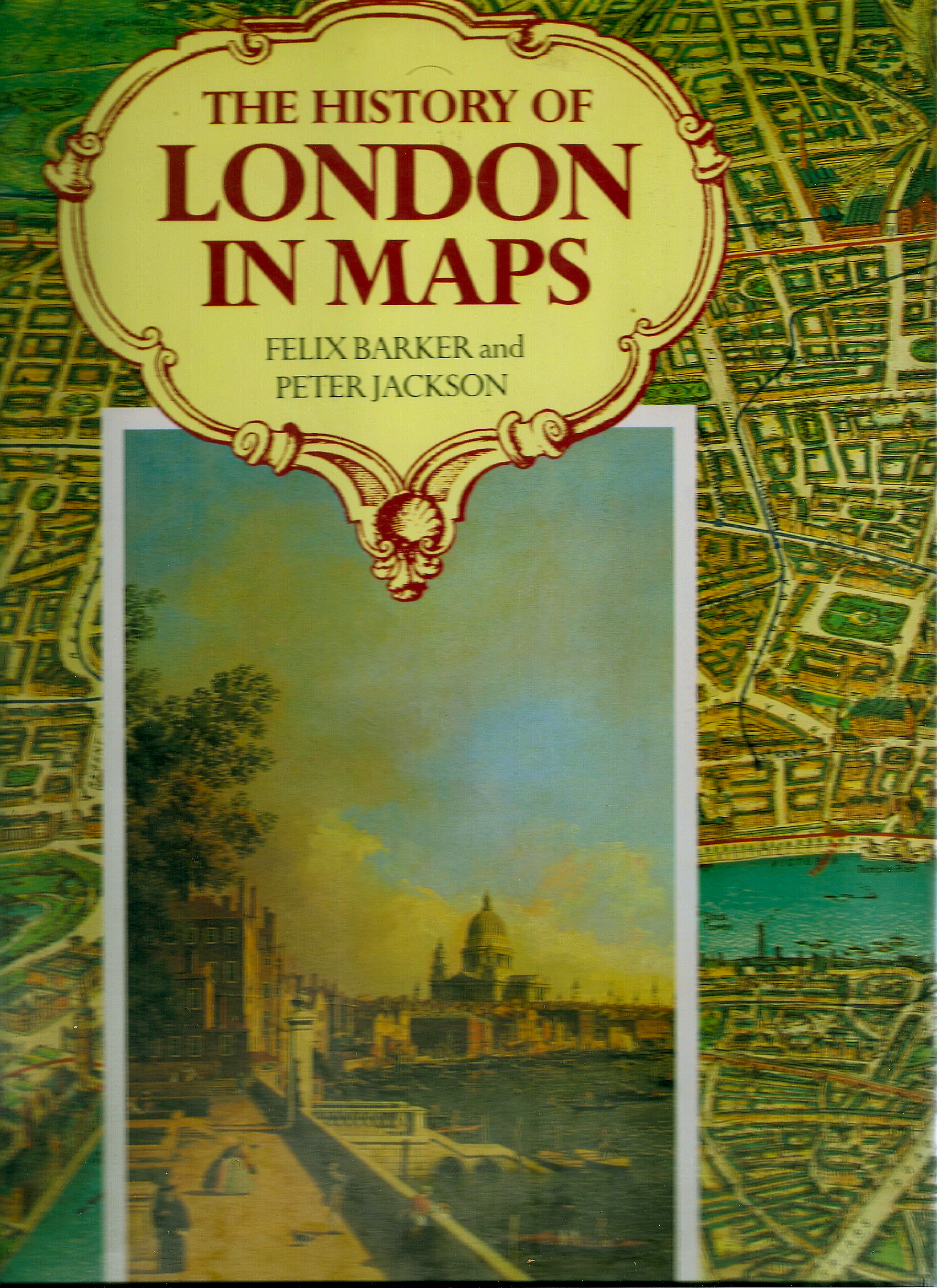
Another book on London maps, for a tenner, from Charing X Road. Yes, I had to get it for myself, but there’s no shame in that. Happy Valentine’s for those so inclined, I’m off to recline with John Rocque…

Despunking chickens: London guidebooks at Guildhall


London guidebooks did not begin with Time Out or even Baedeker. There are thousands out there going back centuries, some aimed at specialist readers, others for a more general audience. I’ve got half-a-dozen myself and left around the same number behind at Time Out.

Finding a great London guidebook isn’t as simple as it might appear. I’ve often found that the ones with the most enticing titles and covers – ‘Len Deighton’s London Dossier’ or Nicholas Saunders’s groovy ‘Alternative London’ – are the most disappointing, as they promise far more than they could ever deliver. But Another Nickel In The Machine‘s merciless deconstruction of Hunter Davies’s ‘The London Spy’ suggests I shouldn’t give up hope yet.

And even the most mundane guide offers something for the diligent reader, even if it’s nothing more than a reminder of how rapidly London changes and how rarely it looks back in regret at what it has lost. A browse of 1986’s rather mainstream ‘New Penguin Guide To London’, for instance, left me pining for National Museum of Labour History, which was once based at Limehouse Town Hall and closed down the year the guide was published.

Pick carefully and there is a rich seam here, so fans of the genre – and there are many of us out there – will want to head to the Guildhall Library before the end of March to see librarian Vicky Hurst’s small curated collection of 30 London guide books, dating from 1755 to now. Among them are such appealing titles as ‘London of Today’ (1890); ‘Cooks’ Handbook for London’ (1902); ‘London for the Disabled’ (1967); ‘Swinging London: A Guide To Where The Action Is’ (1967); ‘Alternative London for Strangers: Survival Guide’ (1973); and ‘The Forest Guide to Smoking in London’ (1996). Split into two cabinets, the covers for the later ones are fab and I particularly loved Osbert Lancaster’s art deco cover for ‘London Night And Day’. The library has thousands such guides, as you would expect from what is perhaps the finest store of London books in the capital.

No space in the display though for my two favourites. John Timbs’s ‘Curiosities Of London’ (1855) is a wonderfully thorough Victorian A-Z that sits somewhere between ‘The London Encyclopedia’ and a standard guidebook, as it features cornucopic history with some practical information and is very readable.

I also love the rather dull-sounding ‘Absolutely Essential Guide To London’ by David Benedictus. It’s from 1986, is again laid out in A-Z format, and includes delightful trivia amid plenty that is useful. There are entries on ‘Chickens’ (a statue in Hornsey), ‘Foot Scrapers’ and ‘Tiles’. Restaurants, theatres and cinemas get reviews packed with (potentially libellous) anecdote and character, while the entry on ‘Prostitutes’ includes advice that even if you never use, you are never likely to forget: ‘if you must pay the girl or boy in advance, tear the note in half. Give them half and promise the other half after you’ve been despunked.’