Tag Archives: London

Pole to pole: more forgotten London street furniture

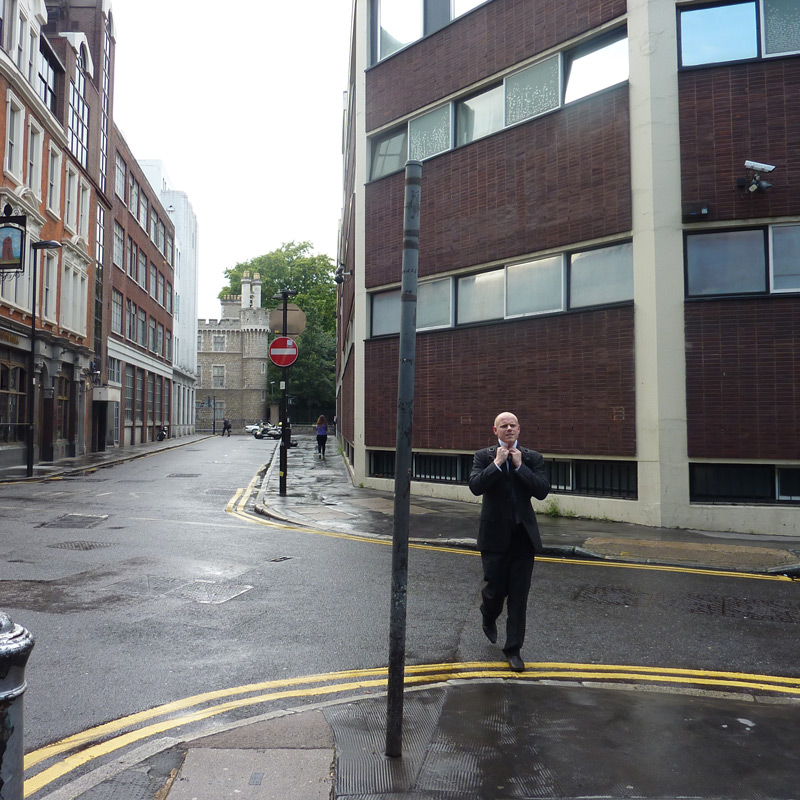
Some months ago, Russell Miller noticed that London was filled with metal posts that are left embedded in the ground long after the signs they once supported are taken away. So he began to photograph them for his website, taking particular interested in the way people walk past these rusting remnants without even noticing. And then he told me about it.

I think they are great. Here are a few examples, but for more check out Russell’s website – We Do This Because We Forget.


My favourite thing in London

The other day, I saw this board outside the Big Red Bus tourist shop near the British Museum and decided straight away that it might be my favourite thing in London. It was so striking, with such a warped sense of perspective and bizarre mishmash of London stereotypes.

I wanted it.

I decided that I would go inside and ask how much it would cost to buy it, but first I stopped and looked at it awhile. Questions entered my head.

What is a Grenadier Guard doing outside Downing Street? If he’s not on duty, why is he wearing his uniform and if he is on duty, which he shouldn’t be, why is he holding the hand of a small foreign bear? What is Paddington Bear doing so far from his comfort zone of Paddington without Mr Brown or any of the Brown family? Why is Paddington Bear standing behind the Grenadier Guard in that curious position? Are Paddington Bear and a Grenadier Guard even particularly relevant symbols of London life in 2012? And is it just me, or does the whole ensemble look rather like a surreal take on something you might see on Crimewatch featuring a stranger caught on CCTV camera leading a small child away from a shopping centre?

I still wanted it though, maybe now more than ever.

While I was plucking up the courage to go inside an ask, two Italian tourists came strolling down the road. They saw the board, giggled, then handed me their camera and asked if I could take their picture. After arguing over who would be the bear and who would be the guard, they poked their heads through the holes. I took a photograph, they thanked my fulsomely and moved on, laughing and chatting, relishing this rare free moment of childish fun in the sterling-sapping city.

I realised then that the need of London’s tourists was greater than mine. I could always come back, but they would only ever have their photographs. I went home, contented.

The Gun Club

I have a piece in the latest Uncut about the Gun Club, the band fronted by Jeffrey Lee Pierce. The Gun Club trailblazed the kind of killer punk-swamp-country-blues later taken on, more lucratively, by Nick Cave and the White Stripes.

Born in California, Pierce settled in London in 1985. He spent a lot of his time hanging out at the Batcave, the Goth nightclub in Soho’s Dean Street.

Pierce left London in 1995, when he was deported after wielding a samurai sword in a Kensington pub. Which makes this trailer for what appears to be an Italian documentary from 2008 all the more intriguing, as it features Pierce wielding a samurai sword in London in 1992. (I’m not sure if it is the same film as this 2006 documentary, Ghost on the Highway.)

Pierce was a talented enigma, who made some amazing music. They also wrote the best song title ever, in Sex Beat, which pretty much sums up what all rock ‘n’ roll is really about.

o

Walking London: rivers and tubes

‘What a bounteous banquet of costly viands is spread before an ardent-minded, grateful-spirited Perambulator!’ Old Humphrey’s Walks In London

‘One must perambulate early and late in all weathers, to know a little about London’. The London Perambulator

London is a gift for those who wander. Sometimes you can pick a new area and just stroll wherever the whim strikes you; sometimes you can take a different route between two familiar destinations. Either way, you’ll find your appreciation of the city is inordinately increased.

There is a healthy industry in London walking – M@ recently compiled a list of his ten favourite for the Guardian – but if you need something cheaper and more challenging, you can always take a self-guided walk over a longer distance. I once walked the Thames from St Paul’s to Hampton Court on a Sunday afternoon, criss-crossing bridges and sticking as close to the river as possible. It was particularly satisfying to see how easy it is to walk on the river bank – the only place I had to take a significant detour was around the ever-weird Chelsea Harbour.

In a similar vein, a couple of books have recently come out on the theme of London walking. Walk The Lines is about Mark Mason‘s decision to walk every tube line in London, above ground, an overall distance of 403 miles that takes him everywhere from Amersham in the north-west and Epping in the far east to Morden in the deep south.

Mason enjoys discovering new parts of the city and peppers his book with brilliant London trivia but is at his best when writing about the pleasure walking can provide. As he writes, ‘Once you’ve caught the bug, you feel an urge to plan your walks, be it thematically, geographically or by some other means. There must be a raison d’être for your ramble.’ This, he thinks, taps into a similar mentality to that of a collector: ‘It’s not about studying, about observing or noting. It’s about collecting. About claiming the city’s greatness, or at least some small part of it, for yourself.’

Mason’s book is a fun read, but you couldn’t very well use it to walk the tube lines yourself, even if you were lunatic enough to want to do so. Tom Bolton’s London’s Lost Rivers, however, bills itself as ‘A Walker’s Guide’ and is a terrific mix of history, topography and practicality. It maps – astonishingly diligently – the courses of eight of London’s buried rivers, so walkers can follow them for themselves, pointing out items of interest they can see along the way while also offering some historical context about the subterranean rivers.

Along with Nicholas Barton’s The Lost Rivers of London, it’s essential for any fan of buried rivers (Diamond Geezer says much the same here). The atmospheric Polaroid photographs by SF Said are a nice touch, as is the introduction by the great Londonphile Chris Fowler. Highly recommended.

London’s mapping renaissance

The growth of online mapping – as seen by the excellent London Mapping website, which collects some of the best digital maps around – has not meant the end of paper maps.

I’ve mentioned Herb Lester‘s lovely themed maps before with reference to their 1960s map of London’s West End, Wish You Were There, and they continue to add new maps to their range, branching into different cities and themes while maintaining an impeccable eye for design. Untamed London, for nature-lovers, is their latest offering.

I’ve also finally got my hands on the Museum of London’s Londonium map and it is hugely impressive. This has been produced by MOLAS, the Museum of London Archeological Service, and is a huge map of the City, with the Roman topography superimposed over a plan of the contemporary city – a little like a paper version of the technology used for the Time Travel Explorer app.

Key Roman finds are listed, with an explanation of what they are and how they can be accessed, while the reverse side has a potted history of Roman London, with many illustrations. The map is printed on good thick paper so won’t tear easily (a constant problem for frequently folded paper maps), and works beautifully as both a decorative item and a practical plan for hunting down the existing remains of Londonium.

It costs just £6.25 and should it prove to be a big seller – which I imagine it will – I hope the Museum can persuade their friends at MOLA to produce more maps along the same lines.

One for the Olympic Park at around this time next year, perhaps?

London bricks

‘The bricks – laid Flemish bond, headers and stretchers alternating – were all old London stock bricks, but of many kinds and colours: rust red, beige, grey, brown, nearly black. Here and there were yellow ones – malm bricks made with an admixture of clay and chalk. The cumulative effect was pleasing – the variety gave texture, interest and warmth to the surface of the wall. The eye approved the range of colour, the uneven look, the way in which each brick differed from its neighbour and yet was in subtle harmony. But, more that that, to look at it was to see the way in which this wall arose from the ashes of many buildings. Studying it, Matthew saw in his mind’s eye warehouses and churches, factories and shops, terrace houses like this one, blasted to the ground perhaps on some furnace night of 1940. He thought of how the city lifts again and again from its own decay, thrusting up from its own detritus, from the sediment of brick dust, rubble, wood splinters, rusted iron, potsherds, coins and bones. He thought of himself, living briefly on top of this pile, inheriting its physical variety and, above all, the clamour of its references. The thought sustained him, in some curious way, as he sat at his desk in the flat which was not yet a home, or as he moved through days and through the city, from Finsbury to Docklands to Covent Garden to Lincoln’s Inn.

Penelope Lively in ‘City Of The Mind’ (1991, Andre Deutsch).

Thomas Paine’s London bridge

Thomas Paine was many things. A writer, revolutionary and political philosopher, Paine was also an inventor and engineer, who made the world’s first smokeless candle. He was also an occasional Londoner, most notably when he stayed at the Angel Inn, Islington, around the time he began writing Rights Of Man in 1791. This monument celebrates that fact.

Considerably more interesting than this, though, is the rarely discussed fact that Tom Paine built bridges. Iron bridges. And he built one of them in London.

Paine was fascinated by bridges, admiring them for their architecture as much as their metaphorical meaning. John Keane, Paine’s biographer, writes that he ‘was stuck by their double meaning. Bridges were for him combinations of architectural beauty and practicality, works of genius that could be breathtaking in their simplicity… the rising spirit of an epoch translated into space.’

Paine first tried to raise the funds to build an iron bridge over the Harlem River in New York in 1785 and then another over the Seine in Paris in 1786, but without success. Bridges of this era were still largely constructed in stone and wood, making Paine’s ideas rather unusual. Plus, he had no real background in engineering or architecture.

But he persevered. In 1788-89, he attempted to build an iron bridge over the River Don in South Yorkshire and although the project was never completed it did secure him a patent for his bridge-building scheme. Paine now decided that he needed to build his prototype bridge in London, where potential investors could see for themselves the sort of brilliant bridge he was going  to make. He told Thomas Jefferson – who himself had many ideas about how the bridge should be built – that a London bridge would soon pay for itself in tolls. Jefferson was impressed, writing to a friend: ‘Mr Paine, the author of Common Sense, has invented an iron bridge, which promises to be cheaper by a great deal than stone, and to admit of a much greater arch. He supposes it may be ventured for an arch of five hundred feet. He has obtained a patent for it in England, and is now executing the first experiment with an arch of between ninety and one hundred feet.’

Paine had originally hoped to build this experimental bridge to nowhere in Soho Square, but when he wrote to George Washington on May 1, 1790 describing his single-arch bridge of 110 feet, he still hadn’t found an appropriate location. By the end of May he could tell the no doubt anxious Washington that a site had been found – a field next to a famous tavern called the Yorkshire Stingo, on the Marylebone Road near what is now Lisson Grove. This was at least partly appropriate, given that the bridge was being constructed by a Rotherham-based ironworker called Thomas Walker.

Paine moved into the Yorkshire Stingo and began erecting his 110-foot bridge on the neighbouring bowling green. By September it was finished. Jefferson wrote to him a very nice letter saying: ‘I congratulate you sincerely on the success of your bridge. I was sure of it before from theory: yet one likes to be assured from practice also.’

However, although there were many interested visitors, none of them were impressed enough to offer to invest in Paine’s scheme to build a bridge over the Thames. By October 1791, Paine’s bridge had been started to rust and Paine had lost interest, so it was dismantled and the iron returned to Yorkshire, where some was used in a bridge built over the River Wear in Sunderland in 1796, which at the time was the longest iron bridge at the world at 240 feet.

Bin Laden world exclusive from Herne Hill

London’s underground press: IT and OZ and the psychedelic left

‘IT came out of the Beats – poetry, jazz and art with a bit of lefty politics,’ says Mick Farren. ‘I told them this was fucked up, they weren’t talking about the weird changes going on with The Who, or where The Beatles were coming from. I’d say that with all respect to John Coltrane there’s this black geezer in the Bag O’ Nails who has long hair and plays guitar with his teeth, what are we going to do about that? So they asked me to be music editor.’

The current issue of Uncut magazine contains my feature on the London underground press of the 1960s and 1970s. It includes a number of stupendous quotes like the above from Mick Farren, one of the most colourful figures from the British psychedelic left.

The piece covers the founding of International Times in 1966, the relationship between the underground press and pop stars, the difficulty of publishing, happenings at the Roundhouse and Alexandra Palace, the creation of the UFO Club and the gradual demise of the movement after the dehibilitating OZ trial of 1971. Interviewees included Pete Townshend, Mick Farren, Marianne Faithfull, Robert Wyatt and Jonathon Green. Townshend was particularly reflective on his troubled relationship with the counterculture, and I’ll post the whole thing up here shortly.

There is some great stuff on the internet about both these publications, which in different ways served the needs of London’s young and switched-on population who were not being sufficiently satisfied by either the mainstream newspapers or the pop press. (And does that sound familiar or what?) They covered pot, pop and politics, were revolutionary in their use of colour, design and language and paved the way for later influential print movements like the punk and football fanzines of the 1970s and 1980s.

The entire International Times archive is online, a hugely valuable resource for hippy-watchers. Discover it here. Some of the old IT heads are also collaborating on a blog called The Fanatic.

For those interested in the OZ trial, I recommend the following two-part news clip made for Australian TV at the time of the trial in 1971. It’s a fascinating watch.

Inside the Fleet: exploring London’s lost rivers

I wrote this piece for Time Out in 2005 and for some reason it’s never been available online. Until now.

It’s only as the filthy brown water rises above my thigh-high waders and my feet struggle to grip the tunnel’s slimy floor that I realise that drowning in a river of shit after breaking into a London sewer would be a really, really crap way to die.

It all began so well. I found Jondoe and Stoop, two urban explorers who get their kicks investigating drains, lost rivers and derelict buildings, on the internet and asked them if I could come on their next journey beneath the city streets.

We met near Farringdon. The plan is to explore one of London’s lost rivers, the Fleet, which once flowed from Hampstead to Blackfriars. Although long bricked over, the Fleet, like many of London’s old rivers, still flows underground through a series of pipes and culverts. Joseph Bazalgette integrated these rivers into his sewer system, using them as storm-relief drains to carry overspill into the Thames when the main east-west sewers were swelled beyond capacity. These days, heavy rain can still cause sewage to flow into the river via the Fleet.

Jondoe and Stoop have been in the Fleet before, but turned back when the stench became overwhelming for even these experienced drainers. This time, they are determined to reach the end. They believe no other UK urban explorer has made the trip, largely because it takes considerable planning to find a way into London drains. Urban explorers are driven by a combination of adrenalin and curiosity, and take their hobby seriously. This trip has been months in the planning. They’ve popped many manholes looking for the right entry point, and the weather has to be right – no rain for at least three days before we enter.

In a nearby car park, we change into waders, boiler suits, flourescent vests and hard hats – the latter more for disguise than protection. Carrying a couple of traffic cones, we’re suddenly transformed into construction workers, practically invisible to passers-by. Nobody bats an eyelid as we walk through busy streets to the selected manhole, stick some cones round it, lift the cover and climb down the ladder into the gloom.

We enter a feeder tunnel with a five-foot ceiling, which means we have to abandon our hats and walk with cricked necks. It’s cramped, damp, dank and dirty but doesn’t smell too bad. Stoop and Jondoe glide like skaters along the slippery floor while I splash clumsily behind, using slimy walls to keep my balance. We head downwards along a series of mini-waterfalls. The light and noise that intermittently emerges from the grates overhead suggest we aren’t getting deeper, but simply following the gradient of the road. It’s a curious feeling, being isolated in the dark but with occasional glimpses of London reminding us that normal life continues up above.

Eventually we reach the end of the feeder tunnel and swing into the Fleet itself using broadband cables that make useful subterranean handrails. It stinks in here and the air is heavy with a strange mist. Jondoe points north, to where the Fleet is blocked by the main east-west sewer. Ominous clumps of matter fester in pools all around. ‘Don’t disturb them,’ he says. ‘It’ll be full of gas that just sits there and collects.’

As he speaks, one of the hard hats we’d left by the entry point shoots out of the feeder tunnel on a wave and floats towards the Thames, bobbing along the shallow water that moves sluggishly down the centre of the tunnel.

We follow, heading south. The tunnel is around ten feet tall and wide, so we can walk two abreast. It’s about the same size as a tube tunnel. The smell slowly subsides, although lumps of faeces and toilet paper gather in places where they’ve washed against the brickwork. Otherwise, there’s just a trickle of brown water ferrying the odd cotton-bud downriver.

It’s no hellhole, but still a far cry from the Fleet’s sixteenth-century heyday as one of London’s key tributaries, when, flanked by wharves and warehouses, it was a centre of London commerce. It separated Westminster from the City and carried cargo to the Thames, was compared unfavourably with the four rivers of Hades by Ben Jonson, was briefly turned into a canal and then covered in portions from 1732, by which time it was little more than an open sewer.

But this was not the end of it. In 1846, the Fleet exploded, its sewage gasses bursting the street above, rendering King’s Cross Road impassable, destroying Clerkenwell poorhouses and smashing a Thames steamboat against Blackfriars Bridge. This river, it seems, has a habit of coming back to ambush those who thought it dead and buried.

Almost two centuries later, traffic and police sirens are audible overhead, competing with the constant crash of water that flows from numerous side tunnels, feeding the central trickle. Rats stop and stare as we walk past. I nervously keep my torch shining on them until we have moved on.

Before Ludgate Circus, the Fleet splits into two parallel tunnels, directly replicating the pattern of Farringdon Street overhead. Otherwise, it’s impossible to work out exactly where we are. The tunnel heads south, but is full of turns. At one point we notice large iron rings cemented into the wall. They are support for scaffolding, but look like mooring rings. Throughout, the Victorian brickwork is surprisingly beautiful for something that is so rarely seen.


After about two miles of trudging, we emerge into an enormous end chamber, more than 20-feet high and elaborate in design and construction. Two short tunnels lead from here, ending in huge metal flaps, which we assume open directly into the Thames.

After taking pictures, we head back. Immediately, we realise there’s a problem. It’s much harder to walk uphill against the flow of water. On the way down, the water was a stream, heading back, it’s more like a river. We labour onwards and upwards in the dark, but it’s tough work.

Stoop eventually says what we’ve all been thinking. ‘Is it just me,’ he asks, ‘Or is the water getting deeper?’

Water which before barely covered our feet is now above our knees, flooding downhill towards us at pace and rising slowly all the time. Wading into the tide, our clothes are heavy with water and our feet struggle to grip the slimy stone floor. Panicking rats scurry up the walls to get out the way of the bubbling water.

It’s frightening. Nobody knows we are down here and as our pace slows I begin to ponder our options. Should we press on, or brave a side tunnel, where a ladder may at least take us above water level, so we can sit it out. But how long would that take? And what if the water keeps rising and the side tunnel we’re in doesn’t have access to the street?

We reach a turn where the water has become a torrent and Stoop tries to brace himself against the tide but instead starts sliding backwards towards me, threatening to skittle us all into the dirty water. For a split second I consider what an undignified death this would make, and with one final effort we press on, forcing ourselves to a point where we can stand without getting knocked off our feet. But we’re exhausted.

Then Jondoe shouts, ‘That’s where we came in!’ It is indeed. We pull ourselves up into the feeder drain via the broadband cable and watch the river below us boil to a frenzy. The Fleet is back with a vengeance. Later Jondoe explains, ‘Somewhere further up the sewer they must have been doing some maintenance and so diverted the flow down the Fleet.’ It is, he says, something he’s never experienced before.

Twenty minutes later, after an exhausting walk through the smaller drain in the course of which I bang my head several times on overhanging pipes and bricks, I haul my battered, sodden body up the ladder and into the sunshine. It’s bright outside. The air smells clean. Half-a-dozen people across the road pay us no heed as we emerge from the manhole and sit slumped in the road, moving only to remove our waders and empty them back down the drain.

We trek back to the car in soaking socks, leaving a trail of footprints behind us.