I’ve written about Denmark Streetbefore – that strangely old-fashioned almost Brooklyn-style street on the border of Soho and Covent Garden that for decades has been home to various aspects of the music industry in the UK.
Tin Pan Alley Tales is a film that plans to tell the story of this small but vitally important street but it needs funding. Made by campaigner Henry Scott-Irvine, the film will tell the stories of the 22 buildings that make up Denmark Street and trace its progression from home of pre-war publishers and songwriters, through skiffle, pop and rock, punk and to the present day.
It will provide an important and fascinating document of a London street that has been at the forefront of popular culture for decades but which is now under threat from London’s rampant development.
For the past seven years, I’ve lived in Victorian London and now it’s time to leave. In 2009, we moved into a small terraced house in Herne Hill, built in around 1880 and modelled along classic London proportions. I wrote about that “common little London house” here, shortly after we moved in. It had the standard measurements of houses of this era – a front that measured one rod, ie 16 ft 6 in – and is pretty much identical to hundreds of thousands of houses thrown up in this era as London expanded alongside railway lines like Japanese knotweed. Throw out the contemporary fittings – the central heating, white goods, plastic toys – and you have a house that even a Victorian might still recognise.
I loved the house when I moved into it. I mainly loved the coal hole on the front step but I also loved the way that when I visited friends almost anywhere else in London I would immediately feel at home. Their house or flat was invariably built along similar dimensions, with a near-identical floorplan adapted only for the size, from grand five-storey detached dwelling to the more humble two-storey terraced house I occupied.
Humble. That word scarcely seems appropriate or even tasteful given the prices such houses now fetch. My house was one step up from the traditional two-up two-down and would have been built, I imagine, for the artisan working classes. Now it makes a fine first home for rich young City bankers exiled from Clapham and Fulham, whose first act is to insert white wooden slatted blinds, paint the front door sage and apply for planning permission to build a side return. The Victorian Londoner would have known his social class simply by the size of the home he inhabited, but it is no longer quite so easy, with the traditionally wealthy forced to occupy somewhat dingy homes originally intended for the poor. Instead the status-conscious London homeowner is forced to mark out his superiority to hangers-on and renters via window furnishing, colour scheme and the size of skip required for the proposed extension.
We’ve time-travelled now to the 1930s, occupying a house that is almost comic in its determination to differentiate itself from the Victorian houses on the other side of the railway line. You can see that in the bourgeois stained-glass window on the stairs, and the wide hallway but most notably in the garage that is attached to every house on the street. It’s an addition that perhaps best distinguish the change from urban to suburban, even if, in 90 per cent of cases, the garage has since been adapted for some other purpose as Londoners in any type of house relentlessly look for a way to tack one more room on to any property they purchase.
I loved my Victorian house. After all, my youngest daughter was born right there in the front room, much like a Victorian baby might have been. But I was glad to leave, tired of the living room slugs and the damp bathroom – badly adapted from the old rear utility room and outdoor privy – and endless noise from the new neighbours and their builders. We’ve moved by choice – the area no longer suits us, but even if it did, we couldn’t afford to live there. Gentrification is the process that eats as all, and as we had moved in because the previous tenants couldn’t afford the rent, we were forced out in part by demographic changes that made us no longer feel entirely at home in a place we’d lived for so long.
Shortly after our landlord put our house on the market, I was in the front garden when a car pulled up. A man got out and asked me how much the house was selling for. I gave him the answer, and after laughing, he introduced himself as a former occupant. This was the house he had grown up in with his parents and three brothers forty years before. I showed him round, and as he pointed out old home improvements, old trees he used to climb, he talked about the past, the street back in the 1980s, when the larger homes were multiple occupancy and the neighbourhood was 80 per cent black. And I told him how two doors down, the last black family on the street are preparing to move as Herne Hill’s Claphamification continues apace.
In 2005, I interviewed the author Tim Lott for Time Out‘s My Favourite Londoner feature, in which we invited writers, actors, musicians and other personalities to tell us about their favourite London character. Lott chose Hancock, who is also one of my heroes, and I’ve reproduced the piece below.
(Incidentally, my other interview in this series was with one of my favourite writers, George MacDonald Fraser, who told me of his fondness for John Bunyan – although I’m not sure how much he actually knew about him, as I recall him slowly reading chunks from the encyclopedia over the phone to me. Sadly, the piece was never published, I’ve lost the transcript and MacDonald Fraser died soon after, never having written the Flashman book about the American Civil War – something he told me kept putting off, as the war was so horrible.)
‘I identify extraordinarily strongly with Hancock. I remember loving him enormously as a kid and living for ‘Hancock’s Half Hour’. I was about eight or nine and thought it was just the funniest thing on television. He spoke directly to my world – I lived in a London suburb like East Cheam and I too was a kind of – I hadn’t reached the level of being pretentious but I was somebody who desperately wanted to transcend what I saw as being my suburban limitations. And yet I was hugely intimidated and bewildered by the larger world beyond. Hancock’s concept of noble failure was very appealing to me. He never gave up trying to raise above his station but he was always doomed, and that was the key behind his comedy.
It goes deeper than that though. Deeper than him being simply funny.
I should incidentally remark that Tony Hancock was born in Birmingham not London, but I’m talking of course about Antony Aloysius St John Hancock, the character created by the London-born Galton and Simpson, who were died in the wool Londoners and that’s why the London voice is so strong. I think that idea of petty pretention underpinned by a real desire to better yourself – a motif shared by another of my great London characters, Steptoe the younger.
Trapped by circumstances but longs to escape the limitations not only of his own external situation, but more crucially the limitations of his own personality. He dreams of a wider world, one that isn’t defined by the quintessentially dullness of a 1950s suburban world.
I remember on the day he died this very famous photograph of him in Sydney looking so haunted, if you wanted to draw a picture of a man about to commit suicide it was almost a perfect representation of depression. I’ve written a memoir about my own depression (‘The Scent Of Dry Roses’) and somehow even at that age – I was 11 – it made an enormous impression me. I wondered how anybody could reach a level of such deep misery that they should want to kill themselves, and I found that utter bewildering. I was too young to recognise the deep melancholy and frustration that lay behind the character of Hancock.
You can look upon Hancock as a ludicrous figure but people loved him and felt a tenderness towards him because of his vulnerability. Underneath his absurdity was a genuine wish to transcend his world. In ‘The Rebel’ he escapes to Paris to become an artist even though he has no talent and that was always my dream, to escape the dead streets of Southall and mix with all the eccentrics, bohemians and artists. But on the one hand you want this, but you also want to be reassured that these people are slightly absurd.
Hancock is greatly loved for that sadness that the real Tony Hancock brought to the role. It was the same with ‘The Likely Lads’, Steptoe, the essential tragedy of the situation.
He was a very beautiful man, he had a lovely face. There was something very evocative about his looks. Those great moony soulful eyes always acted as a counterpoint for the laughter and always said, yes it’s funny but it’s terribly sad as well.
He was the soul of male suburbia in the 1950s. I always felt that aspiration, I always felt doomed, I always felt too stupid, I always feared I would end up back in Southall, my equivalent of Railway Cuttings, Cheam. And like Hancock I always felt a paradoxical affection with that place. It’s not a cruel, angry comedy. It’s very whistful, tender, reflective comedy.
I’m very rarely that shocked or sad when somebody dies, but I was when Hancock died. I remember seeing the story on the cover of the Daily Express and staring at it for a very long time. It’s strange how 20 years later I became terribly depressed, almost as if I had an intimation that it would happen. It’s almost creepy how fascinated I was by him, but he was a social climber with aspirational pretentions.
My favourite moment: when I went to university this sketch always came to mind. Hancock decides he’s going to increase his education so he gets out the biggest book he can find, this massive intellectual tome, and he sets it down on the table and prepares himself to do battle with the contents of this heavyweight textbook. He opens the first page and focuses and there’s this wonderful brave shot when nothing happens for about a minute, it’s just him looking at a page and then he looks up at the camera and just says ‘Stone me’. That basically summed up my entire attitude to learning.
You love the freedom and art and culture of the middle classes, but you despise their pretention and their snobbery and their wealth and their privilege – and the two are very mixed up in your own mind, you want to become what you hate. He was very much of that era of working-class writers – Sillitoe and Storey and Waterhouse and Potter – but all of them were from the north. There were no southern working-class playwrights and in a way it was all transposed into the comedy of Galton and Simpson and Clement and LeFrenais. That novel about the lower-middle classes and working classes in London never came out – there was a whole tradition of northern writing but I didn’t recognise that, it meant nothing to me. But I did recognise Hancock and Steptoe. You didn’t find that world much in novels or drama, but most frequently in comedy and Hancock was the greatest of them.”
I’ve written a review of Rachel Lichtenstein’s very good new book about the Thames Estuary, called Estuary. You can read it here, at Caught By The River.
I have a piece in the current issue of Uncut about the 1960s hippie scene in the Balearic islands of Ibiza, Formentera and Mallorca. It explores three individual but inter-related scenes – the community of artists and writers centred around Robert Graves in Deià, which attracted musicians such Kevin Ayers, Robert Wyatt and Daevid Allen; the hedonistic hippies of Ibiza; and the more hardcore scene on Formentera, that was filled with escapees from London and which had connections to Pink Floyd.
This is a circular tale. Following the arrival of expat Londoners in the 1960s, Ibiza continued to attract a wide range of European travellers throughout the 1970s, and the resulting spirit of chemical hedonism, opportunism and musical adventure eventually spawned Acid House. This came back to London in 1988 at clubs like Shoom, which were directly modelled on the mutant neo-hippie attitude that London DJs had experienced in Ibizan nightclubs. Although the piece concentrates mainly on the Soft Machine/Pink Floyd angle, the circular nature of this journey really interested me – the way a generation of elite London hipster helped transport a certain spirit to the Mediterranean, where it gestated into something quite different that a later generation brought home again.
To get an idea of what life was like in Ibiza and Formentera in the 60s, you should watch More, the film by Barbet Shroeder which had a soundtrack by Pink Floyd. “The film More, that’s what made Ibiza famous forever,” said Jose Padilla, the DJ who founded Cade Del Mar. “That was it for me, the Ibizan white house with no water or electricity, hanging around knackered, guys from Vietnam, girls, there was a lot of heroin too. You can tell [Floyd] were doing a lot of acid… but the landscape must effect the music.” You should also listen to “Formentera Lady” by King Crimson, with evocative lyrics by Peter Sinfield, who often visited the island. As a result, there is now a street named after King Crimson on the tiny island.
Another Balearic-influenced 60s psychedelic classic is Cream’s “Tale Of Brave Ulysses”, with lyrics by the great Australian artist Martin Sharp that were inspired by his time in Ibiza and Formentera.
The Floyd crew spent time on Formentera in the 1960s, with Syd Barrett being sent there to recuperate following acid meltdowns, accompanied by the ever fascinating Sam Hutt, the hippie doctor who later became the country singer Hank Wangford. I’ve written about Sam’s West London hash clinic before. Aubrey Powell, co-founder of Denmark Street-based designers Hipgnosis, also spent much time on Formentera and told me how the island’s landscape influenced the artwork he later produced for Led Zeppelin and Pink Floyd – particularly the weathered sandstone that Syd Barrett would stare at while off his head on LSD.
Meanwhile, over in Deià, the scene that coalesced around poet Robert Graves helped influence Soft Machine and Gong. Graves was an extraordinary character, who straddles so many areas it’s difficult to know where to start, but was connected in several ways with music, drugs and a general spirit of inquisitive mysticism. I spoke to Graves’ Spanish son-in-law and son – both of whom are musicians. I also talked to Gong’s Didier Malherbe, who lived for a while in a cave in Robert Graves’ garden, where he would practise his flute and talk to Graves about Greek mythology, while neighbour Daevid Allen took acid and dreamed up his Gong universe.
Among Graves’ many interests was a fascination with magic mushrooms – he corresponded with Gordon Wasson, the American banker who helped bring mushroom knowledge to the west – and both Soft Machine and Gong were hugely influenced by the psychedelic experience. Artists, writers, musicians and actors from London would often visit Graves, including Ronnie Scott – Graves was a regular at Ronnie Scott’s club whenever he was in London. Graves also spent time with Alan Lomax, the great musical folklorist.
Deià is now a mecca for rich Europeans, partly due to a huge luxury hotel owned by Richard Branson. The story behind this goes back to London in the 1970s, when Branson and his wife were having dinner at Branson’s Little Venice houseboat with Kevin Ayers and his wife. Branson had his eye on Ayers’ wife and in the spirit of the era, this canalside soiree soon turned into a swinging scene, with everybody swapping partners. However, Ayers and Branson’s wife Kristen then fell in love and ran off to Deià. Kristen later ran off again, this time with a German architect, who Branson promptly teamed up with to build the hotel that would destroy the town’s bohemian spirit forever, sending Ayers into further exile, this time to Paris.
While Ibiza/Formentera and Deià were largely separate scenes, there was the occasional crossover. One such was this album, Licors by Pau Riba. Riba, a Formentera-based musician and grandson of Catalan poet Carles Riba, recorded this excellent psych-prog album with Daevid Allen in Deià. Riba also recorded the strange, beautiful Catalan folk album Jo, La Dona I El Gripau, in a stone house on Formentera in 1971.
I went to see the new Tate Modern extension yesterday and very impressive it was too. The extension by Herzog & De Meuron manages that rare trick of looking new and exciting while also reflecting the character and style its neighbouring building. It reminded me a little of the way the British Library sits so comfortably yet confidently next to St Pancras.
The interior is also neatly done, despite some very peculiar shapes in corners. There appears to be more public space than in the original galleries – although that may be because it was filled with only 100 or so journalist rather than several thousand tourists – and it feels genuinely sociable, as well as realistically industrial. The viewing platform on the 10th floor is great, although the vista to the south is sadly blocked by the hideous tower to the left of the image directly above.
The art was fun too, featuring some great oversized installations on the second floor, plus a mix of disciplines – including incredible street photography taken in Newcastle – and loads of women and international artists.
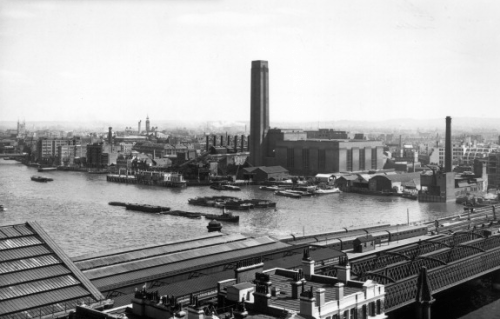
Naturally, this sensitive, thoughtful and exciting treatment of what was once Bankside Power Station got me thinking about its older sibling along the river in Battersea. Both buildings were the work of the same architect, Giles Gilbert Scott, and so naturally share a similar style, most notably the use of decoration on the brick envelope to dress the mass, making it more palatable. Some critics believe that Bankside is the better building, describing it as Scott’s masterpiece.
It is certainly a fine building but I’m not even sure I was aware it existed until it was converted into Tate Modern in 2000. I would have walked past it, sailed past it, looked straight at it numerous times – but the fact of its existence escaped me. This is not uncommon I’ve found and Bankside, for many, only became noticeable when it was turned into an art gallery, finding in its second life a prominence that had eluded it for decades – and perhaps this invisibility is something Scott should be commended for, as the power station’s presence on the river opposite St Paul’s was immediately and understandably controversial.
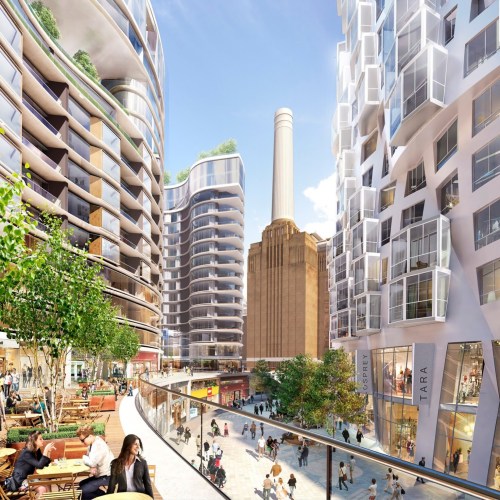
This is all in stark contrast to Battersea, a building that once seen is impossible to forget and which has always had a prominence you rarely find in industrial buildings, let alone their ruins. Only now, as Battersea disappears behind a curtain of contemporary glass and steel is that threatened – so while Bankside eventually found visibility in its afterlife, Battersea faces obscurity, with the thoughtfulness of the Tate’s new extension highlighting the brash ugliness of the new developments around Battersea.
As ever, one ponders alternative presents to that in which we find ourselves. When it became known in the early 1990s that the Tate was looking for a second building, having acquired a collection too large to be contained within the original Pimlico gallery, campaigners at the Battersea Power Station Community Group wrote to the trustees, suggesting they make a bid for Battersea Power Station, then still in the hands of theme park magnate John Broome but already in a terrible state. This, they argued, would make the perfect location for a new art gallery: it was huge, impressive, historic and directly across the river from the Pimlico site. Romantic as this might have been, Tate’s trustees – possibly alerted to the idea of using a power station by the campaigners – instead plumped for Bankside, which had closed in 1981 and facing demolition, for entirely practical reasons.
Inside Bankside before the art arrived
For one, Bankside is much smaller than Battersea, only a third the size. Secondly, Bankside is much easier to get to, surrounded by tube and rail stations, and even a new bridge to the City, while Battersea is strangely isolated despite its prominent location. Thirdly, Bankside wasn’t listed, making it much easier to convert -and later, to stick gargantuan limpet-like extension alongside, when it turned out the original building was too small.
Bankside was saved and the arrival of Tate helped precipitate a huge cultural change along that part of the river. Further west, however, Battersea’s struggles had barely begun.
Up In Smoke: The Failed Dreams Of Battersea Power Station published by Paradise Road.
Travis has previously written excellent books about the Routemaster and London Bridge as well as worked with Saint Etienne/Paul Kelly on their London film (which I’ve still not seen) How We Used To Live.
This time, his scope is a little broader – his history of parks begins with the dawn of urbanisation – but is at its most fascinating when focussing on the 19th century, as cities grew exponentially and parks were needed as never before.
It made me think about my relationship with my nearest park, Brockwell Park, which crops up in the book several times – for instance, as the location of the country’s first One O’Clock Club in 1964, created after an LCC employee was horrified to discover “ten howling babies in their prams abandoned outside Brockwell Park’s playground”, left there by older children who were meant to by looking after their siblings and were instead using the facilities for their own fun.
Brockwell Park is a classic London park in that it covers so much of the history and present of parks. It was formed from a rich man’s land, given to the people for their free use – and within the grounds still stands the austere old Brockwell Hall (now a cafe) and the former kitchen garden. It was landscaped in the Victorian style, with bathing ponds and the kitchen garden made into a formal walled garden, but also has an Art Deco lido as well as more modern facilities such as the BMX track and a superb children’s playground. Here you will also find a bowling green and tennis courts, the remnants of a model village, a lovely miniature railway and the marvellous community greenhouses. During the war, it was used for allotments, barrage balloons and artillery; in the 80s and 90s it became the location for concerts and protests – most memorably, the 1994 Anti-Nazi League concert.
The park still has multiple uses: dog walking, jogging, football, kite flying, BMXing, duck-feeding, picnicking, woods exploring, head-clearing, ice cream eating. It’s where my daughters both learnt to ride their bikes, where they play tennis and meet friends at the playground, in the trees or at the log circle, depending on weather and mood. The park is used for community events – Park Run, film screenings, the Lambeth County Fair – and sometimes also for fundraising, ticketed events and filming, as Lambeth try to balance the annual gap in their budget, a shortfall that means the historic One O’Clock Club is now rarely open.
In Brockwell Park you have the story of all parks, but also a very local and personal one – and it struck me as I read Travis’s book that the best British parks now offer cradle-to-grave facilities but suffer from a similar lack of resources as the rest of the welfare state even though we need them as much as ever before.
The park is at least used and valued, unlike that great modern casualty, the London pub. An excellent history of local pubs – The Pubs Of Herne Hill and Dulwich – has just been published, showing all the pubs in the area that still exist and the many we have lost (including three on Effra Parade alone). A similar history of local parks would be equally treasured.
While I dedicate a chapter of my book about Battersea Power Station, Up In Smoke (now available to purchase from the publisher), to the chaotic photoshoot for Pink Floyd’s Animals album cover, this was not the only time the building has been used in popular culture. Here I’ve listed some of my favourites, but there are dozens more involving Dr Who, Slade, The Jam, Richard III, The Who and The Quatermass Xperiment. It was also used as otherwise anonymous filming locations for numerous TV shows, pop videos and films, including Superman III, Monty Python’s The Meaning of Life, Texas, Manson and The Dark Knight but I’ve chosen the moments that made the building the star.
1 Sabotage (1936)
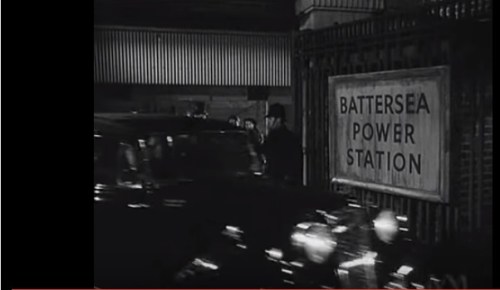
Hitchcock, a Londoner with a sharp eye for locations, was one of the first directors to note the visual potential of the power station, using it in early scenes of his 1936 film Sabotage. Here the power station has only two chimneys, the second half was not started until 1937 and the final chimney not added until 1955.
2. High Treason (1951)
This superior Cold War neo-noir b-movie includes a thrilling climactic scene at Battersea Power Station, where there’s a great shoot-out amid the clanging pipes and hissing steam. Worth seeking out.
3. Up The Junction (1963)
Nell Dunn’s non-fiction collection of writing about Battersea woman is set in the shadow of Battersea Power Station. The poetic back cover blurb for one early edition stated, “Innocence in Battersea lasts as long as the flower remains unsooted by the power station.”
4. Help! (1965)
In The Beatles’ film, the power station is shown blowing a fuse at a critical juncture, causing a black-out and allowing the Fabs to escape their bolthole in Buckingham Palace (“A Well-Known Palace”).
5. Smashing Time (1967)
This goes a step further, with the restaurant at the top of the Post Office Tower revolving so fast it causes the power station to explode. London’s brash newest icon annihilating a venerable predecessor – a metaphor for the 1960s if ever there was.
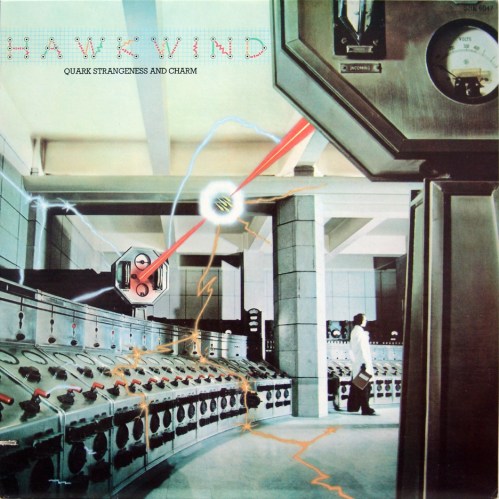
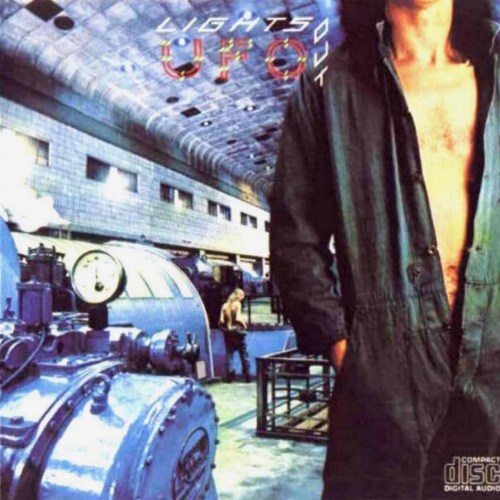
6. Quark Strangeness And Charm & Lights Out (1977)
Despite the Animals debacle, album sleeve artists Hipgnosis returned twice more to the power station in 1977, photographing futuristic interior covers for Hawkwind’s Quark, Strangeness And Charm and UFO’s Lights Out.
7. The Borribles (1983)
A wonderfully feral cover for this brilliant 1983 children’s novel about a group of cockney elven urchins – Borribles – who are at war with the Rumbles, a group of rat-like creatures that are thinly disguised Wombles. The action begins in Battersea, hence the power station backdrop. I loved this book as a child, and the cover was part of that initial attraction.
8. Jet Set Willy (1984)
This level of the classic ZX Spectrum computer game was one of the first products to reference both the power station and Algie the flying pig. I played this game endlessly as a child – though I’m not sure I really got the pop culture or architectural references.
9. “You’re The One For Me, Fatty” (1992)
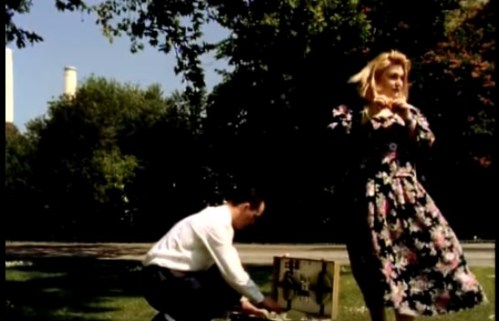
I was obsessed with Morrissey in 1992, and while I didn’t like this song much at the time, I did love the fact the power station featured a couple of times. Now, I think it is one of Morrissey’s finest pop moments, and the shots of the power station still delight me. A couple of years after this, I saw Morrissey play a gig at the power station, although in the dark and funnelled through tunnels, it was impossible to tell that’s where we were. Morrissey was rubbish too.
10. Children of Men (2006)
A striking scene in Children Of Men takes place at the power station, which has been converted into the Ark Of The Arts, containing the world’s most priceless artefacts in this dystopian future London – Alfonso Cuaron, like several other film directors, saw Battersea as the sort of building only a totalitarian could love. Note the pig, flying between the chimneys. The film’s location manager told me, “We wanted strong images that had to represent London but not cheesy London. Using somewhere like Battersea meant there was no question of where you were, it was London but proper London, authentic London.”
I have a post on Londonist about Dream City, a theme park concept cooked up in 1907 by an American developer for a disused waterworks, a site that was later occupied by Battersea Power Station.
The unbuilt Dream City is also the starting point for Alice May Williams’ short film about Battersea Power Station called Dream City: More, Better Sooner produced by the Film And Video Umbrella. The fvu have organised a talk on Friday (April 15) at the Battersea site of the Royal College of Arts by Owen Hatherley called Monetising The Ruin: Batterseas Old And New.
I will be attending the lecture and also selling copies of my bookUp In Smoke: The Failed Dreams Of Battersea Power Station.












 The Great Wen