While there’s no such thing as a romantic rock death, there are few as bleakly pathetic as that of Bon Scott, the AC/DC frontman who died drunk in the passenger seat of a Renault 5 outside a friend’s flat in East Dulwich, just a short distance from where I live.
I wrote about Bon Scott’s life in the current issue of Uncut, which allowed me to revisit some of the fabulous archive footage of Scott and AC/DC you can find on You Tube. The band spend much of the late 1970s based in London, where they were able to build up a large fanbase thanks to regular gigs at the Marquee. Here Scott is interviewed by Australian TV while walking through Covent Garden in a pair of the smallest shorts I’ve ever seen. I’m still not entirely sure where he produces that banana from.
A considerable amount of Scott’s charm as well as his brilliance as a vocalist is captured in this coruscating video for “Let There Be Rock”. Just watch it all the way through, and you can see how Scott worked the camera almost as well as he did the stage.
This is the Bon Scott I knew and loved, but researching the article I discovered more about Scott’s Australian life pre-AC/DC when he performed a pair of bands that were radically different from both each other and from AC/DC. Try this out for size, it’s Scott’s Perth-based teenybop 1960s act, The Valentines, singing, er, “Nick Nack Paddy Whack”. The main singer is Vince Lovegrove. Scott stands at the back next to the drummer, you can see his embarrassed grin at around 90 seconds. (The Valentines also recorded a jingle for Coca-Cola, which lifts you up when you are feeling down apparently.)
After The Valentines broke up, Scott did a complete turnabout and joined Fraternity, a bunch of Aussie hippies who lived in a commune in Adelaide and wanted to be The Band. Here he is, bearded and playing recorder, on a profoundly serious cover of “Seasons Of Change”.
No wonder, then, that he leaped at the chance to join AC/DC, and release some of his natural impish spirit. Here he is doing “I’m A Rocker” in London in 1977, the very image of the 1970s hard rock frontman and one of the best of his generation.
Scott’s “It’s A Long Way To The Top” is one of the great songs about being in a band. Scott wrote it from the heart. He knew. And that is why he could sing it like this, from the Marquee in 76.
And this is where it all ended: 67 Overhill Road, East Dulwich. How about a plaque, Southwark? It’s the least the man deserves.
The Clash have opened a, wait for it, pop-up shop in Soho to promote the release of their new box set. It’s only open for a couple of weeks, and I happened to be in the West End yesterday so paid a quick visit, joining a crowd made up entirely, and unsurprisingly, of middle-aged men.
I wasn’t actually expecting a great deal, but was pleasantly surprised by what I found. While the upstairs is essentially a Clash mini-mart, flogging copies of the band’s albums as well as the Sound System box, the downstairs is more like a mini-museum of Clash memorabilia, featuring the iconic alongside pleasing ephemera.
So while the biggest draw was the buggered bass guitar that Paul Simonon is seen smashing on the cover of London Calling…
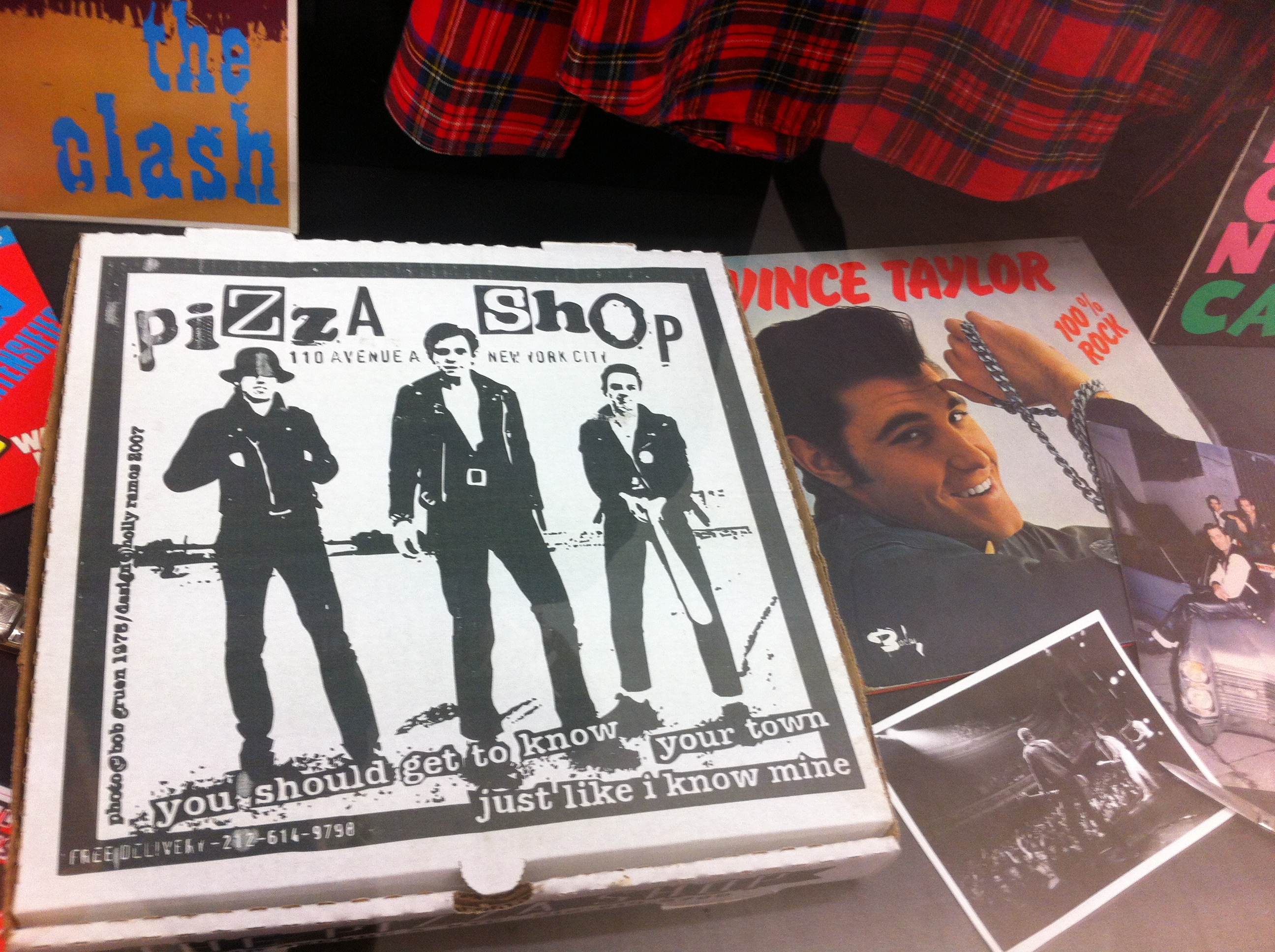
… I rather preferred witty juxtapositions like this, which places a punk-referencing pizza box alongside a Vince Taylor LP.
A long cabinet acts like a timeline of the band’s history, crammed with ephemera relating to the band personally and politically, but also to the musical and literary influences they were absorbing along the way. So the section around the time of, say, Sandinista!, is full of South American political paraphernalia, lyric sheets and cassettes of the music they were discovering, while further along, at the time of Combat Rock, it’s all about cowboys and indians, and the US military. It was a bit like the Bowie V&A show in miniature with a better developed sense of humour, and ably demonstrated that the three-dimensional, technicolor world of rock and roll offers huge potential for entertaining and informative exhibitions when handled with the right blend of respect and irreverence. One day, one hopes, somebody will do a Beatles exhibition that works along similar lines.
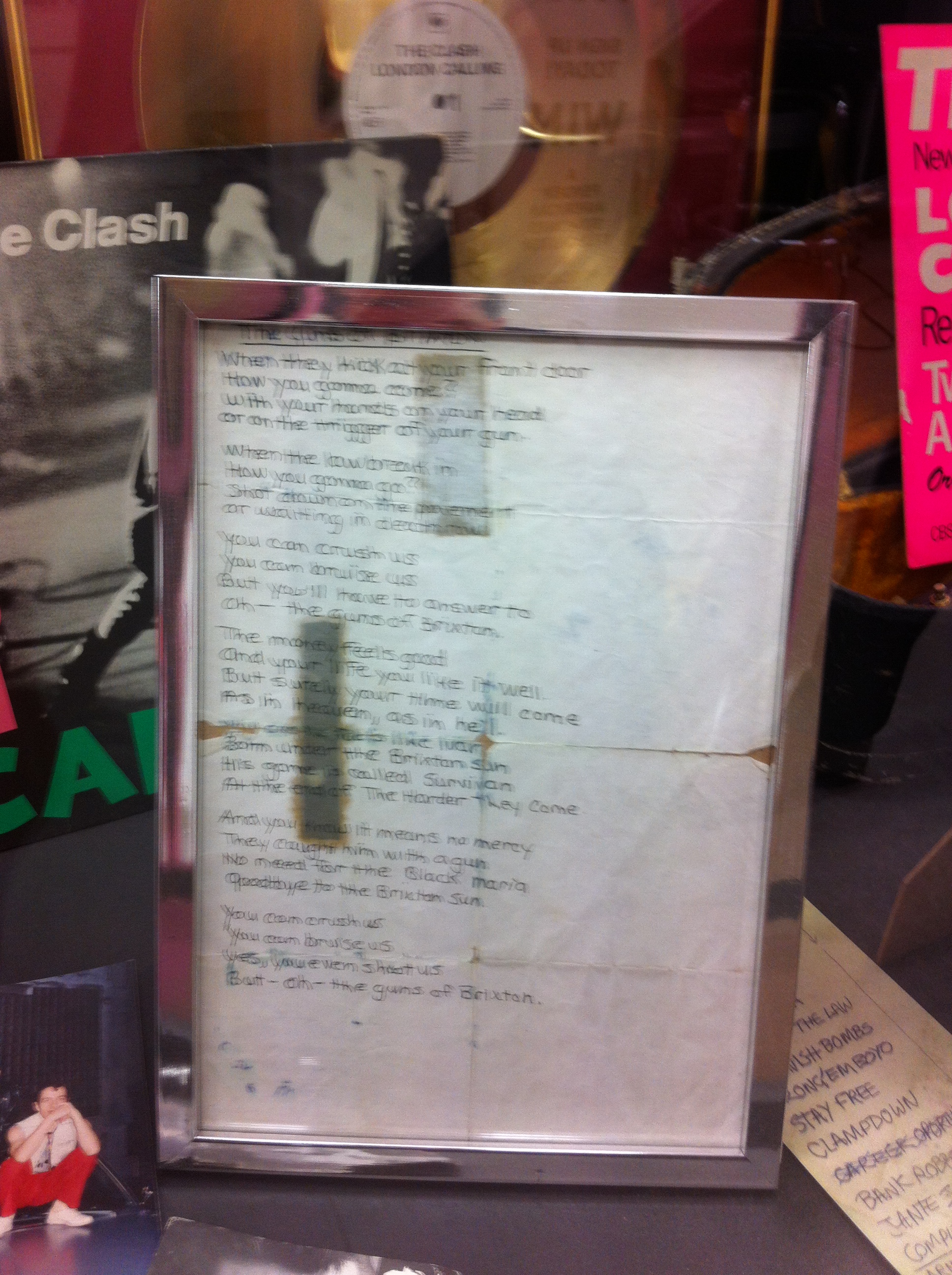
Other items of interest included the Clash’s map of the world, Paul Simonon’s certificate of appreciation from the Guardian Angels, the hand-written lyrics to “Guns Of Brixton” and an old beat box, with rather touching home-made cassettes. Everything is offered entirely without explanation, which is part of the fun. Check it out.
Black Market Clash, 75 Berwick Street, W1. Open until September 22.
‘Sure the underground was elitist: we were an elite. We were the cutting edge of ongoing bohemianism at that point.’ Mick Farren in Days In The Life by Jonathon Green
The last time I spoke to Mick Farren (May, 2013) he was waiting for the doctor to come round. He was, he told me, in pretty poor shape but welcomed our interview as it gave him something else to think about. Farren’s ill health had been known for some years, but it didn’t stop him going on stage with his old band the Deviants every now and then. It was while performing at the Borderline last night (Saturday, July 27) that he collapsed and died.
It seems crude to say that is how Mick Farren would want to go, but it’s certainly no great surprise that this vivacious ball of hair and action, the closest thing London ever came to producing an Abbie Hoffman, should die while giving it all to his great love rock and roll. (The following, and all subsequent quotes, are from my interviews with Farren.)
‘Essentially, from when I was in art school through to Joe Strummer the major communication medium of the counterculture certainly in the second half of the 1960s was rock and roll music. You start with that and everything else was peripheral to it.’
Farren’s Deviants were pre-punk noise terrorists whose self-distributed debut album, Ptooff! was one of the first records to come directly out of the London counterculture. When I spoke to Farren for Uncut about the Rolling Stones free gig at Hyde Park in 1969, I asked him whether the Deviants had wanted to play the show. He said,
‘We asked if we could play. We were vetoed, it was probably Jagger. Everybody said I wouldn’t behave myself and start rabble rousing, which was fair enough.’
I put this to Pete Jenner, who co-organised the gig, who responded.
‘Well, there was that and also the fact they were a rotten band. I really like Mick [Farren] but they were a rotten band who smashed instruments on stage. It wasn’t kick out the jams motherfucker, it was let’s have a joint and a buttercup sandwich.’
The Deviants weren’t really a rotten band, but Farren certainly saw them as London’s answer to the MC5. He was heavily active in the political end of the counterculture, forming the London branch of John Sinclair’s White Panther Party and leading the occasional putsch at the International Times when he felt it was getting too bourgeois and boring. Farren was a key figure in so much of what happened in the counterculture, running the door at UFO, writing for and editing alternative newspapers, organising free festivals while playing shows and really meaning it, man. He was fixer and a doer, a wit and sometimes a sage.
‘IT came out of the Beats – poetry, jazz and art with a bit of lefty politics. I told them this was fucked up, they weren’t talking about the weird changes going on with The Who, or where The Beatles were coming from. I’d say that with all respect to John Coltrane there’s this black geezer in the Bag O’ Nails who has long hair and plays guitar with his teeth, what are we going to do about THAT?’
His politics though, always came with a sense of fun – at one anti-war demo the Deviants played he annoyed the po-faced organisers by being more concerned with getting on stage without splitting his trousers than with espousing the cause. He was once described to me by a fellow traveler as being one of the three coolest men in London in 1967, and that made him one of the three coolest men in the entire world.
”We were always condemned as frivolous and philosophically disorganised, and the counter-accusation was they were just boring totalitarians who wanted to sing the Red Flag when we’d rather listen to Voodoo Child and smoke pot.’
When the alternative press disintegrated, Farren – like many from the underground – went on to write great pieces like this for the NME:
‘The immediate legacy of the underground papers was the NME because we all went there. They had a very profound effect on the visual effect of magazine publishing, but much more important is that the spirit of the thing is now preserved on the internet. It’s all still there, it’s just become more specialised and you have to go looking for it.’
Farren is one of the dominant figures in Jonathon Green’s essential history of the British underground, Days In The Life, and also wrote brilliantly, if unreliably, about his own activities in Give The Anarchist a Cigarette. What resonates from those books is what an unlikely fit Farren seems in the upper-middle-class world of the counterculture, which was largely run by public schoolboys and Oxbridge graduates imbued with that remarkable confidence that comes with a good education. Farren was different, his confidence was self-generated and less polite, while his art school experiences meant he ‘learned to manage chaos’. Indeed, he relished it. Take a look at the clips below if you don’t believe me.
In his own writings and when interviewed, Farren always came across as funny and incredibly sharp but there was more to it at than that. He was fundamentally, intrinsically, decent. A man without edges. As Jonathon Green told me when hearing the news of his death: ‘Of the underground ‘stars’ he seems, and always did, to have been one of the good guys.’
RIP Mick Farren. He will be missed by many.
Farren invading The Frost Show.
Farren recollecting the Grosvenor Square anti-Vietnam riot of 1968.
For the full story of the curse of “Do Anything You Wanna Do”, see my interview with the band in this month’s issue of Uncut magazine.
It’s easy to turn your nose up at any mention of Aleister Crowley, especially if you have little interest in the occult and esoteric world in which he thrived. But to do so means ignoring the man’s often brilliant writing – his Diary of A Drug Fiend is a superior pulp classic, for instance – and also missing out on some of the greatest anecdotes of the 20th century.
For the uninitiated, Crowley (1875–1947) was a British writer who used sex, drugs and magic –often simultaneously – to try to attain altered states of mind and who achieved such a level of notoriety for his activities that he was brandished the ‘wickedest man in the world’. If not wicked, he was certainly a character. As well as signing his letters ‘666’ and conducting numerous affairs with lovers of both sexes, he climbed mountains, wrote pornographic poetry, fraternised with novelists, artists and spies and attempted to write a new American national anthem.
To give a flavour of Crowley’s often bizarre intersections with normal society, in the early days of the Second World War he was tapped up by British intelligence officer Ian Fleming, who asked him to take part in an ‘occult disinformation plot’ against Adolf Hitler’s deputy Rudolf Hess, a fervent believer in astrology and the occult. Crowley was keen, but the plot was ultimately shelved; Fleming, however, later used Crowley as the model for villain Le Chiffre in his first James Bond novel, Casino Royale, in 1953. Another fan of Crowley was Scientology founder L Ron Hubbard. It is claimed Hubbard took part in ‘sexual magick’ (magick was a term favoured by Crowley) with a couple called Jack and Betty Parsons in an attempting to create a magical child, thus fulfilling a prophecy from Crowley’s The Book Of The Law. Crowley was not impressed, writing in one of his typically entertaining letters: ‘Apparently Parsons or Hubbard or somebody is producing a Moonchild. I get fairly frantic when I contemplate the idiocy of these louts.’
Crowley was bisexual and a heavy drug user, eventually becoming addicted to heroin. He also enjoyed peyote, handing it out at parties. On one occasion in New York he gave some to the novelist Theodore Dreiser, who became uncomfortable and asked if there was a doctor in the area. ‘I don’t know about a doctor,’ said Crowley, ‘But there’s a first-class undertaker on the corner of 33rd and 6th.’
This freeness with sex and drugs saw Crowley embraced by the rock and roll generation, particularly after he appeared on the cover of Sgt Pepper. But the story behind another of Crowley’s cover appearances is not so well known. In 1977, Essex rockers Eddie And The Hot Rod wrote a song that was partly inspired by Crowley’s famous motto: ‘Do what thou wilt is the whole of the law’. The band rewrote this as “Do Anything You Wanna Do”, a spirited ode to self-empowerment, and attached the lyrics to a perky pop tune that quickly reached the Top Ten. It was engineered by a young Steve Lillwhite, who recorded it at Island’s studio in Notting Hill.
In recognition of his contribution to the song’s genesis, the band decided to put Crowley on the cover of the single. But they also felt his glowering visage was not really in the spirit of the band, so manager Ed Hollis (brother of Talk Talk’s Mark) attached a slightly comical pair of Mickey Mouse ears to Crowley’s head.
Great cover, big mistake. According to rumour, this image soon came to the attention of Jimmy Page, a Crowley apostle who lived in the Crowley’s old house, had a vast collection of Crowley paraphernalia and was fascinated by the occult. Page had orchestrated the Crowley-influenced occult symbolism that adored Led Zeppelin’s fourth album, which incidentally was also record at Island Studios.
The band were told that Page placed a curse upon Eddie And The Hot Rods for their disrespectful treatment of the Great Beast. From that moment, the band were plagued by problems. They were dropped by their label, their manager became hooked on heroin and they never bothered the higher reaches of the chart again. From behind his Mickey Mouse ears and with the help of satanic rock royalty, Crowley had got his revenge. As bassist Paul Gray told me, ‘Weird shit happened after that. A lot of people said we shouldn’t have fucked about with Crowley.’
This sensational slice of ham and song was made in 1972 to celebrate the purchase of London Bridge by an American theme park. It features a bizarre cast that includes Tom Jones, Rudolf Nureyev, The Carpenters, Kirk Douglas, Charlton Heston and Terry-Thomas and is basically the film the Olympic opening ceremony could have been.
It’s all here, but watch the intro especially, featuring Tom Jones singing his way round various London landmarks before engaging in a small slice of double entendre on a No 13 bus.
Steve Abrams, a key member of the London 1960s counterculture, died last week. Abrams was principally responsible for the above advert, which ran in The Times in July 24 1967 declaring that ‘The law against marijuana is immoral in principle and unworkable in practice’.
The advert was paid for by Paul McCartney and was signed by numerous celebrities, including all four Beatles, Francis Crick, Graham Greene, David Dimbleby, Jonathan Miller, Brian Walden and many others.
Abrams told Jonathon Green in ‘Days In The Life‘ that ‘After the ad came out a friend of mine got on the train and delighted at each stop in watching people opening their copy of The Times and their expressions of disbelief. So wonderful was this that when he got to Victoria he took another train back and did it again just to watch.’
It is less well known that Abrams was also involved in Timothy Leary’s experiments with psilocybin, taking the drug at Harvard for Leary in 1961. Abrams then described his experience as ‘very pleasant’, giving him ‘tremendous insight’ even if it was ‘somewhat alien’, and he was ‘very eager’ to try it again, which he most certainly did.
After the The Times advert, Abrams co-organised a pro-pot rally at Hyde Park in 1967. Everybody got very high, including guest Allen Ginsberg, who wore a virulent psychedelic shirt given to him the day before McCartney and was warned by police for disturbing the peace by playing his harmonium.
Earlier this year I was approached by bookseller Jake Fior, who told me he’d recently discovered a chessboard, never previously known about, that he believed had been handpainted by Victorian Alice In Wonderland illustrator Sir John Tenniel.
Tenniel’s illustrations are absolutely central to how we perceive the character of Alice in the two worlds she visits, inside the rabbit hole and through the looking glass, meaning this was clearly a pretty significant discovery, especially as Through The Looking Glass is plotted to resemble a game of chess.
My piece on the find eventually appeared in yesterday’s The Times. Sadly, this is hidden behind a paywall, but thankfully The Telegraphreprinted pretty much the whole thing word-for-word later the same day. Fans of Alice should keep their eyes peeled on Cecil Court, where an Alice-themed boutique – complete with live white rabbit in the front window – will soon appear.
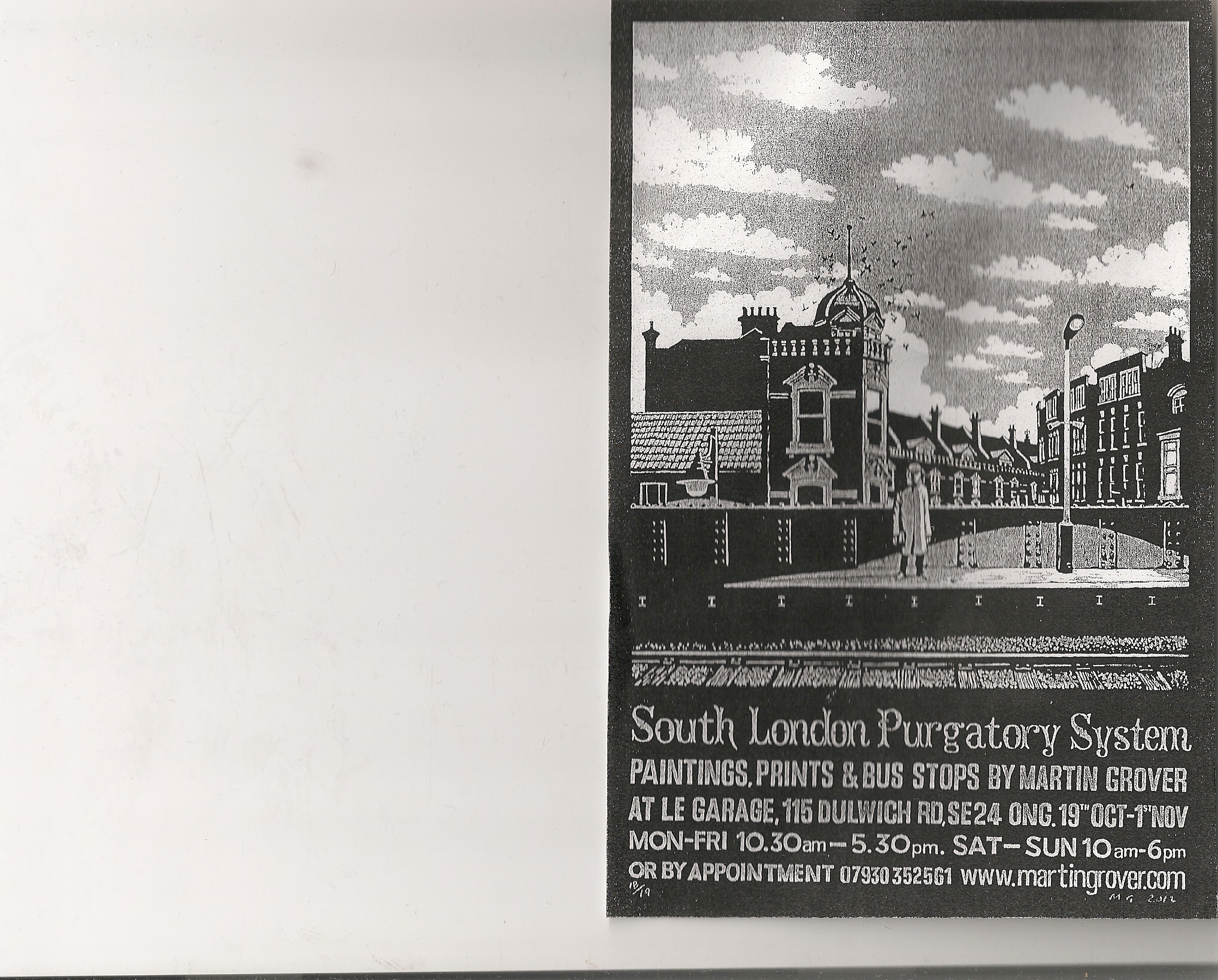
Martin Grover, an artist based in South London, has an exhibition at Le Garage in Herne Hill until Thursday November 1. His paintings are mainly of Brockwell Park, old record covers and bus stops, making him the ideal visual companion to my life.
His bus stop art has now extended from 2D prints into 3D sculptures/installation – in other words, he makes actual bus stops and writes strange slogans on them.
His Brockwell Park paintings are lovely. They are painted from sketches and photographs, although he confesses he makes a lot of it up in the studio, which is why Batman or James Brown might occasionally turn up in one.
Then there are the record sleeves, perfect reproductions of old 45s: often Stax and Motown but also plenty of country and Dylan.
South London Purgatory System at Le Garage until Nov 1, 2012. Mon-Fri, 10.30am-5.30pm; Sat, Sun, 10am-6pm.
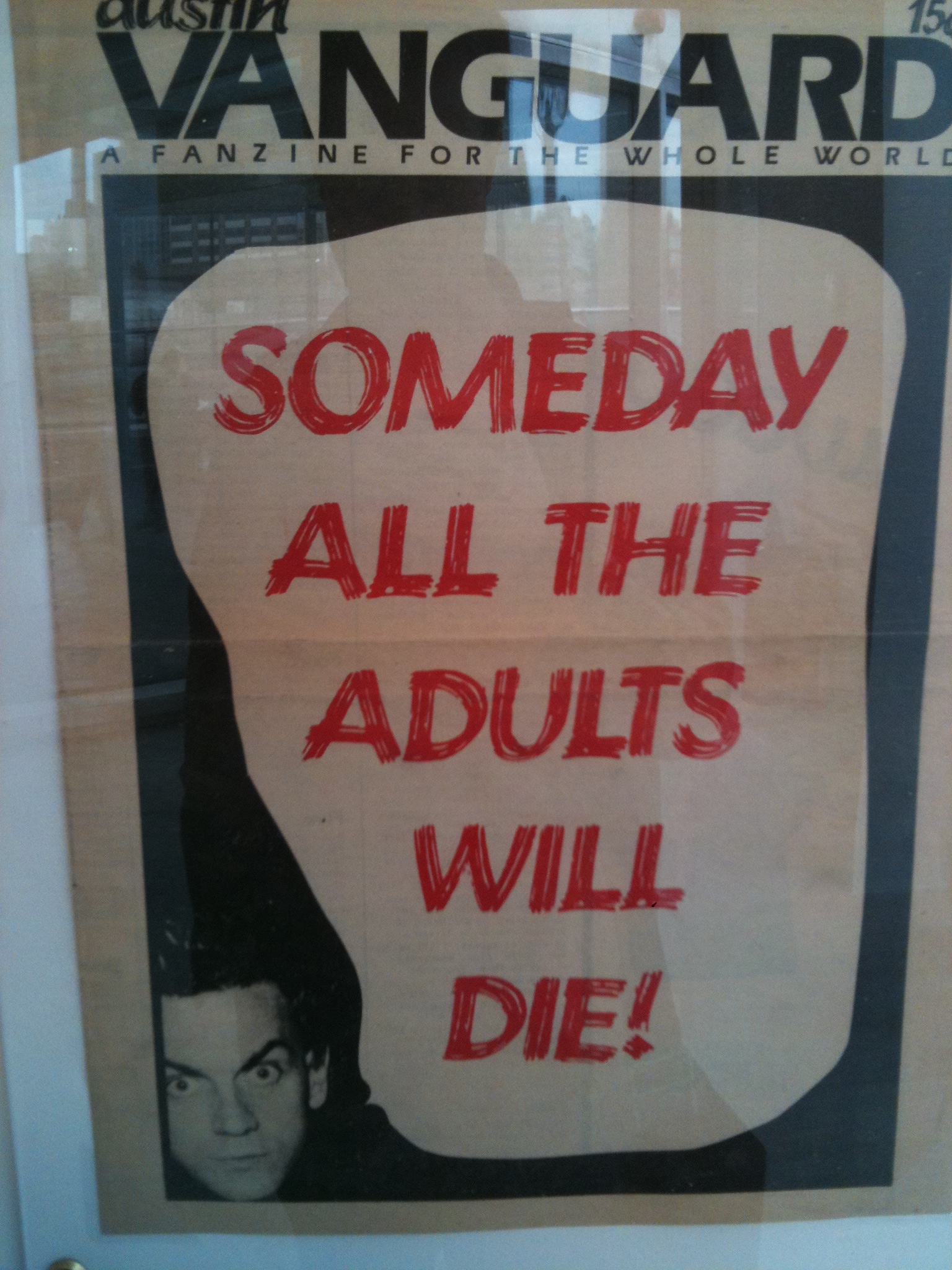
Does any music form have as curatorial approach to its own history as punk? In many ways that is understandable, as the graphic art that came out of the punk movement is as interesting as most of the music, while many of the scene’s key movers always saw themselves as part of a cultural avant-garde that went back to the Symbolists and still wish to emphasise that. One of the most prominent of these voices is Jon Savage, and he has co-curated an exhibition at the Hayward Gallery on punk called Someday All The Adults Will Die.
Despite punk now being nearly 40 years old and having been curated like a dead horse for several decades, it still has a visceral and visual appeal to many – and not necessarily the people you may expect. When I visited the gallery, most of my fellow visitors appeared to be in their 20s: this was clearly not simply an excuse for a nostalgic wander back through adolescence by men suffering a mid-life crisis. The kids dug it.
It’s a wide-ranging exhibition, with sections devoted to seven-inches, cassettes, posters, flyers and fanzines, including Savage’s own London’s Outrage.
My favourite stuff tended to be the less predictable such as pre-punk items involving the Diggers, who co-existed awkwardly with the hippies in San Francisco in 1966 and 1967, as these mimeographs demonstrate.
There was also items reflecting Savage’s fascination with Situationism, including this King Mob poster. Malcolm McLaren was loosely affiliated to King Mob.
I also liked the items relating to Suburban Press, the witty and brilliant pre-punk/Situationist publishing house created by Jamie Reid.
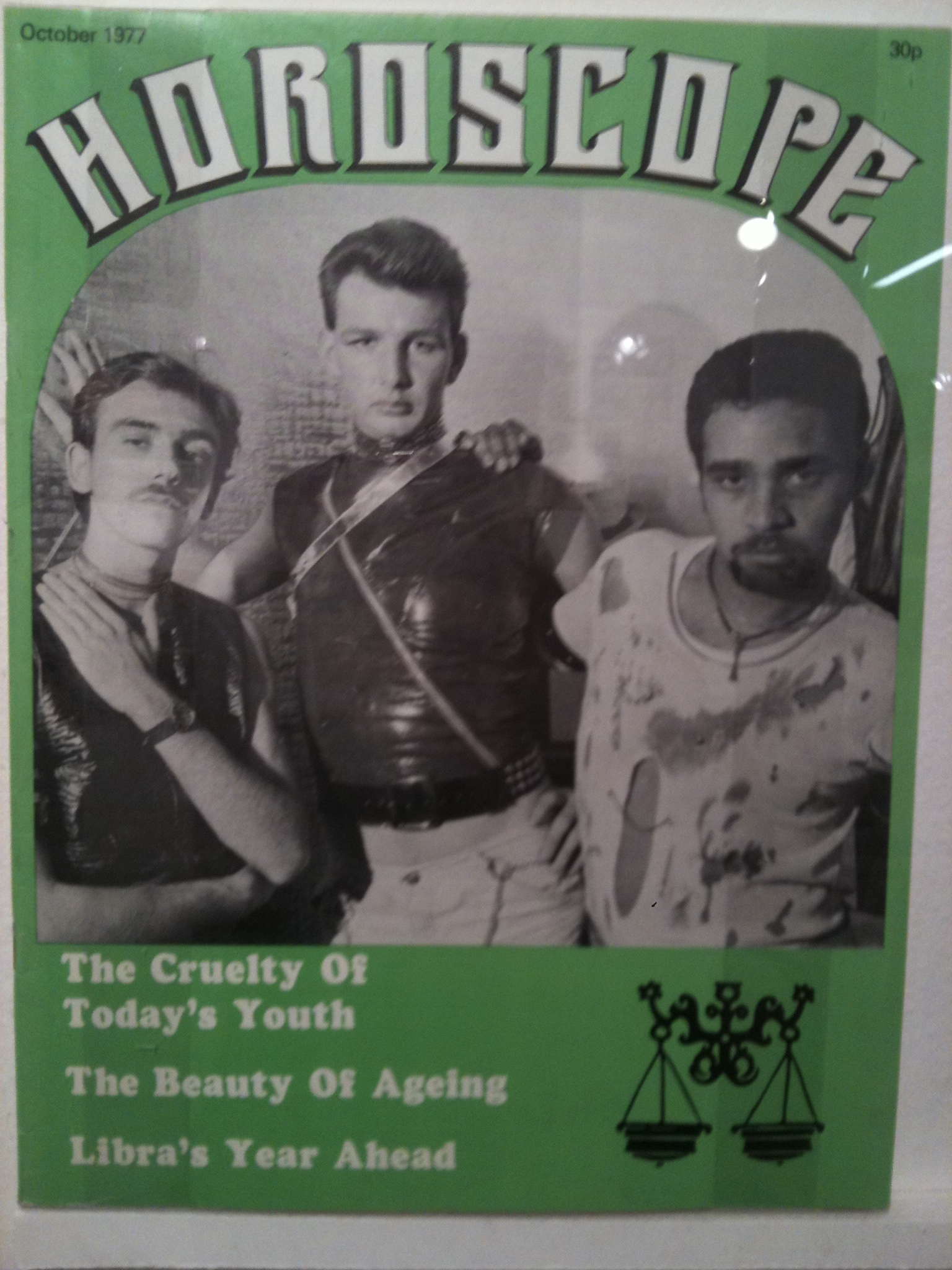
And, finally, I loved the handful of contemporary examples demonstrating how the mainstream tried to cash-in on punk with things like a punk-themed horoscope magazine and punk pulp fiction. Such money-grabbing tactics, it must be noted, have since been refined somewhat…
Someday All The Adults Will Die is at the Hayward until November 4.
Time Out went free this week. It wasn’t really a shock, the notion had been knocking around when I worked there, particularly when thelondonpaper and London Lite were stinking up the streets. The success of the free Evening Standard probably sealed the deal. The economics are unarguable: drop the cover price and circulation rises, allowing you to charge more for advertising. If you can simultaneously reduce costs – which they have been doing through regular redundancies – you may have a viable magazine once again. The danger, though, is that once the decision to go free has been made, there’s no going back…
What has it meant for Time Out? Well, the new magazine has less pages but still has plenty of previews, lists, bitty features and clunky ads, with just a couple of longer reads thrown in for us old-fashioned types. What it doesn’t have – along with book reviews – is listings (at least in any meaningful sense), which was the reason Time Out was invented in 1968. (There’s also no letters page, which is a mistake if they still want to establish that vital personal link with readers, and one I think they will quickly rectify.)
This isn’t really a surprise. Successive TO editors have always struggled with the listings part of their brief: listings are ugly, boring and largely resistant to any sexing up, despite the best attempts of periodic and largely futile ‘redesigns’ (has a redesign of any magazine or newspaper EVER raised circulation?). They are also beyond the control of the editor, who has to leave them to section heads. Even editors who came from within the magazine, and therefore understood the centrality of listings to what Time Out did, didn’t actually appear to like them all that much. They take up valuable space from the exciting things an editor likes to do at the front of the mag and telling a section editor you are cutting their pages is a draaaag.
To make matters worse, listings do not do well when it comes to ‘page views’ or ‘unique users’, the trite and often completely useless method by which the value of anything in print is these days judged. And because people don’t click on listings on the website (for reasons that are so obvious I won’t even bother to explain), the logic goes, they don’t read them in print.
Hmmmmmm.
A number of people have noted that without decent browsable printed listings, Time Out has potentially rendered itself useless, but I don’t want to comment on that. What does interest me is that effect a lack of listings will have London’s smaller venues. The joy of TO‘s listings was that it gave the smallest museum or club as much prominence as the biggest and most well-funded, allowing readers to decide which to visit entirely on the merit of their programming. It’s this that made Time Out absolutely central to the rise of fringe theatre, avant-garde art, clubbing, burlesque and alternative comedy – each scene was created by individuals, but a free listing in Time Out coupled with enthusiastic support from in-the-know section editors took things to another level. Even larger venues have told me they noticed the difference in footfall when they were omitted from listings (by accident or for reasons of space).
Time Out obviously doesn’t have the circulation, and therefore the pull, it once did and there are other specialist resources for those interested in the esoteric fringes of London’s cultural life, but the loss of listings will surely still be felt by venues that aren’t internet savvy or lack a large marketing department. The solution for many will be a prominent place in the preview part of the existing sections. Time Out‘s section heads will never have been in such demand… And PRs can be a dangerously homogenising bunch.














 The Great Wen