Category Archives: London

Gertcha to the British Library, for Viz, Austen and Evolving English


I’ve seen three new exhibitions since being bored senseless by the British Museum’s Book of the Dead, and all of them are vastly superior to that banal blockbuster.

While the British Museum takes a complacent Tesco-like approach of pile it high and intimidate people with sheer weight of history, the Imperial War Museum, Wellcome Collection and British Library all have to work a little harder to get any attention and the results are far more satisfying.

Take Evolving English at the British Library, a superb exhibition about the history of the English language that offers both intelligence, insight and, most tellingly, the cheerful sense of humour that is lacking from Great Russell Street.

There are showstopping exhibits here, such as manuscripts of Jane Austen’s ‘Persuasion’ and Joyce’s ‘Finnegans Wake’ and a copy of ‘Beowulf’, while the curators were ecstatic about a cabinet that featured side-by-side four historic bibles – the Wycliffe, Tyndale, Book of Common Prayer and King James.

But there are also wilder treats hidden in the margins.

One section on the differences between spoken and written English was illustrated by letters from schoolchildren to their teacher, my beloved BS Johnson, written in a glorious mixture of slang, formality and stream of consciousness that later found their way verbatim into his novel ‘Albert Angelo’. (‘Mr Johnson has a poor outlook towards us, calling us peasants and other insulting names of which we would like to contradict… Mr Johnson on the whole although he isn’t all there is a rotton teacher but not proffesionally for he teaches well… in school Mr Johnson is an authentic nit.’)

The section on profanity is illustrated with a copy of ‘Lady Chatterley’s Lover’ and a copy of Viz, while you can explore London English by reading extracts from Charles Dickens or you can just listen to ‘Gertcha!’.

London English, we are reminded, adopts words from many different cultures and I was intrigued to learn about the history of the Black London idiom ‘aksed’ for ‘asked’. This apparently originated in south-west England and found its way to the Southern US states and the Caribbean through emigration, before returning to London via the West Indian diaspora. Take it away, Smiley Culture.

Being brave in SE8: Extraordinary Heroes at the Imperial War Museum

Have you ever heard of Geoffrey Keyes and Operation Flipper?

I hadn’t until this week, when I learnt that Keyes was a Second World War commando who led a team 400km behind enemy lines in North Africa in a bid to assassinate Erwin Rommel. The group evaded guards around the perimeter fence and got inside the house used as the German HQ, but as they entered a ground-floor room Keyes was shot and killed. Rommel wasn’t even in the house at the time.

Keyes was awarded a posthumous Victoria Cross and his story is ripe for a film, but this is the first I’d heard of it.

The new Extraordinary Heroes gallery at the Imperial War Museum is full of such remarkable tales, 243 in all, each tied to either a Victoria or George Cross. 164 of these medals belong to Michael Ashcroft, the Tory party donor, who has also forked out £5m for a new gallery to house them – the first permanent gallery at the museum for a decade. Well, I guess it beats paying tax.

The gallery is a great example of how with a bit of thought a museum can make a lot out of a little. The exhibits – the medals – are not much to look at, and the VC itself is almost parodically tasteful, a modest thing of dull brass (it’s made of gun metal) with a sober ribbon the colour of dried blood. There are numerous medals on display here, and the VC is always the least conspicuous of the lot.

But the curators have done wonders with this unpromising material, emphasising the extraordinary stories behind each medal with frugal but compelling text and embellishing some of the tales with props such as the diving suit worn by James Magennis when placing mines on a target in 1945 or a portrait of recent VC awardee Johnson Beharry taken by Don McCullin.

There’s wit here as well such as a stuffed white rabbit to represent the codename of spy Forest Yeo-Thomas or the surprisingly effective touch-screen version of some of the stories told in Victor comic style. The IWM uses these informal touches confidently, never lapsing into poor taste and aware that excessive sobriety can be just as offputting.

While the bravery of these men and women is moving, the circumstances are often maddening. Many medals were awarded during the carnage of Gallipoli, and there was something about the story of Alfred Wilkinson, a Private who was awarded a VC for delivering a message during the First World War after four previous messengers had died, that somehow summed up all that is most horrific and pointless about that conflict.

Some medals were awarded in peacetime. An 11-year-old girl was given a George Cross in Canada in 1916 for fighting off a cougarm, while Harry Wilson was awarded a GC in 1924 for saving the lives of his colleagues in a flooded colliery.

And, bringing it all back home, a George Cross was awarded for bravery in South London after unarmed PC Tony Gledhill chased a car filled with armed robbers from Creekside Street, Deptford into Rotherhithe. Gledhill’s car was shot at around 15 times by the robbers before he confronted them on foot and eventually subdued the men, securing the conviction of four criminals, including John McVicar.

There’s always a London connection if you look hard enough.

Room for improvement

Writer, Londonphile and intimidatingly prolific blogger Christopher Fowler recently noted my post on the London terraced house on his own excellent blog, adding intriguingly that:

‘Looking into the subject a bit more, I found that the terraced rooms and gardens are all percentages of those [9th century] measurements, making everything look neat and tidy even when it’s not.’

His recommended related reading on the subject is Harry Mount‘s ‘A Lust for Window Sills: A Lover’s Guide to British Buildings from Portcullis to Pebble Dash’.

South London and the birth of the educated footballer

This is an edited version of a piece I wrote for 4-4-2 magazine in September 2009

Whitgift School in Croydon is not the sort of place you’d expect to find the future of English football. This breeding ground for bright young talent is as far from the stereotypical back streets of football’s urban north as you can get. Situated in 45 acres of parkland and boasting colonies of albino wallabies, flamingos and red squirrels, Whitgift School is one of the oldest and wealthiest private boys schools in the country. For centuries, it has produced outstanding academics and sportsmen. The latter have usually been rugby players such as England fly-half Danny Cipriani or cricketers (the county-standard pitch is used by Surrey CC), as befits the tradition of the English independent school, which  leaves football to the hoi polloi of the comprehensive sector.

So how have four professional footballers emerged from Whitgift’s ranks in the past few years? Why does the school currently count 13 children from different footballing academies – including Chelsea and Tottenham – among its 1,200 pupils? And how did the school attract three former footballers to work on its coaching staff?

To answer those questions, I entered the headmaster’s study to meet Dr Christopher Barnett, the man who brought soccer to Whitgift. As we talk, exotic peacocks can be seen through the study window, heads bobbing up and down as they wander around on impeccable lawns. It is an extraordinary environment. In these conditions, Dr Barnett’s belief he can ‘change the mould and develop a new breed of middle-class footballer’ seems entirely plausible.

The Australian connection

Dr Barnett’s conversion from rugby to football came in Australia. ‘In 1996 I went out to a school in Parramatta,’ he says. ‘I was walking round the grounds and it was rugby as far as you could see – rugby match after rugby match after rugby match. But then I turned the corner and there was soccer being played. So I thought, if they can do it…’

Convinced that if something is worth doing, it’s worth doing properly, Dr Barnett looked for a coach and found Colin Pates, the Chelsea and Arsenal centre-back, who had retired with a knee injury. A posh school in the suburbs is not where you’d expect to find a hard-bitten former pro, and Pates admits: ‘Whitgift is quite alien to some of us, because we had state school educations. It was intimidating, and not just for the boys.’ But he jumped at the opportunity.

‘The headmaster asked me to take a sixth-form team on Wednesday afternoons,’ he says. ‘I asked if there were any goalposts, pitches, teams or even footballs, and we didn’t have anything. So we had to start from scratch, pretty much teach them the rules. They were rugby boys playing football, so these were quite aggressive games. But after three years we introduced fixtures and we’ve never looked back.’

Introducing football to a rugby school for the first time in 350 years was no easy task and Pates admits that ‘there was always a concept that we’d bring in swearing and fighting, but we’ve had none of that. History told me it was going to be very difficult to change people’s attitudes, but if you know you’ve got the support from the top man, the head, you can slowly change the perception of football.’ And the Headmaster – motivated by ‘old-fashioned esprit de corps’ as well as the desire to have the newly fashionable sport of football on the syllabus – gave it his full support.

As football cascaded through the school, the coaching team expanded to include John Humphrey, a right-back for Charlton and Crystal Palace, and Steve Kember, the former Chelsea and Palace midfielder. ‘It showed that we were engaging with how we would be a football school, but a different kind of football school,’ says Dr Barnett. ‘What I wanted to do was provide discipline and a serious education. We wanted to tell footballers who were coming to Whitgift: “Yes, but…” and the “but” is that you are going to work.’

The coming of Moses

Whitgift began to offer scholarships and bursaries to help parents of talented young players pay the £13,266 annual fee. It also established an informal relationship with Crystal Palace, with some of the club’s outstanding talent getting recommended for places at the school. David Muir, Education and Welfare Officer at Crystal Palace, explains ‘Whitgift is flexible and open-minded,’ he says. ‘Private schools are generally better than state schools at supporting the academies, offering excellent sports training and balancing that with academic work.’

By 2007, two Whitgift pupils (Victor Moses and Lee Hills) were in the Palace first team. But education was still paramount. ‘A lot of these boys are outstanding academically even if some of them can come here with what appears to be a relatively low IQ,’ says Dr Barnett. ‘But if you work with them and give them belief and encouragement, they can soar.’

Moses, now playing in the Premier League with Wigan, arrived at the school as an 11-year-old orphaned asylum seeker from Nigeria predicted to get no GCSEs at A-C and ended it as an England youth international with GCSE results above the national average. Dr Barnett is adamant that a good education and football skills are mutually beneficial. ‘We did a correlation study on pupils’ academic expectation on entry and then factored in how much they participate outside the classroom,’ he says. ‘And those boys that were more heavily involved in sport did far better academically – quite the reverse of what you might expect. Received wisdom is that if you do too much sport, you’ll damage their education, but that wasn’t the case.’

As for what education can do for your football, he cites the words of an FA Cup-winning manager, who watched Whitgift win the Schools Cup in 2005, when they beat Healing School 5-0 (Moses scored all five). ‘Lawrie McMenemy said to me that if he’s got a choice between a footballer without a brain and a footballer with a brain, he’ll always go for the one with a brain, because he knows he’ll follow instructions and understand tactics and you’ll get far more from him.’

Muir says that  ‘previously, you were either seen as a sportsman or an academic, but our best players have always had the potential to be high-achievers academically as well.’ This backs up Dr Barnett’s claim that ‘the managers of the academies want their boys at Whitgift. Because as well as getting good football training and terrific facilities, they’re going to get discipline and they’re going to get structure and they’re going to get their qualifications.’

It is this that will provide the new type of footballer desired by Dr Barnett. ‘You know that if they were in the state sector they would get lost. Football would be all they had and they’d probably end up with nothing, no career and no qualifications; here, they can end up with 10 GCSEs and still make it as a footballer. And that is one of the key differences in how they will conduct themselves on the pitch  and what image they provide for football. If you get enough kids doing this, you could change things.’

The movement is gathering place. Other private schools – including local rival Trinity and Ardingly College in Sussex – have started to follow Whitgift’s lead.

Finding the kids

So how does Whitgift recruit its talent? Muir says that ‘Palace put forward one or two players every year. We have to find kids who are both outstanding footballers and with a potential to do well academically because they have to pass the entrance exam. The parents pay the fees, though they can be helped by scholarships or wealth-related bursary schemes.’

Other relationships are less formal, and sometimes clubs foot the fees. And sometimes, the players are already at Whitgift before the clubs spot them such as Stefan Amokwandoh, a 13-year-old at Charlton.

A close relationship between school and academy is vital. The school’s fixtures are played midweek to avoid clashing with academy games, while academies benefit from the high standard of coaching the players get from the school.

Whitgift insists that all pupils play in school fixtures, compete in all sports and do their homework. ‘I have to work harder than the other boys at Chelsea,’ says Joel Witele, a 14-year-old who also excels at rugby. ‘When I get homework I have to concentrate and make sure I do it.’

For those football academies accused in a recent book (‘Every Boy’s Dream’ by Chris Green) of offering too many boys nothing but disappointment and educational underachievement, you can see why Whitgift is so attractive.

‘Look Sir, no litter!’

The notion of privately educated footballers no longer seems strange to Pates and Humphrey, even if it must to some of the school teams they come up against (‘We played a local state school,’ said Pates, ‘and one kid said: “Look Sir, no litter!’). Humphrey says: ‘We have quite a few guys at Charlton [where he is an academy coach] who go to private schools. If you have two boys of the same ability, you pick the brighter one because they’ll learn quicker, so we’re moving away from state schools monopolising football. There’s a lot of money out there, and parents want to give their kids the best education they can.’

Pates agrees: ‘A lot of footballers are sending their kids to independent schools. Working-class parents are earning money and putting their kids through private school. We’ve had [Brentford manager] Andy Scott’s boy here, Ian Wright’s boy, Steve Coppell’s – there are lots of them and its spreading into football.’

Muir concurs: ‘It’s great to see the kids get an opportunity I never had. It’s not what people might perceive of from an independent school, it’s not a bunch of boys with plums in their mouths, it’s just normal kids whose parents want them to do really well and provide them the best opportunity to do so.’

Another motivation for Pates and Humphrey is the experiences they had as players. ‘A lot of players from our generation had nothing to fall back on when they came out our game,’ says Pates. ‘There was also nothing in place when we were young – if you didn’t make it, that was that. So we ensure that our players have the opportunity to be everything they want to be, even when they leave. Rhys Coleman was released by Charlton, went to Glenn Hoddle’s academy in Spain and didn’t quite make it, so we got him a trial with Palace. It’s like aftercare. We try and help.’ Another former pupil managed to put himself through university with the money he earned from semi-professional football.

It’s all part of a package that Pates and Dr Barnett believe to be unprecedented. ‘You have to be an exceptional footballer to make it these days,’ says Pates. ‘So we want to give them the best opportunity to be a footballer, but also give them a magnificent education so if they don’t sign scholarship forms they have something to fall back on. It works for us, it works for the academies and it works for the families.’

The question now is will it work for football.

My London Library: No 5 – Night Haunts

  • Title Night Haunts by Sukhdev Sandhu (Verso, 2006)
  • Cost Free
  • Bought from Sent by publisher
  • Genre Contemporary non-fiction; flaneur

At a time when London writing has been dominated by pop historians and psychogeographers, it’s worth noting that the best two London books of recent years are very different beasts.  One of these is Night Haunts, a thoughtful study of the modern London night, commissioned by Artangel, written by Sukhdev Sandhu, and modelled on a similar book by the great London writer, HV Morton. (Sandhu gives a talk about Night Haunts this Friday at Birkbeck.)

Night Haunts first emerged as a beautiful website before appearing in short but sweet printed form. The conceit was simple. As the sub-title explained, it was ‘a journey through the London night’ in which Sandhu explored and observed London’s nocturnal operations, spending evenings with cleaners, pilots, flushers, bargers, fox-hunters, cabbies, exorcists and graffiti artists.

What emerged was an elegant and perceptive portrait of what happens in London while we are asleep, with Sandhu’s own hands-on experience giving it a resonance far greater than the whimsical dilettantism encouraged by the self-indulgent psychogeography movement. 

  • Best bit There’s a marvellous scene early on which sets the tone. Sandhu is on a night-time police helicopter flight over London and writes evocatively of the sleeping city from the air, a passage which concludes with the wonderfully implausible line ‘One pilot describes Croydon as “an oasis of high-rise buildings, sitting there like downtown Dallas”.’
  • Verdict The best book of its kind for decades.

Book of the dead dull: against blockbuster exhibitions

A new British Museum exhibition opens this week and it’s already a guaranteed success. But that doesn’t mean it’s any good.

I went to the press view of the Egyptian Book Of The Dead and afterwards felt much the same as I do after every British Museum exhibition: overwhelmed and underimpressed. But I knew that all the big reviewers would give it a knee-jerk five stars – and sure, enough, before I’d even got home, the first suitably awestruck review was in. Meh.

So why was I so bored, and am I on my own with this? Well, the exhibits are undoubtedly important and fascinating – papyrus and artefacts taken from Egyptian tombs, many dating back more than 3,000 years, which together tell the story of the Egyptian belief in the afterlife. But, gawd, ain’t there a lot of it? And why does the exhibition space look so bloody boring?

The British Museum has an incredible talent at taking something potentially fascinating and kicking all the life out of it through stuffy, unimaginative presentation and a conviction that more is better – and getting away with it every time.

At Book Of The Dead we get acres – and I really mean acres – of stuffy captions and endless cases containing aged papyrus covered in hieroglyphs, with only the odd gaudy mummy case by way of variation. After seeing the first room, I felt I’d seen it all and would have had a more enjoyable experience sitting down with a cup of a tea and reading a good book on the subject. But I still had another dozen rooms to trudge round. Exhibitions are meant to bring a topic to life, but this was deadening. And I was lucky enough to be there when it was relatively empty – for the average punter, it must be chaos.

I’m not sure I’m entirely out on my own here – on my way into the exhibition I bumped into a friend coming out, and he said much the same thing, as did Time Out Art on Twitter. But the British Museum’s methods clearly convince most of the reviewers and they certainly draw the crowds; these are, after all, two of the constituents museums most need to impress.

As a lover of museums, though, I cannot help feel that the BM is doing the art of exhibitions a disservice. There is none of the thoughtful wit of the Imperial War Museum, or the layered smarts of the Wellcome Collection, or the sheer intellectual depth of the British Library, all three of whom have new exhibitions opening next week that will not get anything like the attention of the BM.

The British Museum make museum-going into something worthy rather than fun. My fear is that thousands of people will push through heaving crowds to see this exhibition drawn by fawning publicity and out of a sense of duty, before emerging battered and bored, vowing to never visit another museum until the next blockbuster rolls into town. That really would be a shame.

London’s crappest ghost: a Halloween post

London has many ghost stories and some are actually rather scary, like the Black Dog of Newgate. This spirit is said to haunt Amen Court near St Paul’s, where a wall from Newgate Prison remains. It manifests itself as a shapeless, black form slithering along the wall before it disappears into the shadows.

Considerably less spooky is the ghost said to haunt Pond Square in Highgate.

The story goes like this.

In January 1626, the writer and philosopher Sir Francis Bacon wanted to test his theory that ice could be used to preserve food, so he bought a chicken on Highgate Hill, killed and plucked it, and stuffed the carcass with snow. The frozen chicken had been invented, but the effort caused Bacon to contract pneumonia from which he died.

A sad tale, but one which doesn’t end there. For, ever since, on icy cold nights in the depths of winter, a shape resembling a partially plucked chicken has been seen flapping around Pond Square and squawking before vanishing spookily into the ether.

Yes, that’s right, London is haunted by the spirit of a featherless fowl.

Has there ever been a crapper ghost than this?

Urban legends: Phyllis Pearsall and the A-Z

The story of Phyllis Pearsall and the A-Z is one of London’s most enduring and endearing myths. To take but one example, here’s the Design Museum‘s version of how, in 1935, Pearsall couldn’t find her way to a party in Belgravia so decided to make a completely new map of London, which she did by getting up at 5am each morning and walking every one of London’s 23,000 streets – a distance of 3,000 miles. The result was the A-Z, the first street atlas of London.


You’ll find this story everywhere, often repeated word for word, which is usually a sign something is up. Here it is on the BBC. Here it is in Time Out. Here it is on Wikipedia.  And here’s some sap repeating it in an excerpt from a book on Amazon.

Peter Barber reckons it’s nonsense. And as the head of maps at the British Library, he should know.

‘The Phyllis Pearsall story is complete rubbish,’ Barber told me. ‘There is no evidence she did it and if she did do it, she didn’t need to.’

Barber maintains first of all that the first street-indexed map of London was made in 1623 by John Norden, but his reservations are not just academic. Pearsall’s father, Alexander Gross, had been a map-maker and produced map books of London that were almost identical to the A-Z in everything but name. They looked the same and used the same cartographical tricks. It’s Barber’s belief that Pearsall simply updated these maps to include the newly built areas of outer London and called the result the ‘A-Z’.

‘She was a great myth-maker,’ says Barber. ‘But English Heritage investigated the story and decided not to award her a blue plaque because it was not felt she’d done anything to deserve one [Pearsall does have a plaque, but it was awarded by Southwark]. It was marketing and it’s a very pervasive myth, she was a lovable character and people want to believe it.’

So did she really walk those streets or not? Here, Barber is hard to pin down. In writing he is equivocal, as the final comment here shows, but in conversation he makes his position pretty clear.

‘Pearsall was building on a body of information that had been around for years,’ he says. ‘What she may have done is be more thorough in mapping the new areas that cropped up between the wars, and there were two ways of doing this. You could either tramp the streets of outer suburbia for hours on end, or you could visit the local council office and ask for their plans. Which do you think she did?’

A common little London house

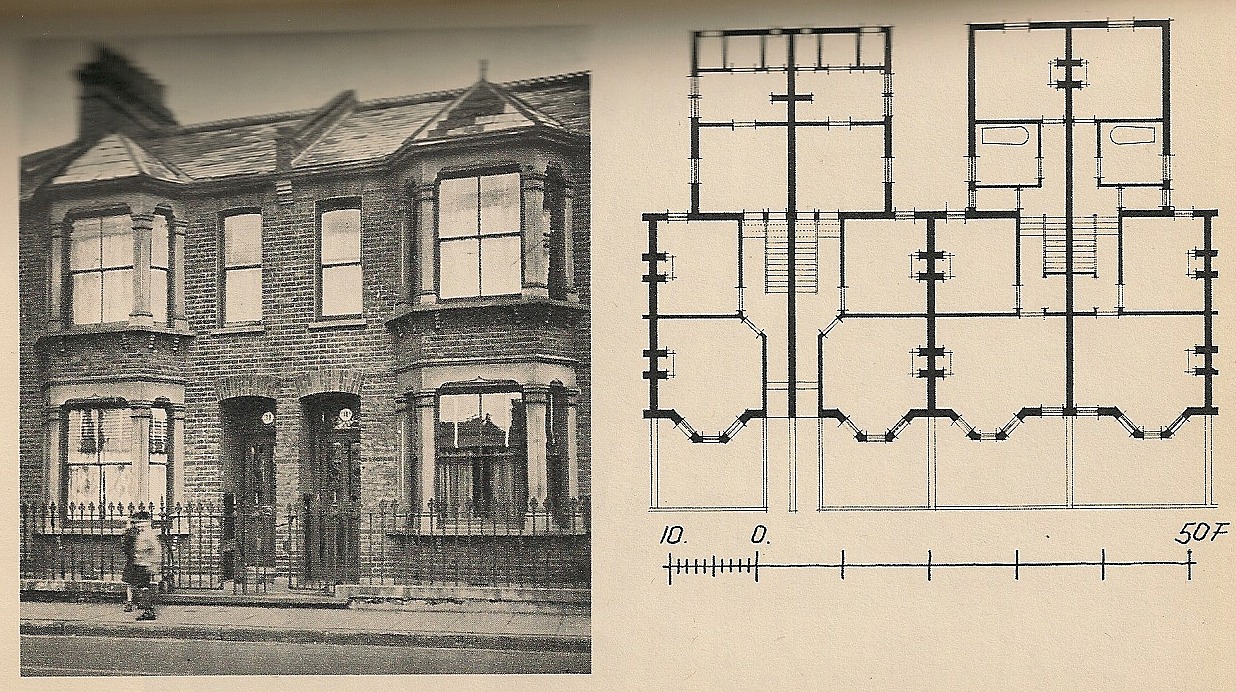
There is nothing special about this house, other than that I live in it. It is one of hundreds of thousands of almost identical houses built in the second half of the nineteenth century for a London population that was expanding at a ferocious rate.

This was the Great Wen that William Cobbett warned about. In ‘London: The Biography’, Ackroyd quotes ‘an observer perched on top of Primrose Hill in 1862, who looked at the growing city and noted that, “the metropolis has thrown out its arms and embraced us, not yet with a stifling clutch, but with ominous closeness.”‘

In ‘London: The Unique City’, Steen Eiler Rasmussen’s classic book about London architecture, he writes about houses just like this: ‘From railroads intersecting the suburbs of London we see interminable rows of these swarthy little houses with all their protruding little kitchen-wings. It is the most compact type imaginable for a street house.’ He includes a picture and plan of these houses. Look, it’s almost indentical to mine.

There is a reason for this ‘interminable’ consistency in London housing, and like most things in this country, it is to do with class. Rasmussen explains that in London, because the class system ensured people of the same social strata would invariably live alongside each other, segregated from those richer or poorer than themselves , it was ‘possible to standardise domestic houses: as people living in the same street have the same requirements all the houses can be absolutely uniform.’

This isn’t quite true of my street – at one end there are grand five storey double-fronted detached houses, which would have been for the very rich with domestic servents, and at the other end there are two-storey railway terraces, with every possible permutation in between. This would have meant unavoidable mixing of the classes and was the result of the street having been built over a number of years, starting with the posh end near the park and ending with the common end near the station. But it is certainly true that London houses of the era are near identical.

Rasmussen also knew the exact width of of my new house – 16 foot 6 inches. He writes, ‘the common little house of which there have been built thousands and thousands is only sixteen feet six inches broad. It has probably been the ordinary size of a site since the Middle Ages… but it is difficult to get information as to how typical houses were built in former days.’ After reading this, I measured the front of my house and he was right. Now everywhere I look, from Brixton to Holloway, I see 16 foot 6 inch house fronts. Try it yourself.

So why is this? For an answer, I turned to English Heritage’s photographic collection ‘Lost London’, in which Philip Davies explains exactly why London’s houses of a certain era are all exactly the same size. He writes of ‘a secret ingredient which conferred an innate harmony on the city, and which influenced everything from the layout of an entire neighbourhood to the size of a window pane – the Imperial system of measures.’

Davies continues. ‘Neighbourhoods were laid out by surveyors who used acres, furlongs, rods and chains – measurements which had been in common usage for marking out arable land since the ninth century. An acre was the length of a furlong (660ft) and its width was one chain (66ft). For shorter lengths a perch, a pole or a rod were used. There were four rods to one chain and a London workman’s house had a frontage of one rod – 16 ft 6 in – so entire districts were created based on endogenous proportional relationships.’

As this website explains, when a landowner wished to build a series of houses for his agricultural labourers on an acre of land, the surveyor could go out with his rod and immediately estimate how many houses there was room for.

So the size of the house in which I live in the twenty-first century was decided by a scale of measurement that dates back to the Dark Ages. For those who find London’s overall sense of scale overwhelming, this internal and very visible consistency might at least provide some comfort.

Secret London: the riddle of the Farringdon spoons

I first saw these spoons several years ago stuck on a wall in a miserable stairwell under Farringdon Road near Mount Pleasant. Nobody seemed to know anything about them or where they came from – the only reference I could find is a passing mention in this interview with the Greenwich Phantom on Londonist.  

I walked past them again the other day and tweeted about them. An answer came back within half-an-hour (from @mrrylln), who said: ‘They have been up there for about 10 years. The stairs were used by heroin addicts a lot… hence the spoon H-shrine.’

Not the most romantic of explanations, but an explanation all the same. Chalk up another one to Twitter.