Category Archives: London

North and south: the enduring hatred of Chelsea and Leeds


It was the draw every older Chelsea fan wanted. The plastic flash of the Champions League may excite shallow newcomers, but a League Cup quarter–final at Leeds is what gets the blood pumping. This is proper football, one of the juiciest rivalries in British football, a celebration of regional differences with mutual bad memories stretching back to the mid-1960s.

That’s about how long Leeds have been singing this little ditty about shooting Chelsea scum.

In the late 1970s, Chelsea fans would reciprocate by asking their Yorkshire foes, ‘Did the Ripper get your mum?’ And they’ll always have this.

The fixture will probably have the sort of ‘toxic’ atmosphere that hysterical commentators love to condemn, but it’s also the very reason people pay to watch football in numbers that dwarf that of any other sport. It’s a game that feels more important than it really is, one steeped in tribalism, history and cultural dislike, offering momentary respite from the sterility that defines the modern football-watching experience. For many fans, this is personal, this is pride.

And Chelsea-Leeds has always been huge. The TV audience for the 1970 FA Cup final replay remains the second largest for any sporting event (after the 1966 World Cup final) and it has the sixth largest TV audience of all time – more than any Champions League or European Cup final involving the self-important Establishment clubs of English football. That’s because Chelsea and Leeds had captured a hold on the national imagination since the mid-60s, when two young, stylish, streetwise sides stormed out of the Second Division within a season of each other.

So much in common but so little alike, Chelsea and Leeds set about each other with a passion in a series of increasingly ill-tempered league and cup encounters. By the time a ferocious 1967 FA Cup semi-final was settled by an awful refereeing decision – a last-minute Leeds equaliser from a rocket-like Lorimer free kick was disallowed because the Chelsea wall had moved too early – the foundations were firmly in place. Chelsea and Leeds, they didn’t get on.

‘Hate. We hated them and they hated us,’ is how Chelsea’s Ian Hutchinson once described it, and footballers are rarely so forthcoming about such things. It was a hatred mired in misconception as much as anything else, an embodiment of all of the north and south’s prejudices about each other. This was Yorkshire v London epitomised.

Chelsea considered themselves the club a la mode, King’s Road stylists, swinging London dandies who knew as much about fashion as they did football. On the pitch, they strutted and posed, playing with flair and panache – but only when they could be bothered. Off the pitch, they dressed up, grew their sideburns, hung out with  filmstars and were photographed by celebrity photographers with famous fans. No wonder George Best said Chelsea was the only other club he’d ever consider playing for.

Raquel Welch, not in a Leeds shirt

Leeds were more hardworking, more focussed, with a Yorkshire work ethic and attention to detail. They were also masters of professionalism in all its forms. Uncompromising, indomitable, they’d only turn to showboating when the opposition were already on the canvas. To make it worse, neither respected the other’s approach: Leeds thought Chelsea were flash failures; Chelsea thought Leeds were boring and nasty.

These stereotypes weren’t entirely fair – Leeds had beautiful footballers like Gray and Lorimer, Chelsea had roughnecks like Harris and Dempsey, and both teams could be said to have underachieved – but they contained more than a grain of truth. When the teams met at the 1970 FA Cup final, fireworks ensued. It must be the most enthrallingly violent games ever seen in this country. Played today, both teams would count on at least three red cards. This tackle (unpunished) is typical. I’d love to see a You Tube compilation just showing the fouls. Paul Hayward would wet himself.

As they rose together, they sank together. From the mid-70s and through much of the 1980s, both clubs endured financial turmoil, relegation, racism and hooliganism. The rivalry remained intense. At a Second Division fixture in 1984, which Chelsea won 5-0 to secure the title, Leeds fans responded by destroying Chelsea’s new scoreboard with a scaffolding pole. This was the scene at another 1980s game at Stamford Bridge, when the fixture still attracted one of the largest crowds of the day.

For a while, things calmed down. When Chelsea won the Second Division title in 1989, the fact they were playing Leeds was almost irrelevant as both sets of supporters maintained an impeccable minute’s silence the week after Hillsborough. When Leeds won the league in 1992, Chelsea fans barely flinched.

The rivalry only really picked up in 1996, when Brian Deane’s vicious ankle-stamp on Mark Hughes signalled the rebirth of Chelsea-Leeds hostilities. For the next few years, Frank Leboeuf, Lee Bowyer, Dennis Wise, Graeme Le Saux, Alan Smith and Jonathan Woodgate produced moments of quite stunning spontaneous cruelty. This was epitomised by George Graham’s side, who arrived at the Bridge in the winter of 1997 with no intention other than to kick Chelsea to pieces. It worked. Leeds had two players sent off before half time, but secured a valuable 0-0 draw. Ruud Gullit’s beautiful but fragile side were never the same.

As Chelsea rebuilt upon experienced foreign lines and David O’Leary went with native youth, the ideology again differed. This time Chelsea came out on top, picking up cups while Leeds imploded (Chelsea even scored, above, one of their greatest ever goals against Leeds). The two sides haven’t faced each other since Leeds were relegated in 2004, in which time Chelsea escaped their own financial reckoning, instead becoming one of the biggest clubs in the world. Leeds, meanwhile, have been scraping along in the lower divisions, the pain exacerbated by the fact they are now owned by much-despised former Chelsea chairman Ken Bates.

So to Elland Road, and while the two clubs have probably never experienced such a vast divergence in fortunes, the fans have been looking forward to this one for weeks. It might be epic, it might be a damp squib, but it will matter, and if we’re really lucky, it’ll be just that little bit toxic. 

At Speakers’ Corner

This article was first published in Time Out in 2006. I am posting it after hearing about Sounds from the Park, a partnership between On the Record and Bishopsgate Institute that is hoping to record an oral history of Speakers’ Corner. Photos by Chris Kennett. 

This London curiosity grew out of revolt, when Edmund Beales led the Reform League to Hyde Park in 1866 to complain about the lack of a vote for working men. The marchers were blocked from entering the park by police and a small but interesting riot developed. The Reform League continued to meet at Marble Arch to test their right to hold public meetings in the park. In 1872, the government relented and granted the right to assembly and free speech in this corner of Hyde Park. The Met promptly responded by turning Marble Arch into a tiny police station to keep an eye on the rabble below.

On a sunny Sunday in October, the rabble are out in force with a dozen speakers taking their spots, espousing black power, Islamism, Christian atheism and much else that is vocal but indeterminable. The two largest crowds gather directly opposite each other on either side of the path. One is engaged in raucous religious debate, slinging insults about the Koran and Bible back and forth, and occasionally taking time out from happily lambasting each other to heckle the speakers, a Christian, a secularist and a Muslim, who each take their turn upon the platform. It’s the sort of ferocious debate about Islam and freedom that the newspapers tell us we don’t dare have in public.  Across the way, a striking young man has drawn a larger but less vocal crowd to hear him eloquently espouse familiar but fervent criticism of the Iraq War.

Nikolai Segura has been coming to Speakers’ Corner on-and-off for seven years, and then on a weekly basis for the last 12 months, during which time he’s become one of the Corner’s regular hecklers. ‘I’ve been heckling for a year,’ he says. ‘It makes a show for the crowd, but it also sends the message that this is a place that exemplifies freedom of speech.’

A couple of weeks ago he was heckling a speaker when ‘some Muslims came up to me and said there were extremists in the park who would kill me for what I was saying,’ he says. Segura’s response was bold. He has returned to the park wearing a Muhammad-baiting T-shirt (‘There’s a picture of the prophet on the back of this shirt… only kidding [please don’t kill me])’, and today he gets on the stepladder to speak himself for the first time. The resulting debate is ferocious, spiteful and fascinating.

Religious debate has been a feature of Speakers’ Corner since before it even existed – many of those executed at nearby Tyburn were Catholics, who used their final speech to try to convert the crowd . But the unmistakable change in overall tone from political to theological – the ‘three Abrahamic religions shouting at each other’ as Segura puts it – was first noticed by speaker Terminator 24 [T24] 25 years ago.

‘It’s changed a lot,’ he says. ‘During the Cold War it was a lot of social democrats, trade unionists, socialists and many intellectuals. But after 1979 international relations affected Speakers’ Corner and the revolution in Iran saw a change. It became more aggressive, more religious. And after 1989 there were even fewer universal, social democratic presentations and more nationalism and fundamentalism. It mirrors how the world changes.’

Heiko Koo, who runs the Speakers’ Corner website, believes the debate there is genuine. ‘All speakers get information from each other and people in the audience and from the internet, so ideas and theories get spread around and I’ve seen them change the mind of some speakers,’ he says.

T24, like Segura, started in the crowd before progressing up the ladder. ‘I came here and started to ask questions, and the speakers were very abusive, so I thought: That’s not the way; if I were speaking, I would not be oppressive and tyrannical. Now, when I talk, I leave it open, without judgment, express a thought and let others join in. It’s unique, very special here. I love being with real people, seeing their expressions, their laughter, their frustrations and anger. I love it here. The open space, it’s free and,’ a pause for effect, and to have a swig of coke, ‘I have nothing else to do.’

Sounds from the Park is  organising a reminiscence event at the Bishopsgate Institute on 8th December for everyone with memories of Speakers’ Corner.

Pot in Hyde Park and the death of Stephen Abrams

Steve Abrams, a key member of the London 1960s counterculture, died last week. Abrams was principally responsible for the above advert, which ran in The Times in July 24 1967 declaring that ‘The law against marijuana is immoral in principle and unworkable in practice’.

The advert was paid for by Paul McCartney and was signed by numerous celebrities, including all four Beatles, Francis Crick, Graham Greene, David Dimbleby, Jonathan Miller, Brian Walden and many others.

Abrams told Jonathon Green in ‘Days In The Life‘ that ‘After the ad came out  a friend of mine got on the train and delighted at each stop in watching people opening their copy of The Times and their expressions of disbelief. So wonderful was this that when he got to Victoria he took another train back and did it again just to watch.’

It is less well known that Abrams was also involved in Timothy Leary’s experiments with psilocybin, taking the drug at Harvard for Leary in 1961. Abrams then described his experience as ‘very pleasant’, giving him ‘tremendous insight’ even if it was ‘somewhat alien’, and he was ‘very eager’ to try it again, which he most certainly did.

After the  The Times advert, Abrams co-organised a pro-pot rally at Hyde Park in 1967. Everybody got very high, including guest Allen Ginsberg, who wore a virulent psychedelic shirt given to him the day before McCartney and was warned by police for disturbing the peace by playing his harmonium.

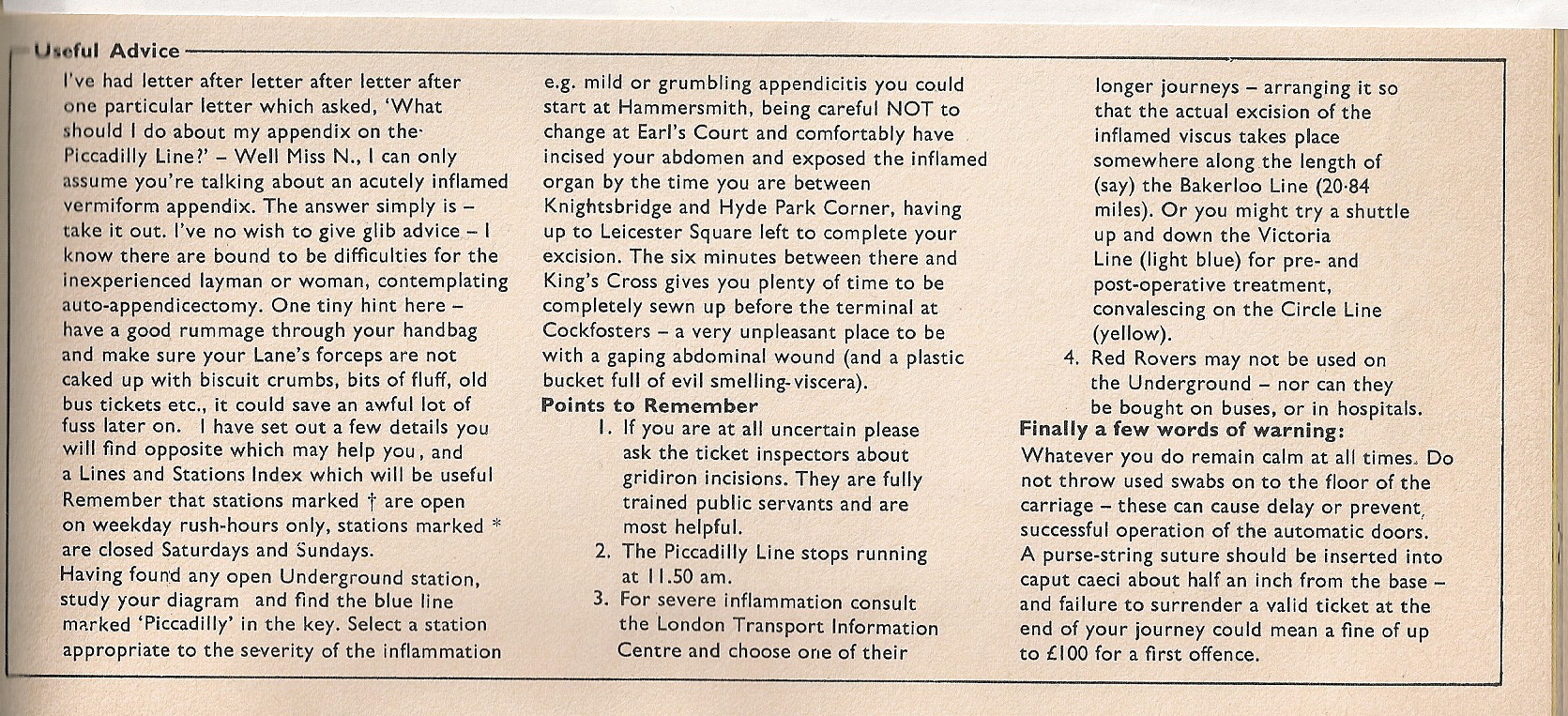
How to take your appendix out on the Piccadilly Line

Advice (click to enlarge) from The Brand New Monty Python Papperbok, 1974.


Beats in London

When Ned Polsky wrote Hustlers, Beats And Others his pioneering sociological study of the Beat subculture as it was in 1960, he was scathing of their literary value. ‘Most beat literature is poor when it is not godawful,’ he opined. ‘And this is certainly true of its best-publicised examples, which have been surpassed by even the minor Victorians: James Thomson’s poetic howl of urban despair, The City of Dreadful Night, is greater by far than anything Ginsberg offers, and in on-the-road literature the genuine gusto of George Borrow is preferable to the faked-up fervour of Kerouac.’

Stinging stuff – and that faked-up charge must have hurt – but times change, and while the Beats are still an acquired taste, one can’t image George Borrow being the subject of a special exhibition at the British Library, as is currently the case with Jack Kerouac.

On The Road: Jack Kerouac’s Manuscript Scroll is a small but welcome look at the basics of Beatery, offering an overview of the main protagonists – Kerouac, Burroughs, Ginsberg, Corso (the only one Polsky rates) – and trying to explain where they fitted within the American literary tradition. The exhibition is illustrated by photographs, many of the American landscape as explored in On The Road, but also of the writers themselves. I particularly liked this shot of William Burroughs, dressed like a fugitive Nazi, hand shielding eyes from the sun as he stares back with clinical impassivity. Burroughs is possibly the most photogenic writer there has ever been.

The main exhibit, though, is the extraordinary scroll on which Kerouac wrote a key draft for On The Road. You do not have to like the book – and I don’t, particularly – to appreciate the sheer thrilling insanity of this object, 120 feet of closely typed pages, filled with ‘spontaneous prose’ and occasional pencil marks. I have never seen a manuscript like it.

Kerouac’s second novel has been described as the book that ‘started
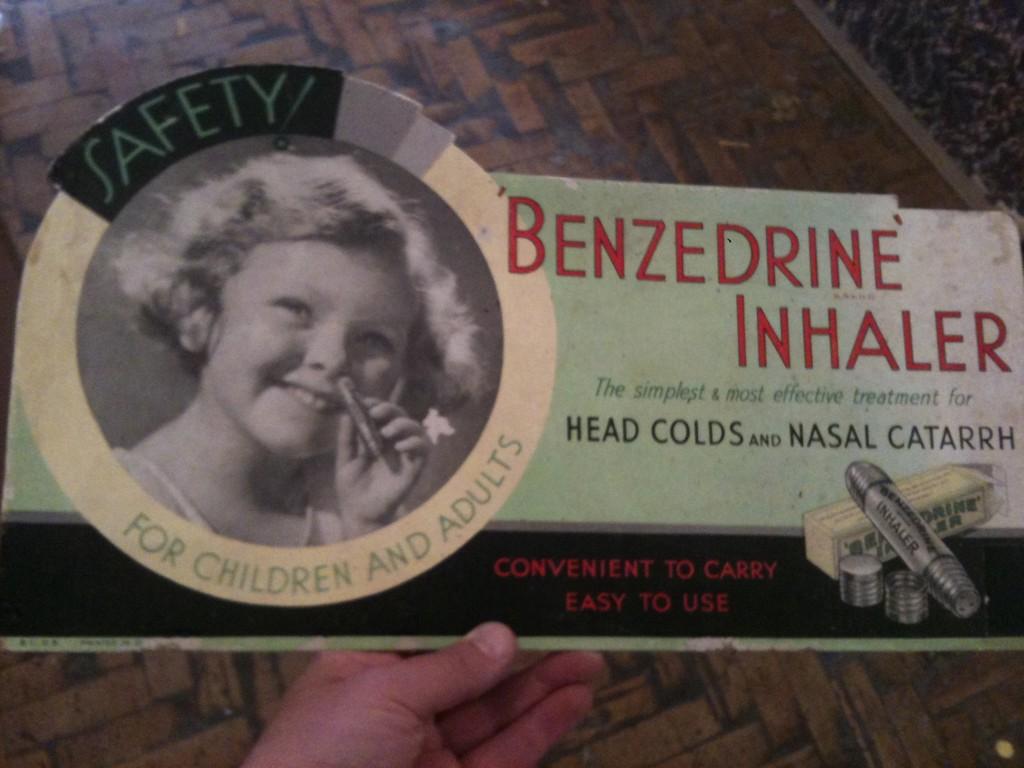
a whole new youth culture of which drugs were an accepted part’, so sodden is it in dope and speed. It was based on a series of road trips Kerouac took with
Neal Cassady (the pair are reinvented as Sal Paradise and Dean Moriarty respectively) between 1947 and 1950, and most of the characters are based on Kerouac’s friends. Mythology states that it was written in a three-week
splurge fuelled by coffee and Benzedrine, but Kerouac actually began it as early as 1948, when he also came up with the title. He spent a while searching for a voice, but eventually settled upon a stream-of-consciousness, jazzy, impressionistic style. This was inspired by a 40,000-word letter written to him Cassady, a charismatic sociopath described by his biographer as ‘a slim hipped hedonist who could throw a football seventy yards, do fifty chin-ups at a clip and masturbate six times a day’. Cassady was trouble; he was also said to have ‘one of the greatest minds I’ve ever known’, by a friend of writer Ken Kesey.

Kerouac sat down to write his famous ‘scroll’ draft on 2 April 1951 on a 120-feet sheet of paper that had belonged to Bill Cannastra, a wild-living friend who had been decapitated after sticking his head out of a New York train window.
Kerouac spent many years rewriting the manuscript as he tried to find a publisher, and it was eventually brought out by Viking in September 1957 – Kerouac belatedly considered renaming it Rock and Roll Road
to catch the spirit of the time – and immediately received an ecstatic review in the New York Times, which claimed it was ‘the most important utterance yet made by the generation Kerouac himself named years ago as Beat’.

On The Road is one of the most important books of the post-War era, but it’s questionable how much it influenced English culture given that it is such a specifically American book on such an American topic written in the American vernacular. London was more taken by Burroughs and Ginsberg, both of whom would spend extensive time in the city while Kerouac only visited for a few days in the 1940s when serving in the Navy. By 1959, Barry Miles, Jeff Nuttall, Michael Horovitz and the rest of the British counterculture scene were soon discussing, publishing, imitating and eulogising the Beat poets. 

Being more of a philistine, though, I prefer the exploitation stuff. Tony Hancock frequently mocked Beatnik culture, notably in The Poetry Society.

Hancock: You see, Sidney, we are a collection of kindred spirits who are all revolting against the Establishment.

Bill: How long have you been at it?

Hancock: Three days.

I also like Colin Wilson’s often sardonic but hugely charismatic novel, Adrift In Soho, which has that time-honoured plot of a young ingenue coming to London and getting drawn into a curious sub-culture, in this case the Beats. It is apparently currently being made into a film.

But the pull of the Beats, that desire to be different, was probably best expressed by Hancock again, in the opening scenes to his film, The Rebel. ‘Where are we going?’ It’s what Kerouac was asking, and it’s what Hancock wanted to know as well. Well, where?

Sir John Tenniel’s Alice In Wonderland chessboard

Earlier this year I was approached by bookseller Jake Fior, who told me he’d recently discovered a chessboard, never previously known about, that he believed had been handpainted by Victorian Alice In Wonderland illustrator Sir John Tenniel.

Tenniel’s illustrations are absolutely central to how we perceive the character of Alice in the two worlds she visits, inside the rabbit hole and through the looking glass, meaning this was clearly a pretty significant discovery, especially as Through The Looking Glass is plotted to resemble a game of chess.

My piece on the find eventually appeared in yesterday’s The Times. Sadly, this is  hidden behind a paywall, but thankfully The Telegraph reprinted pretty much the whole thing word-for-word later the same day. Fans of Alice should keep their eyes peeled on Cecil Court, where an Alice-themed boutique – complete with live white rabbit in the front window – will soon appear.

I think that calls for a song…


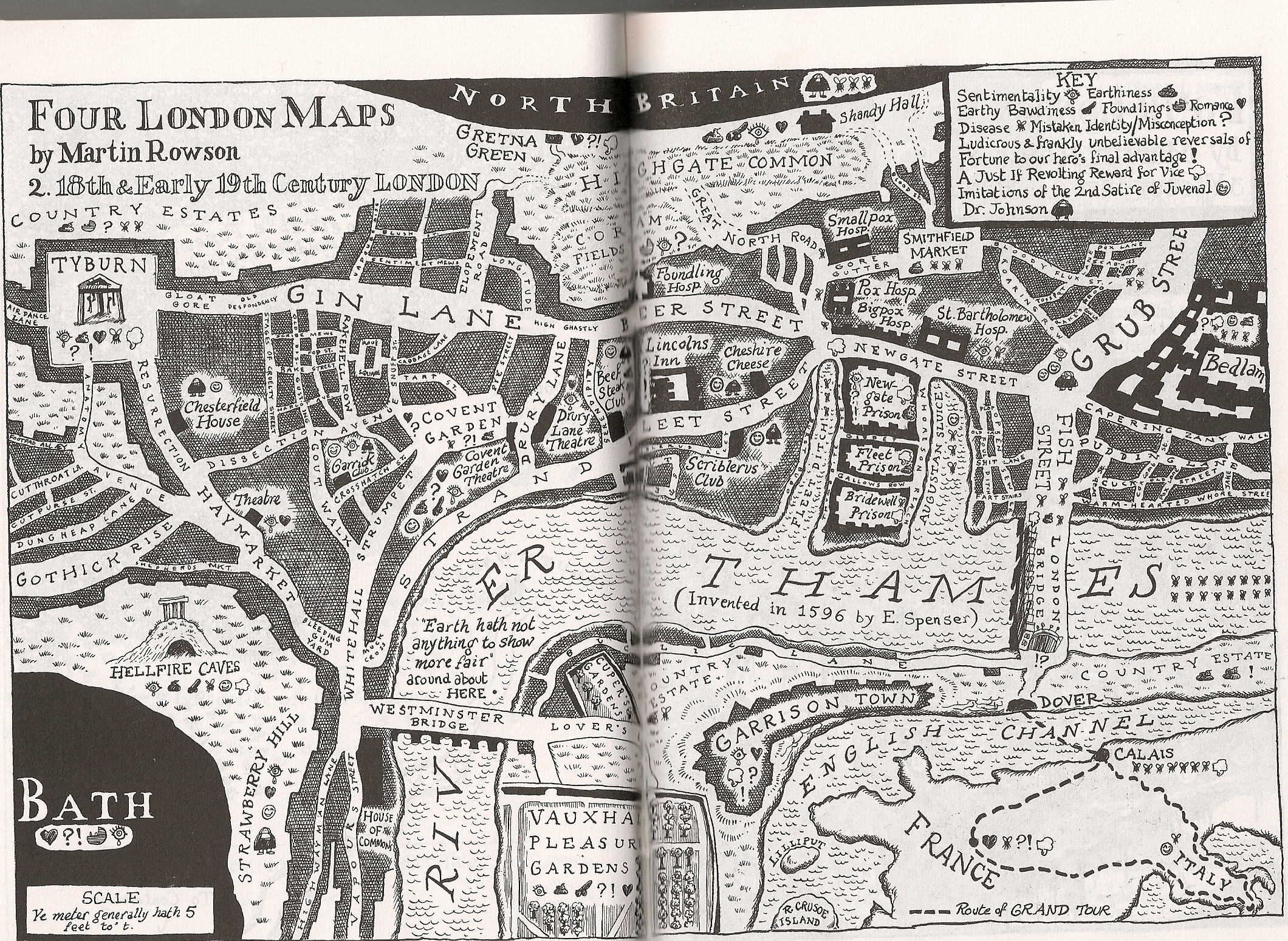
Four literary London maps

These four maps of literary London were drawn by Martin Rowson for the rather wonderful 1999 London issue of Granta magazine.

Chaucer’s London

Georgian London

Victorian London

Modern London

Bus stops and Brockwell Park: exhibition in Herne Hill

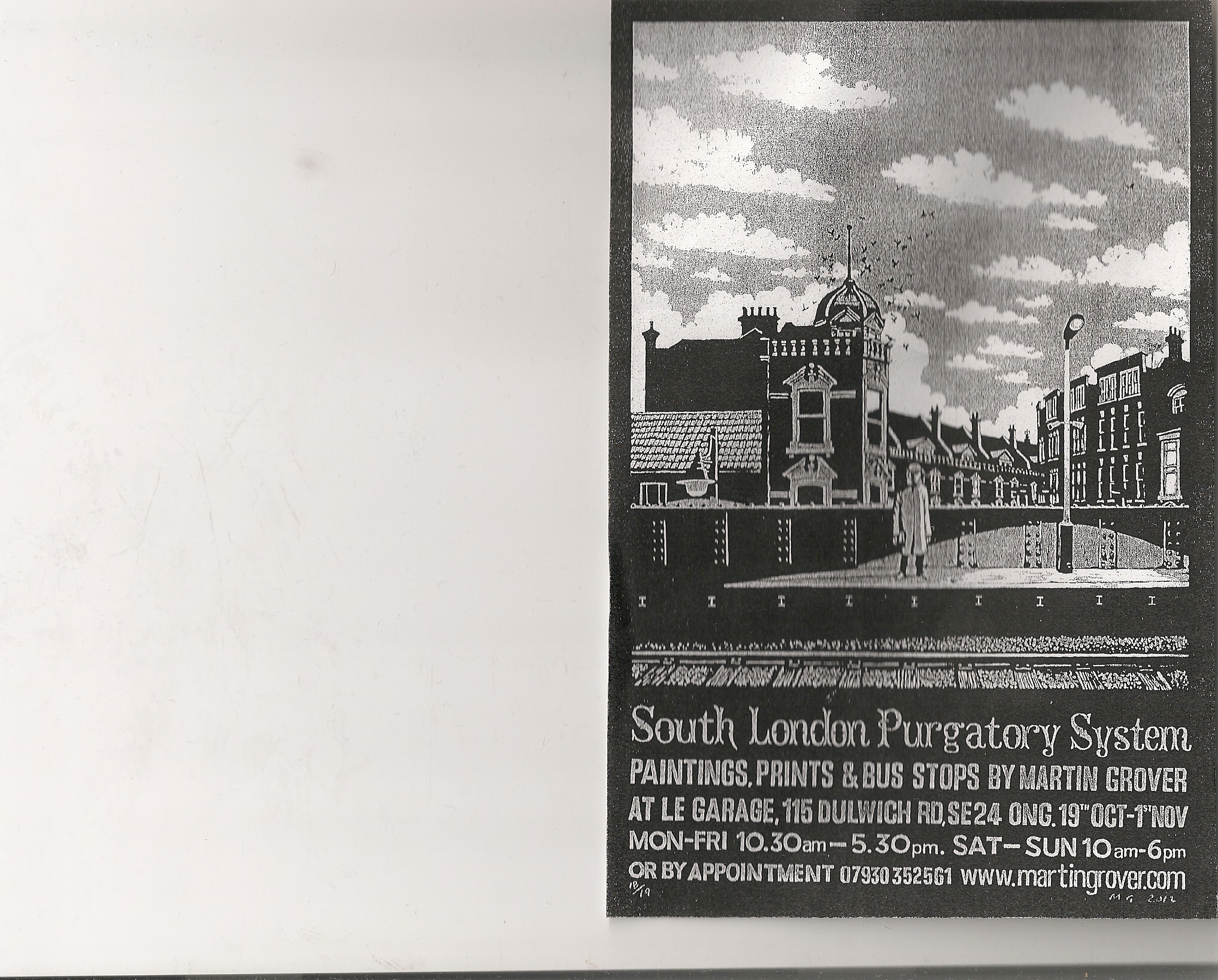
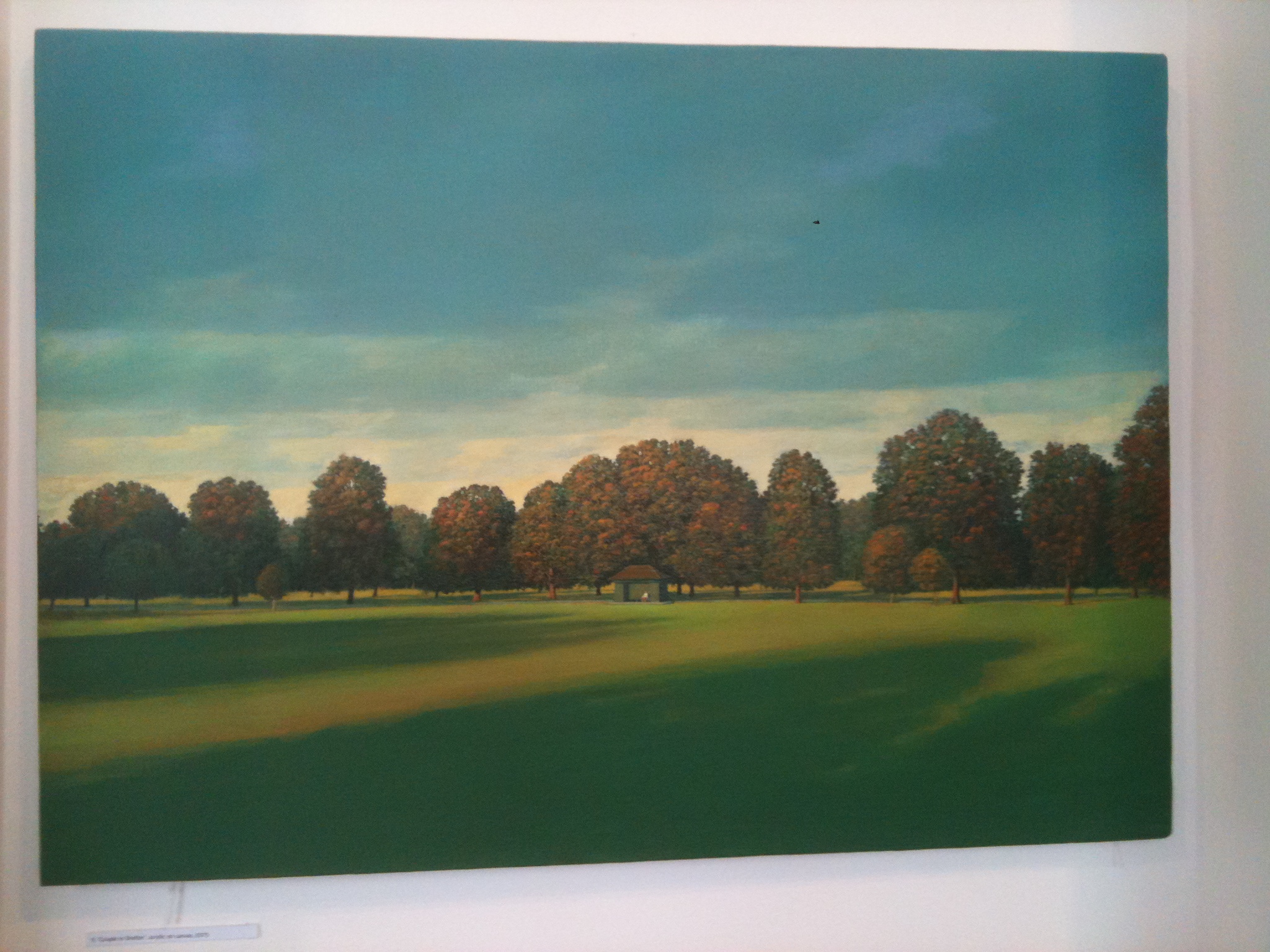
Martin Grover, an artist based in South London, has an exhibition at Le Garage in Herne Hill until Thursday November 1. His paintings are mainly of Brockwell Park, old record covers and bus stops, making him the ideal visual companion to my life.

His bus stop art has now extended from 2D prints into 3D sculptures/installation – in other words, he makes actual bus stops and writes strange slogans on them.

His Brockwell Park paintings are lovely. They are painted from sketches and photographs, although he confesses he makes a lot of it up in the studio, which is why Batman or James Brown might occasionally turn up in one.

Then there are the record sleeves, perfect reproductions of old 45s: often Stax and Motown but also plenty of country and Dylan.

South London Purgatory System at Le Garage until Nov 1, 2012. Mon-Fri, 10.30am-5.30pm; Sat, Sun, 10am-6pm. 

Peter Hitchens on drugs and the moral, opium-eating, Victorians

Peter Hitchens is a very clever man. I’m sure he’s also sincere – I can’t believe British newspapers would employ somebody to say stupid and provocative things just to get attention, after all – but judging by the interviews he’s conducted for his new book about drugs, The War We Never Fought, he’s a little bit daft.

Hitchens theory is that there has never been a war on drugs. ‘Drug-taking was, in effect, decriminalised by the Misuse of Drugs Act 1971,’ is how Decca Aitkenhead paraphrases. Instead, he harks back to the golden age of the Victorians, when there was ‘increasing self-imposed moral conduct’ (Hitchens’ words.)

Where to begin with this nonsense? Well, let’s just stick to the last bit, those morally virtuous Victorians. In a sense, he’s right: the Victorians didn’t take illegal drugs. That’s because they were too busy snaffling down the legal ones – things like opium, cocaine and cannabis – which were available to just about anybody who needed them until 1868, and then over the counter from chemists until 1926. This was the golden age of drug-taking in Britain, with opium being consumed on a scale we could scarcely now believe.

Victorian London was awash with opium, not in semi-mythologised Chinese opium-smoking dens in Limehouse (of which there were very few), but in pubs, chemists, general stores and markets, where it was sold in bottles, powders, pills, lozenges, on plasters, in sweets and much else besides. The centre of trade was in Mincing Lane, London, where 90 per cent of transactions occurred. It was most commonly taken as laudanum, a tincture of opium and red wine, with saffron and cinnamon.

This was not thrill seeking. In the days before aspirin, opium was one of the few reliable painkillers available to Victorians, especially especially fever and diarrhoea, but also malaria, smallpox, syphilis and TB. And it was effective as well. As anybody who has taken codeine or morphine will confirm, opiates have a tendency to block you right up – something that was particularly helpful when the next cholera or dysentery epidemic was just around the corner.

However, opium was also used on children, particularly when teething, in specially formulated sweet concoctions like Godfrey’s Cordial and Mrs Winslow’s Soothing Syrup, and thus surely led to the deaths of many by overdose. It also, believes the drug’s historian Martin Booth in Opium: A History, ‘provided an escape from the misery and vicissitudes of working-class life.’ This was especially the case in the Fens, where ‘many never take their beer without dropping a piece of opium into it.’

Because of these two factors, opium was belatedly seen as a physical and spiritual danger, and Victorian abstinence advocates put it right up there with alcohol and tobacco as serious threats to British life. What’s interesting, though, is the way – anecdotally at least – users were able to effectively and relatively painlessly self-medicate, living normal decent lives despite their addiction, without resorting to crime. This is true for the working classes, it’s true of the famous opium-eating writers like Coleridge, Shelly, Keats, Collins and De Quincey, and it’s also true of the many great statesmen – the sort of people who shaped the British Empire so beloved by Peter Hitchens – who took the drug. You see, because opium was the only halfway reliable painkiller around, everybody took it – including people like William Wilberforce, the great Christian abolitionist, and William Gladstone, who popped some in his coffee before speaking in Parliament to improve his rhetorical powers – even if not all of them became addicted.

In later years, opium – and especially its stronger derivatives morphine and heroin – began to be used by those simply seeking a pathway to an altered consciousness, a shortcut perhaps to the sort of transcendent mystical experience some people get from religion. In doing so, they were merely following pattern taken by mankind in all civilisations since the dawn of time, however much Hitchens may wish that weren’t the case.

As restrictions were introduced – for opium, not alcohol and tobacco – drug-use declined massively and by 1960 there were less than 100 registered heroin addicts in the UK. They received their drugs from doctors, cheap and undiluted, and were largely able to enjoy a normal existence (at least in comparison with their criminalised counterparts in America). However, as drug use increased in the 1960s, restrictions were imposed, culminating with Hitchens hated Misuse of Drugs Acts in 1971, after which drug supply passed almost completely into the hands of the criminal and use immediately rocketed. A far cry indeed from those morally virtuous days of the 1850s, when Britain’s great and good could simply pick up a bottle of premium laudanum from their nearest general store and retreat into blissful opium dreams.

Wellcome to London: how Henry Wellcome ‘hoovered up the world’ and left it on the Euston Road

Wisconsin, 1858. A five-year-old boy is playing near his frontier home when a strange stone catches his eye. He takes it to his father, who examines the flint carefully before deciding that it was a prehistoric tool made thousands of years before to cut meat. It probably meant as much to its creator as the railway did to modern humans. ‘That excited my imagination and never was forgotten,’ wrote Henry Wellcome years later, after he had grown up, moved to London and accumulated one of the largest collections of scientific paraphernalia that has ever been gathered by a single individual.

Wellcome established his pharmaceutical company, Wellcome-Burroughs, in 1880, making a mint selling pills to an English public that had previously taken medicine in the form of powder or syrup. This fortune sits in the Wellcome Trust, which was established 76 years ago and is now worth £14 billion, making it one of the world’s largest charitable foundations. Next door to the Wellcome Trust HQ on Euston Road, a short walk from St Pancras, sits the Wellcome Collection, a museum that houses some of the million or so objects collected by Wellcome in his lifetime. Here is Napoleon Bonaparte’s toothbrush, ancient sex aids, Chinese torture chairs lined with blades, boxes of false eyes, human skeletons and paintings by Van Gogh. It is one of the most extraordinary collections in the world, a throwback to a time when wealthy individuals would hoover up the weird and wonderful of the world for their personal collections, but executed on a scale few could compete with.

Ken Arnold is the Wellcome’s Head of Public Programmes. ‘This is the last great non-connoisseurs collection,’ he says. ‘Our usual concept of a collector is somebody who carefully decides whether something is authentic and then forks out a huge amount of money for it. Wellcome had an “other-end-of-the-telescope” approach. He saw everything through medical-tinted spectacles and wanted to own anything that would illuminate that fascination.’

Wellcome collected everything: paintings, engravings, photographs, models, sculptures, manuscripts, books, periodicals, pamphlets, letters, prescriptions, diplomas, medical instruments, archaeological finds, skeletons, skin, hospital equipment, advertisements, drugs, remedies, food, plants, microscope slides, charms, amulets, ceremonial paraphernalia, costumes, medals, coins and furniture. He bought entire shops, contents, fixtures and fittings, acquiring enough to recreate an entire street. He bought others collections, picked up human skulls from African battlefields and returned from one typical trip abroad with 44 packing cases of material. If something wasn’t available, he had an artist make a reproduction. Teams of buyers were finding him items right up until his death in 1936. His reach was broad and their brief was wide.

‘Wellcome had deep pockets and no bureaucrats telling him what he could bring home so he had none of our moral, financial or logistical concerns,’ says Arnold. ‘He hoovered up the world, and left us with this extraordinarily unwieldy and undisciplined collection.’ Although Wellcome amassed an immense collection, he was frugal with his money. ‘He was very wealthy, but he would send employees to auctions dressed down so they didn’t look too rich, and would set up fake companies so people wouldn’t know it was his money,’ says Ross MacFarlane, research officer at the Wellcome Library.

A chippy self-made American, Wellcome could never become part of the British establishment – although he was awarded both a knighthood and the French Legion d’honneur – and a desire to be taken seriously may have prompted his determination to create a museum of ‘the art and science and healing’. This opened in 1913 in South Kensington, before it moved to Wigmore Street and closing in 1932. When Wellcome died, the collection was put into storage or dispersed.

‘The British Museum has 40,000 objects, the Science Museum has more than 100,000, the Pitt-Rivers in Oxford has 30,000 items and there are bits in almost every museum in the UK,’ says Arnold. The Wellcome Trust has since taken a similarly philanthropic approach, funding wings in numerous UK museums, galleries and academic institutions.

In 2007, the Wellcome Collection opened. It is a modern, classy space, with a cafe and bookshop, as well as a gallery that hosts thought-provoking exhibitions that use art and science to explore topics such as Skin, Sleep and Brains. Their next exhibition, Death, promises to be particularly fascinating and challenging.

The Wellcome dares to be different: while most museums take an unfamiliar topic and wring all the knowledge out of it like a damp dishcloth, the Wellcome looks at something familiar and turns it inside out, using contemporary art and scientific research to make visitors question what they think they already implicitly understand. Their ability to do this can be traced back to Henry Wellcome himself.


‘We feel free to interpret the material Wellcome collected,’ says MacFarlane. ‘Because although we know when something was bought and what it cost, we don’t always know how it got to the auction.’ Arnold expands on this: ‘He didn’t talk about his philosophy. There’s enough to get an idea of why he was collecting, but there’s not so much that we feel we have to conform to his beliefs. He once said ‘Never tell anybody what you are planning to do until you have done it.’ That sounds like a good idea to me…’

So the Wellcome eschews blockbuster shows – which Arnold describes as ‘a depressingly greedy way to conduct exhibitions’ – and takes pride in imaginative live events. ‘We never try to be definitive,’ says Arnold. ‘There’s always more to discover. And we don’t want to be po-faced. Science is either deadly serious or fun with pink fluffy letters – and between these two unpalatable positions is a yawning chasm that can be filled with smart and sophisticated entertainment.’

Of course, the Wellcome is helped by having a lot of money in its coffers. ‘We are much more privileged that most other organisations. We are wealthy and we don’t have to satisfy civil servants, corporate sponsors or shareholders. But that attitude comes from the Wellcome Trust itself: science is a risk-taking business and there is a sense we are allowed to be experimental.’

MacFarlane finishes that thought, ‘When we take the directors an idea, they’ll often want to give it a go, and that’s a bit like how Wellcome collected. It’s a great position to be in.’

Wellcome Collection, 183 Euston Road, NW1 2BE. Admission free. The Wellcome’s next exhibition is Death, from November 15.