Category Archives: Counterculture

HG Wells, My White Bicycle and hygienic seats: a brief history of cycling in London

This piece is in the current issue of BMI Voyager. The photo of Herne Hill Velodrome is via Adrian Fitch

It’s unlikely that any of the world’s top cyclists will be thinking about London’s history with the bike when they set off from the Mall for the gruelling 250km Olympic road race on Saturday (July 28th), but if they do pause for thought, they’re starting from the right place. The route will take cyclists through Putney, Richmond and Hampton Court deep into the scenic Surrey countryside of Woking and round Box Hill, but it starts and finishes near Hyde Park, which is where cycling in the UK first really took off.

Cycling had premiered in Battersea Park in the 1880s, but it was in Hyde Park that the great Victorian cycling craze went overground in the 1890s. London was still a horse-happy city at the time, so when 2,000 cyclists – mainly women, dressed demurely with natty bonnets– formed a parade to cycle round the park in the spring of 1896, those on horseback didn’t know quite what to make of it. Bicycles were still a new thing. Penny-Farthings had been around for a while, but were about as common a sight in Victorian London as they are now, and it took the invention of the ‘safety bicycle’ – one with wheels the same size and pneumatic tyres – in the 1880s for that to change. Indeed, such was the enthusiasm with which women took up cycling, that Victorians were torn between trying to find ways to make money out of it, and trying to ensure it was morally appropriate. With typical Victorian ingenuity, they managed to do both – the Chaperon Cyclists’ Association supplied female escorts for solo women cyclists for 3s 6d an hour, while to avoid any dangerous friction you could purchase special ‘hygienic’ bike seats, which had a modest dip in the area where a lady’s genitalia would usually meet the saddle.

Hygienic seat or not, this was, almost without exception, a hobby enjoyed by the upper classes – the Lady Cyclists Association of 1895 was founded by the Countess of Malmesbury – and the Olympic road race aptly passes through some of the poshest areas of London, along the luxury-lined Knightsbridge and down through the smart streets of Chelsea to Putney Bridge. In 1896, the Countess wrote wittily in The Badminton Magazine about the dangers of cycling around these very Belgravia streets thanks toa new sport’ devised by Hansom Cab driver: ‘chasing the lady who rides her bicycle in the streets of the metropolis’ excited by the ‘petticoat which “half conceals, yet half reveals”… I cannot help feeling that cycling in the streets would be nicer, to use a mild expression, if he’d not try to kill me.’

It wasn’t until 1934 that a solution to this perennial problem arrived, when the UK’s first bike lane was opened not far from where the road race course makes its progress through West London. This specialist cycle lane stretched for two-and-a-half miles alongside the Western Avenue and was a belated response to the scarcely believable statistics that recorded 1,324 deaths of cyclists on British roads the previous year. Despite these awful figures, cycling groups opposed the innovation, arguing bikes should not be forced to give up their place on the road to the new-fangled motor car. It’s not an argument they were ever likely to win.

Roads will be close to traffic on July 28, however, and as the Olympic cyclists make their way towards the river, they will pass Kensington Olympia, the huge exhibition hall built in 1883 and used for all manner of spectacular entertainment –promoters would think nothing of flooding the arena to recreate Venice In London, for instance. Anything fashionable was fair game and cycling races were held here during the 1890s. A mixed-tandem race – one male rider and one female – attracted huge crowds in January 1896. Weird events like this were common at the time –the Crystal Palace in Norwood hosted a bicycle polo international in 1901 between Ireland and England (Ireland won 10-5).

After crossing Putney Bridge, the race continues through Putney, where one of London’s many Victorian velodromes was once located, drawing crowds of 10,000. Putney also featured in one of the first cycling novels, The Wheels of Chance, by HG Wells, a writer who always had an eye for a new invention. In it, the hero, Mr Hoopdriver, leaves his dull job in Putney to go on a cycling holiday on the South Coast following a route out of London very similar to the one that will be taken by the Olympic racers. The race later passes through Woking, where Wells lived and set part of War Of The Worlds – Woking has boasted a huge statue of a tripod since 1998.

From Putney, the cyclists whizz through lovely Richmond – mind the deer! – before hitting the river at Twickenham, where they pass Eel Pie Island, nexus of London’s mid-1960s rock ‘n’ roll revolution. Numerous legendary bands played shows at the charismatic old dancehall on this tiny island in the Thames, including the Rolling Stones, the Yardbirds, Eric Clapton, Jeff Beck and Rod Stewart. Among them was Tomorrow, one of England’s first psychedelic bands (featuring Steve Howe, later of prog-monsters Yes), whose 1967 single “My White Bicycle” was a big counterculture hit in 1966. This splendid slice of trippy frippery was written in homage to the pro-cycling scheme launch by Dutch anarchist collective Provo, who left 50 unlocked white bicycles all over their home city of Amsterdam in 1965, inviting the public to enjoy ‘free communal transport’ and rid themselves from the tyranny of the automobile. The Dutch police swiftly impounded the offending bikes, but the idea finally caught on in recent years in the form of the Paris bike-sharing scheme, Vélib. This idea was appropriated by London in 2010 and came to be christened Boris Bikes after London’s mayor, Boris Johnson, who inherited the scheme from his predecessor Ken Livingstone.

Boris Bikes can be hired by anybody with a chip and pin card at around 500 docking stations in central London. The bikes come without helmet or lock and are pretty hefty, but they are a fairly common sight in London. Although there is an ‘access fee’ (£5 for a week), the first 30-minutes of any ride are free, so smart users hop between docking stations and effectively ride around London for next to nothing. It’s all part of a belated attempt to make London a more-bike friendly city – four giant bike lanes, the blue-painted Cycle Superhighways, have alsobeen created in key commuter routes, with four more planned for 2013. If you want to borrow a Boris Bike to follow the 2012 road race route be careful, as there are few docking stations outside central London and costs soon mount if you go over the initial 30 minutes – while the fines for a late return are high.

From Twickenham, the race heads through Bushy Park and passes the Tudor palace of Hampton Court, before disappearing into the Surrey countryside. After a tour of the Surrey hills, the cyclists will then make the return journey, via Kingston, to the Mall. Sadly, then, there is no time to head to south-east London, where there are a couple of other prime London cycling landmarks. The first is the Herne Hill Velodrome, tucked behind suburban houses down a quiet street near Dulwich. This is the last stadia from the 1948 London Olympics still in use today. Built in 1891, the velodrome had all but closed during the Second World War but was brought out of retirement when London was awarded the 1948 games. It’s had a few scares since then – the gorgeous Victorian grandstand has been a no-go area for years – but was recently awarded £400,000 of Olympic legacy money and plans are afoot to construct a new grandstand, cafe and gym. The venue has played its part in nurturing the latest breed of British champion – Tour de France winner Bradley Wiggins raced here.

Herne Hill Velodrome

While Herne Hill lives on, the velodrome at Catford was demolished in the 1990s. Like the stadia at Putney and Herne Hill, this was built in the 1890s, when it attracted a very special guest. Absinthe-soaked dwarf artist Henri de Toulouse-Lautrec is usually associated with the Montmartre area of Paris, but in 1896 he turned up in the particularly drab suburb of Catford. Lautrec was a cycling fan, and had been asked by a company called Simpson to design a poster for their bike, which used a new type of chain. Lautrec was taken to the newly built Catford Velodrome to watch the bike in action during special races, set up by Simpson to advertise their product, and he produced a couple of images during his visit. The poster was one of the last he designed before his death in 1901, just as the Victorian bike craze was coming to an end.

Norman Mailer and Christine Keeler’s bra

Jay Landesman was an American writer and eccentric entrepreneur who arrived in London in the mid-1960s and immediately flung himself headfirst into the emerging counterculture scene, largely because the first person he met when he arrived here was Peter Cook. Landesman later became best known as the male half of a famously open marriage, much to the shame of his son Cosmo, who gained revenge by marrying Julie Burchill. (‘She hated hippies, ex-hippies, food freaks, open marriages and old people,’ wrote Jay, ‘The only thing she liked about us, was that we were Jewish.’)

In his entertaining 1992 memoir Jaywalking, Landesman’s non-ideological dalliances on the fringes of the London scene make great reading, with walk-on roles for the likes of John Lennon (‘He was uptight about Wendy Cook’s insistence he sample her salade Nicoise, a dish he was highly suspicious of and couldn’t pronounce’), Tom Driberg (‘He took us to a pub whose entire clientele consisted of lesbians, transvestites, young Danish sailors, ageing pederasts and an assortment of amputees’) and Germaine Greer (‘I watched her challenge Jimi Hendrix to an arm-wrestling match, and win’). Although it’s never entirely clear what he did – bar run the disastrous UFO rip-off the Electric Garden for a couple of minutes – Landesman was clearly good company with a penchant for meeting interesting people, and at some point was asked by The Sunday Times to write about the art of giving a party. His ideal guest list is worth repeating in full:

Minimum of three potential celebrities; at least one real celebrity (any field); a foolish couple; a serious couple (straight feed for comics); an engineer or non-speaking Czech (to point out); six swinging teenagers (girls); a bitchy girl who can generate masochism in men; a gym instructress who drinks too much; an older woman who sits and smiles (who is she?); a rune beauty (who was she?); Christine Keeler; no fat people unless Peter Ustinov; nobody jet or Court Circular; no dogs; no Peter Hall, Jonathan Miller, David Frost (or equivalents); no crew cuts; a swinging accountant; a buff (a jazz-hair or gambling buff); two attractive lesbians (to get wrong); one international drug trafficker (to point out); a beautiful flawed couple; a gay MP; Tariq Ali (not Christopher Logue); an Irish showbusiness GP; a titled person (to show you’re not snobbish); no artists’ agents, editors or publishers; no children or headshrinkers (except RD Laing); an eccentric lawyer or priest (no respecters of confessionals); an articulate tradesman (electrician, cabinet maker, house painter, bank manager); a forgotten culture hero; a reliable loudmouth who’ll come early and leave early; the ex-wife of a world celebrity; a pop singer no one recognises; a girl with buck teeth, a corrective shoe, or both; an established figure who decides that night to drop out…

Landesman was fond of Christine Keeler. He met her soon after arriving in London at the Kismet, a Soho drinking club, and the pair became friends. He also knew Norman Mailer from the mid-1950s, Mailer having interviewed Landesman while researching his pioneering essay on hipsterdom, The White Negro. In London, Landesman had an opportunity to bring the two together.

The cause was Mailer’s decision to challenge for the Democrat candidacy as Mayor of New York under the slogan ‘Vote The Rascals In’. The sizeable US expat community in London – there were frequent baseball games in Hyde Park featuring the likes of Tony Curtis, Marlon Brando, John Cassavetes and Charles Bronson with Phil Silvers as umpire – decided to hold a fundraising event.

The Friends of Norman Mailer Committee was founded by charismatic rogue Harvey Matusow, and he put on a celebrity auction, featuring myriad bizarre offerings from Yoko Ono like ‘Dirt From Central Park’, ‘Air over Greenwich Village’, ‘Vial of Genuine New York Tears’ and ‘Jar of Captured Cloud Formations over the Bronx’ as well as bottles of Robert Lowell’s sweat and a slice of raw liver from Philip Roth’s fridge. The star exhibit, however, was supplied by Landesman: Christine Keeler’s bra.

Bidding began at £100. There were no takers. The auctioneer tried again, at £50. Nobody moved. Next he tried £10 for this ‘psychosexually historical’ item, but the opening bid was a measly 10 shillings. Landesman tried to get the bidding going and raised his own hand, but nobody followed suit and he ended up winning the item back for a mere 10s 6d. Later, he discovered it wasn’t even Keeler’s. ‘Christine doesn’t wear a bra,’ a mutual friend confessed, ‘But the deception was justified in a good cause.’ The mayoral election was just as successful – Mailer came fourth, in a field of five.

Secret London: dealing with the counterculture at Maggs

This article originally appeared in Dazed And Confused magazine in February 2012.

Maggs Bros Ltd rare bookshop is an unlikely place to encounter the counterculture. For a start, it’s located on one of London’s poshest squares in Mayfair, the heart of the establishment, and even boasts a Royal warrant just inside the front door. Inside No 50 Berkeley Square – an imposing Georgian terrace once described as ‘the most haunted house in London’ – earnest young men in expensive suits sit at desks covered in large old brown books, which they flog to largely millionaire collectors that occasionally step through the front door.

But round the back, a different world awaits. Carl Williams works in an office converted from the stable block, in a room that is full of wonders. Come here at the right time and you will find boxes full of punk fanzines sitting on chairs draped with Republican flags from Spanish Civil War. Ask Williams nicely and he may show you brooches made by junkie poet Alexander Trocchi from used heroin needles, a complete set of ‘Anti-Monopoly’ board games or a pamphlet drawn by Latvian anarchist Peter the Painter, the shadowy figure behind the Sidney Street Siege of 1911. This recent catalogue will give you an idea of the material. 

Aleister Crowley

Williams, a fast-talking Yorkshireman , is one of the few booksellers who deals in items related to the counterculture, a nebulous term which covers politics, the occult, avant-garde art, film and literature, drug culture, rock and roll and alternative lifestyles. The interesting stuff, in other words. ‘There’s no guide to the counterculture,’ says Williams. ‘It’s not doctrinal. It’s whether something has the right feel, the way it looks, where it came from. It’s folk art, it’s the Watts Towers, it’s Austin Osman Spare, it’s Aleister Crowley. It’s not like Marxism where everybody knows the key texts. There are things in the counterculture that are still being discovered. There are things lost in libraries that will take it in a completely new direction.’ And it isn’t just books: Williams deals in paintings, posters, games, clothes and records. The only requirements are that Williams can locate it somewhere within his own concept of the counterculture, and that he can sell it. He also puts on occasional shows in the gallery beneath his office, such as the recent Lost Rivers exhibition.

Williams was born in 1967 – ‘the autumn of love’ – in Scarborough. Despite failing his O-Levels, he went to the LSE to read sociology, where he discovered the library and ‘read indiscriminately’. In 1997, after a decade of odd jobs and working in book shops, Williams returned to the LSE to do a Masters just as the library was selling off its old stock during a refurbishment. Almost by accident, Williams became a ‘runner’, a pejorative term that describes something which, in essence, all book dealers do. ‘Running is a pre-internet term, now it’s much more transparent, but it means taking a book quickly from one dealer or auction house, to another dealer or collector and selling it for more money than you paid,’ says Williams. ‘The idea is that you get it from A to B without B finding out how much you paid A.’

RED FESTIVAL 77 POSTER

With the LSE library at his disposal, Williams was blessed with early success. ‘I was able to sell all these political economy and philosophy books,’ he says. ‘But although I knew the books I didn’t really know what they were worth. I realised this when I took one dealer the first Western European edition of the Koran, and walked out with £500 when it must have been worth thousands.’

As the stock from the LSE ran out, Williams began frequenting other dealers and auction houses to find sellable books. In February 1999, he wandered into Bloomsbury Book Auctions, where he picked up a book from 1864 called The Pure Logic Of Quality by William Stanley Jevons. ‘Jevons thought this book would revolutionise how we understood logic, but he only sold six copies,’ says Williams. ‘I’d never seen one outside a library. I took it to a dealer, Pickering and Chatto, and a man called Jolyon Hudson asked if he could keep it for a day or two.’

Hudson recognised the book had been stolen from the London Library. The police were notified and Williams’s discovery unravelled what the Guardian described as ‘the most systematic plundering of Britain’s great libraries ever carried out by an individual’. William Simon Jacques, a dealer, had stolen books worth more than £1 million. He was eventually sentenced to four years in prison. (Jay Rayner covered the story here.)

‘I was devastated,’ says Williams, ‘because I thought I’d tried to sell a stolen book, but it turned out to be a blessing because Hudson told the Guardian that I had behaved impeccably and that gave me an entry into the higher levels of the trade.’

Williams began working at Maggs Bros, selling books on the internet and looking after the catalogue. ‘I got to know the customers. There was one guy who had been coming in for 20 years. He’d usually walk out with a travel book, but one day they asked this guy what he actually wanted and he said he wanted books on drugs.’

The man was Julio Mario Santo Domingo, a Colombian billionaire, and Williams sold him a painting made by a Mexican artist after he had been injected in the neck with LSD. Santo Domingo was in the process of putting together one of the great private collections of drug books and paraphernalia, a stunning selection of material that ranges from ancient books about Chinese opium smoking to a bicycle that belonged to Syd Barrett. ‘I worked for Julio [who died in 2009] for three years,’ says Williams. ‘His collection is one of the great untold stories of the 21st century. It’s not just drugs, it’s sex, rock and roll, the occult, erotica and art. And it’s not just books. It’s everything.’

Santo Domingo had a remarkably open concept of what to collect, not just concentrating on the old and valuable but hovering up anything with drug connections. ‘Somewhere in it is a McDonalds coffee stirrer from the 1970s,’ says Williams. ‘It looked like a coke spoon, just in plastic rather than silver. There were press rumours that it was the hillbilly coke spoon and so McDonalds discontinued the range, but I found an original. What do you do with that? Sotheby’s don’t want it, Christie’s don’t want it. But it’s gold. So that’s what I do.’

McDonald's coffee stirrer

Williams operates in a rarefied world, selling unusual and arcane items to billionaires and academic institutions. Some are interested in the subject, others are professional collectors, and still more are collectors who collect other people’s collections, as investments and for the pleasure of ownership. ‘It’s a very small world of dealers and a very large world of buyers, who work on the basis that they should buy now when it is relatively cheap and is all still out there,’ says Williams. ‘And some of it is cheap. The 1960s stuff isn’t because it is more mainstream and the top Beat stuff is far too expensive, although I’ll still buy manuscripts.’

New items are acquired from auctions and the internet, book fares, private sellers and other dealers. A recent haul brought in the first issue of Heat Wave, a British Situationist International magazine written in 1966, which nobody has seen outside the British Library for decades. There’s a file full of items William Burroughs collected during his short-lived immersion in the Church of Scientology. There are four skeletal marionettes that used to live in an amusement arcade in Hastings. There are posters of Black Panther Bobby Seale, complete collections of short-lived No Wave fanzines, cloth bags designed by Yoko Ono and the programme from Michael Clark and The Fall’s collaboration on the ballet ‘I Am Curious Orange’, which took place at Sadler’s Wells in 1988. And there are books, loads of them, by Richard Neville and BS Johnson and Gregory Corso and Timothy Leary. Some of this stuff is hard to sell, partly because it’s difficult to know how much it is worth – ‘there simply isn’t a precedent for some of these things, so you’ve nothing to compare it with.’


Williams found his niche with a little help from Edward Maggs, the man who inherited the family firm. ‘There might have been something brewing in Ed’s mind that we needed to cover this demographic,’ says Williams. ‘It really began when I started cataloguing all this proto-counterculture American Beat stuff from the 50s and it did really well, I sold about 80% of it. I designed a catalogue based on Ginsberg’s Howl, the same size and typeface. It did well, people liked it and I realised I had the right skills for the subject.’

And what are those skills? Williams pauses. ‘It’s judo,’ he says. ‘I have one real ability. I can pick up a book, look at the front, open it, look at the back and I can usually understand what that book is about, condense it, understand where it came from and put a price on it before I’ve put it down. That’s not a talent many people have. It’s like judo, you’re fighting an opponent who is much bigger than you but you don’t need take on the whole thing at one time if you are going to defeat it. It’s an intellectual work-out every day. I have to explain each item, do the research, understand its value, and then I try and sell it.’

Unstable at Maggs Bros Gallery is on until June 8, 2012.

Bowie, Burroughs and the stage production of Ziggy Stardust

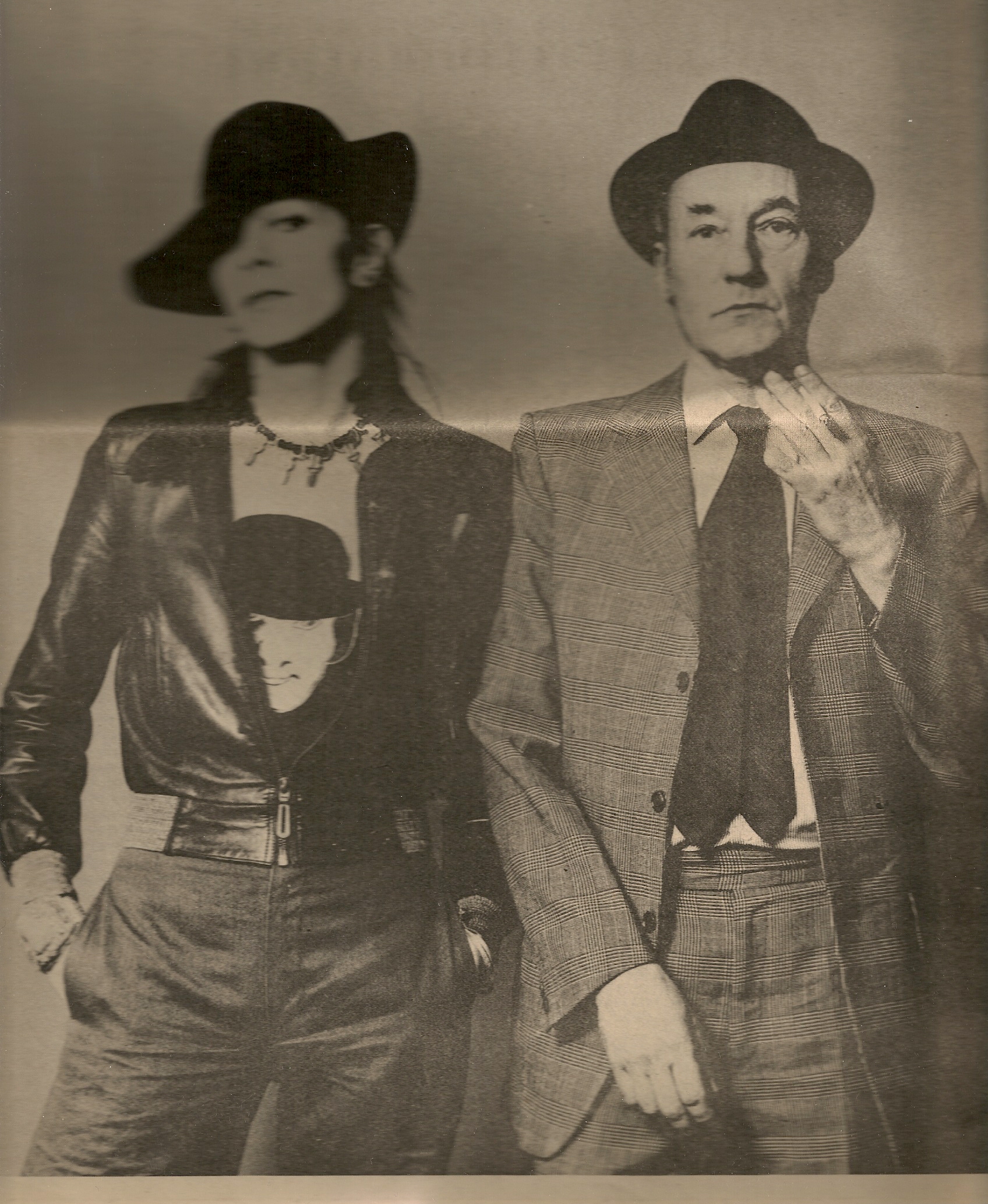
In December 1973, Rolling Stone journalist Craig Copetas brought together David Bowie and William S Burroughs in London for an interview. The piece was published in February 1974, around the time Burroughs returned to America, having finally had enough of the English climate and licensing laws. A wonderful photograph by Terry O’Neill captures the two icons together.

The interview itself isn’t quite as captivating. Bowie had only read one of Burroughs’ books (Nova Express), while Burroughs had only listened to two of Bowie’s songs (“Five Years” and “Starman”). This is my favourite exchange:

Burroughs: What is your inspiration for writing, is it literary?

Bowie: I don’t think so.

Burroughs: Well, I read this “Eight Line Poem” of yours and it is very reminiscent of TS Eliot.

Bowie: Never read him.

During the two-hour conversation in Bowie’s home, Bowie did most of the talking. At one point he discusses in length his plans for a theatrical or television production of Ziggy Stardust, which had been released two years before (and in June 2012 celebrates its 40th anniversary).

It’s worth repeating this section in full, as it is one of the fullest explanations of the story behind the Ziggy concept.

Bowie: Nova Express really reminded me of Ziggy Stardust, which I am going to be putting into a theatrical performance. Forty scenes are in it and it would be nice if the characters and actors learned the scenes and we all shuffled them around in a hat the afternoon of the performance and just performed it as the scenes come out. I got this all from you Bill… so it would change every night.

Burroughs: That’s a very good idea, visual cut-up in a different sequence…. Could you explain this Ziggy Stardust image of yours? From what I can see it has to do with the world being on the eve of destruction within five years.

Bowie: The time is five years to go before the end of the earth. It has been announced that the world will end because of lack of natural resources. Ziggy is in a position where all the kids have access to things that they thought they wanted. The older people have lost all touch with reality and the kids are left on their own to plunder anything. Ziggy was in a rock-and-roll band and the kids no longer want rock-and-roll. There’s no electricity to play it. Ziggy’s adviser tells him to collect news and sing it, ’cause there is no news. So Ziggy does this and there is terrible news. “All The Young Dudes” is a song about this news. It is no hymn to the youth as people thought. It is completely the opposite.

Burroughs: Where did this Ziggy idea come from, and this five-year idea? Of course, exhaustion of natural resources will not develop the end of the world. It will result in the collapse of civilization. And it will cut down the population by about three-quarters.

Bowie: Exactly. This does not cause the end of the world for Ziggy. The end comes when the infinites arrive. They really are a black hole, but I’ve made them people because it would be very hard to explain a black hole on stage.

Burroughs: Yes, a black hole on stage would be an incredible expense. And it would be a continuing performance, first eating up Shaftesbury Avenue.

Bowie: Ziggy is advised in a dream by the infinites to write the coming of a starman, so he writes “Starman”, which is the first news of hope that the people have heard. So they latch on to it immediately. The starmen that he is talking about are called the infinites, and they are black-hole jumpers. Ziggy has been talking about this amazing spaceman who will be coming down to save the earth. They arrive somewhere in Greenwich Village. They don’t have a care in the world and are of no possible use to us. They just happened to stumble into our universe by black-hole jumping. Their whole life is travelling from universe to universe. In the stage show, one of them resembles Brando, another one is a Black New Yorker. I even have one called Queenie the Infinite Fox.

Now Ziggy starts to believe in all this himself and thinks himself a prophet of the future starman. He takes himself up to incredible spiritual heights and is kept alive by his disciples. When the infinites arrive, they take bits of Ziggy to make themselves real because in their original state they are anti-matter and cannot exist in our world. And they tear him to pieces on stage during the song “Rock ‘n’ Roll Suicide”. As soon as Ziggy dies on stage the infinites take his elements and make themselves visible. It is a science fiction fantasy of today and this is what literally blew my head off when I read Nova Express, which was written in 1961. Maybe we are the Rodgers and Hammerstein of the seventies, Bill!

Burroughs: Yes, I can believe that. The parallels are definitely there, and it sounds good.

The Rodgers and Hammerstein of the 1970s never collaborated, unfortunately. You can read a full transcript of the Bowie-Burroughs interview – including discussions of German porn, Lou Reed, Andy Warhol, science fiction and Mick Jagger (‘Jagger is most certainly a mother figure. He’s not a cockadoodledoo; he’s much more like a brothel-keeper or a madame,’ says Bowie) – here.

Now that’s what I call a bus trip, baby

Psychedelic Routemaster, from The Day-Glo Designer’s Guide, 1969.

London’s football gangs: 1972

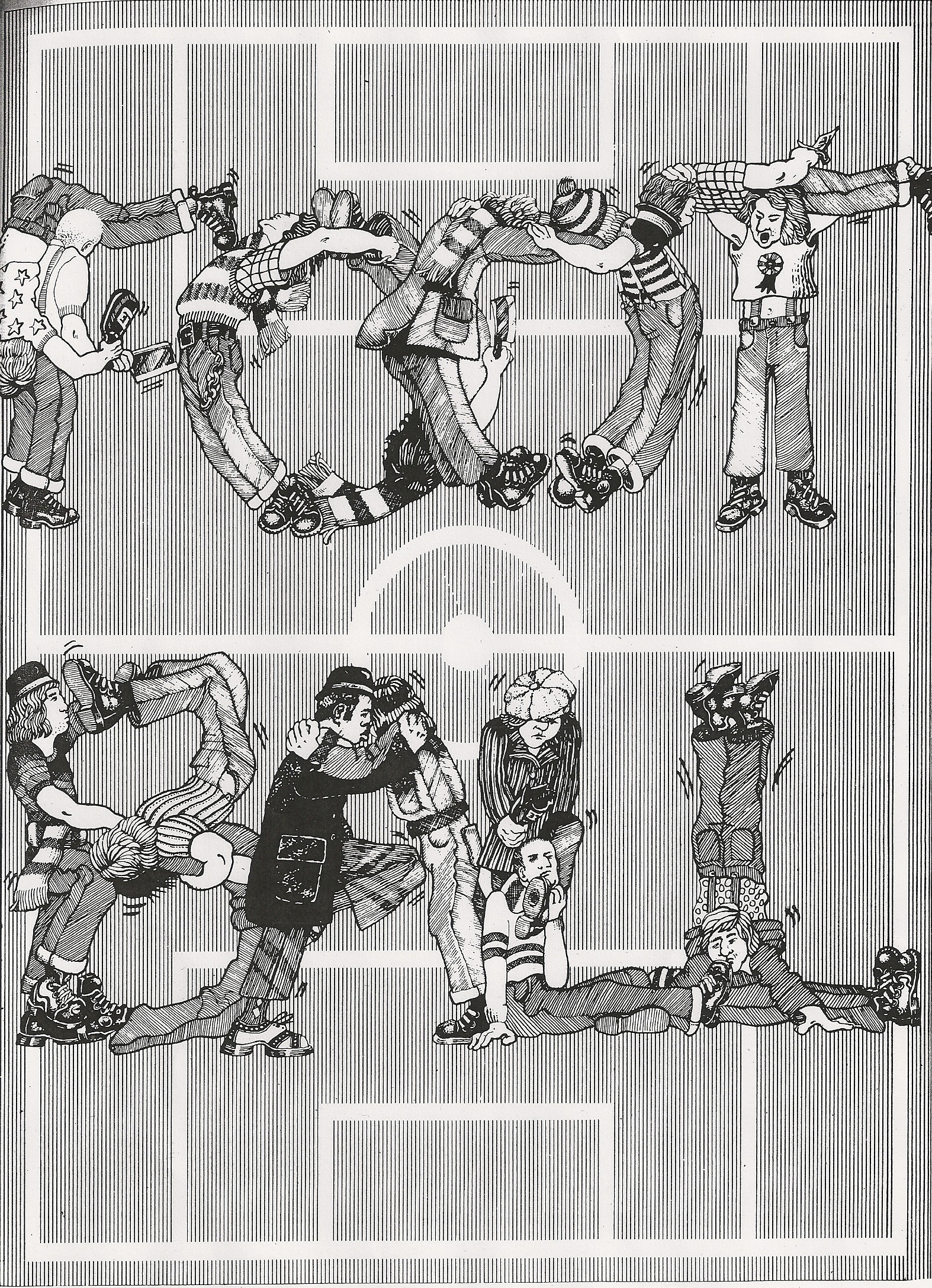
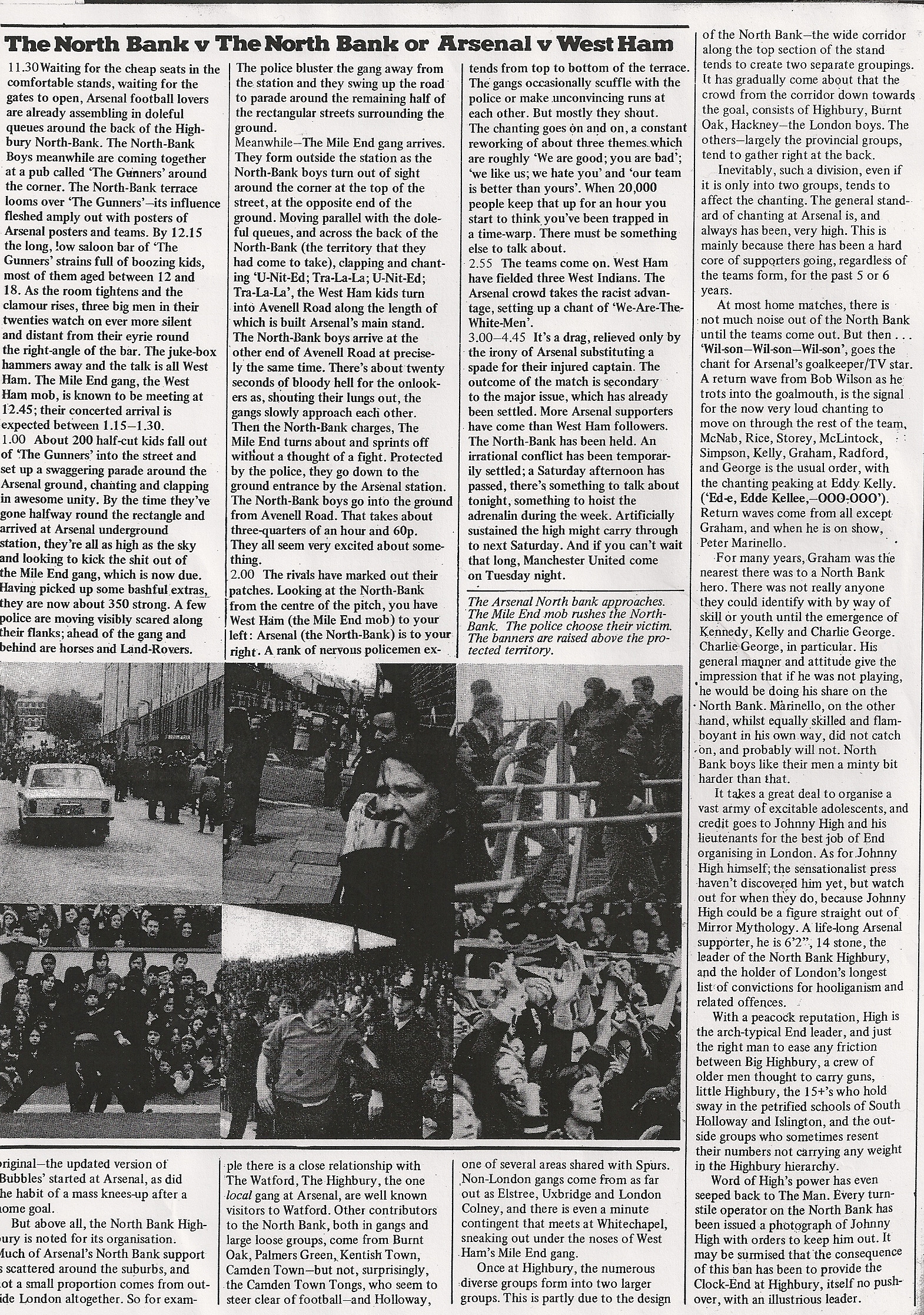
 I’ve mentioned Chris Lightbown’s article on London football gangs a couple of times before, but the piece itself hasn’t been available since it was first published in Time Out in 1972. The section on West Ham was reprinted in the excellent 2008 anthology London Calling, but the full article has been confined to libraries and private collections. Until now.

It is a fascinating read. This is the first time football fan culture had ever been seriously discussed by the press, and it offers a remarkable view of life on the terraces from the terraces, free of any moralism or finger-wagging. It is a thorough and very funny piece of writing, and is probably the first time terrace legends such as Mick Greenaway and Johnny Hoy (although he is called ‘High’ here) ever saw their names in print. It’s analysis of where the different clubs draw on their support is particularly great. 

The writing is very much of its time and place – complete with mention of ‘heads’ and ‘coons’ – and also paints the picture of a time when London terrace culture was very different: the Shed was as loud as the Kop, Arsenal had the most aggressive fans in London and Spurs were just a joke, on and off the pitch. Only West Ham’s identity appears to have remained more or less the same, although older Hammers would doubtless question that.

It is a cracking piece of work. Enjoy.

Harry Redknapp lends a hand

Possibly the only interesting sentence that has ever been written about Harry Redknapp appeared 40 years ago, when Redknapp was playing West Ham. It goes:

‘It is said that when West Ham were fighting Coventry at Coventry station last year, Billy Bonds and the inevitable Harry Redknapp came along to lend a hand.’

This appears almost as an aside in Chris Lightbown’s seminal article Football Gangs in Time Out in April 1972, which looked at the mobs that followed the four big London clubs: Arsenal, Chelsea, Tottenham and West Ham.

Did Redknapp really join in a ruck in 1971? This should surely be the first question put to him if he ends up getting the England job.

Hawksmoor at the Royal Academy: bunkum and brilliance

As the adverts all over the tube let us know, there’s currently a big David Hockney exhibition at the Royal Academy. Less well advertised, but far more compelling from a London point of view, is the same gallery’s fine show on the fascinating architecture of Nicholas Hawskmoor.

This takes place in the Architecture Space – a nice name for a small corridor near the restaurant – and features a short introduction to the architect, alongside photographs and paintings (photographed, not originals) of key works that feature or reference Hawksmoor’s work.

Leon Kossoff's Christchurch, Spitalfields

Hawksmoor, who specialised in hefty Baroque churches, is not an architect to everybody’s taste. In 1734, James Ralph argued that Christchurch was ‘beyond question, one of the most absurd piles in Europe’.  His reputation was resuscitated by Kerry Downes in 1959, who insisted of his churches that ‘they will repel us or fascinate us, but we cannot escape from their strange, haunting power’. This has been a mantra repeated by writers in the following years.

I actually find it quite easy to escape their powers, strange, haunting or otherwise, but this supposed mysterious attraction of Hawksmoor churches is now almost impossible to ignore or deny. It has been repeated so many times, it’s become fact, as Hawksmoor became the anointed architect for a certain type of London writer, the Peter Cook to Sir Christopher Wren’s Dudley Moore. I admire Hawksmoor’s churches, but don’t see them as particularly profound or unsettling.

Charles Hardaker's Hawksmoor Baroque, St Mary Woolnoth, London

Among the first to take up this theme was Iain Sinclair who wrote about Hawksmoor in King Lud (1975). A quote from the book is reproduced on the wall, and it offers a perfect illustration of what I dislike about the psychogeographic way of seeing London: ‘From what is known of Hawksmoor it is possible to imagine he did work a code into the buildings, knowingly or unknowingly, templates of meaning, bands of continuous ritual.’

‘From what is known’; ‘possible to imagine’; ‘knowing or unknowing’. Make it up as you go along, in other words. There’s nothing wrong with this, of course, but I do resent the way it is elevated above all other forms of London writing.

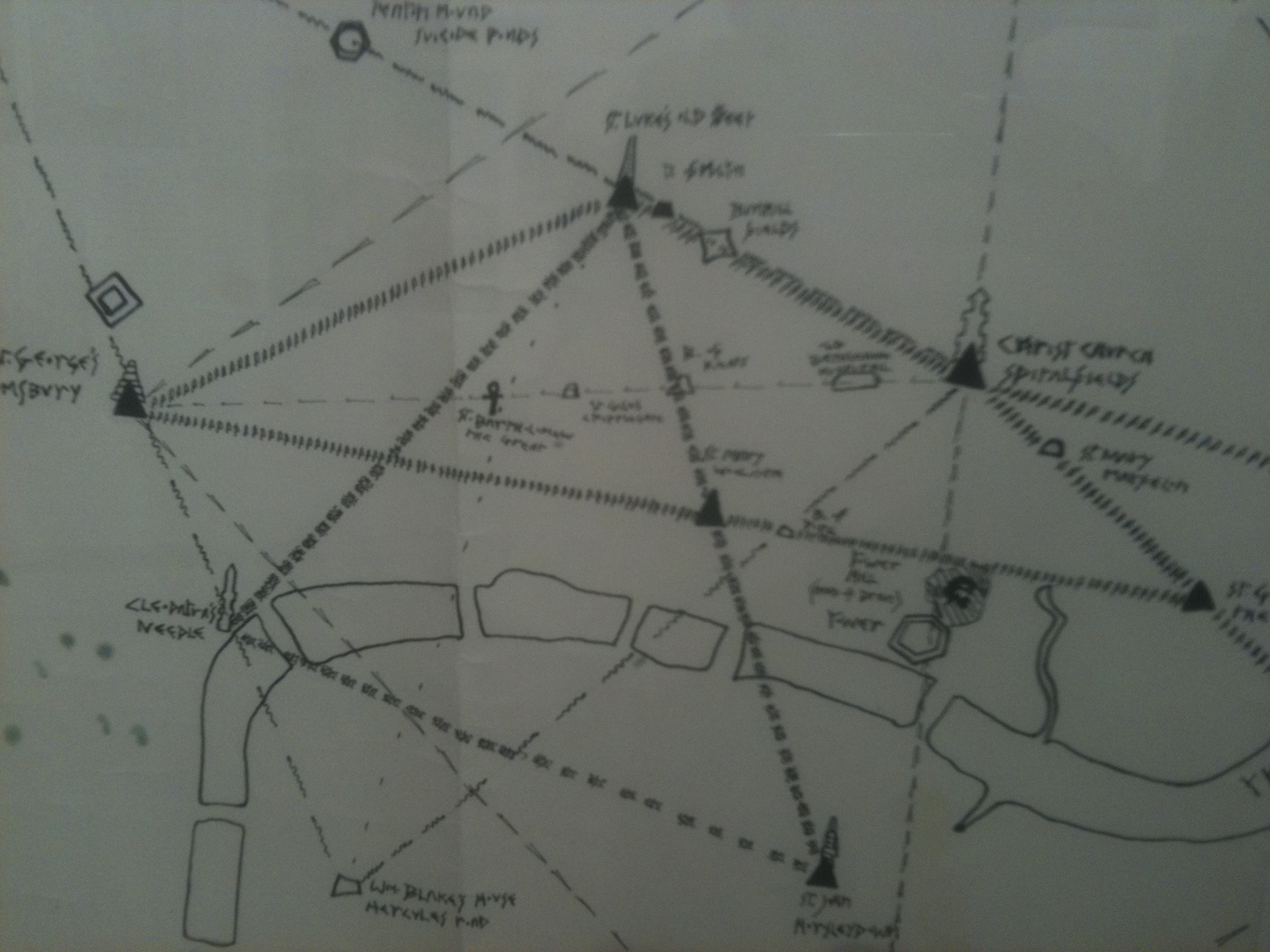
Sinclair has made a career out it, and he does it so well you could almost believe he takes it seriously. A fascinating map drawn by him features in the exhibition, showing his hand-drawn connections between London buildings, and there’s also a great film in which he talks eloquently about his relationship with Hawksmoor, which began when he was a gardener employed by Tower Hamlets to mow the churchyard grass at St Anne, Limehouse. Sinclair is a wonderful speaker, and spins a fine yarn here.

Sinclair's map for King Lud

After Sinclair came Ackroyd and Alan Moore, both of whom woves tales of occultish imagination around this indefinable mystery of Hawksmoor churches. Nonsense clearly, but at least it gave us the majestic From Hell, which features prominently in the exhibition.

From Hell featuring Christchurch, Spitalfields

All this bunkum gets space in the exhibition, but I found much else to entertain besides. There are wonderful photographs and prints of Hawksmoor buildings in many different styles and from varied eras, and also a passionate film by Ptolmy Dean, explaining – quite successfully – the attractions of the easily overlooked St Mary Woolnoth near the Bank of England.

The most interesting element, however, were the photos that drew attention to the parallels between Hawksmoor’s work and more recent buildings. We see a comparison of St Mary Woolnoth and Poultry in the City, and another between St Anne, Limehouse and the National Theatre. It might not be as sexy as psychogeography, but there’s nothing wrong with a bit of straightforward architectural history every now and then.

paul_0133fw.jpg

Celia Paul's St George, Bloomsbury

Secret London: photos of lost rivers and abandoned London

Lovers of London urban landscape, lost rivers, photography and, for want of a better word, psychogeography, should be aware of a forthcoming exhibition, From The Westbourne To The Wandle at Maggs Bros gallery.

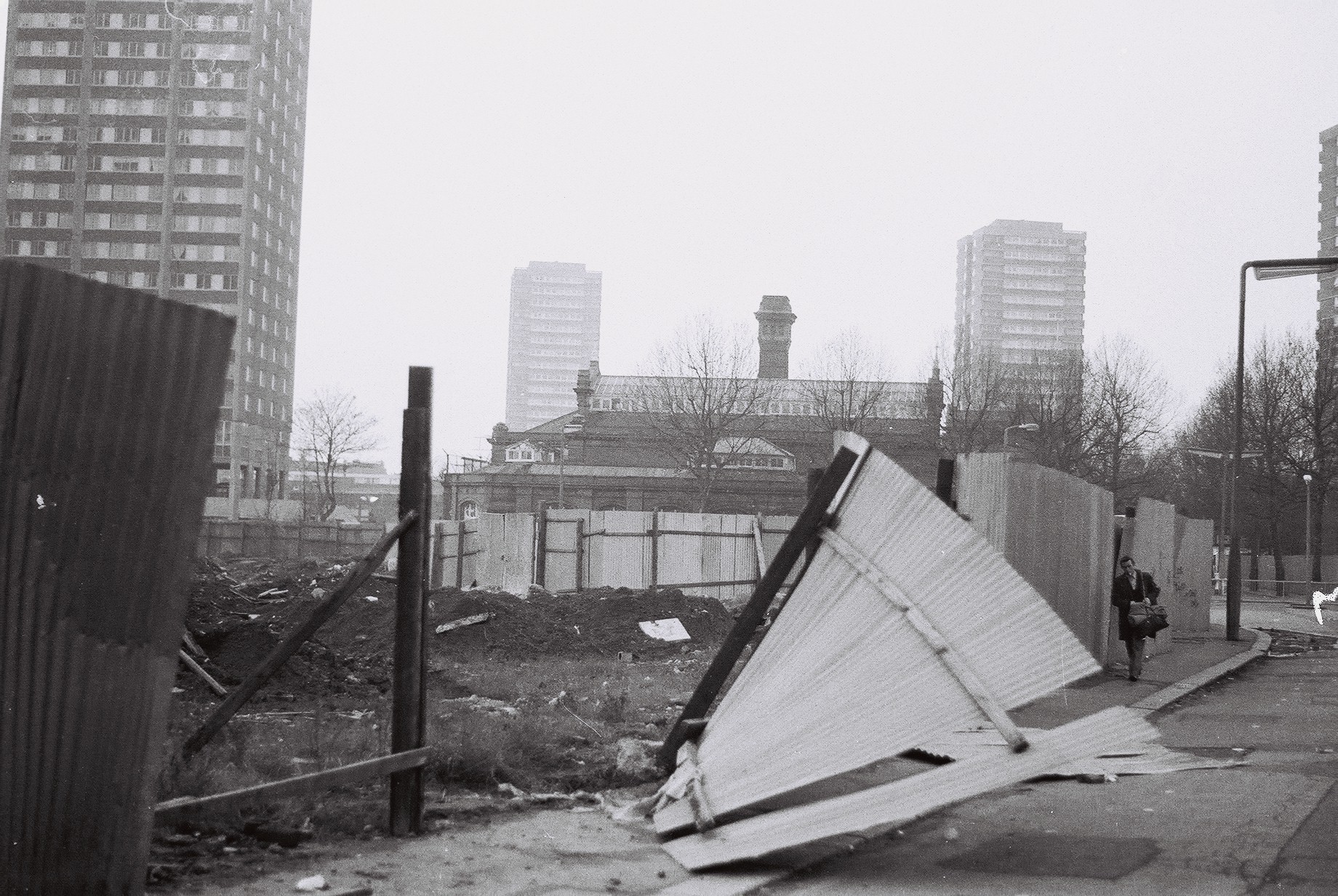
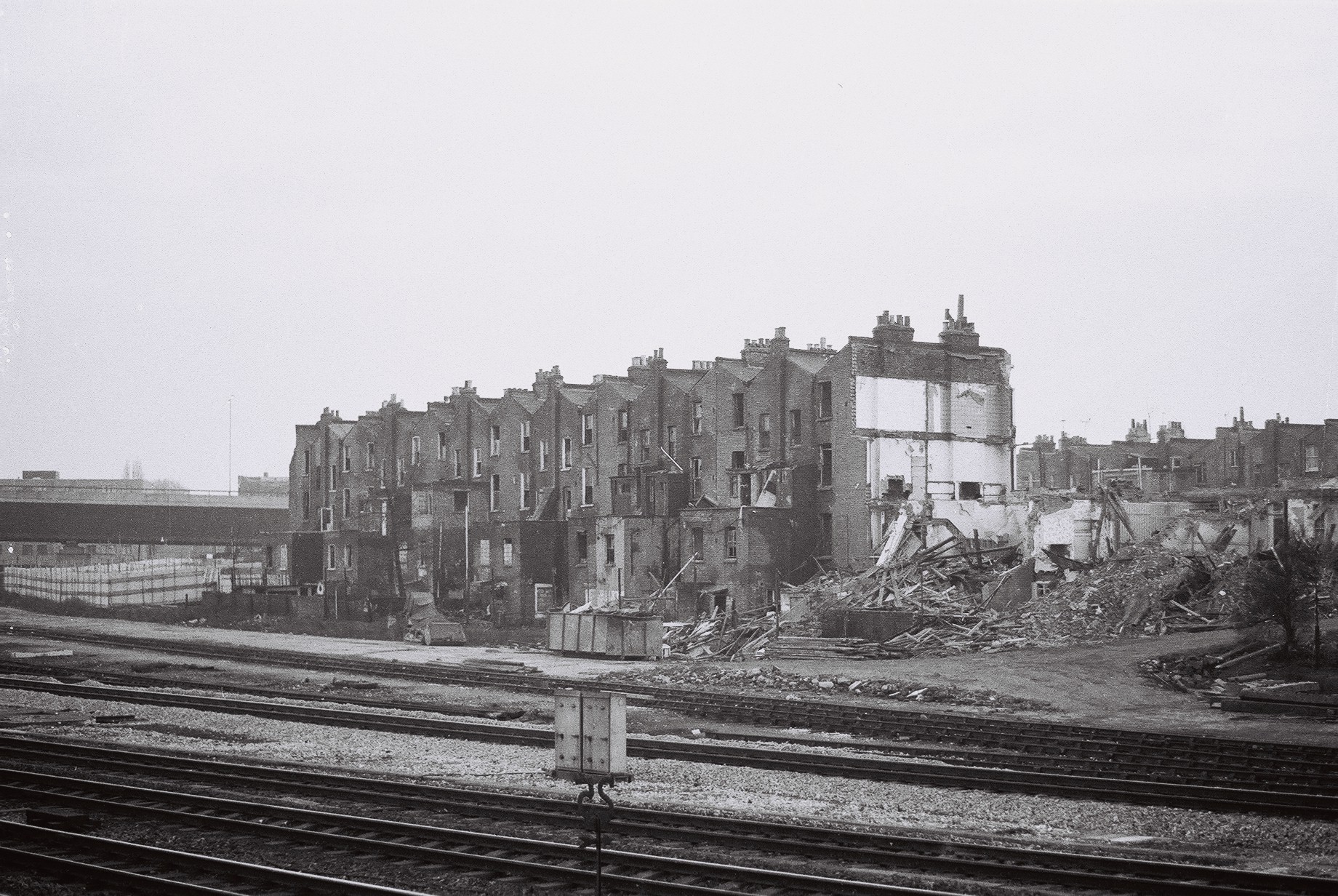
Curated by counterculture bookdealer Carl Williams, this brings together the work of two London photographers and writers, Jon Savage and SF Said. Savage is best known as a music writer, but in 1977, inspired by JG Ballard, he set out to photograph the urban wastelands of West London, taking a sequence of stunning black and white pictures of the lost land beneath the Westway.

He has written, ‘In its emptiness, austerity and gloom, it is an interzone waiting for something to happen, for the beasts to be unleashed. This was how London felt at the time: coming, coming, coming down – like a speed hangover merging into an apocalypse. But in there was also a sense of possibility that new ways of thinking might grow from this emptiness – like the scented buddleia on the bombsites.’

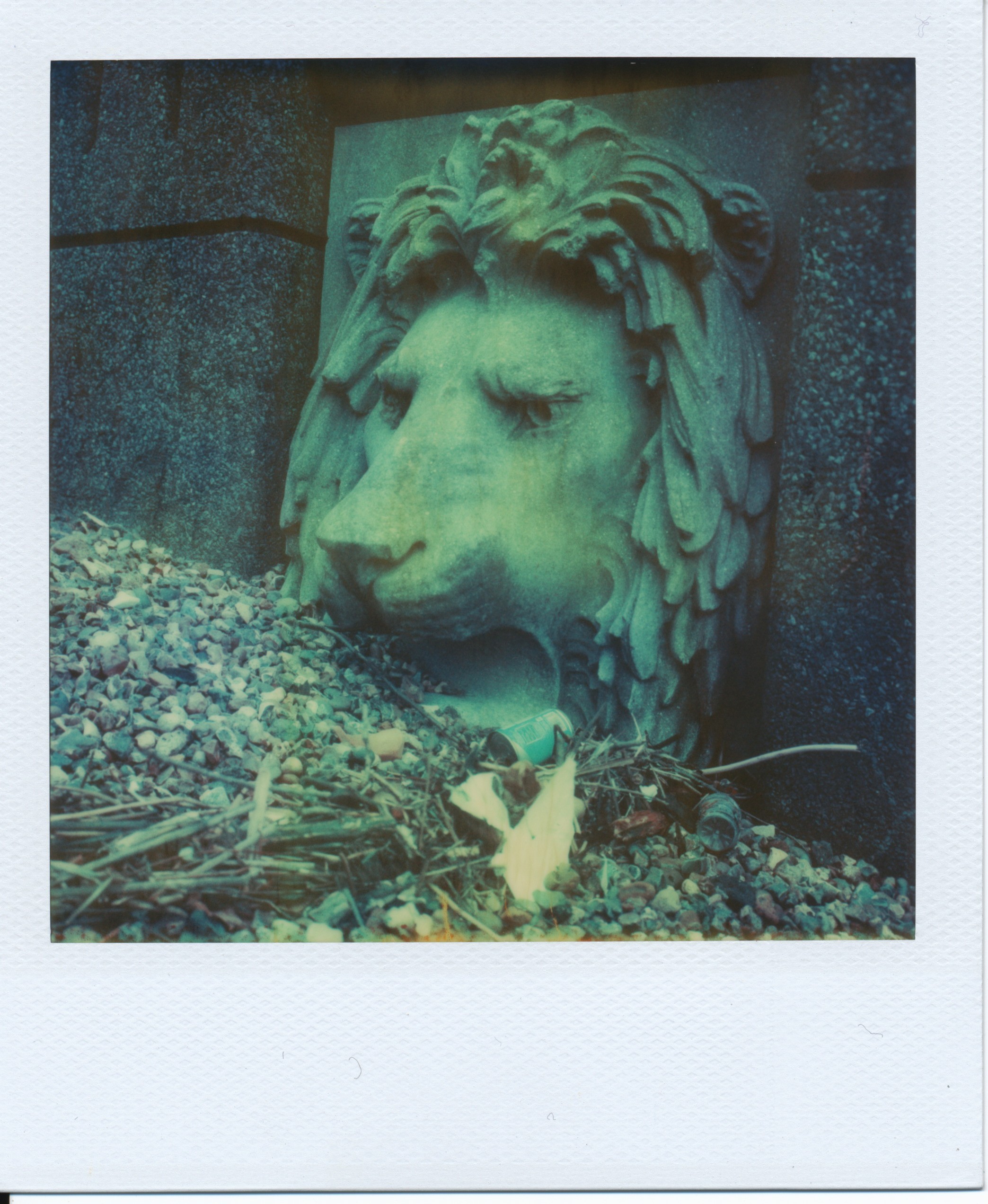
SF Said’s picture were taken for last year’s excellent Lost London Rivers book. Said shoots on Polaroid, which he describes as like a ‘photographic time machine’ and says he wants to ‘capture the dreams that a place might have of itself, or the memories that it stores under layers of time’.

He uses expired film, which can create strange, mesmeric effects and explains ‘as their chemical layers decay, they start to produce strange flame-like swirls and flickering light leaks that go even further into dreamlike realms.  These hallucinatory effects are unpredictable and random; sometimes they ruin a picture.  But when you’re lucky and it all comes together, I think they give you something magical that you could never get any other way.’

The exhibition is at the gallery at Maggs Bros, 50 Hays Mews, W1J 5QJ from March 22 to April 19.

Blank Generation: original punk posters in South London

In 1977, Gary Loveridge spotted a Damned poster that he liked the look of hanging on the wall at his local record shop in Weston Super Mare. He decided to take it. ‘It was on the wall of the listening booth. I took it off the wall, rolled it up and stuck it under my jumper. I walked out, looking very suspicious. They probably knew exactly what was going on.’

And so it began. Loveridge, a landscape gardener, now has around 250 original music posters, and 100 devoted to punk are on display until March 8 at the 198 Gallery  on Railton Road. Not all were collected in quite the clandestine way of the first, but they are all original and numerous bands are featured, including the Sex Pistols, Clash, Ramones, Lurkers, Buzzcocks, TV Personalities, Mekons, Elvis Costello, Ian Dury, PiL and Siouxsie and the Banshees.

The Damned poster that got it all started

‘This is the first time I’ve seen them all on the wall together in one place,’ says Loveridge. ‘At home they are all in tubes, some on the walls but I haven’t enough room to put them all up.’

The posters were largely used to promote LPs and singles in record shops, although there are some from bus stops and concert venues. Most such posters will have been thrown out by the stores, making such a large collection quite unusual. Loveridge collected many on his way from gigs in Bristol, and then later added to his collection at markets and record fairs.

The exhibition takes in two rooms and also features part of Loveridge’s collection of badges, flyers, fanzines and other ephemera, some of which – such as the flyers for the Sex Pistols banned tour – are much sought after. Also on display is a framed advert from 1977, cut out from a local paper, promoting a gig by a mysterious band called The Spots. Now who could they be?

Punk was an incredibly visual movement, as one would expect from something inspired by glam and Situationism and created in art schools and clothes shops, so these posters are eye-catching and iconic.  A small selection are reproduced below, but the real thrill is seeing them collectively and close-up; many have pulled from walls and windows so have an authentically battered look, while the accumulation of colour and striking design is a treat for the eye. But you’ve only got six weeks, so hurry.

Blank Generation: A Collection of Original Punk Posters, 198 Gallery, 198 Railton Road, SE24 0JT. Until March 8, 2012

Spiral Scratch by Buzzcocks

Pretty Vacant by Sex Pistols

The Clash at Brixton Academy

The Mekons at North Staffs Poly

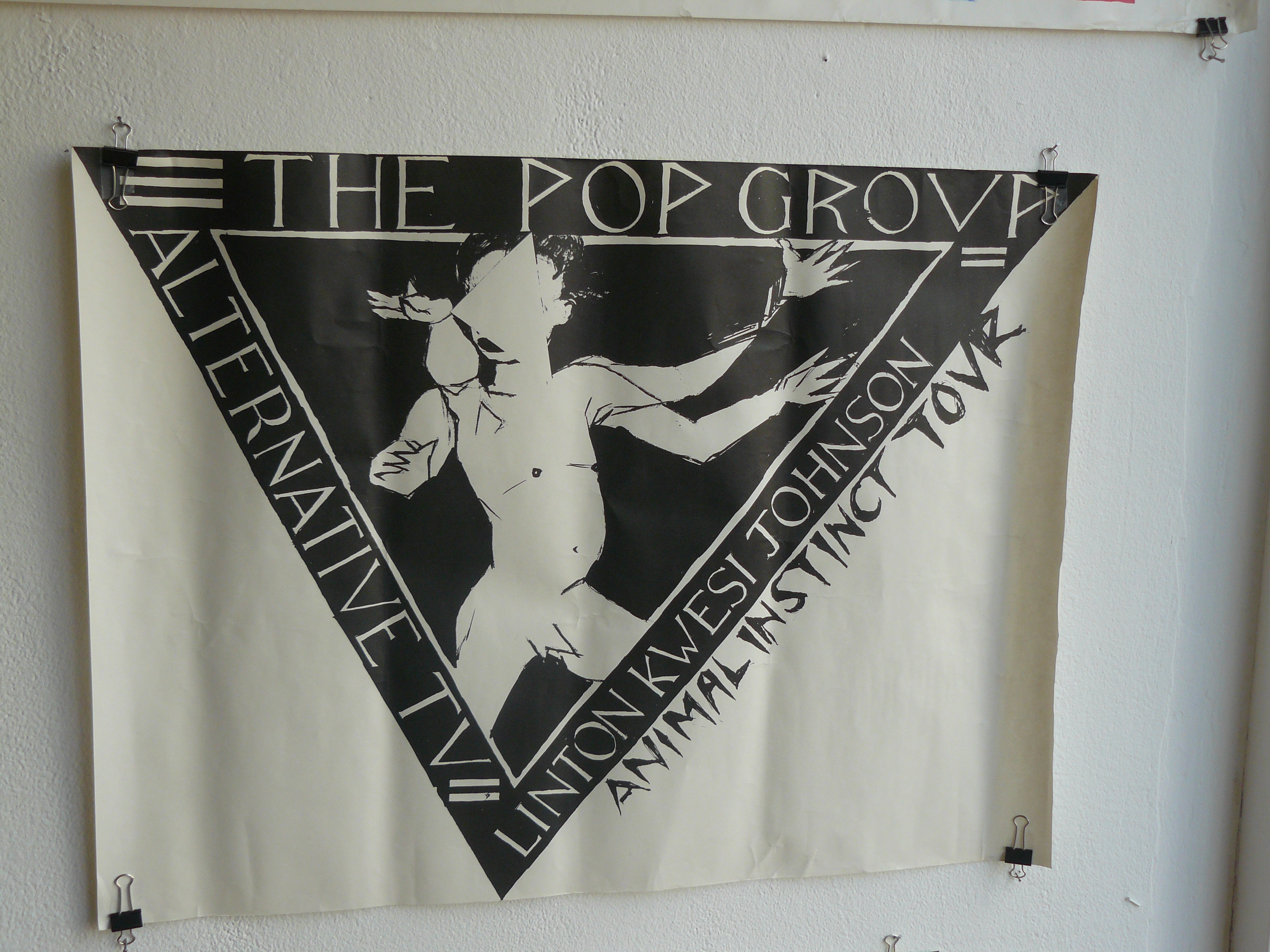
The Pop Group and Alternative TV

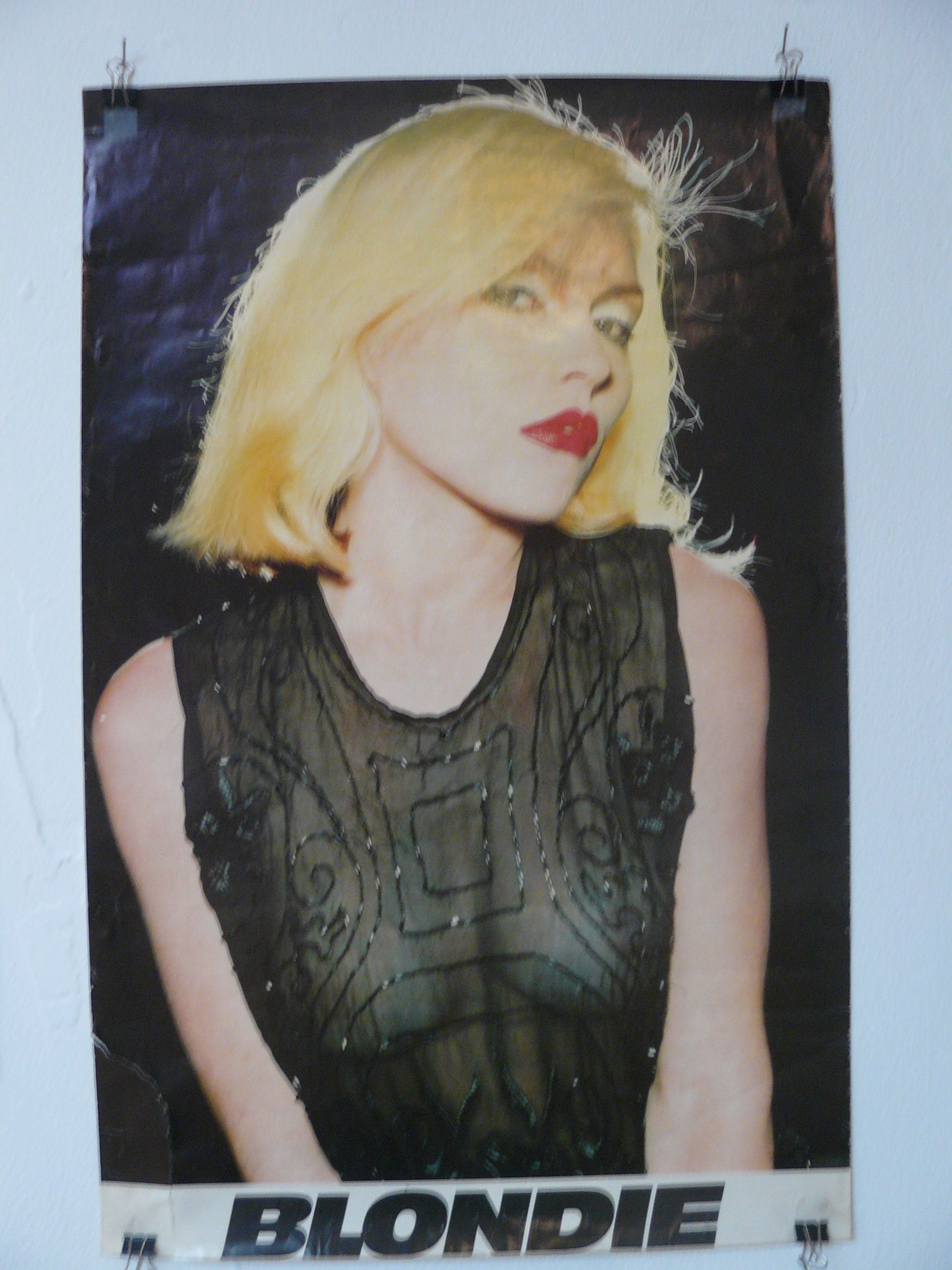
Blondie poster rejected by band as it featured only Debbie Harry

Elvis Costello

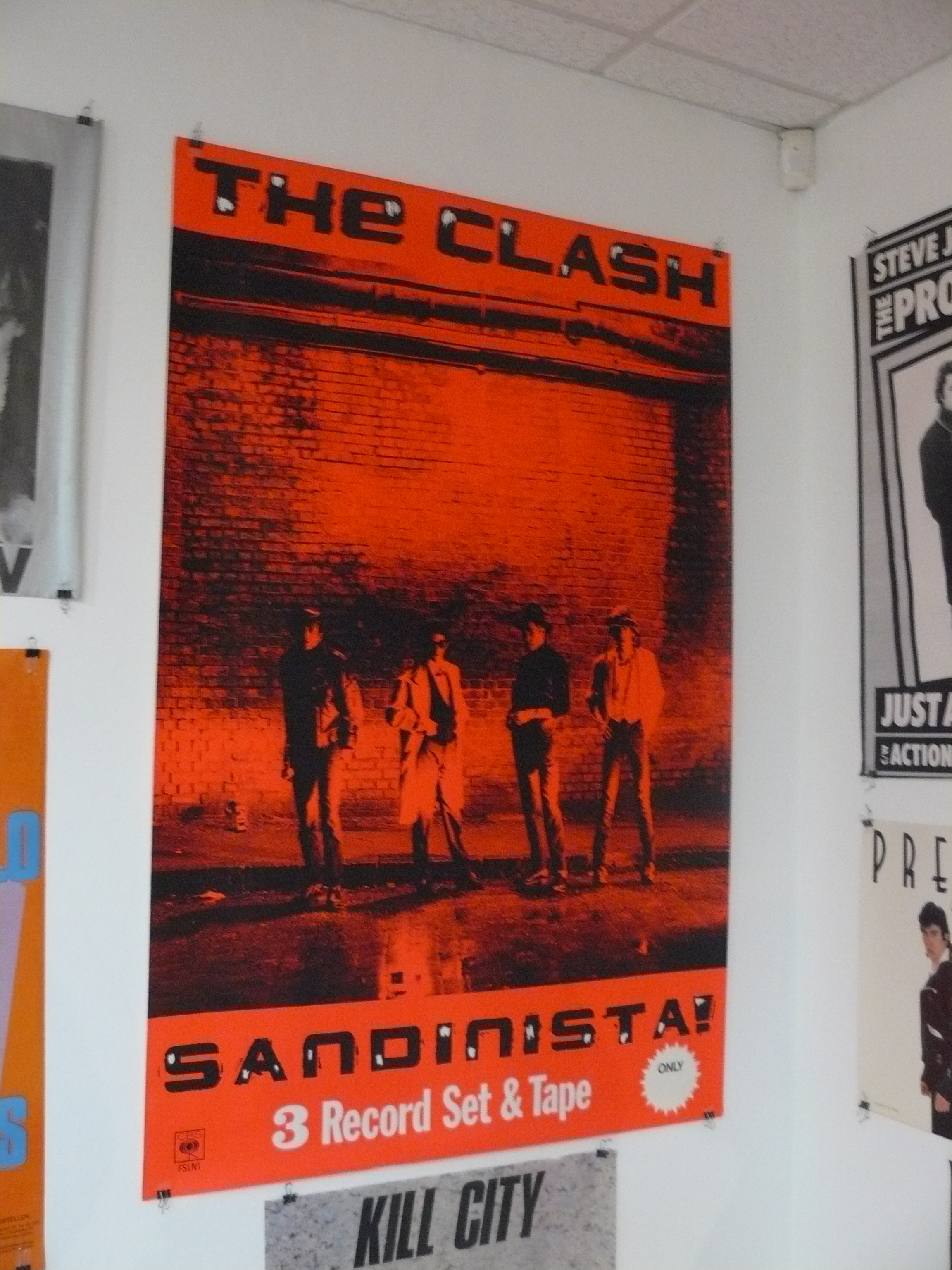
Sandinista by The Clash

The Only Ones

Siouxsie And The Banshees (with Human League third on bill)

London Calling by The Clash ('two for a fiver!')

Sex Pistols - used to introduce the band to the United States

Ian Dury

Sex Pistols

The Jam

Badges and flyers

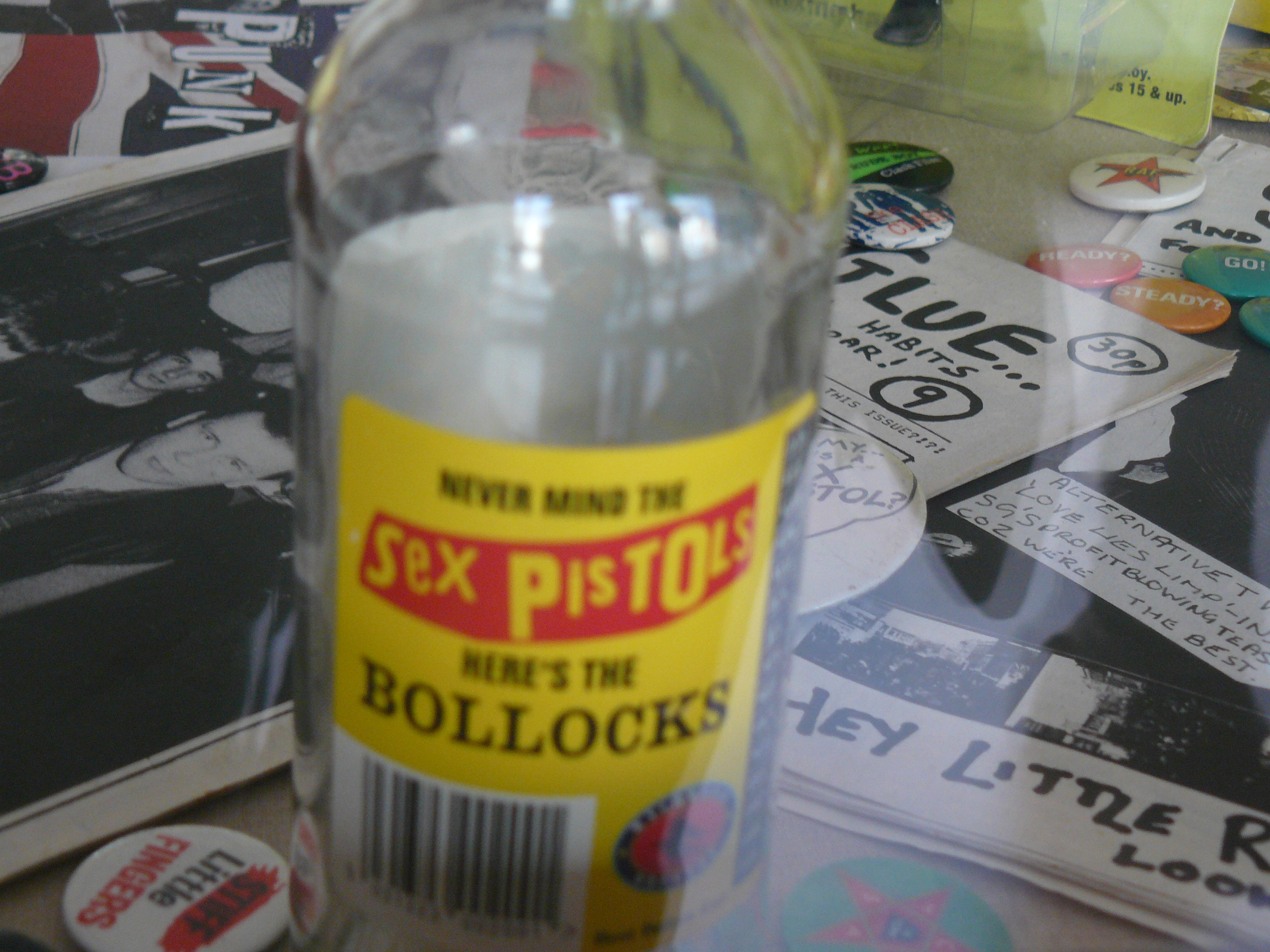
Never Mind The Bollocks beer and fanzines

Sex Pistols flyer from SPOTS tour