Category Archives: Books

Secret London: Davenports Magic Shop

It’s a surprise that Davenports has managed to make it on to the Harry Potter tourist trail given the shop is so damned hard to find. You could walk around the dank subways that link Charing Cross and Trafalgar Square for years without stumbling across it, and then one day you’ll turn a corner and whamkazaam, there it is, right in front of you, looking like it’s appeared out of thin air. Well, what do you expect from a magic shop?
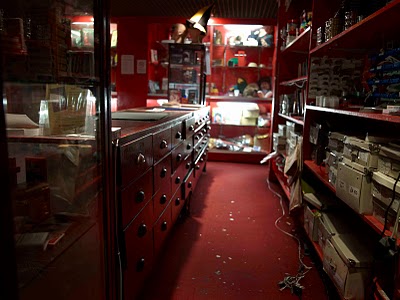
Davenports isn’t any old magic shop (if there even is such a thing), it’s the oldest family magic shop in the world, owned and run by a Davenport for four generations and eyeing up a fifth. It began in the East End in 1898 and its heyday was probably the 1950s and 1960s, when it was based first on New Oxford Street and then Great Russell Street opposite the British Museum. The shop, staffed by magicians only too happy to demonstrate their art, became such a draw for tourists they decided to take themselves off the beaten track and into the tunnels around Trafalgar Square. In the move, Davenports took with them much of the stock, some of the fixtures and all of the atmosphere – walk inside and you step back in time, to late Victorian London, when Davenports was founded and magic was experiencing its first golden age, moving from games of find-the-lady on shadowy street corners into the glamorous Music Hall theatres that dominated popular entertainment.

The vast front window is the first sign that you’ve stumbled upon a refugee from the past. It is crowded with wands, juggling balls, posters advertising old magic shows, ventriloquist dummies, ropes, boxes, cards, red Indian headdresses and a giant dog bone. Enticing no? Opening the door triggers a satisfyingly meaty ‘dong’ from a hidden bell and reveals a small red-hued, slightly creepy interior. Most of the stock, old and weird, is kept in wall-mounted cabinets behind glass doors. The wooden shelves behind the counter are covered with fading handwritten signs – ‘Whoopee Cushion, £1’ –in front of which a young clerk demonstrates sleight-of-hand tricks, pausing only to sell invisible thread and a pack of cards. He pauses between tricks, and I jump in to ask if there is anybody I can talk to about the shop’s history. He disappears, not in a puff of smoke, but round the back, and re-emerges with a neat old lady, wearing a clerk’s apron. This is Betty Davenport, granddaughter of founder Lewis Davenport. ‘I started working here in 1948,’ she tells me, ‘when I was 14 and green as grass.’ Betty has run the business since 1960 and still comes in every afternoon to keep an eye on things. She intends to keep it in the family. One son, Bill, already helps run the business while another, Reg, is a performer, and there are three grandchildren being groomed to take over. Betty has high hopes for the youngest, now seven and doing tricks since he was five. ‘Young boys are inclined to be interested in magic anyway,’ she says, ‘it’s just that when they get older, other things can get in the way.’

Unarguable, and with that thought, conversation peters out. I go back to watching the clerk perform, his brow furrowed in concentration, desperate to get things right and show that in his case those mysterious ‘other things’ were firmly pushed to one side. Davenports has a curiously sober air for a room that’s full of rubber chickens and itching powder. This is a place for serious wizardry, where illusion is business. It’s more like a library than a joke shop. Another customer walks in and starts talking about the art, and I can sense my presence as a non-magician has been noticed. Is it just me, or is there a fear in the room I might hear something I shouldn’t, a trick, as it were, of the trade? So I bid farewell to Betty, close the door and retrace my steps back through the underground passages of Charing Cross, wondering all the while whether Davenports will even be there when I return.

The nature of London: Clay by Melissa Harrison

‘It wasn’t much of a park, really, more a strip of land between the noisy high road and the flats… Despite its size and situation the strip of grass was beautiful – if you had the eyes to see. The Victorians had bequeathed it an imaginative collection of trees; not just the ubiquitous planes and sycamores, and not the easy-care lollipops of cherries either, but hornbeams, service trees, acacias and Turkey oaks with bristly acorn caps like little sea anemones. It was alive with squirrels, jays and wood mice, while in spring thrushes let off football rattles from the treetops, and every few summers stag beetles emerged to rear and fence and mate, and begin another perilous generation among the logs that were left to decay here and there by government decree.’

‘Clay’ by Melissa Harrison

Next to my computer is a small round stone my daughter brought to me from the garden. If I was to pick it up and throw it at the bookshelf, I could hit any of a dozen novels set in London,  all of which carefully detail the grimy, grey, green-free streets of the post-industrial capital. They could be set in Soho (‘Adrift in Soho’ by Colin Wilson) or Kennington (‘London Belongs To Me’ by Norman Collins), Bloomsbury (‘Scamp’ by Roland Camberton) or Bethnal Geen (‘King Dido’ by Alexander Baron). I love some of these books dearly (all of the above) while others I find unforgivably bad (er, ‘Saturday’ by Ian McEwan) but they all inhabit essentially the same milieu – a London of narrow streets and Victorian houses that block out the sky, paved streets, traffic, pubs, smoke and people. This is the written London, or at least the London most experienced by writers in London which they then transfer to the page at the exclusion of almost anything else.

dfgdf 002

None of them, then, do what Melissa Harrison has done with ‘Clay’, which is write a novel about nature in London. The plot, a slight but melancholic meditation on freedom, is really just a MacGuffin for this, Harrison’s real heroine. There are a number of non-fiction books enthusing at the way trees, weeds, flowers, foxes and immigrant parakeets coexist alongside largely uninterested Londoners – try ‘The Unofficial Countryside’ by Richard Mabey or ‘Scrap’ by Nick Papadimitriou – but by placing nature so firmly in the foreground of her novel – and the book is rich with descriptions on each page of everything from pine cones and owl pellets poo  [Harrison tells me that owl pellets aren’t poo] to rain clouds and long grass –  Harrison has managed to achieve what every London fiction writer surely dreams of: she makes you look at the city around you with freshly opened eyes.

I am perhaps a little biased – and not just because I know Harrison through Twitter (where she introduced herself to me by announcing she’d varnished a duck). The book is set in a part of London that I know already, a park based on Rush  Common, a strange, thin, scraggy strip of parkland that follows Brixton Hill from St Matthew’s church down towards the prison. I’ve always thought it a scrawny, rather pointless piece of grass but through her characters – a small boy called TC, a Polish farmer called Jozef and a grandmother Sophia – Harrison shows how much life can be concealed a short walk from a traffic-clogged A road. It gives an unexpectedly life-affirming twist to an otherwise sad but beautiful book, that resonates far louder than its slim size would suggest. Is it a new London genre? It’s certainly a welcome change from the norm, though I doubt whether many other writers would have the knowledge, passion and skill to recreate it so impressively.

A brief history of Covent Garden

There are many reasons to cherish Covent Garden, not least of which is that it exists at all. The area nearly didn’t make it past 1973, when it was scheduled for ‘redevelopment’ after the fruit and veg market moved out. The GLC drew up enthusiastic plans to replace 96 historic acres with a conference centre and lots of roads. The plan was defeated by locals who believed Covent Garden could have a different sort of future, one that didn’t involve hundreds of buildings being demolished and everything getting covered in asphalt. They were eventually proved right, although nobody anticipated that Covent Garden would turn into the upmarket open-air shopping mall it has since become.

Inigo Jones might have approved of its current status, though. It was he who built an elegant Piazza on an old abbey garden in 1630, transplanting a piece of Italy to the centre of London and unwittingly creating that definitively London piece of architecture, the residential square. The area grew in significance after the Great Fire destroyed much of the City, but then decline set it. We may now see Covent Garden as the place where Eliza Doolittle met Henry Higgins, a halfway house between the posh Englishness of Mayfair and louche Frenchness of Soho, but the place got pretty debauched in the 18th century, a hive of taverns, theatres and coffee shops, all haunts for prostitutes like Peg The Seaman’s Wife, Long-Haired Mrs Spencer of Spitalfields and the delightful Fair Rosamund Sugarcunt.

The area’s drift in tone came as the market expanded and the gentry who occupied the Piazza decamped to the newer squares of Berkeley, Grosvenor and St James’s. At around the same time, Charles II reintroduced theatre to the UK, and companies gradually moved from the nearby Inns of Court into Covent Garden by way of Drury Lane. Theatres brought rowdy audiences and actresses who doubled as bawds, and were a magnet for lowlife figures. In 1722, there were 22 gambling dens, countless brothels (one pimp published an annual guide to London’s prostitutes called Harris’s List of Covent Garden Ladies) and street brawls were commonplace. In 1951, HV Morton argued that Covent Garden provided ‘the most accessible glimpse that remains to us of Hogarth’s London’, but post-war Britain offered nothing quite as depraved as the third plate from Hogarth’s Rake’s Progress, set in Covent Garden’s infamous Rose Tavern. Hogarth depicted the Rose as a den of sin, full of drunks, thieves and whores. The tavern specialised in women who engaged in flagellation, both giving and receiving. Pepys was a regular, although he only seems to mention the food, for which it was also famous.

Given such carnage, it is little surprise that in 1754 Henry Fielding would organise the Bow Street Runners, the progenitors of the Met, from Covent Garden, and the area slowly improved from a hotbed of crime into a straightforward slum. Throughout, the market remained central – Charles Fowler’s fine market building was erected in the 1830s and the Flower Market arrived in 1870 – so it was easy to believe that when that moved to Nine Elms, Covent Garden would wither and die.

Amazingly, though, Covent Garden survived. That is largely due to its fringe attractions, which expanded to fill the vacuum left by the market. Theatre was key – opera was now a decidedly upmarket pursuit – but by the 1980s the area also boasted decent restaurants and, on Neal Street, trendy shops like Red Or Dead and Duffer Of St George. Credit must go to Nicholas Saunders, who opened a wholefood shop in Neal’s Yard in 1976. His alternative empire slowly spread to other buildings, creating a colourful corner of the counterculture in the heart of Covent Garden even as anti-hippie punks gathered round the corner, in the Roxy on Neal Street. Neal’s Yard still has an idiosyncratic flavour – the blue plaque to ‘film-maker’ Monty Python seems well placed (Palin and co had offices here).

What Neal’s Yard illustrates is the way that amid the ubiquitous stage doors, posh shops and cobbled streets, the different parts of Covent Garden retain an individual imprint, from the bookshops of Charing Cross Road to the boutiques of Floral Street, where Paul Smith still has a rickety presence. Seven Dials is one of London’s more interesting shopping areas, while the Piazza has been transformed from a ragged craft market into a chi-chi mall. The idea is to attract Londoners as well as tourists, and the Piazza has certainly smartened up, with the central market a mecca for shoppers, serenaded by opera singers and overlooked by a fancy Apple store in one corner and refurbished London Transport Museum in another.


Covent Garden is a patchwork then, more diverse than superficially similar areas like Soho and Spitalfields and still boasting enough fascinating nooks and crannies to keep even the most experienced Londoner busy for hours, even if Hogarth and Fair Rosamund Sugarcunt might no longer recognise the streets they once adored. 


Death and collecting

The Wellcome Collection is currently showing a typically absorbing exhibition titled Death, but it’s not really about that at all. It features work from a private collection, that of Richard Harris, and largely consists of skulls and skeletons, many of which are actually rather lifelike.

In fact, despite its arresting title, this is in many senses a rather squeamish, clean exhibition. There’s no dying, no decomposition, no pain, little mourning or God. There are no worms eating dead bodies, no cancer destroying live ones. It’s not even particularly morbid. It’s more about one man’s obsession with the human skeleton, stripped of flesh and cleansed of blood, sinew and memory, as portrayed by a number of very beautiful works of art over the centuries. If you want a more gruesome, more real, idea of death, try the Museum of London’s Doctors, Dissection and Medicine Men.
Collection owner Richard Harris stands in front of a work my Mexican artist Marcos Raya called Family Portrait : Wedding  at the 'Death: A Self-portrait' exhibition at the Wellcome Collection on November 14, 2012 in London, England. The exhibition showcases 300 works from a unique collection by Richard Harris, a former antique print dealer from Chicago, devoted to the iconography of death. The display highlights art works, historical artifacts, anatomical illustrations and ephemera from around the world and opens on November 15, 2012 until February 24, 2013.

It is tempting to speculate why Harris is so fascinated with his particular idea of death – why so clinical? Why so safe? – but it’s also ultimately rather pointless. In his excellent essay on collecting, Unpacking My Library, Walter Benjamin noted that ‘‘Collectors, like artists, operate out of unconscious motives, and so we cannot be known to ourselves.’ A collection can be about anything, and may reflect a personal interest or a psychological flaw, but the reasons behind their creation are rarely as interesting as you may hope.

What is intriguing about Harris’s love for skulls is that collections are often built as a defence against death itself, a way for the collector to claim mortality for himself in the form of something that will exist after he no longer does so (even if most collections end up being broken by families who lack the passion or obsession to keep them intact). Collections are also about memory, a way for the collector to freeze a moment in time. Every item represents a second, an hour, a week, a month – however long it took to locate and acquire – in the collector’s life that he can look at and recollect for years to come.

A collection is also about surrounding yourself with cool things that you like, although whether this ever makes the serious collector happy is a moot point. In his study of the collecting impulse, To Have And To Hold, Phillip Blom astutely notes that ‘For every collector, the most important object is the next one’, an acknowledgement that the collector will never be satisfied by what they have, as their next acquisition could be the big one, the one that completes the collection, or sends it off in an exciting new direction. This will never happen, of course, locking the collector in a spiral of anticipation and disappointment.

All of this is true whatever is being collected, whether it’s sick bags from aeroplanes, James Bond first editions or things that might be haunted. And just about anything can be collected, if you have the right kind of imagination. My friend Carl Williams, who deals in the counterculture, talks about his idea of collecting around ‘the sullen gaze’, that look of cruel insolence and careless superiority perfected by William Burroughs but which can be traced to many others, putting arresting flesh on Harris’s ambivalent skull.

Pot in Hyde Park and the death of Stephen Abrams

Steve Abrams, a key member of the London 1960s counterculture, died last week. Abrams was principally responsible for the above advert, which ran in The Times in July 24 1967 declaring that ‘The law against marijuana is immoral in principle and unworkable in practice’.

The advert was paid for by Paul McCartney and was signed by numerous celebrities, including all four Beatles, Francis Crick, Graham Greene, David Dimbleby, Jonathan Miller, Brian Walden and many others.

Abrams told Jonathon Green in ‘Days In The Life‘ that ‘After the ad came out  a friend of mine got on the train and delighted at each stop in watching people opening their copy of The Times and their expressions of disbelief. So wonderful was this that when he got to Victoria he took another train back and did it again just to watch.’

It is less well known that Abrams was also involved in Timothy Leary’s experiments with psilocybin, taking the drug at Harvard for Leary in 1961. Abrams then described his experience as ‘very pleasant’, giving him ‘tremendous insight’ even if it was ‘somewhat alien’, and he was ‘very eager’ to try it again, which he most certainly did.

After the  The Times advert, Abrams co-organised a pro-pot rally at Hyde Park in 1967. Everybody got very high, including guest Allen Ginsberg, who wore a virulent psychedelic shirt given to him the day before McCartney and was warned by police for disturbing the peace by playing his harmonium.

Beats in London

When Ned Polsky wrote Hustlers, Beats And Others his pioneering sociological study of the Beat subculture as it was in 1960, he was scathing of their literary value. ‘Most beat literature is poor when it is not godawful,’ he opined. ‘And this is certainly true of its best-publicised examples, which have been surpassed by even the minor Victorians: James Thomson’s poetic howl of urban despair, The City of Dreadful Night, is greater by far than anything Ginsberg offers, and in on-the-road literature the genuine gusto of George Borrow is preferable to the faked-up fervour of Kerouac.’

Stinging stuff – and that faked-up charge must have hurt – but times change, and while the Beats are still an acquired taste, one can’t image George Borrow being the subject of a special exhibition at the British Library, as is currently the case with Jack Kerouac.

On The Road: Jack Kerouac’s Manuscript Scroll is a small but welcome look at the basics of Beatery, offering an overview of the main protagonists – Kerouac, Burroughs, Ginsberg, Corso (the only one Polsky rates) – and trying to explain where they fitted within the American literary tradition. The exhibition is illustrated by photographs, many of the American landscape as explored in On The Road, but also of the writers themselves. I particularly liked this shot of William Burroughs, dressed like a fugitive Nazi, hand shielding eyes from the sun as he stares back with clinical impassivity. Burroughs is possibly the most photogenic writer there has ever been.

The main exhibit, though, is the extraordinary scroll on which Kerouac wrote a key draft for On The Road. You do not have to like the book – and I don’t, particularly – to appreciate the sheer thrilling insanity of this object, 120 feet of closely typed pages, filled with ‘spontaneous prose’ and occasional pencil marks. I have never seen a manuscript like it.

Kerouac’s second novel has been described as the book that ‘started
a whole new youth culture of which drugs were an accepted part’, so sodden is it in dope and speed. It was based on a series of road trips Kerouac took with
Neal Cassady (the pair are reinvented as Sal Paradise and Dean Moriarty respectively) between 1947 and 1950, and most of the characters are based on Kerouac’s friends. Mythology states that it was written in a three-week
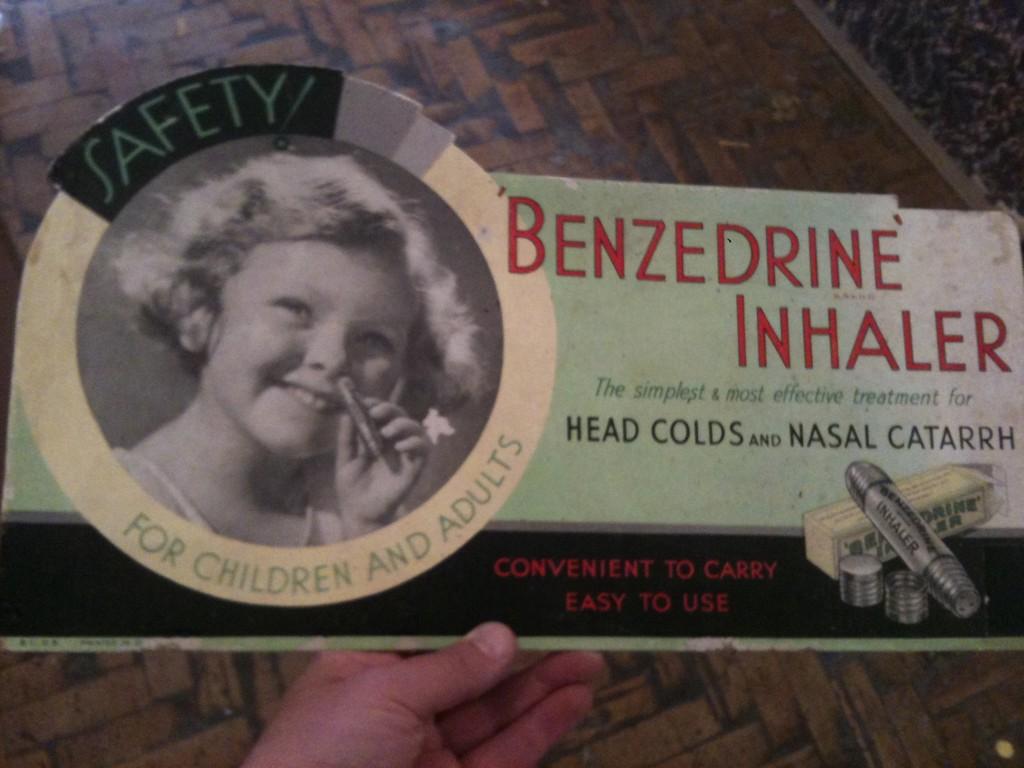
splurge fuelled by coffee and Benzedrine, but Kerouac actually began it as early as 1948, when he also came up with the title. He spent a while searching for a voice, but eventually settled upon a stream-of-consciousness, jazzy, impressionistic style. This was inspired by a 40,000-word letter written to him Cassady, a charismatic sociopath described by his biographer as ‘a slim hipped hedonist who could throw a football seventy yards, do fifty chin-ups at a clip and masturbate six times a day’. Cassady was trouble; he was also said to have ‘one of the greatest minds I’ve ever known’, by a friend of writer Ken Kesey.

Kerouac sat down to write his famous ‘scroll’ draft on 2 April 1951 on a 120-feet sheet of paper that had belonged to Bill Cannastra, a wild-living friend who had been decapitated after sticking his head out of a New York train window.
Kerouac spent many years rewriting the manuscript as he tried to find a publisher, and it was eventually brought out by Viking in September 1957 – Kerouac belatedly considered renaming it Rock and Roll Road
to catch the spirit of the time – and immediately received an ecstatic review in the New York Times, which claimed it was ‘the most important utterance yet made by the generation Kerouac himself named years ago as Beat’.

On The Road is one of the most important books of the post-War era, but it’s questionable how much it influenced English culture given that it is such a specifically American book on such an American topic written in the American vernacular. London was more taken by Burroughs and Ginsberg, both of whom would spend extensive time in the city while Kerouac only visited for a few days in the 1940s when serving in the Navy. By 1959, Barry Miles, Jeff Nuttall, Michael Horovitz and the rest of the British counterculture scene were soon discussing, publishing, imitating and eulogising the Beat poets. 

Being more of a philistine, though, I prefer the exploitation stuff. Tony Hancock frequently mocked Beatnik culture, notably in The Poetry Society.

Hancock: You see, Sidney, we are a collection of kindred spirits who are all revolting against the Establishment.

Bill: How long have you been at it?

Hancock: Three days.

I also like Colin Wilson’s often sardonic but hugely charismatic novel, Adrift In Soho, which has that time-honoured plot of a young ingenue coming to London and getting drawn into a curious sub-culture, in this case the Beats. It is apparently currently being made into a film.

But the pull of the Beats, that desire to be different, was probably best expressed by Hancock again, in the opening scenes to his film, The Rebel. ‘Where are we going?’ It’s what Kerouac was asking, and it’s what Hancock wanted to know as well. Well, where?

Four literary London maps

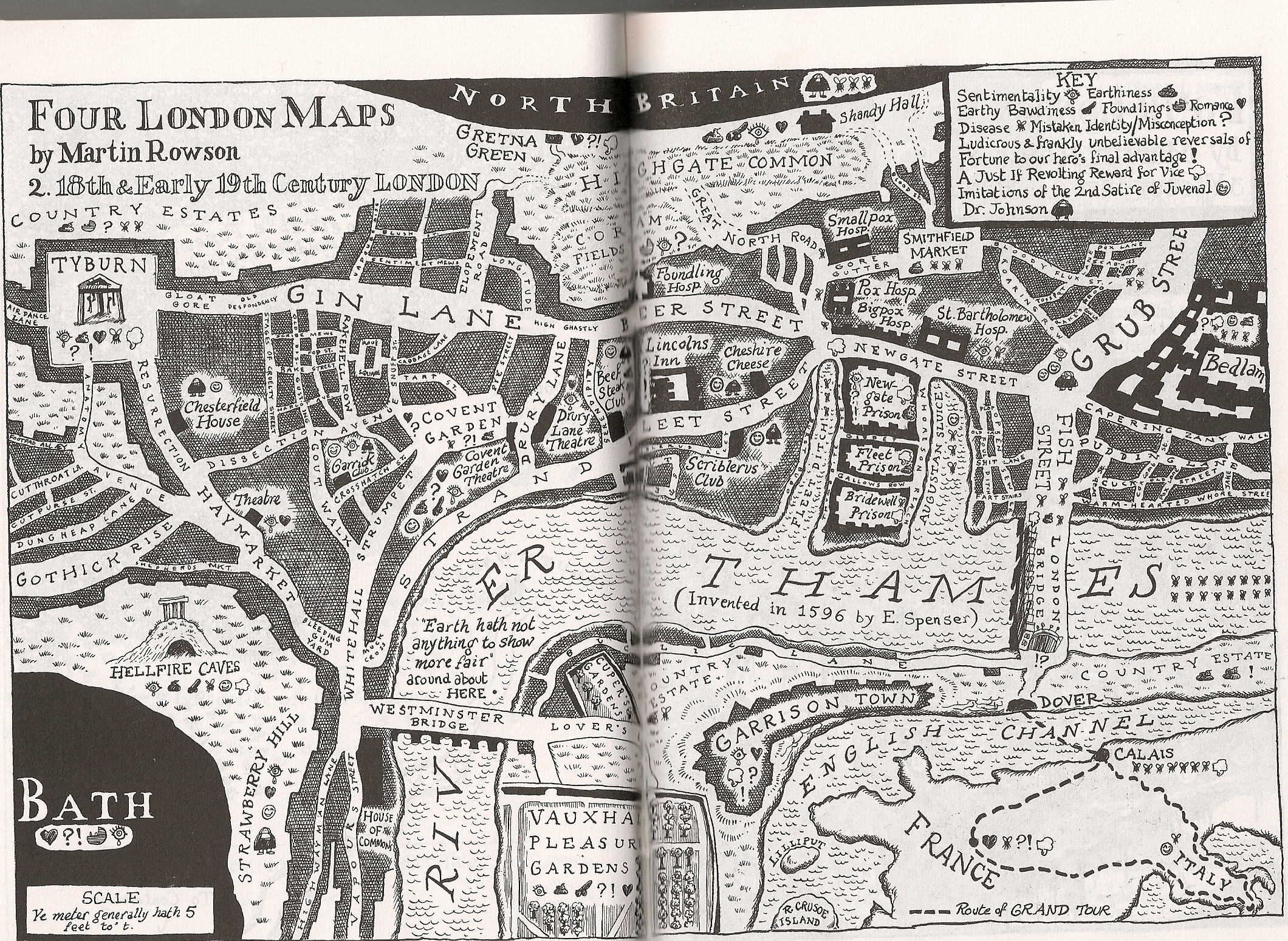
These four maps of literary London were drawn by Martin Rowson for the rather wonderful 1999 London issue of Granta magazine.

Chaucer’s London

Georgian London

Victorian London

Modern London

Peter Hitchens on drugs and the moral, opium-eating, Victorians

Peter Hitchens is a very clever man. I’m sure he’s also sincere – I can’t believe British newspapers would employ somebody to say stupid and provocative things just to get attention, after all – but judging by the interviews he’s conducted for his new book about drugs, The War We Never Fought, he’s a little bit daft.

Hitchens theory is that there has never been a war on drugs. ‘Drug-taking was, in effect, decriminalised by the Misuse of Drugs Act 1971,’ is how Decca Aitkenhead paraphrases. Instead, he harks back to the golden age of the Victorians, when there was ‘increasing self-imposed moral conduct’ (Hitchens’ words.)

Where to begin with this nonsense? Well, let’s just stick to the last bit, those morally virtuous Victorians. In a sense, he’s right: the Victorians didn’t take illegal drugs. That’s because they were too busy snaffling down the legal ones – things like opium, cocaine and cannabis – which were available to just about anybody who needed them until 1868, and then over the counter from chemists until 1926. This was the golden age of drug-taking in Britain, with opium being consumed on a scale we could scarcely now believe.

Victorian London was awash with opium, not in semi-mythologised Chinese opium-smoking dens in Limehouse (of which there were very few), but in pubs, chemists, general stores and markets, where it was sold in bottles, powders, pills, lozenges, on plasters, in sweets and much else besides. The centre of trade was in Mincing Lane, London, where 90 per cent of transactions occurred. It was most commonly taken as laudanum, a tincture of opium and red wine, with saffron and cinnamon.

This was not thrill seeking. In the days before aspirin, opium was one of the few reliable painkillers available to Victorians, especially especially fever and diarrhoea, but also malaria, smallpox, syphilis and TB. And it was effective as well. As anybody who has taken codeine or morphine will confirm, opiates have a tendency to block you right up – something that was particularly helpful when the next cholera or dysentery epidemic was just around the corner.

However, opium was also used on children, particularly when teething, in specially formulated sweet concoctions like Godfrey’s Cordial and Mrs Winslow’s Soothing Syrup, and thus surely led to the deaths of many by overdose. It also, believes the drug’s historian Martin Booth in Opium: A History, ‘provided an escape from the misery and vicissitudes of working-class life.’ This was especially the case in the Fens, where ‘many never take their beer without dropping a piece of opium into it.’

Because of these two factors, opium was belatedly seen as a physical and spiritual danger, and Victorian abstinence advocates put it right up there with alcohol and tobacco as serious threats to British life. What’s interesting, though, is the way – anecdotally at least – users were able to effectively and relatively painlessly self-medicate, living normal decent lives despite their addiction, without resorting to crime. This is true for the working classes, it’s true of the famous opium-eating writers like Coleridge, Shelly, Keats, Collins and De Quincey, and it’s also true of the many great statesmen – the sort of people who shaped the British Empire so beloved by Peter Hitchens – who took the drug. You see, because opium was the only halfway reliable painkiller around, everybody took it – including people like William Wilberforce, the great Christian abolitionist, and William Gladstone, who popped some in his coffee before speaking in Parliament to improve his rhetorical powers – even if not all of them became addicted.

In later years, opium – and especially its stronger derivatives morphine and heroin – began to be used by those simply seeking a pathway to an altered consciousness, a shortcut perhaps to the sort of transcendent mystical experience some people get from religion. In doing so, they were merely following pattern taken by mankind in all civilisations since the dawn of time, however much Hitchens may wish that weren’t the case.

As restrictions were introduced – for opium, not alcohol and tobacco – drug-use declined massively and by 1960 there were less than 100 registered heroin addicts in the UK. They received their drugs from doctors, cheap and undiluted, and were largely able to enjoy a normal existence (at least in comparison with their criminalised counterparts in America). However, as drug use increased in the 1960s, restrictions were imposed, culminating with Hitchens hated Misuse of Drugs Acts in 1971, after which drug supply passed almost completely into the hands of the criminal and use immediately rocketed. A far cry indeed from those morally virtuous days of the 1850s, when Britain’s great and good could simply pick up a bottle of premium laudanum from their nearest general store and retreat into blissful opium dreams.

Wellcome to London: how Henry Wellcome ‘hoovered up the world’ and left it on the Euston Road

Wisconsin, 1858. A five-year-old boy is playing near his frontier home when a strange stone catches his eye. He takes it to his father, who examines the flint carefully before deciding that it was a prehistoric tool made thousands of years before to cut meat. It probably meant as much to its creator as the railway did to modern humans. ‘That excited my imagination and never was forgotten,’ wrote Henry Wellcome years later, after he had grown up, moved to London and accumulated one of the largest collections of scientific paraphernalia that has ever been gathered by a single individual.

Henry Wellcome

Wellcome established his pharmaceutical company, Wellcome-Burroughs, in 1880, making a mint selling pills to an English public that had previously taken medicine in the form of powder or syrup. This fortune sits in the Wellcome Trust, which was established 76 years ago and is now worth £14 billion, making it one of the world’s largest charitable foundations. Next door to the Wellcome Trust HQ on Euston Road, a short walk from St Pancras, sits the Wellcome Collection, a museum that houses some of the million or so objects collected by Wellcome in his lifetime. Here is Napoleon Bonaparte’s toothbrush, ancient sex aids, Chinese torture chairs lined with blades, boxes of false eyes, human skeletons and paintings by Van Gogh. It is one of the most extraordinary collections in the world, a throwback to a time when wealthy individuals would hoover up the weird and wonderful of the world for their personal collections, but executed on a scale few could compete with.

Ken Arnold is the Wellcome’s Head of Public Programmes. ‘This is the last great non-connoisseurs collection,’ he says. ‘Our usual concept of a collector is somebody who carefully decides whether something is authentic and then forks out a huge amount of money for it. Wellcome had an “other-end-of-the-telescope” approach. He saw everything through medical-tinted spectacles and wanted to own anything that would illuminate that fascination.’

Wellcome collected everything: paintings, engravings, photographs, models, sculptures, manuscripts, books, periodicals, pamphlets, letters, prescriptions, diplomas, medical instruments, archaeological finds, skeletons, skin, hospital equipment, advertisements, drugs, remedies, food, plants, microscope slides, charms, amulets, ceremonial paraphernalia, costumes, medals, coins and furniture. He bought entire shops, contents, fixtures and fittings, acquiring enough to recreate an entire street. He bought others collections, picked up human skulls from African battlefields and returned from one typical trip abroad with 44 packing cases of material. If something wasn’t available, he had an artist make a reproduction. Teams of buyers were finding him items right up until his death in 1936. His reach was broad and their brief was wide.

‘Wellcome had deep pockets and no bureaucrats telling him what he could bring home so he had none of our moral, financial or logistical concerns,’ says Arnold. ‘He hoovered up the world, and left us with this extraordinarily unwieldy and undisciplined collection.’ Although Wellcome amassed an immense collection, he was frugal with his money. ‘He was very wealthy, but he would send employees to auctions dressed down so they didn’t look too rich, and would set up fake companies so people wouldn’t know it was his money,’ says Ross MacFarlane, research officer at the Wellcome Library.

A chippy self-made American, Wellcome could never become part of the British establishment – although he was awarded both a knighthood and the French Legion d’honneur – and a desire to be taken seriously may have prompted his determination to create a museum of ‘the art and science and healing’. This opened in 1913 in South Kensington, before it moved to Wigmore Street and closing in 1932. When Wellcome died, the collection was put into storage or dispersed.

‘The British Museum has 40,000 objects, the Science Museum has more than 100,000, the Pitt-Rivers in Oxford has 30,000 items and there are bits in almost every museum in the UK,’ says Arnold. The Wellcome Trust has since taken a similarly philanthropic approach, funding wings in numerous UK museums, galleries and academic institutions.

In 2007, the Wellcome Collection opened. It is a modern, classy space, with a cafe and bookshop, as well as a gallery that hosts thought-provoking exhibitions that use art and science to explore topics such as Skin, Sleep and Brains. Their next exhibition, Death, promises to be particularly fascinating and challenging.

The Wellcome dares to be different: while most museums take an unfamiliar topic and wring all the knowledge out of it like a damp dishcloth, the Wellcome looks at something familiar and turns it inside out, using contemporary art and scientific research to make visitors question what they think they already implicitly understand. Their ability to do this can be traced back to Henry Wellcome himself.

‘We feel free to interpret the material Wellcome collected,’ says MacFarlane. ‘Because although we know when something was bought and what it cost, we don’t always know how it got to the auction.’ Arnold expands on this: ‘He didn’t talk about his philosophy. There’s enough to get an idea of why he was collecting, but there’s not so much that we feel we have to conform to his beliefs. He once said ‘Never tell anybody what you are planning to do until you have done it.’ That sounds like a good idea to me…’

So the Wellcome eschews blockbuster shows – which Arnold describes as ‘a depressingly greedy way to conduct exhibitions’ – and takes pride in imaginative live events. ‘We never try to be definitive,’ says Arnold. ‘There’s always more to discover. And we don’t want to be po-faced. Science is either deadly serious or fun with pink fluffy letters – and between these two unpalatable positions is a yawning chasm that can be filled with smart and sophisticated entertainment.’

Of course, the Wellcome is helped by having a lot of money in its coffers. ‘We are much more privileged that most other organisations. We are wealthy and we don’t have to satisfy civil servants, corporate sponsors or shareholders. But that attitude comes from the Wellcome Trust itself: science is a risk-taking business and there is a sense we are allowed to be experimental.’

MacFarlane finishes that thought, ‘When we take the directors an idea, they’ll often want to give it a go, and that’s a bit like how Wellcome collected. It’s a great position to be in.’

Wellcome Collection, 183 Euston Road, NW1 2BE. Admission free. The Wellcome’s next exhibition is Death, from November 15. 

Punk at the Hayward: curate and destroy

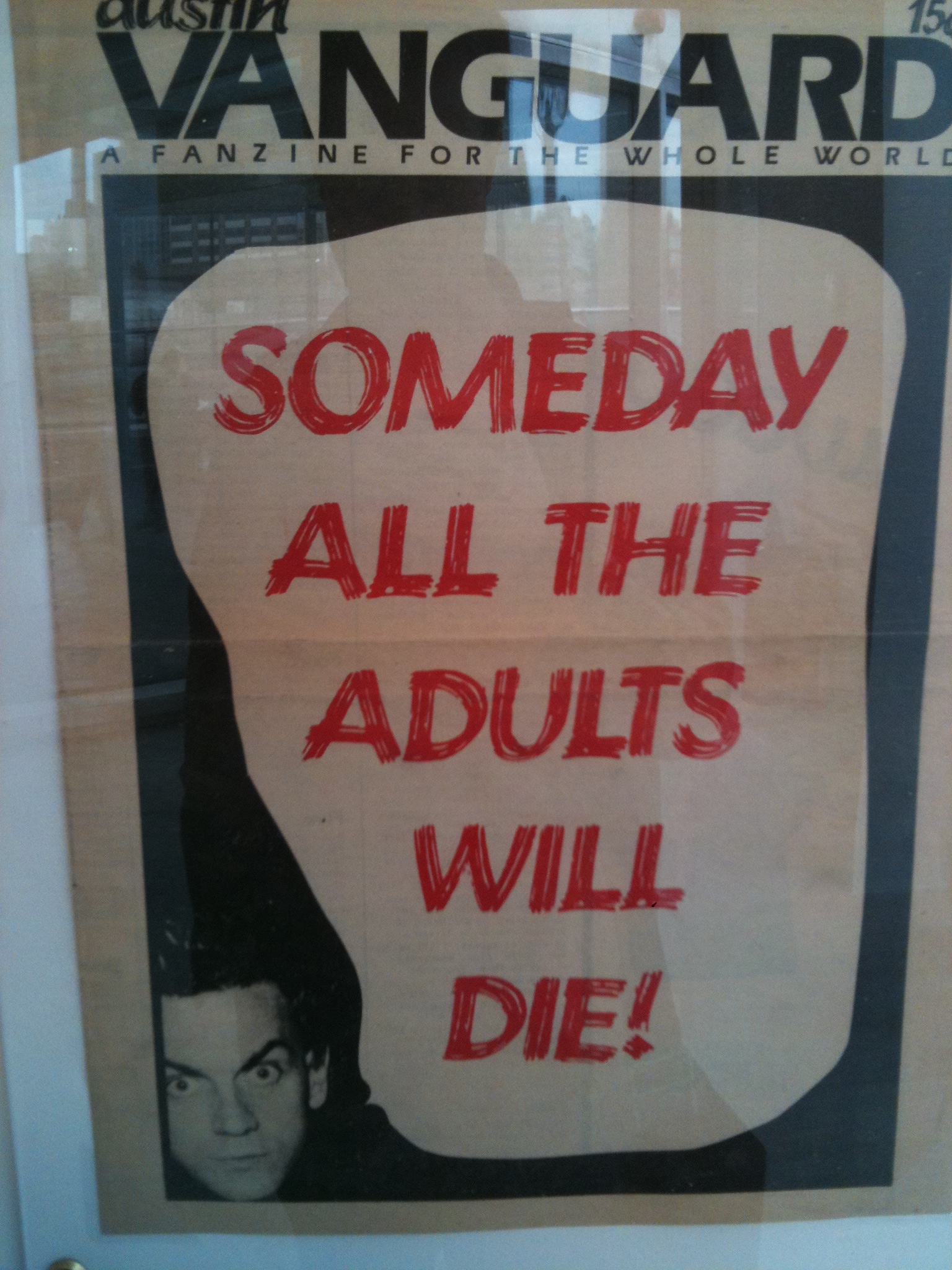
Does any music form have as curatorial approach to its own history as punk? In many ways that is understandable, as the graphic art that came out of the punk movement is as interesting as most of the music, while many of the scene’s key movers always saw themselves as part of a cultural avant-garde that went back to the Symbolists and still wish to emphasise that. One of the most prominent of these voices is Jon Savage, and he has co-curated an exhibition at the Hayward Gallery on punk called Someday All The Adults Will Die.

Despite punk now being nearly 40 years old and having been curated like a dead horse for several decades, it still has a visceral and visual appeal to many – and not necessarily the people you may expect. When I visited the gallery, most of my fellow visitors appeared to be in their 20s: this was clearly not simply an excuse for a nostalgic wander back through adolescence by men suffering a mid-life crisis. The kids dug it.

It’s a wide-ranging exhibition, with sections devoted to seven-inches, cassettes, posters, flyers and fanzines, including Savage’s own London’s Outrage.

My favourite stuff tended to be the less predictable such as pre-punk items involving the Diggers, who co-existed awkwardly with the hippies in San Francisco in 1966 and 1967, as these mimeographs demonstrate.

There was also items reflecting Savage’s fascination with Situationism, including this King Mob poster. Malcolm McLaren was loosely affiliated to King Mob.

I also liked the items relating to Suburban Press, the witty and brilliant pre-punk/Situationist publishing house created by Jamie Reid.

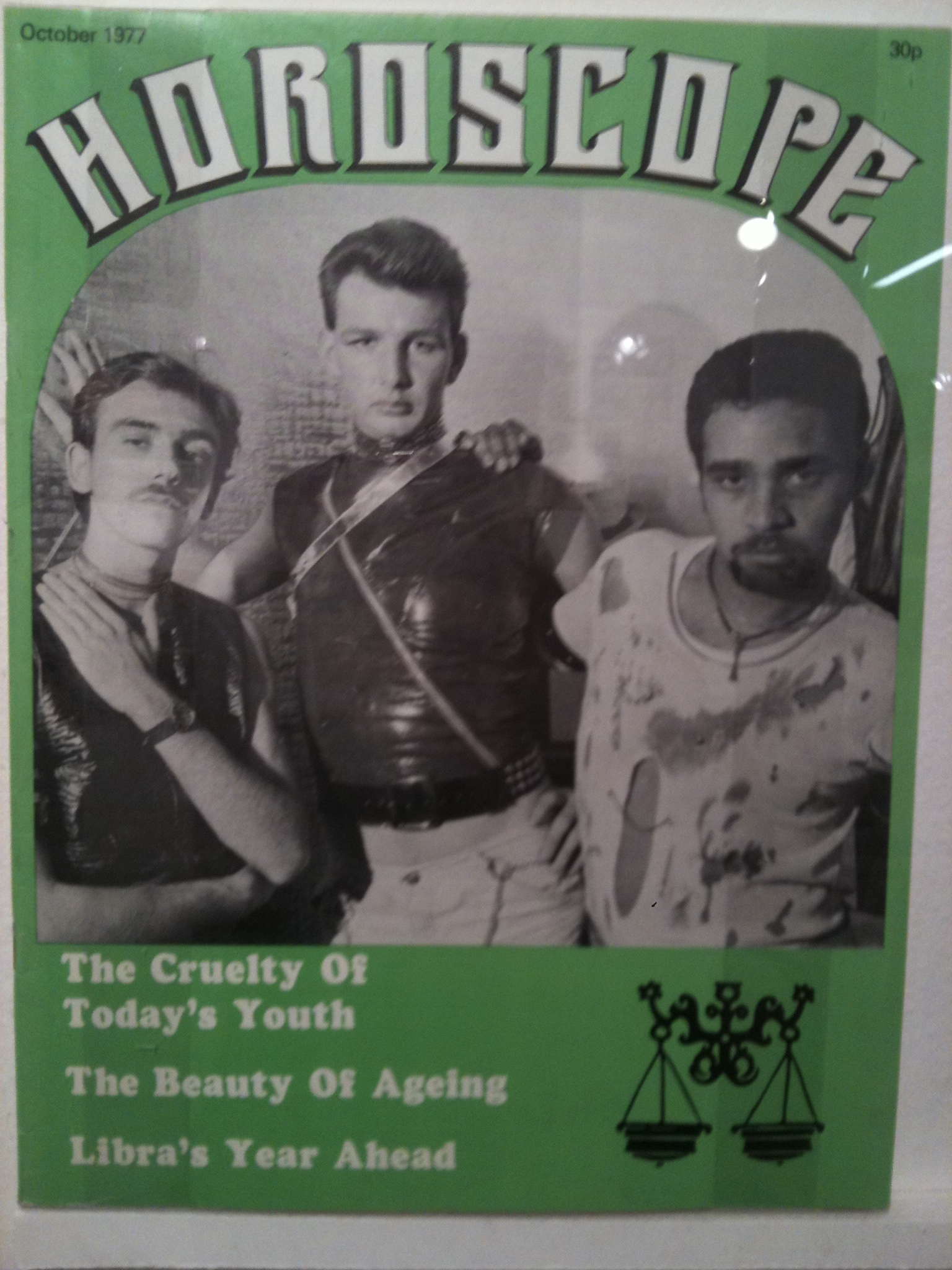
And, finally, I loved the handful of contemporary examples demonstrating how the mainstream tried to cash-in on punk with things like a punk-themed horoscope magazine and punk pulp fiction. Such money-grabbing tactics, it must be noted, have since been refined somewhat…

Someday All The Adults Will Die is at the Hayward until November 4.