Maggs Bros is a posh antiquarian bookseller on Berkeley Square that has a Royal Warrant and is supposed to occupy the site of the most haunted house in Britain, but it is also home to a small contemporary art gallery, located out the back and accessed via 50 Hays Mews.
The latest show is being curated by New Artists and features photographs by Richie Culver taken of London crackhouses. These are loosely based on Gustave Dore’s engravings of Victorian opium dens.
The exhibition also features Polaroids by Shorvon & Hunter that explore the demise of the Polaroid and newspapers as forms of media. It’s definitely worth a look if you are in the area before it closes on Monday, December 5.
If you do, you should also pop upstairs to see a selection of some items that Maggs’s counterculture expert Carl Williams is currently selling. These include photographs of William Burroughs taken by Brion Gysin in Paris and an extraordinary mural taken from an American street gang club house. You could also pick up a copy of Carl’s latest catalogue to see if he has anything you fancy, whether it be items to do with Crowley, punk or the Weathermen. Last time I visited, he showed me some pictures he’d just acquired of dead Victorian babies, but don’t let that put you off.
Hollingshead was the British man who introduced LSD to Tim Leary in December 1961 on the recommendation of Aldous Huxley. Hollingshead was working in New York when he came upon a quantity of LSD. Huxley suggested he send it to Leary, who was already experimenting with administering psilocybin to patients during his psychological research at Harvard. Leary loved it. The LSD revolution began.
After working in America with Leary – he even lived in his house – Hollingshead was sent to London in September 1965 with enough Czechoslovakian lysergic acid to produce 5,000 trips, thirteen boxes of psychedelic literature – The Psychedelic Experience, The Psychedelic Review and The Psychedelic Reader – and plans for ‘a psychedelic jamboree’ at the Royal Albert Hall featuring the Stones, the Beatles and Leary himself. Although this is sometimes presented as Hollingshead playing the role of John The Baptist to Leary’s Psychedelic Christ, Barry Miles’s ‘London Calling’ suggests that Leary was just trying to get rid of the increasingly drug-addled Hollingshead and is said to have remarked upon his departure, ‘Well, that writes off the psychedelic revolution in England for at least ten years.’
Hollingshead promptly set up his base at his flat in Belgravia’s Pont Street, which he renamed the World Psychedelic Centre, and redecorated with the key elements needed for a good trip: bowls of fruit, handwoven cloth, open fire, bread, cheese, wine, candles, incense and goldfish. A chill out space, basically.
This was one of only two reliable sources for LSD in London at the time, so visitors were plentiful and Hollingshead began welcoming key figures from the scene – including Roman Polanski, Alex Trocchi, William Burroughs, Paul McCartney, Eric Clapton, Donovan and the Rolling Stones.
Guests were invited to take part in LSD sessions designed to make the most of the experience, with ‘lots of cushions, some excellent tapes and hi-fi equipment, a slide projector, and several chillums’. The LSD was dispensed after midnight inside grapes impregnated with 300 micrograms of the drug. The atmosphere was key. Hollingshead writes:
Shortly after dropping the acid, I played a tape of Buddhist Cakra music, followed by Concert Percussion by the American composer, John Cage. Next I played some music by Ravi Shankar and some bossanova. Interval of fifteen minutes. Then some music by Scriabin and part of a Bach cello suite. Interval. Some Debussy, and Indian flute music by Ghosh. Interval. Bach organ music and some John Cage ‘space’ music. Interval. The Ali Brothers and Japanese flute music. We also looked at slides projected on to the ceiling Tantric yantras, Vedic Gods, the Buddha, Tibetan mandalas.
There were also regular readings from Leary’s work
While Hollingshead dispensed LSD to his visitors in these carefully controlled conditions, he was soon self-medicating with cannabis, speed and heroin to control the fierce highs he experienced from taking strong doses of acid at least three times a week. The tabloids soon got wind of these experiments with the ‘killer drug’ and after hosting a party of 80 hippies at which two undercover police officers were dosed with acid after sampling the spiked punch, Hollingshead was busted. Naturally, he attended his trial while tripping and was sentenced to 21 months at Wormwood Scrubs. There he met spy George Blake, who promptly took a trip on some of the acid Hollingshead smuggled in to the prison, before escaping and going into exile in the Soviet Union.
Hollingshead didn’t make it quite that far himself, ending up in Cumbrae, a Scottish island, where he settled with a group of believers who treated LSD as a holy sacrament in quasi-religious services. He then went on his world travels.
Hollingshead was undoubtedly a key player in the scene. However, it’s notable that when a copy of his book, The MAn Who Turned on the World was sent to Timothy Leary in prison in the 1970s, Leary underlined only a single sentence – ‘…my taking of methedrine…’ Leary’s acquaintances believe that not everything Hollingshead said about his role in the psychedelic revolution could be trusted because of his addiction to opiates.
Squatting as a 20th-century phenomena originated in the wake of the acute housing shortage after the Second World War. Homeless families began to occupy empty mansion blocks and hotels, including Duchess of Bedford House in Kensington.
Squatters move into Duchess of Bedford House
Some of the squatters of the 1960s took this as their inspiration. Among the most political were the London Street Commune, a group of self-declared space cadets from the streets who were turned into a minor political weapon by a Spart called Phil Cohen, aka Dr John, who had previously been involved with the British Situationist International group, King Mob. The LSC became loosely involved in the counterculture scene and even at one point managed to occupy the offices of the underground newspaper, International Times, believing it was ‘bourgeois’ and needed to be ‘liberated’. They gave up after a few days when they realised they didn’t really understand how to put a newspaper together.
The London Street Commune’s most conspicuous act came when they squatted a vast Park Lane mansion, 144 Piccadilly, at Hyde Park Corner in September 1969. This gained them massive media attention, and the building quickly came to be dubbed ‘Hippy-Dilly’ and attracted vast crowds of largely hostile onlookers. The LSC responded by barricading the front door and creating a ‘drawbridge’ out of wood from one of the ground-floor windows, and asking the Hell’s Angels to protect them.
Around 100 people were said to be living in the building, among them the odd journalist who infiltrated the squat so they could produce salacious copy about the drug-taking ne’er-do-wells. After surviving an attempt by skinheads to ‘take’ the mansion – the LSC threw carpet bowls and balloons filled with ink at the approaching skins – the police decided to take action.
The police moved in on September 21, leading to in the words of the Daily Mirror, ‘The Fall of the Hippy Castle‘. This took place the day after a free festival at Hyde Park, which many of the LSC had attended. The squat was now filled with numerous disparate groups, including Hell’s Angels and French veterans of May 1968, alongside the original Dilly drop-outs, but they were quickly moved out by police, who arrested around 70 of the squatters.
While John Lennon went on TV to offer the displaced squatters a home in the shape of an island off Scotland, the high-profile eviction was greeted with delight by the media. The Times demanded the squatting be made illegal and that hippies be arrested under the vagrancy act. This remarkable Pathe newsreel – with talk of ‘scroungers and drop-outs… snubbing the conventions of decent society… doing the real homeless a disservice’ – demonstrates the prevailing attitude. It is difficult to conceive of broadcast media speaking in such terms today.
In 1972, American film director Sam Fuller wrote a pulp novel about 144 Piccadilly, but the building itself was not to last much longer. It was knocked down in the 1970s and replaced by the ghastly Intercontinental Hotel.
In 1953, a momentous event occurred in Soho. London’s first proper coffee shop – one equipped with a Gaggia coffee machine – opened at 29 Frith Street. This was a place where teenagers too young for pubs could come and gather, and it is said by some that the introduction of this coffee bar prompted the youth culture explosion that soon changed social life in Britain forever.
Inside the Moka Bar
The Moka was an instant success, selling over a thousand cups of coffee a day. The author John Sutherland recalls, ‘the Gaggia machine, a great burbling, wheezing, spluttering monster, would grudgingly excrete some bitter caffeinated essence. It would be swamped with steamed-milk foam and dusted with chocolate to form its ‘cappuccino’ hood… Glass cups and brown sugar (lots of it) were de rigueur. Frankly, 50s espresso was no taste thrill. But it felt smart as hell.’
By 1972, coffee bars where everywhere and the teenage revolution was firmly established. At this time, the author of ‘Naked Lunch’, former junkie and all-round Beat legend William S Burroughs was living in London, quietly going about his business in St James’s. He lived in Dalmeny Court, Duke Street, and loved the plush gentlemen’s shops of the area, not to mention the ‘Dilly Boys‘, young make prostitutes who hustled for clients outside the Regent Palace Hotel.
Although Burroughs was fond of the finer things in life – he got his shoes from John Lobb, hat from Locke’s and bought most of his food in Fortnum and Mason’s – he did at some point stumble into the Moka Bar, and was not impressed by what he found.
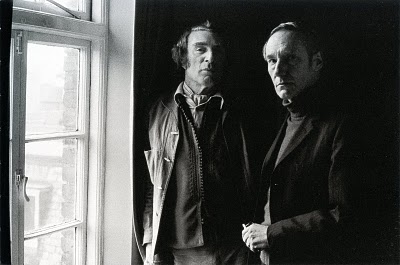
Burroughs and friend Brion Gysin in London
Burroughs at this time was getting sick of London – sick of the licensing laws, sick of the crap food and small drinks, sick of the weather, the terrible service and sexual hypocrisy. He was also sick of the Moka, which he believed responsible for an ‘outrageous and unprovoked discourtesy and poisonous cheesecake’.
The Church of Scientology, Fitzroy Street
Burroughs decided to mount a sound-and-image attack. He had previously launched one of these against the Church of Scientology, of which he had been a member, turning up at their headquarters at 37 Fitzroy Street every day, taking photographs and making sound recordings. He believed that ‘as soon as you start recording a situation and playing them back on the street, you are creating a new reality’ and that repeated exposure to such an attack would lead to ‘accidents, fires and removals’. After a few weeks, the Scientologists did indeed move, round the corner to 68 Tottenham Court Road.
Photo taken by Burroughs during the operation
On August 3, 1972, Burroughs turned his attention to the Moka. He would stand outside every day taking photos and making recordings by tape, and then return the next day to play the previous days recordings. Burroughs was convinced he was winning. ‘They are seething in there,’ he said. ‘I have them and they know it.’
‘What a bounteous banquet of costly viands is spread before an ardent-minded, grateful-spirited Perambulator!’ Old Humphrey’s Walks In London
‘One must perambulate early and late in all weathers, to know a little about London’. The London Perambulator
London is a gift for those who wander. Sometimes you can pick a new area and just stroll wherever the whim strikes you; sometimes you can take a different route between two familiar destinations. Either way, you’ll find your appreciation of the city is inordinately increased.
There is a healthy industry in London walking – M@ recently compiled a list of his ten favourite for the Guardian – but if you need something cheaper and more challenging, you can always take a self-guided walk over a longer distance. I once walked the Thames from St Paul’s to Hampton Court on a Sunday afternoon, criss-crossing bridges and sticking as close to the river as possible. It was particularly satisfying to see how easy it is to walk on the river bank – the only place I had to take a significant detour was around the ever-weird Chelsea Harbour.
In a similar vein, a couple of books have recently come out on the theme of London walking. Walk The Lines is about Mark Mason‘s decision to walk every tube line in London, above ground, an overall distance of 403 miles that takes him everywhere from Amersham in the north-west and Epping in the far east to Morden in the deep south.
Mason enjoys discovering new parts of the city and peppers his book with brilliant London trivia but is at his best when writing about the pleasure walking can provide. As he writes, ‘Once you’ve caught the bug, you feel an urge to plan your walks, be it thematically, geographically or by some other means. There must be a raison d’être for your ramble.’ This, he thinks, taps into a similar mentality to that of a collector: ‘It’s not about studying, about observing or noting. It’s about collecting. About claiming the city’s greatness, or at least some small part of it, for yourself.’
Mason’s book is a fun read, but you couldn’t very well use it to walk the tube lines yourself, even if you were lunatic enough to want to do so. Tom Bolton’s London’s Lost Rivers, however, bills itself as ‘A Walker’s Guide’ and is a terrific mix of history, topography and practicality. It maps – astonishingly diligently – the courses of eight of London’s buried rivers, so walkers can follow them for themselves, pointing out items of interest they can see along the way while also offering some historical context about the subterranean rivers.
Along with Nicholas Barton’s The Lost Rivers of London, it’s essential for any fan of buried rivers (Diamond Geezer says much the same here). The atmospheric Polaroid photographs by SF Said are a nice touch, as is the introduction by the great Londonphile Chris Fowler. Highly recommended.
I have a small piece in the Independent about the fascinating Edward Lovett, whose collection of lucky charms, collated around 100 years ago, has just gone on display at the Wellcome Collection.
Lovett, who lived in Croydon, was a banker and self-taught folklorist who was interested in those items that everyday Londoners kept about their person in aid of good fortune or to ward off bad luck. He would travel to the East End and docks to purchase samples of these lucky charms, which could be anything from a dead mole in a bag to a copy of the Lord’s Prayer written in careful handwriting in a spiral on a tiny scrap of paper dated 1872.
Many of the owners would claim not be superstitious, but then explain in hushed tones how a certain coin or nut or shoe had saved them from disaster; numerous items were from soldiers who had taken them to the Western Front in the First World War.
It is an extraordinary and humble collection, but one that grew so vast that Lovett’s wife eventually left him in despair in 1925. At around this time he wrote a marvellous book – Magic In Modern Love – in which he chronicled some of the items from his collection, but in a delightfully haphazard way, rarely bothering to say exactly where he bought them or when or from whom.
Felicity Powell, the artist who is curating the exhibition for the Wellcome, says, ‘He was not the most diligent of reporters. The labelling is often non-existent, which gives the items real mystery. Sometimes you can’t even be sure what they were for so you have this open space in which to speculate.’
Because Lovett was mainly collecting from the docks around east London, the collection gives a real perspective on London as a trading city that used the river to connect with the wider world. ‘There are objects from all over the world,’ says Powell, ‘There’s even an Inuit paddle. It all came through London and into the hands of dockers and hawkers. We don’t know if these originally belonged to immigrants or natives. We don’t even know if he was collecting authentic objects. Did the people selling them see him coming?’
Lovett died in 1933 and much of his curious collection was absorbed by the Wellcome and the Pitt-Rivers Museum. It is rarely seen by the public. The exhibition at the Wellcome Collection runs until February 26, 2012.
In 1983, just as the band were starting to fall apart, The Clash decided to make a film. But stung by their experiences on the strange but compelling Rude Boy, they decided to make it themselves. They called it Hell W10, filmed it on 16mm silent black and white film, and made the plot up as they went along. The result, understandably, was somewhat bizarre.
‘Let’s make a film!’ said Mick Jones in 2005. ‘We had no other agenda there than that. Everyone put in their time without thinking about it. That was what we did on our time off; we worked! It was totally Joe [Strummer]’s idea. He directed it, he shot it, he did it. And then it was gone. It didn’t even come out!’
Strummer believed the film was lost forever. In 1987, when it looked like he might carve out a new career for himself in the film world, he told an interviewer, ‘I have directed a film myself, a black and white 16mm silent movie and it was a disaster. Luckily the laboratory that held all the negative went bankrupt and destroyed all the stock, so the world can breathe again. I shot without a script. God knows what it was about. I’m the only other one that knew, and I’m not telling.’
In 2002, the film was rediscovered on video tape and re-edited by long-time Clash collaborator Don Letts, who added a fine Clash soundtrack over the top. It is a strange piece indeed, a gangster tale that follows Earl, a musician and small-time hood played by Paul Simonon, who falls foul of the local crime boss called Socrates, ‘The Lord of Ladbroke Grove’, played with some relish by Mick Jones, resplendent in white tux (‘You wanna end up as a pillar in a Canning Town flyover?’ he threatens one lackey). Strummer gives himself a cameo as a corrupt and racist policeman. It’s a cross between The Harder The Come and some of the pulp London crime novels of the 1950s (many of which have been republished by London Books).
Hell W10 also features some cracking period photography of Notting Hill, Paddington and Ladbroke Grove, and weighs in at almost 50 minutes, which suggests it must have taken quite some time to film.
What makes it particularly fascinating is that it was filmed just as the band were starting to go belly up; Topper Headon had already been kicked out for drug abuse, while Simonon and Jones were barely speaking, making their feud in the film a little too close to the truth. Things came to a head within weeks of Hell W10 being made, with Jones sacked from the band in September 1983.
In Letts’s documentary, Westway To The World, both Jones and Strummer confess that the band had simply spent too much time in each other’s company and should have taken a break; if they had done so, hotheads may have had time to cool. Instead, they made a film. Perhaps if they’d had a summer holiday in 1983 rather than fool around with a camera, the band of Jones, Strummer and Simonon might have lasted another few years. Still, it looks like they had fun making it.
Was it worth it? Watch and decide, this is the first of five parts.
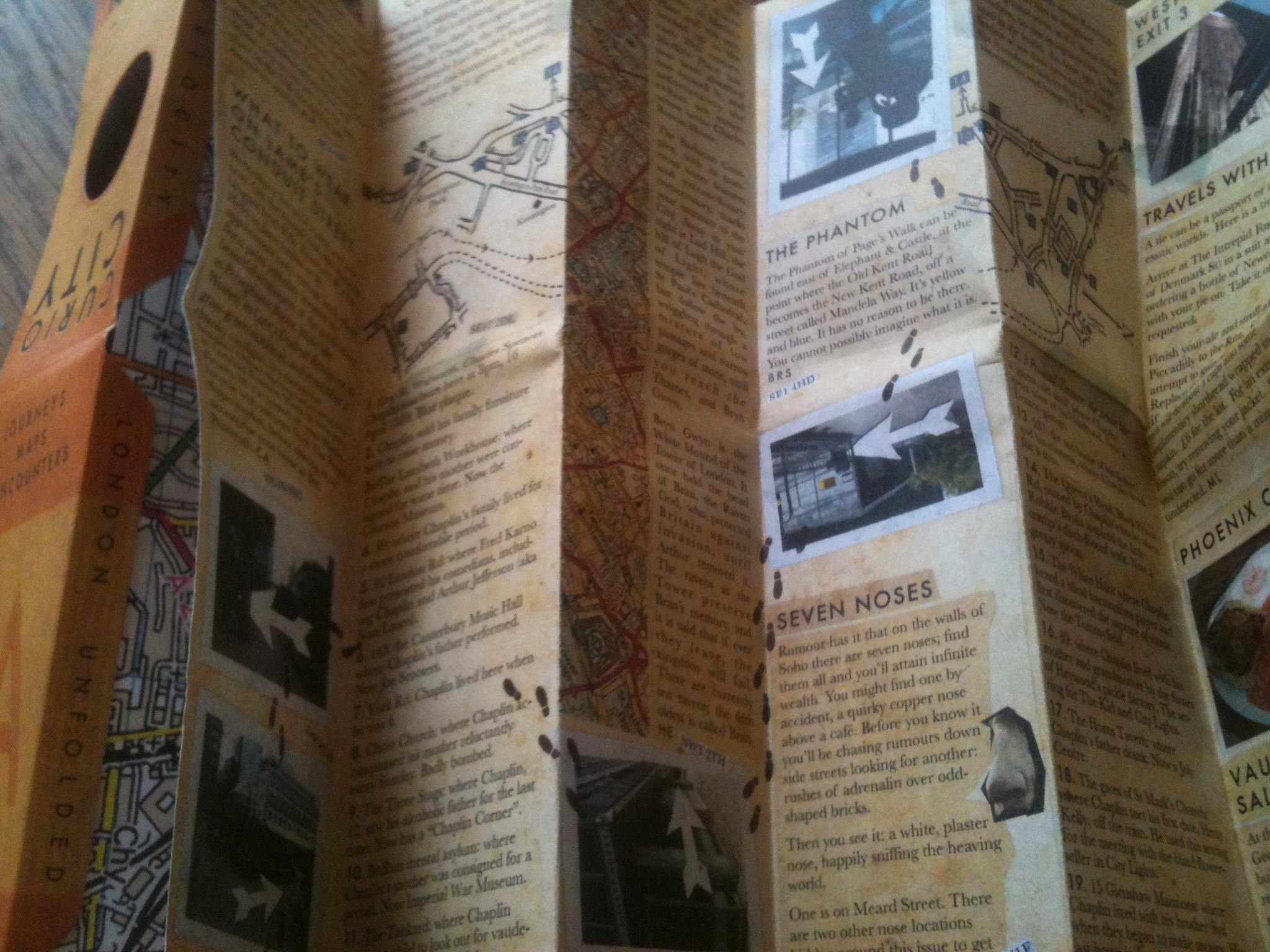
Another day, another London-themed map-related projected. Curiocity is a rather lovely tiny ‘mapazine’, that combines a magazine with a map and folds up into a cute – and curious – little package that costs just £2.
One side features a stack of London-related trivia, including a loosely-mapped Charlie Chaplin walk around Lambeth, a ley-lines walk from Parliament Hill to Tower Hill and a ‘route’ from Hampstead tube to the mixed bathing ponds written out ransom note-style and snaking over five columns. There’s loads more, including bits on the Seven Noses of Soho and a game involving pigeons. It’s witty and it’s whimsical, both of which are obviously very good things indeed.
On the reverse is an entirely unusable but rather interesting map showing the history of London’s orbital road networks, a fascinating story which can be studied in detail here or in even more detail here.
Curiocity is available in a few choice London locations, including Stanfords, the London Review of Books Bookshop, the ICA and the Wellcome. It also has a website and is a more than welcome addition to the London publications landscape.
‘People were determined to smash and destroy. Windows were being smashed and the looters saw their chance. A road sign went straight through the middle of the window. Two people moved in with cardboard boxes and filled them with jumpers. These would be highly resaleable. [Others] were concentrating on the jewellers’ shops and a good few were looted. People who were probably law-abiding citizens at any other time just went berserk. The faces of people as they went into a smashed shop and grabbed goods were amazing; all signs of reason had disappeared from their eyes. One guy came out of a shop with his eyes rolled up, his tongue hanging from an open mouth and breathing heavily. His trip into the shop had been a physical experience, and he was beginning to smile. He had dared and won. In a very short space of time, the streets had been transformed into a madhouse. Sirens blared out and police vans screeched around the streets.’
Was this Tottenham last Saturday? Brixton on Sunday? Battersea or Croydon on Monday? Manchester on Tuesday? Surely it must be from one of those occasions this week when England was forced to confront the reality of a ‘sub-educated, feral underclass’ in a post-Thatcher ‘something-for-nothing society’ (as Andrew Roberts so colourfully described it).
Well, actually no. This was way back in 1983, in tiny Luxembourg, where England fans went on a smashing and looting spree after failing to qualify for the European Championships. Football hooliganism was approaching its nadir after a 20 year spiral that had almost destroyed the national sport and left the authorities baffled at how to control it.
Mob looting by football supporters dates back to at least 1976, when Liverpool supporters descended in large groups to rob shops in St Etienne, where they were watching a European Cup tie. It soon became assimilated into the away trip – usually while being escorted back to the station, away supporters would smash up city centres, fight the police and, if the opportunity arose, loot goods from shops: a jeweller here, a clothes shop there. Whatever could be easily lifted and carried back home.
In Colin Ward’s classic account of terrace culture ‘Steaming In’ (from which the above passage also came), he describes Chelsea fans after a game in Luton: ‘The trip back to the town station saw the mass destruction of the town centre. Shops were looted and a train was set on fire… It was said that one guy who didn’t like football but had a fetish about smashing shop windows went along to have a good night out. Nutters often tag along with football crowds just for the buzz.’
The past week’s violence certainly seemed unprecedented – and in some ways it was – but there are significant parallels with the way overwhelmingly young football fans routinely behaved in the 1970s and 1980s. There’s the casual disregard for other people’s property, the mania of the crowd, the opportunist thieving and violence, the loose organisation into gangs, the sheer thrill of anarchy, the speed of movement and the power of being able to catch the police wrong-footed.
The fear is that mass lootings will become a commonplace event, another part of our lives, as criminal gangs realise what they can get away with if there are enough of them around and as long as the law and lawmakers remain clueless at how to respond. It certainly took the authorities a long time to get a handle on how to police football, but the experience has now been completely transformed, partly because of tough sentences for hooligans, partly because of the disasters at Heysel and Hillsborough but also because the football establishment itself realised it had to change the way it regarded football supporters if the behaviour of fans was to improve.
When I watched a small group of 20 or 30 kids terrorise Hackney in broad daylight on Monday afternoon while the police stood and watched, my first instinct was that they would never have let a bunch of football supporters behave like that these days. There are always lessons to be learnt from the past, if you look in the right places.
‘The bricks – laid Flemish bond, headers and stretchers alternating – were all old London stock bricks, but of many kinds and colours: rust red, beige, grey, brown, nearly black. Here and there were yellow ones – malm bricks made with an admixture of clay and chalk. The cumulative effect was pleasing – the variety gave texture, interest and warmth to the surface of the wall. The eye approved the range of colour, the uneven look, the way in which each brick differed from its neighbour and yet was in subtle harmony. But, more that that, to look at it was to see the way in which this wall arose from the ashes of many buildings. Studying it, Matthew saw in his mind’s eye warehouses and churches, factories and shops, terrace houses like this one, blasted to the ground perhaps on some furnace night of 1940. He thought of how the city lifts again and again from its own decay, thrusting up from its own detritus, from the sediment of brick dust, rubble, wood splinters, rusted iron, potsherds, coins and bones. He thought of himself, living briefly on top of this pile, inheriting its physical variety and, above all, the clamour of its references. The thought sustained him, in some curious way, as he sat at his desk in the flat which was not yet a home, or as he moved through days and through the city, from Finsbury to Docklands to Covent Garden to Lincoln’s Inn.
Penelope Lively in ‘City Of The Mind’ (1991, Andre Deutsch).






 The Great Wen