Hell W10: the film that killed the Clash?

In 1983, just as the band were starting to fall apart, The Clash decided to make a film. But stung by their experiences on the strange but compelling Rude Boy, they decided to make it themselves. They called it Hell W10, filmed it on 16mm silent black and white film, and made the plot up as they went along. The result, understandably, was somewhat bizarre.

‘Let’s make a film!’ said Mick Jones in 2005. ‘We had no other agenda there than that. Everyone put in their time without thinking about it. That was what we did on our time off; we worked! It was totally Joe [Strummer]’s idea. He directed it, he shot it, he did it. And then it was gone. It didn’t even come out!’

Strummer believed the film was lost forever. In 1987, when it looked like he might carve out a new career for himself in the film world, he told an interviewer, ‘I have directed a film myself, a black and white 16mm silent movie and it was a disaster. Luckily the laboratory that held all the negative went bankrupt and destroyed all the stock, so the world can breathe again. I shot without a script. God knows what it was about. I’m the only other one that knew, and I’m not telling.’

In 2002, the film was rediscovered on video tape and re-edited by long-time Clash collaborator Don Letts, who added a fine Clash soundtrack over the top. It is a strange piece indeed, a gangster tale that follows Earl, a musician and small-time hood played by Paul Simonon, who falls foul of the local crime boss called Socrates, ‘The Lord of Ladbroke Grove’, played with some relish by Mick Jones, resplendent in white tux (‘You wanna end up as a pillar in a Canning Town flyover?’ he threatens one lackey). Strummer gives himself a cameo as a corrupt and racist policeman. It’s a cross between The Harder The Come and some of the pulp London crime novels of the 1950s (many of which have been republished by London Books).

Hell W10 also features some cracking period photography of Notting Hill, Paddington and Ladbroke Grove, and weighs in at almost 50 minutes, which suggests it must have taken quite some time to film.

What makes it particularly fascinating is that it was filmed just as the band were starting to go belly up; Topper Headon had already been kicked out for drug abuse, while Simonon and Jones were barely speaking, making their feud in the film a little too close to the truth. Things came to a head within weeks of Hell W10 being made, with Jones sacked from the band in September 1983.

In Letts’s documentary, Westway To The World, both Jones and Strummer confess that the band had simply spent too much time in each other’s company and should have taken a break; if they had done so, hotheads may have had time to cool. Instead, they made a film. Perhaps if they’d had a summer holiday in 1983 rather than fool around with a camera, the band of Jones, Strummer and Simonon might have lasted another few years. Still, it looks like they had fun making it.

Was it worth it? Watch and decide, this is the first of five parts.

Secret London: stink pipes

There is one of these just around the corner from where I live.

Herne Hill stink pipe

It’s long, thin, green and old and thrusts straight into the air like a giant’s, er, finger. It’s not a telegraph pole – there are no wires coming off it – and it’s too tall to be a broken street lamp.

It is, in fact, a stink pipe, one of four such items of street furniture that can be found within a half-mile radius of Brixton Water Lane. These stink pipe were built around the same time as London’s Victorian sewer network in the 1860s and are basically just huge hollow pipes that allow potentially lethal gas to escape into the atmosphere, far above the rooftops.  They often seem to located near the locations of culverted rivers – these ones are found more or less on the route of the Effra or its tributaries – suggesting that when these rivers were incorporated into the sewer system, they required some sort of additional safety valve (the buried Fleet famously exploded at King’s Cross after just such a build-up of gas in 1846).

Some stinkpipes are rather elaborate, but the ones I’ve seen around Herne Hill and Brixton are pretty basic and utilitarian. If you want to find some finer examples, like the fine crowned stench pipes of Kennington Cross, you should check out the excellent London Stench Pipes blog, which is devoted to these marvellous oddities leftover from Victorian London.

Secret London: Brixton’s Windmill

I finally got round to visiting Brixton Windmill during Open House Weekend. I first heard about the windmill ten years or so again, when I would go to gigs at the Windmill pub and pop out between acts to try to catch a glimpse of this extraordinary building in the nearby park, lost and derelict like an abandoned spaceship.

The windmill was built in 1816 and run by John Ashby of Brixton Hall. It was originally on a hill in fields, surrounded by outbuildings like a mill cottage and bake house, where bread was baked with the mill’s stone-ground wholemeal flour and sold to locals.

By the 1850s, Brixton was starting to grow and new housing blocked the wind, hampering performance. In 1862, the Ashby’s took their milling business to the Mitcham watermills along the Wandle, but the Brixton Windmill somehow remained, used for storage. The sails, though, were removed and sold for firewood.


In 1902, the windmill was returned to use, albeit as a location for a steam-powered provender mill. The mill was finally closed in 1934 and left empty until the LCC purchased it in 1957, after at least one attempt had been made to demolish it and cover the site with flats. Despite the sails being restored in 1983, the windmill, now owned by Lambeth, was allowed to run almost to ruin, which is how it appeared when I first saw it.

Since then, a major restoration project has taken place and the windmill is now open again to the public around once a month. The Friends of Windmill Gardens, a local residents association, also hope to start grinding flour again, using the provender mill that still survives on the first floor.

In celebration, here are the Fuck Buttons playing at the Brixton Windmill pub.

How about them Silver Apples

I have a piece in the latest Uncut about 60s electronica pioneers Silver Apple. If you’ve never heard them before, you should. Their main instrument is The Simeon, a bank of nine oscillators mounted on plywood and played by 86 different colour-coded buttons and pedals.

Here is their amazing country-electronica jam from 68, “Ruby”, on which they also play a banjo.

After forming by accident – everybody else in the previous band left, leaving just singer and oscillator-player Simeon Coxe and drummer Danny Taylor – the band had to split in 1970 when they created an LP cover that featured the pair in a Pan Am cockpit on one side, and with a plane crash on the back. Pan Am sued and that was that.

The band reformed in the mid-90s, however, although now it’s Coxe on his own after Taylor died of a heart attack in 2005. Silver Apples play Corsica Studios in Elephant on October 27. Check them out.

Curiocity: London unfolded

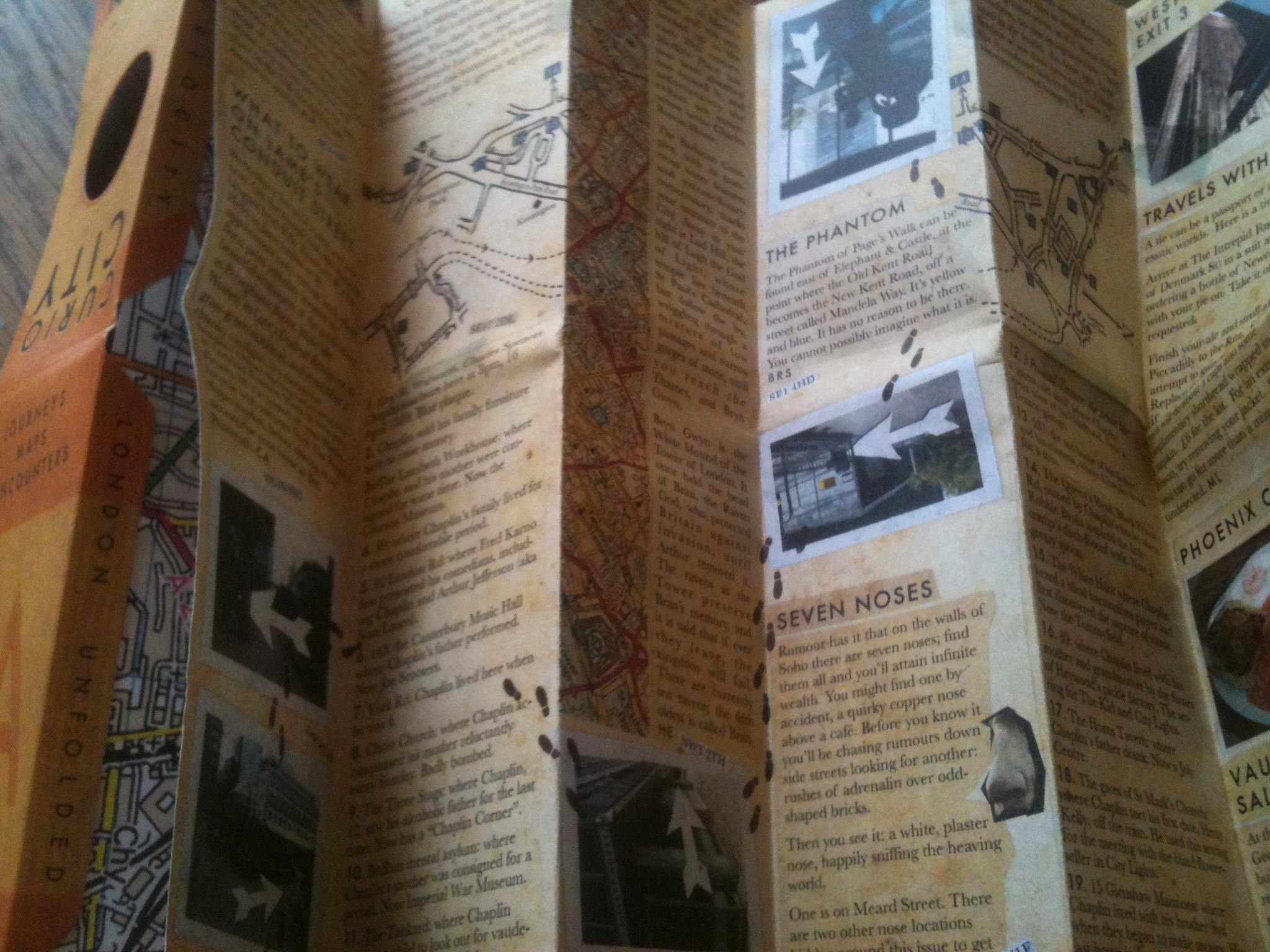
Another day, another London-themed map-related projected. Curiocity is a rather lovely tiny ‘mapazine’, that combines a magazine with a map and folds up into a cute – and curious –  little package that costs just £2.

One side features a stack of London-related trivia, including a loosely-mapped Charlie Chaplin walk around Lambeth, a ley-lines walk from Parliament Hill to Tower Hill and a ‘route’ from Hampstead tube to the mixed bathing ponds written out ransom note-style and snaking over five columns. There’s loads more, including bits on the Seven Noses of Soho and a game involving pigeons. It’s witty and it’s whimsical, both of which are obviously very good things indeed.

On the reverse is an entirely unusable but rather interesting map showing the history of London’s orbital road networks, a fascinating story which can be studied in detail here or in even more detail here.

Curiocity is available in a few choice London locations, including Stanfords, the London Review of Books Bookshop, the ICA and the Wellcome. It also has a website and is a more than welcome addition to the London publications landscape.

Tony Adams on Arsène Wenger: ‘coaching isn’t his strong point’

I interviewed Tony Adams in May for BMI’s Voyager magazine, and we talked at length about Arsène Wenger, who is currently under all sorts of pressure at Arsenal.

To my surprise, Adams refuted the notion that Wenger completely transformed the football culture at Highbury. Received wisdom is that Wenger brought with him ‘European’ attitudes towards diet and fitness that revolutionised English football. Adams, though, insisted:

‘That’s a bit of an insult to the directors and dieticians that had been at Arsenal for years. We were reading books on diet in 1987, ten years before Arsène  walked into the club. Arsène came with his own ideas and strategies, and brought in an osteopath and acupuncturist. But there’s no secrets. Diet won’t change anything if you don’t have great players and I still ate fish and chips every week for the last six years under Arsène Wenger. Every Friday on Putney Bridge I went and got battered cod and a chip sandwich and sat there looking at the river.’

Adams says that ‘the coaching system is the same as it was under George Graham’ and feels Wenger’s biggest triumph was that he ‘walked into a squad of great players. The 1991 squad was the best I’ve ever played with. I’d love to have walked into a squad of players that good as a manager. He brought in everything he learnt, that’s what managers do. He’s a fantastic physiologist and psychologist, that’s where he excelled.’

Adams clearly holds Wenger in great esteem and affection, but seems to feel the pre-history of Arsenal – the terrific team put together by George Graham – has been unfairly forgotten. His comments are an attempt to place Wenger’s achievements in perspective and to understand that his success was only a continuation of what was started by Graham. Wenger is often credited with ending the drinking culture at Arsenal, but Adams says he’d already given up booze at this point and that was something else Wenger benefited from. This terrific interview in The Sunday Times about Graham and Wenger with Adams, Steve Bould, Nigel Winterburn and Lee Dixon seems to back up what Adams told me.

Adams went on to say, ‘Don’t get me wrong, I’m not having a go at Arsène Wenger. One of the gifts he’s got is that he’s a lovely human being and I respect him a great deal. But I’ve got to get it real, he coaching isn’t his strong point [Adams’s original phrase was far more damning, but he later asked for it to be toned down]. I love him dearly, he’s a fantastic physiologist but he’s not a great motivator. I’d just laugh at his attempts to gee us up, but I come from a different place, time and culture. But he got me in the best condition I could possibly get in to do my job, and for that I love him and have so much respect for him.’

It’s an interesting argument. The counter-argument is this goal, although in light of Adams’s comments it no longer looks quite so remarkable – just a triumphant and fit centre-half with a three-goal cushion running through a knackered, battered defence at the end of the season and belting the ball unscientifically past a beleaguered keeper. Total football, or just taking the piss?

London’s mapping renaissance

The growth of online mapping – as seen by the excellent London Mapping website, which collects some of the best digital maps around – has not meant the end of paper maps.

I’ve mentioned Herb Lester‘s lovely themed maps before with reference to their 1960s map of London’s West End, Wish You Were There, and they continue to add new maps to their range, branching into different cities and themes while maintaining an impeccable eye for design. Untamed London, for nature-lovers, is their latest offering.

I’ve also finally got my hands on the Museum of London’s Londonium map and it is hugely impressive. This has been produced by MOLAS, the Museum of London Archeological Service, and is a huge map of the City, with the Roman topography superimposed over a plan of the contemporary city – a little like a paper version of the technology used for the Time Travel Explorer app.

Key Roman finds are listed, with an explanation of what they are and how they can be accessed, while the reverse side has a potted history of Roman London, with many illustrations. The map is printed on good thick paper so won’t tear easily (a constant problem for frequently folded paper maps), and works beautifully as both a decorative item and a practical plan for hunting down the existing remains of Londonium.

It costs just £6.25 and should it prove to be a big seller – which I imagine it will – I hope the Museum can persuade their friends at MOLA to produce more maps along the same lines.

One for the Olympic Park at around this time next year, perhaps?

Morrissey and London: ‘I like it here, can I stay?’

Like many adolescent boys who thought they were cleverer than they really were and were scared of girls, I was obsessed with The Smiths and Morrissey.

The Smiths are a Manchester band, but by the time I became a fan, Morrissey had – like so many Northerners – fled the provinces for London where he spent the next few years revelling in the size, confusion and culture of the Big Smoke. Instead of Whalley Range and the Moors Murders, he sang about Earl’s Court and the Krays and as he entered his ‘Glam Nazi’ era he became obsessed with distinctly London aspects of working-class life such as skinheads, West Ham and the Cockney Rejects.

This was Morrissey’s London period; you could argue it began with the Smiths songs London (1987) and Half A Person (1987), and lasted until he was hounded out of the capital for going a bit crap around a decade later. Sure, London still cropped up in later songs – 2004’s Come Back To Camden, for instance – but the love was gone. He would later sound like any other tedious expat whn complaining to the NME that ‘if you walk through Knightsbridge on any bland day of the week you won’t hear an English accent. You’ll hear every accent under the sun apart from the British accent.’ But it was fun while it lasted.

Interesting Drug (1989)

Although Morrissey’s previous solo singles were very London-influenced, this was the first – rather odd – video to be clearly filmed in London. But where? The red bus glimpsed at 1:21 may tell somebody with better eyesight than I. Is it a 34, placing this somewhere between Barnet and Walthamstow?
Update: Comments suggest this is Battersea, so not the 34 after all. Maybe the 37?

Our Frank (1991)

A pretty poor song, but the video marks the start of Morrissey’s skinhead obsession – it was not long after this that he took to performing before a skinhead backdrop and brandishing the Union Jack at Finsbury Park. There are lots of buses here, and also a gorgeous ghost sign at 1:47. But where is it shot? Charing Cross Road? The City? Victoria? Anybody?
Update: Comments place this definitively as King’s Cross.

We Hate It When Our Friends Become Successful (1992) 

I hated this when it came out, but I was wrong because it is brilliant and the video is a treat as Morrissey wanders around a still not-quite-gentrified Wapping with the gang of bequiffed young boys who have put a smile back on his own thin and youthful face. Most Morrissey fans get a kick out of seeing the old boy looking happy, which is why his recent ‘love’ album, Ringleader Of The Tormentors, got such strangely good reviews. The abandoned pub in this video is now the Turk’s Head cafe and you can also catch a glimpse of Oliver’s Wharf, which was one of the first warehouses in the area to be redeveloped into housing.

You’re The One For Me Fatty (1992)

An awful song, but an unmistakable setting as a young skin takes ‘fatty’ on a date, while Moz whines about how ‘all over Battersea’ there’s ‘some hope, and some despair’, over a shot of the power station. Interestingly, a scene from one of Morrissey’s favourite Northern kitchen sink dramas, ‘Saturday Night and Sunday Morning’ was filmed by director Karel Reisz around here, in Culvert Road, Battersea. Of Reisz, we’ll hear more later.

Boxers (1995)

From the start of Morrissey’s decline – and height of his obsession-with-male-physicality – this ho-hum single was filmed at the legendary York Hall, Bethnal Green, as can be seen in the rather elegant closing shots.

Sunny (1996)

Such a terrible song I didn’t know anything about it until now, as I had long lost interest in Morrissey at this point, but it’s filmed in Victoria Park in East London. And the cover featured this iconic Morrissey shot, outside old Kray haunt the Grave Maurice (now, I think a fried chicken shop).

There were many other London influences in Morrissey’s songs at the time, with the Kray-referencing Last Of The Famous International Playboys, the song Spring-Heeled Jim (a reference to the Victorian London monster Spring-Heeled Jack), the song titles Piccadilly Palare and Dagenham Dave, and the album titles Your Arsenal and Vauxhall & I, as Morrissey explored the seamy side of London life. He was also rumoured to be making his first acting appearance at around this time as the South London gangster Charlie Richardson, although sadly that never came to pass.

I’ll leave you with one last example. This clip is of Kennington kids discussing the infamous case of Derek Bentley, who was sentenced to death for his part in the shooting of a policeman in Croydon, and it comes from Karel Reisz’s classic London documentary ‘We Are The Lambeth Boys’. It was sampled by Morrissey for the track Spring-Heeled Jim, which featured on the Vauxhall & I album. How much more London can you get?

London riots and football hooliganism

‘People were determined to smash and destroy. Windows were being smashed and the looters saw their chance. A road sign went straight through the middle of the window. Two people moved in with cardboard boxes and filled them with jumpers. These would be highly resaleable. [Others] were concentrating on the jewellers’ shops and a good few were looted. People who were probably  law-abiding citizens at any other time just went berserk. The faces of people as they went into a smashed shop and grabbed goods were amazing; all signs of reason had disappeared from their eyes. One guy came out of a shop with his eyes rolled up, his tongue hanging from an open mouth and breathing heavily. His trip into the shop had been a physical experience, and he was beginning to smile. He had dared and won. In a very short space of time, the streets had been transformed into a madhouse. Sirens blared out and police vans screeched around the streets.’

Was this Tottenham last Saturday? Brixton on Sunday? Battersea or Croydon on Monday? Manchester on Tuesday? Surely it must be from one of those occasions this week when England was forced to confront the reality of a ‘sub-educated, feral underclass’ in a post-Thatcher ‘something-for-nothing society’ (as Andrew Roberts so colourfully described it).

Well, actually no. This was way back in 1983, in tiny Luxembourg, where England fans went on a smashing and looting spree after failing to qualify for the European Championships. Football hooliganism was approaching its nadir after a 20 year spiral that had almost destroyed the national sport and left the authorities baffled at how to control it.

Mob looting by football supporters dates back to at least 1976, when Liverpool supporters descended in large groups to rob shops in St Etienne, where they were watching a European Cup tie. It soon became assimilated into the away trip –  usually while being escorted back to the station, away supporters would smash up city centres, fight the police and, if the opportunity arose, loot goods from shops: a jeweller here, a clothes shop there. Whatever could be easily lifted and carried back home.

In Colin Ward’s classic account of terrace culture ‘Steaming In’ (from which the above passage also came), he describes Chelsea fans after a game in Luton: ‘The trip back to the town station saw the mass destruction of the town centre. Shops were looted and a train was set on fire… It was said that one guy who didn’t like football but had a fetish about smashing shop windows went along to have a good night out. Nutters often tag along with football crowds just for the buzz.’

The past week’s violence certainly seemed unprecedented – and in some ways it was – but there are significant parallels with the way overwhelmingly young football fans routinely behaved in the 1970s and 1980s. There’s the casual disregard for other people’s property, the mania of the crowd, the opportunist thieving and violence, the loose organisation into gangs, the sheer thrill of anarchy, the speed of movement and the power of being able to catch the police wrong-footed.

The fear is that mass lootings will become a commonplace event, another part of our lives, as criminal gangs realise what they can get away with if there are enough of them around and as long as the law and lawmakers remain clueless at how to respond. It certainly took the authorities a long time to get a handle on how to police football, but the experience has now been completely transformed, partly because of tough sentences for hooligans, partly because of the disasters at Heysel and Hillsborough but also because the football establishment itself realised it had to change the way it regarded football supporters if the behaviour of fans was to improve.

When I watched a small group of 20 or 30 kids terrorise Hackney in broad daylight on Monday afternoon while the police stood and watched, my first instinct was that they would never have let a bunch of football supporters behave like that these days. There are always lessons to be learnt from the past, if you look in the right places.

London bricks

‘The bricks – laid Flemish bond, headers and stretchers alternating – were all old London stock bricks, but of many kinds and colours: rust red, beige, grey, brown, nearly black. Here and there were yellow ones – malm bricks made with an admixture of clay and chalk. The cumulative effect was pleasing – the variety gave texture, interest and warmth to the surface of the wall. The eye approved the range of colour, the uneven look, the way in which each brick differed from its neighbour and yet was in subtle harmony. But, more that that, to look at it was to see the way in which this wall arose from the ashes of many buildings. Studying it, Matthew saw in his mind’s eye warehouses and churches, factories and shops, terrace houses like this one, blasted to the ground perhaps on some furnace night of 1940. He thought of how the city lifts again and again from its own decay, thrusting up from its own detritus, from the sediment of brick dust, rubble, wood splinters, rusted iron, potsherds, coins and bones. He thought of himself, living briefly on top of this pile, inheriting its physical variety and, above all, the clamour of its references. The thought sustained him, in some curious way, as he sat at his desk in the flat which was not yet a home, or as he moved through days and through the city, from Finsbury to Docklands to Covent Garden to Lincoln’s Inn.

Penelope Lively in ‘City Of The Mind’ (1991, Andre Deutsch).