Brixton Village hawk

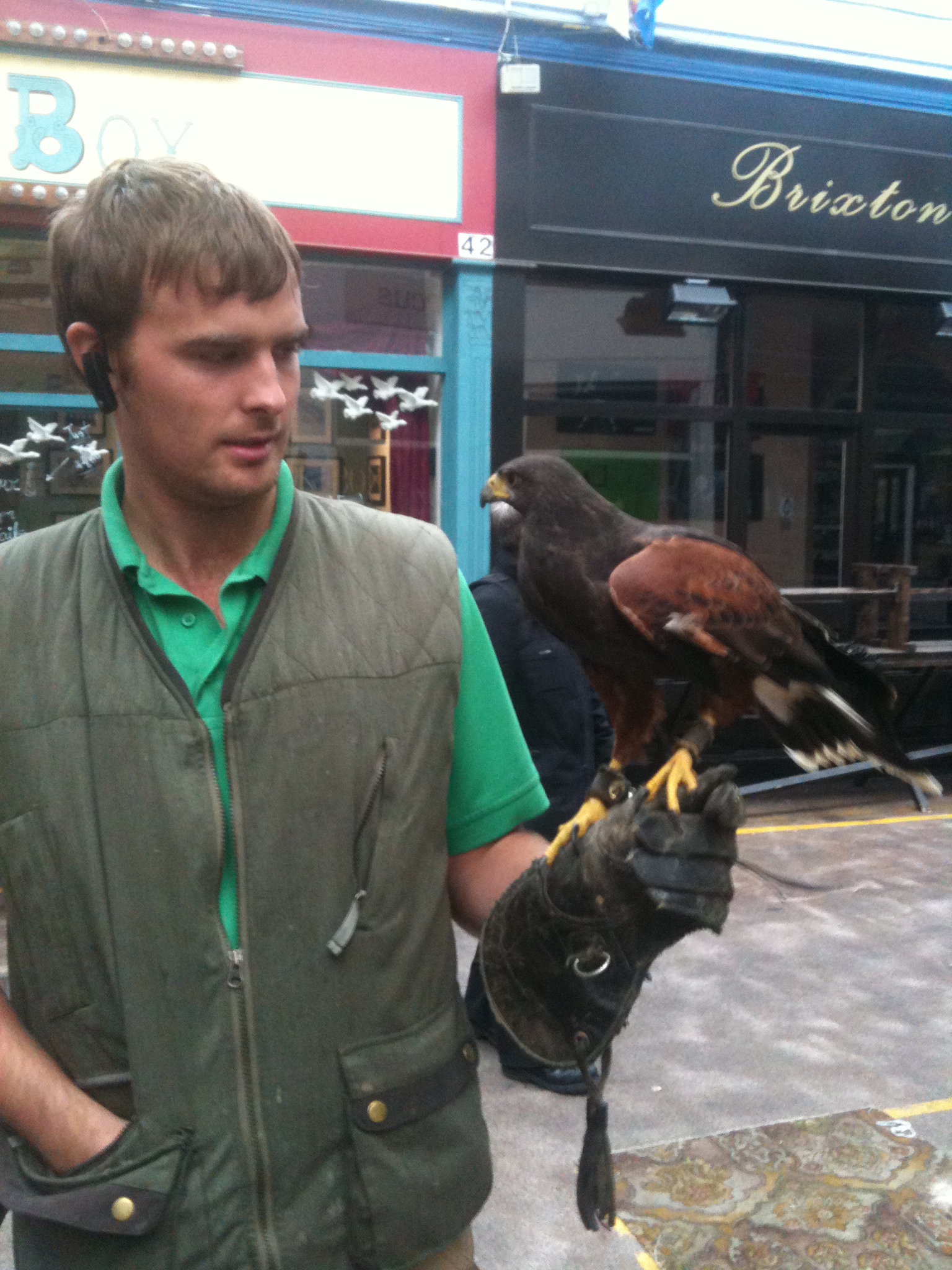
I saw this harrier hawk in the unlikely surroundings of Brixton Village this week while I was quietly tucking into a galette washed down by hot ginger beer.

He is flown around the market twice a week to keep pigeons away and dis-encourage them from nesting in the rafters, where they would crap merrily on hip Londoners going about their hip business. Many of the local stallholders looked terrified.

William Burroughs and the strange demise of London’s first espresso bar

In 1953, a momentous event occurred in Soho. London’s first proper coffee shop – one equipped with a Gaggia coffee machine – opened at 29 Frith Street. This was a place where teenagers too young for pubs could come and gather, and it is said by some that the introduction of this coffee bar prompted the youth culture explosion that soon changed social life in Britain forever.

Inside the Moka Bar

The Moka was an instant success, selling over a thousand cups of coffee a day. The author John Sutherland recalls, ‘the Gaggia machine, a great burbling, wheezing, spluttering monster, would grudgingly excrete some bitter caffeinated essence.  It would be swamped with steamed-milk foam and dusted with chocolate to form its ‘cappuccino’ hood… Glass cups and brown sugar (lots of it) were de rigueur.  Frankly, 50s espresso was no taste thrill.  But it felt smart as hell.’

By 1972, coffee bars where everywhere and the teenage revolution was firmly established. At this time, the author of ‘Naked Lunch’, former junkie and all-round Beat legend William S Burroughs was living in London, quietly going about his business in St James’s. He lived in Dalmeny Court, Duke Street, and loved the plush gentlemen’s shops of the area, not to mention the ‘Dilly Boys‘, young make prostitutes who hustled for clients outside the Regent Palace Hotel.

Although Burroughs was fond of the finer things in life – he got his shoes from John Lobb, hat from Locke’s and bought most of his food in Fortnum and Mason’s – he did at some point stumble into the Moka Bar, and was not impressed by what he found.
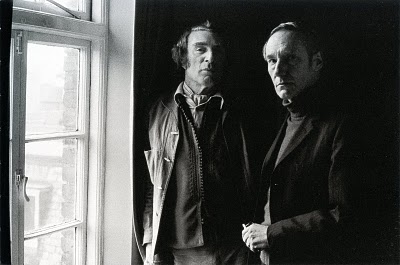
Burroughs and friend Brion Gysin in London

Burroughs at this time was getting sick of London – sick of the licensing laws, sick of the crap food and small drinks, sick of the weather, the terrible service and sexual hypocrisy. He was also sick of the Moka, which he believed responsible for an ‘outrageous and unprovoked discourtesy and poisonous cheesecake’.

The Church of Scientology, Fitzroy Street

Burroughs decided to mount a sound-and-image attack. He had previously launched one of these against the Church of Scientology, of which he had been a member, turning up at their headquarters at 37 Fitzroy Street every day, taking photographs and making sound recordings. He believed that ‘as soon as you start recording a situation and playing them back on the street, you are creating a new reality’ and that repeated exposure to such an attack would lead to ‘accidents, fires and removals’. After a few weeks, the Scientologists did indeed move, round the corner to 68 Tottenham Court Road.

Photo taken by Burroughs during the operation

On August 3, 1972, Burroughs turned his attention to the Moka. He would stand outside every day taking photos and making recordings by tape, and then return the next day to play the previous days recordings. Burroughs was convinced he was winning. ‘They are seething in there,’ he said. ‘I have them and they know it.’

On October 30, 1972, the Moka Bar closed.

Slade in London

I have a piece in the latest Uncut magazine about Slade, the glam rock bovver boys who became the most successful British group of the 1970s.

Slade were proud Black Country band – all raised in and around Wolverhampton and Walsall – and they never really took to life in  London, something that may have explained why it took them so long to break through. As Don Powell, the drummer, told me, ‘We didn’t really feel comfortable in the London scene when we could just be in the pub with our mates in Wolverhampton.’ Even today, all four remain wonderfully faithful to their roots and have the flattest vowels of any band I have ever interviewed.

But London still had an impact on their career. In 1966, beanpole producer Kim Fowley spotted the band – then called the N’Betweens – playing Tiles nightclub in Oxford Street and promptly hustled them into the recording studio. This was the result.

Tiles was a Mod club. John Peel played there once but his hippie tunes didn’t go down too well with the audience and he recalled: ‘It was certainly not the kind of place where they wanted to hear what I was doing. And there were waves of irate customers coming up over the footlights to try and persuade me to play whatever it was they wanted me to play. Which certainly wasn’t the Grateful Dead and Jefferson Airplane and Country Joe and the Fish or whatever I was playing. They didn’t like me at all.’

This terrific Pathe newsreel shows The Animals playing at Tiles, and it was ex-Animal Chas Chandler who gave Slade their next big break after he saw them performing at Rasputins on Bond Street. Noddy Holder told me, ‘Chas wanted to see us live. So we were booked to play a tiny place called Rasputins in Bond Street and we played our usual set there. People stopped dancing to watch us, which didn’t really happen at the time, and as Chas came down the stairs he said we were that good he thought it was a record being played. He thought it was fantastic and signed us the next day, no second thoughts. We started working a lot of London clubs and bigger venues around the country.’

Thereafter, Slade became regulars on the London circuit, and were the first band to book Earl’s Court (Bowie played a show before them, but had booked it after Slade). While Bowie’s show was plagued by sound problems, Slade were able t learn from his mistakes and their concert was deemed a great success.

Their favourite venue was probably the Top of the Pops studio in Elstree, where their rabble-rousing songs and remarkable outfits meant they practically became the house band.

Sadly, though, two of their greatest London moments have been lost forever. As one fan writes here, the band recorded two promo videos for Top of the Pops, one at Chessington Zoo for “Look Wot You Dun” and another at Greenwich Observatory for “Gudbuy T’Jane”. Both films have been wiped and seem to  be lost, among with many other studio Top of the Pops appearances.

Finally, here’s the band just before they made it. Still known as Ambrose Slade, this promo for their first album was filmed in Euston Station. The band had recently come out of their skinhead phase, and are nothing like the colourful eccentrics they would soon become.

Walking London: rivers and tubes

‘What a bounteous banquet of costly viands is spread before an ardent-minded, grateful-spirited Perambulator!’ Old Humphrey’s Walks In London

‘One must perambulate early and late in all weathers, to know a little about London’. The London Perambulator

London is a gift for those who wander. Sometimes you can pick a new area and just stroll wherever the whim strikes you; sometimes you can take a different route between two familiar destinations. Either way, you’ll find your appreciation of the city is inordinately increased.

There is a healthy industry in London walking – M@ recently compiled a list of his ten favourite for the Guardian – but if you need something cheaper and more challenging, you can always take a self-guided walk over a longer distance. I once walked the Thames from St Paul’s to Hampton Court on a Sunday afternoon, criss-crossing bridges and sticking as close to the river as possible. It was particularly satisfying to see how easy it is to walk on the river bank – the only place I had to take a significant detour was around the ever-weird Chelsea Harbour.

In a similar vein, a couple of books have recently come out on the theme of London walking. Walk The Lines is about Mark Mason‘s decision to walk every tube line in London, above ground, an overall distance of 403 miles that takes him everywhere from Amersham in the north-west and Epping in the far east to Morden in the deep south.

Mason enjoys discovering new parts of the city and peppers his book with brilliant London trivia but is at his best when writing about the pleasure walking can provide. As he writes, ‘Once you’ve caught the bug, you feel an urge to plan your walks, be it thematically, geographically or by some other means. There must be a raison d’être for your ramble.’ This, he thinks, taps into a similar mentality to that of a collector: ‘It’s not about studying, about observing or noting. It’s about collecting. About claiming the city’s greatness, or at least some small part of it, for yourself.’

Mason’s book is a fun read, but you couldn’t very well use it to walk the tube lines yourself, even if you were lunatic enough to want to do so. Tom Bolton’s London’s Lost Rivers, however, bills itself as ‘A Walker’s Guide’ and is a terrific mix of history, topography and practicality. It maps – astonishingly diligently – the courses of eight of London’s buried rivers, so walkers can follow them for themselves, pointing out items of interest they can see along the way while also offering some historical context about the subterranean rivers.

Along with Nicholas Barton’s The Lost Rivers of London, it’s essential for any fan of buried rivers (Diamond Geezer says much the same here). The atmospheric Polaroid photographs by SF Said are a nice touch, as is the introduction by the great Londonphile Chris Fowler. Highly recommended.

This Charming Man: Edward Lovett at the Wellcome Collection

I have a small piece in the Independent about the fascinating  Edward Lovett, whose collection of lucky charms, collated around 100 years ago, has just gone on display at the Wellcome Collection.

Lovett, who lived in Croydon, was a banker and self-taught folklorist who was interested in those items that everyday Londoners kept about their person in aid of good fortune or to ward off bad luck. He would travel to the East End and docks to purchase samples of these lucky charms, which could be anything from a dead mole in a bag to a copy of the Lord’s Prayer written in careful handwriting in a spiral on a tiny scrap of paper dated 1872.

Many of the owners would claim not be superstitious, but then explain in hushed tones how a certain coin or nut or shoe had saved them from disaster; numerous items were from soldiers who had taken them to the Western Front in the First World War.

It is an extraordinary and humble collection, but one that grew so vast that Lovett’s wife eventually left him in despair in 1925. At around this time he wrote a marvellous book – Magic In Modern Love – in which he chronicled some of the items from his collection, but in a delightfully haphazard way, rarely bothering to say exactly where he bought them or when or from whom.

Felicity Powell, the artist who is curating the exhibition for the Wellcome, says, ‘He was not the most diligent of reporters. The labelling is often non-existent, which gives the items real mystery. Sometimes you can’t even be sure what they were for so you have this open space in which to speculate.’

Because Lovett was mainly collecting from the docks around east London, the collection gives a real perspective on London as a trading city that used the river to connect with the wider world. ‘There are objects from all over the world,’ says Powell, ‘There’s even an Inuit paddle.  It all came through London and into the hands of dockers and hawkers. We don’t know if these originally belonged to immigrants or natives. We don’t even know if he was collecting authentic objects. Did the people selling them see him coming?’

Lovett died in 1933 and much of his curious collection was absorbed by the Wellcome and the Pitt-Rivers Museum. It is rarely seen by the public. The exhibition at the Wellcome Collection runs until February 26, 2012.

Hell W10: the film that killed the Clash?

In 1983, just as the band were starting to fall apart, The Clash decided to make a film. But stung by their experiences on the strange but compelling Rude Boy, they decided to make it themselves. They called it Hell W10, filmed it on 16mm silent black and white film, and made the plot up as they went along. The result, understandably, was somewhat bizarre.

‘Let’s make a film!’ said Mick Jones in 2005. ‘We had no other agenda there than that. Everyone put in their time without thinking about it. That was what we did on our time off; we worked! It was totally Joe [Strummer]’s idea. He directed it, he shot it, he did it. And then it was gone. It didn’t even come out!’

Strummer believed the film was lost forever. In 1987, when it looked like he might carve out a new career for himself in the film world, he told an interviewer, ‘I have directed a film myself, a black and white 16mm silent movie and it was a disaster. Luckily the laboratory that held all the negative went bankrupt and destroyed all the stock, so the world can breathe again. I shot without a script. God knows what it was about. I’m the only other one that knew, and I’m not telling.’

In 2002, the film was rediscovered on video tape and re-edited by long-time Clash collaborator Don Letts, who added a fine Clash soundtrack over the top. It is a strange piece indeed, a gangster tale that follows Earl, a musician and small-time hood played by Paul Simonon, who falls foul of the local crime boss called Socrates, ‘The Lord of Ladbroke Grove’, played with some relish by Mick Jones, resplendent in white tux (‘You wanna end up as a pillar in a Canning Town flyover?’ he threatens one lackey). Strummer gives himself a cameo as a corrupt and racist policeman. It’s a cross between The Harder The Come and some of the pulp London crime novels of the 1950s (many of which have been republished by London Books).

Hell W10 also features some cracking period photography of Notting Hill, Paddington and Ladbroke Grove, and weighs in at almost 50 minutes, which suggests it must have taken quite some time to film.

What makes it particularly fascinating is that it was filmed just as the band were starting to go belly up; Topper Headon had already been kicked out for drug abuse, while Simonon and Jones were barely speaking, making their feud in the film a little too close to the truth. Things came to a head within weeks of Hell W10 being made, with Jones sacked from the band in September 1983.

In Letts’s documentary, Westway To The World, both Jones and Strummer confess that the band had simply spent too much time in each other’s company and should have taken a break; if they had done so, hotheads may have had time to cool. Instead, they made a film. Perhaps if they’d had a summer holiday in 1983 rather than fool around with a camera, the band of Jones, Strummer and Simonon might have lasted another few years. Still, it looks like they had fun making it.

Was it worth it? Watch and decide, this is the first of five parts.

Secret London: stink pipes

There is one of these just around the corner from where I live.

Herne Hill stink pipe

It’s long, thin, green and old and thrusts straight into the air like a giant’s, er, finger. It’s not a telegraph pole – there are no wires coming off it – and it’s too tall to be a broken street lamp.

It is, in fact, a stink pipe, one of four such items of street furniture that can be found within a half-mile radius of Brixton Water Lane. These stink pipe were built around the same time as London’s Victorian sewer network in the 1860s and are basically just huge hollow pipes that allow potentially lethal gas to escape into the atmosphere, far above the rooftops.  They often seem to located near the locations of culverted rivers – these ones are found more or less on the route of the Effra or its tributaries – suggesting that when these rivers were incorporated into the sewer system, they required some sort of additional safety valve (the buried Fleet famously exploded at King’s Cross after just such a build-up of gas in 1846).

Some stinkpipes are rather elaborate, but the ones I’ve seen around Herne Hill and Brixton are pretty basic and utilitarian. If you want to find some finer examples, like the fine crowned stench pipes of Kennington Cross, you should check out the excellent London Stench Pipes blog, which is devoted to these marvellous oddities leftover from Victorian London.

Secret London: Brixton’s Windmill

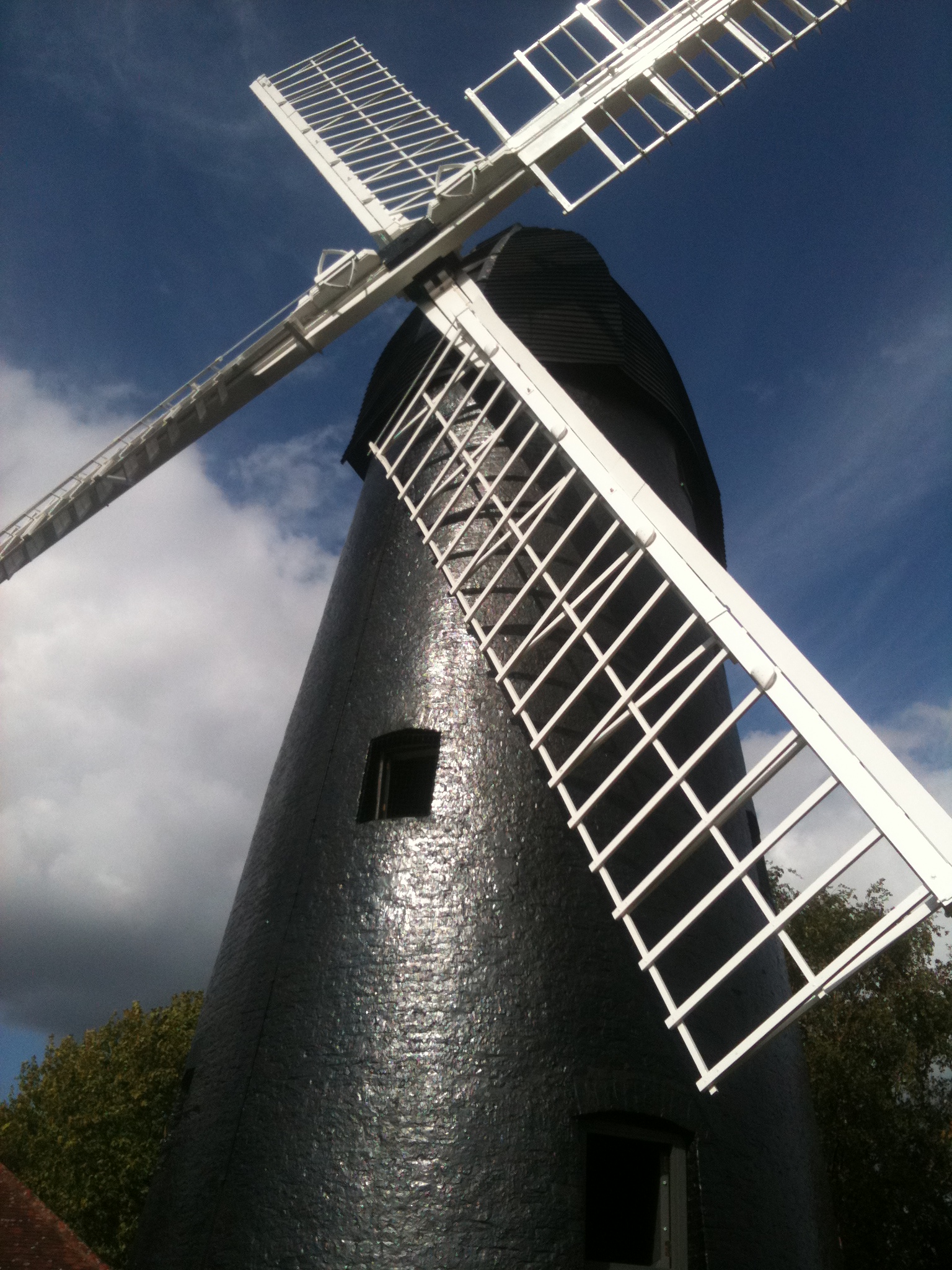
I finally got round to visiting Brixton Windmill during Open House Weekend. I first heard about the windmill ten years or so again, when I would go to gigs at the Windmill pub and pop out between acts to try to catch a glimpse of this extraordinary building in the nearby park, lost and derelict like an abandoned spaceship.

The windmill was built in 1816 and run by John Ashby of Brixton Hall. It was originally on a hill in fields, surrounded by outbuildings like a mill cottage and bake house, where bread was baked with the mill’s stone-ground wholemeal flour and sold to locals.

By the 1850s, Brixton was starting to grow and new housing blocked the wind, hampering performance. In 1862, the Ashby’s took their milling business to the Mitcham watermills along the Wandle, but the Brixton Windmill somehow remained, used for storage. The sails, though, were removed and sold for firewood.

In 1902, the windmill was returned to use, albeit as a location for a steam-powered provender mill. The mill was finally closed in 1934 and left empty until the LCC purchased it in 1957, after at least one attempt had been made to demolish it and cover the site with flats. Despite the sails being restored in 1983, the windmill, now owned by Lambeth, was allowed to run almost to ruin, which is how it appeared when I first saw it.

Since then, a major restoration project has taken place and the windmill is now open again to the public around once a month. The Friends of Windmill Gardens, a local residents association, also hope to start grinding flour again, using the provender mill that still survives on the first floor.

In celebration, here are the Fuck Buttons playing at the Brixton Windmill pub.

How about them Silver Apples

I have a piece in the latest Uncut about 60s electronica pioneers Silver Apple. If you’ve never heard them before, you should. Their main instrument is The Simeon, a bank of nine oscillators mounted on plywood and played by 86 different colour-coded buttons and pedals.

Here is their amazing country-electronica jam from 68, “Ruby”, on which they also play a banjo.

After forming by accident – everybody else in the previous band left, leaving just singer and oscillator-player Simeon Coxe and drummer Danny Taylor – the band had to split in 1970 when they created an LP cover that featured the pair in a Pan Am cockpit on one side, and with a plane crash on the back. Pan Am sued and that was that.

The band reformed in the mid-90s, however, although now it’s Coxe on his own after Taylor died of a heart attack in 2005. Silver Apples play Corsica Studios in Elephant on October 27. Check them out.

Curiocity: London unfolded

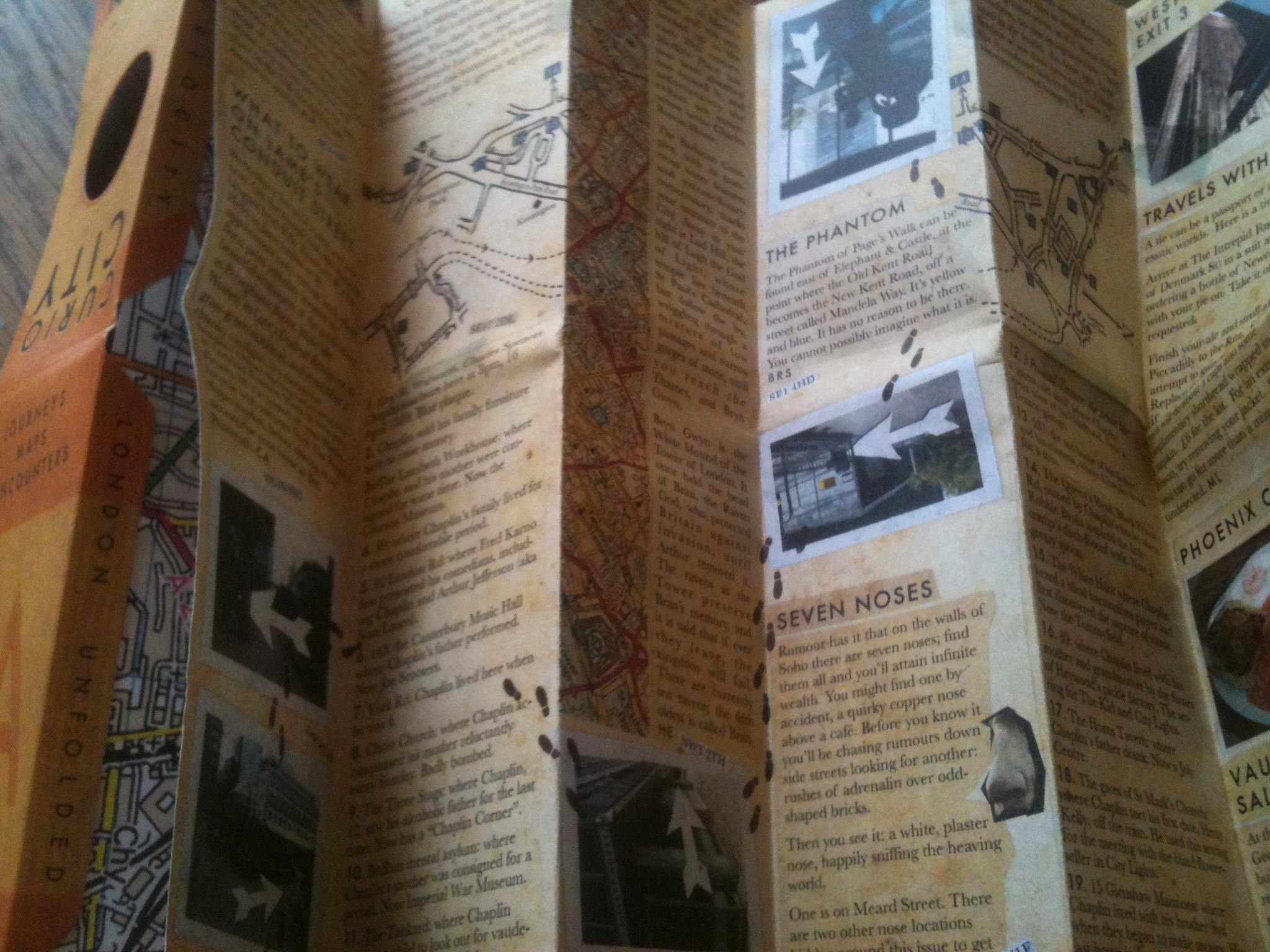
Another day, another London-themed map-related projected. Curiocity is a rather lovely tiny ‘mapazine’, that combines a magazine with a map and folds up into a cute – and curious –  little package that costs just £2.

One side features a stack of London-related trivia, including a loosely-mapped Charlie Chaplin walk around Lambeth, a ley-lines walk from Parliament Hill to Tower Hill and a ‘route’ from Hampstead tube to the mixed bathing ponds written out ransom note-style and snaking over five columns. There’s loads more, including bits on the Seven Noses of Soho and a game involving pigeons. It’s witty and it’s whimsical, both of which are obviously very good things indeed.

On the reverse is an entirely unusable but rather interesting map showing the history of London’s orbital road networks, a fascinating story which can be studied in detail here or in even more detail here.

Curiocity is available in a few choice London locations, including Stanfords, the London Review of Books Bookshop, the ICA and the Wellcome. It also has a website and is a more than welcome addition to the London publications landscape.