Category Archives: Politics

The legacy of the Blitz

I wrote a piece for the Guardian about the way modern London is still shaped by the bomb damage of the Blitz. This was a subject I immersed myself for several weeks and the first draft of my article is very different to the version that was published. I thought it might be interesting to reproduce the original article on The Great Wen. 

————————–

When travel writer HV Morton surveyed London in 1951’s In Search of London, it was still scarred by war. The Blitz had started on 7 September 1940 and more than a decade later, London was a “city of jagged ruins, of hob grates perched in the sunlight in shattered walls, of cellars draped with willow-herb and Canadian fleabane.” As Morton wandered sadly round Cripplegate – an area now covered by the Barbican – he looked “across an area of devastation so final and complete that the memory of it will always rise in my mind whenever I hear the word Blitz. Thousands of buildings have been burnt and blasted to the cellars. Here and there the side of a building rises gauntly from the rubble, a detached gateway stands by itself in the undergrowth, the towers of a few churches, or a spire, lift themselves mournfully, like tombstones in a forgotten cemetery…. How can anyone reconstruct a town from its cellars?”

The scale of this destruction can be gleaned from the bombsight.org website, which uses information from the National Archives to pinpoint every individual bomb strike, and The Bomb Damage Maps 1939-1945, created by the London County Council and now published as a book, which show colour-coded bomb damage on a building-by-building basis. The maps were originally created for financial reasons, but post-war planning was always an issue. “The heart of it was insurance and compensation,” says Laurence Ward, the book’s editor and senior archivist at the London Metropolitan Archive. “But they had one eye on post-war reconstruction and the maps were essential tools for rebuilding London. They give a bird’s eye view of the damage and use a colour scheme that makes it easy to see areas that needed to be cleared.”

By cross-referencing Bomb Damage Maps with the A-Z and www.bombsight.org, London’s post-war evolution can be explored, with modern parks, offices and housing estates replacing black blocks of destruction. As Ward explains, “The maps help areas make sense, they show why the streets look like they do.” We look at six examples that show some of the ways the Blitz shaped contemporary London, and how that process is still continuing today.

Mayday Gardens, SE3

Alan Lee Williams was 10 when his home in Mayday Gardens, near Blackheath, was hit by a parachute mine. “It was meant for the Thames, but damaged 27 houses and took our roof off,” he recalls, now 84 and reflecting on a life that included a period as Labour MP for Hornchurch. Williams’ house was repaired but several houses – marked black for “total destruction” on the bomb maps – remained derelict throughout the war. “They became places for children to play,” says Williams. “They built a big water tank on them for the fire engines, and sometimes we’d swim in it.”

Visit Mayday Gardens now and you’d have no idea anything had happened here. Unlike other streets, where former bomb sites can be identified by the post-war housing blocks that interrupt Victorian terraces, the destroyed houses in Mayday Gardens were rebuilt exactly as before. “They look as if they have been there all the time and I’m sure most people living there have no idea what happened,” says Williams. Indeed, when a local resident – who declined to be named – was asked if they knew of the street’s history, they admitted it came as news to them. “There was no consistency with the reconstruction,” says Ward. “These have pretty good plots and they probably decided it would be easier to rebuild a couple of houses then build a low-rise block.” One issue would have been the material available, with bricks remaining in short supply until the 1950s despite the LCC’s ability to salvage 140 million from damaged houses. The reconstruction of these middle-class homes, though, comes as stark contrast to the way many working-class districts were treated.

IMG_1342

Co-Op, Brook House, Shooters Hill, SE18

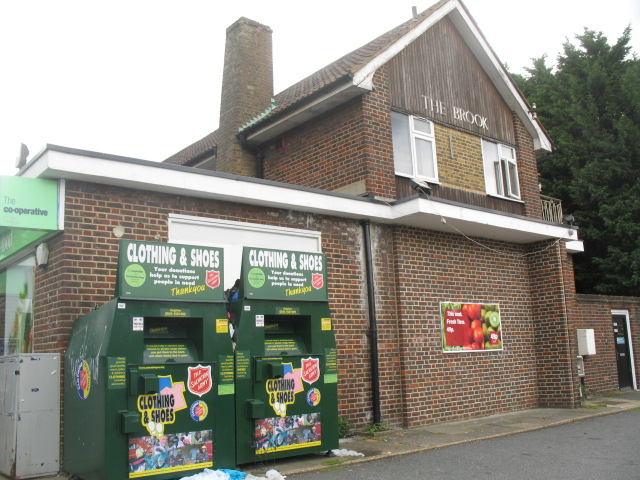
A short walk from Mayday Gardens on the corner of Shooters Hill and Corelli Road is an ugly squat building housing a supermarket. This was the site of the Brook Hotel pub, which was hit by a V2 rocket in November 1944.

Alan Williams, then 14, was one of the first on the scene. “I was on a tram on Shooters Hill, when I heard an explosion and ran down the road just in time to see a No 89 bus explode,” he says. “The pub had been hit by the missile and the bus was passing and caught fire.”

Williams was pressed into service. “The fire officer called for silence so we could listen for people calling for help and we heard somebody,” he says. “The firemen were too big to go down, so they lowered me. I found a body still breathing and helped them pull it back up. We got to the top and the gas blew up beneath us – I never got out of a bombsite so quickly.”

He’d rescued a girl who had been playing with the publican’s daughter. “She lived in the same road as me, and her father was a high-ranking policeman,” says Williams. “He came to see us – my mother thought I’d been in trouble again!” In the carnage, 29 died but the pub was rebuilt immediately. “The pub was a lovely old building,” says Williams. “It was close to where soldiers were billeted so they rebuilt it before the end of the war.” Williams passes such bombsites frequently. “I still live in the area and I bow my head as I go past,” he says. “I can still see that 89 bus exploding. I always thought it was strange that there was never an explanation of what happened to these places. I thought they should have put up plaques. It’s always a puzzle why it didn’t happen, maybe they just wanted to forget.”
IMG_1340

Christ Church, Newgate

There are some memorials, if you know what to look for. Churches played an important role before and after the Blitz. Bombed churches were used as propaganda – a famous wartime photograph shows St Paul’s sheathed in smoke – and London’s churches took a pounding: 624 of 701 churches were damaged, of which 91 were destroyed. Many City churches were damaged by the fire bombs of 29 December 1940, which levelled entire streets.

Almost immediately, a debate began about what to be done with the most badly damaged churches. Architect Sir Edwin Lutyen argued in 1941 that “where there is no congregation I would leave the spaces occupied by destroyed churches as open”, partly as a memorial. In 1944, a letter in The Times presciently articulated this principle: “The time will come – much sooner than most of us to-day can visualize – when no trace of death from the air will be left in the streets of rebuilt London. At such a time the story of the Blitz may begin to seem unreal not only to visiting tourists but to a new generation of Londoners. It is the purpose of war memorials to remind posterity of the reality of the sacrifices upon which its apparent security has been built. These church ruins, we suggest, would do this with realism and gravity”.

The creation of these memorial-ruins was rooted in realism – with attendances in decline, churches simply weren’t always needed. The medieval church of Christ Church, Newgate had been rebuilt by Sir Christopher Wren in 1687 after the Great Fire and then razed again in the inferno of December 1940. It has been left in its ruined state in memory of the Blitz, but in bastardised form.

In 1981, neo-Georgian offices were added in imitation of the 1760 vestry – these currently house a dentist. Two walls to the east were removed in 1974 in a road-widening scheme, while the tower – with a steeple that Ian Nairn considered one of Wren’s finest – was transformed into a 12-storey private home in 2006. Merrill Lynch’s office squeezes against the wall of the church and the fact these gardens act as a memorial to the Blitz probably goes unnoticed by local workers – it’s all far too tidy for one thing. A short-lived campaign was launched in 2013 to turn this into a more thoughtful memorial to the sacrifice of Londoners, of which there are few. Christ Church at least fared better than another memorial-ruin: St Mary Aldermanbury was sold to Westminster College in Fulton, Missouri to act as a memorial to Winston Churchill. London still awaits a fitting tribute.

Old Market Square, Columbia Road, E2

A complex network of priorities faced London’s post-war rebuilders, many of whom had been agitating to reconstruct London since before the war. This bore curious fruit in Columbia Road in Bethnal Green, now the location of a flower market and genteel Victorian terraces but then considered a slum. On the first day of the Blitz, a bomb hit a shelter beneath Columbia Market, killing 38. “Columbia Market was a 19th century development founded by Angela Burdett-Coutts to regenerate the area and improve quality of life,” explains Ward.” The buildings were damaged during the war and subsequently demolished – but, it seems, they could have been repaired – the map notes that the main blocks suffered only general blast damage.”

Burdett-Coutts was a philanthropist and friend of Charles Dickens, and Columbia Market was a combination of market and social housing constructed in a dramatic neo-Gothic style that marked one of the first flowerings of Victorian social housing. The ambitious scheme was deemed a “splendid failure” by The Times in 1936 and after the war was being used for storage. Although salvageable and unquestionably important, it was demolished in 1960 and replaced by Ravenscourt Park and a modern tower block, named Old Market Square in a half-hearted nod to what was lost. This new estate is typical of the buildings that were thrown up after the war to solve the problem of slum housing. A campaign is ongoing to get a plaque erected in memory of those that died.

IMG_1352

In the haste to rebuild London, many important buildings were demolished, inadvertently spawning the modern heritage industry. “The idea of heritage and listing buildings only really started after the war, when things were demolished so rapidly we don’t know exactly what was demolished and what was valuable,” says Peter Larkham, professor of planning at Birmingham School of the Built Environment, who has written on post-war reconstruction. “It was launched as a problematic and ad hoc system that allowed councils to designate conservation areas. After development stopped with the 1970s oil crisis, conservation almost took over and we now have 10,000 conservation areas and half a million listed buildings. Some think we conserve too much.” The only remaining trace of Columbia Market is a section of railing outside a nursery. “It’s a fascinating building that most have cost a fortune and completely dominated the road,” says Ward. “Now you’d never know it existed.”

Palestra, Blackfriars Bridge Road, SE1

This 1990s office block sits atop a site with a fascinating jumbled history. In 1783, the Surrey Chapel was built amid fields by Georgian preacher Rowland Hill, who chose a circular – or octagonal – form as this meant there were no corners where the devil could hide. By 1910, it was being used as a warehouse when boxer Dick Burge decided to turn it into a boxing venue. The Ring was a success but was hit by a bomb on 25th October 1940 and then again in March 1941. According to the Bomb Damage Maps the spot was also later hit by a V1 flying bomb. Damage from one of these strikes can still be seen a few yards away under a railway bridge.

Like many bombsites, The Ring wasn’t replaced until the 1960s. “Some materials required for building were rationed until 1954,” says Larkham. “Every bomb-damaged city was arguing with the government for their allocation of steel and you might have a site and a plan but you might not be able to do anything with it. Britain was selling steel to Australia because the economy was more important than rebuilding.” Eventually Richard Seifert’s gaunt Orbit House was raised on the site. Seifert, one of the UK’s most prolific post-war architects, loved to give his buildings space-age names, and this one also had a circular nod to The Ring. It housed records for the India Office.

But Orbit House’s time was fleeting. In the 1990s it was replaced by Will Alsop’s gargantuan glass Palestra, which is used by TfL. Peter Rees, the City’s former head of planning, once told me that modern office buildings have a life of around 30 years – something that has more to do with the changing requirements of office life than architectural trends – and that’s how long Orbit House lasted. But with his new building, Alsop paid reference to both of Palestra’s forefathers: like Orbit House, it is raised above the road on a pedestal, while its name comes from the Greek word for a wrestling ring. What’s interesting, though, is that as with much of London’s post-war offices – include huge swathes of the City – this site is already on its second generation of development. Larkham questions if that is sustainable. “One of the worst products in terms of sustainability is concrete,” he says. “The fact we can put these building up and then pull them back – is that really the best solution? We need to design for more flexible longer-term planning.”

Elephant Park, SE17

You won’t find Sayer Street on a map but you can hunt it down in photographs. One on the IWM website shows a family sitting at a dinner table outside the Blitzed shell of Sayer Street School eating egg and bacon supplied by American aid.

Another shows Sayer Street before the Blitz, when it consisted of five-storey tenements in one of London’s poorest areas around Elephant & Castle. Elephant was badly hit by bombs, and Sayer Street is riddled with damage on the Bomb Damage Maps. Before the war, the street contained a fishmongers, cat meat dealer, grocer, saddler, bookbinder; after the war, it was the location of a car park, one of the most popular post-war uses for bombsites. The NPC car park empire began with the purchase of a £200 bomb site on Red Lion Square.

In his memoir The Likes Of Us, Michael Collins writes how in the 1960s he explored Elephant’s remaining bombsites, “on which relics of former homes hovered, exposed broken fireplaces and floral or barley corn wallpaper that had witness births, deaths, Christmases, parties, tears, arguments, laughter and sex.” Sayer Street survived this half-life into the 1960s, when it was chewed up by the Heygate Estate. The Heygate was originally conceived as one of three gigantic housing estates that would stretch from Elephant to Peckham, linked by walkways and ramps for two miles. “It was said the planners decided which streets would be erased in the back of a taxi as they were driven around the neighbourhood,” writes Collins, who was forced from his childhood home. One of those to disappear was Sayer Street.

As Larkham explains, “some of the plans were incredibly radical, sweeping away neighbourhoods irrespective of damage and replacing them with high-rise towers nobody wanted to live in.” These were fuelled by idealism, but as early as 1945, the planner CB Purdom had warned of the dangers in How Shall We Rebuild London?, explicitly rejecting Le Corbusier and “the megalomaniac proposals of those who regard the metropolis as a hive of near termites speeding their existence upon escalators or in tubes.” Such pleas were ignored and towers went up on bomb sites all over London. Some were successful like the Barbican, but most were bleak, poorly built and badly maintained.

The Heygate was rarely popular but it housed many of London’s poorest and now it too is gone, having lasted 37 meagre years. Southwark sold it to Land Lease, a private developer and demolition began in 2011. Former residents have been shipped miles from London, displaced even more brutally than those who once lived on Sayer Street. In its place will come Elephant Park, a residential village of towers and plazas, where a three-bed apartment costs £2.5m. “It says a lot about where London is heading, how it is become more like Paris with those areas of social housing being pushed further out,” says Ward. The ripples from London’s post-war redevelopment continue to be felt, and from Blitzed streets and lost bombsites, another London arises. How long will this one last?

Killing Joke at Trafalgar Square

I recently interviewed the four original – and current – members of Killing Joke for a feature in Uncut.  I met them one-by-one in and around Lancaster Gate and we discussed their extraordinary career, from Crowley-inspired magical rituals in Battersea to police raids in Notting Hill squats and recording sessions inside the Great Pyramid.

We also discussed one of their first major gigs, when they headlined a CND show at Trafalgar Square.

As guitarist Kevin “Geordie” Walker recalled: “My favourite gig was the CND rally at Trafalgar Square. 80,000 people and us playing on the steps of the National Gallery in 1980. Jaz told them ‘Margaret Thatcher has bought all these cruise missiles and all you can do is stand there with a fucking placard. You dserve what you are going to get. This one’s called “Wardance”.’ It kicked off. It was killer. We never got invited back and I’ve got my suspicion that’s why we never did Glastonbury cos it’s the same hippie crowd and they remember.”

You can listen to that performance here.

I’ve interviewed several bands over the years for Uncut, from Buzzcocks and Gun Club to Soundgarden and The Damned. I’ve never met any quite like Killing Joke.

Disappearing London: Food For Thought

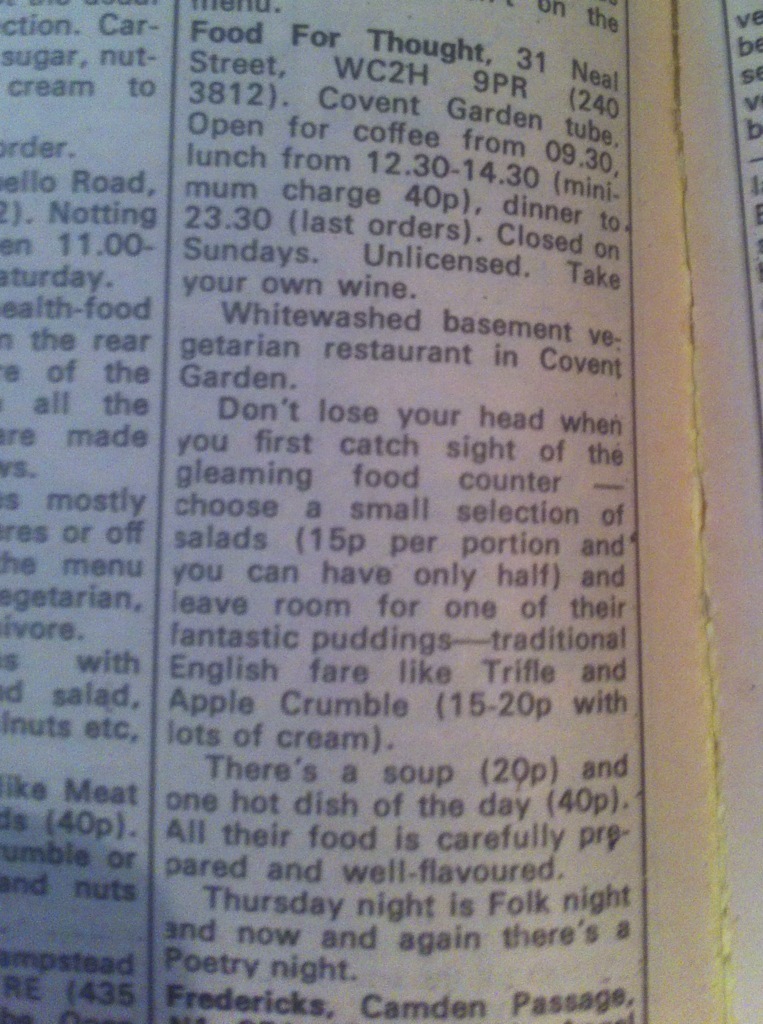
I have a piece in the Guardian about the closure of Food For Thought, one of London’s most charismatic and seemingly nuclear-proof (and I’m not just talking about the consistency of the scones) restaurants. It closes on June 21, rising costs – basically rents and wages to cover staff’s rents – forcing the owner Vanessa Garrett, to shut a business that has been successfully operating since 1971.

Food For Thought is one of those places that’s always been there. It was there when I prowled Neal Street on amateur shopping trips in the early 1990s. I knew, instinctively, that it was some sort of hippie joint, so went elsewhere, a teenage boy in thrall to the twin thrills of the Sex Pistols and bacon double cheeseburgers.

Years later, grown up somewhat, I began to eat there regularly, usually nabbing a takeaway from the ground floor during lunch breaks at Time Out. It always felt more than just a lunch venue. Without wanting to get too Sinclair about it, waiting in line at Food For Thought felt like a visit to polydimensional London, somewhere that had been quietly doing the same thing, for the same people, in the same place, for generations. Close your eyes, and you could be in 1970s London or even London in 2015. For secular souls, there are few areas that carry this atmosphere in quite such an effortless way, not so much a timewarp as timeless. It wasn’t dated, retro or old-fashioned, it just was.

I didn’t realise then quite how entwined Food For Thought was with the counterculture that spawned Time Out. When I tweeted about the closure of Food For Thought, the writer Richard King responded thoughtfully that: “FFT felt like one of the final remaining traces of the original Tony Elliott vision of London for Time Out.”

It was an astute observation. Food For Thought was born in the same spirit as Time Out, a desire to make London new, fresh, exciting, modern and funky, but also to make it, for want of a better word, good: cheap, utilitarian, healthy, an experience to expand the mind and reward the soul. London can still do this, but not in such a distinctive and understated political manner.

It went deeper. One of Food For Thought’s first chefs was Sue Miles, the wife of Barry Miles, founder of International Times, the underground newspaper from which Time Out hatched in 1968. Sue had learnt her trade at the Arts Lab, a counterculture take on the ICA that operated from Drury Street, and she later worked at Time Out, writing its first pair of London guides, which included enthusiastic reviews of Food For Thought.

IMG_3542IMG_3541

What’s particularly depressing about the closure of Food For Thought is that it wasn’t doing anything wrong. It was popular, it was serving good food at reasonable prices. They could have expanded, sought outside investment and gone into the franchise business, but they felt that would dilute the experience. Why should they change when they were doing what they wanted and doing it well?

And it was this commitment to offering value for money – that deeply held desire to not rip off the consumer – that led to its demise. That was at the heart of what Food For Thought represented, and it is precisely the sort of thinking that doesn’t wash in rentier London, where even success is punished and landlords feel duty bound to wring more profit out of something they have done nothing to create, like Mafia bosses demanding their cut. People revolt when a government behaves this way, so why is it acceptable for landlords?

What a city we have created.

Earls Court and the death of fun in London

“In London, it seems everything that’s not a shop, offices or luxury apartments is being demolished,” sighed artist Duggie Fields when I interviewed him last month for a piece in Uncut about the imminent demolition of Earls Court Exhibition Centre. It’s a quote that, in a nutshell, seems to encapsulate all that is going wrong with London right now.

“There is so much damaged being done to London all over, Earl’s Court is just part of it,” says Fields. “London is losing a scale of living that has been very special for a long time. Now we have this mini high rises that could be from anywhere, they are characterless and there are so many of them.”

Earls Court will be pulled down early next year and replaced by houses, ending the area’s 120-year history as a place of fun. This history is well known to London nerds, but is worth repeating. The former cabbage field of Earls Court was transformed into a funzone by Yorkhire entrepreneur John Whitely at the end of the 1880s, when he brought Buffalo Bill’s Wild West Show to the newly transformed exhibition site, hemmed in between railway lines. It featured a miniature Rocky Mountains, Native American village, corrals and a cowboy bunkhouse. “The show was a revelation,” write Felix Barker and Peter Jackson in Pleasures Of London. A few years later, the site attracted London’s first big wheel – a 300ft monster called the Gigantic Wheel.

When that lost its thrill, new entertainments were sought – including plans for a mechanical racecourse. Numerous exhibitions were also held there – including Captain Boynton’s Water Show in 1893, the Greater Britain Exhibition, in 1899 and Shakespeare’s England in 1912. Then in 1937 the Exhibition Centre was built. It opened with a Chocolate and Confectionery Exhibition and went on hold swimming galas, motor shows, the Royal Tournament and events for the 1948 and 2012 Olympics.  It’s a decent looking building, too, well worth saving for its lovely Art Deco curve and revolutionary concrete engineering. So many magnificent buildings from this era are being lost.

Less, pleasantly, in 1939 it hosted a gargantuan meeting of Oswald Mosley’s fascist blackshirts.

From the 1970s, Earls Court also began to host pop shows. David Bowie was first to play there, although Noddy Holder of Slade claims they were the first to book it and then managed to improve the sound after Bowie flopped. Concerts by Bob Dylan, Led Zeppelin, Queen, Rolling Stones and Pink Floyd followed. I saw Oasis there, unfortunately, and also the BRIT awards in 2000, when I threw a champagne cork at Christine Hamilton.

Slade fans at Earls Court

And now it’s to come down, replaced by 8,000 houses and some shops.

Duggie Fields has lived in Earls Court since the 1960s. You may recognise his flat – and former flatmate.

He points out that the removal of the Exhibition Centre will, at a stroke, remove any point or purpose to the Earls Court area. “It has nothing for people to come to,” he says. “Just boring anonymous shops and lots of traffic. All we’ll get is more chainstores because there’s no neighbourhood, there’s no locals. You can’t create villages, they grow over a long period of time.” He also fears for the pubs and restaurants that rely on the Exhibition Centre, which has still been functioning almost round the clock despite impending doom, for their custom.

He’s right. Earls Court is, even with the Exhibition Centre, one of the most boring areas of London. Without it, it’s pretty much irrelevant. But there’s a problem here too. London needs housing, desperately. Surely these 8,000 or so units will help?

It seems unlikely. The new apartments will – like those in the big new developments and Nine Elms – be aimed at the pockets of investors and speculators, people with deep pockets who have taken advantage of stagnant interest rates to buy up property and then charge eye-watering rents for them. It’s hard to blame them, as economic policy seems designed purely to over inflate London’s property market, but the damage is considerable. Because not only are they building identikit apartments in areas nobody that actually needs housing can afford, they are in the process annihilating anything that could be seen as fun – pubmusic venues, sports grounds as well as historic structures like Earls Court. It’s a depressing, dismal outcome that offers the worst of all possible worlds.

It’s also entirely typical of the current state of London: could you possibly imagine a scheme as imaginative and as exciting and beneficial for the public as the conversion of Tate Modern happening today? Not a chance. It would be flattened and replaced by luxury glass apartments. What do we get instead? A bloody Garden Bridge, stupid cable car and shopping centres. Thank god at least the Olympic site has been safeguarded – for now.

“There’s nothing to build on the heritage they’re throwing away,” says Fields of Earls Court. “It’s been an exhibition site for over 100 years. London is tossing that out with as many other things as it can toss out under this current administration.”

London filth

Lee Jackson loves filth. His new book, Dirty Old London, is full of the stuff, as he explores Victorian London’s attempts to cleanse a city that is swilling in muck. I’ve often wondered what Victorian London would have smelled like, and Jackson’s book comes close to capturing what must have been a frightful stink. I knew about the horse shit and the smoke, but had never considered the mud, blood, unwashed bodies, corpses and human excrement that, collectively, would have made the Victorian city one of the foulest places on earth. It’s astonishing anybody wanted to live there.

Jackson shows how Victorians began to push against the tide of muck, which grew worse as London’s population swelled. Victorians did not consider dirt in itself to be a carrier of disease, but they believed the smell could be lethal as well as deeply unpleasant, so eventually set about doing something about it. They built pavements, sewers, public baths and indoor lavatories, improved housing, dug cemeteries and generally tried to do something about “that combined odour of stale fruit and vegetables, rotten eggs, foul tobacco, spilt beer, rank cart-grease, dried soot, smoke, triturated road-dust and damp straw’. They weren’t always successful – some of those aromatic problems lingered long into the 20th century when they were eventually dealt with, or in the case of horse manure, replaced by something even worse such as exhaust fumes.

In explaining how this happened, Jackson is far more entertaining than anybody has the right to be on such a subject. Rather than focus on the well-trod tales of John Snow and Joseph Bazalgette – both of whom barely feature, thankfully – Jackson resuscitates the lives of less well known figures in this lengthy campaign against dirt, characters like reformer Edwin Chadwick who laid much of the groundwork for what was to follow. In the process, he shows how Victorian London functioned – the haphazard, individual-driven nature that saw things get done, or not, as the case might be.

Embedded image permalink

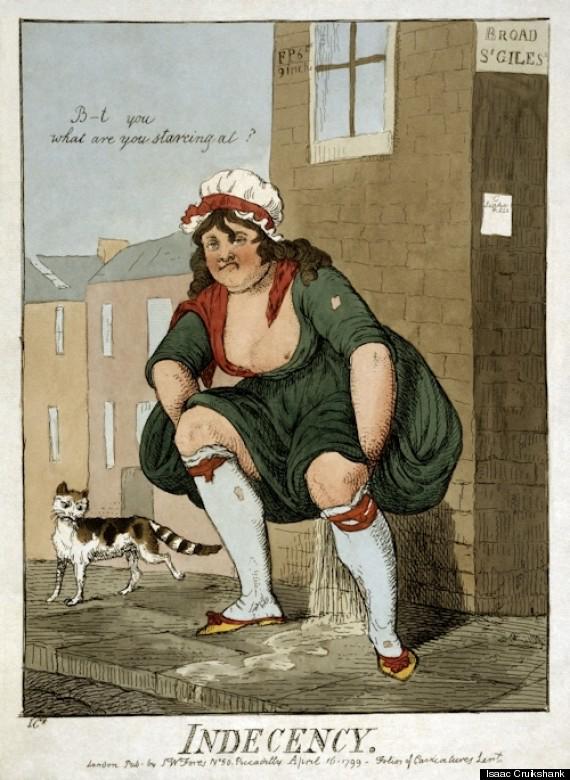
Indecency by Isaac Cruikshank

This is a history with potentially narrow focus, but Jackson – a general historian of the unstuffy, non-academic variety – is removed enough from the subject to be able to show its wider importance and long-term effects. One theme of the book is the way sanitisation – in the form of sewage, rubbish and housing – was the hinge on which London’s social contract turned. For much of the 19th-century, the bewildering array of local authorities that ran London saw their role as, essentially, to keep out the way. They did as little as necessary, thus keeping rates low and relying on private enterprise to fill the gap. But as London grew, getting bigger and smellier every year, this system began to creak. A good example is with the dustmen. Collecting and recycling London’s rubbish was a lucrative job for some entrepreneurs, but not so much for the dustmen themselves, who had to rely on tips to make a living. And given that tips were much more likely to be acquired in rich areas, the poorer streets were increasingly neglected, allowing rubbish to pile higher and higher. Local authorities had to step in to fix this, and it gradually became the accepted role of local authorities in the UK until Thatcherite councils like Wandsworth in the 1980s began to perceive different, pre-Victorian, way of running things.

Jackson also touches on a related angle: the increasing movement of public buildings into private hands. In this case, it’s centred round the Victorian public lavatories, which were only built after ferocious lobbying from some notable figures who recognised the desperate need on the streets for London loos.  The story of how those toilets were eventually built is fascinating in itself, but Jackson also notes the fact that so many have recently been closed, flogged, refurbished and then sold back to us as coffee shops, galleries and an “award winning urban spa”. Perhaps this is the fault of the Victorians, for making things so well and so adaptable, but you can’t help feeling that, now as then, it stinks.

London curiosities, from Don Saltero to Viktor Wynd

This weekend, the grandly titled Viktor Wynd Museum of Curiosities, Fine Art & Natural History opens at 11 Mare Street, Hackney. You may already know of Wynd’s whims. An intriguing dandy, Wynd is the founder of the Last Tuesday Society – a body that promotes the esoteric in lectures, salons and workshops – which included Wynd’s own huge collection of oddities and curiosities, acquired over a lifetime of inquisitive travelling and impulsive purchasing. Originally, these items were meant to be sold – Wynd is still a dealer in the weird, a middleman in this strange underworld of people that buy and sell the corpses of giant spider crabs and Javanese hen’s teeth –  but he found “it didn’t work as a shop and it isn’t fun selling stuff. I had to keep buying and you can never be sure what will sell, it’s an endless cycle. So I thought it would be more fun to make it into a museum.”

These curiosities are now going on display as the new museum. And curious they certainly are. On the shelves are two-headed lambs, tribal skulls, dodo bones, plastic toys, lion skeletons, radioactive scallops, Victorian dolls, surrealist art, an artificial foreskin, a cassette of a John Major speech on the subject of red tape, a Victorian mermaid, convict Charles Bronson’s sketches, feathers from extinct birds, a giant hairball from a cow’s stomach and jars of celebrity poo [“How did you persuade Kylie Minogue to poo in a jar for you?” I asked, when interviewing him for Eurostar; “I asked her very nicely,” he replied.]

Impeccably arranged cabinets contain delight after horror after delight, some labelled, others entirely mysterious, but all put together in a way that implies the art of the display, the way these things look on the shelves, is every bit as important as the items themselves.

poo

London has always appreciated the chance to gawp at a gruesome gallery like this. Wynd’s endeavor harks beck to the very first public museum to open in London at Don Saltero coffee shop in Cheyne Walk in 1695. Saltero, a barber, had previously been known as James Salter and worked for Hans Sloane, the collector who started what became the British Museum. Sloane reputedly gave some of his cast-offs to Saltero, who used them to attract custom to his coffee shop. In 1713, his catalogue boasted in terrible rhyme: “Monsters of all sorts here are seen, Strange things in nature, as they grew so; some  relics of the Sheba Queen, and fragments of the famed Bob Crusoe.”


Saltero’s collection included such marvels as  a giant’s tooth, a necklace made of Job’s tears and Pontius Pilate’s wife’s chambermaid’s sister’s hat, which had been made in Bedford. It was, nonetheless, hugely popular and by 1760 the collection includes priceless artefacts like the Pope’s candle; a piece of the true Cross; the Four Evangelists’ heads cut on a cherry-stone; the King of Morocco’s tobacco-pipe; Mary Queen of Scots’ pincushion; Queen Elizabeth’s prayer-book; a pair of Nun’s stockings; Job’s ears, which grew on a tree and  a frog in a tobacco-stopper. Moreover, it had inspired other entrepreneurs, eager to educate the public in the wider mysteries of the world, to follow likewise. Among those following in Saltero’s wake was Mr Adams of the Royal Swan in Kingsland Road, not far from Wynd’s palace of the strange. In 1756 Mr Adams was exhibiting”the heart of the famous Bess Adams, that was hanged at Tyburn; Sir Walter Raleigh’s tobacco-pipe; Vicar of Bray’s clogs; teeth that grew in a fish’s belly; the very comb that Abraham combed his son Isaac and Jacob’s head with; Wat Tyler’s spurs and the key of the door of the Garden of Eden.”

Well then!

Wynd is an artist as well as a collector and showman, and his museum will double as a gallery, opening with a show devoted to early British Surrealists and including work by Austin Osman Spare, Leonora Carrington, Grace Pailthorpe and Reuben Mednikoff. His curiosities are also sprinkled with the occasional artistic embellishment, whether its sculptures donated by artist friends, his own drawings, fine work by the likes of Spare or Mervyn Peake, or more occultish fare, like “blood squeezed from a stone” or a box containing “some of the darkness that Moses brought upon the Egyptians”. These latter items are much like the imaginative exotica of Saltero and Adams, and also remind me a little of Yoko Ono, and her attempt to auction in London a ‘Vial of Genuine New York Tears’ and ‘Jar of Captured Cloud Formations over the Bronx’  to subsidise Norman Mailer’s Mayoral candidacy.

Wynd’s collection features a lot of dead things in jars – babies, dissected vaginas, stuffed animals, old bones, beetles, butterflies, intestinal worms – but he rejects the notion that it is simply a celebration of the macabre, a house of horrors designed to shock the straights. “Nobody’s ever been shocked,” he says. “If you are going to a curiosity museum you want to see dead babies, it’s what you expect. That isn’t what’s new, what’s new is the idea that dead babies and Furbies are equally attractive. It’s uncanny rather than macabre, it’s the juxtaposition of items, setting off thought processes.”

“I see putting everything together as an art,” says Wynd. “If you are a collector then the world is your tins of paint and the walls and cabinets are the canvas. Everything has to look right. It’s a way of trying to understand the world, but a world that has no meaning. It’s all the pretty things that show what an amazing place we live in. It’s also an attack on conventional aesthetic values, so we have a Furby, which is seen as completely valueless, sitting next to a rare and valuable skull of an extinct beast, sitting next to Chinese sex toys. I don’t recognise a distinction between high and low, it’s just if I like it. It also makes me laugh. I’m quite miserable and this place cheers me up.”

It’s not entirely clear how much Wynd enjoys his role as a collector. As he points out, most of us collect when we are children, but then grow out of it. The collector is in a state of permanent pre-adolescence, unable to move on, still fixated by those items that first caught his attention many years before. Wynd says that as a child his favourite places were the Natural History Museum and the Pitts-River Museum. In adulthood, he is still trying to locate that childish sense of awe and intellectual awakening.

He recalls being a student in Elephant And Castle and compulsively filling a garage with items he find on the streets – “I couldn’t pass a bin liner without opening it.” Later he moved to Paris and discovered that at the end of the month everybody’s rental contracts ended at the same time, and on these moving days treasures would be left outside every block of flats. “It was heaven.”

The problem, he says, is that a collection is “like a garden. It’s never going to be finished. It’s never done. It’s a psychological condition, it’s stupid, it’s pointless and causes endless worries.” It also gives us the Museum of Curiosities, for which London should be thankful. Go gawp, embrace the uncanny.

Turkish London and football

I have a post on Four Four Two about how Turkish Londoners square their support for Turkish club sides with their loyalties to London clubs. It was an interesting assignment, and made me wonder whether other incoming communities face similar quandaries.

Presumably they do: the historically large Italian following at Chelsea will have to occasionally decide between Lazio, Roma or Juve and their London club; Arsenal’s new French fans will have to choose between their love Arsene and their support for PSG – but there is something about the very visibly Turkish nature of the Turkish community and, particularly, the drama of Turkish football fans that made this particularly intriguing. I also got to eat some damn fine bread from the excellent Akdeniz Bakery in Stoke Newington, which I heartily recommend to readers.

‘I didn’t want to drop a turd on the reader’s lap’: Meeting James Ellroy

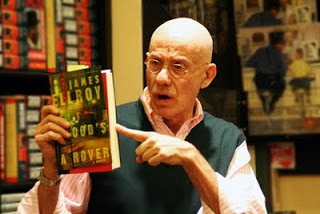
James Ellroy has a new book out, so I thought I’d republish my interview with him from 2009 when he was promoting Blood’s A Rover. I was unusually nervous before our meeting as I’d heard Ellroy was a difficult man to talk to and his memoir – My Dark Places – saw him plead a strong case for his own insanity. But all in all, it went pretty well. Ellroy seemed sad rather than difficult, although anybody can seem lonely in a Chelsea Harbour hotel on a Sunday morning. I wish I had kept the full transcription of the interview, as we also discussed, from memory, his research techniques and his plans for a new series of book, the first of which has just been published.  

Smart, stern and ramrod straight, James Ellroy sits in his Chelsea Harbour hotel room and broods about women and words. He is upright. Terse. Correct. He doesn’t quite speak the way he writes – hell, nobody speaks they way he writes, in sentences entirely unadorned with commas, adjectives or conjunctions – but his sentences are short, exact, punchy.

‘I love the English-American idiom,’ he says. ‘I love Yiddish. I love racial invective. I love alliteration. I love slang. I love profanity. And the simpler the language, the more direct, the more blunt, the better. When writers try to imitate me they always put in too many words, and none of it works.’

People try to copy Ellroy because his jazzy, rhythmic, slang-strewn pulp-prose is deceptive in its simplicity and addiction in its execution. The latest fix comes from Blood’s A Rover, the Nixonland masterpiece that completes his Underworld USA trilogy, an alternative history of conspiracy, crime and collusion that includes American Tabloid and the psychotic The Cold Six Thousand. Like its kin, Blood’s A Rover is a bloody collision of Johnny Cash, Raymond Chandler and Sam Peckinpah in which Ellroy uses three fictional male characters to explore factual events – in this case, the ascent of Richard Nixon, who joins J Edgar Hoover and Howard Hughes in the pantheon of American personalities Ellroy has slyly redrawn. ‘You’ve got to like Nixon,’ he says. ‘He;s funny, full of shit, drunk half the time. You’ve got to love a guy like that.’

Where this novel differs is in its bold ancillary characters such as Joan Klein, a femme fatale who embodies Ellroy’s tribute to a life-changing lover. ‘It’s about a boy who finds a matriarch, and that’s my story,’ he says. ‘One of the men is asked why he does what he does and he says, “So women will love me” and that’s why I write. I wrote it to honour Joan. There was a dark romanticism to the relationship, it ended badly and I will never see her again. There’s a line from The Hilliker Curse [Ellroy’s second memoir]: “I left bloodspills wherever we went.” She just cut me open.’

Joan is the book’s hinge. She is pursued by all three male characters – Wayne Tedrow Jr, a tortured ex-racist; Dwight Holly, a CIA fixer with shadowy brief and headful of grief; and Don Crutchfield, a teenage voyeur with the knack of being in the wrong place at the right time. All of them represent a part of Ellroy himself and all of them are looking for ‘salvation, redemption’, reflecting what Ellroy calls his ‘misunderstood Christian morality’. Joan brings female strength and left-wing idealism into their (and Ellroy’s) masculine right-wing world.

‘I wanted to write the story of that woman and me, and I wanted to write about symbiosis and synthesis and how the right and left need each other and how that often leads to catastrophe, because everything Joan and Dwight touch turns to shit,’ explains Ellroy.

There are other changes from past books. The prosy style is turned down a notch, the violence less gut-churning, the noir bleached a little. ‘The Cold Six Thousand was too difficult,’ he admits. ‘My ex-wife said: “Babe, it’s the most ambitious novel I have ever read, it’s 100 pages too long, it’s fucking complex, the style is too difficult and I didn’t know what the fuck was going on.” And she was right. So here you have a range of characters who are much more thoughtful, much more, in their weird way, composed and who think about shit a great deal more, so you need a more explicatory style.’

Ellroy breaks up the pace with journal entries written from less testosterone-soaked perspectives, and softens the mood towards a tentatively upbeat conclusion. ‘I don’t feel bleak,’ he says. ‘It’s very much a book about romance. I didn’t want to drop a turd on the reader’s lap.’

As distinct as Ellroy’s style is his setting, a pre-70s America where powers is held by the Feds and CIA, rogue cops, Hollywood players, bent pols and the Mob. Plots are punctuated by historic events, which he uses and interprets as narrative demands. It’s a world Ellroy has made his own, but didn’t invent.

‘The three Underworld USA book were launched by Libra by Don DeLillo [a fictionalised biography of Lee Harvey Oswald] and his take that JFK was assassinated by renegade CIA guys, crazy Cuban exiles and the Mob,’ he admits. ‘Conspiracy is there, I love writing about it, I love exploring the collusive mindset and I can’t prove any of it. What it comes down to is whether it is dramatically viable and whether the human infrastructure of the big public events is believable. That’s my job. I take the ideas, the characters, the milieu, the real-life history, the real-life situations and the research fills it in. Then I lie in the dark, I think of love stories, and I brood.’

Art and protest at the V&A

I’d been looking forward to the Disobedient Objects exhibition at the V&A for quite some time, so perhaps it was inevitable that I’d end up being disappointed. The exhibition looks at the art and design of protest, the way campaigners create new objects to enhance their ability to protest. Most obviously, this involves items like banners or posters, but protesters can be incredibly creative, and the boundaries for this are almost limitless.

The V&A exhibition, though, all felt a little safe. There was very little here that could upset anybody. The protests could all have come from a Guardian-approved list of righteous causes, while the objects were either strung up high out of reach – inflatable cobblestones, old banners – or dwarfed by the surrounding cabinets made of cheap plywood. Not that that there were that many objects: some posters and banners, a decorated car, some bicycle contraption, a phone with a subversive game and a limited selection of T-shirts and button badges. I was particularly disappointed that the Barbie Liberation Organization, a group that placed subversive voiceboxes inside old Barbies, were represented only by a film much like one you can watch on You Tube.

It wasn’t terrible. I liked the shields made to resemble book covers, for instance, and the Suffragette china has historic importance, while the Fuck The Law pendants made by a Black Panther who has spent 35 years in solitary had a rare power. Certainly more so than the rather trite banner, below, that the V&A clearly love so much they’re selling as postcards. I liked the free sheets they were giving away, though, telling people how to make their own disobedient devices.

Bone china with transfers printed in green, bearing the emblem of the Women's Social and Political Union (WSPU)Coral Stoakes, I wish my boyfriend was as dirty as your policies

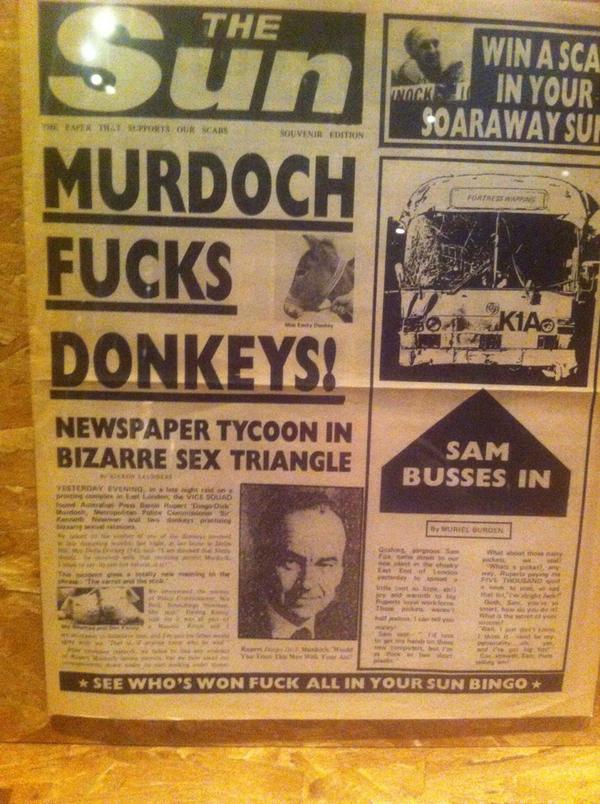
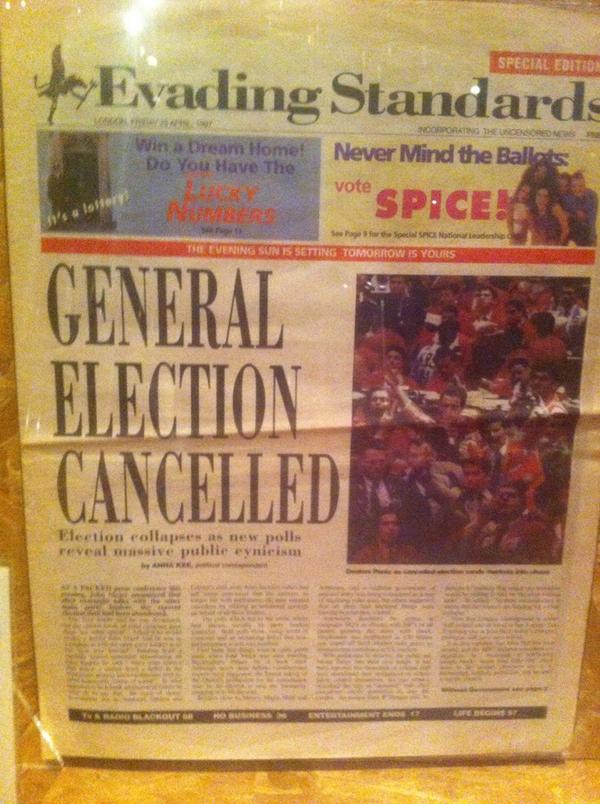
Best of everything, though – and the only stuff that really felt at all dangerous even now – were the mock newspapers created by Reclaim The Streets and Class War. These supported a variety of causes, but were generally just designed to piss off the power of the establishment.

Embedded image permalink

Embedded image permalink

This had a lot in common with the excellent exhibition upstairs in Room 88 called A World To Win: Posters Of Protest And Revolution, where Class War were also represented. This display takes place across two rooms which collectively contained dozens of dramatic posters from more than 100 years of graphic protest across the globe. There are items here from the Weimer Republic, Vietnam, Soviet Russia, Oman, Northern Ireland, Paris 68 and the Iranian Revolution.A lot are designed to shock – dead bodies at My Lai, Fuck The Draft, the incongruity of a poster celebrated the Ayatollah Khomeini placed just across the room from one lauding Angela Davis. The mix worked, and the images were superb.

A few of my favourites are below. but I recommend you check the collection out yourselves. Both this and Disobedient Objects are free.


Poster - So Long as Women are not Free the People are not FreePoster - Never Again! Stop the Nazi NF!

Against Apartheid. Boycott South African Goods (Poster)

Les Beaux-Arts Sont Fermés, Mais L'Art Revolutionaire Est Ne (Poster)

Embedded image permalink

London: a cycling city

I wrote about the challenges facing cycling in London for The London Magazine

Every time I hear that another cyclist has been killed on one of London’s many lethal junctions, I pray to a god I don’t believe in that it isn’t one of my friends. The idea of cycling in London terrifies me. That’s partly because I haven’t ridden a bike more than twice in 20 years, and partly because I have seen so many incidents, altercations and near fatal collisions involving cyclists during my walks around the city.


I’m aware of the figures – the fact that cycling is overall a pretty safe form of transport, even if it could always be better – but it’s hard to shake off that impression that it’s anything but. I’ve seen cyclists get hit by taxi doors and narrowly avoid getting squashed by buses. I’ve seen them shouting with rage and fear at drivers who’ve turned out of a side street in front of them without looking. I’ve seen them cycle headlong into pedestrians who weren’t looking where they were going (and vice versa). I’ve seen them getting into squabbles with bus drivers about ownership of bus/cycle lines that end with blows being traded. I’ve seen them picking themselves and their bent bikes off the pavement after minor crashes. And I’ve seen the blood getting washed off the road after major ones. It looks anything but fun.

So despite the fact I see people cycling quite easily and happily on London streets every day, I still think it’s one of the last things I’d ever want to put myself or my family through on a daily basis.

That is something that needs to change if London is ever going to be a cycling city, which it desperately needs to if it is to remain in any way a human and pleasant place to live in. People like me need to be persuaded that London cycling is safe and that a trip on the bike to the shops won’t result in a serious injury or a shouting match. As Mike Cavenett of the London Cycling Campaign admitted to me “the striking thing is that Dutch cyclists just look like Dutch people”, by which he means you see the elderly and children, men and women, all cycling in their normal clothes – not like London, where cyclists wear tight, bright clothing and manage to look simultaneously over and under dressed.

When London’s cyclists start to look normal, that’s when we know we are heading the right way. And for that to happen, London needs better infrastructure, streets on which cyclists feel safe and are able to relax, making the whole experience better for everybody. Everybody I spoke to – including Andrew Gilligan, the Mayor’s cycling tsar – seemed united on this and agreed on the direction that London needed to go in. Whether it actually happens, whether there is the political will to spend the cash to keep the promises, remains to be seen. But here’s hoping it starts to happen, because a cycling city would be better London for everybody.