Category Archives: Photography

Secret London: photos of lost rivers and abandoned London

Lovers of London urban landscape, lost rivers, photography and, for want of a better word, psychogeography, should be aware of a forthcoming exhibition, From The Westbourne To The Wandle at Maggs Bros gallery.

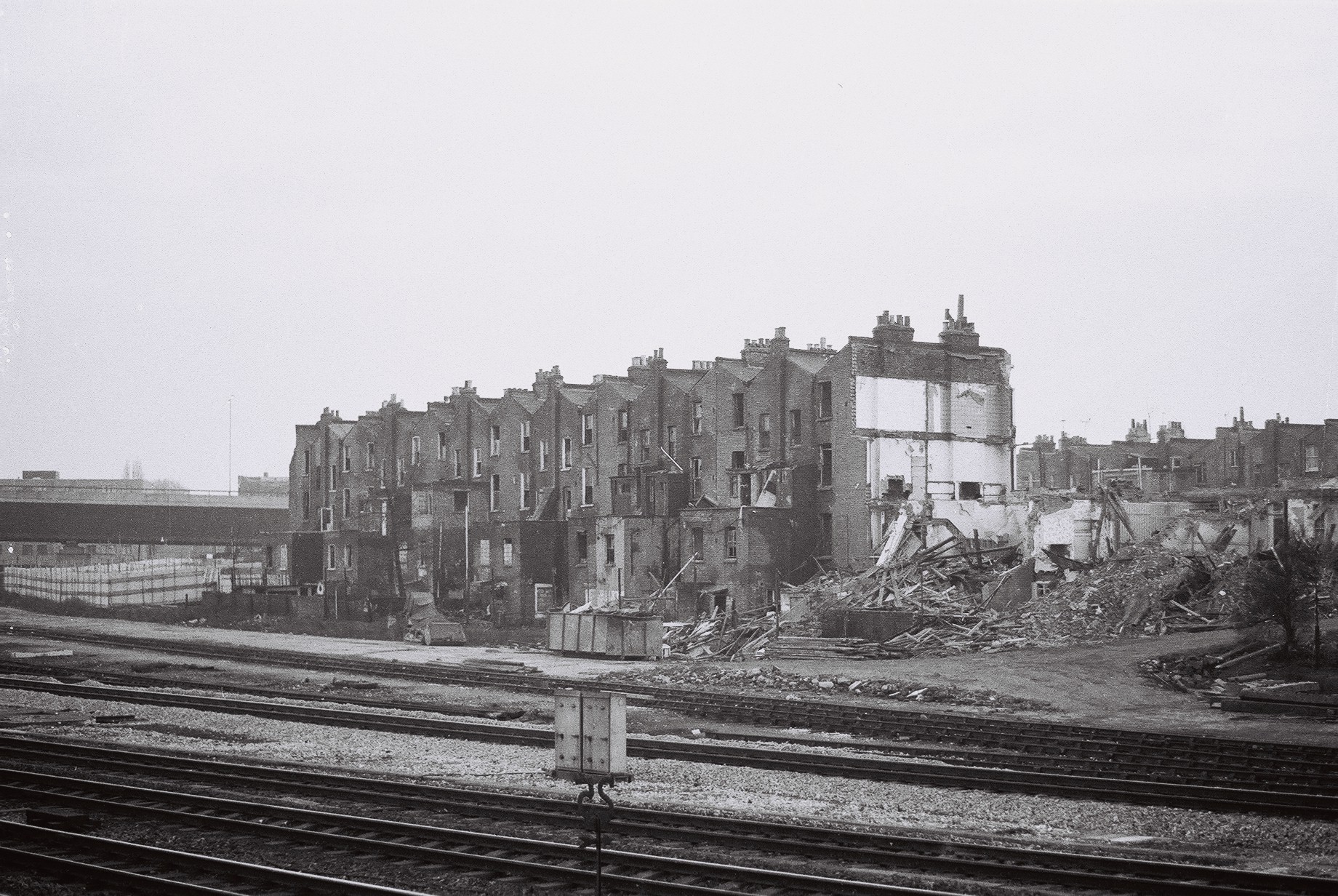
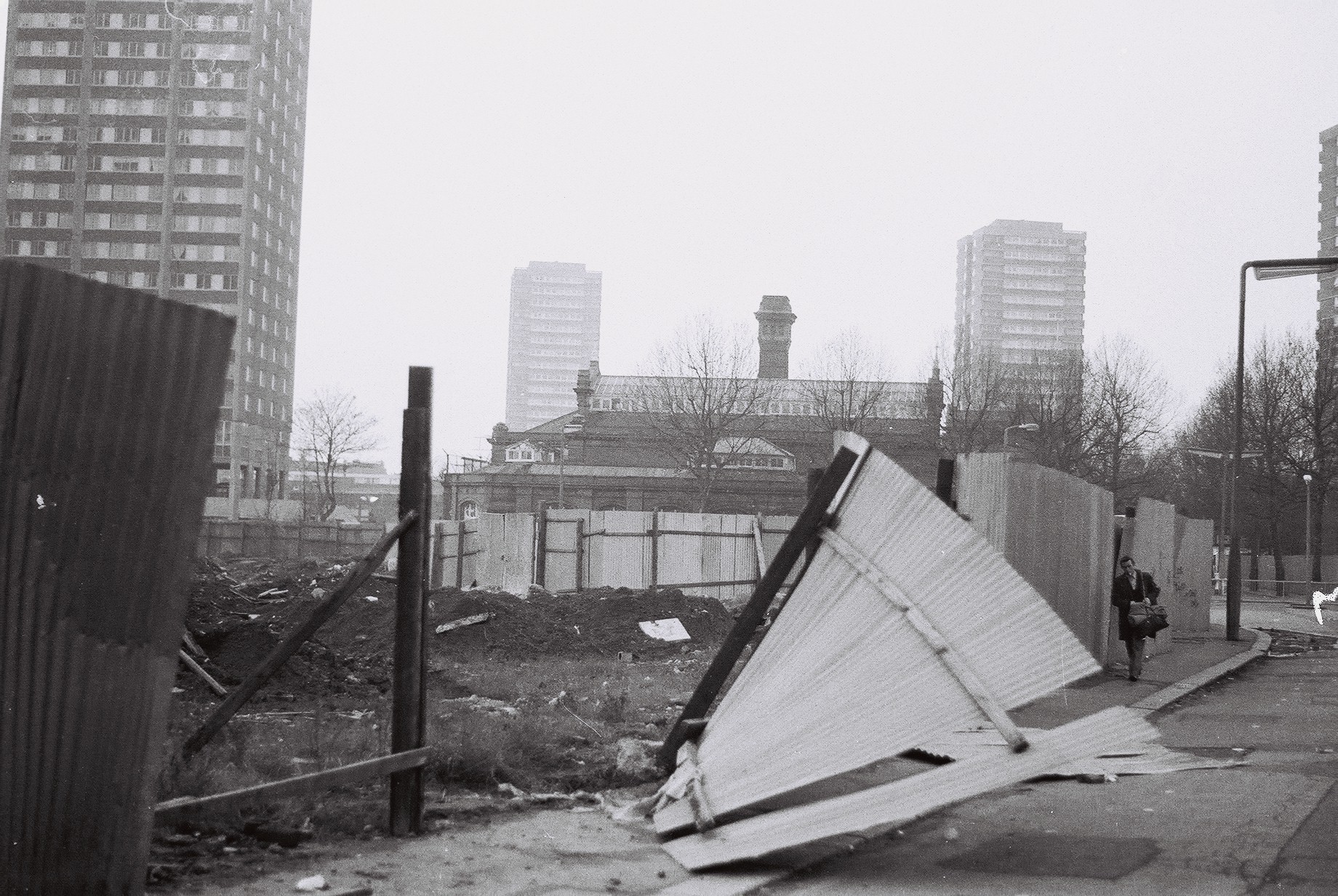
Curated by counterculture bookdealer Carl Williams, this brings together the work of two London photographers and writers, Jon Savage and SF Said. Savage is best known as a music writer, but in 1977, inspired by JG Ballard, he set out to photograph the urban wastelands of West London, taking a sequence of stunning black and white pictures of the lost land beneath the Westway.

He has written, ‘In its emptiness, austerity and gloom, it is an interzone waiting for something to happen, for the beasts to be unleashed. This was how London felt at the time: coming, coming, coming down – like a speed hangover merging into an apocalypse. But in there was also a sense of possibility that new ways of thinking might grow from this emptiness – like the scented buddleia on the bombsites.’
SF Said’s picture were taken for last year’s excellent Lost London Rivers book. Said shoots on Polaroid, which he describes as like a ‘photographic time machine’ and says he wants to ‘capture the dreams that a place might have of itself, or the memories that it stores under layers of time’.

He uses expired film, which can create strange, mesmeric effects and explains ‘as their chemical layers decay, they start to produce strange flame-like swirls and flickering light leaks that go even further into dreamlike realms.  These hallucinatory effects are unpredictable and random; sometimes they ruin a picture.  But when you’re lucky and it all comes together, I think they give you something magical that you could never get any other way.’

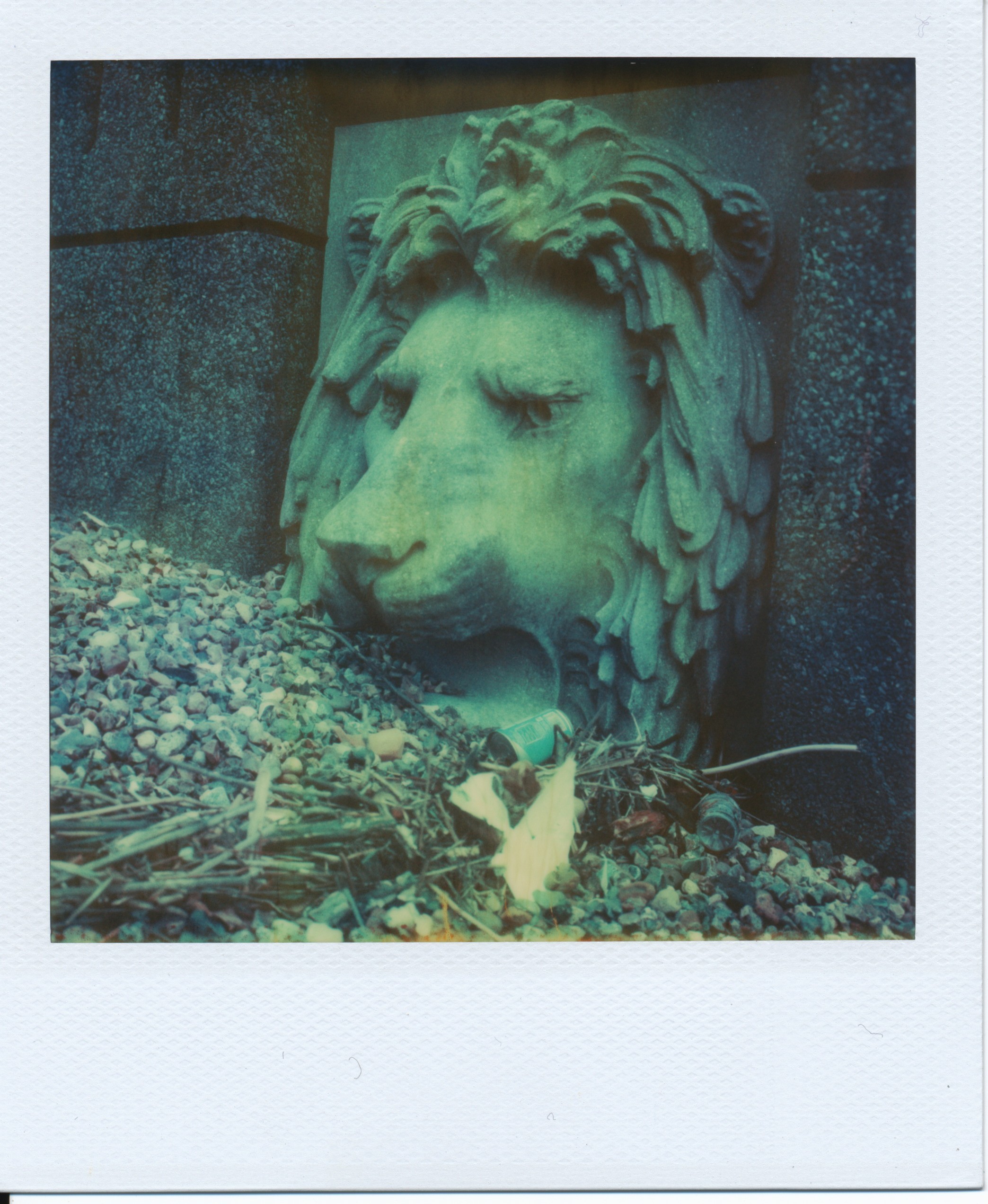
The exhibition is at the gallery at Maggs Bros, 50 Hays Mews, W1J 5QJ from March 22 to April 19.

Muhammad Ali in Tulse Hill, 1974

In 1974, a picture was taken of Muhammad Ali at Tulse Hill Comprehensive, sparring with a schoolboy.

But how did the world heavyweight champion – and one of the most famous men in the world – end up in a South London state school shortly after the Rumble In The Jungle with George Foreman in Zaire?

Well, he was invited by civil rights campaigner Paul Stephenson, who was on the school’s board of governors and thought it would be a good idea to ambush Ali in the lobby of the Hyde Park Hilton and suggest he come to the school assembly.

We continued to chat and he wanted to know how much I’d pay him. I looked him straight in the eye and said: ‘Muhammad, I haven’t got a dollar.’ He responded ‘Not even a dime? You have more nerve than Frazier.’

The full story is here, and it’s a cracker.

Dickens And London at the Museum of London


This review was published in the Independent last week but has not surfaced online.

It’s going to be hard to avoid Charles Dickens in the next few months. The writer will be everywhere, as publishers, programmers and producers commemorate the 200th anniversary of his birth on February 7, 2012. The best celebration of Dickens’s legacy could be this illuminating exhibition at the Museum of London. It’s an imaginative look at a familiar subject, and represents the best of what a museum can do.

This is no staid trawl through Dickens’s back catalogue but a vivid evocation of Victorian life based around themes from his books, from poverty to innovation. Sure, the big objects like Dickens’s writing desk or his manuscript for Great Expectations are there to grab the attention, but this drama is complemented by Victorian minutiae, the fascinating bric-a-brac of everyday life, everything from rent arrears books and mourning wands (wooden sticks carried by footmen ahead of funeral processions) to clay pipes, Punch and Judy puppets, model trains and Dickens’s soup ladle.

The exhibition is more than objects. There are mournful photographs of Victorian buildings that Dickens wrote about but have since disappeared, and a short film by William Raban that meanders around modern London while an actor recites Night Walks, Dickens’s essay about the sleeping city, drawing subtle parallels between his time and our own. The film is a rare chance to wallow in Dickens’s own voice, but neither this nor the manuscripts are quite as impressive as Dickens’s reading copy of Oliver Twist. This is the book he used on reading tours towards the end of his life; words and sentences are underlined for emphasis, and melodramatic stage directions (‘Action’, ‘mystery’, ‘terror to the end’) are scrawled in the margins.

Most rewarding of all, though, is the art. There’s classically sentimental Victoriana, such as William MacDuff’s Shaftesbury, which shows two urchins looking in a shop window like something by Norman Rockwell. There’s the fascinating documentary sketches of George Scharf’s, who drew the people he saw on streets acting as human advertisements, in colourful costume and carrying eye-catching signs for shows and products. And there are many detailed depictions of Victorian street life, which owe a clear debt to Hogarth. Phoebus Levin’s ‘Covent Garden Market’, Caleb Robert Stanley’s ‘The Strand, Looking Eastwards From Exeter Change’ and especially Edmund John Niemann’s ‘Buckingham Street’ portray a city of energetic bustle, cobbled streets and vicious contrasts of wealth that are the visual embodiment of what we still call Dickensian London.

Museum of London, 150 London Wall, EC2Y 5HN (020 7001 9844). Until June 10, 2012. Admission £8 (£7 advance booking); concs £6 (£5 advance booking).

Drugs and dead babies at the Queen’s bookshop

Maggs Bros is a posh antiquarian bookseller on Berkeley Square that has a Royal Warrant and is supposed to occupy the site of the most haunted house in Britain, but it is also home to a small contemporary art gallery, located out the back and accessed via 50 Hays Mews.

The latest show is being curated by New Artists and features photographs by Richie Culver taken of London crackhouses. These are loosely based on Gustave Dore’s engravings of Victorian opium dens.

Opium Smoking

The exhibition also features Polaroids by Shorvon & Hunter that explore the demise of the Polaroid and newspapers as forms of media. It’s definitely worth a look if you are in the area before it closes on Monday, December 5.

If you do, you should also pop upstairs to see a selection of some items that Maggs’s counterculture expert Carl Williams is currently selling. These include photographs of William Burroughs taken by Brion Gysin in Paris and an extraordinary mural taken from an American street gang club house. You could also pick up a copy of Carl’s latest catalogue to see if he has anything you fancy, whether it be items to do with Crowley, punk or the Weathermen. Last time I visited, he showed me some pictures he’d just acquired of dead Victorian babies, but don’t let that put you off.

William Burroughs and the strange demise of London’s first espresso bar

In 1953, a momentous event occurred in Soho. London’s first proper coffee shop – one equipped with a Gaggia coffee machine – opened at 29 Frith Street. This was a place where teenagers too young for pubs could come and gather, and it is said by some that the introduction of this coffee bar prompted the youth culture explosion that soon changed social life in Britain forever.

The Moka was an instant success, selling over a thousand cups of coffee a day. The author John Sutherland recalls, ‘the Gaggia machine, a great burbling, wheezing, spluttering monster, would grudgingly excrete some bitter caffeinated essence.  It would be swamped with steamed-milk foam and dusted with chocolate to form its ‘cappuccino’ hood… Glass cups and brown sugar (lots of it) were de rigueur.  Frankly, 50s espresso was no taste thrill.  But it felt smart as hell.’

By 1972, coffee bars where everywhere and the teenage revolution was firmly established. At this time, the author of ‘Naked Lunch’, former junkie and all-round Beat legend William S Burroughs was living in London, quietly going about his business in St James’s. He lived in Dalmeny Court, Duke Street, and loved the plush gentlemen’s shops of the area, not to mention the ‘Dilly Boys‘, young make prostitutes who hustled for clients outside the Regent Palace Hotel.

Although Burroughs was fond of the finer things in life – he got his shoes from John Lobb, hat from Locke’s and bought most of his food in Fortnum and Mason’s – he did at some point stumble into the Moka Bar, and was not impressed by what he found.

Burroughs at this time was getting sick of London – sick of the licensing laws, sick of the crap food and small drinks, sick of the weather, the terrible service and sexual hypocrisy. He was also sick of the Moka, which he believed responsible for an ‘outrageous and unprovoked discourtesy and poisonous cheesecake’.

Burroughs decided to mount a sound-and-image attack. He had previously launched one of these against the Church of Scientology, of which he had been a member, turning up at their headquarters at 37 Fitzroy Street every day, taking photographs and making sound recordings. He believed that ‘as soon as you start recording a situation and playing them back on the street, you are creating a new reality’ and that repeated exposure to such an attack would lead to ‘accidents, fires and removals’. After a few weeks, the Scientologists did indeed move, round the corner to 68 Tottenham Court Road.

On August 3, 1972, Burroughs turned his attention to the Moka. He would stand outside every day taking photos and making recordings by tape, and then return the next day to play the previous days recordings. Burroughs was convinced he was winning. ‘They are seething in there,’ he said. ‘I have them and they know it.’

On October 30, 1972, the Moka Bar closed.

Walking London: rivers and tubes

‘What a bounteous banquet of costly viands is spread before an ardent-minded, grateful-spirited Perambulator!’ Old Humphrey’s Walks In London

‘One must perambulate early and late in all weathers, to know a little about London’. The London Perambulator

London is a gift for those who wander. Sometimes you can pick a new area and just stroll wherever the whim strikes you; sometimes you can take a different route between two familiar destinations. Either way, you’ll find your appreciation of the city is inordinately increased.

There is a healthy industry in London walking – M@ recently compiled a list of his ten favourite for the Guardian – but if you need something cheaper and more challenging, you can always take a self-guided walk over a longer distance. I once walked the Thames from St Paul’s to Hampton Court on a Sunday afternoon, criss-crossing bridges and sticking as close to the river as possible. It was particularly satisfying to see how easy it is to walk on the river bank – the only place I had to take a significant detour was around the ever-weird Chelsea Harbour.

In a similar vein, a couple of books have recently come out on the theme of London walking. Walk The Lines is about Mark Mason‘s decision to walk every tube line in London, above ground, an overall distance of 403 miles that takes him everywhere from Amersham in the north-west and Epping in the far east to Morden in the deep south.

Mason enjoys discovering new parts of the city and peppers his book with brilliant London trivia but is at his best when writing about the pleasure walking can provide. As he writes, ‘Once you’ve caught the bug, you feel an urge to plan your walks, be it thematically, geographically or by some other means. There must be a raison d’être for your ramble.’ This, he thinks, taps into a similar mentality to that of a collector: ‘It’s not about studying, about observing or noting. It’s about collecting. About claiming the city’s greatness, or at least some small part of it, for yourself.’

Mason’s book is a fun read, but you couldn’t very well use it to walk the tube lines yourself, even if you were lunatic enough to want to do so. Tom Bolton’s London’s Lost Rivers, however, bills itself as ‘A Walker’s Guide’ and is a terrific mix of history, topography and practicality. It maps – astonishingly diligently – the courses of eight of London’s buried rivers, so walkers can follow them for themselves, pointing out items of interest they can see along the way while also offering some historical context about the subterranean rivers.

Along with Nicholas Barton’s The Lost Rivers of London, it’s essential for any fan of buried rivers (Diamond Geezer says much the same here). The atmospheric Polaroid photographs by SF Said are a nice touch, as is the introduction by the great Londonphile Chris Fowler. Highly recommended.

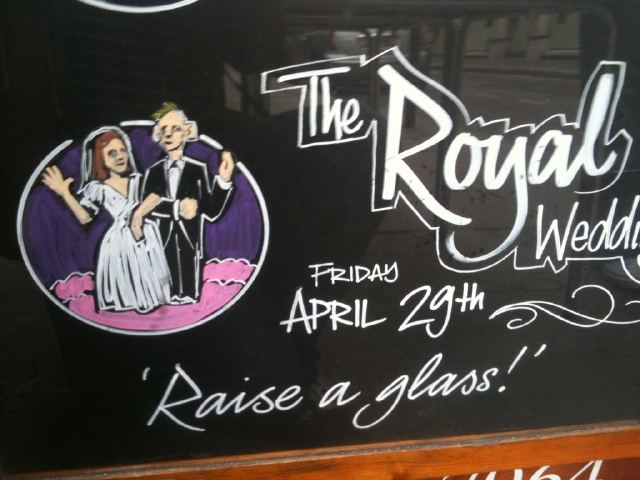
Terrible illustrations of the Royal Wedding outside London venues

Prince William as a zombie? Kate Middleton with a dislocated arm? Still, they’ve captured his receding headline and at least he has his father’s ears.

Check out Kate’s adams apple and Cruella De Vil grey streak.

I’m sure there are more out there. Enjoy the big day. I’ll be doing the gardening.

Secret London: the Mail Rail

A group of Urban Explorers have managed to get inside what some people consider the holy grail of subterranean London – the Mail Rail. This is the mini-underground railway that used to take letters along tracks to different station/sorting offices located deep beneath London streets.

The Mail Rail stretches from Paddington to Whitechapel and is still more or less intact, despite having been mothballed nearly a decade ago in 2002. Silent UK managed to gain access and then explored the full length from the track, investigating and photographing nine stations along six miles of track.

Read the lot here – it’s an extraordinary story.

You can watch a film about Mail Rail here.

London Street Photography at Museum of London

My review of the Museum of London’s excellent London Street Photography exhibition appears in the Independent today.

Street photography – the snatched and unposed glimpse of everyday life – is a fascinating genre even if it is never quite as authentic as it appears. Many of the strongest images in the exhibition reminded me of those Victorian journalists who investigated the slums of working-class London life in the 1880s and 1890s, reporting back in horror on what they found to their middle-class readers.

Thanks to these pioneeers, we now have evocative visual records of London life. My favourite were probably the images Roger Mayne took in the late 1950s to record the streets in West London that were scheduled to be demolished and replaced by Trellick Tower. A book of Mayne’s photographs has just been republished and can be purchased at the Museum of London bookshop, along with the excellent accompanying book for the exhibition.

Mucky pics in Victorian London

It can be hard to persuade people to visit historic houses, which makes you wonder why the owners of 18 Stafford Terrace don’t make more of the secrets that are hidden in the attic.

Stafford Terrace in Kensington is also known as Linley Sambourne’s House. Sambourne was a cartoonist for Punch who bought the five-storey terrace in 1875 and decided to decorate it as fashionably as he could, along aesthetic principles. This meant much William Morris wallpaper and exotic furniture. The problem was, Sambourne was not a wealthy man, so he purchased the latter from house clearances and junk shops and to make the former go further, he would cut out bits of wallpaper that were hidden from sight behind paintings and furniture and use them to paper other parts of the house. And he had a lot of paintings and furniture.

When Sambourne died, his son kept it exactly as it had been left, as did the following generations, until Stafford Terrace, now essentially a time capsule of Victorian middle-class life, was purchased by the GLC.

And that is how it has remained. The house is now owned by Kensington & Chelsea and run by nearby Leighton House.  Visitors get to see inside a fascinating interior and learn about the fashions of the Victorian middle-class first-hand.

But there’s more.

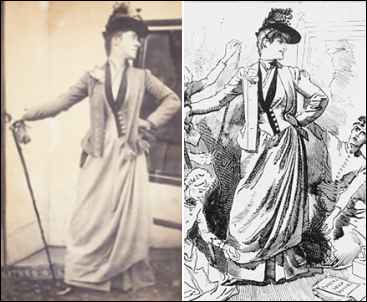
Sambourne was a cartoonist, but he also developed an interest in photography. He realised that instead of drawing his caricatures from scratch, he could get people to assume certain positions, photograph them, and then sketch the results. In his backyard he would get the coach-driver to dress as the statue of Eros, or pretend himself to be a tennis player or Roman soldier, using props from around the house. Here’s an example.

But there’s more.

Sambourne also started a Camera Club. Here his subjects tended to be more specialist.

For some reason, Camera Club always took place when Sambourne’s wife was visiting friends in the country.

In the attic of 18 Stafford Terrace, on a very high shelf, are several unmarked volumes packed with this sort of photographic work. Some are displayed in the bathroom for public study.

Mocked up in the same attic room is a demonstration of how Sambourne worked. An easel contains a cartoon of three women on a bicycle, copied from an adjacent photograph of three women pretending to be on a bike. In the photograph, all the women are nude; not so in the cartoon.

But it doesn’t end there.

Sambourne would also take his camera out with him when he was in Hyde Park or mooching around Kensington, and take surreptitious images of passing nursemaids, which he would carefully file as ‘Zoological Studies’. He even purchased a special camera with a secret lens that took pictures at right-angles so his subjects would be completely unaware as to what was going on. He still received a number of warnings for his behaviour.

And he also liked to take pictures of his maid. In bed. Asleep.

There’s nothing quite as creepy as a middle-aged Victorian male, is there?

See also The Man From London and Virtual Victorian.