Category Archives: Photography

North and south: the enduring hatred of Chelsea and Leeds

chelsealeeds

It was the draw every older Chelsea fan wanted. The plastic flash of the Champions League may excite shallow newcomers, but a League Cup quarter–final at Leeds is what gets the blood pumping. This is proper football, one of the juiciest rivalries in British football, a celebration of regional differences with mutual bad memories stretching back to the mid-1960s.

That’s about how long Leeds have been singing this little ditty about shooting Chelsea scum.

In the late 1970s, Chelsea fans would reciprocate by asking their Yorkshire foes, ‘Did the Ripper get your mum?’ And they’ll always have this.

The fixture will probably have the sort of ‘toxic’ atmosphere that hysterical commentators love to condemn, but it’s also the very reason people pay to watch football in numbers that dwarf that of any other sport. It’s a game that feels more important than it really is, one steeped in tribalism, history and cultural dislike, offering momentary respite from the sterility that defines the modern football-watching experience. For many fans, this is personal, this is pride.

And Chelsea-Leeds has always been huge. The TV audience for the 1970 FA Cup final replay remains the second largest for any sporting event (after the 1966 World Cup final) and it has the sixth largest TV audience of all time – more than any Champions League or European Cup final involving the self-important Establishment clubs of English football. That’s because Chelsea and Leeds had captured a hold on the national imagination since the mid-60s, when two young, stylish, streetwise sides stormed out of the Second Division within a season of each other.

So much in common but so little alike, Chelsea and Leeds set about each other with a passion in a series of increasingly ill-tempered league and cup encounters. By the time a ferocious 1967 FA Cup semi-final was settled by an awful refereeing decision – a last-minute Leeds equaliser from a rocket-like Lorimer free kick was disallowed because the Chelsea wall had moved too early – the foundations were firmly in place. Chelsea and Leeds, they didn’t get on.

‘Hate. We hated them and they hated us,’ is how Chelsea’s Ian Hutchinson once described it, and footballers are rarely so forthcoming about such things. It was a hatred mired in misconception as much as anything else, an embodiment of all of the north and south’s prejudices about each other. This was Yorkshire v London epitomised.

Chelsea considered themselves the club a la mode, King’s Road stylists, swinging London dandies who knew as much about fashion as they did football. On the pitch, they strutted and posed, playing with flair and panache – but only when they could be bothered. Off the pitch, they dressed up, grew their sideburns, hung out with  filmstars and were photographed by celebrity photographers with famous fans. No wonder George Best said Chelsea was the only other club he’d ever consider playing for.

Raquel Welch, not in a Leeds shirt

Leeds were more hardworking, more focussed, with a Yorkshire work ethic and attention to detail. They were also masters of professionalism in all its forms. Uncompromising, indomitable, they’d only turn to showboating when the opposition were already on the canvas. To make it worse, neither respected the other’s approach: Leeds thought Chelsea were flash failures; Chelsea thought Leeds were boring and nasty.

These stereotypes weren’t entirely fair – Leeds had beautiful footballers like Gray and Lorimer, Chelsea had roughnecks like Harris and Dempsey, and both teams could be said to have underachieved – but they contained more than a grain of truth. When the teams met at the 1970 FA Cup final, fireworks ensued. It must be the most enthrallingly violent games ever seen in this country. Played today, both teams would count on at least three red cards. This tackle (unpunished) is typical. I’d love to see a You Tube compilation just showing the fouls. Paul Hayward would wet himself.

As they rose together, they sank together. From the mid-70s and through much of the 1980s, both clubs endured financial turmoil, relegation, racism and hooliganism. The rivalry remained intense. At a Second Division fixture in 1984, which Chelsea won 5-0 to secure the title, Leeds fans responded by destroying Chelsea’s new scoreboard with a scaffolding pole. This was the scene at another 1980s game at Stamford Bridge, when the fixture still attracted one of the largest crowds of the day.

For a while, things calmed down. When Chelsea won the Second Division title in 1989, the fact they were playing Leeds was almost irrelevant as both sets of supporters maintained an impeccable minute’s silence the week after Hillsborough. When Leeds won the league in 1992, Chelsea fans barely flinched.

The rivalry only really picked up in 1996, when Brian Deane’s vicious ankle-stamp on Mark Hughes signalled the rebirth of Chelsea-Leeds hostilities. For the next few years, Frank Leboeuf, Lee Bowyer, Dennis Wise, Graeme Le Saux, Alan Smith and Jonathan Woodgate produced moments of quite stunning spontaneous cruelty. This was epitomised by George Graham’s side, who arrived at the Bridge in the winter of 1997 with no intention other than to kick Chelsea to pieces. It worked. Leeds had two players sent off before half time, but secured a valuable 0-0 draw. Ruud Gullit’s beautiful but fragile side were never the same.

As Chelsea rebuilt upon experienced foreign lines and David O’Leary went with native youth, the ideology again differed. This time Chelsea came out on top, picking up cups while Leeds imploded (Chelsea even scored, above, one of their greatest ever goals against Leeds). The two sides haven’t faced each other since Leeds were relegated in 2004, in which time Chelsea escaped their own financial reckoning, instead becoming one of the biggest clubs in the world. Leeds, meanwhile, have been scraping along in the lower divisions, the pain exacerbated by the fact they are now owned by much-despised former Chelsea chairman Ken Bates.

So to Elland Road, and while the two clubs have probably never experienced such a vast divergence in fortunes, the fans have been looking forward to this one for weeks. It might be epic, it might be a damp squib, but it will matter, and if we’re really lucky, it’ll be just that little bit toxic. 

Death and collecting

The Wellcome Collection is currently showing a typically absorbing exhibition titled Death, but it’s not really about that at all. It features work from a private collection, that of Richard Harris, and largely consists of skulls and skeletons, many of which are actually rather lifelike.

In fact, despite its arresting title, this is in many senses a rather squeamish, clean exhibition. There’s no dying, no decomposition, no pain, little mourning or God. There are no worms eating dead bodies, no cancer destroying live ones. It’s not even particularly morbid. It’s more about one man’s obsession with the human skeleton, stripped of flesh and cleansed of blood, sinew and memory, as portrayed by a number of very beautiful works of art over the centuries. If you want a more gruesome, more real, idea of death, try the Museum of London’s Doctors, Dissection and Medicine Men.

Collection owner Richard Harris stands in front of a work my Mexican artist Marcos Raya called Family Portrait : Wedding  at the 'Death: A Self-portrait' exhibition at the Wellcome Collection on November 14, 2012 in London, England. The exhibition showcases 300 works from a unique collection by Richard Harris, a former antique print dealer from Chicago, devoted to the iconography of death. The display highlights art works, historical artifacts, anatomical illustrations and ephemera from around the world and opens on November 15, 2012 until February 24, 2013.

It is tempting to speculate why Harris is so fascinated with his particular idea of death – why so clinical? Why so safe? – but it’s also ultimately rather pointless. In his excellent essay on collecting, Unpacking My Library, Walter Benjamin noted that ‘‘Collectors, like artists, operate out of unconscious motives, and so we cannot be known to ourselves.’ A collection can be about anything, and may reflect a personal interest or a psychological flaw, but the reasons behind their creation are rarely as interesting as you may hope.

What is intriguing about Harris’s love for skulls is that collections are often built as a defence against death itself, a way for the collector to claim mortality for himself in the form of something that will exist after he no longer does so (even if most collections end up being broken by families who lack the passion or obsession to keep them intact). Collections are also about memory, a way for the collector to freeze a moment in time. Every item represents a second, an hour, a week, a month – however long it took to locate and acquire – in the collector’s life that he can look at and recollect for years to come.

A collection is also about surrounding yourself with cool things that you like, although whether this ever makes the serious collector happy is a moot point. In his study of the collecting impulse, To Have And To Hold, Phillip Blom astutely notes that ‘For every collector, the most important object is the next one’, an acknowledgement that the collector will never be satisfied by what they have, as their next acquisition could be the big one, the one that completes the collection, or sends it off in an exciting new direction. This will never happen, of course, locking the collector in a spiral of anticipation and disappointment.

All of this is true whatever is being collected, whether it’s sick bags from aeroplanes, James Bond first editions or things that might be haunted. And just about anything can be collected, if you have the right kind of imagination. My friend Carl Williams, who deals in the counterculture, talks about his idea of collecting around ‘the sullen gaze’, that look of cruel insolence and careless superiority perfected by William Burroughs but which can be traced to many others, putting arresting flesh on Harris’s ambivalent skull.

At Speakers’ Corner

This article was first published in Time Out in 2006. I am posting it after hearing about Sounds from the Parka partnership between On the Record and Bishopsgate Institute that is hoping to record an oral history of Speakers’ Corner. Photos by Chris Kennett. 

This London curiosity grew out of revolt, when Edmund Beales led the Reform League to Hyde Park in 1866 to complain about the lack of a vote for working men. The marchers were blocked from entering the park by police and a small but interesting riot developed. The Reform League continued to meet at Marble Arch to test their right to hold public meetings in the park. In 1872, the government relented and granted the right to assembly and free speech in this corner of Hyde Park. The Met promptly responded by turning Marble Arch into a tiny police station to keep an eye on the rabble below.

(1968) credit, Chris Kennett

On a sunny Sunday in October, the rabble are out in force with a dozen speakers taking their spots, espousing black power, Islamism, Christian atheism and much else that is vocal but indeterminable. The two largest crowds gather directly opposite each other on either side of the path. One is engaged in raucous religious debate, slinging insults about the Koran and Bible back and forth, and occasionally taking time out from happily lambasting each other to heckle the speakers, a Christian, a secularist and a Muslim, who each take their turn upon the platform. It’s the sort of ferocious debate about Islam and freedom that the newspapers tell us we don’t dare have in public.  Across the way, a striking young man has drawn a larger but less vocal crowd to hear him eloquently espouse familiar but fervent criticism of the Iraq War.
Nikolai Segura has been coming to Speakers’ Corner on-and-off for seven years, and then on a weekly basis for the last 12 months, during which time he’s become one of the Corner’s regular hecklers. ‘I’ve been heckling for a year,’ he says. ‘It makes a show for the crowd, but it also sends the message that this is a place that exemplifies freedom of speech.’

A couple of weeks ago he was heckling a speaker when ‘some Muslims came up to me and said there were extremists in the park who would kill me for what I was saying,’ he says. Segura’s response was bold. He has returned to the park wearing a Muhammad-baiting T-shirt (‘There’s a picture of the prophet on the back of this shirt… only kidding [please don’t kill me])’, and today he gets on the stepladder to speak himself for the first time. The resulting debate is ferocious, spiteful and fascinating.

Religious debate has been a feature of Speakers’ Corner since before it even existed – many of those executed at nearby Tyburn were Catholics, who used their final speech to try to convert the crowd . But the unmistakable change in overall tone from political to theological – the ‘three Abrahamic religions shouting at each other’ as Segura puts it – was first noticed by speaker Terminator 24 [T24] 25 years ago.

‘It’s changed a lot,’ he says. ‘During the Cold War it was a lot of social democrats, trade unionists, socialists and many intellectuals. But after 1979 international relations affected Speakers’ Corner and the revolution in Iran saw a change. It became more aggressive, more religious. And after 1989 there were even fewer universal, social democratic presentations and more nationalism and fundamentalism. It mirrors how the world changes.’

(1972) credit, chris kennett

Heiko Koo, who runs the Speakers’ Corner website, believes the debate there is genuine. ‘All speakers get information from each other and people in the audience and from the internet, so ideas and theories get spread around and I’ve seen them change the mind of some speakers,’ he says.

T24, like Segura, started in the crowd before progressing up the ladder. ‘I came here and started to ask questions, and the speakers were very abusive, so I thought: That’s not the way; if I were speaking, I would not be oppressive and tyrannical. Now, when I talk, I leave it open, without judgment, express a thought and let others join in. It’s unique, very special here. I love being with real people, seeing their expressions, their laughter, their frustrations and anger. I love it here. The open space, it’s free and,’ a pause for effect, and to have a swig of coke, ‘I have nothing else to do.’

Sounds from the Park is  organising a reminiscence event at the Bishopsgate Institute on 8th December for everyone with memories of Speakers’ Corner.

Wellcome to London: how Henry Wellcome ‘hoovered up the world’ and left it on the Euston Road

Wisconsin, 1858. A five-year-old boy is playing near his frontier home when a strange stone catches his eye. He takes it to his father, who examines the flint carefully before deciding that it was a prehistoric tool made thousands of years before to cut meat. It probably meant as much to its creator as the railway did to modern humans. ‘That excited my imagination and never was forgotten,’ wrote Henry Wellcome years later, after he had grown up, moved to London and accumulated one of the largest collections of scientific paraphernalia that has ever been gathered by a single individual.

Henry Wellcome

Wellcome established his pharmaceutical company, Wellcome-Burroughs, in 1880, making a mint selling pills to an English public that had previously taken medicine in the form of powder or syrup. This fortune sits in the Wellcome Trust, which was established 76 years ago and is now worth £14 billion, making it one of the world’s largest charitable foundations. Next door to the Wellcome Trust HQ on Euston Road, a short walk from St Pancras, sits the Wellcome Collection, a museum that houses some of the million or so objects collected by Wellcome in his lifetime. Here is Napoleon Bonaparte’s toothbrush, ancient sex aids, Chinese torture chairs lined with blades, boxes of false eyes, human skeletons and paintings by Van Gogh. It is one of the most extraordinary collections in the world, a throwback to a time when wealthy individuals would hoover up the weird and wonderful of the world for their personal collections, but executed on a scale few could compete with.

Ken Arnold is the Wellcome’s Head of Public Programmes. ‘This is the last great non-connoisseurs collection,’ he says. ‘Our usual concept of a collector is somebody who carefully decides whether something is authentic and then forks out a huge amount of money for it. Wellcome had an “other-end-of-the-telescope” approach. He saw everything through medical-tinted spectacles and wanted to own anything that would illuminate that fascination.’

Wellcome collected everything: paintings, engravings, photographs, models, sculptures, manuscripts, books, periodicals, pamphlets, letters, prescriptions, diplomas, medical instruments, archaeological finds, skeletons, skin, hospital equipment, advertisements, drugs, remedies, food, plants, microscope slides, charms, amulets, ceremonial paraphernalia, costumes, medals, coins and furniture. He bought entire shops, contents, fixtures and fittings, acquiring enough to recreate an entire street. He bought others collections, picked up human skulls from African battlefields and returned from one typical trip abroad with 44 packing cases of material. If something wasn’t available, he had an artist make a reproduction. Teams of buyers were finding him items right up until his death in 1936. His reach was broad and their brief was wide.

‘Wellcome had deep pockets and no bureaucrats telling him what he could bring home so he had none of our moral, financial or logistical concerns,’ says Arnold. ‘He hoovered up the world, and left us with this extraordinarily unwieldy and undisciplined collection.’ Although Wellcome amassed an immense collection, he was frugal with his money. ‘He was very wealthy, but he would send employees to auctions dressed down so they didn’t look too rich, and would set up fake companies so people wouldn’t know it was his money,’ says Ross MacFarlane, research officer at the Wellcome Library.

A chippy self-made American, Wellcome could never become part of the British establishment – although he was awarded both a knighthood and the French Legion d’honneur – and a desire to be taken seriously may have prompted his determination to create a museum of ‘the art and science and healing’. This opened in 1913 in South Kensington, before it moved to Wigmore Street and closing in 1932. When Wellcome died, the collection was put into storage or dispersed.

‘The British Museum has 40,000 objects, the Science Museum has more than 100,000, the Pitt-Rivers in Oxford has 30,000 items and there are bits in almost every museum in the UK,’ says Arnold. The Wellcome Trust has since taken a similarly philanthropic approach, funding wings in numerous UK museums, galleries and academic institutions.

In 2007, the Wellcome Collection opened. It is a modern, classy space, with a cafe and bookshop, as well as a gallery that hosts thought-provoking exhibitions that use art and science to explore topics such as Skin, Sleep and Brains. Their next exhibition, Death, promises to be particularly fascinating and challenging.

The Wellcome dares to be different: while most museums take an unfamiliar topic and wring all the knowledge out of it like a damp dishcloth, the Wellcome looks at something familiar and turns it inside out, using contemporary art and scientific research to make visitors question what they think they already implicitly understand. Their ability to do this can be traced back to Henry Wellcome himself.

‘We feel free to interpret the material Wellcome collected,’ says MacFarlane. ‘Because although we know when something was bought and what it cost, we don’t always know how it got to the auction.’ Arnold expands on this: ‘He didn’t talk about his philosophy. There’s enough to get an idea of why he was collecting, but there’s not so much that we feel we have to conform to his beliefs. He once said ‘Never tell anybody what you are planning to do until you have done it.’ That sounds like a good idea to me…’

So the Wellcome eschews blockbuster shows – which Arnold describes as ‘a depressingly greedy way to conduct exhibitions’ – and takes pride in imaginative live events. ‘We never try to be definitive,’ says Arnold. ‘There’s always more to discover. And we don’t want to be po-faced. Science is either deadly serious or fun with pink fluffy letters – and between these two unpalatable positions is a yawning chasm that can be filled with smart and sophisticated entertainment.’

Of course, the Wellcome is helped by having a lot of money in its coffers. ‘We are much more privileged that most other organisations. We are wealthy and we don’t have to satisfy civil servants, corporate sponsors or shareholders. But that attitude comes from the Wellcome Trust itself: science is a risk-taking business and there is a sense we are allowed to be experimental.’

MacFarlane finishes that thought, ‘When we take the directors an idea, they’ll often want to give it a go, and that’s a bit like how Wellcome collected. It’s a great position to be in.’

Wellcome Collection, 183 Euston Road, NW1 2BE. Admission free. The Wellcome’s next exhibition is Death, from November 15. 

Punk at the Hayward: curate and destroy

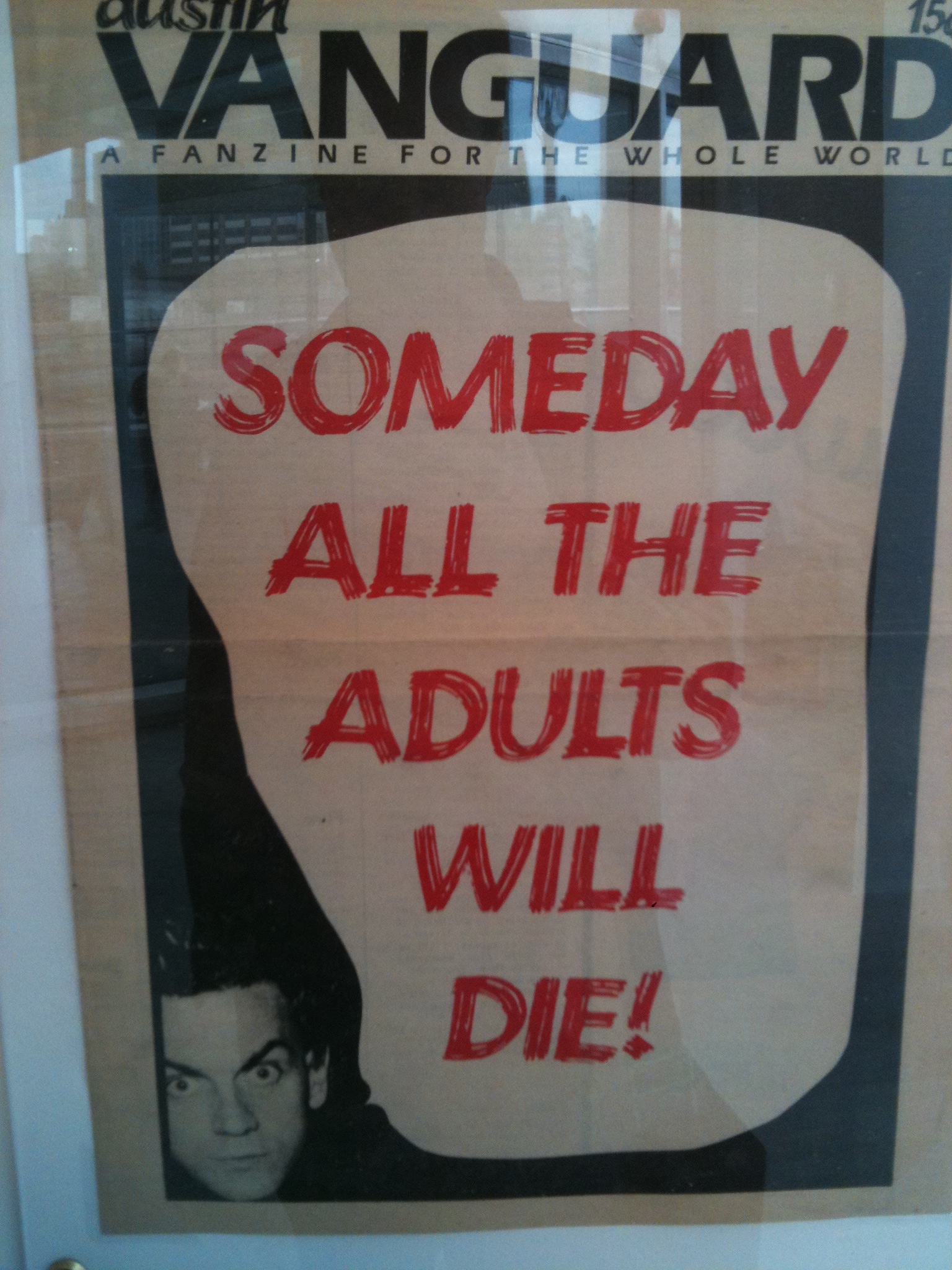
Does any music form have as curatorial approach to its own history as punk? In many ways that is understandable, as the graphic art that came out of the punk movement is as interesting as most of the music, while many of the scene’s key movers always saw themselves as part of a cultural avant-garde that went back to the Symbolists and still wish to emphasise that. One of the most prominent of these voices is Jon Savage, and he has co-curated an exhibition at the Hayward Gallery on punk called Someday All The Adults Will Die.

Despite punk now being nearly 40 years old and having been curated like a dead horse for several decades, it still has a visceral and visual appeal to many – and not necessarily the people you may expect. When I visited the gallery, most of my fellow visitors appeared to be in their 20s: this was clearly not simply an excuse for a nostalgic wander back through adolescence by men suffering a mid-life crisis. The kids dug it.

It’s a wide-ranging exhibition, with sections devoted to seven-inches, cassettes, posters, flyers and fanzines, including Savage’s own London’s Outrage.

My favourite stuff tended to be the less predictable such as pre-punk items involving the Diggers, who co-existed awkwardly with the hippies in San Francisco in 1966 and 1967, as these mimeographs demonstrate.

There was also items reflecting Savage’s fascination with Situationism, including this King Mob poster. Malcolm McLaren was loosely affiliated to King Mob.

I also liked the items relating to Suburban Press, the witty and brilliant pre-punk/Situationist publishing house created by Jamie Reid.

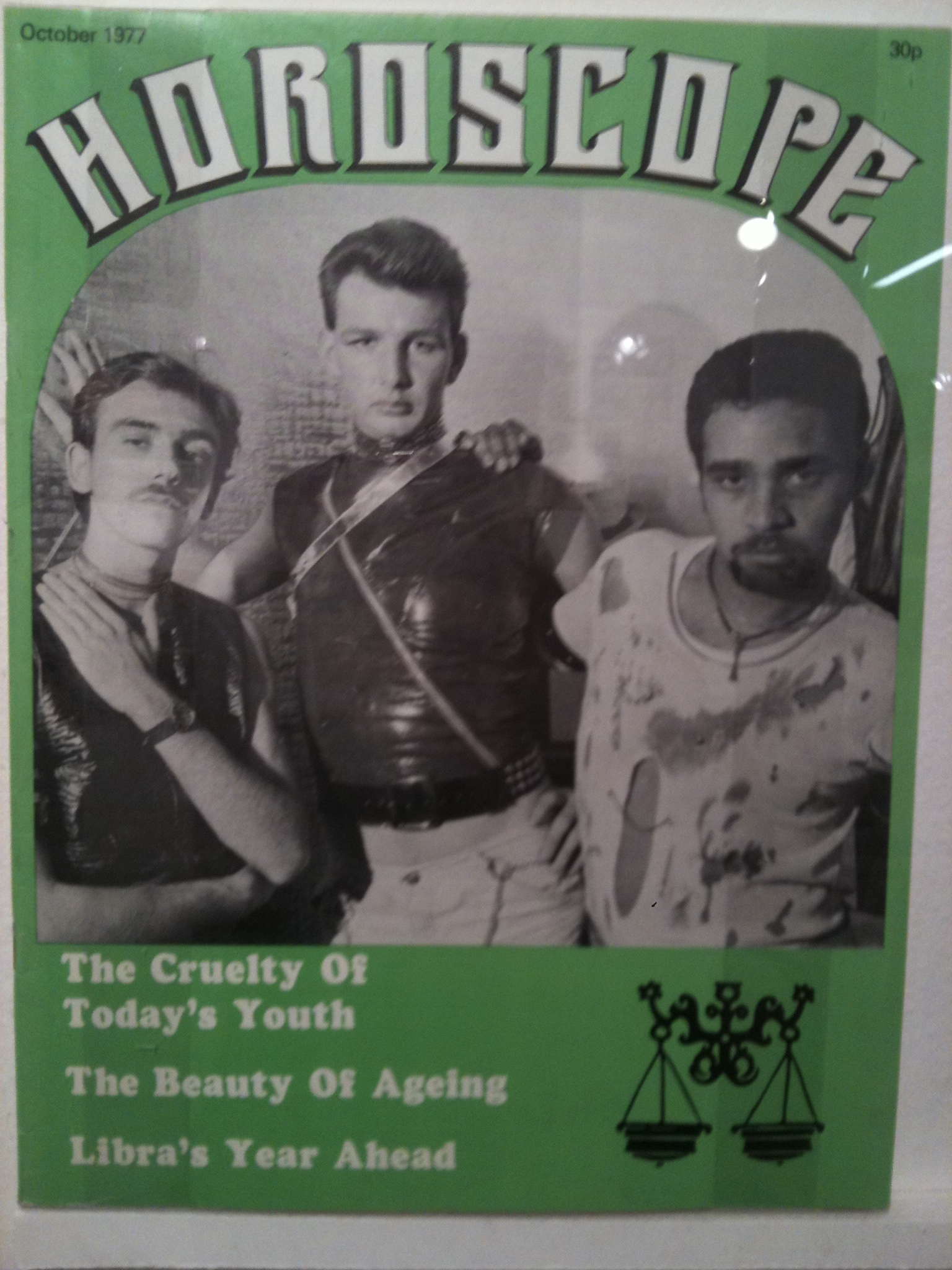
And, finally, I loved the handful of contemporary examples demonstrating how the mainstream tried to cash-in on punk with things like a punk-themed horoscope magazine and punk pulp fiction. Such money-grabbing tactics, it must be noted, have since been refined somewhat…

Someday All The Adults Will Die is at the Hayward until November 4.

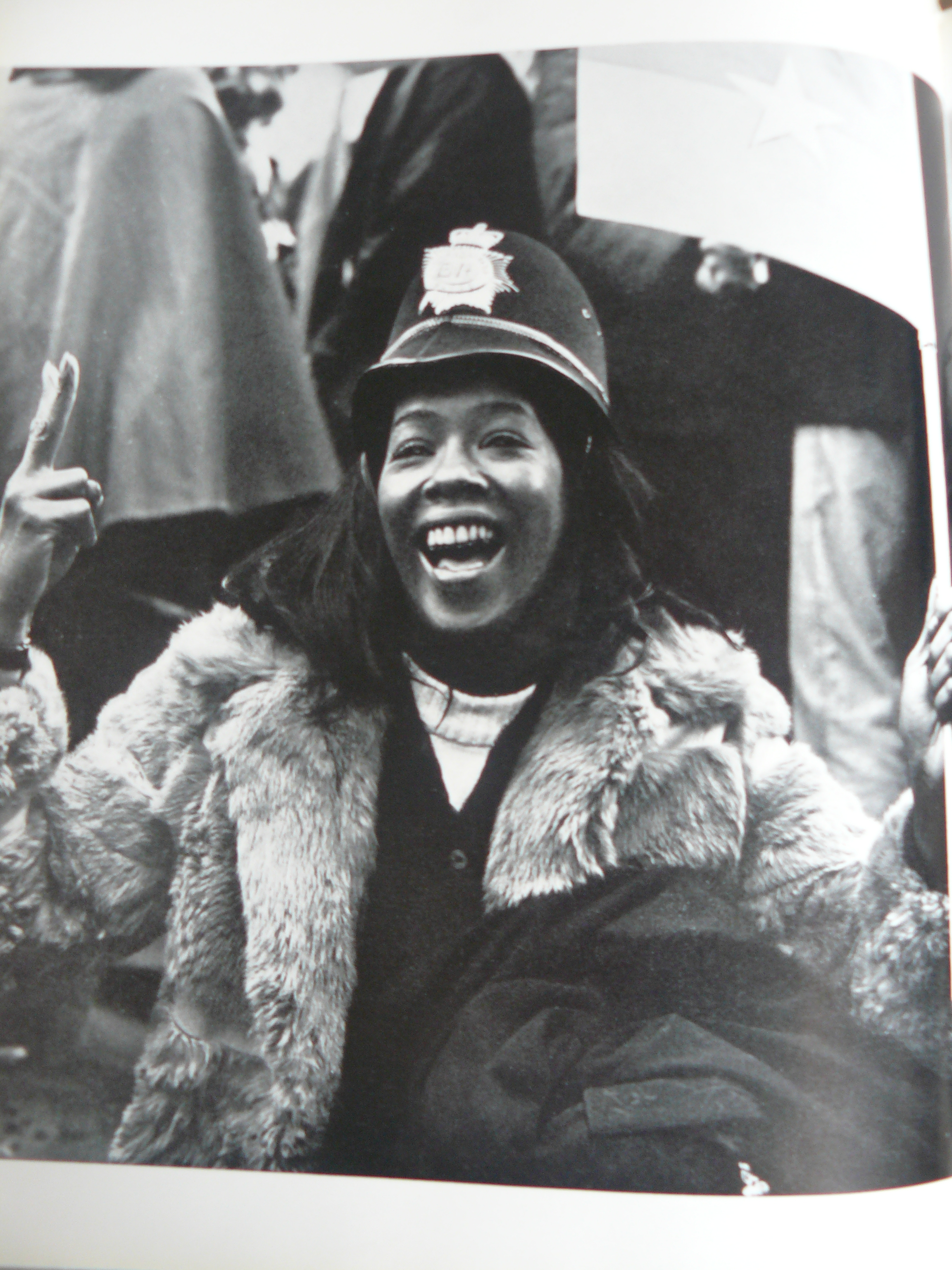
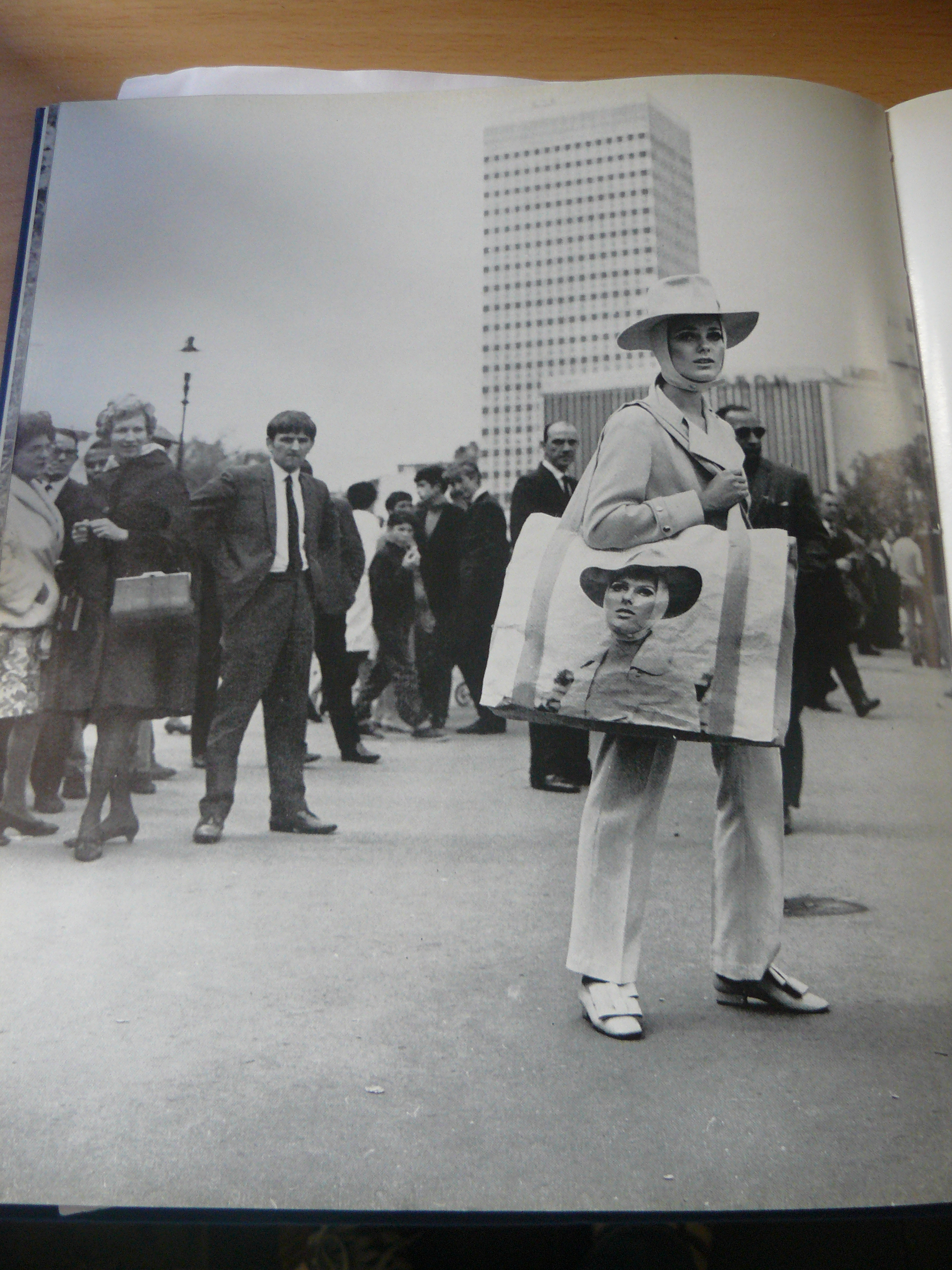
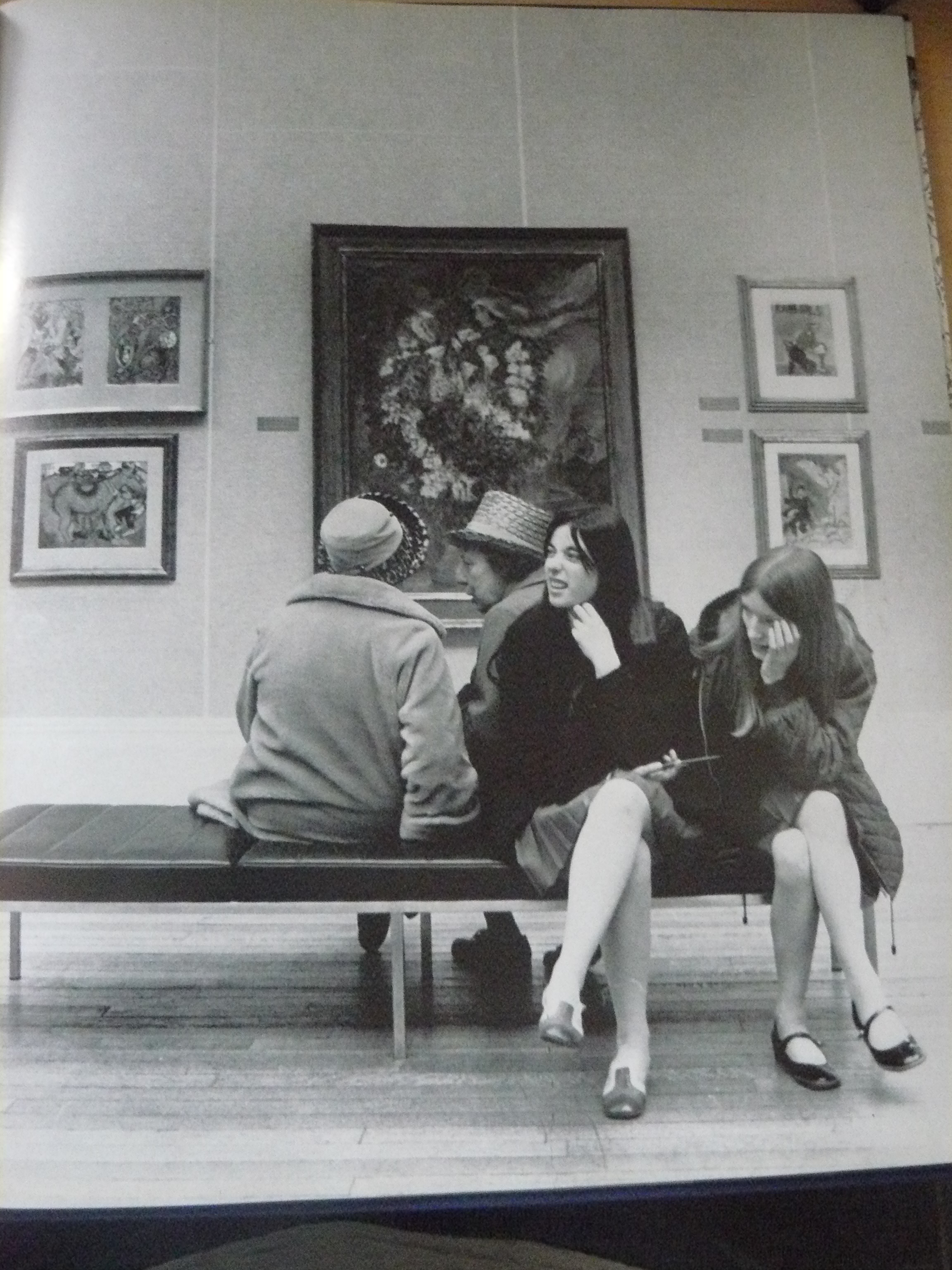
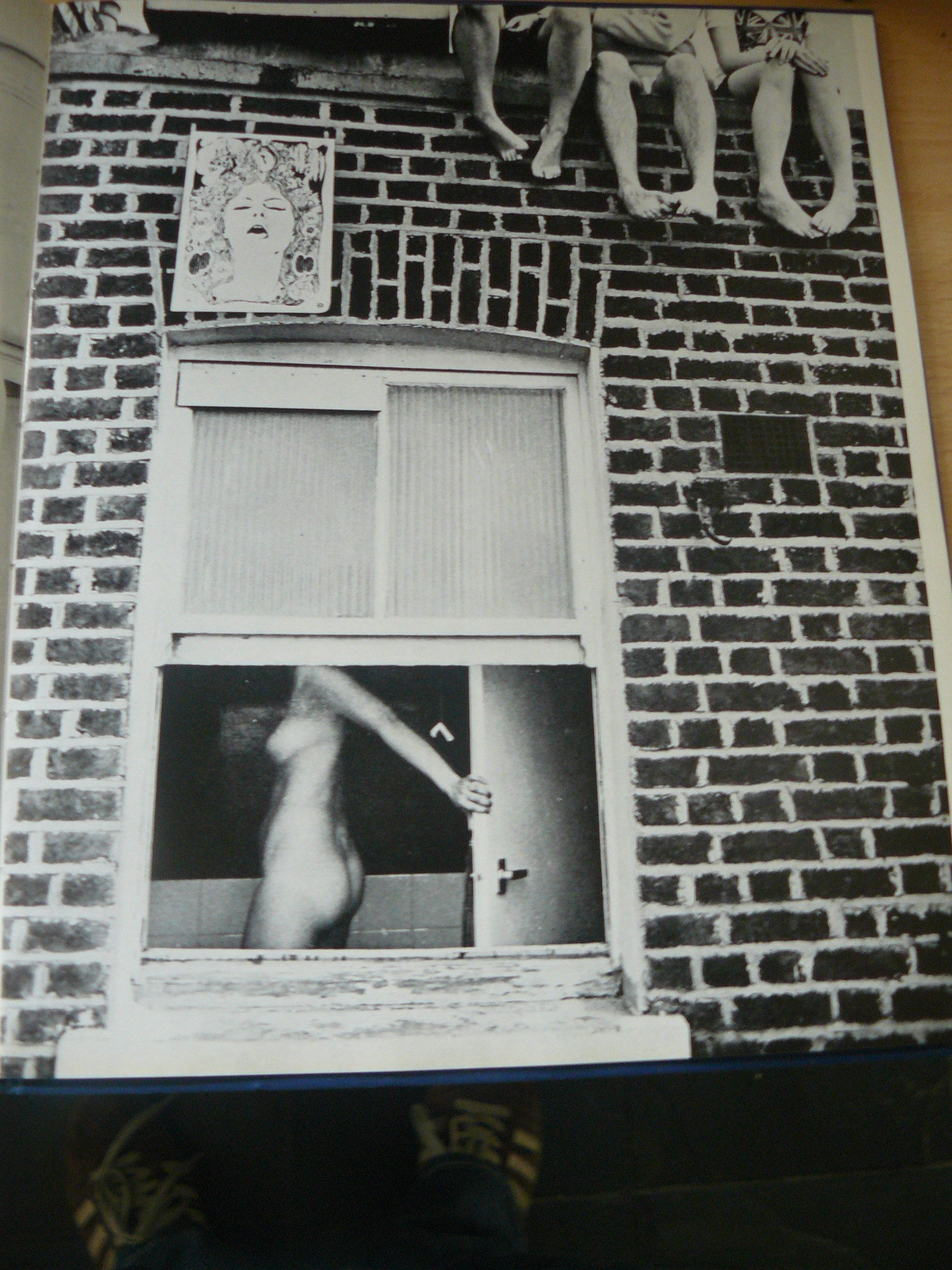
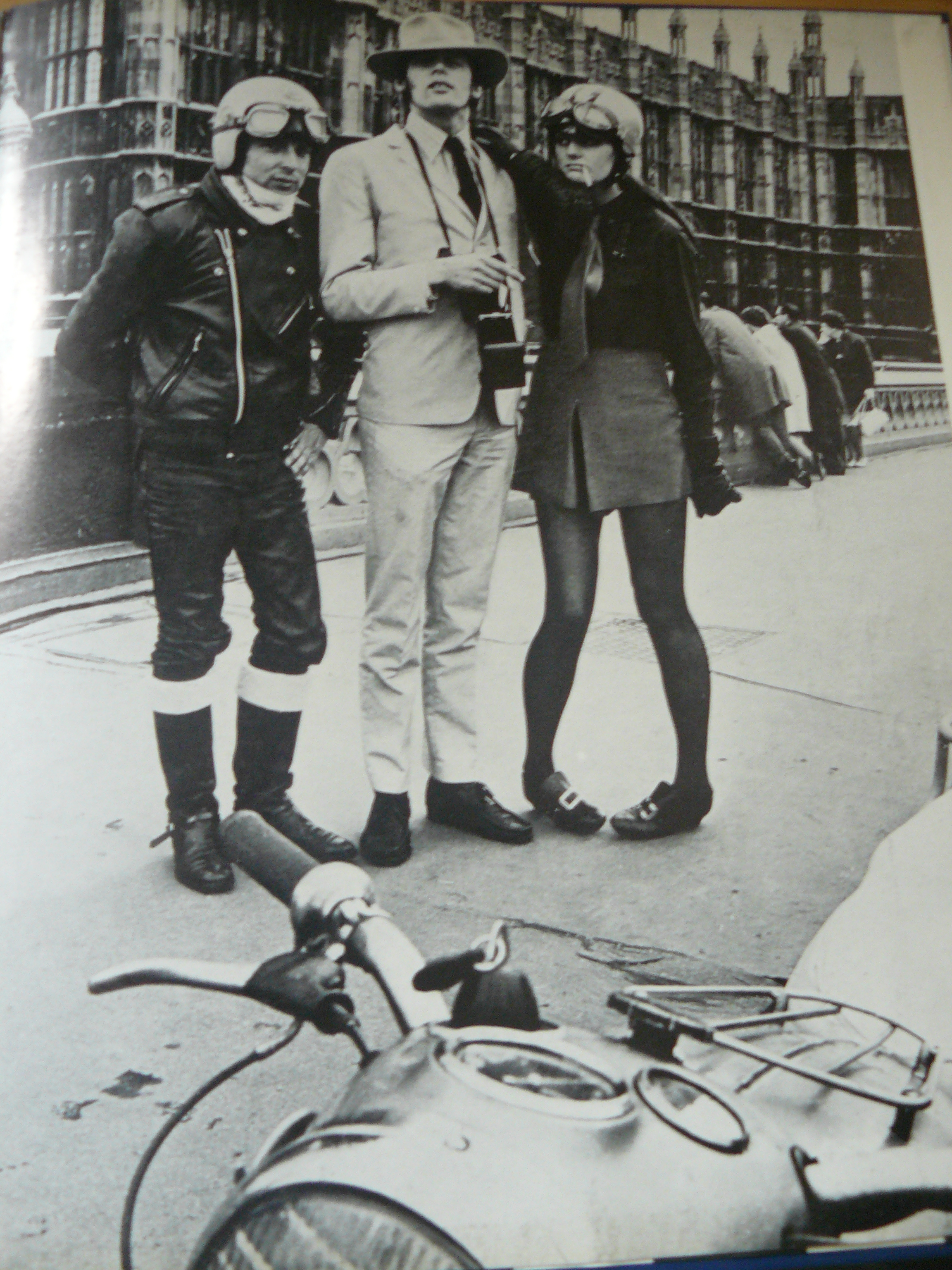
Photos: Young London, Permissive Paradise, 1969

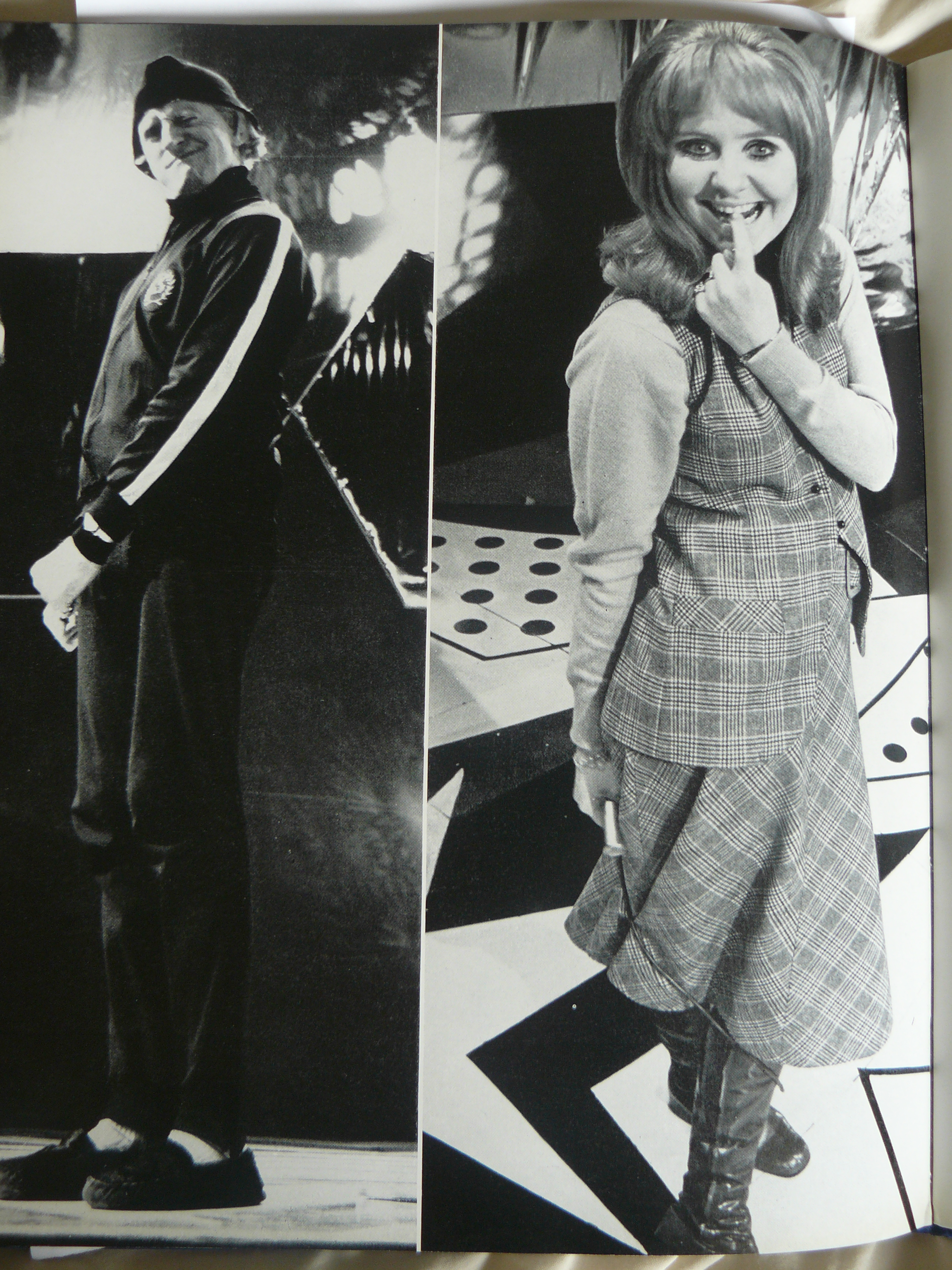
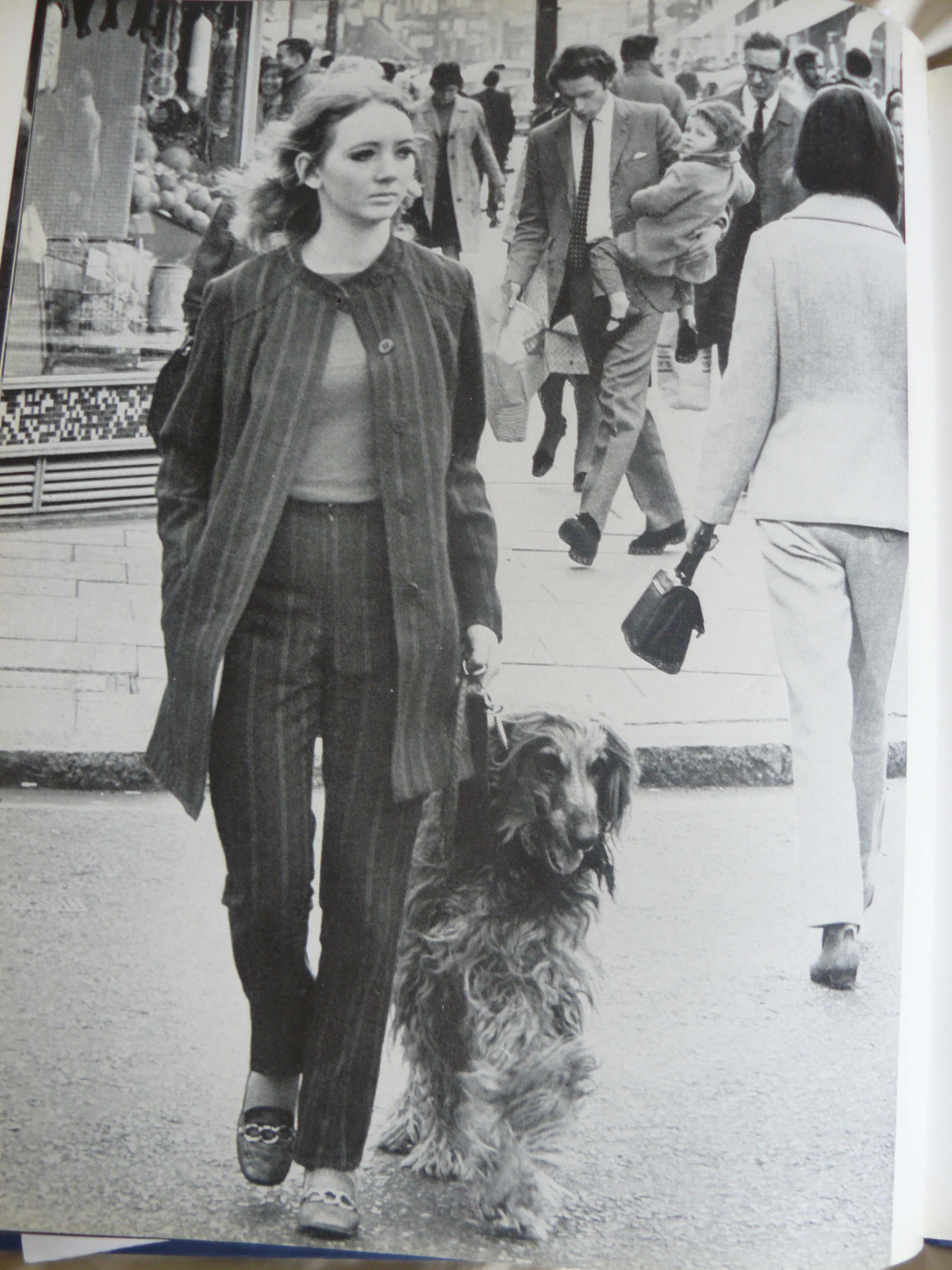
These photographs of London in the late 1960s are a wonderful commentary on the scene of the time. Frank Habicht, who also took some great images of the Rolling Stones, is particularly adept at drawing out the contrasts between the carefree young and the more traditional side of the city. Enjoy.

All photographs are from Frank Habicht’s Young London, Permissive Paradise (1969)

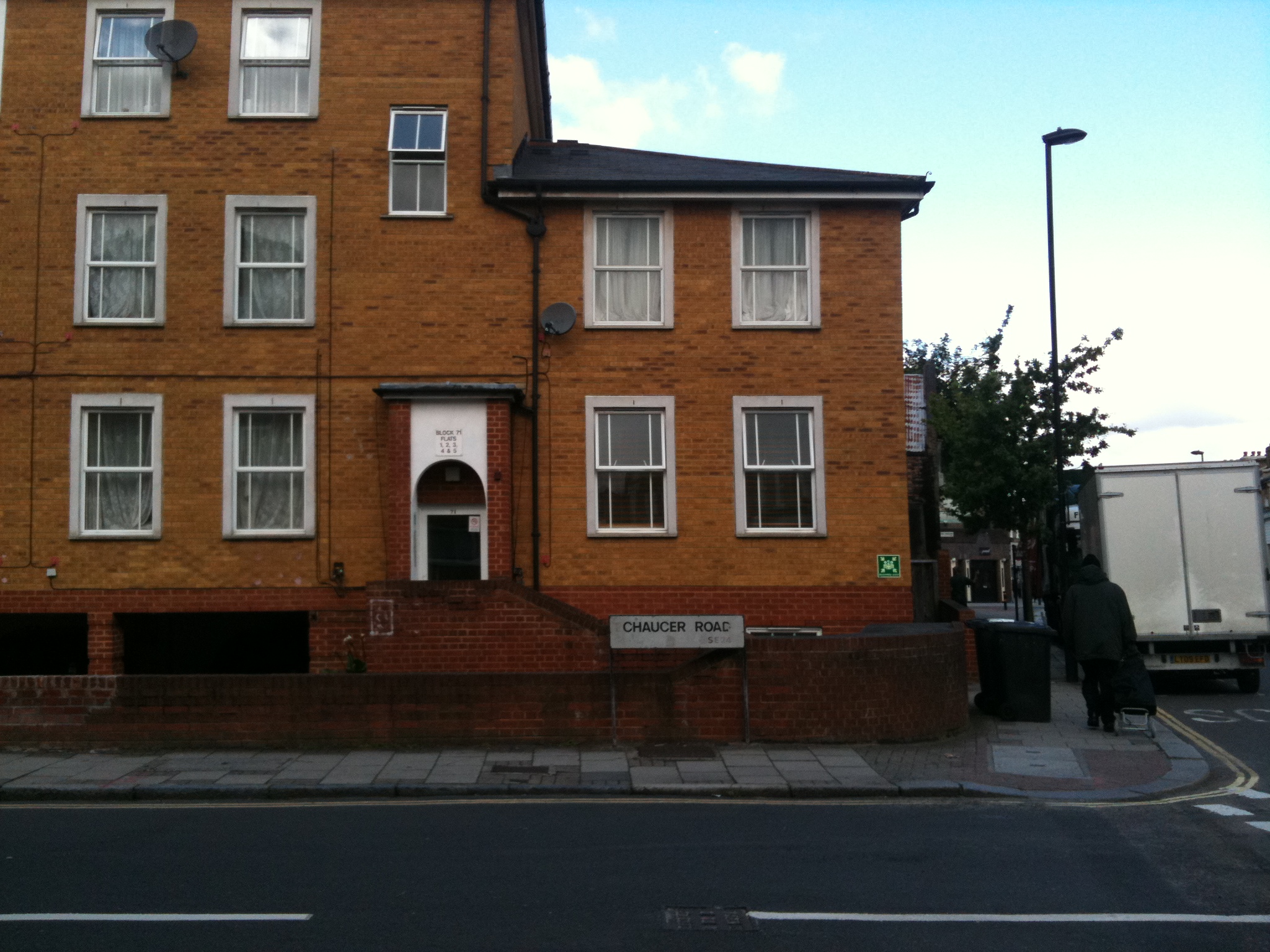
Brixton riots in SE24: then and now

Chaucer Road, SE24 after the 1981 Brixton riots

Chaucer Road, SE24 in 2012

The top picture is taken from Taschen’s superb new book of London photographs, London: Portrait of a City.

HG Wells, My White Bicycle and hygienic seats: a brief history of cycling in London

This piece is in the current issue of BMI Voyager. The photo of Herne Hill Velodrome is via Adrian Fitch

It’s unlikely that any of the world’s top cyclists will be thinking about London’s history with the bike when they set off from the Mall for the gruelling 250km Olympic road race on Saturday (July 28th), but if they do pause for thought, they’re starting from the right place. The route will take cyclists through Putney, Richmond and Hampton Court deep into the scenic Surrey countryside of Woking and round Box Hill, but it starts and finishes near Hyde Park, which is where cycling in the UK first really took off.

Cycling had premiered in Battersea Park in the 1880s, but it was in Hyde Park that the great Victorian cycling craze went overground in the 1890s. London was still a horse-happy city at the time, so when 2,000 cyclists – mainly women, dressed demurely with natty bonnets– formed a parade to cycle round the park in the spring of 1896, those on horseback didn’t know quite what to make of it. Bicycles were still a new thing. Penny-Farthings had been around for a while, but were about as common a sight in Victorian London as they are now, and it took the invention of the ‘safety bicycle’ – one with wheels the same size and pneumatic tyres – in the 1880s for that to change. Indeed, such was the enthusiasm with which women took up cycling, that Victorians were torn between trying to find ways to make money out of it, and trying to ensure it was morally appropriate. With typical Victorian ingenuity, they managed to do both – the Chaperon Cyclists’ Association supplied female escorts for solo women cyclists for 3s 6d an hour, while to avoid any dangerous friction you could purchase special ‘hygienic’ bike seats, which had a modest dip in the area where a lady’s genitalia would usually meet the saddle.

Hygienic seat or not, this was, almost without exception, a hobby enjoyed by the upper classes – the Lady Cyclists Association of 1895 was founded by the Countess of Malmesbury – and the Olympic road race aptly passes through some of the poshest areas of London, along the luxury-lined Knightsbridge and down through the smart streets of Chelsea to Putney Bridge. In 1896, the Countess wrote wittily in The Badminton Magazine about the dangers of cycling around these very Belgravia streets thanks toa new sport’ devised by Hansom Cab driver: ‘chasing the lady who rides her bicycle in the streets of the metropolis’ excited by the ‘petticoat which “half conceals, yet half reveals”… I cannot help feeling that cycling in the streets would be nicer, to use a mild expression, if he’d not try to kill me.’

It wasn’t until 1934 that a solution to this perennial problem arrived, when the UK’s first bike lane was opened not far from where the road race course makes its progress through West London. This specialist cycle lane stretched for two-and-a-half miles alongside the Western Avenue and was a belated response to the scarcely believable statistics that recorded 1,324 deaths of cyclists on British roads the previous year. Despite these awful figures, cycling groups opposed the innovation, arguing bikes should not be forced to give up their place on the road to the new-fangled motor car. It’s not an argument they were ever likely to win.

Roads will be close to traffic on July 28, however, and as the Olympic cyclists make their way towards the river, they will pass Kensington Olympia, the huge exhibition hall built in 1883 and used for all manner of spectacular entertainment –promoters would think nothing of flooding the arena to recreate Venice In London, for instance. Anything fashionable was fair game and cycling races were held here during the 1890s. A mixed-tandem race – one male rider and one female – attracted huge crowds in January 1896. Weird events like this were common at the time –the Crystal Palace in Norwood hosted a bicycle polo international in 1901 between Ireland and England (Ireland won 10-5).

After crossing Putney Bridge, the race continues through Putney, where one of London’s many Victorian velodromes was once located, drawing crowds of 10,000. Putney also featured in one of the first cycling novels, The Wheels of Chance, by HG Wells, a writer who always had an eye for a new invention. In it, the hero, Mr Hoopdriver, leaves his dull job in Putney to go on a cycling holiday on the South Coast following a route out of London very similar to the one that will be taken by the Olympic racers. The race later passes through Woking, where Wells lived and set part of War Of The Worlds – Woking has boasted a huge statue of a tripod since 1998.

From Putney, the cyclists whizz through lovely Richmond – mind the deer! – before hitting the river at Twickenham, where they pass Eel Pie Island, nexus of London’s mid-1960s rock ‘n’ roll revolution. Numerous legendary bands played shows at the charismatic old dancehall on this tiny island in the Thames, including the Rolling Stones, the Yardbirds, Eric Clapton, Jeff Beck and Rod Stewart. Among them was Tomorrow, one of England’s first psychedelic bands (featuring Steve Howe, later of prog-monsters Yes), whose 1967 single “My White Bicycle” was a big counterculture hit in 1966. This splendid slice of trippy frippery was written in homage to the pro-cycling scheme launch by Dutch anarchist collective Provo, who left 50 unlocked white bicycles all over their home city of Amsterdam in 1965, inviting the public to enjoy ‘free communal transport’ and rid themselves from the tyranny of the automobile. The Dutch police swiftly impounded the offending bikes, but the idea finally caught on in recent years in the form of the Paris bike-sharing scheme, Vélib. This idea was appropriated by London in 2010 and came to be christened Boris Bikes after London’s mayor, Boris Johnson, who inherited the scheme from his predecessor Ken Livingstone.

Boris Bikes can be hired by anybody with a chip and pin card at around 500 docking stations in central London. The bikes come without helmet or lock and are pretty hefty, but they are a fairly common sight in London. Although there is an ‘access fee’ (£5 for a week), the first 30-minutes of any ride are free, so smart users hop between docking stations and effectively ride around London for next to nothing. It’s all part of a belated attempt to make London a more-bike friendly city – four giant bike lanes, the blue-painted Cycle Superhighways, have alsobeen created in key commuter routes, with four more planned for 2013. If you want to borrow a Boris Bike to follow the 2012 road race route be careful, as there are few docking stations outside central London and costs soon mount if you go over the initial 30 minutes – while the fines for a late return are high.

From Twickenham, the race heads through Bushy Park and passes the Tudor palace of Hampton Court, before disappearing into the Surrey countryside. After a tour of the Surrey hills, the cyclists will then make the return journey, via Kingston, to the Mall. Sadly, then, there is no time to head to south-east London, where there are a couple of other prime London cycling landmarks. The first is the Herne Hill Velodrome, tucked behind suburban houses down a quiet street near Dulwich. This is the last stadia from the 1948 London Olympics still in use today. Built in 1891, the velodrome had all but closed during the Second World War but was brought out of retirement when London was awarded the 1948 games. It’s had a few scares since then – the gorgeous Victorian grandstand has been a no-go area for years – but was recently awarded £400,000 of Olympic legacy money and plans are afoot to construct a new grandstand, cafe and gym. The venue has played its part in nurturing the latest breed of British champion – Tour de France winner Bradley Wiggins raced here.

Herne Hill Velodrome

While Herne Hill lives on, the velodrome at Catford was demolished in the 1990s. Like the stadia at Putney and Herne Hill, this was built in the 1890s, when it attracted a very special guest. Absinthe-soaked dwarf artist Henri de Toulouse-Lautrec is usually associated with the Montmartre area of Paris, but in 1896 he turned up in the particularly drab suburb of Catford. Lautrec was a cycling fan, and had been asked by a company called Simpson to design a poster for their bike, which used a new type of chain. Lautrec was taken to the newly built Catford Velodrome to watch the bike in action during special races, set up by Simpson to advertise their product, and he produced a couple of images during his visit. The poster was one of the last he designed before his death in 1901, just as the Victorian bike craze was coming to an end.

Nazi Olympics at the Wiener Library

This article first appeared in a recent issue of Time Out London.

The 1936 Berlin Olympics are often presented as a disaster for Nazism thanks to Jesse Owens, who won four golds and shattered Hitler’s fantasies about Aryan superiority. But the truth is a little more complex. Germany actually won the games: they had the most medals and also won more golds, more silvers and more bronzes than anybody else. They were praised for the way the tournament was held, there were no boycotts, innovations like the Olympic village and the torch relay were adopted by the Olympic organisation and the event even turned a profit. So was it really an unqualified sporting, diplomatic, economic and propaganda success for Hitler?

Toby Simpson is curator of The Nazi Games: Politics, The Media And The Body, an exhibition at the Wiener Library, London’s Holocaust library (the oldest in the world). He says, ‘The games were actually received very positively and Hitler’s standing improved as a result. On the whole it was positive for the Nazis and they were pleased with the results.’

This was much as Hitler had hoped when the Nazis inherited the games in 1933. ‘The German organisers were worried he would scrap the games because he wasn’t internationalist in the slightest,’ says Simpson. ‘But he realised that this was a huge propaganda opportunity and began putting pressure on the organisers to shape the games around Nazi interests.’

The results are displayed in a small, compelling exhibition. There are dramatic stills by Leni Riefenstahl, who also filmed the monumental Olympia using new techniques such as slow-motion and tracking shots. Much of the imagery presented the German team as perfect Aryan specimens, evoking Spartan concepts of athleticism, while a neo-Roman bombast was visible in everything from the architecture to the opening ceremony. Hitler wanted to exclude Jews from the team, but under pressure allowed one, Helene Mayer, to take part. ‘Mayer won gold in fencing for Germany in 1928,’ says Simpson. ‘Under Hitler, she had to go to the US to continue her career, but came back to Berlin to compete in the German team.’ A photograph shows Mayer on the podium giving a Nazi salute. All successful athletes were presented with an oak sapling – until 2007, one won by Harold Whitlock, a long-distance walker, grew in the grounds of a school in Hendon.

US team – including Owens with their oak saplings

Mayer’s presence was a sop to a small but persistent anti-Nazi campaign. ‘This was the first Olympics with a boycott movement,’ says Simpson. ‘America was criticised for participating because it was believed they could influence the International Olympics Committee to withdraw the games from Berlin.’

The exhibition features an American pamphlet called Preserve the Olympic Ideal, which made the case against American participation. There’s also an extraordinary camouflaged pamphlet produced by resistance movements in Germany. It looks like an Olympic souvenir but ‘inside talks about soldiers bleeding to death on the fields of Spain. Germany was not yet involved in the Spanish Civil War, but this was being distributed to inform people about what was going on.’

The exhibition has a range of bona fide souvenirs produced to cash in on the games, often incorporating Nazi imagery, and there’s also material produced by travel agents like Thomas Cook, hoping to persuade reluctant tourists to make the journey. ‘Ticket sales were slow at first,’ says Simpson. ‘The Nazis had come to power on a wave of mass unemployment and people worried the country was unstable. Companies offered huge reductions in an unprecedented advertising campaign.’

BERLIN OLYMPICS 1936 (GERMAN ORIGINAL PHOTO BOOK)

The public had fewer concerns politically. ‘The Nuremberg Laws had turned Jews into second-class citizens, but public consciousness was slow to catch up with reality,’ says Simpson. During the games, the Nazis removed anti-Semitic signs in a ‘conscious attempt to cover up the truth.’ At the same time they put 800 Sinti and Roma into camps. The Wiener Library has a game on permanent display in which stereotypically Jewish-looking characters are chased around a board – it was made in 1936. ‘Even as the Olympics were taking place, this game was being produced and people were being put in concentration camps because of their race,’ says Simpson.


The exhibition ends on a positive note. ‘We highlight the story of Dr Guttman, a German-Jewish refugee who came to Britain in 1939 and set up a spinal unit at Stoke Mandeville hospital for veterans. There he introduced a sporting contest that eventually became the Paralympics.’ Some of Guttman’s documents are on display, including call-up papers from the First World War. ‘He volunteered in 1914 to serve in a medical capacity. Like many Jewish Germans he was incredibly patriotic but still exiled.’ It was an exile from which the Olympic movement would eventually profit.

The Nazi Games: Politics, The Media And The Body at the Wiener Library until October 3. Free. 

Cockney Visions: Writing Britain at the British Library

The British Library’s new exhibition Writing Britain, which runs until 25 September 2012, has big ambitions. It aims to study place and landscape in British literature, looking at how writers and poets have been informed by the land around them, and how their writing has transformed the way we view these spaces.

Phew!

The exhibition is divided into different thematic sections, and includes one on Cockney Visions about London writing, and another on the suburbs, which also has considerable London content.

It’s a remarkably bold concept, but the BL does not shy from a challenge – its exhibition on Liberty a few years ago was one of the most intellectually intense I have ever seen, while the one on Language was similarly involved.

This time, it doesn’t quite pull it off. The problem is the same that blighted last year’s science fiction exhibition – too many books. Entering a BL exhibition is like visiting a first rate antiquarian bookshop, but one were you can’t touch the books and none of them are for sale. It’s great to see these rare and beautiful books, but it’s also incredibly frustrating that you can’t pick them up, feel the pages, smell the history.

Paradoxically perhaps, books are also an insufficient way of examining landscape in the way the exhibition intends. If we can’t actually sit there and read Wuthering Heights, immersing ourself in this extraordinary place the writer has created, we need other ways to make the journey. The most evocative part of the exhibition is the one on the Lake District and Highlands, purely because there are some wonderful paintings on display, which help crystallise our vision of what Wordsworth, Keats and Scott were describing. Conversely, the London section takes in the usual suspects on that well-trod wander from Blake and De Quincey to Alan Moore, Neil Gaiman, Will Self and Iain Sinclair  (and includes a wonderful copy of the London Psychogeographic Society newsletter from the early 90s), but fails to really plunge us into the city of our imagination.

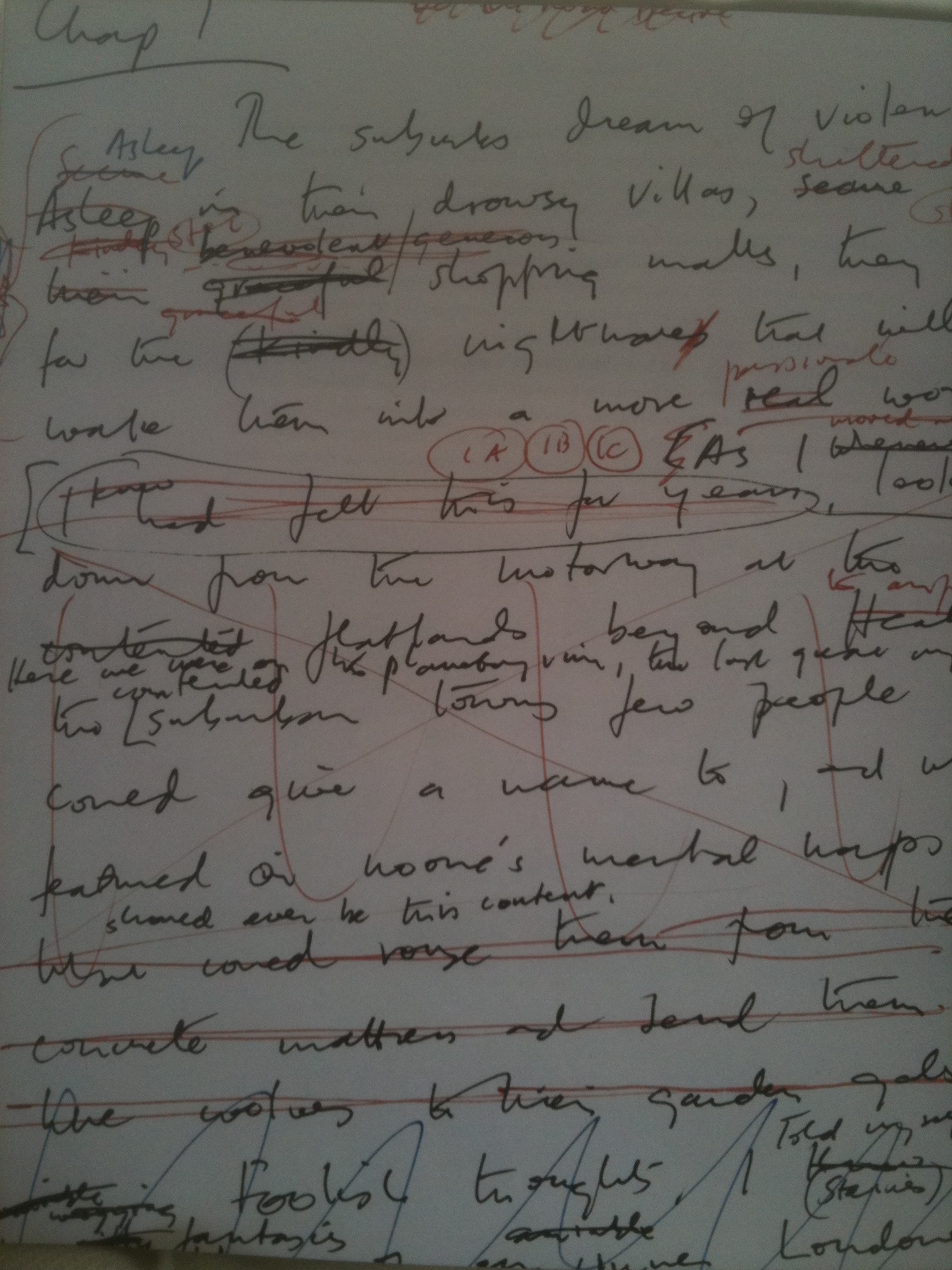
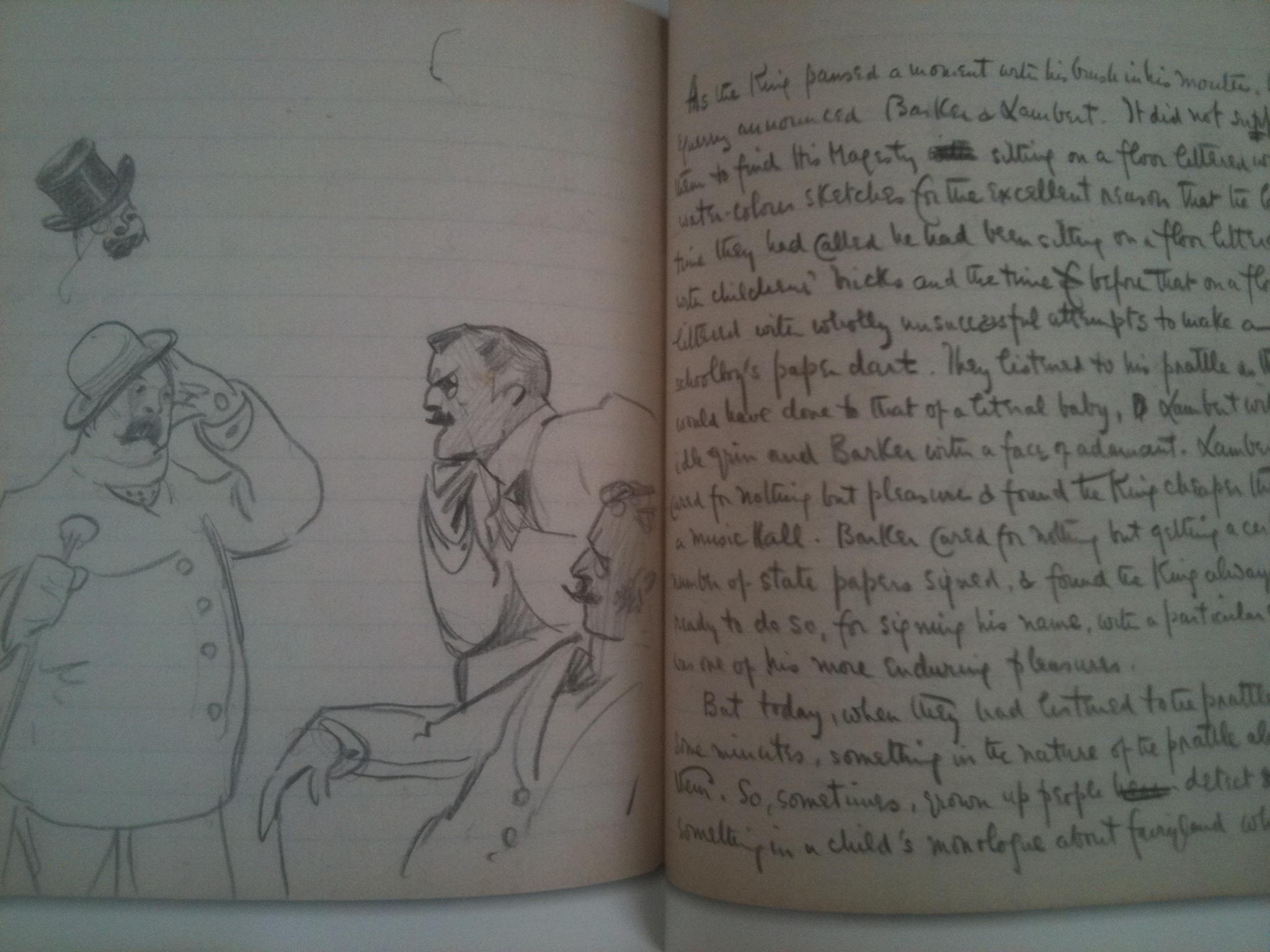
Where the exhibition – and the BL itself – really does excel is when it can produce original manuscripts, diaries and photographs. These messy, scrappy, lovingly flawed items show the writing process in a way a beautifully bound finished book never can. And some of the best of these are to be found in the sections of the exhibition related to London. There’s a sketch by John Betjeman of Dalston Station; an unpublished poem by Evelyn Waugh about the Crystal Palace (complete with Waugh’s drawing of the building); a couple of pages from JG Ballard’s collection, including the heavily amended opening pages to Kingdom Come and Crash; and a lovely drawing by GK Chesterton to accompany his notes for The Napoleon of Notting Hill.

Dalston Station by John Betjeman.

Kingdom Come manuscript

Notes for The Napoleon of Notting Hill by GK Chesterton

I loved also a letter by Conan Doyle sent to his mother from South Norwood, in which he carefully sketched the floorplan of a suburban house he was thinking of buying, and a copy of Pygmalion, which Shaw had phonetically annotated to show how he felt the cockney phrases should be pronounced.

a personal favourite was a draft of Albert Angelo by BS Johnson, showing how Johnson wished a section of one page to be cut out so it would reveal a sentence from later in the book, a brilliant way to create a  flash-forward or pre-cognition.

Best of all, though, was this photograph, which shows JM Barrie, GK Chesterton and George Bernard Shaw dressed as cowboys in 1914. For the full story, read this excellent blog post. It has very little to do with Writing Britain, but it’s bloody marvellous all the same.