Category Archives: London

Metroburbia – by Paul Knox

51Lx1KDP1TL._SX258_BO1,204,203,200_

METROBURBIA: The Anatomy Of Greater London by Paul Knox (Merrell)

London’s suburbia occupies so much space – 695 square miles according to Paul Knox – that it seems ridiculous people even try to summarise it with a single adjective, whether that’s “aspirational” or “banal”. The suburbs contain multitudes and are more like a network of a thousand individual towns then a uniform commuter-ville of identical streets. Knox describes them as “metroburbia”, which he defines as “a multimodal mixture of residential and employment settings, with a fusion of suburban and central-city characteristics”, which is a way of saying that there’s much more to London’s suburbs then large gardens and a fast train to Waterloo: they have shopping centres, office blocks, housing estates, schools, local governments and, critically, millions of residents who never dream of travelling to central London even if they benefit from being within its orbit.

Knox explored central London in his previous book for Merrell, London: Architecture, Building And Social Change, a glossy overview of the relationship between social change and architecture. That book focussed on 27 central districts, looking at how they were originally developed and then exploring in more detail a dozen key buildings. Here he again divides London into sectors, seven of them – Lea Valley, Northeast London, Thames Estuary, South London (all of it), Thames Valley, Northwest London and North London – as defined by the arteries of road, river and rail. Little, though, is made of these sectors once they have been established, with Knox instead taking a chronological overview of metroburbia’s growth and development.

The book is richly illustrated, with the historical narrative interrupted by numerous boxes that focus on individual buildings, trends, regions and housing estates. The story that unfolds is a useful way of understanding how the city has developed. At first, the suburbs were essentially used as a place to put the city’s problems. This is where you could place those big, ugly but necessary things such as cemeteries, asylums, prisons, sewage pumping stations and reservoirs. Housing at this time was just another problem to solve, and in the suburbs there was sufficient space to experiment with both social and private housing, whether in the form of domestic architecture or vast pioneering estates. The increase in population that came with the railways then created a need for further, more localised, infrastructure – libraries, police stations, hospitals, town halls. As a result, one of the joys of this book is the variety of styles it features. There are photos of 60s high-rise towers, modernist mansion blocks, art deco Golden Mile factories, neo-gothic Victorian asylums, Edwardian shopping parades and glitzy suburban villas, with tiny details picked over such as the subtle incorporation of postmodern motifs in domestic housing.

And it’s housing that ultimately dominates the story. The Green Belt is one factor behind this. A crucial reason for the attractiveness of suburbia, it is also a choke on growth with 14 outer boroughs giving more land to the Green Belt than they do to housing. A further complication is the continued fingers-in-ears approach to social housing, something the Government’s recent White Paper on housing suggests isn’t going to change any time soon. Knox picks over all this in a final chapters that analyses the current problem and possible outcomes. What is clear is that the impasse cannot be resolved without direct intervention, and that the fringe land of Metroburbia will be central to any solution.

Buy the book here – http://www.merrellpublishers.com/?9781858946511


1967 Uncut

I have a couple of pieces about 1967 in the new issue of Uncut, a Summer of Love special.

The first is about the Monterey Pop Festival, which became a template for almost all music festivals that followed without actually taking on board the two things that made Monterey such a success – artists played for free and the audience numbers were relatively limited. The concert featured performances from The Who, Hendrix, Grateful Dead, the Byrds, Janis Joplin, Ravi Shankar and several more. The music wasn’t always spectacular but the vibe was clearly unique, thanks to fine weather, excellent LSD and a general mood of harmony both among crowd and audience. I interviewed musicians, organisers and also the guys who did lighting and sound, who provided great insight.

Monterey was arguably the high point in the career of John Phillips, who co-organised the festival, booked the acts, headlined and wrote the best-selling jingle.

It must have seemed that after Monterey anything was possible but in reality – and as a neat metaphor for the movement in general – it was all downhill for Phillips from here. Pete Townshend told me a couple of Phillips anecdotes that I couldn’t include in the piece and so will repeat here.

‘My best John Phillips stories are:

1. He hired my Dad to play sax on a Nic Roeg film (The Man Who Fell To Earth I think). My Dad came home and said, “I thought I could drink, but that John Phillips out-drank me five to one. And he never stopped working, we started at seven, and were still doing takes at five in the morning.” My Dad didn’t really know about cocaine.

2. His sister asked me to call him a few years back to try to persuade him to stop drinking and using cocaine. “Pete!” He was delighted to hear from me. “Have you heard the news?” “Yes,” I replied. “You have a new liver”. “Ah!” He was triumphant. “But it’s a black woman’s liver. At last, I’ve got soul.”

The second piece is about the London scene, which is basically the story of the UFO club but covers everything from the 14-Hour Technicolor Dream to the Dialectics of Liberation conference and the launch of Radio One. I spoke to numerous figures from the scene, including Joe Boyd, Jim Haynes, Jenny Fabian, Dave Davies, Twink, Mike McInnerney and Sam Hutt.

I wanted to make this interesting, to get beyond the Beatles and write as little about fashion as humanly possible, so at the suggestion of Robert Wyatt I spoke to Caroline Coon about Release, the NGO she helped start in 1967 – partly as a result of the Stones bust at Redlands – to provide information and support to those who had been busted for drugs.

I also wrote about the psychedelic art, which is probably my favourite element of the psychedelic experience. Mike McInnerney was excellent at explaining the subtle differences between the key UK practitioners – himself, the Nigel Waymouth/Michael English collective, Martin Sharp and Alan Aldridge.

Hippies are often rejected as fluffy utopians  – partly the fault of The Beatles and “All You Need Is Love” – but I’ve always been impressed by things like Release and Steve Abrams‘s full-page ad in The Times (funded by The Beatles) challenging the marijuana laws. These are radical undertakings, that required considerable gumption and a great deal of practical planning. The underground had these in spades, even if the results weren’t always as intended. This was also the last time when the underground was really united. By the autumn of 1967, political schisms had emerged and pop was beginning to fracture into often opposing genres.

It’s impossible I think to watch the film of Monterey and not want to be there, to feel that this is the world and these are the ideals which we’d all like to inhabit. And no wonder so many still look back on 1967 with such fondness and bristled when I asked if they actually achieved any of what they had intended.

Brief brutalism

There’s a passion for the architecture of Brutalism right now, as seen by the dozens of books that have recently been published showing erotically charged exposed concrete and right angles.

The Royal Academy has a short but interesting exhibition on the subject called Futures Found, open until the end of May.  This takes half-a-dozen different related aspects of post-war British architecture and investigates them with a mix of photos, books, film and objects – all set against the backdrop of fake concrete panelling.

IMG_6396

My favourite sections explored the architecture of car park and the role of architecture at the University of Essex, which was one of the country’s most radical campuses in the late 60s – and where the Angry Brigade had their roots.

IMG_6390

I liked also the section on an estate at Kennington, which included this example of how renderings and reality never quite overlap.


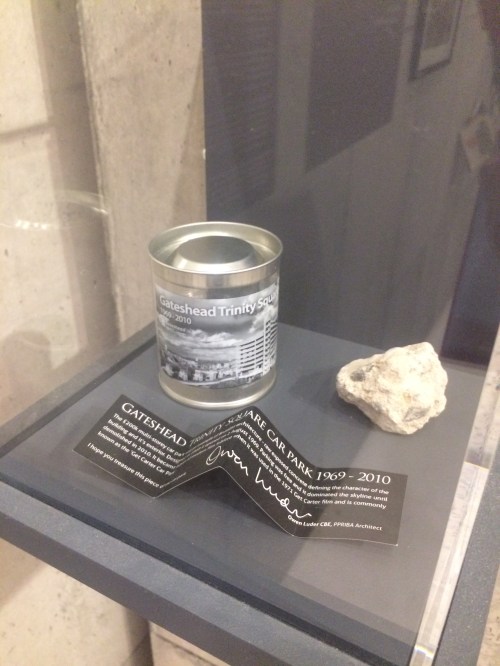
The final section looked at car parks, and also touched on the fetishisation of Brutalist architecture just as much as it has been demolished. Exhibits included a tote bag from Peckham and a certified lump of concrete from the old Trinity Square car park.

IMG_6386IMG_6388

Fiddling with the ingredients at Battersea Power Station

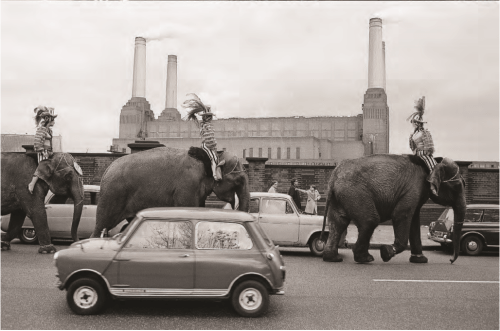
When I interviewed Rob Tincknell, chief executive of the Battersea Power Station development, for my book Up In Smoke, he went to great lengths to explain why the plan would be a success, not just as a business but as a new piece of city.

Well, he actually used the words “urban village”, but let’s try not to blame him for that.

elephants

Tincknell enthused about how carefully they had worked out the exact mix of residential-commercial-leisure space in a way that would create the perfect “place” – a real destination that people wanted to visit. This was the social science of “placemaking” and the developer had published numerous reports and beautiful but boring books to explain their position.

He proudly told me the precise numbers: “57% residential. Of the remaining 43% that’s about 3.4m sq ft, 1.2m retail and restaurants, 1.7m sq ft of offices and the balance  in hotels, leisure and community space.”

These numbers, he insisted, were sacrosanct – they were the recipe that made the cake rise.

“It’s an appropriate density for the centre of the city,” he said when I questioned the scale of the residential aspect. “This level of density has been proved all round the world as a density that works. It creates a critical mass so the shops function, the public transport works, there’s a buzz and that’s what people come for. You create this mix of uses, this cocktail that you really believe in, you have to stick with it, you can’t fiddle with the ingredients.”

Guess what?

That’s right, the ingredients are now being fiddled with. According to an interview with Ticknell in the Financial Times,  the bottom has fallen out of the luxury flat market, causing problems for the power station model. But riding to the rescue are Apple, whose decision to move into the power station’s vast office space in 2021 has undoubtedly been a gigantic coup for the developers. Now, with Apple proving such an attractive hook, Tincknell is talking about turning over more of the residential aspect to offices. He told the FT that at least one planned building in the third phase of the scheme, designed by Frank Gehry and Foster + Partners, was under consideration for a change of use.

“I could easily see us adding another million square feet [of offices],” Tincknell says. “The great thing about a long-term scheme like this is we can adjust with the markets. If there’s no residential market and a very strong office market then we will build offices.”

It looks as if that perfect cocktail is being shaken not stirred.

For Up In Smoke, Tincknell promised me “that we are genuinely committed to creating a brilliant community. We feel very passionate. It will only make the place better. We have a responsibility to London. We are doing things way beyond the remit of the site so it fits in with London and genuinely improve the quality of life. If we succeed in that goal the value of the commercial and residential assets will rise and it will be a great place to live and visit. You can’t just develop it and run away, it has to work.”

On that latter promise, we’ll just have to wait and see.


Purley and dementia

I wrote a piece for the Guardian about the dementia-friendly town concept, which is currently being rolled out in Purley. It is one of many initiatives being considered for towns and cities as the average age of the population continues to rise.


Read or Dredd: 2000 AD at the Cartoon Museum

Everything I love about British pop culture is encapsulated in 2000AD, which celebrates its 40th anniversary in February 2017. There are several birthday events planned, including an exhibition at the Cartoon Museum in Bloomsbury that runs until April 23rd. I had a look around in the company of the curator Steve Marchant, who enthused about the gorgeous clarity of the original artwork from Dave Gibbons, Brian Bolland, Mike McMahon and Carlos Ezquerra (“At times, the comic looked like it was printed with mud on toilet paper,” he said), while I reacquainted myself with the world of Dredd and Rogue Trooper.

croydon

As a kid, my comic-reading progress went something like this: BeanoTransformersRoy Of The Rovers2000AD. It wasn’t quite that simple – the first comic I ever read was Beezer, and I was a big fan of Whizzer And Chips. When I was reading Transformers, I was also regularly reading Batman and Superman. And for a while, I got really into a horror comic called Scream!.

But in this journey, 2000AD always seemed like the inevitable destination. Even when I was reading the playful pranks and japes of Dennis and Minnie, I’d see 2000AD on the rack at WH Smiths and quiver in confused anticipation at the cover, and the weirdness and violence it promised.

I knew one day I’d be ready.

The exhibition at the Cartoon Museum starts by showing how 2000AD was created and how it developed. I learnt that the initial hero was soppy space curate Dan Dare, in whose blue-eyed banality I saw as the very opposite of what 2000AD stood for. Several other strips – often loosely based on popular movies or TV series – were given a turn until Judge Dredd inevitably took over. And it was Judge Dredd who most fascinated me. He is a brilliant creation, this square-jawed, deadpan, literal-minded, licensed thug who you can never be sure is good, evil or amoral. Sure, America had Batman but he was a playboy billionaire who frequently expressed moral conflict. Dredd, by contrast, was a foot soldier with no exterior life who always knew what he was doing was right because he was law incarnate. In that lack of doubt, he had more in common with supervillains than superheros.

But what made Dredd sing was the universe around him, and especially the surreal, sinister Mega-City One, which had its own architecture, slang, fads and culture. The world of Mega-City was often very funny and satirical – giant tower blocks named after some of the most insignificant 20th century personalities and politicians – and Dredd was this single-minded avatar plodding through it, trying to erase difference and make sense of it all.

The combination was fascinating: a strip could be at once nihilistic, surreal, smart, sarcastic, joyful, violent and morally ambiguous. One strip at the Cartoon Museum illustrates this neatly: Dredd is spending Christmas Day on the beat, by the end of which he has deported an illegal immigrant, shot a fellow judge and punched a well-wisher in the face. And this was the good guy.

trooper

Much less ambiguous was my other favourite character, Rogue Trooper. The exhibition looks at several long-standing strips including Judge Anderson, Strontium Dog and the wonderful Halo Jones, but it was Rogue who I adored. He was weird – taciturn and blue, with a talking gun, back pack and helmet – but he at least provided some moral clarity after Dredd. The concept was simple too, a sort of future war Fugitive, with Rogue out to hunt down the man who betrayed his unit – the classic quest that could be strung out for as long as possible.

It’s heartening to see 2000AD is still popular today. When it was formed, it was assumed it would last around six months, as that was the usual lifespan of new comics – indeed, the aforementioned Scream! folded after 15 issues. That it is still relevant is testament to the skill of the artists and the writers, who continue to ensure there are sufficient parallels with the real world for plots to be relevant. A couple of strips at the Cartoon Museum showcase this perfectly: in one, a patriotic, racist robot sings Rule Britannia and whines about foreigners as it goes on the rampage amid the skycrapers of Brit-Cit; in another, Chief Judge Caligula has taken power, a deranged, rambling permanently enraged narcissist with a huge ego and lustrous hair who insists on building a giant wall around his crumbling empire.

Remind you of anybody?

giant-cal


Podcasts, radio and Ray Davies

bps-ray-daviesI have recorded a podcast with N Quentin Woolf for Londonist about Battersea Power Station. It covers the full history of the site, looking at the history of the power station, the property battles, failed dreams and possible future.

On Friday, I will be a guest on Wandsworth Radio at around 6.30, again talking about Up In Smoke and the power station.

The image above, incidentally, is a screengrab from Ray Davies’s excellent 1984 film Return to Waterloo, starring Tim Roth and Ken Colley, which is set largely aboard the 8.52 from Guildford to Waterloo. Recently released on DVD, I review it in the forthcoming edition of Uncut.


Graham Taylor: City slicker, ballet lover

Graham Taylor, who has died aged 72, is the single nicest famous person I have ever interviewed. I met him in a City boardroom, where he was doing risk analysis for somebody who was about to buy a football club. It was a pretty unlikely location, but the conversation was even odder. Taylor had just given a talk to Dance East about leadership, and we were there to talk about ballet.

I had no great expectations of the encounter, but I’ve never forgotten it. There was, from the start, a complete lack of front mixed with gentle humour. “People think I’m retired from football,” he said. “But I haven’t. I’ve just retired from football management and that ought to please them enough.”

As he talked about ballet, something else came through, a genuine love and admiration for dancing that he expressed in completely unguarded fashion, something that seemed so strange and wonderful for a man of his age and background. I’ll always remember one quote he delivered, for the way he spoke as much as what he said. It came with a naivety or openness that was rather beautiful. “I’m no expert,” he said. “But Carlos Acosta and Tamara Rojo at Covent Garden, when they dance in Romeo And Juliet, I would deny anybody, anybody, to tell me they don’t know what passionate unbridled love is. I’m not saying I shed any tears, but boy was I close.”

He talked thoughtfully about the differences and similarities between ballet and football, offering his perspective as a player, manager and fan. He was decent, interesting and normal, but what was most remarkable given his previous experiences with the press was that there was none of the usual sense of distancing performance you get in interviews, whether it’s with a film star in a hotel suite or a caramelised peanut seller being vox popped on Oxford Street. Everybody is always aware they are being interviewed, and they always react ever so slightly to the situation, almost placing themselves outside the experience as if they were observing and monitoring their own responses. This separation of reality and performance can be fractional, but it’s happened with everybody I’ve ever interviewed, even close friends. It’s an entirely natural defence mechanism, and one that I have grown so used to I notice it only subconsciously.

Taylor, astonishingly for a man who had been treated so viciously by journalists in the past, had none of this. There was no distance, no performance, no separation, no judgement. It was just him.

After the interview, he walked with me to the nearest station rather than waiting for me to disappear as pretty much any other interviewees would do. Again, it was a simple moment of niceness I’ve never forgotten. We talked about Didier Drogba all the way to Blackfriars station, before heading our separate ways on the District Line.

gtballet1gtballet2-jpeg


Curiocity – the book

Way back in 2011, I wrote this blog post about something I’d been sent in the post. It was called Curiocity and was a tiny fold-up magazine that featured arcane trivia on one side and a weird map on the other. I think I was one of the first – if not the first – to write about the project. The first editions were numbered and then they began to appear in alphabetical order, with each letter indicating the theme, often wilfully obscure and tangential. It was a wizard wheeze, and I even contributed to later editions but Curiocity the magazine only got as far as G, when they stopped. I was miffed, partly because I’d not got round to asking how it should be pronounced – “curio city” or curiosity”?

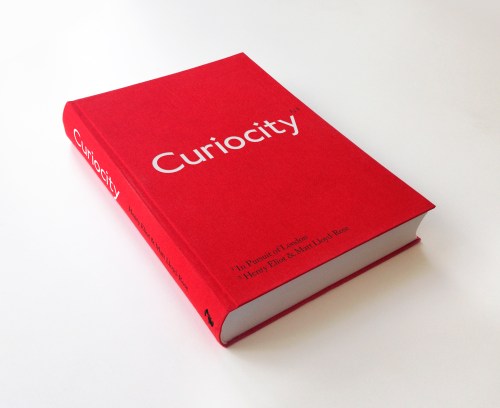
That’s because the pair behind Curiocity – Henry Eliot and Matt Lloyd-Rose – had been approached to write a book. I remember them announcing this to a bunch of us London nerds in a pub in Farringdon. How, we wondered, was this fascinating map concept going to make it into a book? Well, the answer arrived earlier this year with the publication of Curiocity: In Pursuit of London. If it wasn’t for the publication of Up In Smoke, it would probably be the best London book of the year.

Curiocity side on.JPG

I’m not sure when bookshops started having London sections, but I know that I first became aware of the concept of “London writing” in 1999, when Granta published a marvellous London special. Ackroyd’s biography appeared shortly after and a genre was defined. Since then, the concept has exploded. People have always written books about London, but now it has developed into a mini industry all of its own. My bookshelves groan with London books, many brilliant, others less so. There is, in these London bookshop sections, perhaps an over-reliance on ‘secret/eccentric” London-type books, which all seem to contain pretty much the same information just with slightly different covers. But there are also gazetteers on London place names, London maps, London statues, London rivers, London animals, London graveyards, London pubs, London murders, London folklore… my house is packed with these specialist tomes, the best of which are rich in detail and lovingly compiled.

Even so, I’m tempted to chuck them all out because all this information and more can be found in Curiocity. Ostensibly divided into 26 alphabetic themes, the book basically contains all the London trivia, information and history you’d ever require in one place. The esoteric nature is hard to grasp and harder to describe but for example G is for Grids,  a chapter that takes in everything from bollards to bikes – and the bike page includes entries on velodromes, cyclist cafes, Queen videos, mass transit cycling events, recumbent hire and the serial number of the most ridden Boris bike. It’s a mix of trivia, history and listing information that reminds me of peak-era themed issues of Time Out crossed with The London Encyclopedia and then given the Burroughs cut-up technique. 

What’s particularly edifying is there is no attempt to thin out or dumb down  – it’s a total mind dump, with the editors throwing every possible piece of information they can have at the pages and then worrying how to make them stick later. It’s also beautifully illustrated, with special maps created and conceived for the occasion. And while the gargantuan size takes it a long way from the flimsy fold-up map I first received in 2011, it’s gratifying that the spirit of the project has not only survived but been allowed to expand and prosper to the benefit of anybody fascinated by London books and with space enough on their bookshelves for more.

Curiocity: In Pursuit Of London by Henry Eliot and Matt Lloyd-Rose.


The Effra: still flowing under Herne Hill

img_5978

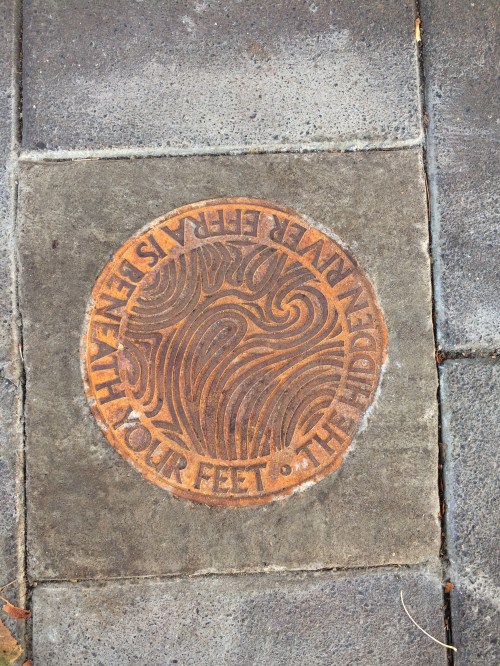
Several of these lovely iron plaques have recently appeared in South London to mark the flow of the River Effra, the lost London river that now lies beneath the streets between Norwood and Vauxhall. It’s a wonderful project and Diamond Geezer has more details. He notes that the first plaques were laid in July and the project appears to be some way from completion, with several plaques yet to be installed. But there is a flurry of them around Herne Hill along Dulwich Road, where they make a nice counterpoint to the Effra’s other principal markers, the stinkpipe.

For those interested in the Effra, a book by Jon Newman has also just been published about the river. I once followed the course of the Effra in the company of a water diviner, who got us all lost in the middle of an estate during a snow storm while taking us on a route that bore very little resemblance to those diligently mapped by Effra experts. Still, it made for an entertaining afternoon.