Category Archives: London

Born is the king of Stamford Bridge…

The story goes like this. In 1955, Chelsea were chasing an unexpected league title when they lost a crucial home game, 6-5 to Manchester United. Manager Ted Drake, devastated at a result that could have cost Chelsea their first trophy never mind championship, took a phone call later that evening from the club’s chief scout. He expected the scout to be equally disappointed about the result, but instead the man on the other end of the phone was elated.

The reason?

That afternoon he had discovered Chelsea’s future, the best player the club would ever produce: Jimmy Greaves.

There was a similar feeling at Stamford Bridge on Wednesday evening, where Chelsea fans emerged from the ground in extraordinarily good spirits despite witnessing a 4-3 defeat to Newcastle United.

The reason?

A 17-year-old called Josh McEachran, who came on when Chelsea were 3-1 down with 30 minutes remaining and went to give a display of such confidence and string-pulling panache that some older fans were saying it was the best debut from a youth player since Osgood’s, while others were comparing him with Cruyff and Xavi.

Well, perhaps. It’s important not to get too carried away. Recent Twitter antihero Leon Knight was described as the ‘new Zola’ in the 1990s and he’s now agitating for a move to Rushden & Diamonds. But when you see a performance of this maturity from a 17-year-old making his home debut for a team that is 3-1 down and playing with ten men, well, you are entitled to dream, aren’t you?

Underground again at Aldwych


Transport for London allowed Aldwych station one of its periodic reopenings this weekend, with 1940-themed tours of the station and platform to commemorate the 70th anniversary of the Blitz.

The tours – which are completely sold out so don’t even try – were arranged to complement the Under Attack exhibition at the London Transport Museum, as explained by museum director Sam Mullins in this BBC clip.

As a part-time moleman who has never been inside Aldwych, I was down there like a greedy ferret in a goldmine. Aldwych, a pointless spur on the Piccadilly Line, closed in 1994 and its history can be read at the wonderful Subterranea Britannica or Abandoned Stations. Ian Visits and Diamond Geezer also have posts about the station.

I’ve wanted to get inside it for ever such a time.

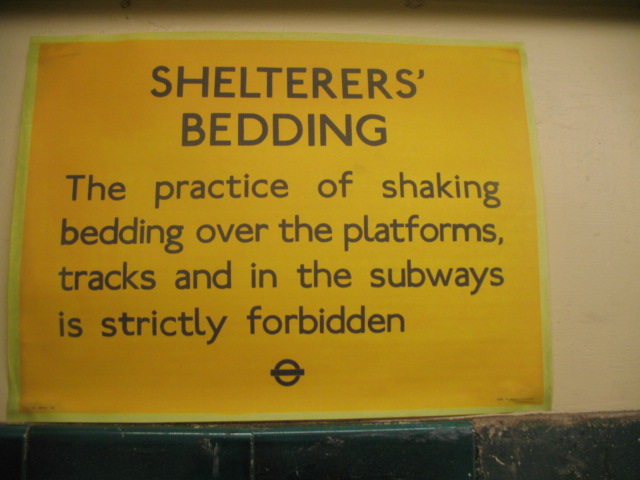
The tours begin in the neat but spartan ticket office, which is decorated with a number of wartime posters giving instruction about shelters and the blackout. You are greeted by an actor playing an Air Raid Precautions officer, whose monologue is interrupted by the forbidding wail of an air raid shelter. You meet three more such actors in the course of the tour, the best being the 1940s housewife who sits in the train down on the platform and can be quite saucy if you ask the right sort of questions.

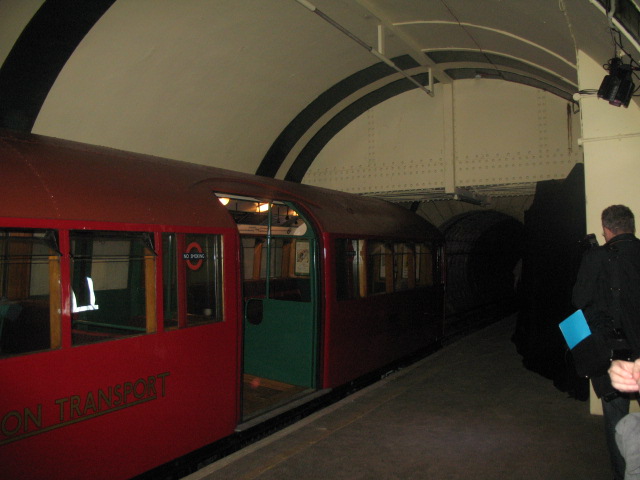
The chance to poke around the station and listen to actors recreating 1940s stereotypes is all well and good, but the star of the show is undoubtedly the 1938 train that has been brought out of retirement for the occasion.


I’m no train nerd, but this one is a beauty, as I’m sure better photographers than I will record this weekend.

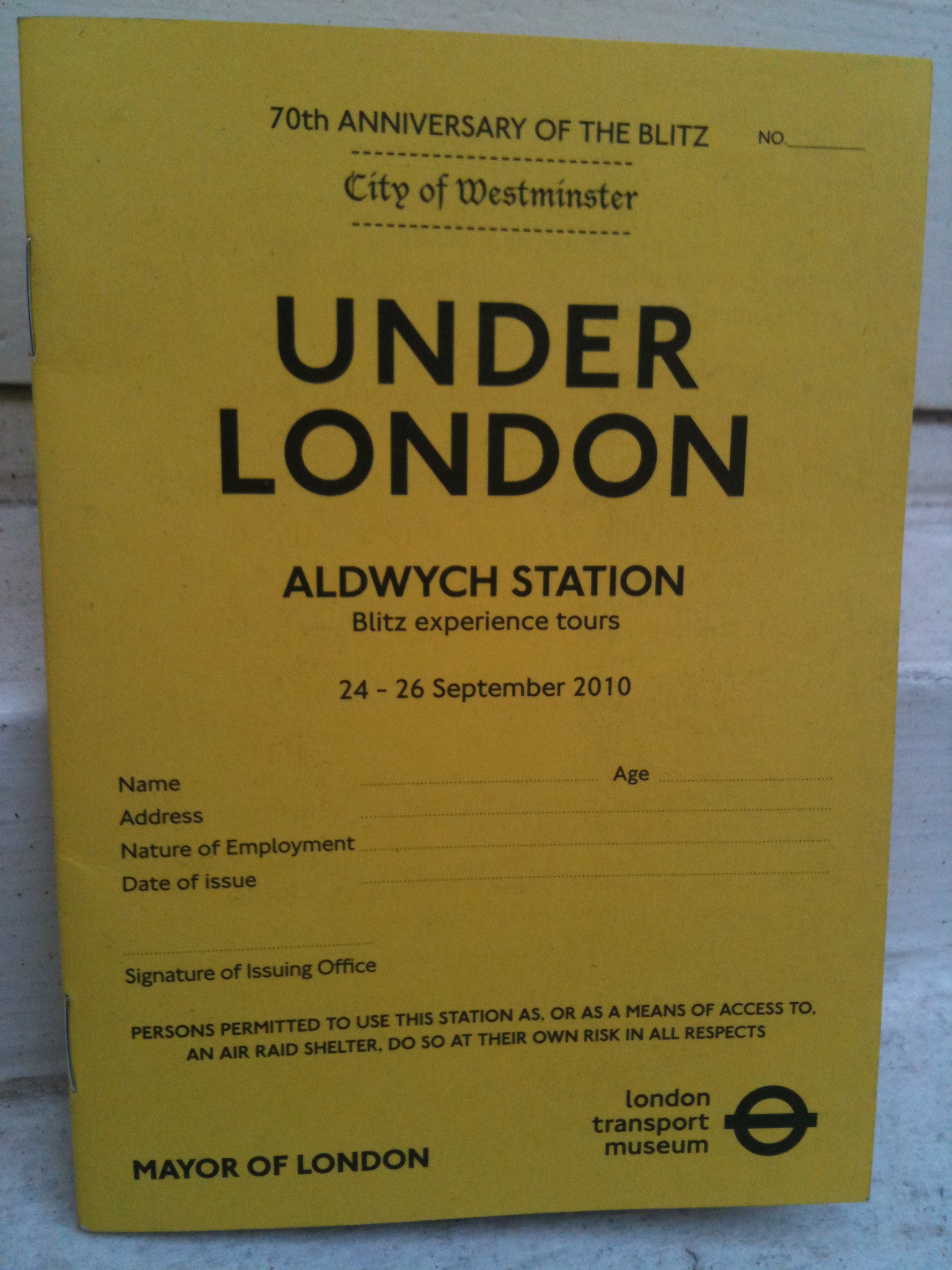
The other highlight is this cracking little souvenir book about Aldwych and the Blitz that is given to everybody who goes on the tour.

The tour ends with a deafening reconstruction of an aerial bombardment, with impressive sound and light, before the all-clear sounds and allows you to climb the steps back to the surface (no lifts or escalators, so prepare for a walk).

A recreation of the ‘Blitz experience’ is an almost impossible thing to pull off for obvious reason and this is neatly done in the circumstances, although it might have been nice to have bunks on the platform to give more of a flavour of what it was like to cower down there for a night.

Interest in the tours have been so great – an estimated 3,000 people will take part this weekend – that the London Transport Museum believe public tours of Aldwych will be reintroduced on an irregular basis in the future.

So that’s one ambition sated, only for another to take its place. Earlier this week I was talking to a curator at the LTM, who told me of his recent tour round Down Street, another abandoned station with wartime connections. It is, he told me, in ‘fabulous condition’. Anybody interested?

Diaghilev at the V&A

Two months ago I knew diddly about Diaghilev. Since then I’ve written two features about him – including this in the Independent On Sunday – and can confidently assert that this Russian-born impressario changed the face of ballet in the early twentieth century when his company, the Ballets Russes, enlisted artists and composers like Picasso, Matisse and Stravinsky to showcase the work of groundbreaking dancers and choreographers like Nijinsky and Massine. Such is the magic of journalism.

The occasion is the V&A’s big autumn exhibition, Diaghilev and the Golden Age of the Ballets Russe, which opens on September 25. It’s an incredibly rich exhibition, crammed with memorabilia and costumes and images and music. Highlights include the astonishing, undanceable costumes from Parade, Picasso and Cocteau’s ‘Cubist ballet’, the monumental back cloth from ‘The Firebird’, and a wonderful bust of Nijinsky that captures his odd features.

I’m not a great fan of the ‘blockbuster’ exhibition as they are rarely as satisfying and intelligent as intimate displays at the more thoughtful museums, but this one is a real cracker, demonstrating decades of learning and showcasing a marvellous collection of costumes bought in auction and secured in the V&A’s vaults for just such an occasion.

(There’s a nice piece here from Diaghilev’s biographer about the Russian’s relationship with London.)

My London Library: No 3 – Cockney Alphabet

  • Title Cockney Alphabet by Rufus Segar (1965, Parrish)
  • Cost £1.99
  • Bought from Oxfam Books, Herne Hill
  • Genre Humour

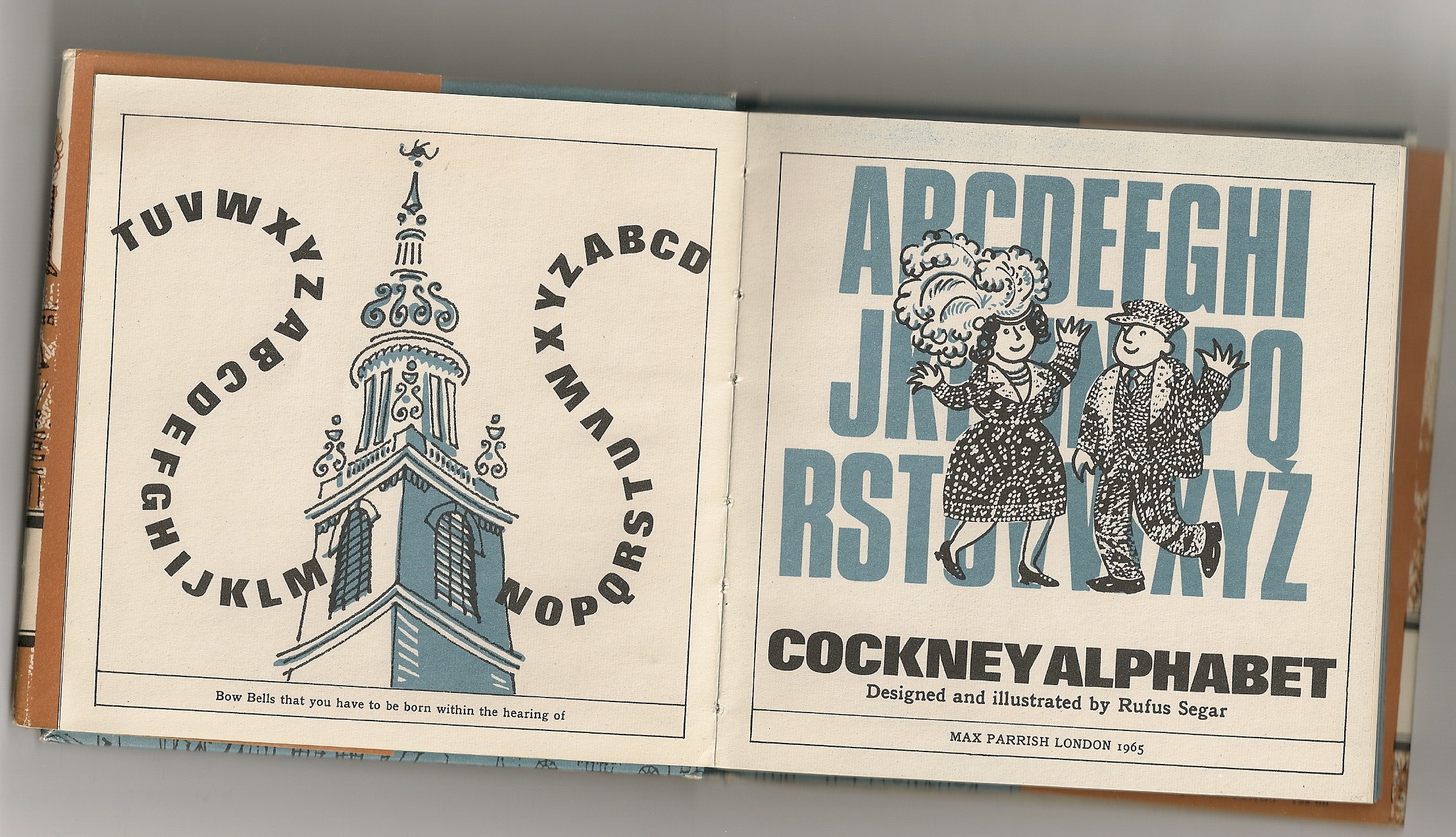
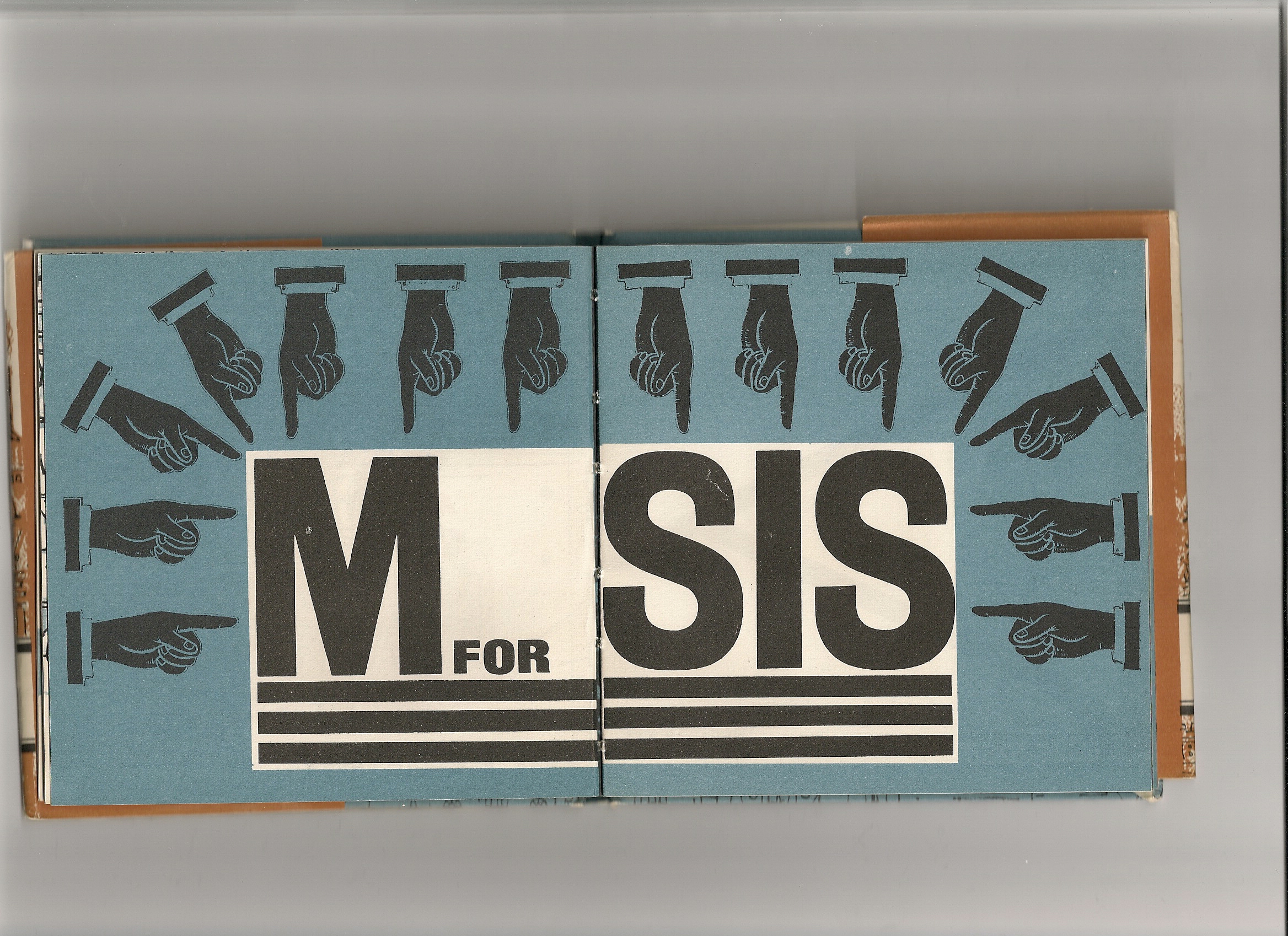
The Cockney Alphabet is a humorous alphabet originally devised by music hall duo Clapham & Dwyer in 1929 that rewrites the alphabet with cockney phonetics, starting with A for ‘Orses (Hay for Horses) and ending with Z for Effect (Said for Effect).

There are loads of different versions and this wonderfully illustrated little toilet book from the 1960s has a nice potted history of the form, including a list of four of the most popular alternative versions.

Like rhyming slang, the alphabet can be rewritten to take in topical themes or personalities (this book has U for Fox, or Uffa Fox, a now forgotten British sailor; it also has Q for Beatles over the traditional Q for the Dole).

This version was compiled by Rufus Segar, who says it is by no means definitive, arguing that ‘Letters such as D, G, H and S still remain to be bettered.’ (Although I do like his S for Ixiation over a mountain of Chapman brothers’ skulls.)

Some of the contributions can be hard to comprehend (D for Payment?) but Segar insists that ‘with perseverance and some latitude in pronunciation they will suddenly become meaningful’ (ah, ‘Defer payment’!). And we can’t ask for more than that.

Best bit Illustratively: ‘G for Police’; phonetically, ‘M for Sis’.

Verdict Time for an update?

Maps and apps


Some months ago, I heard about the Time Travel London Explorer app, a nifty iPhone application that allows you to layer different historical maps of London on top of each other, so you can use GPS to see how the street you are standing in has changed (or not) since 1746.

I was so excited I went out and bought an iPhone in anticipation and wasn’t disappointed when the app was finally completed. It features four different maps – Rocque 1746, Horwood 1799, Greenwood 1830 and Stanford 1862 – as well as lots of easily searchable historical information and photographs of London, along with audio guides. You can read a review here.

It’s a bit like the Museum of London’s Street Museum app only better as fading in from one historic map to another is fun and informative.

The Time Travel Explorer website features a blog about mapping and London history written by myself and M@ from Londonist. If this is the kind of thing that gets you going – and really, how could it not? – go check us out.

Sad news for South London

Jason Cobb, one of south London’s finest bloggers and a hyperlocal hero, is leaving London, defeated by the relentless pace of life in the city and fearful of ‘becoming what I despise – a right wing bigot’.

Just about the only people who will be relieved by his departure will be Lambeth Council, who have regularly been held to rigorous scrutiny by his wonderful Stockwell-based Onion Bag Blog.

Jason was also tremendously helpful and encouraging when I decided to set up my own blog, for which I am forever grateful.

Wivenhoe doesn’t know what’s about to hit it.

Why is there no London monument for the Blitz?

‘When I reached the end of Milk Street, I looked out towards Moorfields across an area of devastation so final and complete that the memory of it will always rise in my mind whenever I hear the word Blitz. There is a savagery, a fury and a hideous wickedness about the ruins of London – and of Berlin also – that chills the heart.’

From HV Morton’s ‘In Search of London’

The Blitz began on September 7th, 1940, seventy years ago today, when London was attacked by 300 German bombers. It lasted three months as London was bombed for 57 consecutive nights. Between September 7 and May 11, 1941, 18,800 tonnes of high explosive was dropped on Holborn, the City, Westminster, Shoreditch, Southwark and Stepney. Up to 20,000 Londoners were killed, many thousands were wounded and 3.5 million houses were damaged or destroyed.

And yet, astonishingly, London – a city of a thousand statues – still does not have a single worthwhile monument to the citizens who suffered the Blitz.

The story of the Blitz is a familiar one – see this wonderful propaganda film for an emotional contemporary look at London under attack – and while the ‘Blitz Spirit’ narrative can be trite and over-mythologised, there was undoubtedly some truth to it. Londoners had to deal with the Blitz in part because they had no other choice, but there is evidence that Londoners did more than just survive, they almost relished the battering they received. As  Humphrey Jennings wrote at the time, Londoners were ‘secretly delighted with the privilege of holding up Hitler’, while Phillip Ziegler said in ‘London At War’ that ‘Londoners made a deliberate attempt to seem nonchalant and unafraid’.

Peter Ackroyd suggests that Londoners might have been able to cope because of spiritual kinship with the destruction of the Great Fire, an idea that HV Morton pre-emptively pooh-poohs in his elegiac 1951 classic ‘In Search of London’. ‘The Fire was an accident and it lasted a matter of days. The Blitz was the deliberate attempt of an enemy to subdue a city whose watchword has always been freedom… the effect of these two events upon the population cannot be compared.’

Yet while London has a Monument for the Fire, it still does not properly commemorate those who experienced the Blitz. There’s a small park in Wapping, a couple of minor plaques – one by St Paul’s, near the firefighters monument, and one in St James’s Churchyard on Piccadilly – and dozens of plaques to individual explosions.

But there is no single iconic statue or monument prominently placed and devoted to the citizens of London in the manner of that for, say Animals In War, or any of the numerous monuments for different branches of the armed forces (Bomber Command are the latest).

This was first pointed out to me in 2006  during an interview with Jack Lohman, the Director of the Museum of London, and his museum does now contain a stunning WWII tribute. The Blitz room is a single stark shadowy space, with an unexploded bomb hanging from the ceiling. The walls show still images of the Blitz, while survivors recount their experiences on audio. It’s incredibly moving, but it isn’t enough.

Why doesn’t London pay sufficient tribute to its Blitz Spirit? I asked Jane Furlong, project co-ordinator of the UK National Inventory of War Memorials, and her answer boiled down to one word:  politics.

Furlong told me: ‘As with all memorials, it’s down to whether individual groups or people want to commemorate something. Also, is there a need of it among those who lived to tell the tale? There are lots of service veterans who want to make sure what they did is never forgotten and a memorial is the best way to do that and so they can go away and organise and make sure it happens. It is all down to having that desire, the community needs to take the lead.’

Bomber Command is a ready-made community that can easily mobilise to commemorate their place in history; London’s civilians are not. Of course, that didn’t stop the Animals In War memorial from getting built, but they managed to enlist the high-profile support of patrons such as the Princess Royal, Kate Adie, Vera Lynn and Joanna Lumley. 

If London is to get the Blitz Spirit memorial it deserves – a dignified sculpture in a prominent public place, dedicated to all Londoners who experienced the Blitz – it requires somebody to take the initiative. And that, ironically, would chime against the spirit of the Blitz: one of exaggerated nonchalance at what took place over London in the winter of 1940-1941.

So it seems for now that the sad and powerful room at the Museum of London and an easily overlooked plaque in the shadow of St Paul’s are the best we are going to get. 

But I think that is a great shame and that ordinary working Londoners, as Ken Livingstone might put it, deserve better.

My London Library: No 2 – London’s Bridges

  • Title London’s Bridges by Peter Matthews (2008, Shire).
  • Cost Free.
  • Bought from Author.
  • Genre Straight history.

The endearingly honest opening line says all you need to know about this historical overview of London’s crossing points. ‘In 1938,’ Matthews reports, ‘an article in the Times observed that: ‘The people of London have a reputation for taking no interest in their bridges’.’

I bet the publisher loved reading that.

It’s a lovely book though, wordy but not too long, nicely illustrated and ruthlessly factual. Bonus points for including non-road bridges such as Grosvenor Railway Bridge.

There’s some great trivia to be found: ‘In 1873, the Royal Humane Society set up a 24-hour ‘receiving host’ by the northern end of Waterloo Bridge, manned by a doctor who would attempt to revive any suicide victims brought to him, and in 1875 alone 21 people were saved by this method’.

The author, Peter Matthews is a proper London nerd and runs the bookshop at the Museum of London, so you can be fairly sure you’ll be able to pick up a copy there.

Verdict Solid reference tome.

My London Library: No 1 – Private Eye On London

I own a lot of books about London, so I thought I’d share them with you in no particular order.

  • Title Private Eye On London by Christopher Booker, Willie Rushton and Richard Ingrams (1962, Weidenfeld and Nicolson).
  • Cost £4.
  • Bought from The Cartoon Museum, Bloomsbury.
  • Genre Humour.

One of – if not the – first special annual produced by the Private Eye team followed the adventures of Gnittie, a ‘little man’ with a ‘vague longing to be rich and famous’, who heads to London to fulfill his dreams.

There he discovers that ‘nobody who is rich and powerful and famous lives South of Old Father Thames’, visits Whitehall, Trafalgar Square and Buckingham Palace, discovers the prisons are full of ‘parking offenders and demonstrators’ and tries unsuccessfully to take a No 11 bus to Fleet Street.

Best bit The Estate Agent.

Verdict Even in London, most things never change.

Jimi Hendrix in the suburbs

Jimi Hendrix’s London flat overlooking Mayfair’s Brook Street is opening to the public tomorrow (August 25th) for the Hendrix In Britain exhibition. The exhibition – which is being mounted by the Handel House Museum (Hendrix and Handel were temporally dislocated neighbours) – is a cosy affair, amounting to a costume, a guitar, some great photos, handwritten lyric sheets, posters (‘The Fabulous Walker Brothers/Cat Stevens/Jimi Hendrix/Englebert Humperdinck’), notes, including directions to the Isle of Wight for the famous festival, and his death certificate (’cause of death: vomit’).

Hendrix’s actual flat is now the Handel House Museum offices, but they will be moving out for two weeks in September so the public can have tours of the quite spacious flat Hendrix lived in with his girlfriend Kathy Etchingham. The museum hopes to open this flat to the public permanently when they manage to raise sufficient funding and get all the hash burns out of the carpets.

My favourite part of the exhibition was the giant map of Hendrix’s London that takes up one wall, with stickers donating key venues, hotels and apartments. Opposite is a list of the major concerts Hendrix played during his three years in London before his death. I was pleased to note that alongside the more famous clubs – Scotch of St James, the Marquee, the Astoria and the Royal Albert Hall – Hendrix found time to play the suburbs, including Bromley Court Hotel, Ricky Tick in Hounslow, Upper Cut in Forest Gate, the Ram Jam Club on Brixton Road, Granada Theatre in Tooting, Star Hotel in Croydon, Bluesville ’67 on Green Lanes,  and the Orchid Ballroom, Purley.

Hendrix in Purley, now that’s a side of swinging London you don’t hear much about these days.