Category Archives: History

Stoney Jack and the Cheapside Hoard


The Cheapside Hoard is one of the great treasures of the Museum Of London. A vast collection of Tudor jewellery, it was found by two workmen in the cellar of a house on Cheapside in 1912 and eventually made its way into the museum’s collection.

The story is a fascinating one, outlined in HV Morton‘s seminal London history ‘In Search Of London’.

Morton, a journalist and insatiable London enthusiast with the knack of knowing not so much the right people as the really interesting ones, begins by describing GF Lawrence, ‘or Stoney Jack as he was known by every navvy who worked in the City’.

Stoney Jack was an asthmatic antiques dealer with a shop on West Hill, Wandsworth. He also had a job as Inspector of Acquisitions at what was then called the London Museum, based in Lancaster House, St James’s.

Since the 1970s, every building site in the UK must by law be visited by a team of archaeologists to ensure no great treasures are missed, but in Lawrence’s time there was no such requirement. Lawrence’s job then was ‘to haunt every demolition site in the City and make friends with the navvies, so that they would bring to him anything that had been found during excavation’.

Morton writes that there was a lot of building work taking place at this time and Lawrence knew it may be the last chance to find any antiquities that might still be hidden in the soil. In his not entirely public-spirited determination to ensure nothing crucial was lost, workmen received rudimentary archaeological training during ‘mysterious transactions behind hoardings and in the tap rooms of City public-houses’.

In this way, Lawrence was able to purchase items from ‘a procession of navvies with mysterious objects wrapped in spotted handkerchiefs’ and flog them on to the London Museum, earning himself a tidy profit. Anything the museum didn’t buy, went into his shop. And even if the navvies brought him something worthless, he always gave them enough cash to buy a pint of beer. In this way, he built up much of the Roman and Medieval collection that is now in the Museum of London.

Morton continues:

I cannot count the times I have been present when navvies have appeared and passed their treasures across the counter with a husky, “Any good to yer, guv’nor?” I have seen handkerchiefs unknotted to reveal Roman pins, mirrors, coins, leather, pottery and every kind of object that can lie concealed in old and storied soil.

I was with him one day when two navvies handed over a heavy mass of clay found beneath a building in Cheapside. It was like an iron football, and they said there was a lot more of it. Sticking in the clay were bright gleams of gold. When they had gone, we went up to the bathroom and turned the water on to the clay. Out fell pearl earrings and pendants and all kinds of crumpled jewellery. That was how the famous hoard of Tudor jewellery, the Cheapside Hoard, was discovered.’

Morton recalls that for this great find, now worth millions, Stoney Jack received a thousand pounds. For their part, the navvies were rewarded with ‘something like a hundred pounds each, and I was told that these man disappeared, and were not seen again for months!’

Being brave in SE8: Extraordinary Heroes at the Imperial War Museum

Have you ever heard of Geoffrey Keyes and Operation Flipper?

I hadn’t until this week, when I learnt that Keyes was a Second World War commando who led a team 400km behind enemy lines in North Africa in a bid to assassinate Erwin Rommel. The group evaded guards around the perimeter fence and got inside the house used as the German HQ, but as they entered a ground-floor room Keyes was shot and killed. Rommel wasn’t even in the house at the time.

Keyes was awarded a posthumous Victoria Cross and his story is ripe for a film, but this is the first I’d heard of it.

The new Extraordinary Heroes gallery at the Imperial War Museum is full of such remarkable tales, 243 in all, each tied to either a Victoria or George Cross. 164 of these medals belong to Michael Ashcroft, the Tory party donor, who has also forked out £5m for a new gallery to house them – the first permanent gallery at the museum for a decade. Well, I guess it beats paying tax.

The gallery is a great example of how with a bit of thought a museum can make a lot out of a little. The exhibits – the medals – are not much to look at, and the VC itself is almost parodically tasteful, a modest thing of dull brass (it’s made of gun metal) with a sober ribbon the colour of dried blood. There are numerous medals on display here, and the VC is always the least conspicuous of the lot.

But the curators have done wonders with this unpromising material, emphasising the extraordinary stories behind each medal with frugal but compelling text and embellishing some of the tales with props such as the diving suit worn by James Magennis when placing mines on a target in 1945 or a portrait of recent VC awardee Johnson Beharry taken by Don McCullin.

There’s wit here as well such as a stuffed white rabbit to represent the codename of spy Forest Yeo-Thomas or the surprisingly effective touch-screen version of some of the stories told in Victor comic style. The IWM uses these informal touches confidently, never lapsing into poor taste and aware that excessive sobriety can be just as offputting.

While the bravery of these men and women is moving, the circumstances are often maddening. Many medals were awarded during the carnage of Gallipoli, and there was something about the story of Alfred Wilkinson, a Private who was awarded a VC for delivering a message during the First World War after four previous messengers had died, that somehow summed up all that is most horrific and pointless about that conflict.

Some medals were awarded in peacetime. An 11-year-old girl was given a George Cross in Canada in 1916 for fighting off a cougarm, while Harry Wilson was awarded a GC in 1924 for saving the lives of his colleagues in a flooded colliery.

And, bringing it all back home, a George Cross was awarded for bravery in South London after unarmed PC Tony Gledhill chased a car filled with armed robbers from Creekside Street, Deptford into Rotherhithe. Gledhill’s car was shot at around 15 times by the robbers before he confronted them on foot and eventually subdued the men, securing the conviction of four criminals, including John McVicar.

There’s always a London connection if you look hard enough.

Room for improvement

Writer, Londonphile and intimidatingly prolific blogger Christopher Fowler recently noted my post on the London terraced house on his own excellent blog, adding intriguingly that:

‘Looking into the subject a bit more, I found that the terraced rooms and gardens are all percentages of those [9th century] measurements, making everything look neat and tidy even when it’s not.’

His recommended related reading on the subject is Harry Mount‘s ‘A Lust for Window Sills: A Lover’s Guide to British Buildings from Portcullis to Pebble Dash’.

London’s crappest ghost: a Halloween post

London has many ghost stories and some are actually rather scary, like the Black Dog of Newgate. This spirit is said to haunt Amen Court near St Paul’s, where a wall from Newgate Prison remains. It manifests itself as a shapeless, black form slithering along the wall before it disappears into the shadows.

Considerably less spooky is the ghost said to haunt Pond Square in Highgate.

The story goes like this.

In January 1626, the writer and philosopher Sir Francis Bacon wanted to test his theory that ice could be used to preserve food, so he bought a chicken on Highgate Hill, killed and plucked it, and stuffed the carcass with snow. The frozen chicken had been invented, but the effort caused Bacon to contract pneumonia from which he died.

A sad tale, but one which doesn’t end there. For, ever since, on icy cold nights in the depths of winter, a shape resembling a partially plucked chicken has been seen flapping around Pond Square and squawking before vanishing spookily into the ether.

Yes, that’s right, London is haunted by the spirit of a featherless fowl.

Has there ever been a crapper ghost than this?

Urban legends: Phyllis Pearsall and the A-Z

The story of Phyllis Pearsall and the A-Z is one of London’s most enduring and endearing myths. To take but one example, here’s the Design Museum‘s version of how, in 1935, Pearsall couldn’t find her way to a party in Belgravia so decided to make a completely new map of London, which she did by getting up at 5am each morning and walking every one of London’s 23,000 streets – a distance of 3,000 miles. The result was the A-Z, the first street atlas of London.


You’ll find this story everywhere, often repeated word for word, which is usually a sign something is up. Here it is on the BBC. Here it is in Time Out. Here it is on Wikipedia.  And here’s some sap repeating it in an excerpt from a book on Amazon.

Peter Barber reckons it’s nonsense. And as the head of maps at the British Library, he should know.

‘The Phyllis Pearsall story is complete rubbish,’ Barber told me. ‘There is no evidence she did it and if she did do it, she didn’t need to.’

Barber maintains first of all that the first street-indexed map of London was made in 1623 by John Norden, but his reservations are not just academic. Pearsall’s father, Alexander Gross, had been a map-maker and produced map books of London that were almost identical to the A-Z in everything but name. They looked the same and used the same cartographical tricks. It’s Barber’s belief that Pearsall simply updated these maps to include the newly built areas of outer London and called the result the ‘A-Z’.

‘She was a great myth-maker,’ says Barber. ‘But English Heritage investigated the story and decided not to award her a blue plaque because it was not felt she’d done anything to deserve one [Pearsall does have a plaque, but it was awarded by Southwark]. It was marketing and it’s a very pervasive myth, she was a lovable character and people want to believe it.’

So did she really walk those streets or not? Here, Barber is hard to pin down. In writing he is equivocal, as the final comment here shows, but in conversation he makes his position pretty clear.

‘Pearsall was building on a body of information that had been around for years,’ he says. ‘What she may have done is be more thorough in mapping the new areas that cropped up between the wars, and there were two ways of doing this. You could either tramp the streets of outer suburbia for hours on end, or you could visit the local council office and ask for their plans. Which do you think she did?’

A common little London house

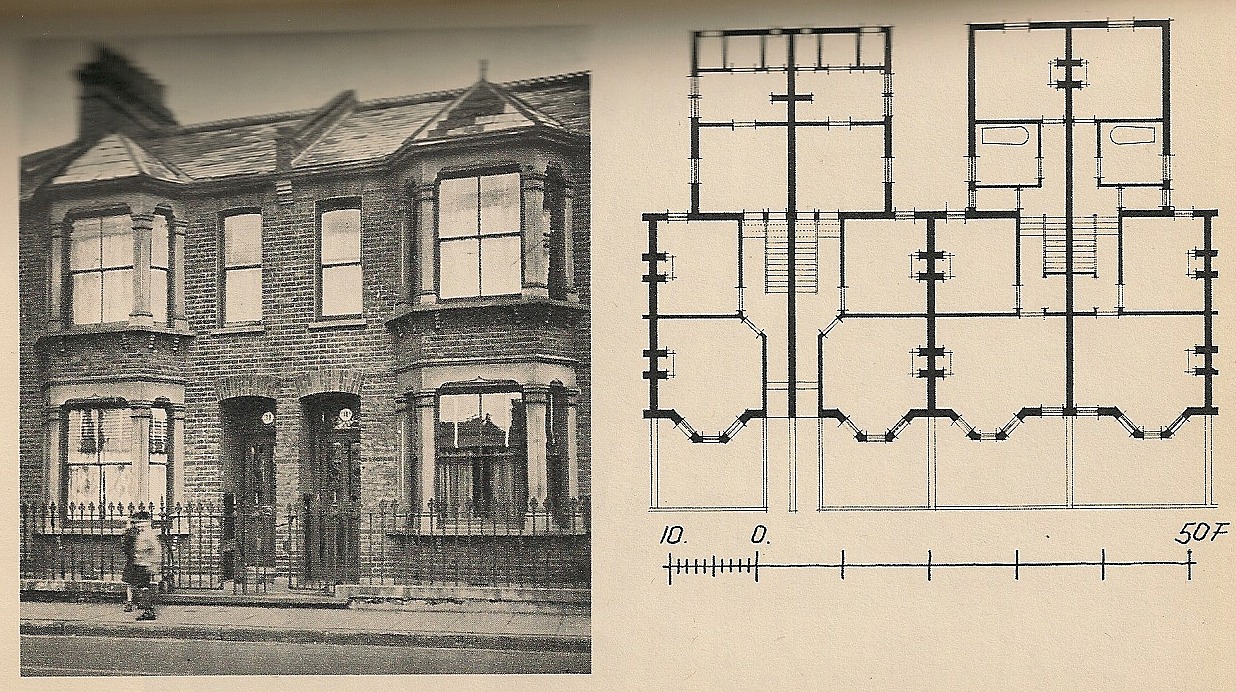
There is nothing special about this house, other than that I live in it. It is one of hundreds of thousands of almost identical houses built in the second half of the nineteenth century for a London population that was expanding at a ferocious rate.

This was the Great Wen that William Cobbett warned about. In ‘London: The Biography’, Ackroyd quotes ‘an observer perched on top of Primrose Hill in 1862, who looked at the growing city and noted that, “the metropolis has thrown out its arms and embraced us, not yet with a stifling clutch, but with ominous closeness.”‘

In ‘London: The Unique City’, Steen Eiler Rasmussen’s classic book about London architecture, he writes about houses just like this: ‘From railroads intersecting the suburbs of London we see interminable rows of these swarthy little houses with all their protruding little kitchen-wings. It is the most compact type imaginable for a street house.’ He includes a picture and plan of these houses. Look, it’s almost indentical to mine.

There is a reason for this ‘interminable’ consistency in London housing, and like most things in this country, it is to do with class. Rasmussen explains that in London, because the class system ensured people of the same social strata would invariably live alongside each other, segregated from those richer or poorer than themselves , it was ‘possible to standardise domestic houses: as people living in the same street have the same requirements all the houses can be absolutely uniform.’

This isn’t quite true of my street – at one end there are grand five storey double-fronted detached houses, which would have been for the very rich with domestic servents, and at the other end there are two-storey railway terraces, with every possible permutation in between. This would have meant unavoidable mixing of the classes and was the result of the street having been built over a number of years, starting with the posh end near the park and ending with the common end near the station. But it is certainly true that London houses of the era are near identical.

Rasmussen also knew the exact width of of my new house – 16 foot 6 inches. He writes, ‘the common little house of which there have been built thousands and thousands is only sixteen feet six inches broad. It has probably been the ordinary size of a site since the Middle Ages… but it is difficult to get information as to how typical houses were built in former days.’ After reading this, I measured the front of my house and he was right. Now everywhere I look, from Brixton to Holloway, I see 16 foot 6 inch house fronts. Try it yourself.

So why is this? For an answer, I turned to English Heritage’s photographic collection ‘Lost London’, in which Philip Davies explains exactly why London’s houses of a certain era are all exactly the same size. He writes of ‘a secret ingredient which conferred an innate harmony on the city, and which influenced everything from the layout of an entire neighbourhood to the size of a window pane – the Imperial system of measures.’

Davies continues. ‘Neighbourhoods were laid out by surveyors who used acres, furlongs, rods and chains – measurements which had been in common usage for marking out arable land since the ninth century. An acre was the length of a furlong (660ft) and its width was one chain (66ft). For shorter lengths a perch, a pole or a rod were used. There were four rods to one chain and a London workman’s house had a frontage of one rod – 16 ft 6 in – so entire districts were created based on endogenous proportional relationships.’

As this website explains, when a landowner wished to build a series of houses for his agricultural labourers on an acre of land, the surveyor could go out with his rod and immediately estimate how many houses there was room for.

So the size of the house in which I live in the twenty-first century was decided by a scale of measurement that dates back to the Dark Ages. For those who find London’s overall sense of scale overwhelming, this internal and very visible consistency might at least provide some comfort.

A punch up the bracket: BS Johnson and Anthony Aloysious St John Hancock

In a comment on my previous post about BS Johnson,  BB writes: ‘To issue a threat ending in “up the bracket” is so much of its time it made me laugh out loud. I had a couple of jobs that involved working with men in their late 50s and early 60s, real Londoners,  and they had a particular argot and mode of expression, which was always making me laugh. Enquiring as to whether you wanted a punch up the bracket was a regular occurrence.’

I also love this phrase, and associate it with another of my heroes, Anthony Aloysious St John Hancock, the greatest British comedian of all time. (There’s a great piece about Hancock here, noting the similarities between Hancock and Seinfeld as well as Hancock’s use of ‘punch up the bracket’.)

Hancock and BS Johnson have much in common. Both were aspirational working-class/lower middle-class men defined by the 1950s who spoke in the language of outer-urban post-war London. Both were men of keen wit and sharp intellect who enjoyed – or couldn’t help – skewering their own occasional lapse into pomposity. Both were depressives with a gift for pointed, painful comedy. Both killed themselves. They even looked similar: thick, heavyset men with wounded eyes. And, most importantly, both referenced Chelsea in key texts (Hancock in ‘The Football Pools’ and Johnson in ‘Albert Angelo’)

I once interviewed Tim Lott – or was it Toby Litt? – who suggested that Hancock was London’s answer to the Angry Young Men of 1950s northern working-class fiction, and there’s something this, though I’m not sure Sillitoe or Wain ever came up with anything as dark as Galton and Simpson’s ‘The Poison Pen Letters’, in which Hancock is so consumed by self-loathing he starts sending himself hate mail in his sleep.

But this is something you can imagine BS Johnson writing, another angry, sad, brilliant man who went raging into the tragedy of premature death.

Underground again at Aldwych


Transport for London allowed Aldwych station one of its periodic reopenings this weekend, with 1940-themed tours of the station and platform to commemorate the 70th anniversary of the Blitz.

The tours – which are completely sold out so don’t even try – were arranged to complement the Under Attack exhibition at the London Transport Museum, as explained by museum director Sam Mullins in this BBC clip.

As a part-time moleman who has never been inside Aldwych, I was down there like a greedy ferret in a goldmine. Aldwych, a pointless spur on the Piccadilly Line, closed in 1994 and its history can be read at the wonderful Subterranea Britannica or Abandoned Stations. Ian Visits and Diamond Geezer also have posts about the station.

I’ve wanted to get inside it for ever such a time.

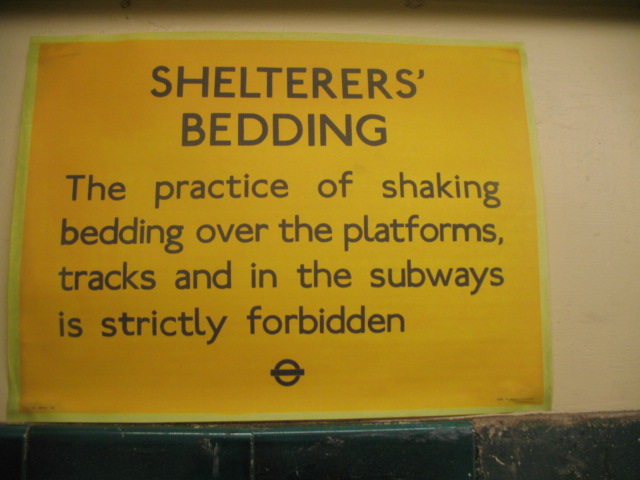
The tours begin in the neat but spartan ticket office, which is decorated with a number of wartime posters giving instruction about shelters and the blackout. You are greeted by an actor playing an Air Raid Precautions officer, whose monologue is interrupted by the forbidding wail of an air raid shelter. You meet three more such actors in the course of the tour, the best being the 1940s housewife who sits in the train down on the platform and can be quite saucy if you ask the right sort of questions.

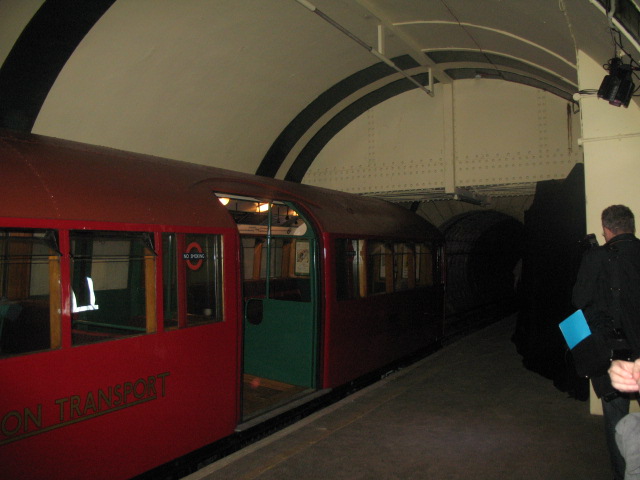
The chance to poke around the station and listen to actors recreating 1940s stereotypes is all well and good, but the star of the show is undoubtedly the 1938 train that has been brought out of retirement for the occasion.


I’m no train nerd, but this one is a beauty, as I’m sure better photographers than I will record this weekend.

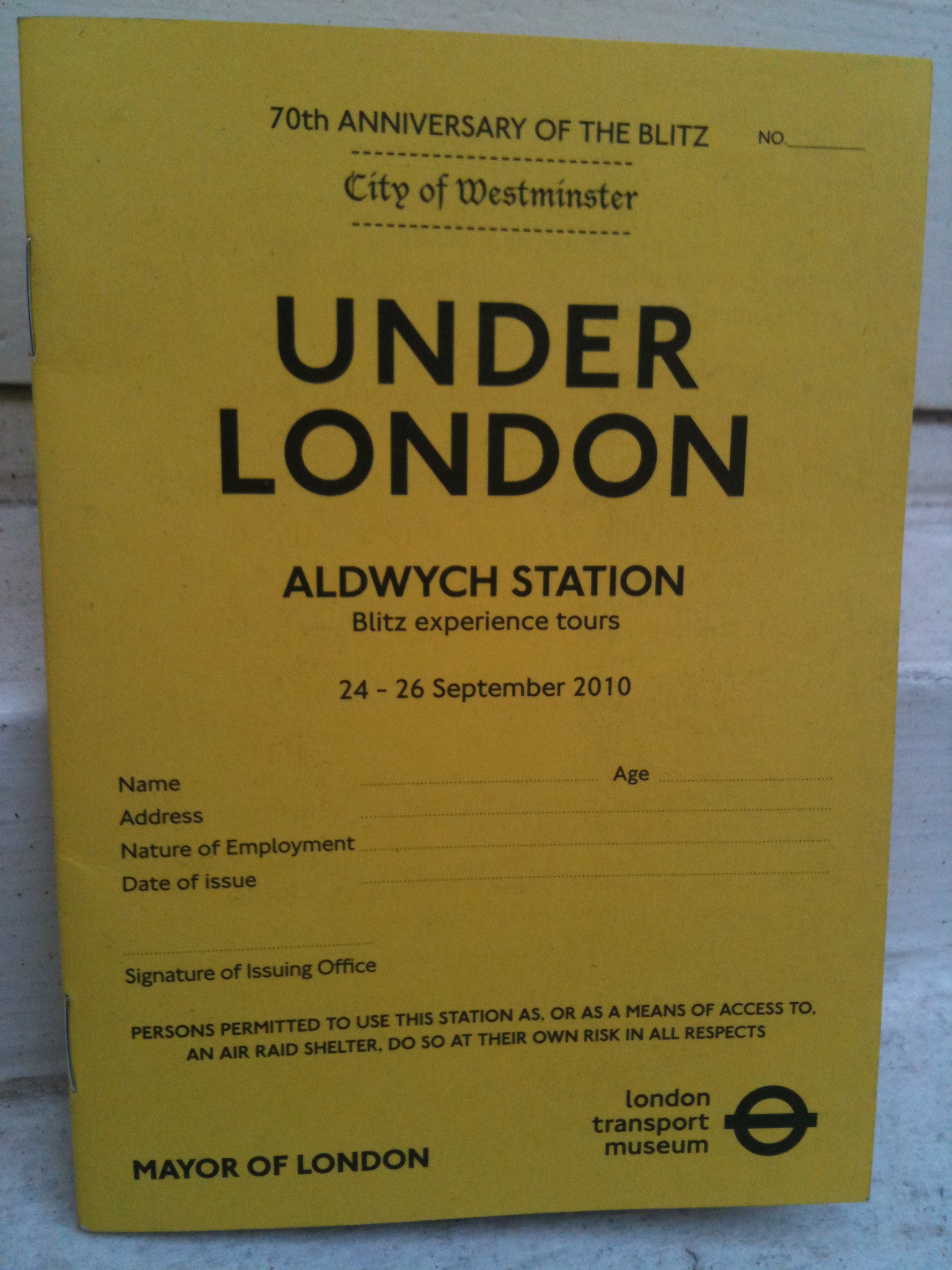
The other highlight is this cracking little souvenir book about Aldwych and the Blitz that is given to everybody who goes on the tour.

The tour ends with a deafening reconstruction of an aerial bombardment, with impressive sound and light, before the all-clear sounds and allows you to climb the steps back to the surface (no lifts or escalators, so prepare for a walk).

A recreation of the ‘Blitz experience’ is an almost impossible thing to pull off for obvious reason and this is neatly done in the circumstances, although it might have been nice to have bunks on the platform to give more of a flavour of what it was like to cower down there for a night.

Interest in the tours have been so great – an estimated 3,000 people will take part this weekend – that the London Transport Museum believe public tours of Aldwych will be reintroduced on an irregular basis in the future.

So that’s one ambition sated, only for another to take its place. Earlier this week I was talking to a curator at the LTM, who told me of his recent tour round Down Street, another abandoned station with wartime connections. It is, he told me, in ‘fabulous condition’. Anybody interested?

Maps and apps


Some months ago, I heard about the Time Travel London Explorer app, a nifty iPhone application that allows you to layer different historical maps of London on top of each other, so you can use GPS to see how the street you are standing in has changed (or not) since 1746.

I was so excited I went out and bought an iPhone in anticipation and wasn’t disappointed when the app was finally completed. It features four different maps – Rocque 1746, Horwood 1799, Greenwood 1830 and Stanford 1862 – as well as lots of easily searchable historical information and photographs of London, along with audio guides. You can read a review here.

It’s a bit like the Museum of London’s Street Museum app only better as fading in from one historic map to another is fun and informative.

The Time Travel Explorer website features a blog about mapping and London history written by myself and M@ from Londonist. If this is the kind of thing that gets you going – and really, how could it not? – go check us out.

Why is there no London monument for the Blitz?

‘When I reached the end of Milk Street, I looked out towards Moorfields across an area of devastation so final and complete that the memory of it will always rise in my mind whenever I hear the word Blitz. There is a savagery, a fury and a hideous wickedness about the ruins of London – and of Berlin also – that chills the heart.’

From HV Morton’s ‘In Search of London’

The Blitz began on September 7th, 1940, seventy years ago today, when London was attacked by 300 German bombers. It lasted three months as London was bombed for 57 consecutive nights. Between September 7 and May 11, 1941, 18,800 tonnes of high explosive was dropped on Holborn, the City, Westminster, Shoreditch, Southwark and Stepney. Up to 20,000 Londoners were killed, many thousands were wounded and 3.5 million houses were damaged or destroyed.

And yet, astonishingly, London – a city of a thousand statues – still does not have a single worthwhile monument to the citizens who suffered the Blitz.

The story of the Blitz is a familiar one – see this wonderful propaganda film for an emotional contemporary look at London under attack – and while the ‘Blitz Spirit’ narrative can be trite and over-mythologised, there was undoubtedly some truth to it. Londoners had to deal with the Blitz in part because they had no other choice, but there is evidence that Londoners did more than just survive, they almost relished the battering they received. As  Humphrey Jennings wrote at the time, Londoners were ‘secretly delighted with the privilege of holding up Hitler’, while Phillip Ziegler said in ‘London At War’ that ‘Londoners made a deliberate attempt to seem nonchalant and unafraid’.

Peter Ackroyd suggests that Londoners might have been able to cope because of spiritual kinship with the destruction of the Great Fire, an idea that HV Morton pre-emptively pooh-poohs in his elegiac 1951 classic ‘In Search of London’. ‘The Fire was an accident and it lasted a matter of days. The Blitz was the deliberate attempt of an enemy to subdue a city whose watchword has always been freedom… the effect of these two events upon the population cannot be compared.’

Yet while London has a Monument for the Fire, it still does not properly commemorate those who experienced the Blitz. There’s a small park in Wapping, a couple of minor plaques – one by St Paul’s, near the firefighters monument, and one in St James’s Churchyard on Piccadilly – and dozens of plaques to individual explosions.

But there is no single iconic statue or monument prominently placed and devoted to the citizens of London in the manner of that for, say Animals In War, or any of the numerous monuments for different branches of the armed forces (Bomber Command are the latest).

This was first pointed out to me in 2006  during an interview with Jack Lohman, the Director of the Museum of London, and his museum does now contain a stunning WWII tribute. The Blitz room is a single stark shadowy space, with an unexploded bomb hanging from the ceiling. The walls show still images of the Blitz, while survivors recount their experiences on audio. It’s incredibly moving, but it isn’t enough.

Why doesn’t London pay sufficient tribute to its Blitz Spirit? I asked Jane Furlong, project co-ordinator of the UK National Inventory of War Memorials, and her answer boiled down to one word:  politics.

Furlong told me: ‘As with all memorials, it’s down to whether individual groups or people want to commemorate something. Also, is there a need of it among those who lived to tell the tale? There are lots of service veterans who want to make sure what they did is never forgotten and a memorial is the best way to do that and so they can go away and organise and make sure it happens. It is all down to having that desire, the community needs to take the lead.’

Bomber Command is a ready-made community that can easily mobilise to commemorate their place in history; London’s civilians are not. Of course, that didn’t stop the Animals In War memorial from getting built, but they managed to enlist the high-profile support of patrons such as the Princess Royal, Kate Adie, Vera Lynn and Joanna Lumley. 

If London is to get the Blitz Spirit memorial it deserves – a dignified sculpture in a prominent public place, dedicated to all Londoners who experienced the Blitz – it requires somebody to take the initiative. And that, ironically, would chime against the spirit of the Blitz: one of exaggerated nonchalance at what took place over London in the winter of 1940-1941.

So it seems for now that the sad and powerful room at the Museum of London and an easily overlooked plaque in the shadow of St Paul’s are the best we are going to get. 

But I think that is a great shame and that ordinary working Londoners, as Ken Livingstone might put it, deserve better.