Title London’s Bridges by Peter Matthews (2008, Shire).
Cost Free.
Bought from Author.
Genre Straight history.
The endearingly honest opening line says all you need to know about this historical overview of London’s crossing points. ‘In 1938,’ Matthews reports, ‘an article in the Times observed that: ‘The people of London have a reputation for taking no interest in their bridges’.’
I bet the publisher loved reading that.
It’s a lovely book though, wordy but not too long, nicely illustrated and ruthlessly factual. Bonus points for including non-road bridges such as Grosvenor Railway Bridge.
There’s some great trivia to be found: ‘In 1873, the Royal Humane Society set up a 24-hour ‘receiving host’ by the northern end of Waterloo Bridge, manned by a doctor who would attempt to revive any suicide victims brought to him, and in 1875 alone 21 people were saved by this method’.
The author, Peter Matthews is a proper London nerd and runs the bookshop at the Museum of London, so you can be fairly sure you’ll be able to pick up a copy there.
Jimi Hendrix’s London flat overlooking Mayfair’s Brook Street is opening to the public tomorrow (August 25th) for the Hendrix In Britain exhibition. The exhibition – which is being mounted by the Handel House Museum (Hendrix and Handel were temporally dislocated neighbours) – is a cosy affair, amounting to a costume, a guitar, some great photos, handwritten lyric sheets, posters (‘The Fabulous Walker Brothers/Cat Stevens/Jimi Hendrix/Englebert Humperdinck’), notes, including directions to the Isle of Wight for the famous festival, and his death certificate (’cause of death: vomit’).
Hendrix’s actual flat is now the Handel House Museum offices, but they will be moving out for two weeks in September so the public can have tours of the quite spacious flat Hendrix lived in with his girlfriend Kathy Etchingham. The museum hopes to open this flat to the public permanently when they manage to raise sufficient funding and get all the hash burns out of the carpets.
My favourite part of the exhibition was the giant map of Hendrix’s London that takes up one wall, with stickers donating key venues, hotels and apartments. Opposite is a list of the major concerts Hendrix played during his three years in London before his death. I was pleased to note that alongside the more famous clubs – Scotch of St James, the Marquee, the Astoria and the Royal Albert Hall – Hendrix found time to play the suburbs, including Bromley Court Hotel, Ricky Tick in Hounslow, Upper Cut in Forest Gate, the Ram Jam Club on Brixton Road, Granada Theatre in Tooting, Star Hotel in Croydon, Bluesville ’67 on Green Lanes, and the Orchid Ballroom, Purley.
Hendrix in Purley, now that’s a side of swinging London you don’t hear much about these days.
A few years ago, during a BBC attempt to find the nation’s best sitcom, Armando Ianucci was asked to make the case for ‘Yes, Minister’. In the excellent documentary that followed, Ianucci discovered that one of the reasons ‘Yes, Minister’ holds up so well is that the creators went back over the news archives for the past 50 years and analysed what stories recurred, and than based their episodes around these themes – the special relationship, the EU, expenses and honours scandals, arts funding, civil service waste. Hence it still seems fresh and relevent today.
Ianucci went on to nick this idea wholesale for ‘The Thick Of It’.
You can very easily do the same thing when writing about English football. When I was researching a piece on 40 years of London football for Time Out‘s (very fine) ‘London Calling’ book, I discovered familiar arguments being made twenty or thirty years ago.
‘Football has been taken away from its natural community, commercialised and given the worst trappings of Hollywood by the mediam,’ wrote Peter Ball in 1974. What would he make of it now?
The same writer than analysed the national team’s failings in 1980 and surmised that ‘The English game does not enhance the development of technique, nor of flair players, who tend to be regarded with suspicion.’
The more things change, the more they stay the same.
I was reminded of this when I was handed half-a-dozen old newspapers from 1973, covering the aftermath of England’s infamous World Cup failure at the hands of Poland. England had followed up that result with a 1-0 defeat at Wembley against Italy in November, prompting some very familiar comments in the papers.
‘Now England need a substitute for Alf’, said the Daily Mail (and press nerds will be interested to note that the hated ‘Now’ to pad out a headline was already in use at this time).
Alf Ramsey was quoted as saying the result was ‘unbelievable’ and insisting that ‘only the Press asks me if I want to resign. It is none of their business.’
On it goes. He told London’s Evening News that ‘soccer must change at club level if England are to show more skill in internationals’ and pointed out that ‘people say we need more skill, but this has been said for years’. Alan Hardaker, secretary of the Football League, was ready with the platitudes, ‘We must all buckle down to the job in hand. To strengthen our game at domestic level and through that our standing at national level.’
Even the Italian manager, Ferruccio Valcareggio, had a view we can recognise: ‘You must have flair and only Osgood appeared to have this.’
But the press weren’t interested in excuses, they wanted blood. And they got it. Ramsey lasted one more game, a 0-0 draw against Portugal, before he was sacked. Astonishingly, England’s internationals didn’t suddenly develop greater flair and technique as a consequence.
And who scored the crucial goal for Italy that night in November? Do I really need to say? Arrivederci Fabio, it was always going to end this way, eventually.
This week, I interviewed Top Topham, founder member of the Yardbirds. At one point he told me: ‘I also remember seeing Keith West’s Tomorrow, who had Steve Howe (later with Yes) on guitar. He was brilliant, a completely different style. They were a very interesting experimental band. ‘My White Bicycle’ was quite infectious, very ahead of its time.’
Tomorrow were a fascinating mid-60s band who had close ties with the London counterculture, regularly performing at head venues like the UFO Club and the Roundhouse.
‘My White Bicycle’ was inspired by the Dutch anarchist group the PROVOS. Counterculture writer Stewart Home explains:
‘The PROVOS announced in a leaflet that white bicycles would be left unlocked throughout the city for use by the general population. The prototype of this ‘free communal transport’ was presented to the press and public on 28th July 1965 near the statue of Lieverdja. The plan proved an enormous success as a ‘provocation against capitalist private property’ and ‘the car monster’, but failed as a social experiment. The police, horrified at the implications of communal property being left on the streets, impounded any bicycle that they found left unattended and unlocked.’
I have been in contact with Chambers since 2009, when he first sent me a teasing business card in the post to promote his idea of turning old underground stations into tourist attractions. One thing that has always impressed me about Chambers is his determination to succeed despite the tremendous obstacles in his way (basically, TfL are incredibly reluctant to open old stations to anyone, let alone to give an outsider access to such prime assets).
I interviewed Chambers last month for a feature that runs in the June edition of Metropolitan, the new (excellent) magazine for Eurostar passengers. He told me then that his motto is ‘proving things can work by doing them without asking’ and his decision to bushwhack Boris Johnson and Anthony Browne at a conference for small businesses is a perfect illustration of how he goes about his work. No wonder TfL are ruffled.
Chambers got his idea on Valentine’s Day 2009, when he was looking for something to do with his wife that was ‘more exciting that just sitting in a restaurant with loads of other couples. I wanted an adventure, something like a first date, and I thought there must be loads of secret doors all over London just waiting to be opened. So I started researching and discovered the abandoned stations.’
He has identified 26 sites he wants to pursue with a view to opening each one as a venue with three revenue streams – as a museum, as storage and as a space for entertaining. This is astonishingly ambitious and he is so far being stymied by TfL, so he is trying to circumvent them by purchasing the deep-level shelter at Chancery Lane (pictured above) – which I wrote about after visiting in 2008. This would be a terrific venue, as it has a fascinating back story, is wonderfully evocative and lies at the heart of a network of underground spaces.
I hope he succeeds. Londoners have a tremendous thirst for the mysterious parts of the city that lie beneath their feet – the weekend opening of Brunel’s Thames Tunnel earlier this year proved to be extraordinarily popular – and a dedicated museum to Subterranean London would be possibly the most exciting to happen in this city ever (although I may be biased in this view).
Chambers is determined, as Boris and Browne are soon to discover, and I would never bet against him. ‘I’m not going to give up,’ he told me. ‘There’s no stopping me. And as soon as people realise that they seem to come on board pretty quickly.’
Update There is some discussion about the feasibility of Chambers’s plan at Annie Mole‘s blog.
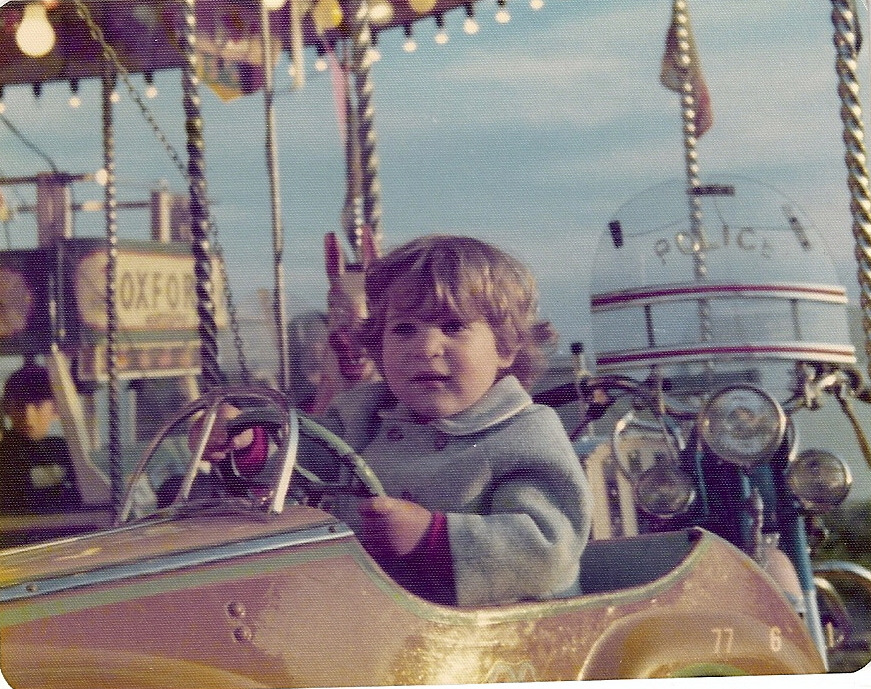
This week, I went to the fair at Brockwell Park. I don’t have a picture of that, but here’s me at another funfair in 1977. I was not a particularly pretty child, nor a thin one, nor one that actually looked all that much like a boy. And what is that coat I’m wearing? But along with a photograph of me and my dad riding the dodgems taken a year later – me marginally cuter, he like the Brummie James Dean – it is one of my favourite images from my youth.
That’s because it was taken at the Epsom Derby funfair, where we went as a family every year. It is almost impossible for an adult to now understand how exciting the funfair is to a small child – the colour and clatter of the rides, the sweet smell of popcorn, onions and candy floss, the sheer thrill of being outside after dark – but this picture brings a lot of that back to me. It’s a pure pleasure, one without any compromises or guilt. By contrast, most grown-up fun tends to come with the feeling that one is doing something one shouldn’t, and will pay for it later, either with a hangover or an empty wallet. Or perhaps that’s just the Catholic in me talking.
When I was a teenager, fairs were still about thrillseeking, just in a different way. There were the rides of course, but now it was more because this was were you went to meet girls (or watch your friends meet girls, or watch your friends talk about how they’d like to meet girls). You also went along in fear/search of some real danger – the possibility of getting chased round the park by the semi-mythical Roundshaw gang, who supposedly spent every evening roaming the borough, looking for people to beat up. Such bifftastic activity has been circumvented by the organisers of the Brockwell Park fair, who have a ‘No Gangs’ notice prominently displayed and a police van on constant vigil. I’m not sure whether this is a good or a bad thing. The parent says ‘good’, the teenager says not.
And it’s as a parent that I take my daughter to the funfair every time it comes to Brockwell Park. That’s partly for her sake, because she loves it so much, but it’s also partly for me, because I want to remember what it’s like to feel this way.
Here she is last week, on a violently orange airplane.
I read an article last week about the dishonesty of most funfairs, how it is impossible to win any prizes and the whole thing is essentially a tiny, tacky, travelling confidence trick. It’s very difficult to visit the fair as an adult and not see the sleaziness. But to a child, unaware that the coconut might be glued to the stand, this is paradise. It is wonderful to witness, but also slightly depressing, because it is impossible to share in the innocence, to see the funfair through an eye unstained by prejudice.
My daughter had more fun at Brockwell Park funfair than I think it is possible for an adult to comprehend, when everything is costed in terms of money and time. I hoped that when I went with her, I’d vicariously absorb some of her glee. And I was happy to see her happy, but I also ended up wallowing in nostalgia and misremembered romance. Is that such a bad thing?
This guy knows what I mean, or at least I used to think he did.
The new issue of Uncut magazine contains my feature about the International Poetry Incarnation, which took place 45 years ago this month on June 11, 1965. It begins like this:
Allen Ginsberg is drunk. Big, bald and bearded, like a Jewish bear stuffed in a suit, the beat poet stands tall in the Royal Albert Hall, London’s sacred haven of the high arts, and proclaims to 7,000 fellow thinkers:
“Fuck me up the asshole”.
In the crowd was Heathcote Williams, the future poet, playwright and artist. Williams recounts what happened next: “A man with a bowler hat, beside himself with anger, shouted out: ‘We want poetry. This is not poetry’, and Ginsberg retorted, looking up towards the gods: ‘I want you to fuck me up the asshole.’”
And it goes on in a similar manner for another 2,400 words. If you think that sounds like fun, head down to your local newsagent now.
The International Poetry Incarnation – which featured Allen Ginsberg, Adrian Mitchell, Gregory Corso and Michael Horovitz – is said to be the moment that signalled the arrival of the 1960s counterculture movement in London. However, in ‘White Heat’, his otherwise splendid history of the 1960s, Dominic Sandbrook writes dismissively: ‘Seven thousand people was indeed an enormous attendance… on the other hand, it was still considerably smaller than the typical crowd for a Second Division football match… to millions of people, the event meant absolutely nothing. What is more, it had not even been a very good reading.’
Oh, really? Watch this extraordinary clip of Adrian Mitchell from Peter Whitehead’s film of the reading, ‘Wholly Communion’, and tell me it has the same impact as Torquay vs Rochdale.
My review of the Museum of London reopening appeared in yesterday’s Independent On Sunday. The museum has refurbished its entire collection from the Great Fire to the present day, something that necessitated closing down the lower-ground floor of the museum for four years. I’ve been on site at a number of times during the refurbishment, so had a good idea of what was intended, but was still hugely impressed (and, in a strange way, rather relieved as so many things can go wrong with these things) by the final result.
The museum now has a great blend of the old and new, with some genuinely impressive modern interactive but also loads of good old-fashioned things in cases. Check it out when it opens to the public on Friday May 28 (it is opening till 9pm on the first day).
I suppose that a museum ideally wants the visitor feel they’ve ‘got it’ after just one visit, but not ‘got it’ so much that they won’t come back . They don’t want people to be so overwhelmed by information they can’t see what story the museum is telling, but they equally don’t want them to feel they’ve absorbed it all in one go, seen everything there is to see and so never bother returning. The Museum of London, I think, pulls off this delicate balancing act, while also being lots of fun, which is something every good museum wants and needs to be.
Museum nerds might note that they also manage to subtly highlight a couple of their less appreciated areas of expertise – the excellent costume collection, which gets two strong displays – and their outstanding collection of oral history, which is used to tell the story of the Blitz.
I am particularly interested in oral history. These first-hand recollections from largely ordinary Londoners could be vitally important to future historians, and the museum continues to expand its collection at an impressive rate. One thing I firmly believe is that everybody has a fascinating story to tell, they just don’t always realise what it is about their lives that makes them unique and therefore interesting. Most people are too self-conscious when they write, so oral history is the best way to break down this barrier and capture those stories before they disappear forever.
Finally (and no, I’m not on the payroll), the museum also has a very good (and free) new iPhone app. Check it out here.
‘Nostalgia – it’s delicate, but potent. Teddy told me that in Greek, “nostalgia” literally means “the pain from an old wound.” It’s a twinge in your heart far more powerful than memory alone.’ Don Draper, ‘Mad Men’
You can experience nostalgia in the most unlikely places. Yesterday it was when Lou Reed’s ‘Satellite of Love’ came on the radio, a song my circle of friends listened to incessantly when we were 18 but I’ve hardly heard since. Like ‘Debris’ by the Faces, it’s a song can instantly take me back in time and space, 16 years and to the kitchen of my best friend Scott, when we all had curtain haircuts, smoked like chimneys and were terrifyingly sincere about everything all the time.
A couple of months ago the potent twinge in my heart came when I went to a screening of the new Bill Hicks documentary ‘American’.
When you go and see a film about Bill Hicks you probably expect to come out laughing or enraged or saddened, but I emerged wistful, contemplative and swamped by memories.
I hadn’t thought about Hicks a great deal since 1992, but suddenly it all came flooding back. Staying in to watch Hicks on ‘Clive Anderson Talks Back’ or being interviewed at the Montreal Comedy Festival as C4 surfed the wave of having the hippest comedy content on the block. Reading about Hicks in the NME on the bus to school, enthralled by this astonishing man who called himself a comedian but was sandwiched between features on the Lemonheads, Sonic Youth and Mudhoney and never looked out of place. You couldn’t do that with Jasper Carrot.
C4 comedy and the NME were the two key cultural influences for me at the time, so it’s little surprise that Hicks and his performances should have seemed so important, and also that they should be so easily forgotten, as what we most value in late adolescence is often the first thing that gets abandoned on the roadside during the long march to maturity.
I wrote an article exploring some of this in the context of British love for Hicks in the Independent on Sunday, but can’t help wondering the extent to which I am projecting my own memories of Hicks onto a wider canvas.
Are these memories entirely personal and therefore largely irrelevent, or are there other people my age who place Hicks in the same C4/NME bracket? In a sense, I don’t really want to know, because this is my nostalgia, not yours, but at the same, like everybody else, Hicks included (and why else did he love the UK so much?), I desire vindication, some confirmation that my nostalgia isn’t just a ‘twinge’, but something that has real cultural value beyond that. So come on people, vindicate me.
‘Yoko One was one of the most boring artists I came across, but she had the ability to put people into a state of expectancy that didn’t always result in a satisfactory outcome. I went to a happening at Conway Hall. There were rows of seats all occupied with people, and she started at the front on the left and whispered something in somebody’s ear. They whispered the message in the ear of the person next to them and it went on person by person, row by row for 30 minutes, until it reached the last person at the back of the hall. Then that person went over to Yoko and whispered the message in her ear, and Yoko stood up and said “Thank you” and walked out.’