Category Archives: Celebrity

Wellcome to London: how Henry Wellcome ‘hoovered up the world’ and left it on the Euston Road

Wisconsin, 1858. A five-year-old boy is playing near his frontier home when a strange stone catches his eye. He takes it to his father, who examines the flint carefully before deciding that it was a prehistoric tool made thousands of years before to cut meat. It probably meant as much to its creator as the railway did to modern humans. ‘That excited my imagination and never was forgotten,’ wrote Henry Wellcome years later, after he had grown up, moved to London and accumulated one of the largest collections of scientific paraphernalia that has ever been gathered by a single individual.

Henry Wellcome

Wellcome established his pharmaceutical company, Wellcome-Burroughs, in 1880, making a mint selling pills to an English public that had previously taken medicine in the form of powder or syrup. This fortune sits in the Wellcome Trust, which was established 76 years ago and is now worth £14 billion, making it one of the world’s largest charitable foundations. Next door to the Wellcome Trust HQ on Euston Road, a short walk from St Pancras, sits the Wellcome Collection, a museum that houses some of the million or so objects collected by Wellcome in his lifetime. Here is Napoleon Bonaparte’s toothbrush, ancient sex aids, Chinese torture chairs lined with blades, boxes of false eyes, human skeletons and paintings by Van Gogh. It is one of the most extraordinary collections in the world, a throwback to a time when wealthy individuals would hoover up the weird and wonderful of the world for their personal collections, but executed on a scale few could compete with.

Ken Arnold is the Wellcome’s Head of Public Programmes. ‘This is the last great non-connoisseurs collection,’ he says. ‘Our usual concept of a collector is somebody who carefully decides whether something is authentic and then forks out a huge amount of money for it. Wellcome had an “other-end-of-the-telescope” approach. He saw everything through medical-tinted spectacles and wanted to own anything that would illuminate that fascination.’

Wellcome collected everything: paintings, engravings, photographs, models, sculptures, manuscripts, books, periodicals, pamphlets, letters, prescriptions, diplomas, medical instruments, archaeological finds, skeletons, skin, hospital equipment, advertisements, drugs, remedies, food, plants, microscope slides, charms, amulets, ceremonial paraphernalia, costumes, medals, coins and furniture. He bought entire shops, contents, fixtures and fittings, acquiring enough to recreate an entire street. He bought others collections, picked up human skulls from African battlefields and returned from one typical trip abroad with 44 packing cases of material. If something wasn’t available, he had an artist make a reproduction. Teams of buyers were finding him items right up until his death in 1936. His reach was broad and their brief was wide.

‘Wellcome had deep pockets and no bureaucrats telling him what he could bring home so he had none of our moral, financial or logistical concerns,’ says Arnold. ‘He hoovered up the world, and left us with this extraordinarily unwieldy and undisciplined collection.’ Although Wellcome amassed an immense collection, he was frugal with his money. ‘He was very wealthy, but he would send employees to auctions dressed down so they didn’t look too rich, and would set up fake companies so people wouldn’t know it was his money,’ says Ross MacFarlane, research officer at the Wellcome Library.

A chippy self-made American, Wellcome could never become part of the British establishment – although he was awarded both a knighthood and the French Legion d’honneur – and a desire to be taken seriously may have prompted his determination to create a museum of ‘the art and science and healing’. This opened in 1913 in South Kensington, before it moved to Wigmore Street and closing in 1932. When Wellcome died, the collection was put into storage or dispersed.

‘The British Museum has 40,000 objects, the Science Museum has more than 100,000, the Pitt-Rivers in Oxford has 30,000 items and there are bits in almost every museum in the UK,’ says Arnold. The Wellcome Trust has since taken a similarly philanthropic approach, funding wings in numerous UK museums, galleries and academic institutions.

In 2007, the Wellcome Collection opened. It is a modern, classy space, with a cafe and bookshop, as well as a gallery that hosts thought-provoking exhibitions that use art and science to explore topics such as Skin, Sleep and Brains. Their next exhibition, Death, promises to be particularly fascinating and challenging.

The Wellcome dares to be different: while most museums take an unfamiliar topic and wring all the knowledge out of it like a damp dishcloth, the Wellcome looks at something familiar and turns it inside out, using contemporary art and scientific research to make visitors question what they think they already implicitly understand. Their ability to do this can be traced back to Henry Wellcome himself.

‘We feel free to interpret the material Wellcome collected,’ says MacFarlane. ‘Because although we know when something was bought and what it cost, we don’t always know how it got to the auction.’ Arnold expands on this: ‘He didn’t talk about his philosophy. There’s enough to get an idea of why he was collecting, but there’s not so much that we feel we have to conform to his beliefs. He once said ‘Never tell anybody what you are planning to do until you have done it.’ That sounds like a good idea to me…’

So the Wellcome eschews blockbuster shows – which Arnold describes as ‘a depressingly greedy way to conduct exhibitions’ – and takes pride in imaginative live events. ‘We never try to be definitive,’ says Arnold. ‘There’s always more to discover. And we don’t want to be po-faced. Science is either deadly serious or fun with pink fluffy letters – and between these two unpalatable positions is a yawning chasm that can be filled with smart and sophisticated entertainment.’

Of course, the Wellcome is helped by having a lot of money in its coffers. ‘We are much more privileged that most other organisations. We are wealthy and we don’t have to satisfy civil servants, corporate sponsors or shareholders. But that attitude comes from the Wellcome Trust itself: science is a risk-taking business and there is a sense we are allowed to be experimental.’

MacFarlane finishes that thought, ‘When we take the directors an idea, they’ll often want to give it a go, and that’s a bit like how Wellcome collected. It’s a great position to be in.’

Wellcome Collection, 183 Euston Road, NW1 2BE. Admission free. The Wellcome’s next exhibition is Death, from November 15. 

Une saison en Camden: Rimbaud and Verlaine in Victorian London

I am an ephemeral and a not too discontented citizen of a metropolis considered modern because all known taste has been avoided in the furnishings and the exterior of the houses as well as in the plan of the city. Here you would fail to detect the least trace of any monument to superstition.

Arthur Rimbaud on London in Illuminations

Getting a face full of wet fish is usually associated with Monty Python at Teddington Lock rather than French poets in North London, but such is the warping power of Camden Town. Arthur Rimbaud and Paul Verlaine were the Gallic rhymers in question. The pair enjoyed a tempestuous relationship in a variety of London addresses, which culminated in the aforementioned fish-slapping incident in Camden.

rimbverl

They had arrived in London in September 1872 after fleeing scandal in Paris. Rimbaud was 17, Verlaine ten years older, married with a child. Verlaine’s brother-in-law described Rimbaud as ‘a vile, vicious, disgusting little schoolboy’, but Verlaine found him an ‘exquisite creature’ probably for much the same reasons. At first they settled in Howland Street in Fitzrovia. They became part of Soho’s expat anarchist dissident set, reportedly attending meetings helmed by Karl Marx in Old Compton Street, drinking heavily, taking hash and opium (Rimbaud advocated ‘derangement of all the senses’) and keeping warm at the British Museum, where Rimbaud’s name  – but not Verlaine’s – was later added to the Reading Room roll of honour. Neither were particularly politically motivated, but the anti-establishment environment would undoubtedly have appealed to the outlaw couple.

Drawing by Verlaine of Rimbaud in Canon Street

They both loved London. Rimbaud felt that by comparison Paris looked like nothing more than a ‘pretty provincial town’ and loved the ‘interminable docks’, while Verlaine was captivated by the ‘incessant railways on splendid cast iron bridges’ and the ‘brutal, loud-mouthed people in the streets’. Together they travelled on the river, visited Hampstead Heath and rode the newly opened underground railway. They visited Hyde Park Corner, Madame Tussaud’s, the National Gallery and the Tower Subway (‘It stinks, it’s hot and it quivers like a suspension bridge, while all the while you hear the sound of the enormous volume of water,’ they reported back).

They wrote as well. Parts of Rimbaud’s Illuminations and Une Saison en Enfer were written in London, and his relationship with Verlaine is recorded in the latter’s lines: ‘On several nights, his demon seized me, we rolled around together, I wrestled with him!—At nights, often, drunk, he lies in wait in the streets or in the houses, to frighten me half to death… In the hovels where we used to get drunk, he would weep at the sight of those around us, miserable beasts…’ Verlaine was also influenced by the hectic modernity of the docks, and wrote a poem about Regent’s Canal.

Their sojourn in Fitzrovia was briefly commemorated with a plaque written in French and erected in 1922, although it only mentioned Verlaine – Rimbaud’s name was omitted on grounds of morality. Unfortunately, the street numbers had changed by this time, so the plaque on No 34 was almost certainly commemorating the wrong house. These defects were solved in 1938 by simple means – the house was demolished. It’s said the plaque was saved from destruction, but if so it has long since been lost.

There is a plaque for their next house however, left by ‘unknown hand’ according to Simon Callow. This is on their residence at 8 Great (now Royal) College Street, which they moved to in May 1873, living in two rooms on the top floor for three months. Here the pair’s self-destructive instincts really blossomed. They argued relentlessly, and often fought physically. This reached its nadir one July morning when Verlaine returned from Camden market carrying fresh fish and olive oil. It was a hot day and Verlaine had a hangover, but Rimbaud, watching from an upstairs window, was unsympathetic. He laughed and bellowed, ‘Ce que tu as l’air con!’ (‘What a cunt you look!’). Verlaine responded with a kipper in the face (hurt, he later wrote to a friend rather pathetically,  ‘I retaliated, because, I can assure you, I definitely did not look ridiculous’), packed his bags and fled to Brussels. Rimbaud eventually followed, only to receive two bullets in his wrist for his troubles.

Verlaine was sentenced to two years in prison, which he spent in part reading Une Saison en Enfer, and that was pretty much the end of that relationship. Rimbaud returned to London in 1874, living at Stamford Street, SE1 with the poet Germain Nouveau and later taking a room at No 12 Argyll Square in 1875. He then disappeared for four months – biographers still speculate about whether he was in Scotland, Scarborough or Reading. He barely wrote another word and died, one-legged, in 1891. Verlaine also returned to England, teaching in Boston and Bournemouth, before returning to Paris where he succumbed to alcoholism and died in 1896. Camden can do that.

Photo by Dornac of Paul Verlaine in the Café François 1er in Paris on May 28, 1892

Londoner Challenge: the beautiful South

We won.

Many thanks to my illustrious team mates, our competitors, the Museum of London and Matt from Londonist for putting on such a fun night.

A sample of the questions are posted below. 

  • What pub name can be found on Newman Street, Berwick Street, Kingly Street, Rupert Street and Bennett Street?
  • What’s the only street name within the City of London that ends in the word ‘Road’?
  • Which current production completes this sequence: The Woman in White, Monty Python’s Spamalot, Priscilla Queen of the Desert and…
  • According to A Day in the Life, by the Beatles, how many holes would it take to fill the Albert Hall, assuming it’s the same as the number of holes in Blackburn, Lancashire?
  • In which London museum might you find a jar full of moles, half a pregnant cat and the penis bone of a walrus, all on prominent display?
  • What gets divided up between the monarch, the Vintners’ company and the Dyers’ company on the Thames each year?
  • Who was the last English monarch to enter the House of Commons?
  • At the 1948 London Olympics, the British amateur football team was managed by the great Matt Busby. What unlikely item did he hand out to his players at half time, in accordance with the sponsors’ wishes?
  • Who are the “Official Supplier of Cereal Bars To The Olympic and Paralympic Games”?
  • What can be found in Earl’s Court and King’s Cross St Pancras Tube stations, but is missing from Barons Court Tube?

Norman Mailer and Christine Keeler’s bra

Jay Landesman was an American writer and eccentric entrepreneur who arrived in London in the mid-1960s and immediately flung himself headfirst into the emerging counterculture scene, largely because the first person he met when he arrived here was Peter Cook. Landesman later became best known as the male half of a famously open marriage, much to the shame of his son Cosmo, who gained revenge by marrying Julie Burchill. (‘She hated hippies, ex-hippies, food freaks, open marriages and old people,’ wrote Jay, ‘The only thing she liked about us, was that we were Jewish.’)

In his entertaining 1992 memoir Jaywalking, Landesman’s non-ideological dalliances on the fringes of the London scene make great reading, with walk-on roles for the likes of John Lennon (‘He was uptight about Wendy Cook’s insistence he sample her salade Nicoise, a dish he was highly suspicious of and couldn’t pronounce’), Tom Driberg (‘He took us to a pub whose entire clientele consisted of lesbians, transvestites, young Danish sailors, ageing pederasts and an assortment of amputees’) and Germaine Greer (‘I watched her challenge Jimi Hendrix to an arm-wrestling match, and win’). Although it’s never entirely clear what he did – bar run the disastrous UFO rip-off the Electric Garden for a couple of minutes – Landesman was clearly good company with a penchant for meeting interesting people, and at some point was asked by The Sunday Times to write about the art of giving a party. His ideal guest list is worth repeating in full:

Minimum of three potential celebrities; at least one real celebrity (any field); a foolish couple; a serious couple (straight feed for comics); an engineer or non-speaking Czech (to point out); six swinging teenagers (girls); a bitchy girl who can generate masochism in men; a gym instructress who drinks too much; an older woman who sits and smiles (who is she?); a rune beauty (who was she?); Christine Keeler; no fat people unless Peter Ustinov; nobody jet or Court Circular; no dogs; no Peter Hall, Jonathan Miller, David Frost (or equivalents); no crew cuts; a swinging accountant; a buff (a jazz-hair or gambling buff); two attractive lesbians (to get wrong); one international drug trafficker (to point out); a beautiful flawed couple; a gay MP; Tariq Ali (not Christopher Logue); an Irish showbusiness GP; a titled person (to show you’re not snobbish); no artists’ agents, editors or publishers; no children or headshrinkers (except RD Laing); an eccentric lawyer or priest (no respecters of confessionals); an articulate tradesman (electrician, cabinet maker, house painter, bank manager); a forgotten culture hero; a reliable loudmouth who’ll come early and leave early; the ex-wife of a world celebrity; a pop singer no one recognises; a girl with buck teeth, a corrective shoe, or both; an established figure who decides that night to drop out…

Landesman was fond of Christine Keeler. He met her soon after arriving in London at the Kismet, a Soho drinking club, and the pair became friends. He also knew Norman Mailer from the mid-1950s, Mailer having interviewed Landesman while researching his pioneering essay on hipsterdom, The White Negro. In London, Landesman had an opportunity to bring the two together.

The cause was Mailer’s decision to challenge for the Democrat candidacy as Mayor of New York under the slogan ‘Vote The Rascals In’. The sizeable US expat community in London – there were frequent baseball games in Hyde Park featuring the likes of Tony Curtis, Marlon Brando, John Cassavetes and Charles Bronson with Phil Silvers as umpire – decided to hold a fundraising event.

The Friends of Norman Mailer Committee was founded by charismatic rogue Harvey Matusow, and he put on a celebrity auction, featuring myriad bizarre offerings from Yoko Ono like ‘Dirt From Central Park’, ‘Air over Greenwich Village’, ‘Vial of Genuine New York Tears’ and ‘Jar of Captured Cloud Formations over the Bronx’ as well as bottles of Robert Lowell’s sweat and a slice of raw liver from Philip Roth’s fridge. The star exhibit, however, was supplied by Landesman: Christine Keeler’s bra.

Bidding began at £100. There were no takers. The auctioneer tried again, at £50. Nobody moved. Next he tried £10 for this ‘psychosexually historical’ item, but the opening bid was a measly 10 shillings. Landesman tried to get the bidding going and raised his own hand, but nobody followed suit and he ended up winning the item back for a mere 10s 6d. Later, he discovered it wasn’t even Keeler’s. ‘Christine doesn’t wear a bra,’ a mutual friend confessed, ‘But the deception was justified in a good cause.’ The mayoral election was just as successful – Mailer came fourth, in a field of five.

Five videos of Paul McCartney’s London

Inspired by this marvellous piece of Paul McCartney-related London trivia from Mark Mason, I thought we should look at five classic Macca In London videos on You Tube.

1 Press, 1986
Here’s Macca on the tube in this little known video from 1986. Check out the modestly greying locks, and drink in the 80s atmosphere and the now lost station architecture.

2 Busking, 1984
A dream sequence from Give My Regards To Broad Street features Macca busking outside Leicester Square tube.

3 Give My Regards To Broad Street computer game, 1984
This appalling Commodore 64 game based on the film sees Macca taking a cab around London to a brilliant, blippy 8-bit soundtrack of Band On The Run.

4 London Town, 1978
Paul and Linda take a boat trip down the Thames to promote London Town. Features many bridges and some fish and chips.

5 Oxford Street, 1983
And here’s Macca nipping round the West End in the back of a cab with Lesley Ash.

http://www.youtube.com/watch?v=z6dHRTQH-js


Secret London: inside Savile Row

I had never gone anywhere near Savile Row until a couple of years ago, when I was asked to write about the Mayfair street’s long history of tailoring for an upmarket style magazine. Given that my greatest fashion claim-to-fame is that Manolo Blahnik’s niece once laughed at my trainers, this was a bit out of my comfort zone and I didn’t feel much better when I walked into Henry Poole and the immaculately dressed owner, Simon Cundey, informed me that ‘any good man should own five to seven suits’. I nodded and smiled nervously – I own one suit and it rarely leaves the closet.

Cundey then gave me a tour of the shop, and I was immediately struck by the contrast between the elegant ground floor where customers are measured up for their new clobber and the basement where most of the work gets done. This long subterranean room was filled with tailors of all ages and nationalities, some making waistcoats, others making pockets or trousers. They were sitting at battered wooden benches, cutting cloth delicately with solid scissors the size of scythes. The sound of sewing machines and portable radios were the only sign that we weren’t in the 19th century. It was a thrill to see an old industry being kept alive in such charismatic fashion, and the fact that most of the tailors were as badly dressed as me, didn’t hurt either. I made a mental note that I’d return, which I did earlier this year for a series of interview with the pocket-makers and trouser-tailors of Savile Row, during the course of which I asked my worst ever question as a journalist: ‘What is your favourite kind of pocket?’.

You can read it all here.

Bowie, Burroughs and the stage production of Ziggy Stardust

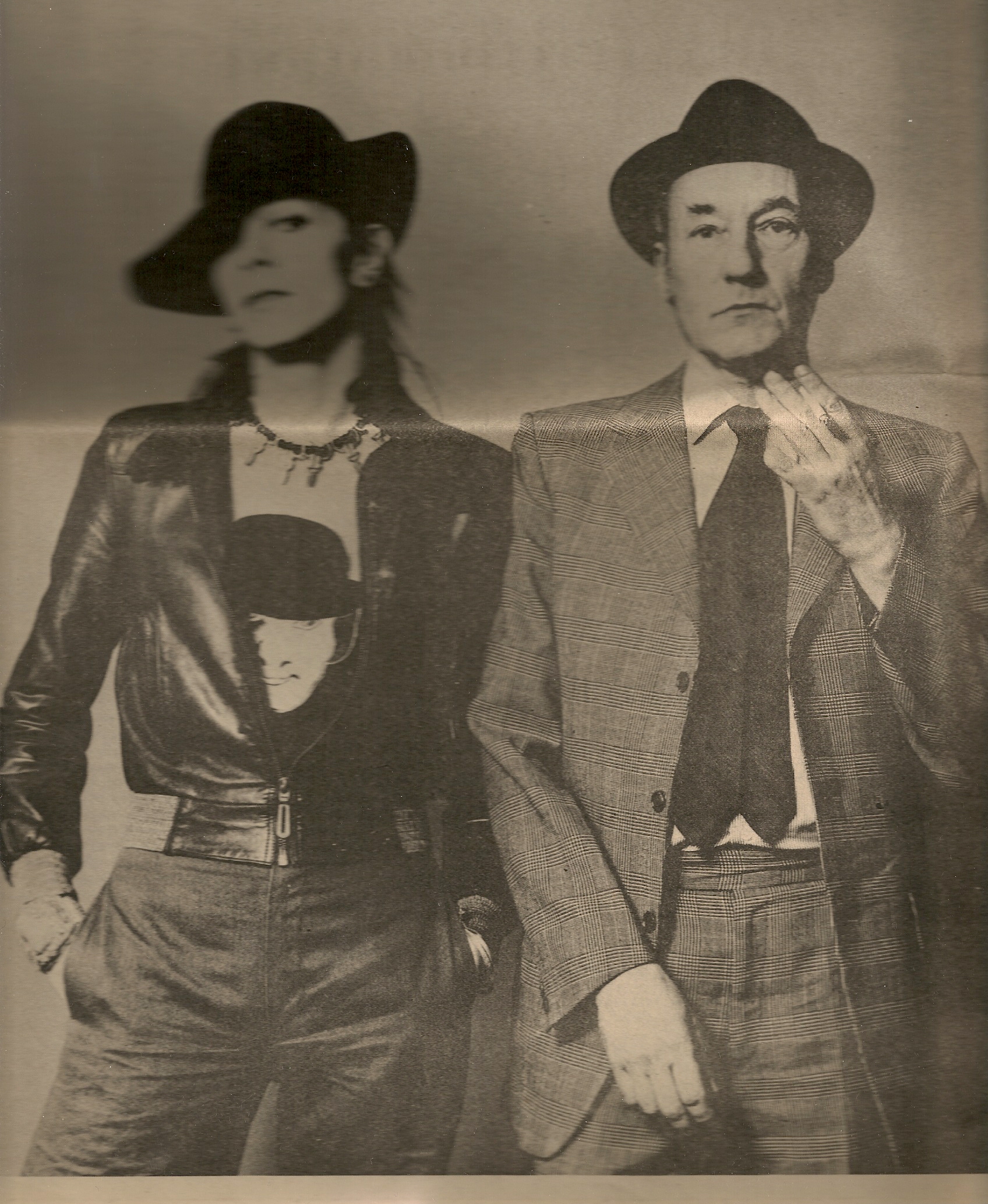
In December 1973, Rolling Stone journalist Craig Copetas brought together David Bowie and William S Burroughs in London for an interview. The piece was published in February 1974, around the time Burroughs returned to America, having finally had enough of the English climate and licensing laws. A wonderful photograph by Terry O’Neill captures the two icons together.

The interview itself isn’t quite as captivating. Bowie had only read one of Burroughs’ books (Nova Express), while Burroughs had only listened to two of Bowie’s songs (“Five Years” and “Starman”). This is my favourite exchange:

Burroughs: What is your inspiration for writing, is it literary?

Bowie: I don’t think so.

Burroughs: Well, I read this “Eight Line Poem” of yours and it is very reminiscent of TS Eliot.

Bowie: Never read him.

During the two-hour conversation in Bowie’s home, Bowie did most of the talking. At one point he discusses in length his plans for a theatrical or television production of Ziggy Stardust, which had been released two years before (and in June 2012 celebrates its 40th anniversary).

It’s worth repeating this section in full, as it is one of the fullest explanations of the story behind the Ziggy concept.

Bowie: Nova Express really reminded me of Ziggy Stardust, which I am going to be putting into a theatrical performance. Forty scenes are in it and it would be nice if the characters and actors learned the scenes and we all shuffled them around in a hat the afternoon of the performance and just performed it as the scenes come out. I got this all from you Bill… so it would change every night.

Burroughs: That’s a very good idea, visual cut-up in a different sequence…. Could you explain this Ziggy Stardust image of yours? From what I can see it has to do with the world being on the eve of destruction within five years.

Bowie: The time is five years to go before the end of the earth. It has been announced that the world will end because of lack of natural resources. Ziggy is in a position where all the kids have access to things that they thought they wanted. The older people have lost all touch with reality and the kids are left on their own to plunder anything. Ziggy was in a rock-and-roll band and the kids no longer want rock-and-roll. There’s no electricity to play it. Ziggy’s adviser tells him to collect news and sing it, ’cause there is no news. So Ziggy does this and there is terrible news. “All The Young Dudes” is a song about this news. It is no hymn to the youth as people thought. It is completely the opposite.

Burroughs: Where did this Ziggy idea come from, and this five-year idea? Of course, exhaustion of natural resources will not develop the end of the world. It will result in the collapse of civilization. And it will cut down the population by about three-quarters.

Bowie: Exactly. This does not cause the end of the world for Ziggy. The end comes when the infinites arrive. They really are a black hole, but I’ve made them people because it would be very hard to explain a black hole on stage.

Burroughs: Yes, a black hole on stage would be an incredible expense. And it would be a continuing performance, first eating up Shaftesbury Avenue.

Bowie: Ziggy is advised in a dream by the infinites to write the coming of a starman, so he writes “Starman”, which is the first news of hope that the people have heard. So they latch on to it immediately. The starmen that he is talking about are called the infinites, and they are black-hole jumpers. Ziggy has been talking about this amazing spaceman who will be coming down to save the earth. They arrive somewhere in Greenwich Village. They don’t have a care in the world and are of no possible use to us. They just happened to stumble into our universe by black-hole jumping. Their whole life is travelling from universe to universe. In the stage show, one of them resembles Brando, another one is a Black New Yorker. I even have one called Queenie the Infinite Fox.

Now Ziggy starts to believe in all this himself and thinks himself a prophet of the future starman. He takes himself up to incredible spiritual heights and is kept alive by his disciples. When the infinites arrive, they take bits of Ziggy to make themselves real because in their original state they are anti-matter and cannot exist in our world. And they tear him to pieces on stage during the song “Rock ‘n’ Roll Suicide”. As soon as Ziggy dies on stage the infinites take his elements and make themselves visible. It is a science fiction fantasy of today and this is what literally blew my head off when I read Nova Express, which was written in 1961. Maybe we are the Rodgers and Hammerstein of the seventies, Bill!

Burroughs: Yes, I can believe that. The parallels are definitely there, and it sounds good.

The Rodgers and Hammerstein of the 1970s never collaborated, unfortunately. You can read a full transcript of the Bowie-Burroughs interview – including discussions of German porn, Lou Reed, Andy Warhol, science fiction and Mick Jagger (‘Jagger is most certainly a mother figure. He’s not a cockadoodledoo; he’s much more like a brothel-keeper or a madame,’ says Bowie) – here.

Forgotten Londoners: Frank Harris, editor, prisoner and pornographer

Frank Harris was an objectionable little man. He was sallow as a gypsy. He had bat ears, dark hair with a crinkle in it that grew low on the forehead, and a truculent mustache. People remarked on the richness of his bass voice. His charm was great, particularly for the opposite sex. He had the gift of gab to a sublime degree and a streak of deep scoundrelism that was the ruin of him.

John Dos Passos, 1963

Frank Harris wrote My Life And Loves in 1922 when he was 68. It was partly about his career as an editor of the Evening News and Saturday Review in London, where he had championed critics like Oscar Wilde and George Bernard Shaw, but it was mainly about sex.

Harris was a rumbustious character with a voice so deep that one of his many mistresses claimed ‘it made her sex open and shut’ when she heard it. His memoir was scandalously candid, and featured several photographs of naked women, to emphasise the point.

It was these – ‘too much for the English’, Harris later observed – as much as Harris’s candid discussion of sex (he was particularly keen on cunnilingus) that saw the New York Supreme Court rule the book ‘unquestionably obscure, lewd,
lascivious and indecent’ and it was banned in several countries and pretty much did for Harris as a serious writer and journalist thereafter.

It had been a turbulent career. Harris was born in Ireland, educated in Wales and after a series of adventures in America, settled in London in 1882, where he talked his way into newspapers. His greatest triumphs were at the Saturday Review, the London paper he edited in the 1890s, publishing criticism by HG Wells, Shaw and Wilde and gaining a reputation for being unreliably unspoken and outrageously opinionated for a man of his position. He later wrote a biography of Wilde, who surely would have agreed with Harris’s insistence that ‘Modesty is a figleaf for mediocrity’.

As George Bernard Shaw said, ‘He blazed through London like a comet, leaving a trail of deeply annoyed persons behind him.’ Harris was briefly adopted as a Conservative candidate for South Hackney, resigning after he defended Charles Parnell during an adultery scandal. He also defended Wilde during his trial, and suggested he flee the country while out on bail, and took the side of the Boers during the Boer War. 

Years later, Harris looked back on his time as editor with satisfaction. He believed in positive criticism, not handing out brickbats and instructed his critics to celebrate, rather than denigrate. “When I was editor of the Saturday Review,’ he said ‘with the greatest assembly of literary men in history, I had a policy and I believed in sticking to it. There was Shaw and Wells and Rowe and oh, everybody else. I called a dinner and I said: “Gentlemen, it has come to my attention that people have started to call it the Saturday Reviler. Well, this sort of thing doesn’t get us any place. Hereafter the Saturday Review is going to try to find stars, and if it can’t find stars, it won’t merely hurl bricks. What good does it do? Insults, raps, knocks! Mainly lies. Nobody’ll remember them in fifty years. If we can’t do something constructive,” I said, “we won’t do anything.” Well, it worked.’

By 1913, Harris was editing a magazine called Modern Society and was charged with prejudicing a trial after publishing an ongoing divorce case.  ‘It seems to me you have a certain disdain for this court,’ noted the judge during his trial. ‘Oh, if I could only express all the disdain I have,’ replied Harris.

That did it. Harris refused to apologise publicly and was sent to Brixton Prison for contempt. The cartoonist Max Beerbohm visited Harris in Brixton and drew a cartoon, ‘To the best talker in London – from one of his best listeners’. Prints were made and posted all over London in a bid to raise public awareness with the message: ‘This is the man that was sent to prison.’

Harris was released after three months, complaining afterwards that ‘what I suffered most from in prison was lack of books’. Shortly after his release he left London and never lived there again. He died in Nice in 1931.

Max Beerbohm's cartoon of Frank Harris

For more on Harris, visit this excellent Odd Books website.

London’s football gangs: 1972

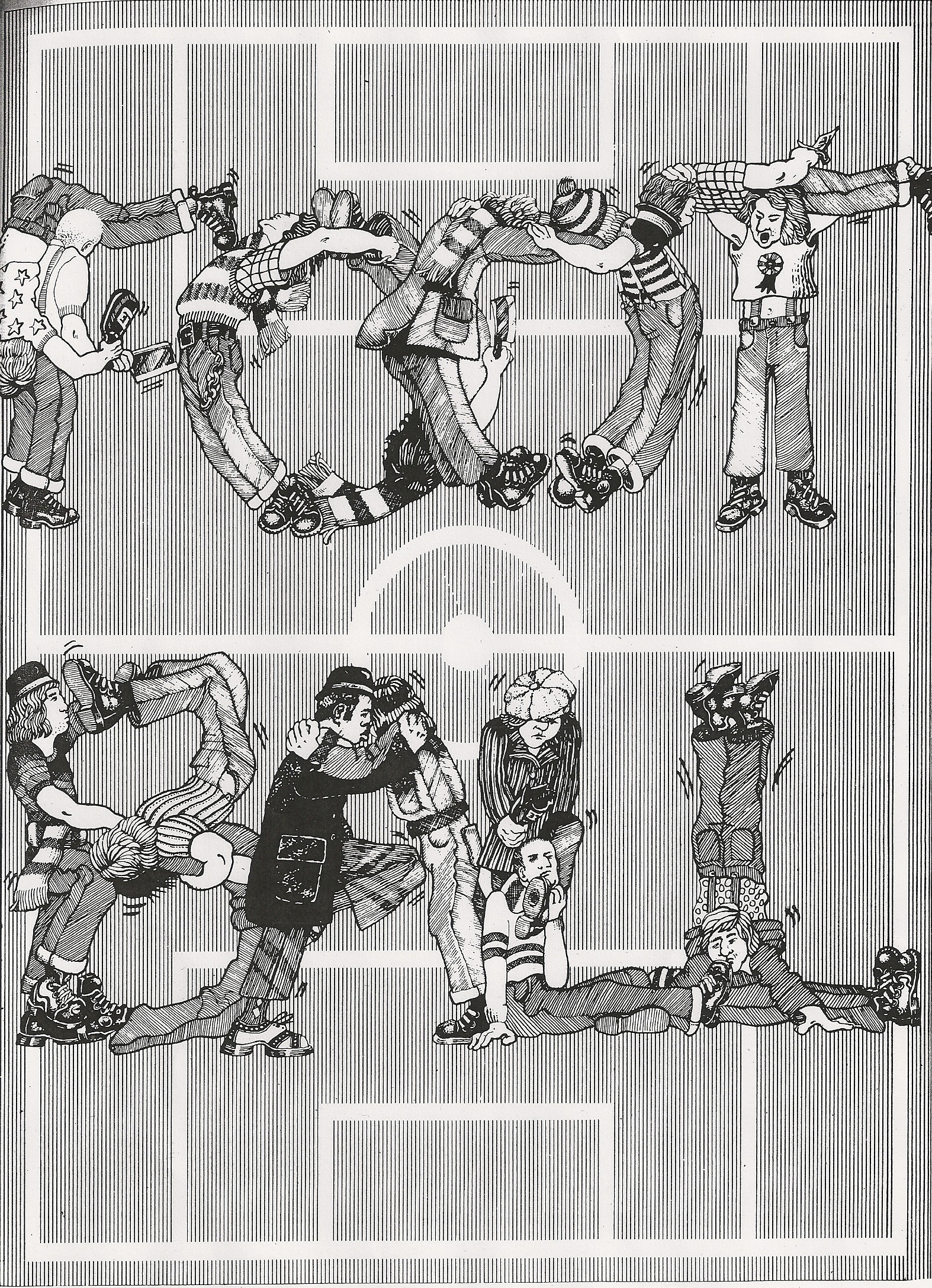
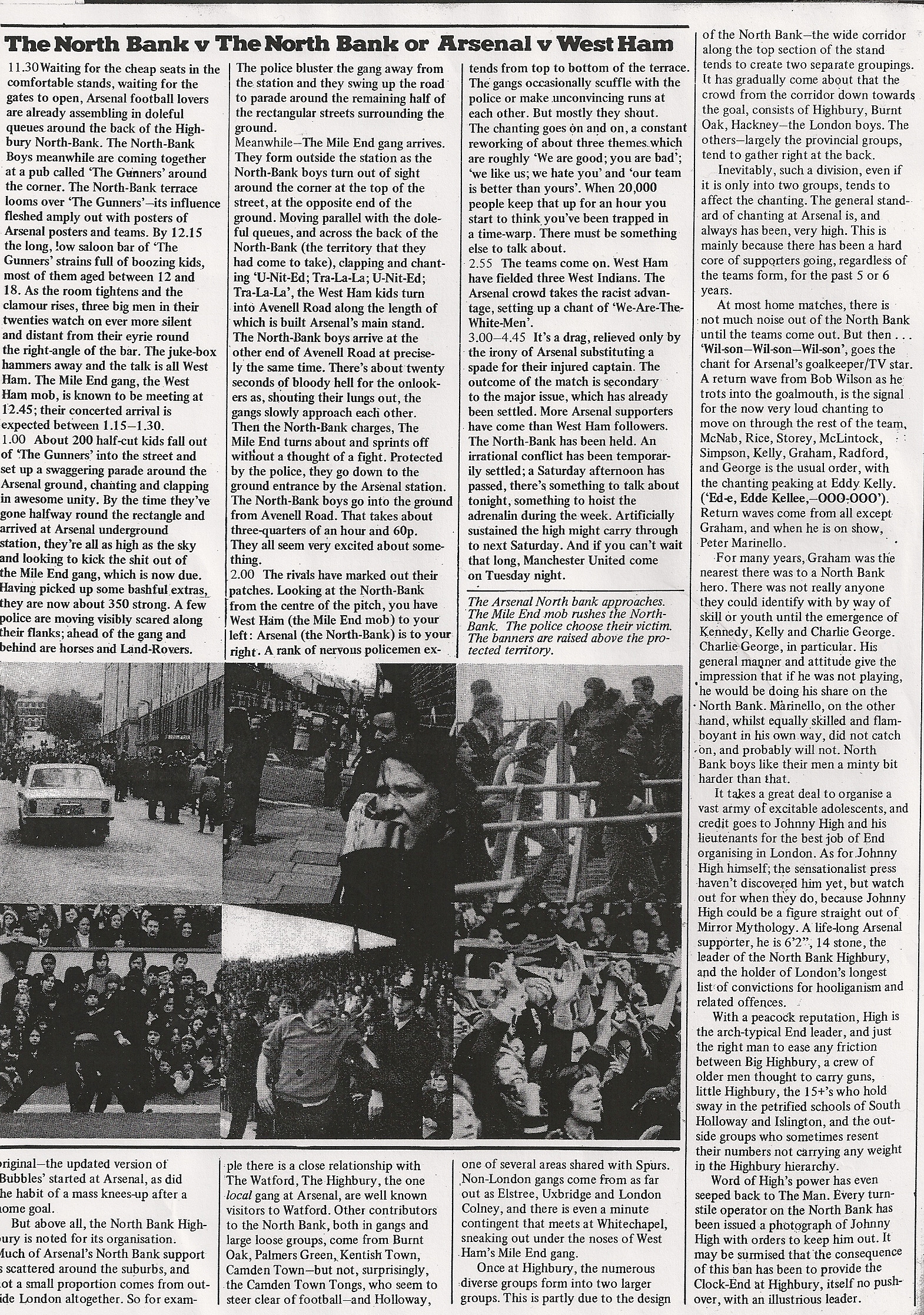
 I’ve mentioned Chris Lightbown’s article on London football gangs a couple of times before, but the piece itself hasn’t been available since it was first published in Time Out in 1972. The section on West Ham was reprinted in the excellent 2008 anthology London Calling, but the full article has been confined to libraries and private collections. Until now.

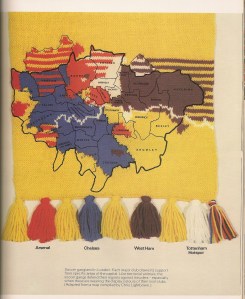
It is a fascinating read. This is the first time football fan culture had ever been seriously discussed by the press, and it offers a remarkable view of life on the terraces from the terraces, free of any moralism or finger-wagging. It is a thorough and very funny piece of writing, and is probably the first time terrace legends such as Mick Greenaway and Johnny Hoy (although he is called ‘High’ here) ever saw their names in print. It’s analysis of where the different clubs draw on their support is particularly great. 

The writing is very much of its time and place – complete with mention of ‘heads’ and ‘coons’ – and also paints the picture of a time when London terrace culture was very different: the Shed was as loud as the Kop, Arsenal had the most aggressive fans in London and Spurs were just a joke, on and off the pitch. Only West Ham’s identity appears to have remained more or less the same, although older Hammers would doubtless question that.

It is a cracking piece of work. Enjoy.

My favourite thing in London

The other day, I saw this board outside the Big Red Bus tourist shop near the British Museum and decided straight away that it might be my favourite thing in London. It was so striking, with such a warped sense of perspective and bizarre mishmash of London stereotypes.

I wanted it.

I decided that I would go inside and ask how much it would cost to buy it, but first I stopped and looked at it awhile. Questions entered my head.

What is a Grenadier Guard doing outside Downing Street? If he’s not on duty, why is he wearing his uniform and if he is on duty, which he shouldn’t be, why is he holding the hand of a small foreign bear? What is Paddington Bear doing so far from his comfort zone of Paddington without Mr Brown or any of the Brown family? Why is Paddington Bear standing behind the Grenadier Guard in that curious position? Are Paddington Bear and a Grenadier Guard even particularly relevant symbols of London life in 2012? And is it just me, or does the whole ensemble look rather like a surreal take on something you might see on Crimewatch featuring a stranger caught on CCTV camera leading a small child away from a shopping centre?

I still wanted it though, maybe now more than ever.

While I was plucking up the courage to go inside an ask, two Italian tourists came strolling down the road. They saw the board, giggled, then handed me their camera and asked if I could take their picture. After arguing over who would be the bear and who would be the guard, they poked their heads through the holes. I took a photograph, they thanked my fulsomely and moved on, laughing and chatting, relishing this rare free moment of childish fun in the sterling-sapping city.

I realised then that the need of London’s tourists was greater than mine. I could always come back, but they would only ever have their photographs. I went home, contented.