Category Archives: Books

The London Anti-University

This newsclip of the London Anti-University from 1968 is wonderfully evocative, not just for the interviewees’ earnest insistence that they could change the world of education, but also through the grim tattiness of late 1960s Shoreditch, reproduced in glorious colour.

The London Anti-University was formed after participants at 1967’s Congress on the Dialectics Of Liberation at the Roundhouse decided they wanted to continue to explore some of the themes and conversations that had started there (sample debates: The Future of Capitalism; Black Power; Imperialism and Revolution in America).

Based at 49 Rivington Street – previously home of the Vietnam Solidarity Campaign – the Anti-University was opened in February 1968 by David Cooper and Alan Krebs, and featured lecturers such as Cornelius Cardew, CLR James, Robin Blackburn, Bob Cobbing, RD Laing, Yoko Ono, Jeff Nuttall, John Latham and Alex Trocchi – all key figures on the intellectual left-wing of the 1960s counterculture.  The Anti-University syllabus covered three main areas: radical politics, existential psychiatry and the artistic avant-garde. 

 Poster announcing the opening of the Antiuniversity of London (1968)

An idea of the direction of the Anti-University can be gleaned by a reported exchange at Joseph Berke’s course on ‘anti-universities, anti-hospitals, anti-theatres and anti-families’.

He asked the class: ‘How can we discuss how we can discuss what we want to discuss?’ After a long silence, somebody answered ‘Maybe we don’t need to discuss it.’ Berke pondered this for a while and then left; the class continued for an hour despite his absence.

The Anti-University lasted almost a year, which isn’t bad by the standards of the time, but it’s premises soon became squatted, and the landlords, the Bertrand Russell Peace Foundation, reclaimed the campus.

But the Anti-University’s most important legacy may have come from a conversation in the classroom of psychoanalyst Juliet Mitchell, who lectured on literature and psychology.

One of Mitchell’s students, Diana Gravill, had inherited some money and was intending here to spend it on a women’s refuge. Mitchell instead persuaded her to put it towards a bookshop. This she did, and the shop, named Compendium, was opened by Gravill and her partner Nicholas Rochford on Camden High Street in August 1968.

Over the next thirty years it became one of the world’s great bookshops, stocking everything from academic studies of the women’s movement to punk fanzines. It was still going strong when I used to go there in the late 1990s, fascinated and intimidated by the content of the bookshelves. It eventually closed in 2000, a sad end to one of London’s greatest counterculture institutions, but a longstanding tribute to the ideas and passions raised by the London Anti-University.

Mapping Sixties London

This exquisite map of the 1960s West End is one of the most interesting ways I’ve seen of making tangible that fascinating era that remains tantalisingly out of reach and hard to comprehend. Produced by Herb Lester Associates, Wish You Were There is a fascinating physical attempt to bridge the gap in time, to fill in some of the blanks.

It is also a beautiful artefact, a fold-up map that offers a ‘retrospective guide to London’s shops, clubs, boutiques and sundry diversions, 1960-66’. Included are such diverse pleasures as Better Books, home of the Beats, the offices of promoter Don Arden and restaurants like Cranks and The Nosh Bar alongside better known clothes shops, bars and venues.

On one side is a map of central London, and on the other a written guide to the 130 locations, padded out with period advertisements.

Wish You Were There can be purchased here for a bargain £4.

Schools Out! The moral contamination of schoolkid strikers

Yesterday’s protests by schoolchildren were by no means the first time London’s schoolkids have chosen to withdraw their labour from the classroom, as Clive Bloom discusses in his recently updated ‘Violent London’.

There were waves of strikes in 1889 and 1911 around issues such as corporal punishment, the length school day, leaving age, holidays and bullying teachers. In 1889 there were strikes in Finsbury Park, Homerton, Woolwich, Plumstead, Kennington, Charlton and Lambeth and in 1911 in Enfield, Islington, Hoxton, Fulham, East Ham and Deptford. Strikes continued until long into the 20th century. I’m pretty sure Grange Hill went on strike a couple of times as well.

These original strikes featured pickets, marches and demos with flags and banners, and often ended with some casual window-breaking, for which the pupils would invariably receive disproportionate punishment such as being birched in front of the whole school or sent to the workhouse.

That was because the authorities were terrified about these strikes, firstly because of the lack of discipline it demonstrated but also because they suggested the children were developing a political consciousness that challenged and threatened the establishment. Kids were learning to think for themselves and were bold enough to shout about it. Some in Bethnal Green even carried red flags. 

Newspapers argued that strikes were ‘manifestations of a serious deterioration in the moral fibre of the rising generation’, argued that ringleaders ‘could prove dangerous centres of moral contamination’ and claimed that ‘such movements as this do not spring up spontaneously. They are always evidence of a deep conspiracy against social order… the doom of the Empire must be near at end if the country is honeycombed with Secret Societies of schoolchildren.’ 

Things never change all that much, do they?

Gertcha to the British Library, for Viz, Austen and Evolving English

I’ve seen three new exhibitions since being bored senseless by the British Museum’s Book of the Dead, and all of them are vastly superior to that banal blockbuster.

While the British Museum takes a complacent Tesco-like approach of pile it high and intimidate people with sheer weight of history, the Imperial War Museum, Wellcome Collection and British Library all have to work a little harder to get any attention and the results are far more satisfying.

Take Evolving English at the British Library, a superb exhibition about the history of the English language that offers both intelligence, insight and, most tellingly, the cheerful sense of humour that is lacking from Great Russell Street.

There are showstopping exhibits here, such as manuscripts of Jane Austen’s ‘Persuasion’ and Joyce’s ‘Finnegans Wake’ and a copy of ‘Beowulf’, while the curators were ecstatic about a cabinet that featured side-by-side four historic bibles – the Wycliffe, Tyndale, Book of Common Prayer and King James.

But there are also wilder treats hidden in the margins.

One section on the differences between spoken and written English was illustrated by letters from schoolchildren to their teacher, my beloved BS Johnson, written in a glorious mixture of slang, formality and stream of consciousness that later found their way verbatim into his novel ‘Albert Angelo’. (‘Mr Johnson has a poor outlook towards us, calling us peasants and other insulting names of which we would like to contradict… Mr Johnson on the whole although he isn’t all there is a rotton teacher but not proffesionally for he teaches well… in school Mr Johnson is an authentic nit.’)


The section on profanity is illustrated with a copy of ‘Lady Chatterley’s Lover’ and a copy of Viz, while you can explore London English by reading extracts from Charles Dickens or you can just listen to ‘Gertcha!’.

London English, we are reminded, adopts words from many different cultures and I was intrigued to learn about the history of the Black London idiom ‘aksed’ for ‘asked’. This apparently originated in south-west England and found its way to the Southern US states and the Caribbean through emigration, before returning to London via the West Indian diaspora. Take it away, Smiley Culture.

My London Library: No 5 – Night Haunts

  • Title Night Haunts by Sukhdev Sandhu (Verso, 2006)
  • Cost Free
  • Bought from Sent by publisher
  • Genre Contemporary non-fiction; flaneur

At a time when London writing has been dominated by pop historians and psychogeographers, it’s worth noting that the best two London books of recent years are very different beasts.  One of these is Night Haunts, a thoughtful study of the modern London night, commissioned by Artangel, written by Sukhdev Sandhu, and modelled on a similar book by the great London writer, HV Morton. (Sandhu gives a talk about Night Haunts this Friday at Birkbeck.)

Night Haunts first emerged as a beautiful website before appearing in short but sweet printed form. The conceit was simple. As the sub-title explained, it was ‘a journey through the London night’ in which Sandhu explored and observed London’s nocturnal operations, spending evenings with cleaners, pilots, flushers, bargers, fox-hunters, cabbies, exorcists and graffiti artists.

What emerged was an elegant and perceptive portrait of what happens in London while we are asleep, with Sandhu’s own hands-on experience giving it a resonance far greater than the whimsical dilettantism encouraged by the self-indulgent psychogeography movement. 

  • Best bit There’s a marvellous scene early on which sets the tone. Sandhu is on a night-time police helicopter flight over London and writes evocatively of the sleeping city from the air, a passage which concludes with the wonderfully implausible line ‘One pilot describes Croydon as “an oasis of high-rise buildings, sitting there like downtown Dallas”.’
  • Verdict The best book of its kind for decades.

A common little London house

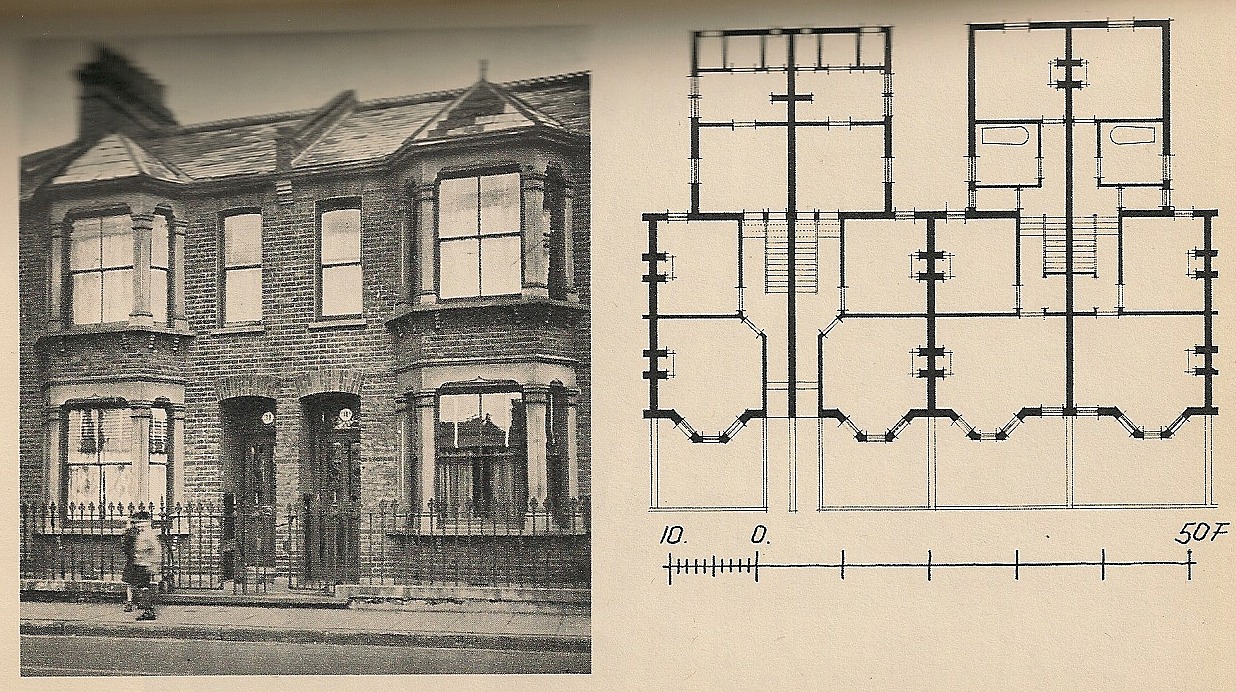
There is nothing special about this house, other than that I live in it. It is one of hundreds of thousands of almost identical houses built in the second half of the nineteenth century for a London population that was expanding at a ferocious rate.

This was the Great Wen that William Cobbett warned about. In ‘London: The Biography’, Ackroyd quotes ‘an observer perched on top of Primrose Hill in 1862, who looked at the growing city and noted that, “the metropolis has thrown out its arms and embraced us, not yet with a stifling clutch, but with ominous closeness.”‘

In ‘London: The Unique City’, Steen Eiler Rasmussen’s classic book about London architecture, he writes about houses just like this: ‘From railroads intersecting the suburbs of London we see interminable rows of these swarthy little houses with all their protruding little kitchen-wings. It is the most compact type imaginable for a street house.’ He includes a picture and plan of these houses. Look, it’s almost indentical to mine.

There is a reason for this ‘interminable’ consistency in London housing, and like most things in this country, it is to do with class. Rasmussen explains that in London, because the class system ensured people of the same social strata would invariably live alongside each other, segregated from those richer or poorer than themselves , it was ‘possible to standardise domestic houses: as people living in the same street have the same requirements all the houses can be absolutely uniform.’

This isn’t quite true of my street – at one end there are grand five storey double-fronted detached houses, which would have been for the very rich with domestic servents, and at the other end there are two-storey railway terraces, with every possible permutation in between. This would have meant unavoidable mixing of the classes and was the result of the street having been built over a number of years, starting with the posh end near the park and ending with the common end near the station. But it is certainly true that London houses of the era are near identical.

Rasmussen also knew the exact width of of my new house – 16 foot 6 inches. He writes, ‘the common little house of which there have been built thousands and thousands is only sixteen feet six inches broad. It has probably been the ordinary size of a site since the Middle Ages… but it is difficult to get information as to how typical houses were built in former days.’ After reading this, I measured the front of my house and he was right. Now everywhere I look, from Brixton to Holloway, I see 16 foot 6 inch house fronts. Try it yourself.

So why is this? For an answer, I turned to English Heritage’s photographic collection ‘Lost London’, in which Philip Davies explains exactly why London’s houses of a certain era are all exactly the same size. He writes of ‘a secret ingredient which conferred an innate harmony on the city, and which influenced everything from the layout of an entire neighbourhood to the size of a window pane – the Imperial system of measures.’

Davies continues. ‘Neighbourhoods were laid out by surveyors who used acres, furlongs, rods and chains – measurements which had been in common usage for marking out arable land since the ninth century. An acre was the length of a furlong (660ft) and its width was one chain (66ft). For shorter lengths a perch, a pole or a rod were used. There were four rods to one chain and a London workman’s house had a frontage of one rod – 16 ft 6 in – so entire districts were created based on endogenous proportional relationships.’

As this website explains, when a landowner wished to build a series of houses for his agricultural labourers on an acre of land, the surveyor could go out with his rod and immediately estimate how many houses there was room for.

So the size of the house in which I live in the twenty-first century was decided by a scale of measurement that dates back to the Dark Ages. For those who find London’s overall sense of scale overwhelming, this internal and very visible consistency might at least provide some comfort.

A punch up the bracket: BS Johnson and Anthony Aloysious St John Hancock

In a comment on my previous post about BS Johnson,  BB writes: ‘To issue a threat ending in “up the bracket” is so much of its time it made me laugh out loud. I had a couple of jobs that involved working with men in their late 50s and early 60s, real Londoners,  and they had a particular argot and mode of expression, which was always making me laugh. Enquiring as to whether you wanted a punch up the bracket was a regular occurrence.’

I also love this phrase, and associate it with another of my heroes, Anthony Aloysious St John Hancock, the greatest British comedian of all time. (There’s a great piece about Hancock here, noting the similarities between Hancock and Seinfeld as well as Hancock’s use of ‘punch up the bracket’.)

Hancock and BS Johnson have much in common. Both were aspirational working-class/lower middle-class men defined by the 1950s who spoke in the language of outer-urban post-war London. Both were men of keen wit and sharp intellect who enjoyed – or couldn’t help – skewering their own occasional lapse into pomposity. Both were depressives with a gift for pointed, painful comedy. Both killed themselves. They even looked similar: thick, heavyset men with wounded eyes. And, most importantly, both referenced Chelsea in key texts (Hancock in ‘The Football Pools’ and Johnson in ‘Albert Angelo’).


I once interviewed Tim Lott – or was it Toby Litt? – who suggested that Hancock was London’s answer to the Angry Young Men of 1950s northern working-class fiction, and there’s something this, though I’m not sure Sillitoe or Wain ever came up with anything as dark as Galton and Simpson’s ‘The Poison Pen Letters’, in which Hancock is so consumed by self-loathing he starts sending himself hate mail in his sleep.

But this is something you can imagine BS Johnson writing, another angry, sad, brilliant man who went raging into the tragedy of premature death.

My London Library: No 4 – Street Children

  • Title Street Children by BS Johnson (text) and Julia Trevelyan Oman (photographs) (Hodder & Stoughton, 1964)
  • Cost £120 (yes, £120!)
  • Bought from Maggs Books, Berkeley Square
  • Genre Photographs

I became fascinated by BS Johnson after seeing the under-rated film adaptation of Christy Malry’s Own Double-Entry and then reading Jonathan Coe’s splendid biography, Like A Fiery Elephant.

Johnson was a London novelist and suicidal Chelsea fan who believed all fiction was lies and killed himself in 1973 after producing a number of extraordinary books, such as The Unfortunates (adapted for radio this week), in which all the chapters were individually bound so they could be read in any order, or Albert Angelo, a semi-autobiographical, superbly located, London-set novel in which the narrator declares mid-sentence towards the end ‘OH FUCK ALL THIS LYING’ before launching into an extraordinary stream of consciousness about all the pent-up shit that was swirling around Johson’s head as he was writing it. 

It sounds heavy, but it isn’t. Johnson is funny and smart and his books are short and punchy. Read them all.

In 1964, Johnson was asked to write the captions for a book of photographs of kids at play in the streets of South London. He did so in a typically original way that utterly perplexed the publishers.

Johnson places himself inside the heads of the children and then imagines what they might be thinking, using typographical tricks to get the point across. It’s an extraordinary conceit and one that is typical of Johnson.

  • Best bit It’s all good. The photos of kids playing on carless streets are lovely, and the bizarre captions from Johnson must have given the publisher kittens when he first handed them over. Johnson is an exquisite and brutally honest writer, and the text is strange but very funny.
  • Verdict This was bought for me as a leaving present from Time Out. It is the most expensive book I own, and for both these reasons I treasure it. I also like the fact I found this small card inside that had once been used as a bookmark.

My London Library: No 3 – Cockney Alphabet

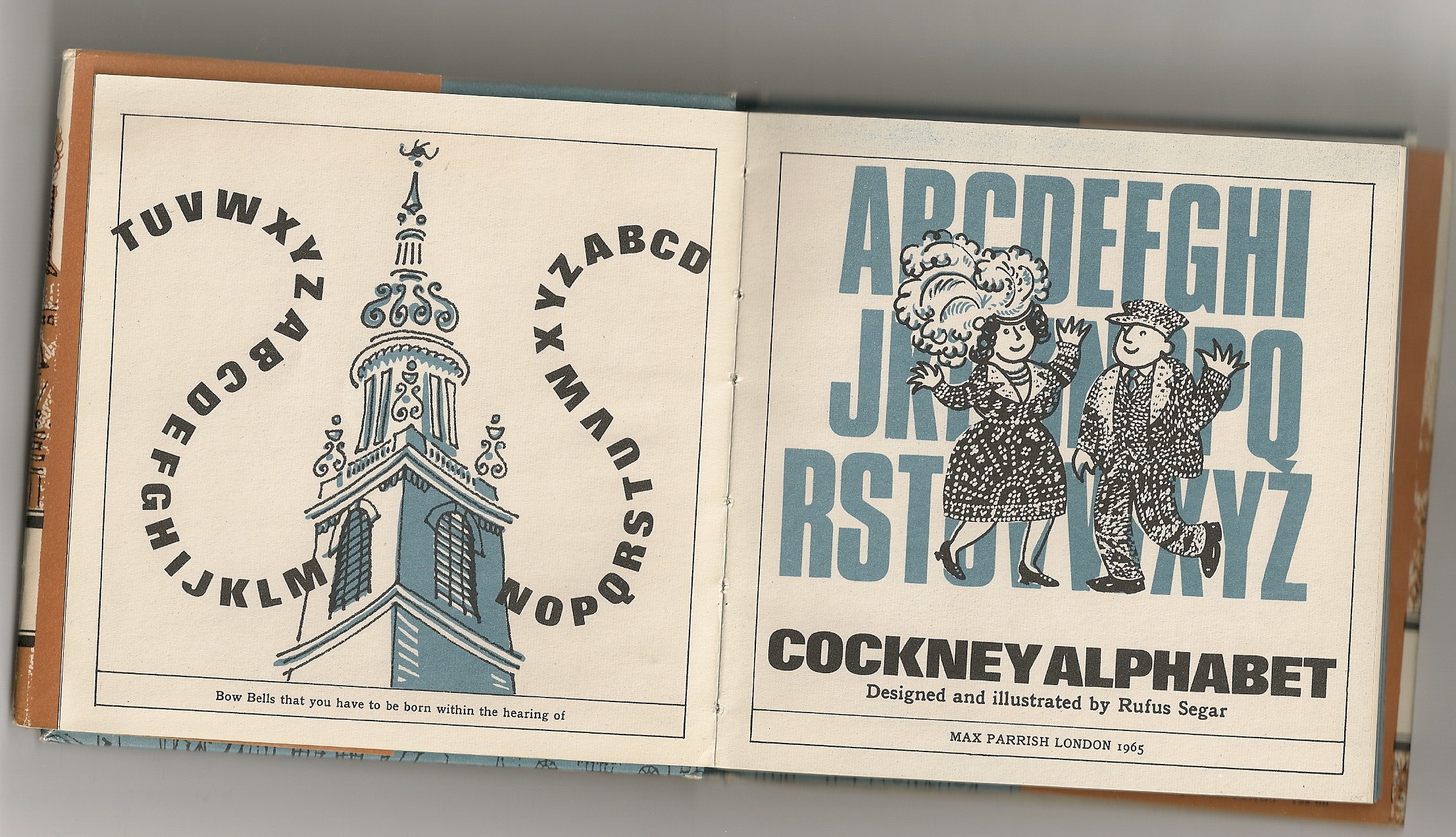
  • Title Cockney Alphabet by Rufus Segar (1965, Parrish)
  • Cost £1.99
  • Bought from Oxfam Books, Herne Hill
  • Genre Humour

The Cockney Alphabet is a humorous alphabet originally devised by music hall duo Clapham & Dwyer in 1929 that rewrites the alphabet with cockney phonetics, starting with A for ‘Orses (Hay for Horses) and ending with Z for Effect (Said for Effect).

There are loads of different versions and this wonderfully illustrated little toilet book from the 1960s has a nice potted history of the form, including a list of four of the most popular alternative versions.

Like rhyming slang, the alphabet can be rewritten to take in topical themes or personalities (this book has U for Fox, or Uffa Fox, a now forgotten British sailor; it also has Q for Beatles over the traditional Q for the Dole).

This version was compiled by Rufus Segar, who says it is by no means definitive, arguing that ‘Letters such as D, G, H and S still remain to be bettered.’ (Although I do like his S for Ixiation over a mountain of Chapman brothers’ skulls.)

Some of the contributions can be hard to comprehend (D for Payment?) but Segar insists that ‘with perseverance and some latitude in pronunciation they will suddenly become meaningful’ (ah, ‘Defer payment’!). And we can’t ask for more than that.

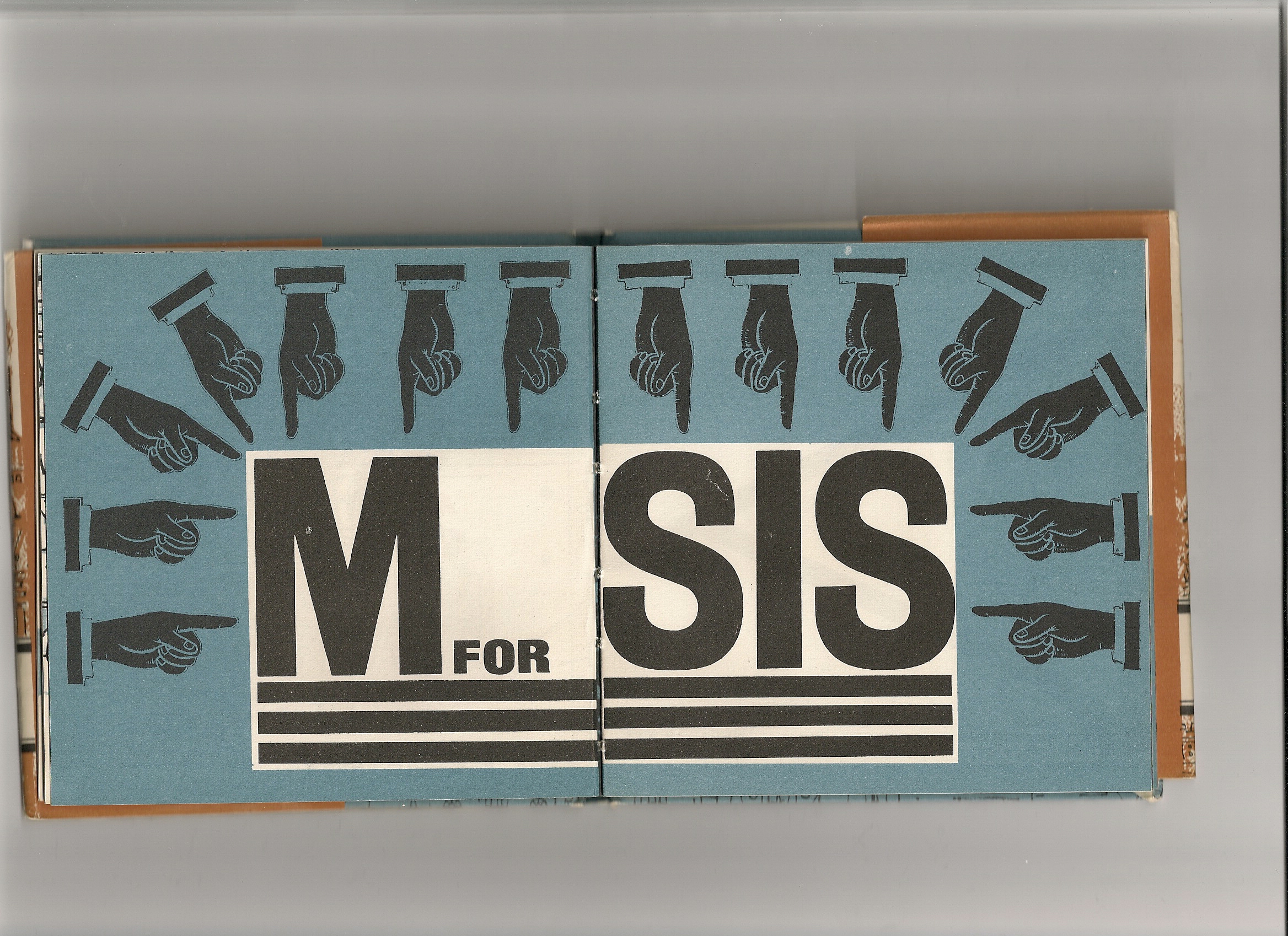
Best bit Illustratively: ‘G for Police’; phonetically, ‘M for Sis’.

Verdict Time for an update?

My London Library: No 2 – London’s Bridges

  • Title London’s Bridges by Peter Matthews (2008, Shire).
  • Cost Free.
  • Bought from Author.
  • Genre Straight history.

The endearingly honest opening line says all you need to know about this historical overview of London’s crossing points. ‘In 1938,’ Matthews reports, ‘an article in the Times observed that: ‘The people of London have a reputation for taking no interest in their bridges’.’

I bet the publisher loved reading that.

It’s a lovely book though, wordy but not too long, nicely illustrated and ruthlessly factual. Bonus points for including non-road bridges such as Grosvenor Railway Bridge.

There’s some great trivia to be found: ‘In 1873, the Royal Humane Society set up a 24-hour ‘receiving host’ by the northern end of Waterloo Bridge, manned by a doctor who would attempt to revive any suicide victims brought to him, and in 1875 alone 21 people were saved by this method’.

The author, Peter Matthews is a proper London nerd and runs the bookshop at the Museum of London, so you can be fairly sure you’ll be able to pick up a copy there.

Verdict Solid reference tome.