Category Archives: Books

To whom it may concern: Poetry Incarnation at the Royal Albert Hall

The new issue of Uncut magazine contains my feature about the International Poetry Incarnation, which took place 45 years ago this month on June 11, 1965. It begins like this:

Allen Ginsberg is drunk. Big, bald and bearded, like a Jewish bear stuffed in a suit, the beat poet stands tall in the Royal Albert Hall, London’s sacred haven of the high arts, and proclaims to 7,000 fellow thinkers:

“Fuck me up the asshole”.

In the crowd was Heathcote Williams, the future poet, playwright and artist. Williams recounts what happened next: “A man with a bowler hat, beside himself with anger, shouted out: ‘We want poetry. This is not poetry’, and Ginsberg retorted, looking up towards the gods: ‘I want you to fuck me up the asshole.’”

And it goes on in a similar manner for another 2,400 words. If you think that sounds like fun, head down to your local newsagent now.

The International Poetry Incarnation – which featured Allen Ginsberg, Adrian Mitchell, Gregory Corso and Michael Horovitz – is said to be the moment that signalled the arrival of the 1960s counterculture movement in London. However, in ‘White Heat’, his otherwise splendid history of the 1960s, Dominic Sandbrook writes dismissively: ‘Seven thousand people was indeed an enormous attendance… on the other hand, it was still considerably smaller than the typical crowd for a Second Division football match… to millions of people, the event meant absolutely nothing. What is more, it had not even been a very good reading.’

Oh, really? Watch this extraordinary clip of Adrian Mitchell from Peter Whitehead’s film of the reading, ‘Wholly Communion’, and tell me it has the same impact as Torquay vs Rochdale.

London disaster porn, or how I learnt to stop worrying and love the flood

I bought this book the other day. How could I not? Everything from the cover to the title to the name of the author screams ‘BUY ME!’, and so I did.

The Big Wave: The Day London Collapsed is, as you might have guessed, about a tsunami that destroys London. Here is a choice paragraph:

Somewhere twenty or so feet below us, under uncountable tons of debris, was the street we had once known as Haymarket; the grey hill to our right was largely the remains of Canada House; the ravine in front would be Sussex Place and beyond that – at the moment not visible – would be the National Gallery. The city we knew had been buried, the streets engulfed by debris, wiped out of existence. I stared at the grey and broken landscape attempting to absorb the scale of the disaster. It was too much. It was too big.

Hot stuff, huh?

And it got me thinking. Not about the danger of a seismic episode taking place ten miles off the Thames Estuary, sending shock waves through the city, felling major landmarks and preempting a giant tidal wave that turns the entire London basin into a corpse-riddled swamp, but about authors who love destroying London.

Will Self’s The Book Of Dave, Richard Jeffries’s After London and JG Ballard’s The Drowned World all take place in a London destroyed by flood (interestingly, Conrad Voss Bark’s The Big Wave is the only book I own that actually describes the flood taking place), and all are marked by a relish in seeing the city brought low. It’s all very Biblical.

‘The deserted and utterly extinct city of London was under his foot,’ writes Jeffries in After London, an almost unreadable Victorian novel. ‘He had penetrated into the midst of that dreadful place…’ We never find out what has destroyed London other than some sort of catastrophic flood, but Jeffries carefully draws an entirely new, almost medieval, world, which he clearly prefers to the Victorian one he has demolished. It’s a bit like John Christopher’s Prince In Waiting trilogy, only nowhere near as good.

Ballard’s dense and difficult 1963 novel The Drowned World is little better. Again, after catastrophic flooding, London has been replaced by a fetid swamp, something that Ballard seems remarkably sanguine about, as this spot of dialogue makes clear.

‘Do you know where we are, the name of this city?’ he asked.

‘Part of it used to be called London; not that it matters.’

Later, in the book’s most evocative passages, the characters walk through drained streets around Leicester Square. ‘Dying fish and marine plants expired in the centre of the roadways… they stood in the entrance to one of the huge cinemas, sea urchins and cucumbers flickering faintly across the tiled floor.’

Both these books were obvious influences for Self’s recent The Book Of Dave, which takes places on the island of Ham. This is Self’s name for the high-lying remains of Hampstead Heath, which overlook a London that has been replaced by a lagoon after, you guessed it, catastrophic flooding. Self doesn’t exhibit quite so much glee at the demise of London, although he draw a strong contrast between the idyllic, unquestioning life of those on Ham and the manic contemporary Londoners, brains overfilled with unnecessary knowledge, that we meet in flashback. One of them, the titular Dave, has been driven insane by the intensity of modern living.

So all three, in their different ways, present the London-free future as being preferable to the present. And if they are accurate predictions of the future, perhaps the following shouldn’t freak me out quite as much as it does.

Pleasant dreams!

I should be so lucky: blackmailed by a poet

My interview with the writer Michael Horovitz appeared in the Times on Saturday. You can read it here.

This piece had a curious gestation. I contacted Michael in December as part of my ongoing attempts to track down a lost London counterculture magazine of the 1970s to which Michael had contributed.

I asked him to help, and he said he would, but only if I first wrote a feature about him based on the many anniversaries he was about to celebrate, including his own 75th birthday. It was blackmail, but of the nicest sort because Horovitz is an extraordinary figure, who I had great fun interviewing and writing about.  He also has a fridge packed with some of the most delightful cupcakes I have tasted in years (and I have tasted a lot of cupcakes). The piece then proved to be a surprisingly easy sell to the Times and has directly led to a couple of other pieces that are now in the pipeline. To all of which, I say ‘Hurrah!’

Michael has worked with artists and writers as distinct as William Burroughs, Paul McCartney, Lenny Bruce, Dudley Moore, Spike Milligan, Joe Strummer, David Hockney, Peter Blake, Allen Ginsberg and Patti Smith, and of his many achievements, the one I sadly didn’t get space to write about in the Times was the part he played in the unexpected cultural renaissance of Kylie Minogue.

It was at one of Michael’s Poetry Olympics events at the Royal Albert Hall in 1996 that Kylie first shook off her Stock, Aitken and Waterman pop image when she performed a tongue-in-cheek spoken word version of ‘I Should Be So Lucky’. ‘Indie Kylie’, the NME star, was born.

Michael currently has an exhibition of his paintings on display at Art@42 in Notting Hill Gate until the end of April, and a documentary about his life was broadcast on Sunday on BBC Radio 4, which you can listen to here.

Angry Young Men and me

I forget which of my teachers called me an ‘angry young man’, which is a shame as it lead to just about the only useful thing I took from school. I was a cocky wee gobshite and regularly got ticked off in class, but the phrase ‘angry young man’ clearly had something more about it than the usual earbashing, so I asked my mum to explain. She told me of John Osborne, Kingsley Amis, Alan Sillitoe and John Braine, and I rushed off to the library to devour ‘Look Back In Anger’, ‘Lucky Jim’, ‘Saturday Night And Sunday Morning’, ‘Room At The Top’ and whatever else I could find about these 1950s writers who raged against the establishment.

As I learnt more, I kept finding references to a writer called Colin Wilson, whose book ‘The Outsider’ had kicked the whole movement off. He’d written it at the British Museum while sleeping rough on Hampstead Heath, but, pre-Amazon, I couldn’t find it anywhere.

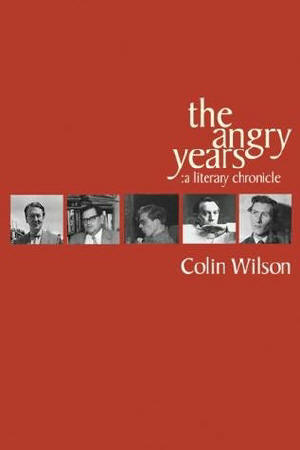
I never read ‘The Outsider’ or thought of Wilson for years until I came upon this excellent summary of Wilson’s life on Another Nickel In The Machine. Then came two more references in quick succession, in Barry Miles’s ‘London Calling’ and David Kynaston’s ‘Family Britain’. When I saw Wilson’s ‘The Angry Years’ for £3.99 in a remaindered bookshop in Waterloo, I knew I shouldn’t resist.

I’m glad I did. What a treat. Wilson’s book is a lively package of memoir, biography, literary criticism and score-settling as he describes his life with the ‘Angries’ in the 1950s. At times, Wilson comes across as a sort of intellectual Forrest Gump, who becomes unexpectedly famous and then wanders round the literary scene telling his peers why they aren’t as clever or important as he is, acting baffled that they take this the wrong way. It is bracing stuff: ‘I wrote [Kingsley] Amis a letter… trying to explain what I found unacceptable about his attitudes’; John Wain ‘seems totally unaware of how real people behave’; Beckett writes ‘dreary rubbish’; ‘Osborne’s use of a current event only demonstrated his lack of invention and the bankruptcy of his creative talent’. Larkin and Tynan also get it in the neck, and there are walk on parts for Sillitoe, Wesker, Braine and Alex Trocchi.

Wilson may not be subtle – and the latter part of the book, tracing the Angries’ decline is genuinely sorrowful – but by and large he’s right. When I first read ‘Look Back In Anger’ I thought it was nasty, fatuous and improbable, but was too frightened to say so. Ditto ‘Lucky Jim’. If this was meant to be a comic novel, why is it so bloody unfunny? And Jim Dixon isn’t angry (or all that young), he’s a middle-class twat with arrested development. I guess context is everything, and these works were revolutionary when they came out, paving the way for the novels that I loved: ‘Billy Liar’, funny, touching and true in all the ways ‘Lucky Jim’ wasn’t, ‘The Loneliness Of The Long Distance Runner’, a rabble-rousing morality tale that made a virtue of its simplicity, and above all David Storey’s ‘This Sporting Life’, which towers over everything else produced by or sucked into the Angry Young Men/Kitchen Sink orbit.

For me, the Angry Young Men worked best when rooted in the working class, and dilettantes like Amis’s Dixon and Osborne’s Porter just seemed to be a slightly different and no more appealing version of the very phoneys they raged against.

Throughout the book, Wilson writes engagingly and incisively and it’s sad that he has been so neglected (an issue this article takes up). But Wilson is a hard-to-pigeonhole oddball with a tendency to rub people up the wrong way, utterly convinced of his own seriousness but also happy to write books about things that aren’t allowed to be serious such as aliens, murder (at one point he mentions his ‘homicidal acquaintance Ian Brady’) and the occult.

I liked the book a great deal, but still won’t be rushing out to buy ‘The Outsider’ as I think I’d rather leave it unread. But I’m delighted that Wilson has reintroduced the Angry Young Men to me after a decade and am hugely grateful. So thanks Colin, and don’t let the bastards grind you down.

What is London?

‘I walked back up the East India Road and caught a bus back to London. But then what, I asked myself, is London? To me, London is one thing; but to the inhabitants of Bermondsey, Wapping, Stepney and Poplar it is quite another. There are hundreds of London, all of them equally real to those who live in them.’

HV Morton, ‘In Search of London’, 1951.

Books and charity in Herne Hill

When I moved to Herne Hill three years ago the one thing I thought it lacked was a bookshop. In Waterloo, we’d had the excellent Crockatt And Powell (now sadly closed) as well as numerous shops selling second-hand and remaindered book. In Herne Hill, all we had was the brilliant but not-for-adults Tales On Moon Lane, a children’s bookshop.

Fast forward a few years and we have not one but two grown-up bookshops. Rejoice! But this bliss for booklovers, has not come without controversy.

The Bookseller has the background, but for those who can’t be bothered to click through, here’s the story. Shortly before Christmas, Herne Hill Books opened near the station. It’s a lovely shop albeit in the smallest space I have ever seen, but with good stock and helpful, friendly stuff – exactly what an independent should be like. It did well before Christmas and was seen as a welcome and overdue addition to the area.

Then, last month, a competitor arrived around the corner on Half Moon Lane. But this was no ordinary competitor, this was a branch of Oxfam Books. I was delighted, the more bookshops the better say I!, but Alastair Kenward at Herne Hill Books was less pleased. I bumped into him last week while he was out walking his dog, and we discussed the problem, which boils down to this.

Oxfam Books are not like any other business. They are a huge company with all the economies of scale that go with that, but they do not pay staff and do not pay for stock, which gives them an even greater advantage over their rivals. And to cap it all, they are a lovely fluffy charity, so you can’t criticise them without being called an evil sod who steals shirts from the backs of starving orphans, as happened to Kenward when he spoke out in The Bookseller.

I have a lot of sympathy with his position, especially given the threats indie booksellers already face from the internet and supermarkets.

So here’s the issue: should Oxfam go about their business like any other company even though we have established they are not actually like any other company?

Should they, as a charity, be beholden to a higher moral principle, one that is perhaps ludicrously idealistic and impractical but which is that they endeavour to only open in areas where there no existing local independent businesses to threaten?

Or does being a charity mean they should exploit every loophole and advantage they can, because at the end of the day all the money they make will theoretically make the world a better place?

I take the middle view, with many caveats, but that won’t stop me using both shops, which in the end do serve slightly different markets- new and second-hand – and together with Tales On Moon Lane make Herne Hill south London’s answer to Hay-on-Wye.

Perhaps all three shops should get together and organise SE24’s first literary festival?

Passages in books that make reviews unnecessary: No 1

‘Gustav Metzger and John Sharkey were prosecuted under the Obscene Publications Act for organizing Hermann Nitsch’s Abreaktionsspiel No 5 at the St Bride’s Institute in 1966. This consisted of a film showing male genitals controlled by wires and dipped in various liquids projected on an eviscerated lamb carcass used as a screen.’

P154, ‘London Calling: A Countercultural History of London since 1945’ by Barry Miles (Atlantic, £25).

Buy it.

Hare Marsh and Rabbit Marsh: fact and fiction in Bethnal Green, part two

In ‘King Dido’, his 1969 novel about Dido Peach, a docker turned criminal, Alexander Baron set the action in a shabby Bethnal Green alleyway called Rabbit Marsh. This was directly inspired by Baron’s memories of Hare Marsh, a tiny cul-de-sac that still exists near Brick Lane. Here, Baron gives us a careful description of the squalid street.

‘In 1911, although the crowding was less abominable and the old Hogarthian bedlam had vanished, the street was still a slum, the roadway narrow and cobbled, the houses black and decayed, many of the ground floors turned into miserable shops and workshops… the railway lines ran behind high brick walls on an embankment behind Rabbit Marsh.’

It hasn’t changed much, has it?

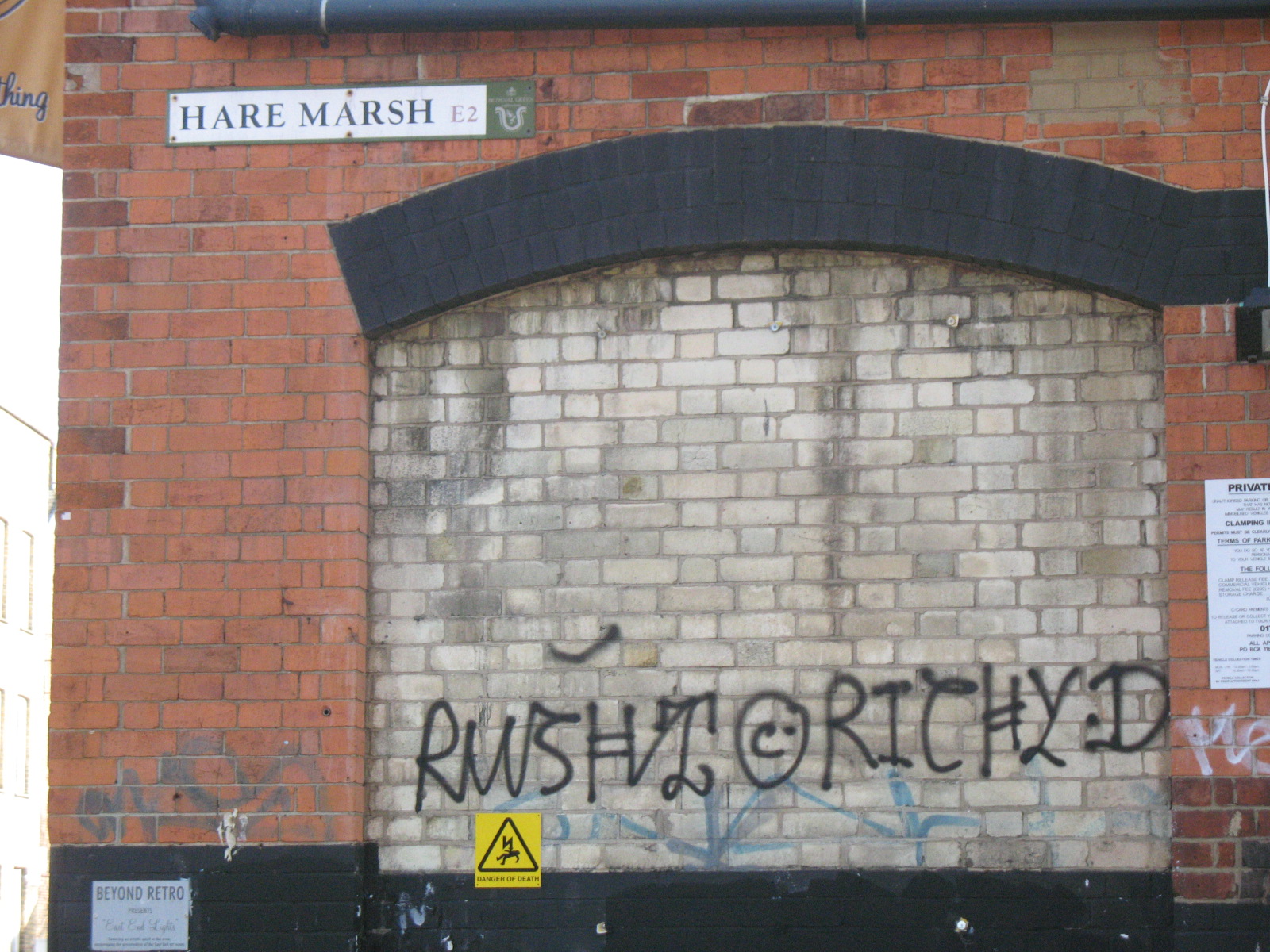
Although a new block of luxury flats sits on the right-hand side, the left wall is an old workshop, the street is still cobbled and it ends abruptly and noisily at the railway. Dido Peach lived above his mother’s rag shop, so it is perhaps apposite that the building to the left is now a second-hand clothes shop.

Here it is again in 1973, in a brilliant, bleak image by Jonathan Barker on Flickr. Scroll down and Barker also has a great picture of it later that year with Cheshire Street’s atmospheric market in full swing.

Baron writes.

‘Imagine a narrow ravine whose floor consists of worn cobbles running between pavements of uneven flags. Such was Rabbit Marsh. That was all the street was; two narrowly facing rows of such buildings, leaning forward with age, cleft by an alley here or there or pierced at the base by a porch leading into a yard.’

Alexander chose his location carefully – the contrast between the rural idealism of the name and the reality of the space is crucial; the words ‘rabbit’ and ‘marsh’ also have insinuations, of over-breeding and of getting stuck  – but he also cheated a bit. Although we know that Rabbit/Hare Marsh is a short dead-end street in the book it is still large enough to contain several dozen shops and houses (Dido lives at No.34) as well as a pub (the Railway), and we are told it hosts a street market on Sundays. The real Hare Marsh simply isn’t large enough for all of that.

Nowhere in the book does Baron mention Hare Street (as Cheshire Street was then named), the now trendy road that links Hare Marsh to Brick Lane, and my assumption is that the author conflated Hare Marsh and Hare Street to give Rabbit Marsh a little extra space for him to play with than really existed. So Rabbit Marsh is stretched, the residents allowed more room in which to breath.

He did not have to imagine much. Opposite Hare Marsh is a pub that looks a lot like the one described in the book.

This is the Carpenter’s Arms. In another nod to reality, there is real villainy here. Dido Peach ends up becoming a kind of local enforcer, taking protection money from local shopkeepers, and the Carpenter’s was once owned by the Krays. All three Krays – Ron, Reg and Charlie – had their funerals at the nearby St Matthew’s church.

Baron’s descriptions of Hare Marsh are captivating, but they are necessarily evocative. Dido Peach’s universe is tiny, and we have to believe in it. This was true to life. In this era, the average Londoner was born, lived, worked and died within a three-mile circle and Peach’s world is similarly shrivelled. The furthest north he gets is Dalston; south is the impenetrable barrier of the river. His one trip west takes him as far as Liverpool Street station, where he heads for the Tube platform and sits watching the trains coming and going, but never considers getting on board.

In ‘The People Of The Abyss’, Jack London’s 1902 account of the East London poor, he writes of one young soak: ‘From the moment of his birth, all the forces of his environment had tended to harden him, and he viewed his wretched, inevitable future with a callousness and unconcern I could not shake.’

This is also the tragedy of Dido Peach’s life, the limitations of possibility and how poverty destroys self-belief and any means the protagonist has of escape, but it is what makes the book so acute and so realistic. Seek it out, then take the pilgrimage to this tiny and otherwise forgotten dead-end alleyway in E2, where fact and fiction collide in gritty, grotty greatness.

Part one is here.

Hare Marsh and Rabbit Marsh: fact and fiction in Bethnal Green

Last month, a friend bought me ‘King Dido’ by Alexander Baron, a lost London novel written in 1969 that has recently been reprinted. It is set in the East End in 1911 and is about Dido Peach, a taciturn docker who almost against his will and certainly against his intentions becomes a vicious criminal, the boss of his manor. It’s a great book – lively, cynical, witty, violent yet thoughtful; it reminded me of Camus’ ‘The Stranger’, but filtered through a very exacting East End eye.

Off  Cheshire Street, south of where it meets St Matthew’s Road, you will find an easily overlooked dead-end street called Hare Marsh. This is where Baron’s mother grew up and it’s where Baron places Dido’s small and rather pathetic manor, renamed Rabbit Marsh in the book.

Originally, Hare Marsh was the name given to the entire area. It had been built on since before the 1670s, but had long been a slum by the time Baron’s book was set. He writes:

‘Rabbit Marsh acquired its name at the end of the seventeenth century, when it was a green and pleasant country place on the outskirts of London. Artisans came here to picnic, practise their sports and trap the rabbits, which abounded… The industrial revolution had turn the whole eastern quarter into an immense slum which had overrun Bethnal Green. Rabbit Marsh was swallowed up with the rest… ‘

This is why William Cobbett called London ‘the Great Wen’, a monstrous cyst that was consuming the country around it, and you can trace the development and decline of Hare Marsh in maps.

Here you can see it on this enlarged square of John Rocque’s London map of 1746. It’s towards the top of the map in the shape of a little lane coming south off Hare Street, the last turning on the right, and heading into fields. Bucolic, no?

To get some perspective, here’s a link to the whole map; Hare Marsh is in square 1F.

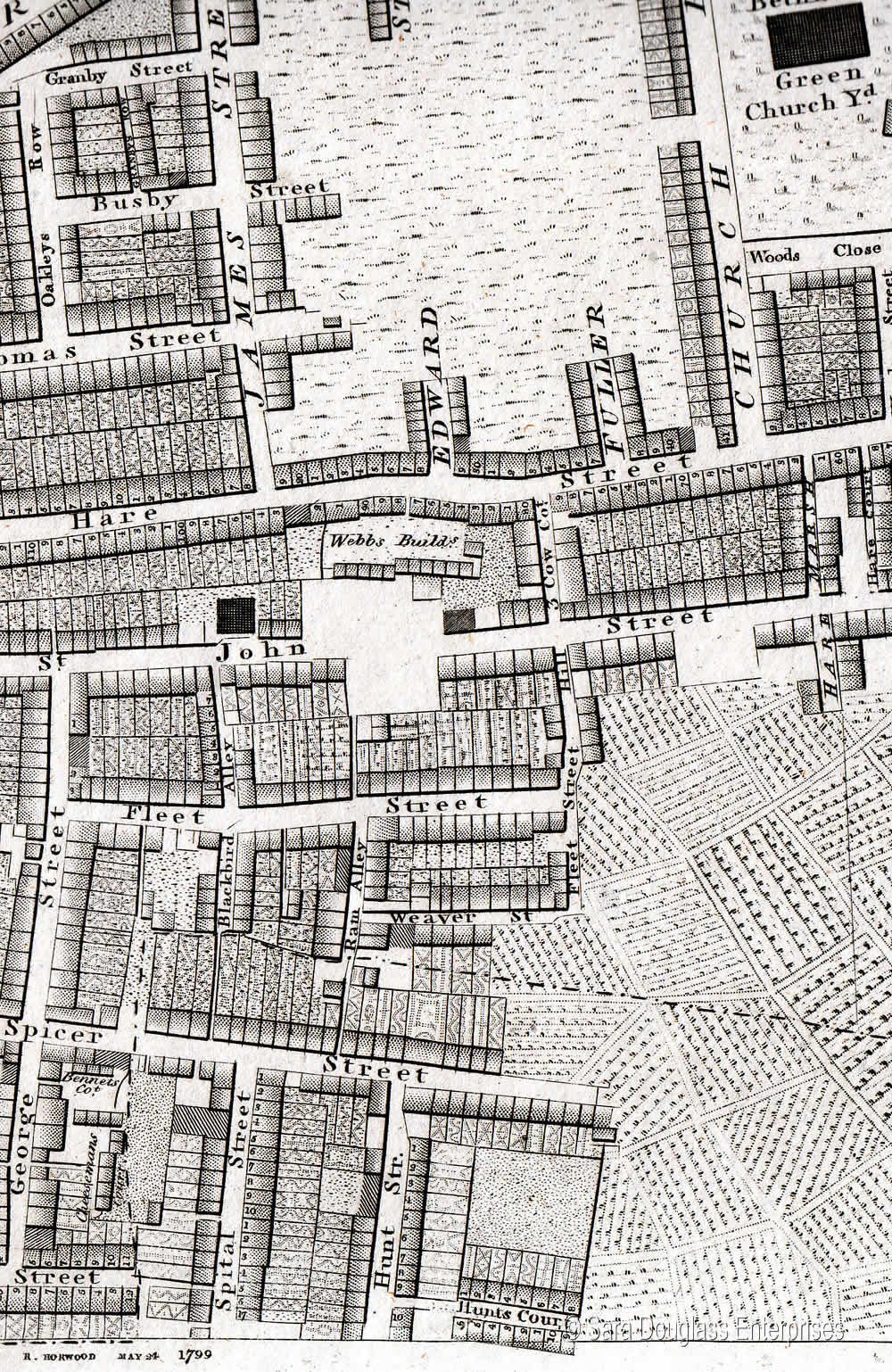
Now, here’s the incredible Horwood map of 1792 – Hare Marsh is on the far right, still an open and pleasant looking space but buildings are starting to encroach.

It hasn’t changed much by the time of the Greenwood map of 1827.

It’s the short street off Hare Street (as Cheshire Street was known until sometime between 1929 and 1945) directly below St Matthew’s Church right next to the big black square.

The square is the workhouse and Hare Marsh also contains almshouses, buildings that show there has been a change in the area’s status. But there’s still no sign of the railway, so even now Hare Marsh opens directly on to fields.

That was soon to change.

Here it is on Booth’s poverty map of 1898, coloured dark and light blue – not quite black (semi-criminal) on Booth’s colour coded scale, but not far off it. Bethnal Green is now entirely built over.

Again it’s the little turning off Hare Street – you can just see it between the ‘r’ and ‘e’ of street. By now, the railway is very much in place, closing in the inhabitants and offering them no escape. This feeling of dead-endness, of a lack of options, of claustrophobia, is central to the atmosphere of Baron’s book and partly explains why he chose this as the location. The railways brought London its greatest devastation since the Great Fire, and this is a great example of the adverse impact it had on individual streets.

Finally, here it is (square aD) in 1922 shortly after the period in which Baron’s book was set (and again in 1952, by which time Hare Street had become Cheshire Street). What had been a quiet lane, open to fields and on the very edge of London, was now a cul-de-sac, hemmed in by a noisy and polluting railway, in the heaving centre of London’s chaotic and overpopulated East End. The perfect location for a novel about poverty and powerlessness.

More on Hare Marsh later.

Many of these maps are available for purchase from the linked websites.

Free London writing talk with Iain Sinclair

Iain Sinclair is one of three writers who will be giving free talks on the subject of ’21st-century London writing’ at the University of Westminster’s Regent Street campus (309 Regent Street, W1B 2UW) starting next month.

Sinclair will be talking on March 4 at 6pm. He will be followed by Toby Litt on March 11 and Rachel Lichtenstein on April 22, both at 6pm. The writers will discuss their work in relation to the city and the opportunities and challenges it offers/poses to contemporary writers.

All talks are free and take place in the Boardroom, but booking is essential. Reserve your seat by emailing Sharon Sinclair at sinclas@wmin.ac.uk to book a place.