Category Archives: Secret London

The Special London Bridge Special

This sensational slice of ham and song was made in 1972 to celebrate the purchase of London Bridge by an American theme park. It features a bizarre cast that includes Tom Jones, Rudolf Nureyev, The Carpenters, Kirk Douglas, Charlton Heston and Terry-Thomas and is basically the film the Olympic opening ceremony could have been.

It’s all here, but watch the intro especially, featuring Tom Jones singing his way round various London landmarks before engaging in a small slice of double entendre on a No 13 bus.

Secret London: Davenports Magic Shop

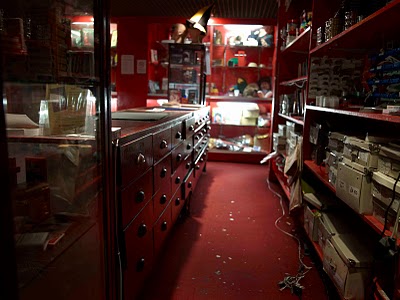
It’s a surprise that Davenports has managed to make it on to the Harry Potter tourist trail given the shop is so damned hard to find. You could walk around the dank subways that link Charing Cross and Trafalgar Square for years without stumbling across it, and then one day you’ll turn a corner and whamkazaam, there it is, right in front of you, looking like it’s appeared out of thin air. Well, what do you expect from a magic shop?

Davenports isn’t any old magic shop (if there even is such a thing), it’s the oldest family magic shop in the world, owned and run by a Davenport for four generations and eyeing up a fifth. It began in the East End in 1898 and its heyday was probably the 1950s and 1960s, when it was based first on New Oxford Street and then Great Russell Street opposite the British Museum. The shop, staffed by magicians only too happy to demonstrate their art, became such a draw for tourists they decided to take themselves off the beaten track and into the tunnels around Trafalgar Square. In the move, Davenports took with them much of the stock, some of the fixtures and all of the atmosphere – walk inside and you step back in time, to late Victorian London, when Davenports was founded and magic was experiencing its first golden age, moving from games of find-the-lady on shadowy street corners into the glamorous Music Hall theatres that dominated popular entertainment.

The vast front window is the first sign that you’ve stumbled upon a refugee from the past. It is crowded with wands, juggling balls, posters advertising old magic shows, ventriloquist dummies, ropes, boxes, cards, red Indian headdresses and a giant dog bone. Enticing no? Opening the door triggers a satisfyingly meaty ‘dong’ from a hidden bell and reveals a small red-hued, slightly creepy interior. Most of the stock, old and weird, is kept in wall-mounted cabinets behind glass doors. The wooden shelves behind the counter are covered with fading handwritten signs – ‘Whoopee Cushion, £1’ –in front of which a young clerk demonstrates sleight-of-hand tricks, pausing only to sell invisible thread and a pack of cards. He pauses between tricks, and I jump in to ask if there is anybody I can talk to about the shop’s history. He disappears, not in a puff of smoke, but round the back, and re-emerges with a neat old lady, wearing a clerk’s apron. This is Betty Davenport, granddaughter of founder Lewis Davenport. ‘I started working here in 1948,’ she tells me, ‘when I was 14 and green as grass.’ Betty has run the business since 1960 and still comes in every afternoon to keep an eye on things. She intends to keep it in the family. One son, Bill, already helps run the business while another, Reg, is a performer, and there are three grandchildren being groomed to take over. Betty has high hopes for the youngest, now seven and doing tricks since he was five. ‘Young boys are inclined to be interested in magic anyway,’ she says, ‘it’s just that when they get older, other things can get in the way.’

Unarguable, and with that thought, conversation peters out. I go back to watching the clerk perform, his brow furrowed in concentration, desperate to get things right and show that in his case those mysterious ‘other things’ were firmly pushed to one side. Davenports has a curiously sober air for a room that’s full of rubber chickens and itching powder. This is a place for serious wizardry, where illusion is business. It’s more like a library than a joke shop. Another customer walks in and starts talking about the art, and I can sense my presence as a non-magician has been noticed. Is it just me, or is there a fear in the room I might hear something I shouldn’t, a trick, as it were, of the trade? So I bid farewell to Betty, close the door and retrace my steps back through the underground passages of Charing Cross, wondering all the while whether Davenports will even be there when I return.

Secret London: inside a cabmen’s shelter

File:London taxi shelter.jpg

This piece was published in Time Out in March 2006.

You must have noticed them: jolly green garden sheds that squad in odd spots of London like displaced emerald Tardises, steam coming out the windows and queues of black cabs lining the streets outside. These are London’s few remaining cabmen’s shelters – 13 in all, for 23,000 drivers – places where cabbies can gather to enjoy tea and sympathy away from the hopeful eyes and raised arms of the stranded, late and lazy who make up their regular custom. The Russell Square shelter is the domain of Maureen, 52, who runs a tight ship, keeping an eye on regulars like Ken (‘Say I’m 21’) and Malcolm (‘I’ve been a cabbie for 37 years. That’s all you need to know’).

‘These places are very interesting to the outsider,’ I say, by way of introduction.

‘They’re even more interesting when you’re on the inside,’ Malcolm replies.

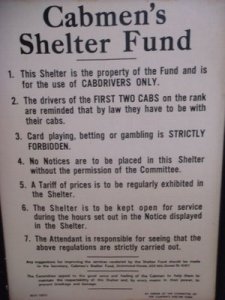
He and Ken come in every day, more or less, to swap tales of fares and roadworks, grumble about Ken Livingstone, talk football, and have something to drink and a bite to eat. They’re keeping alive a long tradition. The Cabman’s Shelter Fund was created by Sir George Armstrong, a newspaper publisher who get fed up waiting for cabs in the rain when drivers had decamped to the nearest pub. He started a fund to supply drivers with a place to get out of the cold and enjoy a cheap meal without straying from the cab stand. The first shelter, erected in 1875, was located on the stand nearest his house (in Oxford). Because the shelters stood on a public highway, the police stipulated they weren’t allowed to be any larger than a horse and cart. At their peak, there were more than 60 in London. Although meant for cabbies, the public could also pop in. Ernest Shackleton was said to frequent the Hyde Park Corner shelter, while the Piccadilly one was nicknamed the ‘Junior Turf Club’ by bright young things, who smuggled in champagne despite the strict teetotal licensing regulations.

Their number declined after WWII as they fell victim to bombs and road-widening schemes, but for a time where a notable feature of London life. HG Wells wrote about ‘the little group of cabmen and loafers that collects around the cabmen’s shelter at Haverstock Hill’, while PG Wodehouse went into greater detail in ‘The Intrusion of Jimmy’ in 1910.

‘Just beyond the gate of Hyde Park… stands a cabmen’s shelter. Conversation and emotion had made Lord Dreever thirsty. He suggested coffee as a suitable conclusion to the night’s revels…. The shelter was nearly full when they opened the door. It was very warm inside. A cabman gets so much fresh air in the exercise of his duties that he is apt to avoid it in private life. The air was heavy with conflicting scents. Fried onions seemed to have the best of the struggle, though plug tobacco competed strongly. A keenly analytical nose might also have detected steak and coffee.’

Food, warmth and companionship are the key. As WJ Gordon wrote in 1893’s The Horse World of London: ‘The cabman is not so much a large drinker as a large eater. At one shelter lately the great feature was boiled rabbit and pickled pork at two o’clock in the morning, and for weeks a small warren of Ostenders was consumed nightly.’

The menu doesn’t stretch to rabbit now, with cabbies preferring tucker that is more in keeping with what a tired cabbie needs, and prices to match. Tea and coffee are 50p. Hot food starts at a quid.

Maureen We do soup, sarnies, fry-ups, curries, jackets… I know what everybody wants. I know everybody who comes in, what he eats and what he don’t eat. Malcolm here had boiled eggs with cucumber in rolls. Except Wednesday. He has baked beans on toast on Wednesday. Ken, he don’t eat nothing. He has a cup of tea.

Time Out You don’t eat here?

Ken No! And I haven’t been in hospital either. Look at the pictures: there’s three up there, four, five, six. All dead. And they used to eat in here.

Malcolm That’s why we’ve got the sign up there: ‘God’s waiting room.’

TO It’s for older cabbies then?

Ken No, anyone can use it. We have one young lad comes in – how old’s Gary, Maur?

Maureen Forty-four. Some of the other shelters are very cliquey – no, I won’t tell you which. If a stranger comes in, they’ll say, ‘You can’t sit there, it’s so-and-so’s seat.’ But we’re not like that.

Malcolm We just check ’em straight out.

Maureen No, we’re friendly here.

TO There’s lots of Arsenal flags, do you have to be an Arsenal fan?

Ken We get a lot of Arsenal, unfortunately.

Malcolm The Tottenham fans get in and out early.

Ken We let the Arsenal in here ‘cos they’re not allowed in the other shelters.

Maureen This one’s been going since 1901. It used to be in Leicester Square, but moved up here.

Ken That was in 1960-something. When I started cabbing in 1967, it was in Leicester Square. I reckon it moved in around 1969.

Malcolm They’re not all the same size.

Maureen They’re similar, but some are longer or wider. They never used to look like this inside though. They used to have seating all round the sides and a big square heater in the middle. People would bring their own food to cook, but there was no kitchen – it was really for keeping warm. Now it’s more like a caravan, with a kitchen at one end and tables at the other.

TO I read they were originally built to keep cabbies out of pubs.

Ken Well, that didn’t work did it?

TO Can non-cabbies come in here?

Ken Builders come in sometimes and have a cup of tea, but if it gets crowded they have it away and let the drivers in.

Malcolm Cabbies get priority. 

TO Who owns this one?

Maureen I rent it off the Trust Fund. I pay the rent and the bills out of what I make. It’s all right in the summer, but in winter it gets very cold. Once you start letting people in, it’s okay, and in the summer we have all the doors open or sit outside. We get heat from the ovens as well.

Ken That’s why they have us two come in here before the rest, to warm it up.

TO What are your opening hours?

Ken That’s a sore point.

Malcolm When she wakes up.

Maureen These are the only two who come in at this time, so I open for them.

Ken We’re up early – we go out at 4.30 or 5am. The others don’t start till seven or eight, so they don’t want a cup of tea or a sandwich until about 12 but we get hungry before. I eat elsewhere. I ate here once and was laid up for two years.

TO When do you close?

Maureen About half-five. We get some people sitting here all day.

Malcolm We get a lot of people that put their head round the door looking for cabs or information.

Maureen There’s a bloke from Holland who’s fascinated with black cabs. He comes over now and then to talk. We get people all the time. Who’s that bloke off the radio who talks and talks?

Ken Robert Elms

Maureen Yeah, he’s been in here.

Ken And what’s-his-name, Ricky Gervais, he’s always walking past, says hello. Angela Rippon popped here head in the other day.

Maureen And then there’s that bleeding Madonna. She came in to try and get a cab.

TO Do you get any women cabbies?

Maureen Yeah, we’ve got Marion. But they don’t seem to stay – they have one look and go straight out again. We’ve too many nutters. We’ve Mad Bob, Cockhead, the Village Idiot…

Ken We’re all different in here and we’ve all got our stories.

Malcolm We come in to keep track of who is alive and who is dead.

Maureen You’d be surprised how many we can fit inside. It holds ten or 12 sitting but for Christmas dinner we have 30 or 40 standing inside.

Ken We get slung out, me and Malcolm. It’s better anyway  – if anybody’s going to get a turkey with bird flu, it’s Maureen.

Maureen doesn’t rise to the bait. She’s used to it. And, as it has every day for more than 100 years, the hut fills with the smell of fried onions. The cabbies start to file in for lunch, and I have it away to let them grumble, joke and eat in peace.
Peter Hitchens on drugs and the moral, opium-eating, Victorians

Peter Hitchens is a very clever man. I’m sure he’s also sincere – I can’t believe British newspapers would employ somebody to say stupid and provocative things just to get attention, after all – but judging by the interviews he’s conducted for his new book about drugs, The War We Never Fought, he’s a little bit daft.

Hitchens theory is that there has never been a war on drugs. ‘Drug-taking was, in effect, decriminalised by the Misuse of Drugs Act 1971,’ is how Decca Aitkenhead paraphrases. Instead, he harks back to the golden age of the Victorians, when there was ‘increasing self-imposed moral conduct’ (Hitchens’ words.)

Where to begin with this nonsense? Well, let’s just stick to the last bit, those morally virtuous Victorians. In a sense, he’s right: the Victorians didn’t take illegal drugs. That’s because they were too busy snaffling down the legal ones – things like opium, cocaine and cannabis – which were available to just about anybody who needed them until 1868, and then over the counter from chemists until 1926. This was the golden age of drug-taking in Britain, with opium being consumed on a scale we could scarcely now believe.

Victorian London was awash with opium, not in semi-mythologised Chinese opium-smoking dens in Limehouse (of which there were very few), but in pubs, chemists, general stores and markets, where it was sold in bottles, powders, pills, lozenges, on plasters, in sweets and much else besides. The centre of trade was in Mincing Lane, London, where 90 per cent of transactions occurred. It was most commonly taken as laudanum, a tincture of opium and red wine, with saffron and cinnamon.

This was not thrill seeking. In the days before aspirin, opium was one of the few reliable painkillers available to Victorians, especially especially fever and diarrhoea, but also malaria, smallpox, syphilis and TB. And it was effective as well. As anybody who has taken codeine or morphine will confirm, opiates have a tendency to block you right up – something that was particularly helpful when the next cholera or dysentery epidemic was just around the corner.

However, opium was also used on children, particularly when teething, in specially formulated sweet concoctions like Godfrey’s Cordial and Mrs Winslow’s Soothing Syrup, and thus surely led to the deaths of many by overdose. It also, believes the drug’s historian Martin Booth in Opium: A History, ‘provided an escape from the misery and vicissitudes of working-class life.’ This was especially the case in the Fens, where ‘many never take their beer without dropping a piece of opium into it.’

Because of these two factors, opium was belatedly seen as a physical and spiritual danger, and Victorian abstinence advocates put it right up there with alcohol and tobacco as serious threats to British life. What’s interesting, though, is the way – anecdotally at least – users were able to effectively and relatively painlessly self-medicate, living normal decent lives despite their addiction, without resorting to crime. This is true for the working classes, it’s true of the famous opium-eating writers like Coleridge, Shelly, Keats, Collins and De Quincey, and it’s also true of the many great statesmen – the sort of people who shaped the British Empire so beloved by Peter Hitchens – who took the drug. You see, because opium was the only halfway reliable painkiller around, everybody took it – including people like William Wilberforce, the great Christian abolitionist, and William Gladstone, who popped some in his coffee before speaking in Parliament to improve his rhetorical powers – even if not all of them became addicted.

In later years, opium – and especially its stronger derivatives morphine and heroin – began to be used by those simply seeking a pathway to an altered consciousness, a shortcut perhaps to the sort of transcendent mystical experience some people get from religion. In doing so, they were merely following pattern taken by mankind in all civilisations since the dawn of time, however much Hitchens may wish that weren’t the case.

As restrictions were introduced – for opium, not alcohol and tobacco – drug-use declined massively and by 1960 there were less than 100 registered heroin addicts in the UK. They received their drugs from doctors, cheap and undiluted, and were largely able to enjoy a normal existence (at least in comparison with their criminalised counterparts in America). However, as drug use increased in the 1960s, restrictions were imposed, culminating with Hitchens hated Misuse of Drugs Acts in 1971, after which drug supply passed almost completely into the hands of the criminal and use immediately rocketed. A far cry indeed from those morally virtuous days of the 1850s, when Britain’s great and good could simply pick up a bottle of premium laudanum from their nearest general store and retreat into blissful opium dreams.

Wellcome to London: how Henry Wellcome ‘hoovered up the world’ and left it on the Euston Road

Wisconsin, 1858. A five-year-old boy is playing near his frontier home when a strange stone catches his eye. He takes it to his father, who examines the flint carefully before deciding that it was a prehistoric tool made thousands of years before to cut meat. It probably meant as much to its creator as the railway did to modern humans. ‘That excited my imagination and never was forgotten,’ wrote Henry Wellcome years later, after he had grown up, moved to London and accumulated one of the largest collections of scientific paraphernalia that has ever been gathered by a single individual.

Henry Wellcome

Wellcome established his pharmaceutical company, Wellcome-Burroughs, in 1880, making a mint selling pills to an English public that had previously taken medicine in the form of powder or syrup. This fortune sits in the Wellcome Trust, which was established 76 years ago and is now worth £14 billion, making it one of the world’s largest charitable foundations. Next door to the Wellcome Trust HQ on Euston Road, a short walk from St Pancras, sits the Wellcome Collection, a museum that houses some of the million or so objects collected by Wellcome in his lifetime. Here is Napoleon Bonaparte’s toothbrush, ancient sex aids, Chinese torture chairs lined with blades, boxes of false eyes, human skeletons and paintings by Van Gogh. It is one of the most extraordinary collections in the world, a throwback to a time when wealthy individuals would hoover up the weird and wonderful of the world for their personal collections, but executed on a scale few could compete with.

Ken Arnold is the Wellcome’s Head of Public Programmes. ‘This is the last great non-connoisseurs collection,’ he says. ‘Our usual concept of a collector is somebody who carefully decides whether something is authentic and then forks out a huge amount of money for it. Wellcome had an “other-end-of-the-telescope” approach. He saw everything through medical-tinted spectacles and wanted to own anything that would illuminate that fascination.’

Wellcome collected everything: paintings, engravings, photographs, models, sculptures, manuscripts, books, periodicals, pamphlets, letters, prescriptions, diplomas, medical instruments, archaeological finds, skeletons, skin, hospital equipment, advertisements, drugs, remedies, food, plants, microscope slides, charms, amulets, ceremonial paraphernalia, costumes, medals, coins and furniture. He bought entire shops, contents, fixtures and fittings, acquiring enough to recreate an entire street. He bought others collections, picked up human skulls from African battlefields and returned from one typical trip abroad with 44 packing cases of material. If something wasn’t available, he had an artist make a reproduction. Teams of buyers were finding him items right up until his death in 1936. His reach was broad and their brief was wide.

‘Wellcome had deep pockets and no bureaucrats telling him what he could bring home so he had none of our moral, financial or logistical concerns,’ says Arnold. ‘He hoovered up the world, and left us with this extraordinarily unwieldy and undisciplined collection.’ Although Wellcome amassed an immense collection, he was frugal with his money. ‘He was very wealthy, but he would send employees to auctions dressed down so they didn’t look too rich, and would set up fake companies so people wouldn’t know it was his money,’ says Ross MacFarlane, research officer at the Wellcome Library.

A chippy self-made American, Wellcome could never become part of the British establishment – although he was awarded both a knighthood and the French Legion d’honneur – and a desire to be taken seriously may have prompted his determination to create a museum of ‘the art and science and healing’. This opened in 1913 in South Kensington, before it moved to Wigmore Street and closing in 1932. When Wellcome died, the collection was put into storage or dispersed.

‘The British Museum has 40,000 objects, the Science Museum has more than 100,000, the Pitt-Rivers in Oxford has 30,000 items and there are bits in almost every museum in the UK,’ says Arnold. The Wellcome Trust has since taken a similarly philanthropic approach, funding wings in numerous UK museums, galleries and academic institutions.

In 2007, the Wellcome Collection opened. It is a modern, classy space, with a cafe and bookshop, as well as a gallery that hosts thought-provoking exhibitions that use art and science to explore topics such as Skin, Sleep and Brains. Their next exhibition, Death, promises to be particularly fascinating and challenging.

The Wellcome dares to be different: while most museums take an unfamiliar topic and wring all the knowledge out of it like a damp dishcloth, the Wellcome looks at something familiar and turns it inside out, using contemporary art and scientific research to make visitors question what they think they already implicitly understand. Their ability to do this can be traced back to Henry Wellcome himself.

‘We feel free to interpret the material Wellcome collected,’ says MacFarlane. ‘Because although we know when something was bought and what it cost, we don’t always know how it got to the auction.’ Arnold expands on this: ‘He didn’t talk about his philosophy. There’s enough to get an idea of why he was collecting, but there’s not so much that we feel we have to conform to his beliefs. He once said ‘Never tell anybody what you are planning to do until you have done it.’ That sounds like a good idea to me…’

So the Wellcome eschews blockbuster shows – which Arnold describes as ‘a depressingly greedy way to conduct exhibitions’ – and takes pride in imaginative live events. ‘We never try to be definitive,’ says Arnold. ‘There’s always more to discover. And we don’t want to be po-faced. Science is either deadly serious or fun with pink fluffy letters – and between these two unpalatable positions is a yawning chasm that can be filled with smart and sophisticated entertainment.’

Of course, the Wellcome is helped by having a lot of money in its coffers. ‘We are much more privileged that most other organisations. We are wealthy and we don’t have to satisfy civil servants, corporate sponsors or shareholders. But that attitude comes from the Wellcome Trust itself: science is a risk-taking business and there is a sense we are allowed to be experimental.’

MacFarlane finishes that thought, ‘When we take the directors an idea, they’ll often want to give it a go, and that’s a bit like how Wellcome collected. It’s a great position to be in.’

Wellcome Collection, 183 Euston Road, NW1 2BE. Admission free. The Wellcome’s next exhibition is Death, from November 15. 

Une saison en Camden: Rimbaud and Verlaine in Victorian London

I am an ephemeral and a not too discontented citizen of a metropolis considered modern because all known taste has been avoided in the furnishings and the exterior of the houses as well as in the plan of the city. Here you would fail to detect the least trace of any monument to superstition.

Arthur Rimbaud on London in Illuminations

Getting a face full of wet fish is usually associated with Monty Python at Teddington Lock rather than French poets in North London, but such is the warping power of Camden Town. Arthur Rimbaud and Paul Verlaine were the Gallic rhymers in question. The pair enjoyed a tempestuous relationship in a variety of London addresses, which culminated in the aforementioned fish-slapping incident in Camden.

rimbverl

They had arrived in London in September 1872 after fleeing scandal in Paris. Rimbaud was 17, Verlaine ten years older, married with a child. Verlaine’s brother-in-law described Rimbaud as ‘a vile, vicious, disgusting little schoolboy’, but Verlaine found him an ‘exquisite creature’ probably for much the same reasons. At first they settled in Howland Street in Fitzrovia. They became part of Soho’s expat anarchist dissident set, reportedly attending meetings helmed by Karl Marx in Old Compton Street, drinking heavily, taking hash and opium (Rimbaud advocated ‘derangement of all the senses’) and keeping warm at the British Museum, where Rimbaud’s name  – but not Verlaine’s – was later added to the Reading Room roll of honour. Neither were particularly politically motivated, but the anti-establishment environment would undoubtedly have appealed to the outlaw couple.

Drawing by Verlaine of Rimbaud in Canon Street

They both loved London. Rimbaud felt that by comparison Paris looked like nothing more than a ‘pretty provincial town’ and loved the ‘interminable docks’, while Verlaine was captivated by the ‘incessant railways on splendid cast iron bridges’ and the ‘brutal, loud-mouthed people in the streets’. Together they travelled on the river, visited Hampstead Heath and rode the newly opened underground railway. They visited Hyde Park Corner, Madame Tussaud’s, the National Gallery and the Tower Subway (‘It stinks, it’s hot and it quivers like a suspension bridge, while all the while you hear the sound of the enormous volume of water,’ they reported back).

They wrote as well. Parts of Rimbaud’s Illuminations and Une Saison en Enfer were written in London, and his relationship with Verlaine is recorded in the latter’s lines: ‘On several nights, his demon seized me, we rolled around together, I wrestled with him!—At nights, often, drunk, he lies in wait in the streets or in the houses, to frighten me half to death… In the hovels where we used to get drunk, he would weep at the sight of those around us, miserable beasts…’ Verlaine was also influenced by the hectic modernity of the docks, and wrote a poem about Regent’s Canal.

Their sojourn in Fitzrovia was briefly commemorated with a plaque written in French and erected in 1922, although it only mentioned Verlaine – Rimbaud’s name was omitted on grounds of morality. Unfortunately, the street numbers had changed by this time, so the plaque on No 34 was almost certainly commemorating the wrong house. These defects were solved in 1938 by simple means – the house was demolished. It’s said the plaque was saved from destruction, but if so it has long since been lost.

There is a plaque for their next house however, left by ‘unknown hand’ according to Simon Callow. This is on their residence at 8 Great (now Royal) College Street, which they moved to in May 1873, living in two rooms on the top floor for three months. Here the pair’s self-destructive instincts really blossomed. They argued relentlessly, and often fought physically. This reached its nadir one July morning when Verlaine returned from Camden market carrying fresh fish and olive oil. It was a hot day and Verlaine had a hangover, but Rimbaud, watching from an upstairs window, was unsympathetic. He laughed and bellowed, ‘Ce que tu as l’air con!’ (‘What a cunt you look!’). Verlaine responded with a kipper in the face (hurt, he later wrote to a friend rather pathetically,  ‘I retaliated, because, I can assure you, I definitely did not look ridiculous’), packed his bags and fled to Brussels. Rimbaud eventually followed, only to receive two bullets in his wrist for his troubles.

Verlaine was sentenced to two years in prison, which he spent in part reading Une Saison en Enfer, and that was pretty much the end of that relationship. Rimbaud returned to London in 1874, living at Stamford Street, SE1 with the poet Germain Nouveau and later taking a room at No 12 Argyll Square in 1875. He then disappeared for four months – biographers still speculate about whether he was in Scotland, Scarborough or Reading. He barely wrote another word and died, one-legged, in 1891. Verlaine also returned to England, teaching in Boston and Bournemouth, before returning to Paris where he succumbed to alcoholism and died in 1896. Camden can do that.

Photo by Dornac of Paul Verlaine in the Café François 1er in Paris on May 28, 1892

Secret London: the London Grill

I was recently asked to answer a few questions about Secret London by the blogging cabbies at Radio Taxis.

If you are interested in my favourite London building, London landmark and favourite London film and book, head here, where you will be rewarded with a mildly disturbing image of my face. 

Secret London: dealing with the counterculture at Maggs

This article originally appeared in Dazed And Confused magazine in February 2012.

Maggs Bros Ltd rare bookshop is an unlikely place to encounter the counterculture. For a start, it’s located on one of London’s poshest squares in Mayfair, the heart of the establishment, and even boasts a Royal warrant just inside the front door. Inside No 50 Berkeley Square – an imposing Georgian terrace once described as ‘the most haunted house in London’ – earnest young men in expensive suits sit at desks covered in large old brown books, which they flog to largely millionaire collectors that occasionally step through the front door.

But round the back, a different world awaits. Carl Williams works in an office converted from the stable block, in a room that is full of wonders. Come here at the right time and you will find boxes full of punk fanzines sitting on chairs draped with Republican flags from Spanish Civil War. Ask Williams nicely and he may show you brooches made by junkie poet Alexander Trocchi from used heroin needles, a complete set of ‘Anti-Monopoly’ board games or a pamphlet drawn by Latvian anarchist Peter the Painter, the shadowy figure behind the Sidney Street Siege of 1911. This recent catalogue will give you an idea of the material. 

Aleister Crowley

Williams, a fast-talking Yorkshireman , is one of the few booksellers who deals in items related to the counterculture, a nebulous term which covers politics, the occult, avant-garde art, film and literature, drug culture, rock and roll and alternative lifestyles. The interesting stuff, in other words. ‘There’s no guide to the counterculture,’ says Williams. ‘It’s not doctrinal. It’s whether something has the right feel, the way it looks, where it came from. It’s folk art, it’s the Watts Towers, it’s Austin Osman Spare, it’s Aleister Crowley. It’s not like Marxism where everybody knows the key texts. There are things in the counterculture that are still being discovered. There are things lost in libraries that will take it in a completely new direction.’ And it isn’t just books: Williams deals in paintings, posters, games, clothes and records. The only requirements are that Williams can locate it somewhere within his own concept of the counterculture, and that he can sell it. He also puts on occasional shows in the gallery beneath his office, such as the recent Lost Rivers exhibition.

Williams was born in 1967 – ‘the autumn of love’ – in Scarborough. Despite failing his O-Levels, he went to the LSE to read sociology, where he discovered the library and ‘read indiscriminately’. In 1997, after a decade of odd jobs and working in book shops, Williams returned to the LSE to do a Masters just as the library was selling off its old stock during a refurbishment. Almost by accident, Williams became a ‘runner’, a pejorative term that describes something which, in essence, all book dealers do. ‘Running is a pre-internet term, now it’s much more transparent, but it means taking a book quickly from one dealer or auction house, to another dealer or collector and selling it for more money than you paid,’ says Williams. ‘The idea is that you get it from A to B without B finding out how much you paid A.’

RED FESTIVAL 77 POSTER

With the LSE library at his disposal, Williams was blessed with early success. ‘I was able to sell all these political economy and philosophy books,’ he says. ‘But although I knew the books I didn’t really know what they were worth. I realised this when I took one dealer the first Western European edition of the Koran, and walked out with £500 when it must have been worth thousands.’

As the stock from the LSE ran out, Williams began frequenting other dealers and auction houses to find sellable books. In February 1999, he wandered into Bloomsbury Book Auctions, where he picked up a book from 1864 called The Pure Logic Of Quality by William Stanley Jevons. ‘Jevons thought this book would revolutionise how we understood logic, but he only sold six copies,’ says Williams. ‘I’d never seen one outside a library. I took it to a dealer, Pickering and Chatto, and a man called Jolyon Hudson asked if he could keep it for a day or two.’

Hudson recognised the book had been stolen from the London Library. The police were notified and Williams’s discovery unravelled what the Guardian described as ‘the most systematic plundering of Britain’s great libraries ever carried out by an individual’. William Simon Jacques, a dealer, had stolen books worth more than £1 million. He was eventually sentenced to four years in prison. (Jay Rayner covered the story here.)

‘I was devastated,’ says Williams, ‘because I thought I’d tried to sell a stolen book, but it turned out to be a blessing because Hudson told the Guardian that I had behaved impeccably and that gave me an entry into the higher levels of the trade.’

Williams began working at Maggs Bros, selling books on the internet and looking after the catalogue. ‘I got to know the customers. There was one guy who had been coming in for 20 years. He’d usually walk out with a travel book, but one day they asked this guy what he actually wanted and he said he wanted books on drugs.’

The man was Julio Mario Santo Domingo, a Colombian billionaire, and Williams sold him a painting made by a Mexican artist after he had been injected in the neck with LSD. Santo Domingo was in the process of putting together one of the great private collections of drug books and paraphernalia, a stunning selection of material that ranges from ancient books about Chinese opium smoking to a bicycle that belonged to Syd Barrett. ‘I worked for Julio [who died in 2009] for three years,’ says Williams. ‘His collection is one of the great untold stories of the 21st century. It’s not just drugs, it’s sex, rock and roll, the occult, erotica and art. And it’s not just books. It’s everything.’

Santo Domingo had a remarkably open concept of what to collect, not just concentrating on the old and valuable but hovering up anything with drug connections. ‘Somewhere in it is a McDonalds coffee stirrer from the 1970s,’ says Williams. ‘It looked like a coke spoon, just in plastic rather than silver. There were press rumours that it was the hillbilly coke spoon and so McDonalds discontinued the range, but I found an original. What do you do with that? Sotheby’s don’t want it, Christie’s don’t want it. But it’s gold. So that’s what I do.’

McDonald's coffee stirrer

Williams operates in a rarefied world, selling unusual and arcane items to billionaires and academic institutions. Some are interested in the subject, others are professional collectors, and still more are collectors who collect other people’s collections, as investments and for the pleasure of ownership. ‘It’s a very small world of dealers and a very large world of buyers, who work on the basis that they should buy now when it is relatively cheap and is all still out there,’ says Williams. ‘And some of it is cheap. The 1960s stuff isn’t because it is more mainstream and the top Beat stuff is far too expensive, although I’ll still buy manuscripts.’

New items are acquired from auctions and the internet, book fares, private sellers and other dealers. A recent haul brought in the first issue of Heat Wave, a British Situationist International magazine written in 1966, which nobody has seen outside the British Library for decades. There’s a file full of items William Burroughs collected during his short-lived immersion in the Church of Scientology. There are four skeletal marionettes that used to live in an amusement arcade in Hastings. There are posters of Black Panther Bobby Seale, complete collections of short-lived No Wave fanzines, cloth bags designed by Yoko Ono and the programme from Michael Clark and The Fall’s collaboration on the ballet ‘I Am Curious Orange’, which took place at Sadler’s Wells in 1988. And there are books, loads of them, by Richard Neville and BS Johnson and Gregory Corso and Timothy Leary. Some of this stuff is hard to sell, partly because it’s difficult to know how much it is worth – ‘there simply isn’t a precedent for some of these things, so you’ve nothing to compare it with.’


Williams found his niche with a little help from Edward Maggs, the man who inherited the family firm. ‘There might have been something brewing in Ed’s mind that we needed to cover this demographic,’ says Williams. ‘It really began when I started cataloguing all this proto-counterculture American Beat stuff from the 50s and it did really well, I sold about 80% of it. I designed a catalogue based on Ginsberg’s Howl, the same size and typeface. It did well, people liked it and I realised I had the right skills for the subject.’

And what are those skills? Williams pauses. ‘It’s judo,’ he says. ‘I have one real ability. I can pick up a book, look at the front, open it, look at the back and I can usually understand what that book is about, condense it, understand where it came from and put a price on it before I’ve put it down. That’s not a talent many people have. It’s like judo, you’re fighting an opponent who is much bigger than you but you don’t need take on the whole thing at one time if you are going to defeat it. It’s an intellectual work-out every day. I have to explain each item, do the research, understand its value, and then I try and sell it.’

Unstable at Maggs Bros Gallery is on until June 8, 2012.

Secret London: the mystery of London’s World War II railings

I recently received this email:

‘Stumbled across your blog recently and wondered if you’d be interested in doing a bit of digging to find out what happened to London’s railings.

During WWII there was a national scrap drive especially active in London where a lot of railings were grubbed up and sent off to be scrapped. I have never been able to find out what really happened with this pre-emptive move to destroy London before the Luftwaffe but it seems that program was more of a public relations exercise rather than of any practical use and the railings were dumped.
I have heard tell of them being dumped in the Thames and being used as ballast for ships leaving the Port of London. It is said that seaport buildings in Guyana and Nigeria still sport rather nice Georgian railings.’
And that was it. In truth, I know little about London railings (image below from Knowledge Of London). I’d also heard the story that were used for scrap metal in the war, and was also aware that in Harleyford Street, SE11, some ARP stretchers used during the war to ferry casualties away from bombsites had been turned into railings (you can see a glimpse of them in Patrick Keiller’s London and they also feature in Peter Ashley’s excellent More London Peculiars).
So I turned to my dog-eared copy of London Street Furniture, which wasn’t much help. ‘Doubtless, railings have their devotees,’ I read. ‘The authors may be nerds, but this is one items of street furniture that even they cannot get excited about.’
Oh.
The section continues: ‘When we were children we heard all about the drive to uproot railings to produce scrap iron to assist the war effort in the early 1940s. We suspect that railings were seized and removed more keenly from working-class districts than from the fronts of the houses of people who had wealth and social and political clout.
Removing railings in WW2 (Imperial War Museum)
I’m not sure this is true, as I have read that railings were removed from many garden squares, making them suddenly accessible to the public (indeed, that is what is happening in the image above).
That the railings were removed is beyond doubt. Here is a typical quote from somebody who had their railings removed during the war, taken from the BBC’s People’s War site.
They took away our railings. Men came and cut the ornamental railing from the copings on the little walls outside of the houses, along the whole length of the road, they were taken away to be melted down to make weapons.
But did they really get melted down? A quick scour of the internet produces this interesting nugget from a WWII forum. It is a letter from 1984 to the Evening Standard and says in full:
I was interested in your item about the railings which are to be replaced in Ennismore Gardens. The tragedy is that so many of London’s railings were pulled down in order to support Britain’s war effort, bearing in mind that they never became the guns and tanks they were intended for.
In fact I believe that many hundreds of tons of scrap iron and ornamental railings were sent to the bottom in the Thames Estuary because Britain was unable to process this ironwork into weapons of war.
Christopher Long Earl’s Court Square, Earl’s Court,
London SW5.
The forum correspondent goes on to add: ‘This information came from dockers in Canning Town in 1978 who had worked during the war on ‘lighters’ that were towed down the Thames estuary to dump vast quantities of scrap metal and decorative ironwork. They claimed that so much was dumped at certain spots in the estuary that ships passing the area needed pilots to guide them because their compasses were so strongly affected by the quantity of iron on the sea-bed.’
A great story, but is it true? If anybody can say for sure, please do let us know.
UPDATE: The fine Johnny L, a noted nerd and jazz lover, points us towards this documentary by Jonathan Meades about Victorian houses.

Meades begins talking about railings after 4min 40secs. At 5min 30 secs he reports:

There aren’t many railings left now in London. This is because in 1940 there were ripped up as part of the war effort. It may have been a morale booster, but it was impractical – the stuff was never melted down and was thrown into the Thames rather unceremoniously off Sheerness on the Isle of Sheppey. The stuff’s still there.’

London’s football gangs: 1972

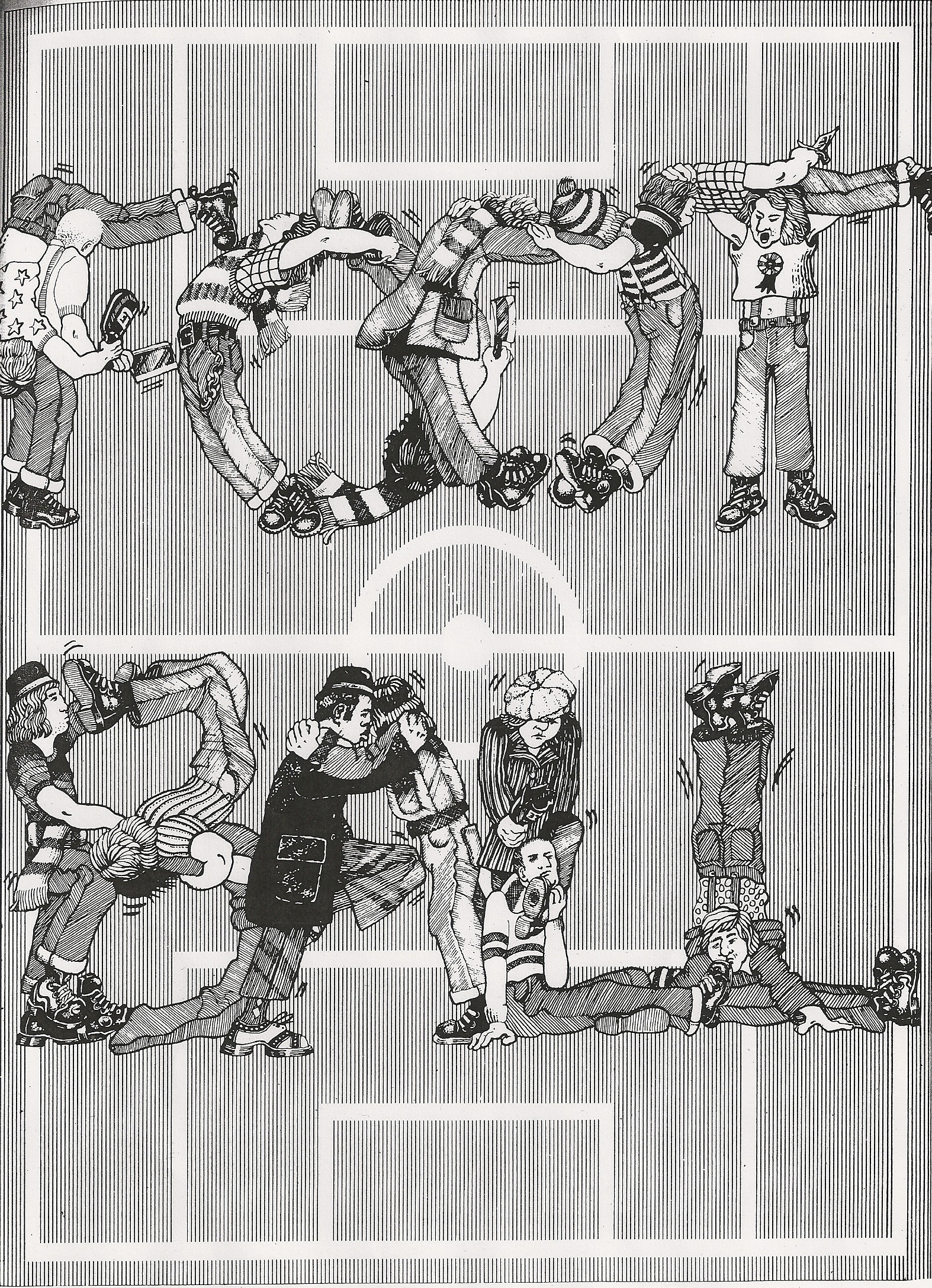
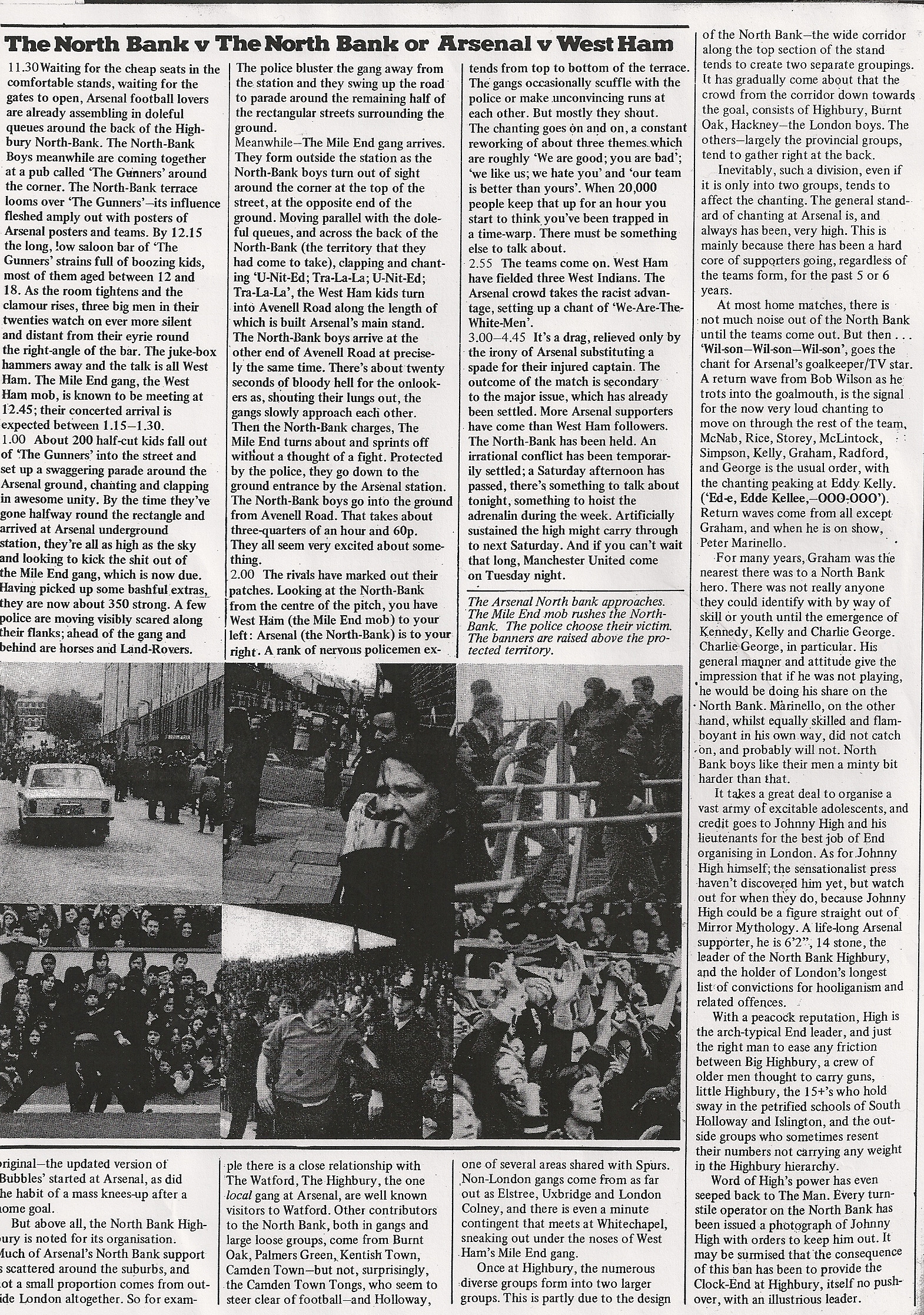
 I’ve mentioned Chris Lightbown’s article on London football gangs a couple of times before, but the piece itself hasn’t been available since it was first published in Time Out in 1972. The section on West Ham was reprinted in the excellent 2008 anthology London Calling, but the full article has been confined to libraries and private collections. Until now.

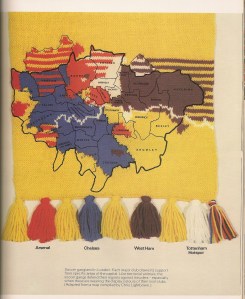
It is a fascinating read. This is the first time football fan culture had ever been seriously discussed by the press, and it offers a remarkable view of life on the terraces from the terraces, free of any moralism or finger-wagging. It is a thorough and very funny piece of writing, and is probably the first time terrace legends such as Mick Greenaway and Johnny Hoy (although he is called ‘High’ here) ever saw their names in print. It’s analysis of where the different clubs draw on their support is particularly great. 

The writing is very much of its time and place – complete with mention of ‘heads’ and ‘coons’ – and also paints the picture of a time when London terrace culture was very different: the Shed was as loud as the Kop, Arsenal had the most aggressive fans in London and Spurs were just a joke, on and off the pitch. Only West Ham’s identity appears to have remained more or less the same, although older Hammers would doubtless question that.

It is a cracking piece of work. Enjoy.