Category Archives: Politics

London riots and football hooliganism

‘People were determined to smash and destroy. Windows were being smashed and the looters saw their chance. A road sign went straight through the middle of the window. Two people moved in with cardboard boxes and filled them with jumpers. These would be highly resaleable. [Others] were concentrating on the jewellers’ shops and a good few were looted. People who were probably  law-abiding citizens at any other time just went berserk. The faces of people as they went into a smashed shop and grabbed goods were amazing; all signs of reason had disappeared from their eyes. One guy came out of a shop with his eyes rolled up, his tongue hanging from an open mouth and breathing heavily. His trip into the shop had been a physical experience, and he was beginning to smile. He had dared and won. In a very short space of time, the streets had been transformed into a madhouse. Sirens blared out and police vans screeched around the streets.’

Was this Tottenham last Saturday? Brixton on Sunday? Battersea or Croydon on Monday? Manchester on Tuesday? Surely it must be from one of those occasions this week when England was forced to confront the reality of a ‘sub-educated, feral underclass’ in a post-Thatcher ‘something-for-nothing society’ (as Andrew Roberts so colourfully described it).

Well, actually no. This was way back in 1983, in tiny Luxembourg, where England fans went on a smashing and looting spree after failing to qualify for the European Championships. Football hooliganism was approaching its nadir after a 20 year spiral that had almost destroyed the national sport and left the authorities baffled at how to control it.

Mob looting by football supporters dates back to at least 1976, when Liverpool supporters descended in large groups to rob shops in St Etienne, where they were watching a European Cup tie. It soon became assimilated into the away trip –  usually while being escorted back to the station, away supporters would smash up city centres, fight the police and, if the opportunity arose, loot goods from shops: a jeweller here, a clothes shop there. Whatever could be easily lifted and carried back home.

In Colin Ward’s classic account of terrace culture ‘Steaming In’ (from which the above passage also came), he describes Chelsea fans after a game in Luton: ‘The trip back to the town station saw the mass destruction of the town centre. Shops were looted and a train was set on fire… It was said that one guy who didn’t like football but had a fetish about smashing shop windows went along to have a good night out. Nutters often tag along with football crowds just for the buzz.’

The past week’s violence certainly seemed unprecedented – and in some ways it was – but there are significant parallels with the way overwhelmingly young football fans routinely behaved in the 1970s and 1980s. There’s the casual disregard for other people’s property, the mania of the crowd, the opportunist thieving and violence, the loose organisation into gangs, the sheer thrill of anarchy, the speed of movement and the power of being able to catch the police wrong-footed.

The fear is that mass lootings will become a commonplace event, another part of our lives, as criminal gangs realise what they can get away with if there are enough of them around and as long as the law and lawmakers remain clueless at how to respond. It certainly took the authorities a long time to get a handle on how to police football, but the experience has now been completely transformed, partly because of tough sentences for hooligans, partly because of the disasters at Heysel and Hillsborough but also because the football establishment itself realised it had to change the way it regarded football supporters if the behaviour of fans was to improve.

When I watched a small group of 20 or 30 kids terrorise Hackney in broad daylight on Monday afternoon while the police stood and watched, my first instinct was that they would never have let a bunch of football supporters behave like that these days. There are always lessons to be learnt from the past, if you look in the right places.

Secret London: swastikas

One of the great London rumours is that somewhere inside the Royal Society’s building on Carlton House Terrace sits a giant swastika.  This is not because these esteemed scientists and thinkers are secretly Hitler-worshipping fascists, but because their home at Nos 6-9 was the location of the German Embassy (at Nos 8-9) during the pre-war Nazi era.

Carlton House Terrace was designed by John Nash between 1827-1832 to occupy a site previously taken by Carlton House. No 9 almost immediately became the seat of the Prussian Legation, which slowly evolved into the German Embassy. In the spirit of the time, it soon expanded to occupy the house next door at No 8.

In 1936, Joachim von Ribbentrop moved in, replacing the late Ambassador Leopold von Hoesch (whose dog’s gravestone can be seen under a tree near the Duke of York steps). Von Ribbentrop demanded a complete renovation of the property, and the Nazi’s top architect, Albert Speer, was called in to do the job. Exactly what he did remains something of a mystery, but the German Embassy website claims:

‘Only the fact that the Nash Terrace was a listed building saved the facades from being included in Ribbentrop’s plan to establish a model of the Third Reich architecture in the centre of the British capital. The renovation was exhaustive, money was no object.’

It is hard to discern exactly what alterations Speer made, but one diplomat wrote that the showy renovation of No 8 and 9 Carlton House Terrace had produced a style and furniture less suitable for an embassy and more comparable to that of German luxury liners of the time like the “Bremen”.  A contemporary set of photographs are lodged at the Library of Congress. The only one currently viewable is of the very modern-looking kitchen.

This decent phot0-set shows the building now, including Speer’s striking staircase, said to be constructed by marble supplied by Mussolini.

Albert Speer designed this

Among Speer’s embellishments was said to be the inclusion of a swastika mosaic on the floor of one of the public rooms. After the war, rather than remove the offending article, the swastika was said to have been simply covered with a carpet. (And this website claims there are still visible ‘border designs of swastikas on the floor of one public room’, which seems unlikely.)

Is it true?

Well, I’ve never seen a photo to substantiate the claim and people I know who have been inside the Royal Society are also none the wiser. However, I did once receive an email at Time Out from a builder who claimed to have renovated the building in the 1990s and seen a huge swastika under one carpet. Where, presumably, it still remains. Von Ribbentrop also had a house built for him in Pinner, which was said to have swastikas carved into the staircase.

If you do have a hankering to see a swastika in London, you should head for India House, where this plaque can be seen on the wall.

It represents the swastika when it was still an intriguing sign from the east, before it was appropriated by Hitler. In the first two decades of the 20th century, the swastika was a popular symbol in the west, often used as a good luck charm and adopted by groups as varied as the Boy Scouts and the Druids. My copy of Rudyard Kipling’s Just-So Stories still has a prominent swastika featured in one illustration and the British Museum is full of the things.

Indeed, so popular was the swastika, it was even used to liven up the decor at Hounslow Bus Garage. Click on that last link and zoom in and you’ll see the border of pretty little swastikas that featured in the staff canteen. These swiftly disappeared as the truth about Hitler became impossible to ignore.


Thomas Paine’s London bridge

Thomas Paine was many things. A writer, revolutionary and political philosopher, Paine was also an inventor and engineer, who made the world’s first smokeless candle. He was also an occasional Londoner, most notably when he stayed at the Angel Inn, Islington, around the time he began writing Rights Of Man in 1791. This monument celebrates that fact.

Considerably more interesting than this, though, is the rarely discussed fact that Tom Paine built bridges. Iron bridges. And he built one of them in London.

Paine was fascinated by bridges, admiring them for their architecture as much as their metaphorical meaning. John Keane, Paine’s biographer, writes that he ‘was stuck by their double meaning. Bridges were for him combinations of architectural beauty and practicality, works of genius that could be breathtaking in their simplicity… the rising spirit of an epoch translated into space.’

Paine first tried to raise the funds to build an iron bridge over the Harlem River in New York in 1785 and then another over the Seine in Paris in 1786, but without success. Bridges of this era were still largely constructed in stone and wood, making Paine’s ideas rather unusual. Plus, he had no real background in engineering or architecture.

But he persevered. In 1788-89, he attempted to build an iron bridge over the River Don in South Yorkshire and although the project was never completed it did secure him a patent for his bridge-building scheme. Paine now decided that he needed to build his prototype bridge in London, where potential investors could see for themselves the sort of brilliant bridge he was going  to make. He told Thomas Jefferson – who himself had many ideas about how the bridge should be built – that a London bridge would soon pay for itself in tolls. Jefferson was impressed, writing to a friend: ‘Mr Paine, the author of Common Sense, has invented an iron bridge, which promises to be cheaper by a great deal than stone, and to admit of a much greater arch. He supposes it may be ventured for an arch of five hundred feet. He has obtained a patent for it in England, and is now executing the first experiment with an arch of between ninety and one hundred feet.’

Paine had originally hoped to build this experimental bridge to nowhere in Soho Square, but when he wrote to George Washington on May 1, 1790 describing his single-arch bridge of 110 feet, he still hadn’t found an appropriate location. By the end of May he could tell the no doubt anxious Washington that a site had been found – a field next to a famous tavern called the Yorkshire Stingo, on the Marylebone Road near what is now Lisson Grove. This was at least partly appropriate, given that the bridge was being constructed by a Rotherham-based ironworker called Thomas Walker.

Paine moved into the Yorkshire Stingo and began erecting his 110-foot bridge on the neighbouring bowling green. By September it was finished. Jefferson wrote to him a very nice letter saying: ‘I congratulate you sincerely on the success of your bridge. I was sure of it before from theory: yet one likes to be assured from practice also.’

However, although there were many interested visitors, none of them were impressed enough to offer to invest in Paine’s scheme to build a bridge over the Thames. By October 1791, Paine’s bridge had been started to rust and Paine had lost interest, so it was dismantled and the iron returned to Yorkshire, where some was used in a bridge built over the River Wear in Sunderland in 1796, which at the time was the longest iron bridge at the world at 240 feet.

London, JFK and Profumo

As fans of conspiracy theories know, there is always a connection if you look hard enough, and the one between JFK and the Profumo Scandal is particularly intriguing.

The connection is called Mariella, or Maria, Novotny. Different sources give her different places of birth – London, Sheffield, Prague – but most agree that she was really called Stella Capes. She almost certainly wasn’t the niece of former Czech President Antonin Novotny as she claimed, nor had she spent four years in a Soviet camp. But what’s undeniable is that she lived quite the life.

It was Novotny who hosted the infamous Man In The Mask orgy in an apartment in Hyde Park Square in December 1961, where various members of high society consorted with glamorous woman such as Mandy Rice-Davies and Christine Keeler. Novotny, who called the party The Feast of Peacocks after what had been served for dinner (she also cooked badger), spent much of the evening wearing a corset in bed with a whip and six men. Stephen Ward, the mysterious society osteopath, was there wearing socks and nothing else. Everybody else – among them actors, MPs and judges – was naked except for a man wearing a gimp mask, who was tied between two pillars and whipped by everybody on entry. There has been much speculation as to his identity, with names including minor royalty and Cabinet Ministers, but he has never been named.

The Feast Of The Peacocks became public knowledge after featuring in Lord Denning’s 1963 report into the security implications of the Profumo Scandal. This was written in the wake of Conservative Minister John Profumo’s resignation from the Cabinet following revelations regarding his relationship with Keeler and Keeler’s relationship with Soviet naval attach Eugene Ivanov.

This was not the first political scandal Novotny was at the centre of. Wherever she was born, she had moved to London in 1958 to become a model, and was soon performing as a topless dancer in Soho.

In 1960, she married. Her husband, Horace ‘Hod’ Dibben was in his 50s and moved in serious company. He ran the Black Sheep Club in Piccadilly and knew both the Duke of Kent and the Krays. He was a sado-masochist and a friend of Stephen Ward. Through Hod, Novotny met Harry Towers, a mysterious and sinister figure, who persuaded her to go to New York for some modelling work.

Novotny was soon operating as a prostitute in New York, with Towers as her pimp. Before long Towers had introduced her to Peter Lawford, the film star and John F Kennedy’s brother-in-law whose main responsibility was to find willing women for the insatiable President.  Novotny was soon sleeping with JFK. On one occasion she and fellow prostitute Suzy Chang were asked to dress as nurses, with JFK the patient.

In May 1961, Novotny was deported from the US, returning to London on the Queen Mary where she began hosting her memorable parties. Guests are said to include everybody from Bobby Moore to Felix Topolski. She was also introduced by Ward to both Ivanov and Profumo before Keeler, but nothing developed from this. Novotny believed she had been used to ‘get’ JFK and was wary of the same thing happening again. Keeler was not so smart.

When the Profumo Scandal broke, JFK was said to be fascinated by it, demanding to be kept informed of ongoing events, at least in part because of his own tenuous connection. Robert McNamara, the US Defence Secretary, knew all about the President’s dalliances with this prostitute who claimed to be from Eastern Europe and said ‘he felt like he was sitting on a bomb’. On June 23, one American newspaper even hinted at the President’s involvement, until his brother Robert Kennedy forcefully intervened and the story was dropped. Nobody picked it up and the President took his secret to the grave.

What to make of this? Some believe the fact Novotny was connected to JFK and Profumo was no coincidence and here you could go down a rabbit warren of theories and counter-accusations. One argument is that Novotny was part of a honey trap operation, run by Lyndon Johnson’s office by Towers and Ward with the assistance of the sex-obsessed FBI, aimed at blackmailing powerful men in Britain and America. Others claim it was a KGB sting – Novotny claimed Czech heritage and Chang was Chinese – and Towers was using his women to try to infiltrate the United Nations. Still others  say Ward and Towers were working for MI5 to entrap Ivanov. Conspiracy journal Lobster has more. This stuff could drive you insane.

Novotny later worked for the police in same capacity, and was used to help bring down gangster Charles Taylor. She died of an overdose in 1983. Some, including Christine Keeler, claim it was murder. Novotny had attempted to write a book about her life shortly before her death, but mysterious things kept happening to her and the ghostwriter, causing them to nervously end the project. After her death, her house was burgled and her diaries disappeared.

She did write a book in 1971. It is a fictionalised account of her adventures called King’s Road and one of the worst books I’ve ever read. You can get it on Amazon for 14p.

Marf: City Blues at the Guildhall Art Gallery

My review of Marf: City Blues, an exhibition at the Guildhall Art Gallery, appears in the Independent.

The Guildhall in the City is an appropriate venue for a series of cartoons about the financial crisis of 2008 and its aftermath. Marf is Canadian, but her cartoons are all set in London, and the Gherkin, St Paul’s and the tube all make appearances. The exhibition is on until June 20.

The Guildhall has recently become a free venue, which is slightly contrary to current trends, but the City of London has always done things a bit differently. It has a wonderful collection of London-related paintings, and is definitely worth a visit, and there are also plans to host regular paid-for temporary exhibitions. Marf, however, is free. The intention is that local workers, who are overwhelmingly from the financial services, will come to the gallery in their lunchtime to nose around.

I wonder what they will make of cartoons like the following when they do? Water off a duck’s back, probably.

Celebrating the noble tradition of defacing London statues

It seems to happen every time a march or protest takes place in London. A much-loved statue or monument is defaced, horrifying the sort of people who are horrified by this sort of thing while the rest of us wonder why nobody’s got round to throwing a bucket of paint at that godawful Animals At War monstrosity on Park Lane.

On Saturday, after the TUC and some kids dressed in black marched through the London to complain about stuff, it was the turn for the Landseer lions at Trafalgar Square to take a pasting.

lion

While the statue of Charles I received a more artful reimagining.

statue

Interestingly, this Charles I statue had already been manhandled by the mob – albeit inadvertently – way back in 1867 when a reporter climbed the statue to get a better view of a passing protest and used the sword to steady himself. The sword promptly fell off and disappeared into the crowd, never to be seen again.

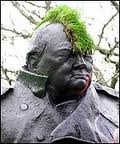
Most people think that this habit of deliberately defacing certain statues is a recent thing, dating back to the inarguably splendid Winston Churchill turf mohican on May Day 2000.

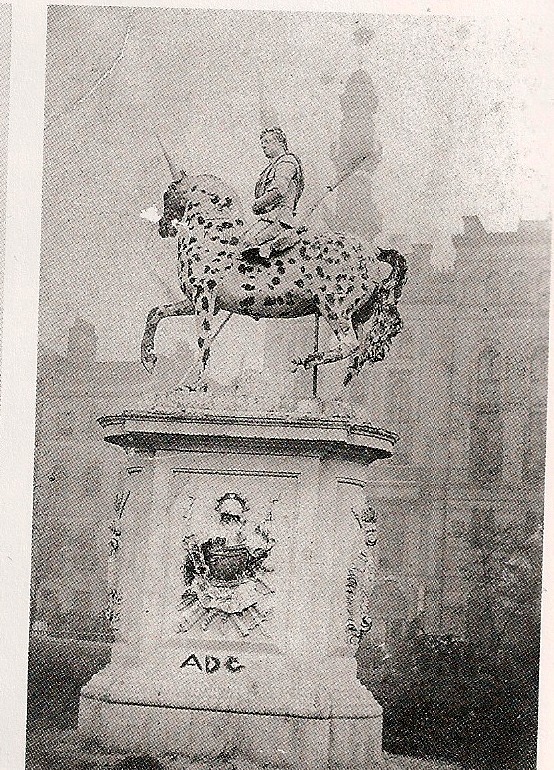
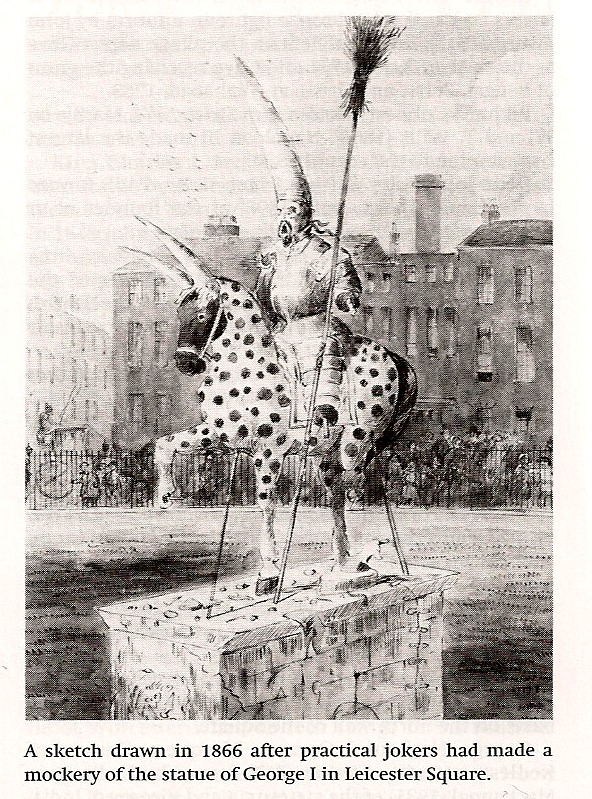
But the London mob has a rich tradition of dressing up (or down, depending on your viewpoint) London statues. My favourite example is the treatment dished out to the statue of a mounted George I, which was cast in 1716 and placed in Leicester Fields in 1784. This received serious punishment over the years as children clambered all over it, so both horse and rider lost bits, and at one point the poor king was without head, legs and arms. But worse was to come.

In October 1866, after the state of the statue had been discussed in the Times, guerilla jokers attacked the statue at night, painting black spots all over the horse, replacing the lance with a broomstick and putting a dunce’s hat from the nearby Alhambra Theatre on George’s bonce. Crowds flocked to see the spectacle. It was cleaned up, but eventually sold for £16 and pulled down in 1872.

As British History online website comments: ‘It would be almost impossible to tell all the pranks that were played upon this ill-starred monument, and how Punch and his comic contemporaries made fun of it, whilst the more serious organs waxed indignant as they dilated on the unmerited insults to which it was subjected.’

Nothing changes, once again.

Footballers: the new aristocracy

A few years ago, on a train coming back from Wales, I fell into conversation with the chap sitting next to me. He was a former professional footballer who now worked in the strange world of ‘player services’, which meant he was employed by a large London club to hold the hands of footballers. He helped them find a house, pay their utility bills, run the car, deal with cleaners and nannies, liaise with solicitors, represent them in court after unfortunate incidents with air rifles – basically all these annoying bits of life that most of us have to deal with but would probably rather we didn’t.

He told me a story about an African player who moved from London to a smaller club outside the capital. They who did not employ anybody in ‘player services’ but the footballer managed to get himself a new house easily enough. However, some months later he was astonished to discover his electricity and gas had been cut off.

It turned out that he hadn’t paid any of his bills. He thought that once you forked out for a house that was it, everything else – the lighting, heating, phone line etc – was taken care of. He’d stuck all his utilities bills unopened in a drawer and forgotten about them.

I recalled this splendid story recently when reading about the adventures of Jessica Mitford. Jessica was the Communist Mitford, an aristocrat who moved to Rotherhithe in the 1930s so she could live among the proles. Mitford seemed happy, even if she noted that ‘the locals were a shorter and paler race of people than the inhabitants of the West End. In appearance, dress and speech they form so radical a contrast as to give the impression of a different ethnic group.’

Mitford looked forward to a life of May Day parades and pie and mash among ‘the rough children of Rotherhithe’, but sadly it didn’t work out that way. Her daughter died of pneumonia, and the disconsolate parents fled to Corsica for three months.

When they returned, the problems continued to mount. Mitford and her equally posh husband, Esmond Romilly, a nephew of Winston Churchill, had never been told they needed to pay for utilities, and so ‘lights, electric heaters and stoves blazed away day and night’ in their house overlooking the river.

A gargantuan gas bill built up. Soon the gasman began to pay regular visits to try to get it settled, so Romilly took to wearing a false moustache as a disguise. Eventually, though, it all got too tiresome for words, and the couple fled back across the river to the sanctity of Marble Arch, where people were so much more understanding about the foibles of landed gentry.

London’s underground press: IT and OZ and the psychedelic left

‘IT came out of the Beats – poetry, jazz and art with a bit of lefty politics,’ says Mick Farren. ‘I told them this was fucked up, they weren’t talking about the weird changes going on with The Who, or where The Beatles were coming from. I’d say that with all respect to John Coltrane there’s this black geezer in the Bag O’ Nails who has long hair and plays guitar with his teeth, what are we going to do about that? So they asked me to be music editor.’

The current issue of Uncut magazine contains my feature on the London underground press of the 1960s and 1970s. It includes a number of stupendous quotes like the above from Mick Farren, one of the most colourful figures from the British psychedelic left.

The piece covers the founding of International Times in 1966, the relationship between the underground press and pop stars, the difficulty of publishing, happenings at the Roundhouse and Alexandra Palace, the creation of the UFO Club and the gradual demise of the movement after the dehibilitating OZ trial of 1971. Interviewees included Pete Townshend, Mick Farren, Marianne Faithfull, Robert Wyatt and Jonathon Green. Townshend was particularly reflective on his troubled relationship with the counterculture, and I’ll post the whole thing up here shortly.

There is some great stuff on the internet about both these publications, which in different ways served the needs of London’s young and switched-on population who were not being sufficiently satisfied by either the mainstream newspapers or the pop press. (And does that sound familiar or what?) They covered pot, pop and politics, were revolutionary in their use of colour, design and language and paved the way for later influential print movements like the punk and football fanzines of the 1970s and 1980s.

The entire International Times archive is online, a hugely valuable resource for hippy-watchers. Discover it here. Some of the old IT heads are also collaborating on a blog called The Fanatic.

For those interested in the OZ trial, I recommend the following two-part news clip made for Australian TV at the time of the trial in 1971. It’s a fascinating watch.

Moonlighting

I am going to be blogging current affairs type stuff over at Snipe, in the illustrious company of Adam and Darryl.  

My first post about the Old London Underground Company can be read here.

You can also read more of my stuff over at the Time Travel Explorer blog, which is devoted to maps and history. My latest piece is about the constancy of one London burial ground.

How a shoe can teach the Holocaust

It starts with a shoe. An old shoe, scuffed, brown and small. It’s old and battered, and has been carefully re-stitched at the back where the seam has come apart. A classroom of Year Nine schoolchildren are asked what they can tell from the shoe just by looking at it. They agree it once belonged to a boy and that it’s been repaired a few times – perhaps by a family too poor to buy a replacement – but at some point was lost or thrown away.

Then the teacher tells them where the shoe was found, in Poland, outside a village called Oswiecim, and that it probably belonged to a boy from Hungary, who would have arrived there on a train with his parents nearly 60 years ago. After getting off the train, he would have been told to remove his shoes while he went to take a shower from which he would never re-emerge. Oswiecim is the place that we now call Auschwitz.

The Holocaust is a daunting topic for schools. Pupils can be overwhelmed by the sheer scale of the genocide, and troubled by the complex emotions it can raise. For their part, teachers can struggle to define the Holocaust correctly, or explain why it happened and what made it so uniquely horrific.

Which is where the shoe comes in. ‘There are lots of issues when teaching emotional subjects like the Holocaust,’ says Paul Salmons, who created the Holocaust Education Development Programme (HEDP), a course prepared by the Institute of Education to help secondary school teachers. ’It has the potential to raise profound questions and move children very emotionally. This course tries to balance an emotional engagement with a cognitive reflective approach.’

The story of the shoe, explains Salmons, ‘isn’t just intended to get an emotional reaction, it is to raise questions in response to the children’s emotional encounter.’ So after the children are told about the shoe, they are encouraged to ask questions. What happened to the boy’s parents? Why did they allow him to die? Why was he killed at all? From here, a discussion about the Holocaust and its repercussions can begin, with teachers using material taken from the HEDP website. It is a fascinating and intuitive way to introduce the subject, immediately bringing something huge and monstrous down to a level that a child can comprehend.

The course was developed in response to research conducted by the IOE in 2006. This showed that while the Holocaust was widely taught in schools – it has been on the National Curriculum since 1991 – there were many areas where knowledge was lacking. The research also revealed that 77.5 per cent of teachers wanted professional guidance, finding it difficult to convey the enormity of the genocide without inundating children with brutal images.

‘It is important children learn about the Holocaust because of its significance in world history, but it’s equally important not to traumatise them,’ says Salmons. ‘We have a history of human atrocity that’s also a history of forgetting and until the Second World War, nobody tried to analyse man’s capacity for self-annihilation. So we see the Holocaust as pivotal in understanding certain things about human nature and important for children’s social and political education and historical literacy.’

The Jewish Museum

This is done without using images of heaped corpses or film of mass executions. On the first day of the course at London’s Jewish Museum, tutor Kay Andrew tells the 15 teachers that this is ‘not about threatening or graphic images. Traumatic images can be seen as leading material.’

Peter Sullivan, a history teacher at Forest Gate Community School in East London, concurs. ‘These images can actually lead to arguments about holocaust denial – kids will say that they were staged or are of prisoners-of-war who died of natural causes – so we try to use more specific material to avoid pointless arguments.’

Is Holocaust denial really a problem in secondary schools? ‘You do get some of the Muslim kids, not so much in denial, but arguing that they deserved it because of the way they treated Palestinians. A percentage cannot differentiate between Jewish and Israeli and don’t have the life experience to put it into the proper context. It’s not just the Muslim kids, just up the road is Barking and Dagenham where the BNP are active, and when Nick Griffin says “I can’t deny the holocaust because it is illegal to do so” you know exactly what he’s saying. We have to combat that.’

Salmons says ‘The issue is more Holocaust diminishing or trivialisation,’ he says. ‘The way it can be used to suit different agendas or to promote a cause.’ He cites the example of the invasion of Iraq, when ‘there was a tendency to equate Saddam Hussein with Hitler in a fairly unreflective way perhaps designed to mobilise people behind a policy, which should have been argued on the merits of whether it was right or not, not by appropriating something powerful from the past. If young people are aware of what really happened, then they are better equipped to make that judgment for themselves.’

Leon Greenman

The course puts the Holocaust into context. On the first of two days, Andrews covers a number of different topics that have little to do with genocide itself. Teachers look at the diversity of pre-war Jewish life to ensure teachers don’t present the 6 million as a faceless monolith, and are asked to consider different forms of resistance and resilience to escape notions of the Jews as passive victims. The story of Leon Greenman, a British-born Jewish man who lived in Holland and whose family was killed in Auschwitz, runs throughout the course. ‘Leon was taking about his experiences from the very beginning,’ says Andrews. ‘We have archive of him talking to the BBC in 1945. He remained active in anti-fascist politics and received an OBE from the Queen, so you can explore the influence of the Holocaust through the life of this one man.’

The course does not neglect the other Nazi crimes, including the persecution of Jehovah Witnesses, Communists, homosexuals, the disabled and the Roma. Salmons explains, ‘We take an academic definition of what the Holocaust was – that it was the genocide of European Jewry by the Nazis and their collaborators – but you have to look at other victims. They are part of the broader context and a lot of these crimes overlapped, but if you lump them together and call them the ‘Holocaust’ it ceases to have much meaning, because the differences are as important as the similarities. With the genocide of the Roma-Sinti, there is a parallel to the Holocaust but one that has its own name – the Porajmos – and it needs to be studied with its own significance.’

The course is part-funded by the Pears Foundation, a philanthropic venture who have recently invested £1.5 million in the UK’s first Institute for the Study of Antisemitism at Birkbeck and donated funds to London’s Wiener Library, the world’s oldest Holocaust library.

Improved understanding of the Holocaust in schools could help combat increasing anti-Semitism, but Salmons says it isn’t as simple as that. ‘We don’t cover contemporary anti-Semitism, but do try to understand the historical and ideological anti-Semitism of the leading Nazis. But we also explore how you didn’t have to be anti-Semitic to be complicit in genocide, you just had to benefit from it. Many Germans bought the goods of Jewish neighbours in auction, which means they give tacit approval. We hope that young people aren’t racist, but they can still be unwittingly complicit in all sorts of injustices without having any personal or ideological prejudices.’