Category Archives: London

‘Ladies who bus’

This is a piece I wrote for the Speed issue of the excellent Completely London magazine. 

Sometimes, it feels like there are few slower ways of getting round London than by public transport. And the bus –so often a victim of roadworks and burst water mains – can be the slowest of all. But for some, that slowness is part of the attraction. Jo Hunt (67), Mary Rees (68) and Linda Smither (64) are ‘ladies who bus’. Since March 2009, they have been taking all of London’s buses in numerical order, starting at No 1, travelling each route from one end to the other, and then writing about it on their blog. As a way to pass the time, it is a distinctively London thing to do. There are, after all, over 500 routes in London; more if you include those that start with letters, like the A10 or X68.

‘It began when I retired from my last job,’ says Jo, the head buskateer and a former teacher. ‘People asked what I was going to do. I said I’d just loll about or play computer games, but then I decided I’d get every bus in London.’

From that moment of whimsy came a plan, which became a blog and has now evolved into something like a mission. Jo, Mary and Linda have acquired matching sweatshirts with their blog address on it – these proved to be handy in winter when one bus’s central heating was broken – and they have printed business cards to hand to drivers at the end of journeys to explain what they are up to. Online, they have built up a following among London nerds and bus enthusiasts.

Jo got the idea when she got on a bus and saw it was terminating at Ponder’s End. ‘I thought, “Where’s Ponder’s End?”’ and elected to find out. ‘Then I thought if I was going to do one, I should do them all, and if I was going to do them all, I should do them in the right order.’ Linda and Mary were both ready for retirement as well, so – armed with their Freedom Passes –they agreed to come along. Jo’s son created a blog, and 200 buses later we are now travelling by bus from Brixton to Mitcham on one of the hottest days of the year.

And here I must make a confession. I also spent a couple of years on the buses, writing a weekly column for Time Out about exactly this topic – taking every bus in London in numerical order, from end to end. Well, it started as a weekly column, but soon lethargy took over, the column became fortnightly and then monthly and in the end I never made it further than the low 60s. Jo, Linda and Mary have persevered, resolve stiffened by each other’s company – and by Jo’s determination to complete the task. ‘Jo is the leader,’ confesses Mary. Jo plans each route a week in advance, working out how they are going to get to and from the stops that bookend the route, and she and Linda take turns writing them up on the blog.

But they are clearly enjoying themselves as well. There is much to appreciate about a lazy morning spent taking a bus for no other reason than the sheer fun of travel, watching London knit together while everybody outside rushes about their daily business without time to stop and absorb the city around them. As we slip languidly through south London streets, the trio note familiar landmarks and reminisce about other routes that have passed this way. They are also able to recall what an area was like 5, 10, 20, even 40 years previously. ‘It’s evocative,’ says Linda of the experience of revisiting old haunts. She also comments on how they have watched London change in the two-and-a-half years they’ve been doing the routes. When they began, the Strata Tower at Elephant & Castle was a building site – now it’s one of the tallest buildings in London. A rapid transformation, observed at leisure.

They are fascinated by London’s arcane history of– such as the Balham estate we pass that was reported to be Hitler’s choice for a home if he successfully invaded Britain – but also by the present, especially in Tooting, as South Indian restaurants slowly give way to West African clothes shops and Mary contemplates hopping off to pick up three crates of mangoes for £10.

London as seen by bus is a city of delights and surprises. ‘I’ve been surprised at how good the drivers are,’ says Jo. ‘I’ve really enjoyed being able to understand how London ties together. And sometimes you’ll be bumbling along and then suddenly you are in the country, surrounded by green. It’s like you’ve reached the end of the world.’ Or the end of London, which sometimes feels like much the same thing.

Inside the Bank of Ideas

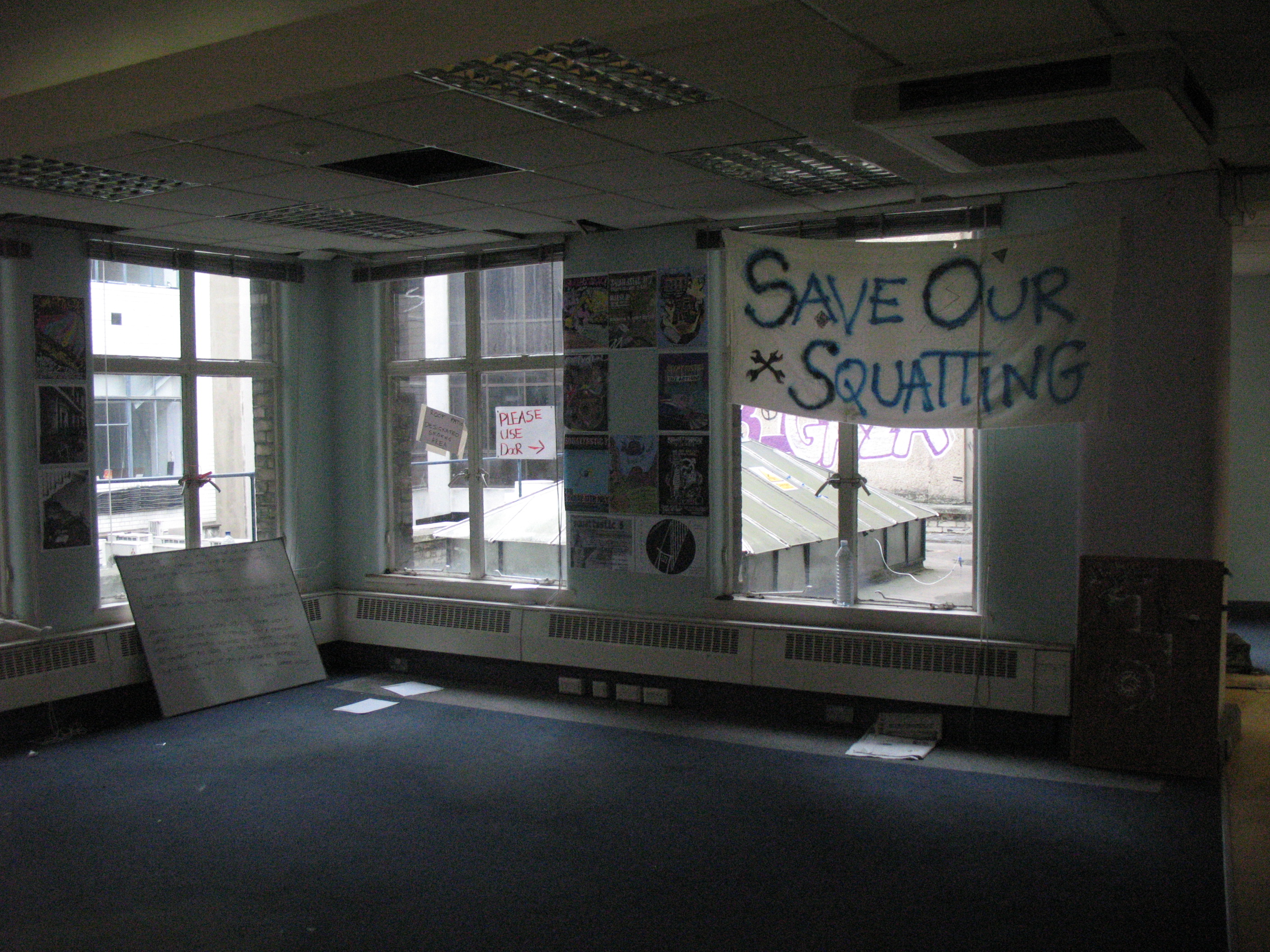
Last week, I paid a visit to the Bank of Ideas, the squat/community centre that has been set up inside an empty office building near Liverpool Street.

I didn’t know quite what to find inside, and while I expected a friendly welcome I was surprised by the  depth of organisation that has gone into the enterprise, owing as much to the methods of middle management as it does the spirit of the co-operative. This is organised occupation on an impressive scale. There were flowcharts, spreadsheets and white boards full of information and advice on every surface, with people running round spreading messages and sharing news. I’ve worked in dozens of newspaper offices where communication was worse than this. It’s energetic, unifying and genuinely impressive on every level.

All members of the media are asked to visit a room next to the entrance hall to sign in and get tapped up for donations (the Bank is run a voluntary basis, with donations and skill-sharing). It was here I spoke to one of the ‘caretakers’, Bryn Phillips, an earnest youngish man in music PR who informed me that they had decided to squat the building when they ‘discovered it was owned by UBS. After researching UBS they seemed the perfect target for a Situationist critique of the finance industry’. As a fan of Situationist critiques, I thoroughly approved.

The Bank, of course, taps into a long tradition of London communes and squats that seek to serve a greater purpose than merely place a roof over peoples heads – the best example is the squatting of Centre Point in the 1970s to raise awareness of homelessness – while its educational aspects, the Free University and regular workshops, recall the London Anti-University and Notting Hill’s London Free School of the 1960s, though I’d hazard a guess that neither was as carefully organised as this.

How long the Bank of Ideas will be allowed to remain open remains to be seen, but it should be around in the early part of next week at least. If so, I recommend you pay a visit quickly, before the dead hand of corporatism crushes another lowly outlet of fun and dissent.

Drugs and dead babies at the Queen’s bookshop

Maggs Bros is a posh antiquarian bookseller on Berkeley Square that has a Royal Warrant and is supposed to occupy the site of the most haunted house in Britain, but it is also home to a small contemporary art gallery, located out the back and accessed via 50 Hays Mews.

The latest show is being curated by New Artists and features photographs by Richie Culver taken of London crackhouses. These are loosely based on Gustave Dore’s engravings of Victorian opium dens.

Opium Smoking

The exhibition also features Polaroids by Shorvon & Hunter that explore the demise of the Polaroid and newspapers as forms of media. It’s definitely worth a look if you are in the area before it closes on Monday, December 5.

If you do, you should also pop upstairs to see a selection of some items that Maggs’s counterculture expert Carl Williams is currently selling. These include photographs of William Burroughs taken by Brion Gysin in Paris and an extraordinary mural taken from an American street gang club house. You could also pick up a copy of Carl’s latest catalogue to see if he has anything you fancy, whether it be items to do with Crowley, punk or the Weathermen. Last time I visited, he showed me some pictures he’d just acquired of dead Victorian babies, but don’t let that put you off.

Secret London: LSD experiments at the World Psychedelic Centre

Michael Hollingshead has been described as ‘an English trickster and con man of the first order’ by one commentator, but he described himself as ‘The Man Who Turned on The World‘.

Hollingshead was the British man who introduced LSD to Tim Leary in December 1961 on the recommendation of Aldous Huxley. Hollingshead was working in New York when he came upon a quantity of LSD. Huxley suggested he send it to Leary, who was already experimenting with administering psilocybin to patients during his psychological research at Harvard. Leary loved it. The LSD revolution began.

After working in America with Leary – he even lived in his house – Hollingshead was sent to London in September 1965 with enough Czechoslovakian lysergic acid to produce 5,000 trips, thirteen boxes of psychedelic literature – The Psychedelic Experience, The Psychedelic Review and The Psychedelic Reader – and plans for ‘a psychedelic jamboree’ at the Royal Albert Hall featuring the Stones, the Beatles and Leary himself. Although this is sometimes presented as Hollingshead playing the role of John The Baptist to Leary’s Psychedelic Christ, Barry Miles’s ‘London Calling’ suggests that Leary was just trying to get rid of the increasingly drug-addled Hollingshead and is said to have remarked upon his departure, ‘Well, that writes off the psychedelic revolution in England for at least ten years.’

Hollingshead promptly set up his base at his flat in Belgravia’s Pont Street, which he renamed the World Psychedelic Centre, and redecorated with the key elements needed for a good trip: bowls of fruit, handwoven cloth, open fire,  bread, cheese, wine, candles, incense and goldfish. A chill out space, basically.

This was one of only two reliable sources for LSD in London at the time, so visitors were plentiful and Hollingshead began welcoming key figures from the scene – including Roman Polanski, Alex Trocchi, William Burroughs, Paul McCartney, Eric Clapton, Donovan and the Rolling Stones.

Guests were invited to take part in LSD sessions designed to make the most of the experience, with ‘lots of cushions, some excellent tapes and hi-fi equipment, a slide projector, and several chillums’. The LSD was dispensed after midnight inside grapes impregnated with 300 micrograms of the drug. The atmosphere was key. Hollingshead writes:

Shortly after dropping the acid, I played a tape of Buddhist Cakra music, followed by Concert Percussion by the American composer, John Cage. Next I played some music by Ravi Shankar and some bossanova. Interval of fifteen minutes. Then some music by Scriabin and part of a Bach cello suite. Interval. Some Debussy, and Indian flute music by Ghosh. Interval. Bach organ music and some John Cage ‘space’ music. Interval. The Ali Brothers and Japanese flute music. We also looked at slides projected on to the ceiling Tantric yantras, Vedic Gods, the Buddha, Tibetan mandalas.

There were also regular readings from Leary’s work

While Hollingshead dispensed LSD to his visitors in these carefully controlled conditions, he was soon self-medicating with cannabis, speed and heroin to control the fierce highs he experienced from taking strong doses of acid at least three times a week. The tabloids soon got wind of these experiments with the ‘killer drug’  and after hosting a party of 80 hippies at which two undercover police officers were dosed with acid after sampling the spiked punch, Hollingshead was busted. Naturally, he attended his trial while tripping and was sentenced to 21 months at Wormwood Scrubs. There he met spy George Blake, who promptly took a trip on some of the acid Hollingshead smuggled in to the prison, before escaping and going into exile in the Soviet Union.

Hollingshead didn’t make it quite that far himself, ending up in Cumbrae, a Scottish island, where he settled with a group of believers who treated LSD as a holy sacrament in quasi-religious services. He then went on his world travels.

Hollingshead was undoubtedly a key player in the scene. However, it’s notable that when a copy of his book, The MAn Who Turned on the World was sent to Timothy Leary in prison in the 1970s, Leary underlined only a single sentence – ‘…my taking of methedrine…’ Leary’s acquaintances believe that not everything Hollingshead said about his role in the psychedelic revolution could be trusted because of his addiction to opiates.

Art of Mapping at Air Gallery

The Art of Mapping at the Air Gallery in Mayfair is the latest exhibition to take mapping as its inspiration. It consists of 34 contemporary works that are based on maps, some more loosely than others.  Among those familiar to map freaks will be Grayson Perry’s Map of Nowhere.

Stephen Walter, who created the magnificent, possibly definitive London map, The Island, also features with two different works, Isle of Dis and Down River.

Maps of cities dominate (perhaps a little too much), and London is heavily featured. Prominent is Simon Patterson’s The Great Bear, perhaps the first map to mash-up Beck’s Tube map and deserving of praising for that, even if I’ve always found the Bear map itself rather dull.

I was, however, fascinated by Jeremy Wood’s My Ghost, which used GPS to map nine years of movement around London, creating a spidery thread that created an approximate outline of the city’s streets.

It reminded me of a similar project undertaken by London cab driver Richard Cudlip. Similarly, I liked Rob Good’s Two Cities, which reproduced a stencil of the south-east of England shorn of anything manmade, and mounted powerfully on stainless steel.

There was something in both these maps about landscape and the way humans interact with it which is best expressed through contemporary art. Many of the maps seemed to promote this similar sense of alienation with the city, making it a stark contrast to the Museum of London’s recent Londonist-inspired exhibition, which emphasised the way areas of a city can become as familiar to us as our own bodies.

Stanley Donwood’s London was a more colourful and less ambitious version of The Island, emphasising that where Patterson’s Great Bear introduced a concept others could better, Walter has created something that will probably never be matched.

The last London map was Nigel Peake’s XXXIV Crossings, which was a lovely stylised look at London’s various river crossings, overlapping chaotically. Nigel has created a lovely book on a similar theme, featuring London’s bridges drawn in various ways.

Away from London, I also loved Susan Stockwell’s Jerusalem, which reconstructed a map of the British Isles out of recycled computer components, and Emma Johnson’s Dislocation: Time And Place, for which she had taken a pair of scissors to a map, removing streets and parks and then reconstructed it in  an overlapping 3D effect, like a pop-up plate of paper spaghetti.

The Art of Mapping, curated by TAG Fine Art, is at Air Gallery on Dover Street until Sat November 26.

Hippy-dilly: squatting and the London Street Commune at 144 Piccadilly

Tonight, Radio 4 will broadcast a show on squatting, called ‘From Frestonia To Belgravia‘.

Squatting as a 20th-century phenomena originated in the wake of the acute housing shortage after the Second World War. Homeless families began to occupy empty mansion blocks and hotels, including Duchess of Bedford House in Kensington.

Some of the squatters of the 1960s took this as their inspiration. Among the most political were the London Street Commune, a group of self-declared space cadets from the streets who were turned into a minor political weapon by a Spart called Phil Cohen, aka Dr John, who had previously been involved with the British Situationist International group, King Mob. The LSC became loosely involved in the counterculture scene and even at one point managed to occupy the offices of the underground newspaper, International Times, believing it was ‘bourgeois’ and needed to be ‘liberated’. They gave up after a few days when they realised they didn’t really understand how to put a newspaper together.

The London Street Commune’s most conspicuous act came when they squatted a vast Park Lane mansion, 144 Piccadilly, at Hyde Park Corner in September 1969. This gained them massive media attention, and the building quickly came to be dubbed ‘Hippy-Dilly’ and attracted vast crowds of largely hostile onlookers. The LSC responded by barricading the front door and creating a ‘drawbridge’ out of wood from one of the ground-floor windows, and asking the Hell’s Angels to protect them.

Around 100 people were said to be living in the building, among them the odd journalist who infiltrated the squat so they could produce salacious copy about the drug-taking ne’er-do-wells. After surviving an attempt by skinheads to ‘take’ the mansion – the LSC threw carpet bowls and balloons filled with ink at the approaching skins – the police decided to take action.

The police moved in on September 21, leading to in the words of the Daily Mirror, ‘The Fall of the Hippy Castle‘. This took place the day after a free festival at Hyde Park, which many of the LSC had attended. The squat was now filled with numerous disparate groups, including Hell’s Angels and French veterans of May 1968, alongside the original Dilly drop-outs, but they were quickly moved out by police, who arrested around 70 of the squatters.

While John Lennon went on TV to offer the displaced squatters a home in the shape of an island off Scotland, the high-profile eviction was greeted with delight by the media. The Times demanded the squatting be made illegal and that hippies be arrested under the vagrancy act. This remarkable Pathe newsreel – with talk of ‘scroungers and drop-outs… snubbing the conventions of decent society… doing the real homeless a disservice’ – demonstrates the prevailing attitude. It is difficult to conceive of broadcast media speaking in such terms today.
In 1972, American film director Sam Fuller wrote a pulp novel about 144 Piccadilly, but the building itself was not to last much longer. It was knocked down in the 1970s and replaced by the ghastly Intercontinental Hotel.

Secret London: the Temple of Mithras goes back where it came from

The Temple of Mithras is one of London’s most easily viewed and best known Roman sites, but it is also one of its crappest. The temple has been in the wrong place pretty much ever since it was discovered 50 years ago and now sits unimpressively in a bed of a concrete in front of a banal office building in the City (image below from Knowledge Of London).

The Temple of Mithras: ‘crap’

All that is about to change. Next week, Museum of London Archaeology will begin a three year project that will put the Temple back where it belongs, and restore it to something closer to its original form. They will also do a little digging, to see what else they can discover.

The Temple – a shrine to an Iranian god who was said to have killed a mythical bull – was found by archaeologist WF Grimes  in 1952 on Walbrook. The cult was adopted by the Romans in 1 AD and the temple – probably built in around 250 AD – would originally have been a subterranean space where bulls were sacrificed. Archeologists had suspected there was Mithran temple in London since 1889, after the discovery in Walbrook of a relief depicting the god killing a bull but it was only uncovered after the Second World War, when the area suffered heavy bomb damage and became ripe for development.

A statue of Mithras were found buried beneath the temple, and it may well have later been used by followers of Bacchus, as Mithraism went into decline. Mithraism is sometimes seen as a precursor to Christianity, although I don’t know enough about that to possibly comment.

The temple was dismantled shortly after it was discovered so the construction of Bucklersbury House could continue. The material was put into storage and many of the statues loaned to the Museum of London. In 1962, the temple was reconstructed on Queen Victoria Street, 90 metres from its original site at ground level, embedded in the courtyard of a City office block. It was a particularly dismal and unsympathetic treatment of a genuine archaeological curiosity. Most people had no idea what it was, and even if they did, it was very hard to care.

The site is now owned by Bloomberg, and they are about to start dismantling the temple by removing it from the cement that currently encases it, and then reconstructing it on its original site in what they call ‘a purpose-built and publicly accessible interpretation space within their new building’. This will take three years, but many will rejoice that it is happening at all.

Brixton Village hawk

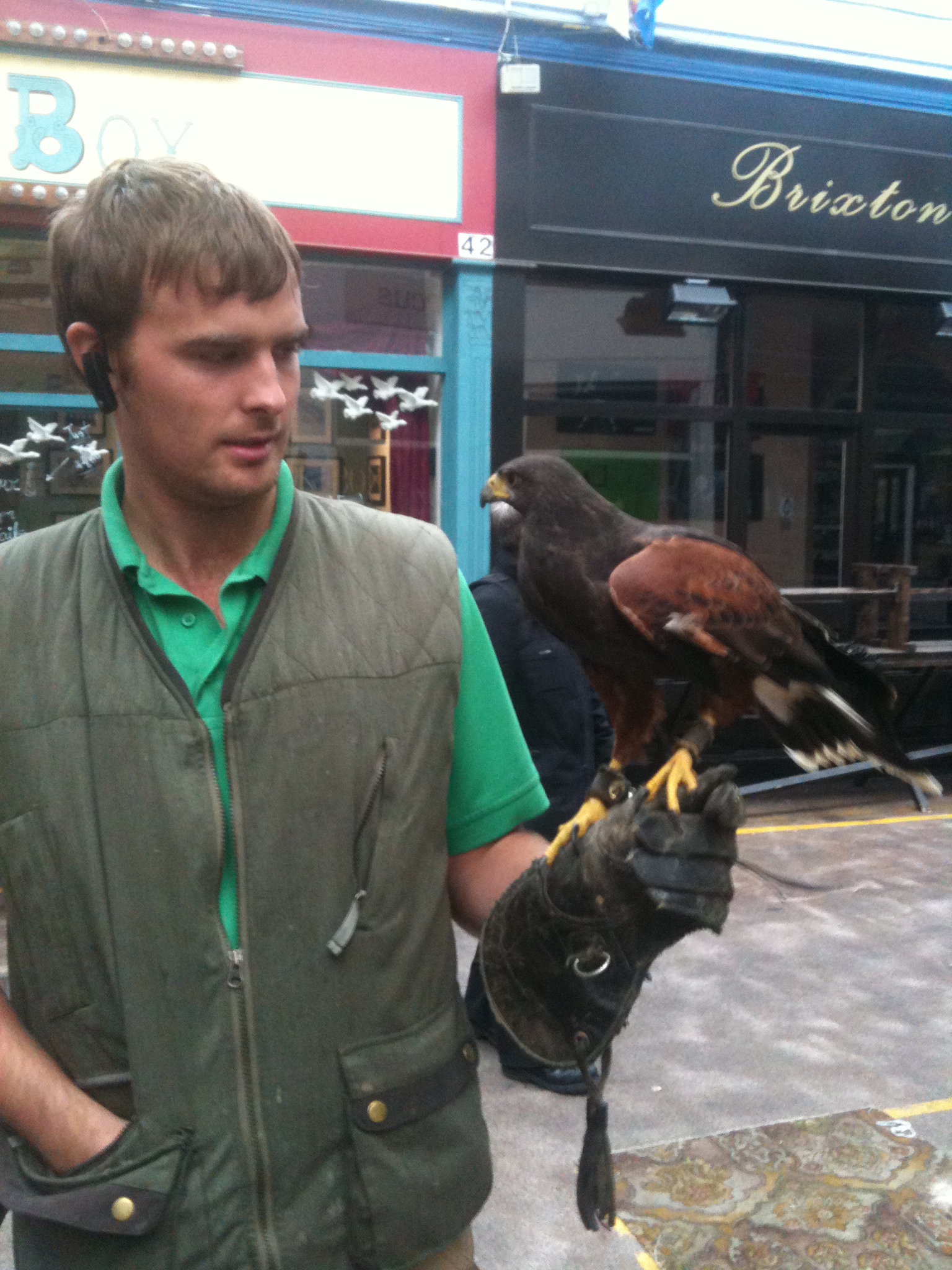
I saw this harrier hawk in the unlikely surroundings of Brixton Village this week while I was quietly tucking into a galette washed down by hot ginger beer.

He is flown around the market twice a week to keep pigeons away and dis-encourage them from nesting in the rafters, where they would crap merrily on hip Londoners going about their hip business. Many of the local stallholders looked terrified.

William Burroughs and the strange demise of London’s first espresso bar

In 1953, a momentous event occurred in Soho. London’s first proper coffee shop – one equipped with a Gaggia coffee machine – opened at 29 Frith Street. This was a place where teenagers too young for pubs could come and gather, and it is said by some that the introduction of this coffee bar prompted the youth culture explosion that soon changed social life in Britain forever.

The Moka was an instant success, selling over a thousand cups of coffee a day. The author John Sutherland recalls, ‘the Gaggia machine, a great burbling, wheezing, spluttering monster, would grudgingly excrete some bitter caffeinated essence.  It would be swamped with steamed-milk foam and dusted with chocolate to form its ‘cappuccino’ hood… Glass cups and brown sugar (lots of it) were de rigueur.  Frankly, 50s espresso was no taste thrill.  But it felt smart as hell.’

By 1972, coffee bars where everywhere and the teenage revolution was firmly established. At this time, the author of ‘Naked Lunch’, former junkie and all-round Beat legend William S Burroughs was living in London, quietly going about his business in St James’s. He lived in Dalmeny Court, Duke Street, and loved the plush gentlemen’s shops of the area, not to mention the ‘Dilly Boys‘, young make prostitutes who hustled for clients outside the Regent Palace Hotel.

Although Burroughs was fond of the finer things in life – he got his shoes from John Lobb, hat from Locke’s and bought most of his food in Fortnum and Mason’s – he did at some point stumble into the Moka Bar, and was not impressed by what he found.

Burroughs at this time was getting sick of London – sick of the licensing laws, sick of the crap food and small drinks, sick of the weather, the terrible service and sexual hypocrisy. He was also sick of the Moka, which he believed responsible for an ‘outrageous and unprovoked discourtesy and poisonous cheesecake’.

Burroughs decided to mount a sound-and-image attack. He had previously launched one of these against the Church of Scientology, of which he had been a member, turning up at their headquarters at 37 Fitzroy Street every day, taking photographs and making sound recordings. He believed that ‘as soon as you start recording a situation and playing them back on the street, you are creating a new reality’ and that repeated exposure to such an attack would lead to ‘accidents, fires and removals’. After a few weeks, the Scientologists did indeed move, round the corner to 68 Tottenham Court Road.

On August 3, 1972, Burroughs turned his attention to the Moka. He would stand outside every day taking photos and making recordings by tape, and then return the next day to play the previous days recordings. Burroughs was convinced he was winning. ‘They are seething in there,’ he said. ‘I have them and they know it.’

On October 30, 1972, the Moka Bar closed.

Slade in London

I have a piece in the latest Uncut magazine about Slade, the glam rock bovver boys who became the most successful British group of the 1970s.

Slade were proud Black Country band – all raised in and around Wolverhampton and Walsall – and they never really took to life in  London, something that may have explained why it took them so long to break through. As Don Powell, the drummer, told me, ‘We didn’t really feel comfortable in the London scene when we could just be in the pub with our mates in Wolverhampton.’ Even today, all four remain wonderfully faithful to their roots and have the flattest vowels of any band I have ever interviewed.


But London still had an impact on their career. In 1966, beanpole producer Kim Fowley spotted the band – then called the N’Betweens – playing Tiles nightclub in Oxford Street and promptly hustled them into the recording studio. This was the result.

Tiles was a Mod club. John Peel played there once but his hippie tunes didn’t go down too well with the audience and he recalled: ‘It was certainly not the kind of place where they wanted to hear what I was doing. And there were waves of irate customers coming up over the footlights to try and persuade me to play whatever it was they wanted me to play. Which certainly wasn’t the Grateful Dead and Jefferson Airplane and Country Joe and the Fish or whatever I was playing. They didn’t like me at all.’

This terrific Pathe newsreel shows The Animals playing at Tiles, and it was ex-Animal Chas Chandler who gave Slade their next big break after he saw them performing at Rasputins on Bond Street. Noddy Holder told me, ‘Chas wanted to see us live. So we were booked to play a tiny place called Rasputins in Bond Street and we played our usual set there. People stopped dancing to watch us, which didn’t really happen at the time, and as Chas came down the stairs he said we were that good he thought it was a record being played. He thought it was fantastic and signed us the next day, no second thoughts. We started working a lot of London clubs and bigger venues around the country.’

Thereafter, Slade became regulars on the London circuit, and were the first band to book Earl’s Court (Bowie played a show before them, but had booked it after Slade). While Bowie’s show was plagued by sound problems, Slade were able t learn from his mistakes and their concert was deemed a great success.

Their favourite venue was probably the Top of the Pops studio in Elstree, where their rabble-rousing songs and remarkable outfits meant they practically became the house band.

Sadly, though, two of their greatest London moments have been lost forever. As one fan writes here, the band recorded two promo videos for Top of the Pops, one at Chessington Zoo for “Look Wot You Dun” and another at Greenwich Observatory for “Gudbuy T’Jane”. Both films have been wiped and seem to  be lost, among with many other studio Top of the Pops appearances.

Finally, here’s the band just before they made it. Still known as Ambrose Slade, this promo for their first album was filmed in Euston Station. The band had recently come out of their skinhead phase, and are nothing like the colourful eccentrics they would soon become.