Category Archives: Journalism

London’s football gangs: 1972

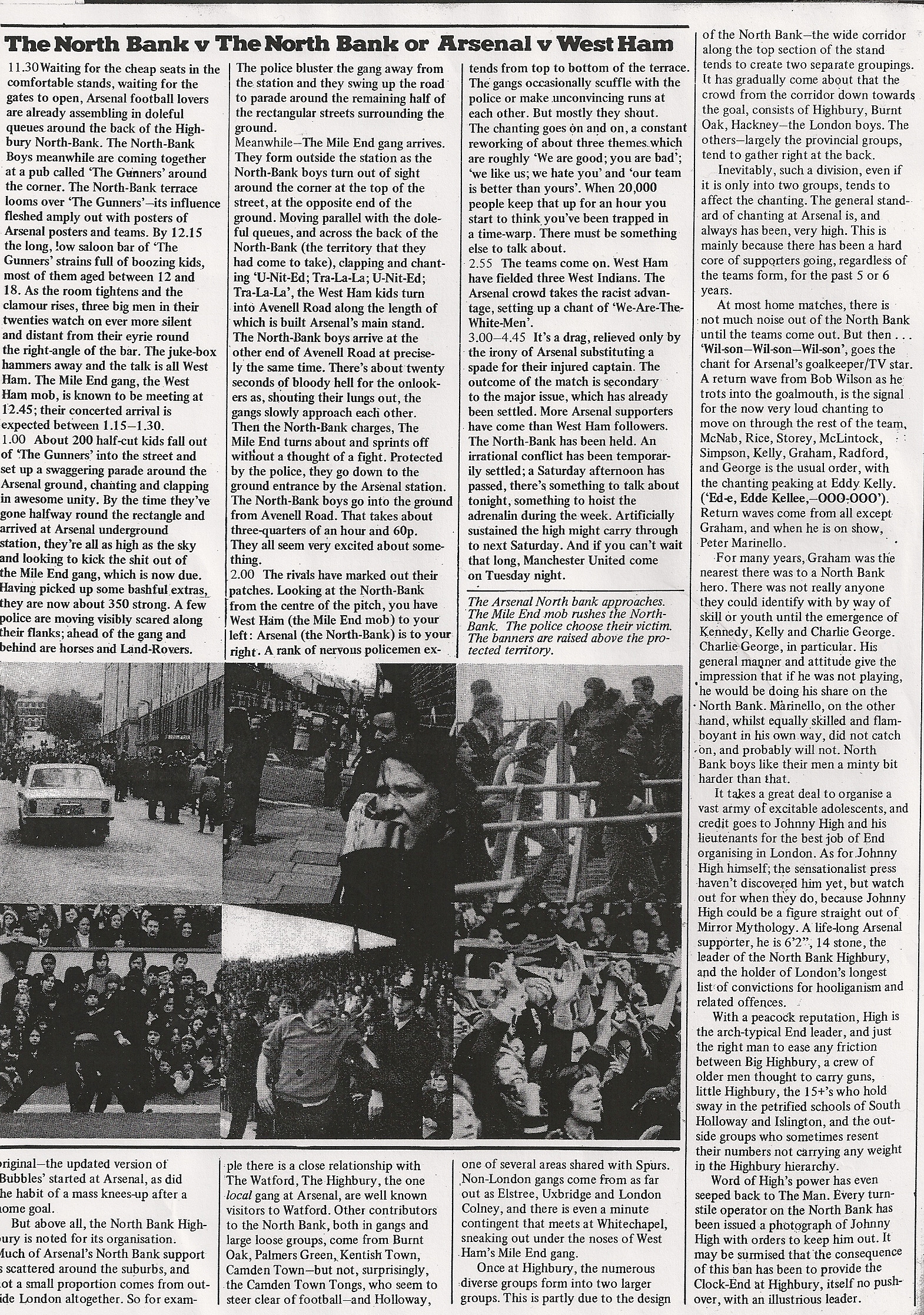
 I’ve mentioned Chris Lightbown’s article on London football gangs a couple of times before, but the piece itself hasn’t been available since it was first published in Time Out in 1972. The section on West Ham was reprinted in the excellent 2008 anthology London Calling, but the full article has been confined to libraries and private collections. Until now.

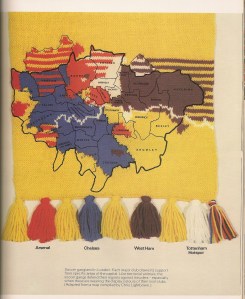
It is a fascinating read. This is the first time football fan culture had ever been seriously discussed by the press, and it offers a remarkable view of life on the terraces from the terraces, free of any moralism or finger-wagging. It is a thorough and very funny piece of writing, and is probably the first time terrace legends such as Mick Greenaway and Johnny Hoy (although he is called ‘High’ here) ever saw their names in print. It’s analysis of where the different clubs draw on their support is particularly great. 

The writing is very much of its time and place – complete with mention of ‘heads’ and ‘coons’ – and also paints the picture of a time when London terrace culture was very different: the Shed was as loud as the Kop, Arsenal had the most aggressive fans in London and Spurs were just a joke, on and off the pitch. Only West Ham’s identity appears to have remained more or less the same, although older Hammers would doubtless question that.

It is a cracking piece of work. Enjoy.

Lying about London

This appeared as part of an article that was published in the January 2012 edition of The Sunday Times Travel Magazine about London walks. Chris Roberts also runs the  wonderful One Eye Grey magazine and he will shortly issue a volume of stories from the magazine on Kindle.  In March 2012, Chris will be hosting some special related one-off walking tours

Deep in Chelsea’s prim back streets on a drizzly winter evening, half-a-dozen people wearing blindfolds are groping their way down a quiet Georgian square past James Bond’s house, leaning on each other for guidance, and giggling like schoolchildren. This is what happens when you go on Chris Roberts’s Liars London tour, a walk that offers fact, fiction and forfeits in the fancy surroundings of Sloane Square.

Roberts, a librarian, London historian and author, came up with the Liars London idea four years ago when he was asked to curate a tour for the local council. It’s a simple idea. Roberts and Silvana Maimone lead the walk and at each stop they both tell a story about the area: one story will be true and the other false. The audience are asked to guess who is lying and the person who is right most often receives a small prize at the end. Get it wrong, and you may have to pay a location-related forfeit, such as walk around in a blindfold, write a poem, or have a duel with waterpistols. Roberts and Maimone are a great double act, garrulous and witty, happily interrupting each other’s story-telling with exaggerated scoffing. Under their spell the 20-or-so walkers soon start to relax.

We are strangers when we meet among the evening commuters and blinking fairy lights at Sloane Square, but have already bonded by the time we reach the Saatchi Gallery at the affluent end of the King’s Road, where London’s wealthy still promenade in ostentatious fashion. Roberts is spinning an improbable yarn about British fascist Oswald Mosley, when an eavesdropping passer-by indignantly mutters in plumy tones, quite correctly as it happens, ‘What a load of rubbish!’ much to our amusement.

Because the walks require two hosts and require around 20 people attendees – people are happier to participate as part of a larger group, Roberts believes – they must be booked in advance. The Chelsea tour goes from busy Sloane Square down through quiet residential back streets, where every house is impeccably maintained and fragrantly festooned with hanging baskets, before finishing at Cheyne Walk, an 18th-century parade of grand houses nestling on the banks of the Thames, whose surface gleams inkily in the moonlight.

Over 90 fascinating minutes, we take in unusual landmarks such as James Bond’s fictional house on Royal Avenue and the riverside home of wombat-obsessed Romantic poet Dante Gabriel Rossetti. When it comes to the stories, the truth is often just as entertaining and unlikely-sounding as the fiction. Outside the rich brick walls of Chelsea Physic Garden, a seventeenth-century botanical garden, we are asked to choose between Maimone’s story about how a strange plant here became the inspiration for the fiendish foliage in John Wyndham’s sci-fi classic Day Of The Triffids, and Roberts’s (correct) claim that cotton seeds taken from Chelsea ended up being picked by slaves in the southern state of the United States, ultimately leading to the American Civil War.

Tall tales or otherwise, this sort of London knowledge is a personal obsession for Roberts, who has written a book, ‘Cross River Traffic’, about London’s bridges, and edits One Eye Grey, a magazine devoted to capital folklore. As such, he can’t help himself but pepper each conversation with a few extra facts and arcane titbits, making the walk a treasure trove for those who like trivia, albeit trivia that’s sometimes indistinguishable from entertaining falsehood.

Harry Redknapp lends a hand

Possibly the only interesting sentence that has ever been written about Harry Redknapp appeared 40 years ago, when Redknapp was playing West Ham. It goes:

‘It is said that when West Ham were fighting Coventry at Coventry station last year, Billy Bonds and the inevitable Harry Redknapp came along to lend a hand.’

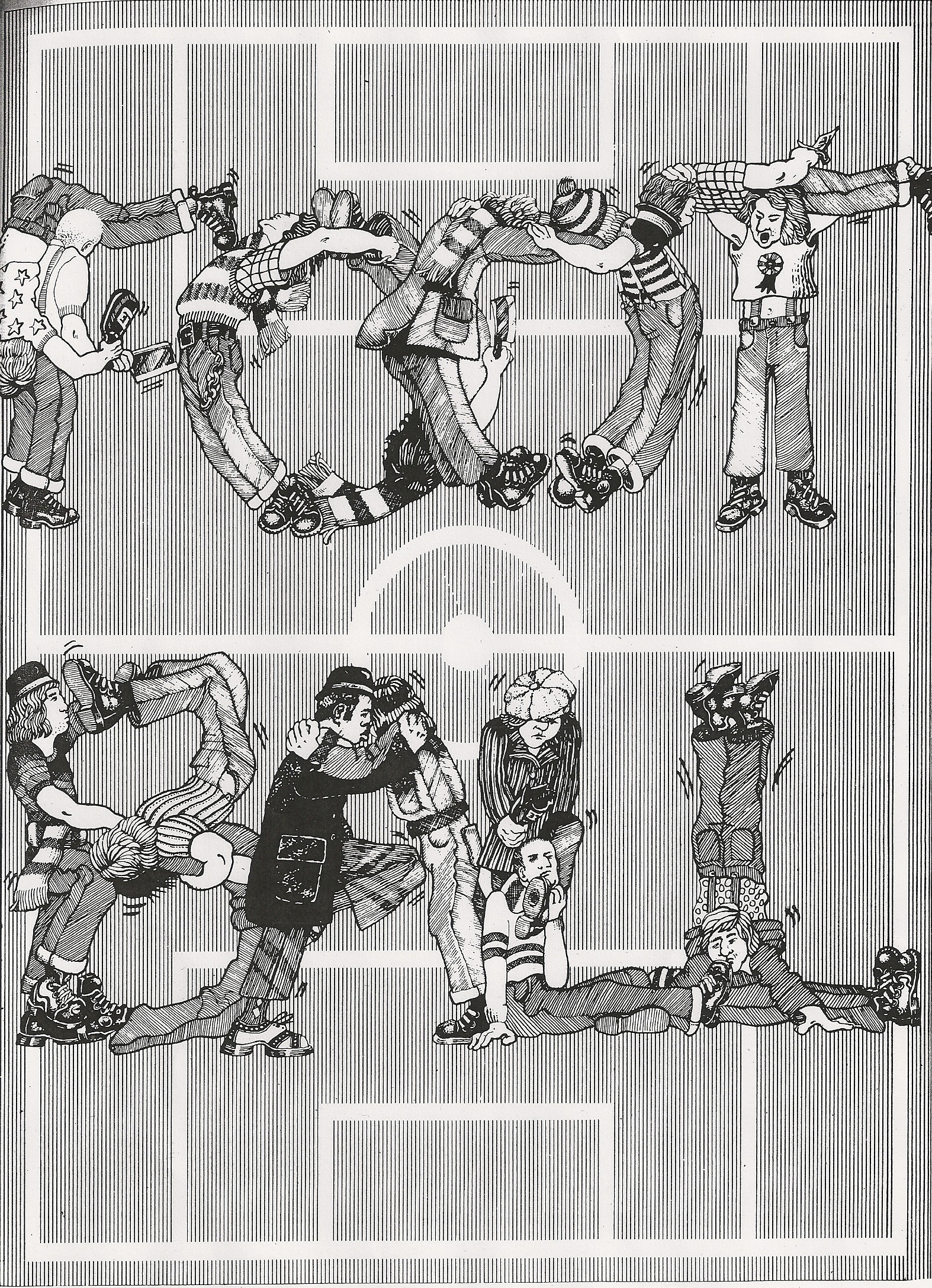
This appears almost as an aside in Chris Lightbown’s seminal article Football Gangs in Time Out in April 1972, which looked at the mobs that followed the four big London clubs: Arsenal, Chelsea, Tottenham and West Ham.

Did Redknapp really join in a ruck in 1971? This should surely be the first question put to him if he ends up getting the England job.

The Gun Club

I have a piece in the latest Uncut about the Gun Club, the band fronted by Jeffrey Lee Pierce. The Gun Club trailblazed the kind of killer punk-swamp-country-blues later taken on, more lucratively, by Nick Cave and the White Stripes.

Born in California, Pierce settled in London in 1985. He spent a lot of his time hanging out at the Batcave, the Goth nightclub in Soho’s Dean Street.

Pierce left London in 1995, when he was deported after wielding a samurai sword in a Kensington pub. Which makes this trailer for what appears to be an Italian documentary from 2008 all the more intriguing, as it features Pierce wielding a samurai sword in London in 1992. (I’m not sure if it is the same film as this 2006 documentary, Ghost on the Highway.)

Pierce was a talented enigma, who made some amazing music. They also wrote the best song title ever, in Sex Beat, which pretty much sums up what all rock ‘n’ roll is really about.

o

James Watt’s workshop at the Science Museum

This piece was originally published in World of Interiors in December 2011.

James Watt was not a tidy man. Inside the Scottish engineer’s eighteenth-century workshop, shelves are thick with dust and overlapping objects of marvellous obscurity. It’s chaotic, but it is the past, a life perfectly preserved. Almost 100 years ago, this attic room was moved from Birmingham and reconstructed at the Science Museum, but the public have only recently been readmitted. It’s a delightful and very human sight. Unlike the modern scientist’s sterile laboratory, items are stuck to wall and floor, or piled harum-scarum on shelves, desks, tables, lathes and huge wooden machines of curious design. There are 8,434 objects all told, each lovingly listed on an exterior wall. Pincers, mallets, drawer knobs, hacksaws, charcoal, ladles, a frying pan, washers, broken thermometers, bent wire, drills, bradawls (six without handles), packages of chemicals wrapped in yellow paper and tied with brittle string, lumps of metal, fossils, half-finished statues, cogs, pieces of wood, barrels full of plaster of Paris and a clock key. There’s even, or so it says, a sea horse tooth. Nothing thrown away. This is the testimony of a life in science, and it looks exactly as Watt left it almost 200 years ago.

Watt was born in Greenock, Scotland in 1736. For several years, he quietly sold scientific instruments, musical instruments and toys from a shop in Glasgow but he had a curious mind and was an inveterate tinkerer. In 1776, he completed a steam engine that used a fifth of the coal of the existing engine. Factories and mines all over the country were soon powered by Watt engines as Britain surged into the steam-driven Industrial Revolution. Watt became a hero, as crucial to the national identity as Wellington and Nelson. On his death in 1819, he was the first engineer to have a statue in Westminster Abbey, although it was later removed as it was grotesquely large. His legend was international. In Japan, the state dispensed prints of Watt to promote the British values of industry, resilience and ingenuity that he embodied.

Watt began work on the steam engine in 1764 and moved to Birmingham ten years later taking with him the tools, fixtures and fittings he had accumulated in Glasgow. In 1790, he settled in Handsworth where he had his final workshop, a garret room where he could work undisturbed. In this dark space, Watt drilled, sawed and chiselled, experimented with chemicals, and developed a variety of extraordinary devices, including a perspective drawing machine, a letter-copying press and a sculpture-copying machine. He often had to make for himself the tools he needed for his inventions, including what Science Museum curators think is the oldest circular saw they’ve ever seen. The impression gained is of somebody who loved using his hands, and was always looking for ways to improve production, to make more things, and faster. He was a solitary soul. To ensure he could work without interference, Watt built a shelf outside the door on which the maid could leave his dinner. When he was ready, he would bring it inside and warm it on the stove. There’s a hint of sadness too. In one corner lies a chest full of things that belonged to his son Gregory, who died of tuberculosis in 1804. It seems Watt kept it here, close by, for 15 years until his own death.

At which point, the door was closed and the room left untouched. Even as the house was occupied by new families, the workshop was kept as Watt had left it for more than a century, with drawers full of half-made thermometers wrapped in wax paper and surfaces strewn with rusty hinges. It became a shrine. One visitor commented, ‘the dust lay so thick it was like walking in soft snow’. One pilgrim was Bennet Woodcroft, who ran the Patent Office Museum, part of the South Kensington Museum. Woodcroft was acquiring key artefacts from the Industrial Revolution and in the 1860s registered an interest in the room. However, it was not transferred until 1924, by which time Woodcroft was dead and the Patent Office Museum had become the Science Museum.

They took everything– not just the furniture and contents but the floorboards, door, window frames, fireplace, stove and flue – and reconstructed them on the ground floor of the museum. Workman even asked if they should remove the dust. The public would peer through a window above Watt’s workbench and observe a scene almost identical to the one painted by visiting artists in 1864 and 1889. But by the 1970s, it had become a museum relic. The room was moved to the mezzanine, where it was ignored for another couple of decades before being ignominiously boarded up. Staff could still reach it if they took the wrong door out of the admin office, but the public would never know it was there.
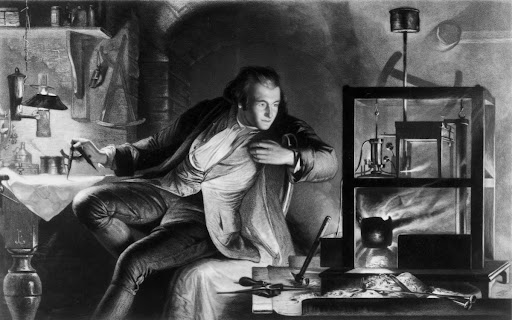
So it remained until earlier this year, when the room was returned to the ground floor and made the centrepiece of an exhibition that examined Watt’s life in the context of the Industrial Revolution. In an act of domestic archaeology, objects were removed from drawers where they had been invisible for centuries as curators resolved to explore every nook and cranny. These were then replaced exactly where Watt had left them.

The exhibition shows that Watt was a scientist but also a workman, constructing by hand the very machines that made mass production possible. Years later, William Morris would reject the industrialised world that Watt had created, but the two had something in common in their love of forming things by hand. However, Watt’s inventions meant things no longer had to be created at such labour and expense, and people could choose for themselves the design and furnishing of their home rather than rely on what was passed on to them by their forefathers. It was the start of the consumer age, making Watt was partly responsible for many of the decorative items that can be studied at length next door at the V&A Museum. When Woodcroft visited Watt’s workshop, this relationship between industry and design would have been more apparent. The South Kensington Museum was essentially the Science Museum and the V&A combined, and had been created partly to inspire the working class with technique as well as design, showing not just beautiful objects but also how they were made. Now cause and effect, science and art, are divided by the bustle of Exhibition Road. But enter Watt’s workshop, and just for a moment the two become one.

Dickens And London at the Museum of London

This review was published in the Independent last week but has not surfaced online.

It’s going to be hard to avoid Charles Dickens in the next few months. The writer will be everywhere, as publishers, programmers and producers commemorate the 200th anniversary of his birth on February 7, 2012. The best celebration of Dickens’s legacy could be this illuminating exhibition at the Museum of London. It’s an imaginative look at a familiar subject, and represents the best of what a museum can do.

This is no staid trawl through Dickens’s back catalogue but a vivid evocation of Victorian life based around themes from his books, from poverty to innovation. Sure, the big objects like Dickens’s writing desk or his manuscript for Great Expectations are there to grab the attention, but this drama is complemented by Victorian minutiae, the fascinating bric-a-brac of everyday life, everything from rent arrears books and mourning wands (wooden sticks carried by footmen ahead of funeral processions) to clay pipes, Punch and Judy puppets, model trains and Dickens’s soup ladle.

The exhibition is more than objects. There are mournful photographs of Victorian buildings that Dickens wrote about but have since disappeared, and a short film by William Raban that meanders around modern London while an actor recites Night Walks, Dickens’s essay about the sleeping city, drawing subtle parallels between his time and our own. The film is a rare chance to wallow in Dickens’s own voice, but neither this nor the manuscripts are quite as impressive as Dickens’s reading copy of Oliver Twist. This is the book he used on reading tours towards the end of his life; words and sentences are underlined for emphasis, and melodramatic stage directions (‘Action’, ‘mystery’, ‘terror to the end’) are scrawled in the margins.

The Strand, Looking Eastwards from Exeter Change, London

Most rewarding of all, though, is the art. There’s classically sentimental Victoriana, such as William MacDuff’s Shaftesbury, which shows two urchins looking in a shop window like something by Norman Rockwell. There’s the fascinating documentary sketches of George Scharf’s, who drew the people he saw on streets acting as human advertisements, in colourful costume and carrying eye-catching signs for shows and products. And there are many detailed depictions of Victorian street life, which owe a clear debt to Hogarth. Phoebus Levin’s ‘Covent Garden Market’, Caleb Robert Stanley’s ‘The Strand, Looking Eastwards From Exeter Change’ and especially Edmund John Niemann’s ‘Buckingham Street’ portray a city of energetic bustle, cobbled streets and vicious contrasts of wealth that are the visual embodiment of what we still call Dickensian London.

Museum of London, 150 London Wall, EC2Y 5HN (020 7001 9844). Until June 10, 2012. Admission £8 (£7 advance booking); concs £6 (£5 advance booking).

Buckingham Street, Strand, London

‘Ladies who bus’

This is a piece I wrote for the Speed issue of the excellent Completely London magazine. 

Sometimes, it feels like there are few slower ways of getting round London than by public transport. And the bus –so often a victim of roadworks and burst water mains – can be the slowest of all. But for some, that slowness is part of the attraction. Jo Hunt (67), Mary Rees (68) and Linda Smither (64) are ‘ladies who bus’. Since March 2009, they have been taking all of London’s buses in numerical order, starting at No 1, travelling each route from one end to the other, and then writing about it on their blog. As a way to pass the time, it is a distinctively London thing to do. There are, after all, over 500 routes in London; more if you include those that start with letters, like the A10 or X68.

File:London Bus route 23.JPG

‘It began when I retired from my last job,’ says Jo, the head buskateer and a former teacher. ‘People asked what I was going to do. I said I’d just loll about or play computer games, but then I decided I’d get every bus in London.’

From that moment of whimsy came a plan, which became a blog and has now evolved into something like a mission. Jo, Mary and Linda have acquired matching sweatshirts with their blog address on it – these proved to be handy in winter when one bus’s central heating was broken – and they have printed business cards to hand to drivers at the end of journeys to explain what they are up to. Online, they have built up a following among London nerds and bus enthusiasts.

Jo got the idea when she got on a bus and saw it was terminating at Ponder’s End. ‘I thought, “Where’s Ponder’s End?”’ and elected to find out. ‘Then I thought if I was going to do one, I should do them all, and if I was going to do them all, I should do them in the right order.’ Linda and Mary were both ready for retirement as well, so – armed with their Freedom Passes –they agreed to come along. Jo’s son created a blog, and 200 buses later we are now travelling by bus from Brixton to Mitcham on one of the hottest days of the year.

And here I must make a confession. I also spent a couple of years on the buses, writing a weekly column for Time Out about exactly this topic – taking every bus in London in numerical order, from end to end. Well, it started as a weekly column, but soon lethargy took over, the column became fortnightly and then monthly and in the end I never made it further than the low 60s. Jo, Linda and Mary have persevered, resolve stiffened by each other’s company – and by Jo’s determination to complete the task. ‘Jo is the leader,’ confesses Mary. Jo plans each route a week in advance, working out how they are going to get to and from the stops that bookend the route, and she and Linda take turns writing them up on the blog.

But they are clearly enjoying themselves as well. There is much to appreciate about a lazy morning spent taking a bus for no other reason than the sheer fun of travel, watching London knit together while everybody outside rushes about their daily business without time to stop and absorb the city around them. As we slip languidly through south London streets, the trio note familiar landmarks and reminisce about other routes that have passed this way. They are also able to recall what an area was like 5, 10, 20, even 40 years previously. ‘It’s evocative,’ says Linda of the experience of revisiting old haunts. She also comments on how they have watched London change in the two-and-a-half years they’ve been doing the routes. When they began, the Strata Tower at Elephant & Castle was a building site – now it’s one of the tallest buildings in London. A rapid transformation, observed at leisure.

They are fascinated by London’s arcane history of– such as the Balham estate we pass that was reported to be Hitler’s choice for a home if he successfully invaded Britain – but also by the present, especially in Tooting, as South Indian restaurants slowly give way to West African clothes shops and Mary contemplates hopping off to pick up three crates of mangoes for £10.

London as seen by bus is a city of delights and surprises. ‘I’ve been surprised at how good the drivers are,’ says Jo. ‘I’ve really enjoyed being able to understand how London ties together. And sometimes you’ll be bumbling along and then suddenly you are in the country, surrounded by green. It’s like you’ve reached the end of the world.’ Or the end of London, which sometimes feels like much the same thing.

Cockney Rebel’s Make Me Smile: exclusive pop trivia included in this post

There are some songs I have listened to all my life, without really stopping to think what they are about.

So it is with Steve Harley and Cockney Rebel’s “Make Me Smile (Come And See Me”), which I’ve spent around 20 years assuming was some sort of love song.

When I wrote about the song in this month’s Uncut, Harley told me the song was actually a rebuke to his old bandmates who asked for more money and then left him – he felt – in the lurch – shortly before he entered the recording studio. Harley’s response was to immediately write the accusatory “Make Me Smile” (‘Blue eyes, blue eyes, why must you tell so many lies?’) and sing it with a Dylanesque sneer, but bury the sentiment beneath a layer of perfect pop production. So a song written in a despondent stew made his fame and fortune and still follows him all round the world.

The favourite thing Harley told me though, was that one of the backing singers for the song’s famous ‘ooooh la la’ chorus was the actor and singer Clarke Peters, now better known as Lester Freamon from The Wire. You won’t find that on Wikipedia. Yet.

https://greatwen.com/2011/12/05/cockney-rebels-make-me-smile-exclusive-pop-trivia-included-in-this-post/

Slade in London

I have a piece in the latest Uncut magazine about Slade, the glam rock bovver boys who became the most successful British group of the 1970s.

Slade were proud Black Country band – all raised in and around Wolverhampton and Walsall – and they never really took to life in  London, something that may have explained why it took them so long to break through. As Don Powell, the drummer, told me, ‘We didn’t really feel comfortable in the London scene when we could just be in the pub with our mates in Wolverhampton.’ Even today, all four remain wonderfully faithful to their roots and have the flattest vowels of any band I have ever interviewed.

But London still had an impact on their career. In 1966, beanpole producer Kim Fowley spotted the band – then called the N’Betweens – playing Tiles nightclub in Oxford Street and promptly hustled them into the recording studio. This was the result.

Tiles was a Mod club. John Peel played there once but his hippie tunes didn’t go down too well with the audience and he recalled: ‘It was certainly not the kind of place where they wanted to hear what I was doing. And there were waves of irate customers coming up over the footlights to try and persuade me to play whatever it was they wanted me to play. Which certainly wasn’t the Grateful Dead and Jefferson Airplane and Country Joe and the Fish or whatever I was playing. They didn’t like me at all.’

This terrific Pathe newsreel shows The Animals playing at Tiles, and it was ex-Animal Chas Chandler who gave Slade their next big break after he saw them performing at Rasputins on Bond Street. Noddy Holder told me, ‘Chas wanted to see us live. So we were booked to play a tiny place called Rasputins in Bond Street and we played our usual set there. People stopped dancing to watch us, which didn’t really happen at the time, and as Chas came down the stairs he said we were that good he thought it was a record being played. He thought it was fantastic and signed us the next day, no second thoughts. We started working a lot of London clubs and bigger venues around the country.’

Thereafter, Slade became regulars on the London circuit, and were the first band to book Earl’s Court (Bowie played a show before them, but had booked it after Slade). While Bowie’s show was plagued by sound problems, Slade were able t learn from his mistakes and their concert was deemed a great success.

Their favourite venue was probably the Top of the Pops studio in Elstree, where their rabble-rousing songs and remarkable outfits meant they practically became the house band.

Sadly, though, two of their greatest London moments have been lost forever. As one fan writes here, the band recorded two promo videos for Top of the Pops, one at Chessington Zoo for “Look Wot You Dun” and another at Greenwich Observatory for “Gudbuy T’Jane”. Both films have been wiped and seem to  be lost, among with many other studio Top of the Pops appearances.

Finally, here’s the band just before they made it. Still known as Ambrose Slade, this promo for their first album was filmed in Euston Station. The band had recently come out of their skinhead phase, and are nothing like the colourful eccentrics they would soon become.

This Charming Man: Edward Lovett at the Wellcome Collection

I have a small piece in the Independent about the fascinating  Edward Lovett, whose collection of lucky charms, collated around 100 years ago, has just gone on display at the Wellcome Collection.

Lovett, who lived in Croydon, was a banker and self-taught folklorist who was interested in those items that everyday Londoners kept about their person in aid of good fortune or to ward off bad luck. He would travel to the East End and docks to purchase samples of these lucky charms, which could be anything from a dead mole in a bag to a copy of the Lord’s Prayer written in careful handwriting in a spiral on a tiny scrap of paper dated 1872.

Many of the owners would claim not be superstitious, but then explain in hushed tones how a certain coin or nut or shoe had saved them from disaster; numerous items were from soldiers who had taken them to the Western Front in the First World War.

It is an extraordinary and humble collection, but one that grew so vast that Lovett’s wife eventually left him in despair in 1925. At around this time he wrote a marvellous book – Magic In Modern Love – in which he chronicled some of the items from his collection, but in a delightfully haphazard way, rarely bothering to say exactly where he bought them or when or from whom.

Felicity Powell, the artist who is curating the exhibition for the Wellcome, says, ‘He was not the most diligent of reporters. The labelling is often non-existent, which gives the items real mystery. Sometimes you can’t even be sure what they were for so you have this open space in which to speculate.’

Because Lovett was mainly collecting from the docks around east London, the collection gives a real perspective on London as a trading city that used the river to connect with the wider world. ‘There are objects from all over the world,’ says Powell, ‘There’s even an Inuit paddle.  It all came through London and into the hands of dockers and hawkers. We don’t know if these originally belonged to immigrants or natives. We don’t even know if he was collecting authentic objects. Did the people selling them see him coming?’

Lovett died in 1933 and much of his curious collection was absorbed by the Wellcome and the Pitt-Rivers Museum. It is rarely seen by the public. The exhibition at the Wellcome Collection runs until February 26, 2012.