Category Archives: Journalism

Secret London: the Victorian herbalist

This piece originally appeared in Completely London magazine. 

You don’t expect to find a shop as beautiful as Baldwin’s on the Walworth Road, the grimy but charismatic street that connects Elephant & Castle with Camberwell and is otherwise punctuated by pound shops and bookmakers. ‘We have the greatest range of herbal products in the UK,’ says owner Steve Dagnell proudly, and that is easy to believe. Baldwin’s is lined with aged apothecary drawers stuffed with herbs, gleaming wooden shelves holding big bottles of wood curls, lavender and liquorice and ancient signs that advertise pills ‘for piles, pains in the back, pimples and dizziness’ and tonic mixture ‘for lowness of spirits’.

Baldwin’s has been on this road for 150 years, selling herbs, tinctures, oils, beauty remedies and sarsaparilla to customers – among them celebrities such as Terence Stamp, Michael Caine and Max Bygraves, who came here for his throat sweets – since 1844. It started at No.77, but moved to 173 in 1969, taking many of the original fittings with it. The store is currently run by Dagnell, 57, whose grandfather started work at Baldwin’s in 1918. ‘At that time there were six shops in London, but the others were closing,’ says Dadnell. ‘His first job was to go round all the other shops with a handcart buying back the old stock.’

Dadnell himself began working there in 1981. The store stocks a mind-boggling variety of herbs – everything from agnus castus to yerba santa, including helonias root at £322 per 500g – as well as essential oils, shampoos, body washes and handmade soup. ‘We do an enormous range of essential oils and have developed a cosmetics range based on these,’ says Dadnell. ‘A lot of people use them to make their own shampoo, massage oil and soap.’ It’s a beautiful shop selling beautiful products, the hidden jewel of the Walworth Road.

Baldwin and Co, 171-173 Walworth Road, SE17. 

Hogarth was right: Beer and London’s brewing renaissance

This piece originally appeared in the May 2012 issue of Eurostar’s Metropolitan magazine. 

Is it a renaissance, or a revolution? In 2006, when Young’s left its brewery in Wandsworth to move to Bedford, it felt final orders had been called on brewing in London. The city that was once swimming in beer – literally, when a brewery exploded in Tottenham Court Road in 1814, causing the Great Beer Flood –had become a desert; only a handful of breweries remained. Six years later, everything has changed. London now has 21 breweries, in every corner of the capital, with more opening all the time.

‘London was once the brewing capital of the world,’ says Paddy Johnson, director of the Windsor & Eton brewery but speaking for the London Brewers Alliance, formed in April 2010 to represent London breweries. ‘It was bigger than Burton-on-Trent or bloomin’ Munich. We want to return to that. At our first meeting there were 13 brewers, ranging from Windsor & Eton, who had just done our first brew, to Fuller’s the biggest, oldest brewery in the capital. At our last meeting we had 21, and another six are on the way. It’s a vibrant scene. There is a real buzz about London beer. The public have cottoned on big time.’

So, why the change? It’s partly about microbrewing – a movement that began in America among people feel they weren’t getting sufficient taste, value or variety from the conglomerates that rule the beer world, so begin brewing their own. Microbreweries reached the UK in the 1980s and flourished after 2002, when tax rules were relaxed. London took a while to catch on, people put off by the barren London beer scene and the high-cost of starting up.

Under a railway arch down a cobbled mews in north London, Rob Gargan, brewmaster at Camden Town Brewery, takes a break from overseeing the production of 16,500 litres of beer a week to explain. ‘London is one of the last areas of the country to open up,’ he says, amid gleaming hi-tech equipment. ‘People realised that the beer they were drinking was from up north but there’s no reason why we can’t do it here.’ First to the pump was Meantime in Greenwich in 2000, but the new wave really began when Sambrook’s opened in 2008 in south-west London. Through 2010 and 2011 it felt a new brewery was opening every month as the resurgent London scene became the talk of the beer world. It isn’t just about microbreweries, either, Chiswick’s huge and venerable Fuller’s is a keen member of the LBA. ‘It’s not about micro it’s about local,’ insists Johnson. ‘Local beer for London is our mantra.’

And it is more than the rediscovery of a lost art, it’s about introducing a new drinking experience into London. There’s a running joke in ‘Asterix In Britain’ about the Englishmen’s baffling fondness for warm, flat beer, and while these classic brown ales are still brewed in London, the new breweries often look across the Atlantic for inspiration. Peter Holt, landlord at the award-winning Southampton Arms, explains: ‘English beers would be a bitter or mild made with Kentish hops, for an older generation. But a lot of the beers we sell use New World hops. Hops are measured in alphas and while English hops might be three, American hops are 13, 14 or 15. It’s much more intense.’

The Southampton Arms, the Campaign For Real Ale’s London pub of the year, only stocks beer and cider from small, independent breweries. It’s one of a growing number of London pubs to steer clear of mass-produced lagers and foamy bitters. ‘People are much more aware of what they eat and drink,’ says Holt. ‘People are conscious that you can buy Aussie lager in the supermarket for very little, so why go to the pub to pay three times as much when they have decent beer that can’t be found elsewhere?’

It’s not just locals. ‘Tourists desperately want to drink local beer,’ says Johnson. ‘When they go to a pub, they ask what’s local. London now has a huge range of award-winning beers to offer them.’

Most popular among these are the American-influenced pale ales (IPAs): golden, citrusy, stronger in alcoholic content, gassy and cold. Asterix and Obelix would approve. ‘Pale ale is the big thing,’ says Mark Dredge, a beer writer turned communications officer at Camden Town Brewery. ‘Most breweries sell more of them than anything else. It comes between a lager and a cask ale, so if you’re an ale drinker you can appreciate the flavours, and if you’re a lager drinker you can enjoy the texture and the fact it is colder. It’s the sort of beer anybody feels they can drink.’

Camden Town does a popular IPA, while the ones bottled by Kernel, a brewery near Tate Modern, have beer-lovers in raptures. But there’s variety among London brewers. Sambrook’s – founded by Duncan Sambrook, an accountant who attended CAMRA’s Great British Beer Festival in Earl’s Court, realised no London beers were available and decided to do something about it – specialises in traditional British beers. He talks me through the beer-making process. It’s a complex business. Who ever realised that if you got some barley, soaked it to the point of germination, and then rotated it on a flat floor with a large rake so the seeds didn’t know which way is up and can’t break into shoot, you could roast this malted barley, boil it, add hops, cool it, add yeast, add a fish’s bladder, call it beer, drink it and not kill yourself?

Adapt this basic method, and much can be made. Meantime does lager, pale ale, fruit and wheat beers, you can get a great thick bottled stout from former solicitor Gary Ward’s Redchurch Street Brewery in Shoreditch, while Redemption – which was opened by banker Andy Moffat in Tottenham in 2010 – and Brodie’s – run by a brother-and-sister team, James and Lizzie Brodie, in Leyton since 2008 – make beers that come somewhere between the pioneering Kernel and the traditional Sambrook’s. And that’s just for starters.

Camden Town’s big seller is lager. The brewery was founded by Jasper Cuppaidge, who realised that the beers he liked came from abroad so decided to make some himself. His beer is now in 120 pubs, mainly in London – for most London breweries, distribution is limited to the M25, although the LBA helps organise festivals of London beer all around the country, as well as having regular London beer showcases in different London pubs each week. The LBA also set up a marquee at London Zoo during their late-night summer openings, which was very popular among customers in their 20s and 30s. Many of the breweries themselves are run by similarly young, self-taught enthusiasts.

The LBA give these tyros the help they need. ‘A lot of our members are young so we assist them with distribution and technical problems,’ says Johnson. ‘We want to raise the bar for everybody brewing in London. We’re competitors, but we act co-operatively. If more people drink more London beer we all benefit.’

Secret London: dealing with the counterculture at Maggs

This article originally appeared in Dazed And Confused magazine in February 2012.

Maggs Bros Ltd rare bookshop is an unlikely place to encounter the counterculture. For a start, it’s located on one of London’s poshest squares in Mayfair, the heart of the establishment, and even boasts a Royal warrant just inside the front door. Inside No 50 Berkeley Square – an imposing Georgian terrace once described as ‘the most haunted house in London’ – earnest young men in expensive suits sit at desks covered in large old brown books, which they flog to largely millionaire collectors that occasionally step through the front door.

But round the back, a different world awaits. Carl Williams works in an office converted from the stable block, in a room that is full of wonders. Come here at the right time and you will find boxes full of punk fanzines sitting on chairs draped with Republican flags from Spanish Civil War. Ask Williams nicely and he may show you brooches made by junkie poet Alexander Trocchi from used heroin needles, a complete set of ‘Anti-Monopoly’ board games or a pamphlet drawn by Latvian anarchist Peter the Painter, the shadowy figure behind the Sidney Street Siege of 1911. This recent catalogue will give you an idea of the material. 

Aleister Crowley

Williams, a fast-talking Yorkshireman , is one of the few booksellers who deals in items related to the counterculture, a nebulous term which covers politics, the occult, avant-garde art, film and literature, drug culture, rock and roll and alternative lifestyles. The interesting stuff, in other words. ‘There’s no guide to the counterculture,’ says Williams. ‘It’s not doctrinal. It’s whether something has the right feel, the way it looks, where it came from. It’s folk art, it’s the Watts Towers, it’s Austin Osman Spare, it’s Aleister Crowley. It’s not like Marxism where everybody knows the key texts. There are things in the counterculture that are still being discovered. There are things lost in libraries that will take it in a completely new direction.’ And it isn’t just books: Williams deals in paintings, posters, games, clothes and records. The only requirements are that Williams can locate it somewhere within his own concept of the counterculture, and that he can sell it. He also puts on occasional shows in the gallery beneath his office, such as the recent Lost Rivers exhibition.

Williams was born in 1967 – ‘the autumn of love’ – in Scarborough. Despite failing his O-Levels, he went to the LSE to read sociology, where he discovered the library and ‘read indiscriminately’. In 1997, after a decade of odd jobs and working in book shops, Williams returned to the LSE to do a Masters just as the library was selling off its old stock during a refurbishment. Almost by accident, Williams became a ‘runner’, a pejorative term that describes something which, in essence, all book dealers do. ‘Running is a pre-internet term, now it’s much more transparent, but it means taking a book quickly from one dealer or auction house, to another dealer or collector and selling it for more money than you paid,’ says Williams. ‘The idea is that you get it from A to B without B finding out how much you paid A.’

RED FESTIVAL 77 POSTER

With the LSE library at his disposal, Williams was blessed with early success. ‘I was able to sell all these political economy and philosophy books,’ he says. ‘But although I knew the books I didn’t really know what they were worth. I realised this when I took one dealer the first Western European edition of the Koran, and walked out with £500 when it must have been worth thousands.’

As the stock from the LSE ran out, Williams began frequenting other dealers and auction houses to find sellable books. In February 1999, he wandered into Bloomsbury Book Auctions, where he picked up a book from 1864 called The Pure Logic Of Quality by William Stanley Jevons. ‘Jevons thought this book would revolutionise how we understood logic, but he only sold six copies,’ says Williams. ‘I’d never seen one outside a library. I took it to a dealer, Pickering and Chatto, and a man called Jolyon Hudson asked if he could keep it for a day or two.’

Hudson recognised the book had been stolen from the London Library. The police were notified and Williams’s discovery unravelled what the Guardian described as ‘the most systematic plundering of Britain’s great libraries ever carried out by an individual’. William Simon Jacques, a dealer, had stolen books worth more than £1 million. He was eventually sentenced to four years in prison. (Jay Rayner covered the story here.)

‘I was devastated,’ says Williams, ‘because I thought I’d tried to sell a stolen book, but it turned out to be a blessing because Hudson told the Guardian that I had behaved impeccably and that gave me an entry into the higher levels of the trade.’

Williams began working at Maggs Bros, selling books on the internet and looking after the catalogue. ‘I got to know the customers. There was one guy who had been coming in for 20 years. He’d usually walk out with a travel book, but one day they asked this guy what he actually wanted and he said he wanted books on drugs.’

The man was Julio Mario Santo Domingo, a Colombian billionaire, and Williams sold him a painting made by a Mexican artist after he had been injected in the neck with LSD. Santo Domingo was in the process of putting together one of the great private collections of drug books and paraphernalia, a stunning selection of material that ranges from ancient books about Chinese opium smoking to a bicycle that belonged to Syd Barrett. ‘I worked for Julio [who died in 2009] for three years,’ says Williams. ‘His collection is one of the great untold stories of the 21st century. It’s not just drugs, it’s sex, rock and roll, the occult, erotica and art. And it’s not just books. It’s everything.’

Santo Domingo had a remarkably open concept of what to collect, not just concentrating on the old and valuable but hovering up anything with drug connections. ‘Somewhere in it is a McDonalds coffee stirrer from the 1970s,’ says Williams. ‘It looked like a coke spoon, just in plastic rather than silver. There were press rumours that it was the hillbilly coke spoon and so McDonalds discontinued the range, but I found an original. What do you do with that? Sotheby’s don’t want it, Christie’s don’t want it. But it’s gold. So that’s what I do.’

McDonald's coffee stirrer

Williams operates in a rarefied world, selling unusual and arcane items to billionaires and academic institutions. Some are interested in the subject, others are professional collectors, and still more are collectors who collect other people’s collections, as investments and for the pleasure of ownership. ‘It’s a very small world of dealers and a very large world of buyers, who work on the basis that they should buy now when it is relatively cheap and is all still out there,’ says Williams. ‘And some of it is cheap. The 1960s stuff isn’t because it is more mainstream and the top Beat stuff is far too expensive, although I’ll still buy manuscripts.’

New items are acquired from auctions and the internet, book fares, private sellers and other dealers. A recent haul brought in the first issue of Heat Wave, a British Situationist International magazine written in 1966, which nobody has seen outside the British Library for decades. There’s a file full of items William Burroughs collected during his short-lived immersion in the Church of Scientology. There are four skeletal marionettes that used to live in an amusement arcade in Hastings. There are posters of Black Panther Bobby Seale, complete collections of short-lived No Wave fanzines, cloth bags designed by Yoko Ono and the programme from Michael Clark and The Fall’s collaboration on the ballet ‘I Am Curious Orange’, which took place at Sadler’s Wells in 1988. And there are books, loads of them, by Richard Neville and BS Johnson and Gregory Corso and Timothy Leary. Some of this stuff is hard to sell, partly because it’s difficult to know how much it is worth – ‘there simply isn’t a precedent for some of these things, so you’ve nothing to compare it with.’


Williams found his niche with a little help from Edward Maggs, the man who inherited the family firm. ‘There might have been something brewing in Ed’s mind that we needed to cover this demographic,’ says Williams. ‘It really began when I started cataloguing all this proto-counterculture American Beat stuff from the 50s and it did really well, I sold about 80% of it. I designed a catalogue based on Ginsberg’s Howl, the same size and typeface. It did well, people liked it and I realised I had the right skills for the subject.’

And what are those skills? Williams pauses. ‘It’s judo,’ he says. ‘I have one real ability. I can pick up a book, look at the front, open it, look at the back and I can usually understand what that book is about, condense it, understand where it came from and put a price on it before I’ve put it down. That’s not a talent many people have. It’s like judo, you’re fighting an opponent who is much bigger than you but you don’t need take on the whole thing at one time if you are going to defeat it. It’s an intellectual work-out every day. I have to explain each item, do the research, understand its value, and then I try and sell it.’

Unstable at Maggs Bros Gallery is on until June 8, 2012.

The Shard: ‘There hasn’t been a building like this in living memory’

View from the top floor of the Shard in September 2011

Throughout 2011 and 2012, the Shard has risen on the London horizon, a totem pole wrapped in glass that gets taller by the day and is now impossible to ignore. Not yet finished, it’s been the tallest building in the UK since December 2010 and when completed later this year will be the tallest in Europe, topping out at 310m (1,017 feet). The Shard stretches 72-storeys (although the mast on top takes it to the equivalent of 87 storeys) and will offer 1.2 million square feet of floor space. They say that on a clear day you will be able to see all the way to France from the top of Renzo Piano’s elegant skyscraper, and while that may be rather fanciful, the impact it will have on London is certainly far-reaching.

London is a city with plenty of tall buildings but the Shard is something else. Few buildings have so divided public opinion. ‘It is grotesquely out of scale with other London landmarks,’ says Jonathan Jones, the Guardian’s art critic, while Sir Terry Farrell, the architect, says, ‘It’s got style and it is a phenomenon. If we come back in ten years, people will feel affectionate towards it.’ The Shard’s developer, a straight-talking cockney called Irvine Sellar, cuts to the chase. ‘There hasn’t been a building like this in living memory,’ he says.

It all began in the late 90s, when Sellar purchased an unlovely office block near London Bridge station. After the government indicated they would support high-density buildings that were built near transport hubs, he decided to ‘maximise the potential’ of the one acre site by building a skyscraper. ‘We decided that if we wanted planning permission we had to get an international architect,’ recalls Sellar. ‘We met Renzo Piano in March 2000 in Berlin. He saw the beauty of the river and the railways and the way their energy blended and began to sketch in green felt pen on a napkin what he saw as a giant sail or an iceberg. The Shard emerged from that piece of paper.’

It took another nine years for construction to begin after English Heritage, St Paul’s and the Tower of London objected to the impact the Shard would have on London’s skyline. A spokesperson from English Heritage offers a view shared by many: ‘We have never denied the Shard as a piece of architecture with merit. Our problem is that it is in the wrong place – it is overwhelming and dominating –and in the backdrop of government protected views of St Paul’s Cathedral.’ Critics cite the fact the Shard looms over the dome of St Paul’s when viewed from Parliament Hill.

Sir Terry Farrell has built plenty of tall buildings and has also worked with English Heritage. He offers an interesting insight on London’s protected views. ‘We have created these visual roads in the sky,’ he says. ‘These rather ludicrous and arbitrary imaginary sky corridors around St Paul’s. I spoke to a Parisian who told me “You British really do puzzle me. In Paris, Haussmann arranged all the roads in long boulevards so you have these long vistas, but you Londoners have Haussmannised the sky even though it is a mess on the ground.” I mean, what’s wrong with seeing the Shard from Parliament Hill? If you really don’t like it, walk 20 yards to one side and the view will be different.’

The development went to a public enquiry, which Sellar won. ‘There is a case to protect certain sightlines,’ he admits. ‘But we’re not living in a museum. We didn’t want a public enquiry but it did make us think a little bit harder and as a result we’ve ended up with a better building.’

The Shard is unusual among London skyscrapers in that it will contain offices, restaurants, a hotel, public viewing gallery and apartments. Sellar says he always wanted a mixed-use building because he didn’t want to rely on any one sector for income, but it was Piano who pushed for what could be the most important aspect of the building –the public galleries right at the top. ‘Renzo thought it was vital the building was open to the public. That didn’t bother me at first, but it does now because we’ve built a building that Londoners feel they own –they can eat there, sleep there and view there.’ Farrell believes that this factor could make it London’s answer to the Empire State Building.

One positive part of the development that English Heritage does acknowledge is the regenerating effect it will have on London Bridge. ‘We have created a new quarter for London,’ says Sellar. Next to the Shard, Sellar is constructing a 17-storey office and retail building called the Place and the company is also assisting Network Rail in refurbishing London Bridge station. ‘That’s what tall buildings do,’ says Farrell. ‘They create a massive amount of demand and that brings in revenues and taxes that allow the council to sort out the immediate area.’

The overall effect on the neighbourhood will be immense and John Corey, chairman of the Bermondsey Forum, says local reaction is positive to the Goliath on their doorstep. ‘We feel it will put the area on the map. The area between London Bridge and Waterloo will become the third biggest economic region in London.’ A new outpost of the White Cube art gallery has opened on Bermondsey Street, and other developments will surely follow the money. Locals, though, are keen to strike a balance between existing independent shopping destinations like Borough Market and Bermondsey Street, and the new businesses that are soon to arrive.

Shane Clarke, Deputy CEO for Team London Bridge, the area’s Business Improvement District, says ‘There are some dissenting voices on the aesthetics, but there’s a feeling it’s going to be a huge driver for regeneration. But some local shops don’t want the big brands coming in on the back of regeneration, and we agree. We have the riverfront which is corporate and touristy and then we have Bermondsey Street which is more bohemian – both those areas complement each other very nicely and we want to create a gradual transition from the corporate shiny stuff to the independent shops on Bermondsey Street.’

The upshot is a striking building that will dominate the London skyline for generations, as well as transform a neighbourhood, one way or another. ‘It’s an amazing feeling to create this sort of building,’ says Sellar. ‘The Shard will be instantly recognisable around the globe like the Taj Mahal or the Sydney Opera House. We may not always be the tallest building in Europe, but we will be the most beautiful.’

This article first appeared in bthere, the magazine for Brussels Airlines magazine.

Secret London: inside Savile Row

I had never gone anywhere near Savile Row until a couple of years ago, when I was asked to write about the Mayfair street’s long history of tailoring for an upmarket style magazine. Given that my greatest fashion claim-to-fame is that Manolo Blahnik’s niece once laughed at my trainers, this was a bit out of my comfort zone and I didn’t feel much better when I walked into Henry Poole and the immaculately dressed owner, Simon Cundey, informed me that ‘any good man should own five to seven suits’. I nodded and smiled nervously – I own one suit and it rarely leaves the closet.

Cundey then gave me a tour of the shop, and I was immediately struck by the contrast between the elegant ground floor where customers are measured up for their new clobber and the basement where most of the work gets done. This long subterranean room was filled with tailors of all ages and nationalities, some making waistcoats, others making pockets or trousers. They were sitting at battered wooden benches, cutting cloth delicately with solid scissors the size of scythes. The sound of sewing machines and portable radios were the only sign that we weren’t in the 19th century. It was a thrill to see an old industry being kept alive in such charismatic fashion, and the fact that most of the tailors were as badly dressed as me, didn’t hurt either. I made a mental note that I’d return, which I did earlier this year for a series of interview with the pocket-makers and trouser-tailors of Savile Row, during the course of which I asked my worst ever question as a journalist: ‘What is your favourite kind of pocket?’.

You can read it all here.

Bowie, Burroughs and the stage production of Ziggy Stardust

In December 1973, Rolling Stone journalist Craig Copetas brought together David Bowie and William S Burroughs in London for an interview. The piece was published in February 1974, around the time Burroughs returned to America, having finally had enough of the English climate and licensing laws. A wonderful photograph by Terry O’Neill captures the two icons together.

The interview itself isn’t quite as captivating. Bowie had only read one of Burroughs’ books (Nova Express), while Burroughs had only listened to two of Bowie’s songs (“Five Years” and “Starman”). This is my favourite exchange:

Burroughs: What is your inspiration for writing, is it literary?

Bowie: I don’t think so.

Burroughs: Well, I read this “Eight Line Poem” of yours and it is very reminiscent of TS Eliot.

Bowie: Never read him.

During the two-hour conversation in Bowie’s home, Bowie did most of the talking. At one point he discusses in length his plans for a theatrical or television production of Ziggy Stardust, which had been released two years before (and in June 2012 celebrates its 40th anniversary).

It’s worth repeating this section in full, as it is one of the fullest explanations of the story behind the Ziggy concept.

Bowie: Nova Express really reminded me of Ziggy Stardust, which I am going to be putting into a theatrical performance. Forty scenes are in it and it would be nice if the characters and actors learned the scenes and we all shuffled them around in a hat the afternoon of the performance and just performed it as the scenes come out. I got this all from you Bill… so it would change every night.

Burroughs: That’s a very good idea, visual cut-up in a different sequence…. Could you explain this Ziggy Stardust image of yours? From what I can see it has to do with the world being on the eve of destruction within five years.

Bowie: The time is five years to go before the end of the earth. It has been announced that the world will end because of lack of natural resources. Ziggy is in a position where all the kids have access to things that they thought they wanted. The older people have lost all touch with reality and the kids are left on their own to plunder anything. Ziggy was in a rock-and-roll band and the kids no longer want rock-and-roll. There’s no electricity to play it. Ziggy’s adviser tells him to collect news and sing it, ’cause there is no news. So Ziggy does this and there is terrible news. “All The Young Dudes” is a song about this news. It is no hymn to the youth as people thought. It is completely the opposite.

Burroughs: Where did this Ziggy idea come from, and this five-year idea? Of course, exhaustion of natural resources will not develop the end of the world. It will result in the collapse of civilization. And it will cut down the population by about three-quarters.

Bowie: Exactly. This does not cause the end of the world for Ziggy. The end comes when the infinites arrive. They really are a black hole, but I’ve made them people because it would be very hard to explain a black hole on stage.

Burroughs: Yes, a black hole on stage would be an incredible expense. And it would be a continuing performance, first eating up Shaftesbury Avenue.

Bowie: Ziggy is advised in a dream by the infinites to write the coming of a starman, so he writes “Starman”, which is the first news of hope that the people have heard. So they latch on to it immediately. The starmen that he is talking about are called the infinites, and they are black-hole jumpers. Ziggy has been talking about this amazing spaceman who will be coming down to save the earth. They arrive somewhere in Greenwich Village. They don’t have a care in the world and are of no possible use to us. They just happened to stumble into our universe by black-hole jumping. Their whole life is travelling from universe to universe. In the stage show, one of them resembles Brando, another one is a Black New Yorker. I even have one called Queenie the Infinite Fox.

Now Ziggy starts to believe in all this himself and thinks himself a prophet of the future starman. He takes himself up to incredible spiritual heights and is kept alive by his disciples. When the infinites arrive, they take bits of Ziggy to make themselves real because in their original state they are anti-matter and cannot exist in our world. And they tear him to pieces on stage during the song “Rock ‘n’ Roll Suicide”. As soon as Ziggy dies on stage the infinites take his elements and make themselves visible. It is a science fiction fantasy of today and this is what literally blew my head off when I read Nova Express, which was written in 1961. Maybe we are the Rodgers and Hammerstein of the seventies, Bill!

Burroughs: Yes, I can believe that. The parallels are definitely there, and it sounds good.

The Rodgers and Hammerstein of the 1970s never collaborated, unfortunately. You can read a full transcript of the Bowie-Burroughs interview – including discussions of German porn, Lou Reed, Andy Warhol, science fiction and Mick Jagger (‘Jagger is most certainly a mother figure. He’s not a cockadoodledoo; he’s much more like a brothel-keeper or a madame,’ says Bowie) – here.

Forgotten Londoners: Frank Harris, editor, prisoner and pornographer

Frank Harris was an objectionable little man. He was sallow as a gypsy. He had bat ears, dark hair with a crinkle in it that grew low on the forehead, and a truculent mustache. People remarked on the richness of his bass voice. His charm was great, particularly for the opposite sex. He had the gift of gab to a sublime degree and a streak of deep scoundrelism that was the ruin of him.

John Dos Passos, 1963

Frank Harris wrote My Life And Loves in 1922 when he was 68. It was partly about his career as an editor of the Evening News and Saturday Review in London, where he had championed critics like Oscar Wilde and George Bernard Shaw, but it was mainly about sex.

Harris was a rumbustious character with a voice so deep that one of his many mistresses claimed ‘it made her sex open and shut’ when she heard it. His memoir was scandalously candid, and featured several photographs of naked women, to emphasise the point.

It was these – ‘too much for the English’, Harris later observed – as much as Harris’s candid discussion of sex (he was particularly keen on cunnilingus) that saw the New York Supreme Court rule the book ‘unquestionably obscure, lewd,
lascivious and indecent’ and it was banned in several countries and pretty much did for Harris as a serious writer and journalist thereafter.

It had been a turbulent career. Harris was born in Ireland, educated in Wales and after a series of adventures in America, settled in London in 1882, where he talked his way into newspapers. His greatest triumphs were at the Saturday Review, the London paper he edited in the 1890s, publishing criticism by HG Wells, Shaw and Wilde and gaining a reputation for being unreliably unspoken and outrageously opinionated for a man of his position. He later wrote a biography of Wilde, who surely would have agreed with Harris’s insistence that ‘Modesty is a figleaf for mediocrity’.

As George Bernard Shaw said, ‘He blazed through London like a comet, leaving a trail of deeply annoyed persons behind him.’ Harris was briefly adopted as a Conservative candidate for South Hackney, resigning after he defended Charles Parnell during an adultery scandal. He also defended Wilde during his trial, and suggested he flee the country while out on bail, and took the side of the Boers during the Boer War. 

Years later, Harris looked back on his time as editor with satisfaction. He believed in positive criticism, not handing out brickbats and instructed his critics to celebrate, rather than denigrate. “When I was editor of the Saturday Review,’ he said ‘with the greatest assembly of literary men in history, I had a policy and I believed in sticking to it. There was Shaw and Wells and Rowe and oh, everybody else. I called a dinner and I said: “Gentlemen, it has come to my attention that people have started to call it the Saturday Reviler. Well, this sort of thing doesn’t get us any place. Hereafter the Saturday Review is going to try to find stars, and if it can’t find stars, it won’t merely hurl bricks. What good does it do? Insults, raps, knocks! Mainly lies. Nobody’ll remember them in fifty years. If we can’t do something constructive,” I said, “we won’t do anything.” Well, it worked.’

By 1913, Harris was editing a magazine called Modern Society and was charged with prejudicing a trial after publishing an ongoing divorce case.  ‘It seems to me you have a certain disdain for this court,’ noted the judge during his trial. ‘Oh, if I could only express all the disdain I have,’ replied Harris.

That did it. Harris refused to apologise publicly and was sent to Brixton Prison for contempt. The cartoonist Max Beerbohm visited Harris in Brixton and drew a cartoon, ‘To the best talker in London – from one of his best listeners’. Prints were made and posted all over London in a bid to raise public awareness with the message: ‘This is the man that was sent to prison.’

Harris was released after three months, complaining afterwards that ‘what I suffered most from in prison was lack of books’. Shortly after his release he left London and never lived there again. He died in Nice in 1931.

Max Beerbohm's cartoon of Frank Harris

For more on Harris, visit this excellent Odd Books website.

All aboard the Boris Bus!

Boris Johnson’s much touted new bus launched in London on Monday, and I managed to take a trip on it. It wasn’t easy: the bus left Victoria two hours late after breaking down twice and being slipstreamed by a Routemaster filled with anti-Boris protesters, but the public cared not a jot. Read my piece for Time Out here.

The bus is a classic example of how far bluster and bullshit can carry you, if the public are even half-interested in your vision. This is not a Routemaster, it carries fewer passengers than the bus it is replacing, has cost a fortune to develop, it doesn’t stop fare dodgers, the back platform closes in the evenings and the conductors aren’t allowed to take fares – but it’s still, in my view, a guaranteed vote winner because people like the look of it and aren’t going to look at the downsides too deeply. And maybe they are right, because when all is said and done, a fleet of these on London streets in a few years won’t look too shabby, and all the complaints – accurate as they may be – will look like so much narrow-minded nitpicking.

London’s football gangs: 1972

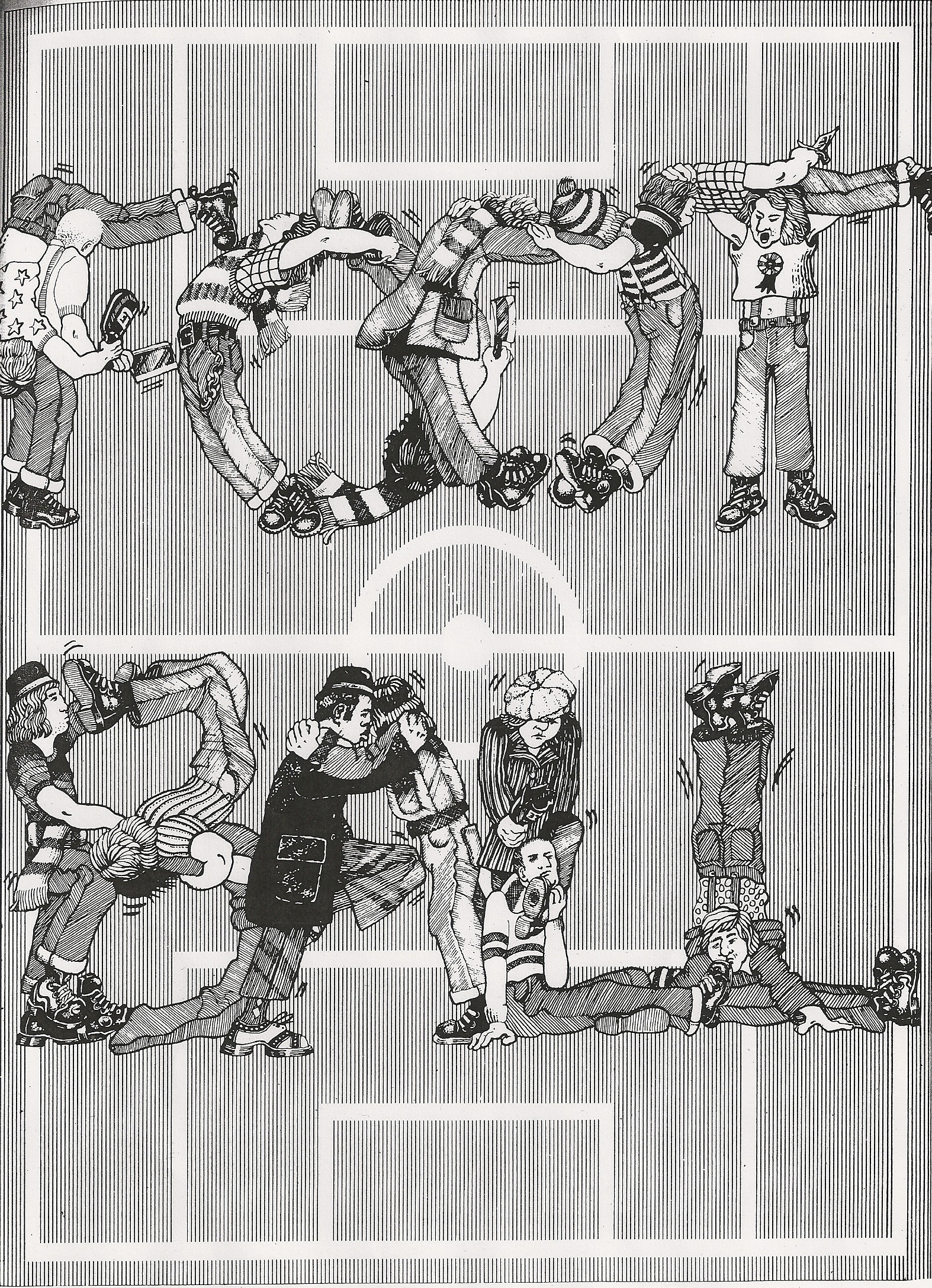
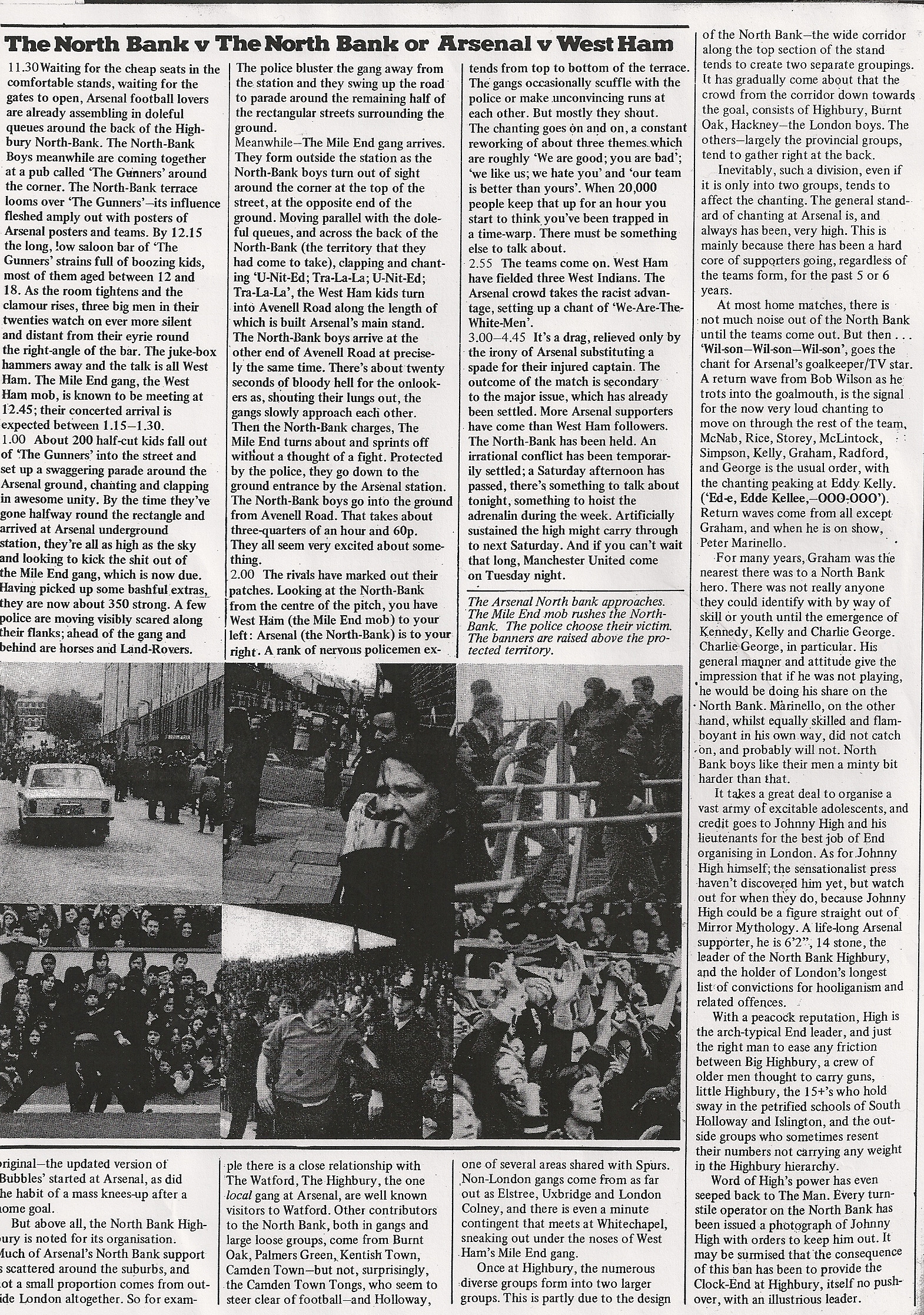
 I’ve mentioned Chris Lightbown’s article on London football gangs a couple of times before, but the piece itself hasn’t been available since it was first published in Time Out in 1972. The section on West Ham was reprinted in the excellent 2008 anthology London Calling, but the full article has been confined to libraries and private collections. Until now.

It is a fascinating read. This is the first time football fan culture had ever been seriously discussed by the press, and it offers a remarkable view of life on the terraces from the terraces, free of any moralism or finger-wagging. It is a thorough and very funny piece of writing, and is probably the first time terrace legends such as Mick Greenaway and Johnny Hoy (although he is called ‘High’ here) ever saw their names in print. It’s analysis of where the different clubs draw on their support is particularly great. 

The writing is very much of its time and place – complete with mention of ‘heads’ and ‘coons’ – and also paints the picture of a time when London terrace culture was very different: the Shed was as loud as the Kop, Arsenal had the most aggressive fans in London and Spurs were just a joke, on and off the pitch. Only West Ham’s identity appears to have remained more or less the same, although older Hammers would doubtless question that.

It is a cracking piece of work. Enjoy.

Lying about London

This appeared as part of an article that was published in the January 2012 edition of The Sunday Times Travel Magazine about London walks. Chris Roberts also runs the  wonderful One Eye Grey magazine and he will shortly issue a volume of stories from the magazine on Kindle.  In March 2012, Chris will be hosting some special related one-off walking tours

Deep in Chelsea’s prim back streets on a drizzly winter evening, half-a-dozen people wearing blindfolds are groping their way down a quiet Georgian square past James Bond’s house, leaning on each other for guidance, and giggling like schoolchildren. This is what happens when you go on Chris Roberts’s Liars London tour, a walk that offers fact, fiction and forfeits in the fancy surroundings of Sloane Square.

Roberts, a librarian, London historian and author, came up with the Liars London idea four years ago when he was asked to curate a tour for the local council. It’s a simple idea. Roberts and Silvana Maimone lead the walk and at each stop they both tell a story about the area: one story will be true and the other false. The audience are asked to guess who is lying and the person who is right most often receives a small prize at the end. Get it wrong, and you may have to pay a location-related forfeit, such as walk around in a blindfold, write a poem, or have a duel with waterpistols. Roberts and Maimone are a great double act, garrulous and witty, happily interrupting each other’s story-telling with exaggerated scoffing. Under their spell the 20-or-so walkers soon start to relax.

We are strangers when we meet among the evening commuters and blinking fairy lights at Sloane Square, but have already bonded by the time we reach the Saatchi Gallery at the affluent end of the King’s Road, where London’s wealthy still promenade in ostentatious fashion. Roberts is spinning an improbable yarn about British fascist Oswald Mosley, when an eavesdropping passer-by indignantly mutters in plumy tones, quite correctly as it happens, ‘What a load of rubbish!’ much to our amusement.

Because the walks require two hosts and require around 20 people attendees – people are happier to participate as part of a larger group, Roberts believes – they must be booked in advance. The Chelsea tour goes from busy Sloane Square down through quiet residential back streets, where every house is impeccably maintained and fragrantly festooned with hanging baskets, before finishing at Cheyne Walk, an 18th-century parade of grand houses nestling on the banks of the Thames, whose surface gleams inkily in the moonlight.

Over 90 fascinating minutes, we take in unusual landmarks such as James Bond’s fictional house on Royal Avenue and the riverside home of wombat-obsessed Romantic poet Dante Gabriel Rossetti. When it comes to the stories, the truth is often just as entertaining and unlikely-sounding as the fiction. Outside the rich brick walls of Chelsea Physic Garden, a seventeenth-century botanical garden, we are asked to choose between Maimone’s story about how a strange plant here became the inspiration for the fiendish foliage in John Wyndham’s sci-fi classic Day Of The Triffids, and Roberts’s (correct) claim that cotton seeds taken from Chelsea ended up being picked by slaves in the southern state of the United States, ultimately leading to the American Civil War.

Tall tales or otherwise, this sort of London knowledge is a personal obsession for Roberts, who has written a book, ‘Cross River Traffic’, about London’s bridges, and edits One Eye Grey, a magazine devoted to capital folklore. As such, he can’t help himself but pepper each conversation with a few extra facts and arcane titbits, making the walk a treasure trove for those who like trivia, albeit trivia that’s sometimes indistinguishable from entertaining falsehood.