Category Archives: Journalism

Time Out – logo-agogo

As has been reported elsewhere, the big glowing Time Out sign came down this week from the front of the TO office in Tottenham Court Road where it has lived since around 1993. It has gone into storage, ahead of a proposed office move and will at some point, we are promised, be restored to wherever the magazine ends up next. I hope it does. This is, after all, one of London’s few bursts of neon and probably the only one that is halfway decent to look at.

That’s because the logo is a design classic, the work of Pearce Marchbank, an art school student who drifted into the more agitated end of the counterculture after the Grosvenor Square anti-Vietnam demo. ‘The impact on me,’ he said, ‘Was blowing away all that love and peace shit which I thought was bollocks and complete pretence.’

After working on Friends, Marchbank was asked by Time Out founder Tony Elliott to redesign his shambolic magazine. ‘I hated the unadventurous way it looked,’ said Marchbank. The entire magazine was redesigned, with the logo being created at the last minute on a Sunday afternoon in November 1970. ‘It was supposed to look like an out-of-focus neon light,’ Marchbank explained. ‘It was Letraset Franklin Gothic, shot out of focus so it had a glowing fuzziness to it. I put a negative over the positive and the gap between the two made the glowing neon outline, which I shot in line then again out of focus. It was deliberately transparent, so the cover images could read through it, as if it were on the glass of a window.’

This distinctive, blurry effect was intended to be a short-term solution, but Elliott refused to change it. It was a wise decision although not everybody liked the new look. One reader wrote in asking if the magazine could include a pair of glasses with each issue as the typeface was now too small to read.

TOAllNight

Marchbank continued to work for the magazine on-and-off throughout the 1970s creating some of the best covers in the history of publishing. He was back there in 1981 when it imploded in a series of strikes, stand-offs and occupations between staff and management over wages and the historic equal-pay system. As Elliott attempted to regain control he learnt that the logo – which was now being branded all over London and which the strikers were hoping to claim as their own – actually belonged to Marchbank.

Elliott called Marchbank, saying ‘I want you to write me a letter saying you’re giving the logo to me.’ Marchbank figured it was probably worth as much as £100,000 but, strapped for cash and short of time, asked Elliott for a mere £2,000.

‘What? £2,000! How can you do this to me after all the things I’ve done for you?’

The conversation ended. Shortly afterwards, however, Marchbank was offered a job with Richard Branson’s new London magazine, Event. As his parting gift, he presented all rights to the logo to Elliott. To turn into a real piece of neon was both a no-brainer and a stroke of genius. I hope one day the sign will be back above the door in some London street – if not, I’m sure it’ll fetch more than £2,000 on eBay.

Secret London: inside a cabmen’s shelter

File:London taxi shelter.jpg

This piece was published in Time Out in March 2006.

You must have noticed them: jolly green garden sheds that squad in odd spots of London like displaced emerald Tardises, steam coming out the windows and queues of black cabs lining the streets outside. These are London’s few remaining cabmen’s shelters – 13 in all, for 23,000 drivers – places where cabbies can gather to enjoy tea and sympathy away from the hopeful eyes and raised arms of the stranded, late and lazy who make up their regular custom. The Russell Square shelter is the domain of Maureen, 52, who runs a tight ship, keeping an eye on regulars like Ken (‘Say I’m 21’) and Malcolm (‘I’ve been a cabbie for 37 years. That’s all you need to know’).

‘These places are very interesting to the outsider,’ I say, by way of introduction.

‘They’re even more interesting when you’re on the inside,’ Malcolm replies.

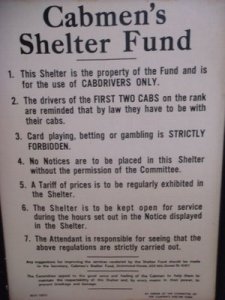
He and Ken come in every day, more or less, to swap tales of fares and roadworks, grumble about Ken Livingstone, talk football, and have something to drink and a bite to eat. They’re keeping alive a long tradition. The Cabman’s Shelter Fund was created by Sir George Armstrong, a newspaper publisher who get fed up waiting for cabs in the rain when drivers had decamped to the nearest pub. He started a fund to supply drivers with a place to get out of the cold and enjoy a cheap meal without straying from the cab stand. The first shelter, erected in 1875, was located on the stand nearest his house (in Oxford). Because the shelters stood on a public highway, the police stipulated they weren’t allowed to be any larger than a horse and cart. At their peak, there were more than 60 in London. Although meant for cabbies, the public could also pop in. Ernest Shackleton was said to frequent the Hyde Park Corner shelter, while the Piccadilly one was nicknamed the ‘Junior Turf Club’ by bright young things, who smuggled in champagne despite the strict teetotal licensing regulations.

Their number declined after WWII as they fell victim to bombs and road-widening schemes, but for a time where a notable feature of London life. HG Wells wrote about ‘the little group of cabmen and loafers that collects around the cabmen’s shelter at Haverstock Hill’, while PG Wodehouse went into greater detail in ‘The Intrusion of Jimmy’ in 1910.

‘Just beyond the gate of Hyde Park… stands a cabmen’s shelter. Conversation and emotion had made Lord Dreever thirsty. He suggested coffee as a suitable conclusion to the night’s revels…. The shelter was nearly full when they opened the door. It was very warm inside. A cabman gets so much fresh air in the exercise of his duties that he is apt to avoid it in private life. The air was heavy with conflicting scents. Fried onions seemed to have the best of the struggle, though plug tobacco competed strongly. A keenly analytical nose might also have detected steak and coffee.’

Food, warmth and companionship are the key. As WJ Gordon wrote in 1893’s The Horse World of London: ‘The cabman is not so much a large drinker as a large eater. At one shelter lately the great feature was boiled rabbit and pickled pork at two o’clock in the morning, and for weeks a small warren of Ostenders was consumed nightly.’

The menu doesn’t stretch to rabbit now, with cabbies preferring tucker that is more in keeping with what a tired cabbie needs, and prices to match. Tea and coffee are 50p. Hot food starts at a quid.

Maureen We do soup, sarnies, fry-ups, curries, jackets… I know what everybody wants. I know everybody who comes in, what he eats and what he don’t eat. Malcolm here had boiled eggs with cucumber in rolls. Except Wednesday. He has baked beans on toast on Wednesday. Ken, he don’t eat nothing. He has a cup of tea.

Time Out You don’t eat here?

Ken No! And I haven’t been in hospital either. Look at the pictures: there’s three up there, four, five, six. All dead. And they used to eat in here.

Malcolm That’s why we’ve got the sign up there: ‘God’s waiting room.’

TO It’s for older cabbies then?

Ken No, anyone can use it. We have one young lad comes in – how old’s Gary, Maur?

Maureen Forty-four. Some of the other shelters are very cliquey – no, I won’t tell you which. If a stranger comes in, they’ll say, ‘You can’t sit there, it’s so-and-so’s seat.’ But we’re not like that.

Malcolm We just check ’em straight out.

Maureen No, we’re friendly here.

TO There’s lots of Arsenal flags, do you have to be an Arsenal fan?

Ken We get a lot of Arsenal, unfortunately.

Malcolm The Tottenham fans get in and out early.

Ken We let the Arsenal in here ‘cos they’re not allowed in the other shelters.

Maureen This one’s been going since 1901. It used to be in Leicester Square, but moved up here.

Ken That was in 1960-something. When I started cabbing in 1967, it was in Leicester Square. I reckon it moved in around 1969.

Malcolm They’re not all the same size.

Maureen They’re similar, but some are longer or wider. They never used to look like this inside though. They used to have seating all round the sides and a big square heater in the middle. People would bring their own food to cook, but there was no kitchen – it was really for keeping warm. Now it’s more like a caravan, with a kitchen at one end and tables at the other.

TO I read they were originally built to keep cabbies out of pubs.

Ken Well, that didn’t work did it?

TO Can non-cabbies come in here?

Ken Builders come in sometimes and have a cup of tea, but if it gets crowded they have it away and let the drivers in.

Malcolm Cabbies get priority. 

TO Who owns this one?

Maureen I rent it off the Trust Fund. I pay the rent and the bills out of what I make. It’s all right in the summer, but in winter it gets very cold. Once you start letting people in, it’s okay, and in the summer we have all the doors open or sit outside. We get heat from the ovens as well.

Ken That’s why they have us two come in here before the rest, to warm it up.

TO What are your opening hours?

Ken That’s a sore point.

Malcolm When she wakes up.

Maureen These are the only two who come in at this time, so I open for them.

Ken We’re up early – we go out at 4.30 or 5am. The others don’t start till seven or eight, so they don’t want a cup of tea or a sandwich until about 12 but we get hungry before. I eat elsewhere. I ate here once and was laid up for two years.

TO When do you close?

Maureen About half-five. We get some people sitting here all day.

Malcolm We get a lot of people that put their head round the door looking for cabs or information.

Maureen There’s a bloke from Holland who’s fascinated with black cabs. He comes over now and then to talk. We get people all the time. Who’s that bloke off the radio who talks and talks?

Ken Robert Elms

Maureen Yeah, he’s been in here.

Ken And what’s-his-name, Ricky Gervais, he’s always walking past, says hello. Angela Rippon popped here head in the other day.

Maureen And then there’s that bleeding Madonna. She came in to try and get a cab.

TO Do you get any women cabbies?

Maureen Yeah, we’ve got Marion. But they don’t seem to stay – they have one look and go straight out again. We’ve too many nutters. We’ve Mad Bob, Cockhead, the Village Idiot…

Ken We’re all different in here and we’ve all got our stories.

Malcolm We come in to keep track of who is alive and who is dead.

Maureen You’d be surprised how many we can fit inside. It holds ten or 12 sitting but for Christmas dinner we have 30 or 40 standing inside.

Ken We get slung out, me and Malcolm. It’s better anyway  – if anybody’s going to get a turkey with bird flu, it’s Maureen.

Maureen doesn’t rise to the bait. She’s used to it. And, as it has every day for more than 100 years, the hut fills with the smell of fried onions. The cabbies start to file in for lunch, and I have it away to let them grumble, joke and eat in peace.
150 years of the London Underground

To mark the 150th anniversary of the London Underground, here is a piece I wrote for Time Out in 2007.

It was, on the face of it, a stupid idea. Running trains, and steam trains at that, in tunnels underneath the London streets. In 1862, the Times described it as an ‘insult to common sense’ and it was probably right. But the London Underground turned out to be one of the great engineering feats of modern times, the world’s only steam-driven underground railway and the first electrified underground railway. A socially egalitarian and liberating phenomenon, it helped drive London’s rapid expansion and got people to work on time, while providing the city with a bold new identity through impeccable branding that incorporated iconic typography, cartography and architecture.

And yet… And yet…

It’s fair to say that the Underground remains unloved by Londoners, and it would take a more dishonest contrarian than I to defend the grime, the delays, the heat, the way it’s so busy and unreliable and the fact that, year after year, we are asked to pay more for a service that doesn’t seem to be getting any better, cleaner, quicker or cooler. But that’s a fault of management and decades of underinvestment, not of a system that remains something Londoners should treasure as remarkable, groundbreaking and emphatically ours.

The story began with Charles Pearson, the first in a succession of underground visionaries. It was he who first proposed the notion of ‘trains in drains’ in 1845, when the railway was a relatively new invention (the first steam passenger service only opened in 1830). Pearson, instrumental in the removal of the anti-Catholic inscription on the foot of the Monument, was a progressive and a pioneer – his persistence helped persuade the House of Commons to approve a bill in 1853 to build a subterranean railway between Paddington and Farringdon.

The reason such a hare-brained, experimental scheme received approval was one of necessity. London roads were suffering from terrible overcrowding and the mainline railways all stopped on the fringes of the West End and City thanks to a Royal Commission of 1846 that declared central London a no-go area for railway companies. A method of linking the mainline stations of Paddington, Euston and King’s Cross was needed, and Pearson’s plan fitted the bill. He helped raise the finance from private investors and the City of London, and excavation began in 1860, with a shallow trench dug beneath Euston Road and then covered over. Thousands of poor residents were displaced in the process.

The Metropolitan Line opened for business on January 10 1863, clocking 30,000 passengers on the first day. A celebratory banquet had been held the previous day at Farringdon. Pearson was not among the guests, having passed away the previous year. Another absentee was Prime Minister Lord Palmerston, who was approaching his 80th birthday, and said he wanted to spend as much time above ground as he possibly could (he died two years later).

The Metropolitan was a success, with 11.8 million passengers (the population of London was about 3.2 million) braving the foul, smoke-filled conditions in its first year. The Metropolitan’s owners claimed the ‘invigorating’ atmosphere ‘provided a sort of health resort for people who suffered from asthma’, but they also allowed drivers to grow beards in a futile bid to filter out the worst of the fumes. A civil servant who had spent time in Sudan said the smell reminded him of a ‘crocodile’s breath’. One attempt to improve conditions saw smoking banned, until an MP objected and insisted that all railways provided a smoking carriage. Smoking was not banned again on the trains until 1985, and at stations until after the King’s Cross fire of 1987, itself the culmination of 30 years of neglect.

Among those to benefit most from the new railway were the lowest-paid workers, who were entitled to use a special, cheap pre-6am train. Social journalist Henry Mayhew interviewed some such passengers in 1865, first explaining that ‘this subterranean method of locomotion had always struck us as being the most thoroughly Cockney element of all within the wide range of Cocaigne’. The labourers he spoke to all voiced their enthusiasm for a service that allowed poorer Londoners to live further out, sparing them a six-mile walk to work and allowing their families to live in two rooms rather than one. As the Metropolitan expanded westwards, it opened up new areas for Londoners to move to, and the overcrowded city d slowly started to expand – one of the reasons that London still has such a relatively low population density. When Hammersmith received its first station in 1864 it was still a village ‘best known for spinach and strawberries’, writes Christian Wolmar in his definitive ‘The Subterranean Railway’ (2004), but it soon became a major interchange. This pattern was repeated throughout the Underground’s history. When the Northern Line hit Morden in 1926, it was a village of 1,000 inhabitants; five years later, its population was 12,600.

The success of the Metropolitan led to the building of the District Line along the Victoria Embankment, and then the creation of a Circle Line to link the two. Unfortunately, the two east-west lines were run by rivals, James Forbes and Edward Watkin, whose perpetual bickering meant the Circle took twenty years to complete. When it was finished in 1884, Watkins’ Met operated trains that ran clockwise, while Forbes’ District controlled those in the other direction; such was the antagonism between the two, the companies refused to sell tickets for their rival line, meaning a passenger might end up paying for 20 stops rather than seven. When the Circle was finally electrified in 1905 the companies used different systems which proved incompatible, resulting in a further three-month delay. Because the Underground was built haphazardly by private investment and with no central planning, there were many such inconsistencies. Some destinations had more than one station, built by competing interests, which explains why there is such a poor interchange at Hammersmith between the Hammersmith & City and District Lines, and why Oxford Circus has two different surface stations on either side of Argyll Street. This is also why there are so many ghost stations on the network – about 40 – built without adequate knowledge of whether they were actually needed.

The completion of the Circle Line marked the last of the sub-surface lines, built by the simple, cut-and-cover method. Advances in tunnelling and the use of electrified rails now allowed for the building of deep-level lines that gave birth to the phrase ‘tube’ and allowed London’s network to really connect the dots beneath the capital. The first was the cramped City & South London line from City to the Elephant & Castle, later incorporated into the Northern Line, which was opened in 1890 by the future king Edward VII. This was followed by the Waterloo & City, Central, Bakerloo, Piccadilly and Charing Cross, Euston and Hampstead (now the Charing Cross branch of the Northern), all before 1907.

This splurge of lines occurred within a narrow window of opportunity after the invention of suitable tunnelling technology and before the appearance of the motorised bus. It was aided by gullible investors (who never quite received the returns they were promised), public demand and London’s favourable geological conditions – the capital’s clay being an ideal substance through which to tunnel.

Several of these lines were built by American financier Charles Tyson Yerkes, who also controlled the District and was the first person to attempt to realise a unified vision of London’s chaotic underground network. A property speculator with a questionable reputation (he served time in prison in Philadelphia for embezzlement) Yerkes put together numerous complex financial schemes to get his lines built, often using capital from the States, but never got the chance to cash in on his success, dying in 1905.

Yerkes left an extraordinary legacy. While lines such as City & South London never proved popular with the public – something that had much to do with the fact that the trains, or ‘padded cells’, were built without windows because the manufacturers figured there was nothing to see down there – his Central Line was a hit. This was largely because, like the Metropolitan half a century before, it served major transport routes, relieving strain on crowded streets above. There were drawbacks – the line followed the road pattern because the tunnellers didn’t want to pay compensation to surface landowners, so there were unnecessary kinks – but the Central Line was a groundbreaking service, attracting 100,000 passengers daily. For a start, it only had one class of travel, and one price, hence the nickname the d d Twopenny Tube. It also had some innovative engineering aspects (each station was built atop a slight incline, meaning trains naturally slowed when entering stations and sped up when leaving, while the flat face of the train pushing air in front of it provided much-need ventilation) and carriages were considerably plusher than on the City & South London. Yerkes’ desire for a unified service also led to the introduction of what can be seen as the first attempt at branding on the tube – the Leslie Green-designed distinctive dried-blood-coloured tiles of the surface stations – something pursued by the man who followed.

Frank Pick began working for Yerkes’ Underground Electric Railway Limited (UERL), which owned all the underground lines other than the Metropolitan and the Waterloo & City, in 1906. Over the next 30 years, in partnership with Lord Ashfield, general manager of UERL and future chairman of London Transport, he helped make the tube the ‘most famous and respected transport system in the world’. Historian Nikolaus Pevsner believes Pick’s accomplishments to be greater still: in 1942 he described him as ‘the greatest patron of the arts whom this century has so far produced in England and indeed the ideal patron of our age’. He is certainly one of the few transport gurus to have met Stalin, Hitler and Churchill.

Pick’s reputation was based on his eye for design. He introduced the roundel, borrowed from the London General Omnibus Company, but made famous by the tube; he asked calligrapher Edward Johnston to design the tube’s unique font; commissioned beautiful posters by Man Ray, Graham Sutherland and Edward Nash; introduced each line’s distinctive patterned seat-covers or moquettes; appointed architect Charles Holden to design modernist stations, most famously at Arnos Grove; and in 1931 he paid Harry Beck five guineas to come up with a new kind of map that would simplify the most complicated transport system in the world. All the while, the tube continued to spread east, west, north and even – occasionally – south, and was by 1934 carrying 410 million passengers a year. Pick can be said to be as responsible for the image London projects around the world as Christopher Wren, George Gilbert Scott or Norman Foster. Even today, Transport for London is well aware of the value of the brand, and jealously guards icons such as the roundel and Beck’s map from even the most loving of imitators.

Pick’s definition of the tube did not end there. In tandem with Lord Ashfield, he also arranged the integration of London’s various transport systems in 1933 under the umbrella London Transport, ensuring that an underground network that had hitherto been privately funded and unprofitable became publicly supported, thanks in part to Leader of London County Council (and Peter Mandelson’s grandfather) Herbert Morrison.

Finance has always been the failing of the tube, largely because, as Wolmar astutely points out, the early railwaymen ‘were building a fantastic resource for Londoners whose value could never be adequately reflected through the fare box which was their only source of income’. This was as true in the days of private entrepreneur and public ownership as it is with today’s uncomfortable mish-mash, the great experiment of the Public Private Partnership. All too briefly London Transport papered over this failing through a combination of Ashfield and Pick’s acumen and the fact that, following the depression, there was greater confidence in public ownership, and more skill in the manner with which it was executed. But this was soon diluted with World War II (in which the tube played its own valuable role), after which, rebuilding the country took precedence.

Which, more or less, is where we are today. The tube has acquired only two new lines since Yerkes’ frenzy: the Victoria, which took 20 years from planning to opening in 1968, and the Jubilee, hewn in part from the Bakerloo Line and extended magnificently in 2000. Years of under-investment have taken their toll, and the system looks haggard and worn. Recent years have seen some improvement, but the cost to users has soared. Even the ongoing improvements leave the system, temporarily at least, worse off – with stations closed for months and entire lines closed weekend after weekend, reinforcing the public’s lack of sympathy for this ancient marvel.

So it’s no wonder that we look upon the city’s mighty works and despair. But perhaps we should, every now and then at least, reflect on what the city would be like if the tube had never existed, be thankful for the visionaries of the past, and hopeful that their legacy will once more receive the attention and adulation it deserves.

At Speakers’ Corner

This article was first published in Time Out in 2006. I am posting it after hearing about Sounds from the Parka partnership between On the Record and Bishopsgate Institute that is hoping to record an oral history of Speakers’ Corner. Photos by Chris Kennett. 

This London curiosity grew out of revolt, when Edmund Beales led the Reform League to Hyde Park in 1866 to complain about the lack of a vote for working men. The marchers were blocked from entering the park by police and a small but interesting riot developed. The Reform League continued to meet at Marble Arch to test their right to hold public meetings in the park. In 1872, the government relented and granted the right to assembly and free speech in this corner of Hyde Park. The Met promptly responded by turning Marble Arch into a tiny police station to keep an eye on the rabble below.

(1968) credit, Chris Kennett

On a sunny Sunday in October, the rabble are out in force with a dozen speakers taking their spots, espousing black power, Islamism, Christian atheism and much else that is vocal but indeterminable. The two largest crowds gather directly opposite each other on either side of the path. One is engaged in raucous religious debate, slinging insults about the Koran and Bible back and forth, and occasionally taking time out from happily lambasting each other to heckle the speakers, a Christian, a secularist and a Muslim, who each take their turn upon the platform. It’s the sort of ferocious debate about Islam and freedom that the newspapers tell us we don’t dare have in public.  Across the way, a striking young man has drawn a larger but less vocal crowd to hear him eloquently espouse familiar but fervent criticism of the Iraq War.

Nikolai Segura has been coming to Speakers’ Corner on-and-off for seven years, and then on a weekly basis for the last 12 months, during which time he’s become one of the Corner’s regular hecklers. ‘I’ve been heckling for a year,’ he says. ‘It makes a show for the crowd, but it also sends the message that this is a place that exemplifies freedom of speech.’

A couple of weeks ago he was heckling a speaker when ‘some Muslims came up to me and said there were extremists in the park who would kill me for what I was saying,’ he says. Segura’s response was bold. He has returned to the park wearing a Muhammad-baiting T-shirt (‘There’s a picture of the prophet on the back of this shirt… only kidding [please don’t kill me])’, and today he gets on the stepladder to speak himself for the first time. The resulting debate is ferocious, spiteful and fascinating.

Religious debate has been a feature of Speakers’ Corner since before it even existed – many of those executed at nearby Tyburn were Catholics, who used their final speech to try to convert the crowd . But the unmistakable change in overall tone from political to theological – the ‘three Abrahamic religions shouting at each other’ as Segura puts it – was first noticed by speaker Terminator 24 [T24] 25 years ago.

‘It’s changed a lot,’ he says. ‘During the Cold War it was a lot of social democrats, trade unionists, socialists and many intellectuals. But after 1979 international relations affected Speakers’ Corner and the revolution in Iran saw a change. It became more aggressive, more religious. And after 1989 there were even fewer universal, social democratic presentations and more nationalism and fundamentalism. It mirrors how the world changes.’

(1972) credit, chris kennett

Heiko Koo, who runs the Speakers’ Corner website, believes the debate there is genuine. ‘All speakers get information from each other and people in the audience and from the internet, so ideas and theories get spread around and I’ve seen them change the mind of some speakers,’ he says.

T24, like Segura, started in the crowd before progressing up the ladder. ‘I came here and started to ask questions, and the speakers were very abusive, so I thought: That’s not the way; if I were speaking, I would not be oppressive and tyrannical. Now, when I talk, I leave it open, without judgment, express a thought and let others join in. It’s unique, very special here. I love being with real people, seeing their expressions, their laughter, their frustrations and anger. I love it here. The open space, it’s free and,’ a pause for effect, and to have a swig of coke, ‘I have nothing else to do.’

Sounds from the Park is  organising a reminiscence event at the Bishopsgate Institute on 8th December for everyone with memories of Speakers’ Corner.

Sir John Tenniel’s Alice In Wonderland chessboard

Earlier this year I was approached by bookseller Jake Fior, who told me he’d recently discovered a chessboard, never previously known about, that he believed had been handpainted by Victorian Alice In Wonderland illustrator Sir John Tenniel.

Tenniel’s illustrations are absolutely central to how we perceive the character of Alice in the two worlds she visits, inside the rabbit hole and through the looking glass, meaning this was clearly a pretty significant discovery, especially as Through The Looking Glass is plotted to resemble a game of chess.

My piece on the find eventually appeared in yesterday’s The TimesSadly, this is  hidden behind a paywall, but thankfully The Telegraph reprinted pretty much the whole thing word-for-word later the same day. Fans of Alice should keep their eyes peeled on Cecil Court, where an Alice-themed boutique – complete with live white rabbit in the front window – will soon appear.

I think that calls for a song…


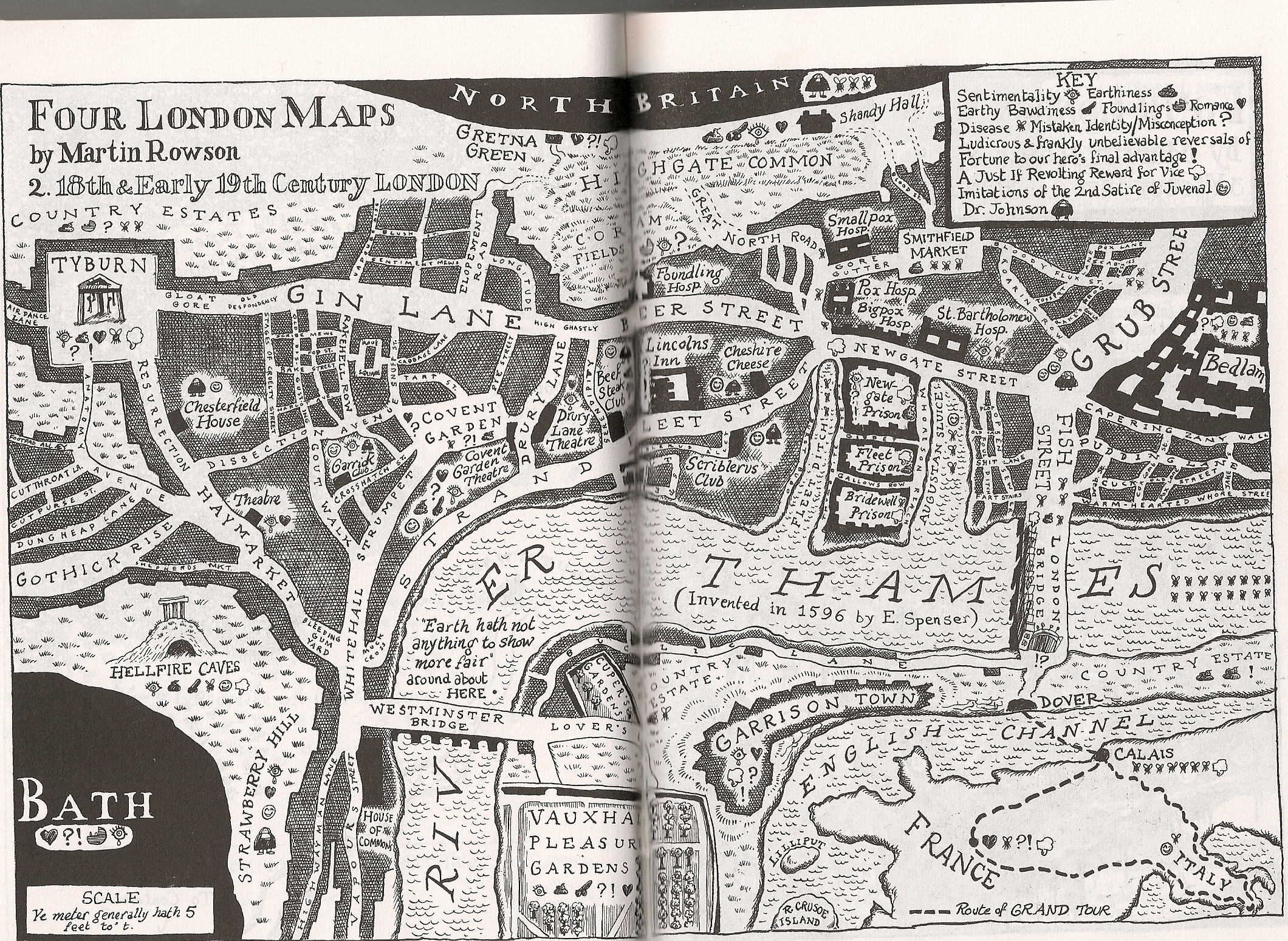
Four literary London maps

These four maps of literary London were drawn by Martin Rowson for the rather wonderful 1999 London issue of Granta magazine.

Chaucer’s London

Georgian London

Victorian London

Modern London

Peter Hitchens on drugs and the moral, opium-eating, Victorians

Peter Hitchens is a very clever man. I’m sure he’s also sincere – I can’t believe British newspapers would employ somebody to say stupid and provocative things just to get attention, after all – but judging by the interviews he’s conducted for his new book about drugs, The War We Never Fought, he’s a little bit daft.

Hitchens theory is that there has never been a war on drugs. ‘Drug-taking was, in effect, decriminalised by the Misuse of Drugs Act 1971,’ is how Decca Aitkenhead paraphrases. Instead, he harks back to the golden age of the Victorians, when there was ‘increasing self-imposed moral conduct’ (Hitchens’ words.)

Where to begin with this nonsense? Well, let’s just stick to the last bit, those morally virtuous Victorians. In a sense, he’s right: the Victorians didn’t take illegal drugs. That’s because they were too busy snaffling down the legal ones – things like opium, cocaine and cannabis – which were available to just about anybody who needed them until 1868, and then over the counter from chemists until 1926. This was the golden age of drug-taking in Britain, with opium being consumed on a scale we could scarcely now believe.

Victorian London was awash with opium, not in semi-mythologised Chinese opium-smoking dens in Limehouse (of which there were very few), but in pubs, chemists, general stores and markets, where it was sold in bottles, powders, pills, lozenges, on plasters, in sweets and much else besides. The centre of trade was in Mincing Lane, London, where 90 per cent of transactions occurred. It was most commonly taken as laudanum, a tincture of opium and red wine, with saffron and cinnamon.

This was not thrill seeking. In the days before aspirin, opium was one of the few reliable painkillers available to Victorians, especially especially fever and diarrhoea, but also malaria, smallpox, syphilis and TB. And it was effective as well. As anybody who has taken codeine or morphine will confirm, opiates have a tendency to block you right up – something that was particularly helpful when the next cholera or dysentery epidemic was just around the corner.

However, opium was also used on children, particularly when teething, in specially formulated sweet concoctions like Godfrey’s Cordial and Mrs Winslow’s Soothing Syrup, and thus surely led to the deaths of many by overdose. It also, believes the drug’s historian Martin Booth in Opium: A History, ‘provided an escape from the misery and vicissitudes of working-class life.’ This was especially the case in the Fens, where ‘many never take their beer without dropping a piece of opium into it.’

Because of these two factors, opium was belatedly seen as a physical and spiritual danger, and Victorian abstinence advocates put it right up there with alcohol and tobacco as serious threats to British life. What’s interesting, though, is the way – anecdotally at least – users were able to effectively and relatively painlessly self-medicate, living normal decent lives despite their addiction, without resorting to crime. This is true for the working classes, it’s true of the famous opium-eating writers like Coleridge, Shelly, Keats, Collins and De Quincey, and it’s also true of the many great statesmen – the sort of people who shaped the British Empire so beloved by Peter Hitchens – who took the drug. You see, because opium was the only halfway reliable painkiller around, everybody took it – including people like William Wilberforce, the great Christian abolitionist, and William Gladstone, who popped some in his coffee before speaking in Parliament to improve his rhetorical powers – even if not all of them became addicted.

In later years, opium – and especially its stronger derivatives morphine and heroin – began to be used by those simply seeking a pathway to an altered consciousness, a shortcut perhaps to the sort of transcendent mystical experience some people get from religion. In doing so, they were merely following pattern taken by mankind in all civilisations since the dawn of time, however much Hitchens may wish that weren’t the case.

As restrictions were introduced – for opium, not alcohol and tobacco – drug-use declined massively and by 1960 there were less than 100 registered heroin addicts in the UK. They received their drugs from doctors, cheap and undiluted, and were largely able to enjoy a normal existence (at least in comparison with their criminalised counterparts in America). However, as drug use increased in the 1960s, restrictions were imposed, culminating with Hitchens hated Misuse of Drugs Acts in 1971, after which drug supply passed almost completely into the hands of the criminal and use immediately rocketed. A far cry indeed from those morally virtuous days of the 1850s, when Britain’s great and good could simply pick up a bottle of premium laudanum from their nearest general store and retreat into blissful opium dreams.

Wellcome to London: how Henry Wellcome ‘hoovered up the world’ and left it on the Euston Road

Wisconsin, 1858. A five-year-old boy is playing near his frontier home when a strange stone catches his eye. He takes it to his father, who examines the flint carefully before deciding that it was a prehistoric tool made thousands of years before to cut meat. It probably meant as much to its creator as the railway did to modern humans. ‘That excited my imagination and never was forgotten,’ wrote Henry Wellcome years later, after he had grown up, moved to London and accumulated one of the largest collections of scientific paraphernalia that has ever been gathered by a single individual.

Henry Wellcome

Wellcome established his pharmaceutical company, Wellcome-Burroughs, in 1880, making a mint selling pills to an English public that had previously taken medicine in the form of powder or syrup. This fortune sits in the Wellcome Trust, which was established 76 years ago and is now worth £14 billion, making it one of the world’s largest charitable foundations. Next door to the Wellcome Trust HQ on Euston Road, a short walk from St Pancras, sits the Wellcome Collection, a museum that houses some of the million or so objects collected by Wellcome in his lifetime. Here is Napoleon Bonaparte’s toothbrush, ancient sex aids, Chinese torture chairs lined with blades, boxes of false eyes, human skeletons and paintings by Van Gogh. It is one of the most extraordinary collections in the world, a throwback to a time when wealthy individuals would hoover up the weird and wonderful of the world for their personal collections, but executed on a scale few could compete with.

Ken Arnold is the Wellcome’s Head of Public Programmes. ‘This is the last great non-connoisseurs collection,’ he says. ‘Our usual concept of a collector is somebody who carefully decides whether something is authentic and then forks out a huge amount of money for it. Wellcome had an “other-end-of-the-telescope” approach. He saw everything through medical-tinted spectacles and wanted to own anything that would illuminate that fascination.’

Wellcome collected everything: paintings, engravings, photographs, models, sculptures, manuscripts, books, periodicals, pamphlets, letters, prescriptions, diplomas, medical instruments, archaeological finds, skeletons, skin, hospital equipment, advertisements, drugs, remedies, food, plants, microscope slides, charms, amulets, ceremonial paraphernalia, costumes, medals, coins and furniture. He bought entire shops, contents, fixtures and fittings, acquiring enough to recreate an entire street. He bought others collections, picked up human skulls from African battlefields and returned from one typical trip abroad with 44 packing cases of material. If something wasn’t available, he had an artist make a reproduction. Teams of buyers were finding him items right up until his death in 1936. His reach was broad and their brief was wide.

‘Wellcome had deep pockets and no bureaucrats telling him what he could bring home so he had none of our moral, financial or logistical concerns,’ says Arnold. ‘He hoovered up the world, and left us with this extraordinarily unwieldy and undisciplined collection.’ Although Wellcome amassed an immense collection, he was frugal with his money. ‘He was very wealthy, but he would send employees to auctions dressed down so they didn’t look too rich, and would set up fake companies so people wouldn’t know it was his money,’ says Ross MacFarlane, research officer at the Wellcome Library.

A chippy self-made American, Wellcome could never become part of the British establishment – although he was awarded both a knighthood and the French Legion d’honneur – and a desire to be taken seriously may have prompted his determination to create a museum of ‘the art and science and healing’. This opened in 1913 in South Kensington, before it moved to Wigmore Street and closing in 1932. When Wellcome died, the collection was put into storage or dispersed.

‘The British Museum has 40,000 objects, the Science Museum has more than 100,000, the Pitt-Rivers in Oxford has 30,000 items and there are bits in almost every museum in the UK,’ says Arnold. The Wellcome Trust has since taken a similarly philanthropic approach, funding wings in numerous UK museums, galleries and academic institutions.

In 2007, the Wellcome Collection opened. It is a modern, classy space, with a cafe and bookshop, as well as a gallery that hosts thought-provoking exhibitions that use art and science to explore topics such as Skin, Sleep and Brains. Their next exhibition, Death, promises to be particularly fascinating and challenging.

The Wellcome dares to be different: while most museums take an unfamiliar topic and wring all the knowledge out of it like a damp dishcloth, the Wellcome looks at something familiar and turns it inside out, using contemporary art and scientific research to make visitors question what they think they already implicitly understand. Their ability to do this can be traced back to Henry Wellcome himself.

‘We feel free to interpret the material Wellcome collected,’ says MacFarlane. ‘Because although we know when something was bought and what it cost, we don’t always know how it got to the auction.’ Arnold expands on this: ‘He didn’t talk about his philosophy. There’s enough to get an idea of why he was collecting, but there’s not so much that we feel we have to conform to his beliefs. He once said ‘Never tell anybody what you are planning to do until you have done it.’ That sounds like a good idea to me…’

So the Wellcome eschews blockbuster shows – which Arnold describes as ‘a depressingly greedy way to conduct exhibitions’ – and takes pride in imaginative live events. ‘We never try to be definitive,’ says Arnold. ‘There’s always more to discover. And we don’t want to be po-faced. Science is either deadly serious or fun with pink fluffy letters – and between these two unpalatable positions is a yawning chasm that can be filled with smart and sophisticated entertainment.’

Of course, the Wellcome is helped by having a lot of money in its coffers. ‘We are much more privileged that most other organisations. We are wealthy and we don’t have to satisfy civil servants, corporate sponsors or shareholders. But that attitude comes from the Wellcome Trust itself: science is a risk-taking business and there is a sense we are allowed to be experimental.’

MacFarlane finishes that thought, ‘When we take the directors an idea, they’ll often want to give it a go, and that’s a bit like how Wellcome collected. It’s a great position to be in.’

Wellcome Collection, 183 Euston Road, NW1 2BE. Admission free. The Wellcome’s next exhibition is Death, from November 15. 

Brixton Bugle: the future of local newspapers?

Even in these days of live blogs, hyperlocal websites and social media, it can be easy to miss news stories. While national attention focuses disproportionately on a handful of big stories – whether that be tweeting footballers or dead paedophiles – smaller bits of news, especially local news, can fall through the gaps of newspapers that often seem to be more interested in filling their pages with the contrived comments of tedious columnists so snobbish, banal and privileged they could be auditioning for a lead role in the next Ian McEwan novel. And the time spent registering a new profile so you can leave an angry comment about their latest inanities makes it difficult for the average person to find those precious seconds when they can check out and absorb the content of a website devoted to your local area.

This is where the traditional local newspaper used to step in, but, er, well let’s not talk about that. But in Brixton, there is a solution. The Brixton Bugle is a monthly free newspaper (affiliated to the Brixon Blog) that rounds up all the most important news in Brixton, Herne Hill, Tulse Hill and Loughborough Junction. Around 7,000 copies are published and handed out for free outside the tube once a month or given to local shops. And it’s really rather good, occasionally breaking news that the bigger but less focused South London Press can easily miss. Visually it can still be a bit shonky, but the content is good and it is easily the best way of keeping locals abreast of the changes, both large and small, taking place in Brixton (such as the plans to knock down the local Rec Centre), especially since the council’s own free paper was scrapped.

This sort of grassroots, hyperlocal newspaper, with low distribution costs, small staff, funded by local advertising and with close and committed connections to the area in which it operates has real potential, which is presumably why the Lebedevs’ Journalism Foundation has given the Bugle a grant and mentoring support.

There are plenty of London areas – the south-east for instance, or Barnet – that do not receive the attention they deserve from the existing print media, but which have strong blogging communities. Their work is impressive and they often get lots of attention when they break big stories, but there is still nothing quite like print for keeping an entire community – not just political nerds and news junkies – involved and aware of local developments that do not have headline-grabbing power. Will they heed Brixton’s trumpet call? Here’s hoping.

My interview with Brixton Bugle co-editor Tim Dickens for Completely London

Time Out and listings

Time Out went free this week. It wasn’t really a shock, the notion had been knocking around when I worked there, particularly when thelondonpaper and London Lite were stinking up the streets. The success of the free Evening Standard probably sealed the deal. The economics are unarguable: drop the cover price and circulation rises, allowing you to charge more for advertising. If you can simultaneously reduce costs – which they have been doing through regular redundancies – you may have a viable magazine once again. The danger, though, is that once the decision to go free has been made, there’s no going back…

What has it meant for Time Out? Well, the new magazine has less pages but still has plenty of previews, lists, bitty features and clunky ads, with just a couple of longer reads thrown in for us old-fashioned types. What it doesn’t have – along with book reviews –  is listings (at least in any meaningful sense), which was the reason Time Out was invented in 1968. (There’s also no letters page, which is a mistake if they still want to establish that vital personal link with readers, and one I think they will quickly rectify.)

This isn’t really a surprise. Successive TO editors have always struggled with the listings part of their brief: listings are ugly, boring and largely resistant to any sexing up, despite the best attempts of periodic and largely futile ‘redesigns’ (has a redesign of any magazine or newspaper EVER raised circulation?). They are also beyond the control of the editor, who has to leave them to section heads. Even editors who came from within the magazine, and therefore understood the centrality of listings to what Time Out did, didn’t actually appear to like them all that much. They take up valuable space from the exciting things an editor likes to do at the front of the mag and telling a section editor you are cutting their pages is a draaaag.

To make matters worse, listings do not do well when it comes to ‘page views’ or ‘unique users’, the trite and often completely useless method by which the value of anything in print is these days judged. And because people don’t click on listings on the website (for reasons that are so obvious I won’t even bother to explain), the logic goes, they don’t read them in print.

Hmmmmmm.

A number of people have noted that without decent browsable printed listings, Time Out has potentially rendered itself useless, but I don’t want to comment on that. What does interest me is that effect a lack of listings will have London’s smaller venues. The joy of TO‘s listings was that it gave the smallest museum or club as much prominence as the biggest and most well-funded, allowing readers to decide which to visit entirely on the merit of their programming. It’s this that made Time Out absolutely central to the rise of fringe theatre, avant-garde art, clubbing, burlesque and alternative comedy – each scene was created by individuals, but a free listing in Time Out coupled with enthusiastic support from in-the-know section editors took things to another level. Even larger venues have told me they noticed the difference in footfall when they were omitted from listings (by accident or for reasons of space).

Time Out obviously doesn’t have the circulation, and therefore the pull,  it once did and there are other specialist resources for those interested in the esoteric fringes of London’s cultural life, but the loss of listings will surely still be felt by venues that aren’t internet savvy or lack a large marketing department. The solution for many will be a prominent place in the preview part of the existing sections. Time Out‘s section heads will never have been in such demand… And PRs can be a dangerously homogenising bunch.

For more on the new Time Out, here’s Diamond Geezer (positive), Christopher Fowler (not) and Londonist (neutral).