Category Archives: History

London filth

Lee Jackson loves filth. His new book, Dirty Old London, is full of the stuff, as he explores Victorian London’s attempts to cleanse a city that is swilling in muck. I’ve often wondered what Victorian London would have smelled like, and Jackson’s book comes close to capturing what must have been a frightful stink. I knew about the horse shit and the smoke, but had never considered the mud, blood, unwashed bodies, corpses and human excrement that, collectively, would have made the Victorian city one of the foulest places on earth. It’s astonishing anybody wanted to live there.

Jackson shows how Victorians began to push against the tide of muck, which grew worse as London’s population swelled. Victorians did not consider dirt in itself to be a carrier of disease, but they believed the smell could be lethal as well as deeply unpleasant, so eventually set about doing something about it. They built pavements, sewers, public baths and indoor lavatories, improved housing, dug cemeteries and generally tried to do something about “that combined odour of stale fruit and vegetables, rotten eggs, foul tobacco, spilt beer, rank cart-grease, dried soot, smoke, triturated road-dust and damp straw’. They weren’t always successful – some of those aromatic problems lingered long into the 20th century when they were eventually dealt with, or in the case of horse manure, replaced by something even worse such as exhaust fumes.

In explaining how this happened, Jackson is far more entertaining than anybody has the right to be on such a subject. Rather than focus on the well-trod tales of John Snow and Joseph Bazalgette – both of whom barely feature, thankfully – Jackson resuscitates the lives of less well known figures in this lengthy campaign against dirt, characters like reformer Edwin Chadwick who laid much of the groundwork for what was to follow. In the process, he shows how Victorian London functioned – the haphazard, individual-driven nature that saw things get done, or not, as the case might be.
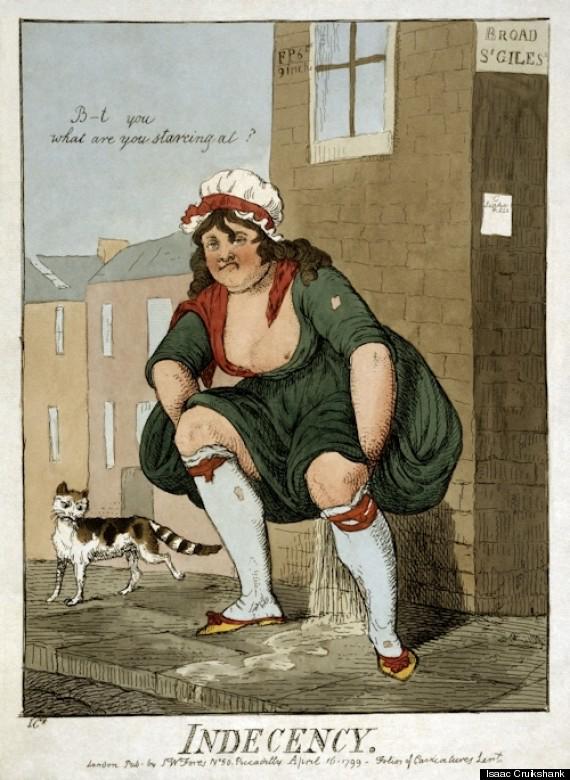
Embedded image permalink

Indecency by Isaac Cruikshank

This is a history with potentially narrow focus, but Jackson – a general historian of the unstuffy, non-academic variety – is removed enough from the subject to be able to show its wider importance and long-term effects. One theme of the book is the way sanitisation – in the form of sewage, rubbish and housing – was the hinge on which London’s social contract turned. For much of the 19th-century, the bewildering array of local authorities that ran London saw their role as, essentially, to keep out the way. They did as little as necessary, thus keeping rates low and relying on private enterprise to fill the gap. But as London grew, getting bigger and smellier every year, this system began to creak. A good example is with the dustmen. Collecting and recycling London’s rubbish was a lucrative job for some entrepreneurs, but not so much for the dustmen themselves, who had to rely on tips to make a living. And given that tips were much more likely to be acquired in rich areas, the poorer streets were increasingly neglected, allowing rubbish to pile higher and higher. Local authorities had to step in to fix this, and it gradually became the accepted role of local authorities in the UK until Thatcherite councils like Wandsworth in the 1980s began to perceive different, pre-Victorian, way of running things.

Jackson also touches on a related angle: the increasing movement of public buildings into private hands. In this case, it’s centred round the Victorian public lavatories, which were only built after ferocious lobbying from some notable figures who recognised the desperate need on the streets for London loos.  The story of how those toilets were eventually built is fascinating in itself, but Jackson also notes the fact that so many have recently been closed, flogged, refurbished and then sold back to us as coffee shops, galleries and an “award winning urban spa”. Perhaps this is the fault of the Victorians, for making things so well and so adaptable, but you can’t help feeling that, now as then, it stinks.

Survivors in Wapping, 1976

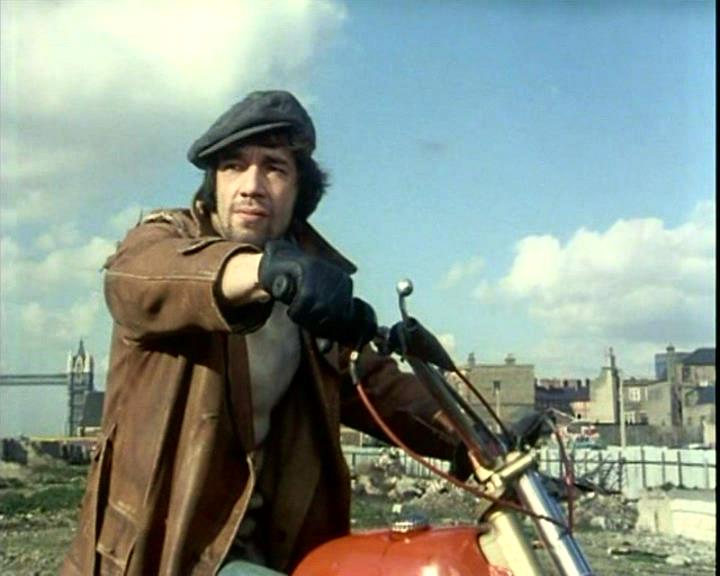
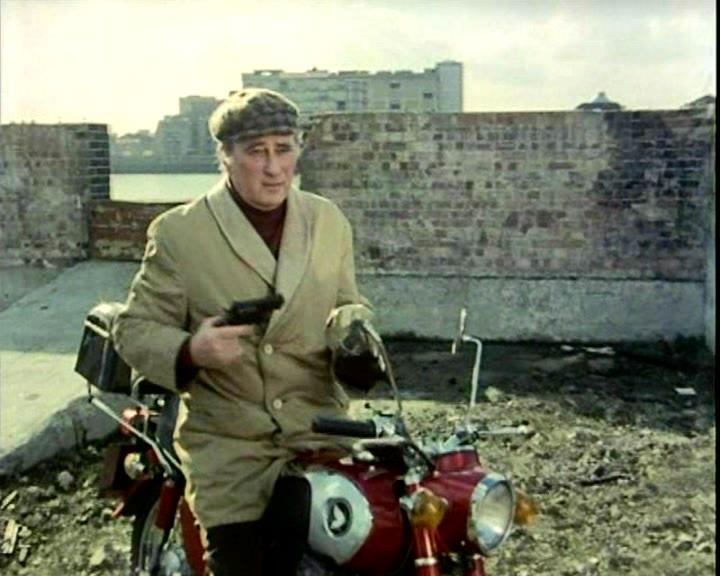
Survivors was a TV series made by the BBC in the mid-1970s that explored Britain’s post-apocalyptic near future. With most of the world’s population killed by plague, the survivors were ‘reduced to trudging across the countryside in their parkas’ (Dominic Sandbrook in Seasons In The Sun) in search of food and shelter. The creator, Terry Nation, went on to make Blake’s 7. The series featured numerous guest stars – Brian Blessed, Patrick Troughton – as well as faces that would become better known in the 1980s like Dot from Eastenders, Peter Duncan from Blue Peter and Trigger from Only Fool’s And Horses.

It’s Trigger, aka Roger Lloyd-Pack, who you may recognise in the pictures below. They come from an episode shot on  a bleak wasteland in Wapping in 1976.

In the absence of an actual post-apocalyptic landscape on which to film, the decimated docks of Wapping made a handy substitute. The main location is the site of the current Hermitage Riverside Memorial Gardens – then a bombsite but now the location for London’s only memorial to the civilian dead of the Blitz – but there are several interesting looking buildings in the background. Reader Steve, who sent me the pictures, wants to know if any of these buildings remain. (Other than Tower Bridge, obviously.)

If you know, please tell us in the comments below.

steves032

steves033

steves034

steves035

steves036

steves037

steves038

London curiosities, from Don Saltero to Viktor Wynd

This weekend, the grandly titled Viktor Wynd Museum of Curiosities, Fine Art & Natural History opens at 11 Mare Street, Hackney. You may already know of Wynd’s whims. An intriguing dandy, Wynd is the founder of the Last Tuesday Society – a body that promotes the esoteric in lectures, salons and workshops – which included Wynd’s own huge collection of oddities and curiosities, acquired over a lifetime of inquisitive travelling and impulsive purchasing. Originally, these items were meant to be sold – Wynd is still a dealer in the weird, a middleman in this strange underworld of people that buy and sell the corpses of giant spider crabs and Javanese hen’s teeth –  but he found “it didn’t work as a shop and it isn’t fun selling stuff. I had to keep buying and you can never be sure what will sell, it’s an endless cycle. So I thought it would be more fun to make it into a museum.”

These curiosities are now going on display as the new museum. And curious they certainly are. On the shelves are two-headed lambs, tribal skulls, dodo bones, plastic toys, lion skeletons, radioactive scallops, Victorian dolls, surrealist art, an artificial foreskin, a cassette of a John Major speech on the subject of red tape, a Victorian mermaid, convict Charles Bronson’s sketches, feathers from extinct birds, a giant hairball from a cow’s stomach and jars of celebrity poo [“How did you persuade Kylie Minogue to poo in a jar for you?” I asked, when interviewing him for Eurostar; “I asked her very nicely,” he replied.]

Impeccably arranged cabinets contain delight after horror after delight, some labelled, others entirely mysterious, but all put together in a way that implies the art of the display, the way these things look on the shelves, is every bit as important as the items themselves.

poo

London has always appreciated the chance to gawp at a gruesome gallery like this. Wynd’s endeavor harks beck to the very first public museum to open in London at Don Saltero coffee shop in Cheyne Walk in 1695. Saltero, a barber, had previously been known as James Salter and worked for Hans Sloane, the collector who started what became the British Museum. Sloane reputedly gave some of his cast-offs to Saltero, who used them to attract custom to his coffee shop. In 1713, his catalogue boasted in terrible rhyme: “Monsters of all sorts here are seen, Strange things in nature, as they grew so; some  relics of the Sheba Queen, and fragments of the famed Bob Crusoe.”


Saltero’s collection included such marvels as  a giant’s tooth, a necklace made of Job’s tears and Pontius Pilate’s wife’s chambermaid’s sister’s hat, which had been made in Bedford. It was, nonetheless, hugely popular and by 1760 the collection includes priceless artefacts like the Pope’s candle; a piece of the true Cross; the Four Evangelists’ heads cut on a cherry-stone; the King of Morocco’s tobacco-pipe; Mary Queen of Scots’ pincushion; Queen Elizabeth’s prayer-book; a pair of Nun’s stockings; Job’s ears, which grew on a tree and  a frog in a tobacco-stopper. Moreover, it had inspired other entrepreneurs, eager to educate the public in the wider mysteries of the world, to follow likewise. Among those following in Saltero’s wake was Mr Adams of the Royal Swan in Kingsland Road, not far from Wynd’s palace of the strange. In 1756 Mr Adams was exhibiting”the heart of the famous Bess Adams, that was hanged at Tyburn; Sir Walter Raleigh’s tobacco-pipe; Vicar of Bray’s clogs; teeth that grew in a fish’s belly; the very comb that Abraham combed his son Isaac and Jacob’s head with; Wat Tyler’s spurs and the key of the door of the Garden of Eden.”

Well then!

Wynd is an artist as well as a collector and showman, and his museum will double as a gallery, opening with a show devoted to early British Surrealists and including work by Austin Osman Spare, Leonora Carrington, Grace Pailthorpe and Reuben Mednikoff. His curiosities are also sprinkled with the occasional artistic embellishment, whether its sculptures donated by artist friends, his own drawings, fine work by the likes of Spare or Mervyn Peake, or more occultish fare, like “blood squeezed from a stone” or a box containing “some of the darkness that Moses brought upon the Egyptians”. These latter items are much like the imaginative exotica of Saltero and Adams, and also remind me a little of Yoko Ono, and her attempt to auction in London a ‘Vial of Genuine New York Tears’ and ‘Jar of Captured Cloud Formations over the Bronx’  to subsidise Norman Mailer’s Mayoral candidacy.

Wynd’s collection features a lot of dead things in jars – babies, dissected vaginas, stuffed animals, old bones, beetles, butterflies, intestinal worms – but he rejects the notion that it is simply a celebration of the macabre, a house of horrors designed to shock the straights. “Nobody’s ever been shocked,” he says. “If you are going to a curiosity museum you want to see dead babies, it’s what you expect. That isn’t what’s new, what’s new is the idea that dead babies and Furbies are equally attractive. It’s uncanny rather than macabre, it’s the juxtaposition of items, setting off thought processes.”

“I see putting everything together as an art,” says Wynd. “If you are a collector then the world is your tins of paint and the walls and cabinets are the canvas. Everything has to look right. It’s a way of trying to understand the world, but a world that has no meaning. It’s all the pretty things that show what an amazing place we live in. It’s also an attack on conventional aesthetic values, so we have a Furby, which is seen as completely valueless, sitting next to a rare and valuable skull of an extinct beast, sitting next to Chinese sex toys. I don’t recognise a distinction between high and low, it’s just if I like it. It also makes me laugh. I’m quite miserable and this place cheers me up.”

It’s not entirely clear how much Wynd enjoys his role as a collector. As he points out, most of us collect when we are children, but then grow out of it. The collector is in a state of permanent pre-adolescence, unable to move on, still fixated by those items that first caught his attention many years before. Wynd says that as a child his favourite places were the Natural History Museum and the Pitts-River Museum. In adulthood, he is still trying to locate that childish sense of awe and intellectual awakening.

He recalls being a student in Elephant And Castle and compulsively filling a garage with items he find on the streets – “I couldn’t pass a bin liner without opening it.” Later he moved to Paris and discovered that at the end of the month everybody’s rental contracts ended at the same time, and on these moving days treasures would be left outside every block of flats. “It was heaven.”

The problem, he says, is that a collection is “like a garden. It’s never going to be finished. It’s never done. It’s a psychological condition, it’s stupid, it’s pointless and causes endless worries.” It also gives us the Museum of Curiosities, for which London should be thankful. Go gawp, embrace the uncanny.

In defence of Midtown

I recently wrote a piece for The London Magazine about Midtown.

Midtown is the bastard offspring name for what people traditionally think of Holborn. For some reason, that really pisses people off. Perhaps it’s the very crassness of the name – Midtown – that deliberate literalness with its clear nod to grid-like American cities where entire areas are known by their compass points. In London, of course, we have nothing like that.

Except the West End.

And the East End.

And the South Bank.

Ah, but they are all different, aren’t they?

It is very easy to get annoyed about Midtown – the idea of it, rather than the place itself, which is pretty inoffensive – but what interested me is why. Why take on the challenge of renaming a traditional part of London? What’s the benefit? How do you summon up the gall? And how do you persuade locals it’s a good idea?

To answer those questions, I spoke to Tass Mavrogordato, Chief Executive of InMidtown, a very nice woman who appears to be permanently on her guard against negative attacks on her Midtown baby. She quickly explained to me that Midtown isn’t another name for Holborn at all. “It’s an umbrella term for the entire area between the West End and the City ,” she says. “We didn’t want to take anything away from the historic areas of St Giles, Bloomsbury or Holborn, and in many ways should help them as it helps to locate them in a wider area. We look at places like the South Bank and can see how these names with a geographical sense have been successful.”

Mavrogordato draws a straight comparison with the West End, an umbrella term that people happily use for a wider area that takes in some of London’s most historic and lovable quarters – Mayfair, Soho, Marylebone – without in any way detracting from them. Nobody has a problem with the West End. Why, she wants to know, can’t Midtown do the same thing, just a bit further east?

It all sounds very logical when she puts it like that, but I doubt people will be convinced.

Part of the problem is one of perception. People don’t like being told what to call places by other people with more money than them. InMidtown is a Business Improvement District and uses aggressive branding to push the concept of Midtown in ways that rubs people up the wrong way – even if the term Midtown predates the BID and has been in use by estate agents since the 1990s.

It’s this noxious aroma of branding that really galls, making Midtown appear distinct from the West End and South Bank, even though these are equally artificial constructions, placing rather spurious boundaries on areas that already had well-defined, historic names. But the latter two appeared more organically, or more to the point they appeared so long ago that nobody actually remembers how they came about, so they are accepted simply because they predate people’s perception of what London is, which was generally formed when they first moved to the city.

London, though, evolves far more quickly than people are comfortable with – and most people don’t actually want London to evolve at all, or at least only in ways that benefits them directly, in the form of better coffee shops or making their flat more valuable, but not so valuable that people a lot richer than them might buy it.

And that gets to the crux of people’s problem with Midtown, it’s change that appears to be directed from above, by outside forces, by money. That’s why people delight in using the ridiculous name Fitzrovia, an inter-war construct for an area that was previously considered to be an extension of Soho, but rejected Noho when that was proposed by developers as it just felt too damned American, too damned money, even if it was, in many ways, more appropriate and certainly no less daft. (Imagine trying to name somewhere Fitzrovia now – you would be laughed out of town, and rightly so.)

There is a consistency here, it’s just a very wobbly one.

And so it goes. Londoners will boast long and loud that London is the greatest city in the world, a barrel of fun for all concerned. Other people will come to London, push the property prices out of orbit and rename the streets so they can get from Lincoln’s Inn Fields to Gower Street without looking at their phone.

And suddenly, it doesn’t seem so much fun.

So in Midtown, poor helpless Midtown, they draw the line.

Turkish London and football

I have a post on Four Four Two about how Turkish Londoners square their support for Turkish club sides with their loyalties to London clubs. It was an interesting assignment, and made me wonder whether other incoming communities face similar quandaries.

Presumably they do: the historically large Italian following at Chelsea will have to occasionally decide between Lazio, Roma or Juve and their London club; Arsenal’s new French fans will have to choose between their love Arsene and their support for PSG – but there is something about the very visibly Turkish nature of the Turkish community and, particularly, the drama of Turkish football fans that made this particularly intriguing. I also got to eat some damn fine bread from the excellent Akdeniz Bakery in Stoke Newington, which I heartily recommend to readers.

Sportscapes of London

oasis

The Oasis swimming pool in Covent Garden in 1946

I’ve spent the past week immersed in Played In London, a book that is about as ambitious as any you are likely to see published about London this year. Written by Simon Inglis (author of the seminal book on British football grounds) for English Heritage, it attempts to tell the story of every sport that has ever been played in any venue in the capital – that’s everything from lost Tudor skittle alleys to skateboard parks, including all the major football and cricket grounds as well as lost lidos and billiards halls, archery grounds and greyhound tracks, relocated diving boards and blue plaques. There’s even space to mention rugby netball, a sport created in 1907 by soldiers on Clapham Common and which is still played there every Tuesday and nowhere else.

It’s a breathtaking accomplishment, full of terrific nuggets of information – did you know there were Eton Fives courts under the Westway, or that the BBC’s Maida Vale studio was built in an old rollerskating rink? – but also attempting to tell the story of how a city and its people indulge in play, how that play is shaped by the culture and topography of the city, and how it develops over time, often wittingly reinventing itself as a ‘heritage’ sport rather than die out.

This is social history as much as anything, but goes much deeper than any other book I’ve seen on the subject, like the marvellous Pleasures Of London. One fascinating section looks at the history of company sports grounds. There were once dozens of these in south-east and south-west London – Catford had several – where civil servants or bankers could take part in regular games of rugby or football, or enjoy the annual sports day. Knowing more about these events, Inglis says, would let us learn so much about the culture of work, belonging and inter-office bonding in 19th and 20th century London.

hernehill

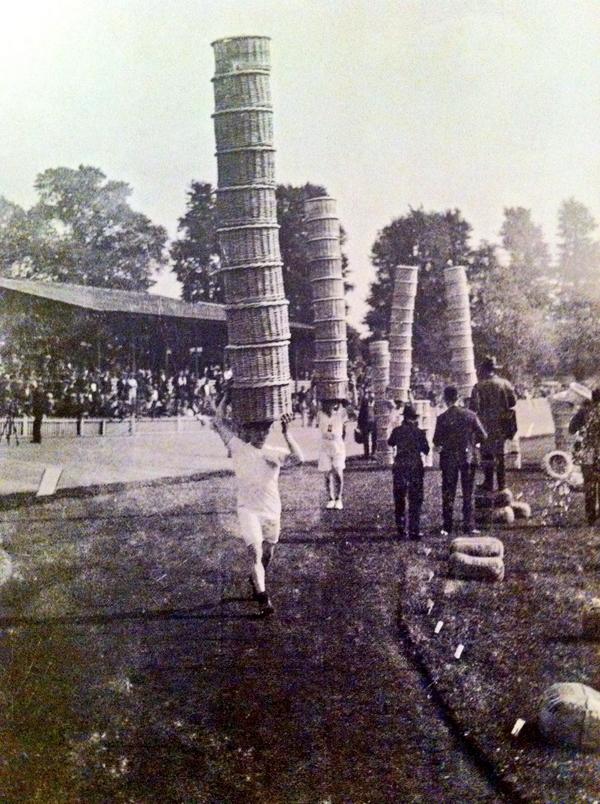
Bushel basket race for Borough Market sports day at Herne Hill, 1931

Given the scale of the project, the navigation of the book can be a little complex, but the layout makes sense over time. Inglis begins with an overview of the history of sport in London and of London parks and open spaces, before examining several areas in greater detail to see what they tell us about sport and London, and how certain spaces have been used repeatedly over time. He uses the phrase sportscapes and essentially is intending to show that sport, play and leisure require greater understanding of history than simply observing the architecture and listing club records (although the architectural chapters on Pavilions and Grandstands are genuine delights). It requires a knowledge of how space was utilised and developed, and what accidents of personality, business, culture and geography in the wider world outside sport allowed some sports and grounds to thrive while others died. It also shows how some spaces are defined by sport, but also how sports, clubs and associations are defined by the space they occupy.

The river is an obvious candidate for this treatment (and I never knew there were so many boathouses), but he also looks at length at such intriguing places as Wembley Park, Crystal Palace Park, Lea Valley, Dulwich and the Westway – all of which have long, complex relationships with myriad sports – to uncover stories that may otherwise only be known to local historians, or single-sport specialists. This approach repeats itself throughout the book, allowing ‘found spaces’ such as the South Bank skatepark to be included alongside manicured golf greens and expensive new all-seater stadia.

netball

Office workers play netball in Lincoln’s Inn Field, 1950s.

Oh, and if this isn’t enough the whole thing is illustrated lavishly throughout – indeed, they may have tried to cram in one or two photographs too many – with some spectacular mapping also included.

It makes a fine accompaniment to another book I read recently, on a more modest scale but still of some importance to London’s sporting heritage. Fighting Men Of London by Alex Daley is essentially an oral history – although the author occasionally makes his presence felt – of London’s boxing history between the 1930s and 1960s, told through seven former fighters. It puts some flesh on the bones of Inglis’s research: the boxers describe the lost boxing rings of London such as the shambolic Mile End Arena or the refined Stadium Club in Holborn, where inter-war gentlemen would dine ringside, ignoring the blood that splashed into their supper. They also talk about the old Central London gyms like Bill Klein’s in a basement in Fitzroy Street or Jack Solomon’s near the Windmill Theatre with an eye for detail that makes you think of Gerald Kersh.

The appetite for boxing in this age was vast, and many of the fighters interviewed built up large followings as they fought as frequently as once a month. None of them really made it into the big money though, and it’s notable that upon retiring several became involved in crime – The Krays, former boxers themselves, have walk-on roles in several of the stories. As a history of East End culture, it’s illuminating.

First World War in London

Britain declared war on Germany 100 years ago today on 4th August, 1914, and to mark the centenary of the outbreak of the First World War I was asked to write a piece for Metropolitan magazine looking at some of the most remarkable items from the refurbished Imperial War Museum.

pigEdith

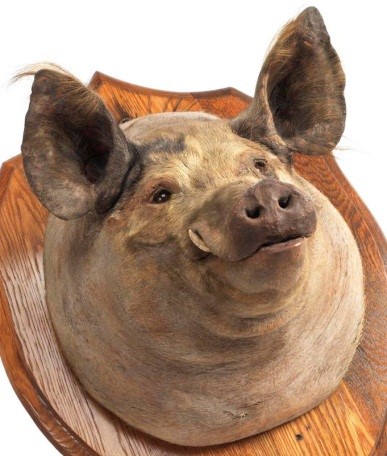
The selection includes items as varied as a mounted German pig’s head and Edith Cavell’s nurse cap. One thing I like about the IWM is that it is very good at driving home individual stories amid the context of immense global suffering and complex geopolitics, meaning you can find numerous, remarkably touching, small personal items in its collections, such as this postcard written on a piece of wood from the Western Front.

Picture 4172

One of the favourite items I came across – or rather, which the incredibly helpful press team at the museum pointed me towards – was this decorated tin, painted by a disabled Belgian soldier in London as part of a fascinating occupational therapy programme.

belgiantin

The fascinating story of California House at 82 Lancaster Gate is recounted here, but in short the hospital was set up in 1914 by an American expat artist and writer called Julie Heyneman, who – like many in London in the early months of the war – was horrified by the casualties caused by the German advance into Belgium. California House became a refuge for injured, displaced Belgian soldiers who were taught languages and sciences.

CH

Those left paralysed or limbless were encouraged to take up activities like painting, book-binding, wood-carving and drawing – anything that required manual dexterity. Objects created, such as the tin above, were then sold to Londoners, with the soldier-creator keeping some of the proceeds. A similar establishment, Kitchener House at Cambridge Gate, Regent’s Park, was set up for British soldiers. California treated around 500 soldiers, some of whom were able to return home after the war and make a living from their new skills. It closed in 1918.

california

Art and protest at the V&A

I’d been looking forward to the Disobedient Objects exhibition at the V&A for quite some time, so perhaps it was inevitable that I’d end up being disappointed. The exhibition looks at the art and design of protest, the way campaigners create new objects to enhance their ability to protest. Most obviously, this involves items like banners or posters, but protesters can be incredibly creative, and the boundaries for this are almost limitless.

The V&A exhibition, though, all felt a little safe. There was very little here that could upset anybody. The protests could all have come from a Guardian-approved list of righteous causes, while the objects were either strung up high out of reach – inflatable cobblestones, old banners – or dwarfed by the surrounding cabinets made of cheap plywood. Not that that there were that many objects: some posters and banners, a decorated car, some bicycle contraption, a phone with a subversive game and a limited selection of T-shirts and button badges. I was particularly disappointed that the Barbie Liberation Organization, a group that placed subversive voiceboxes inside old Barbies, were represented only by a film much like one you can watch on You Tube.

It wasn’t terrible. I liked the shields made to resemble book covers, for instance, and the Suffragette china has historic importance, while the Fuck The Law pendants made by a Black Panther who has spent 35 years in solitary had a rare power. Certainly more so than the rather trite banner, below, that the V&A clearly love so much they’re selling as postcards. I liked the free sheets they were giving away, though, telling people how to make their own disobedient devices.

Bone china with transfers printed in green, bearing the emblem of the Women's Social and Political Union (WSPU)Coral Stoakes, I wish my boyfriend was as dirty as your policies

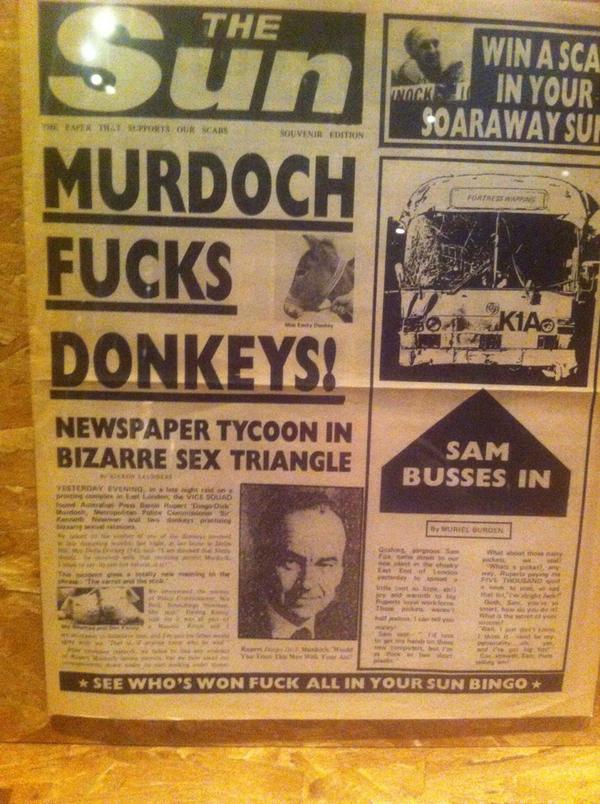
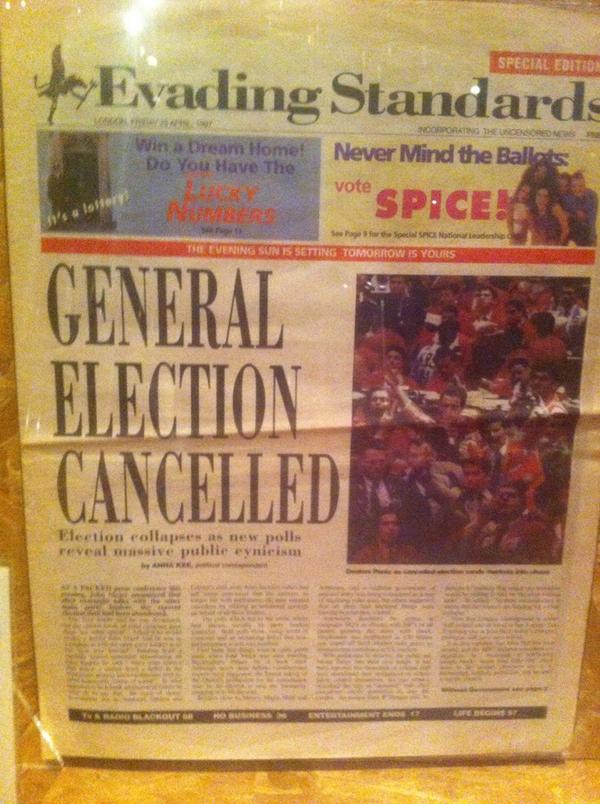
Best of everything, though – and the only stuff that really felt at all dangerous even now – were the mock newspapers created by Reclaim The Streets and Class War. These supported a variety of causes, but were generally just designed to piss off the power of the establishment.

Embedded image permalink

Embedded image permalink

This had a lot in common with the excellent exhibition upstairs in Room 88 called A World To Win: Posters Of Protest And Revolution, where Class War were also represented. This display takes place across two rooms which collectively contained dozens of dramatic posters from more than 100 years of graphic protest across the globe. There are items here from the Weimer Republic, Vietnam, Soviet Russia, Oman, Northern Ireland, Paris 68 and the Iranian Revolution.A lot are designed to shock – dead bodies at My Lai, Fuck The Draft, the incongruity of a poster celebrated the Ayatollah Khomeini placed just across the room from one lauding Angela Davis. The mix worked, and the images were superb.

A few of my favourites are below. but I recommend you check the collection out yourselves. Both this and Disobedient Objects are free.


Poster - So Long as Women are not Free the People are not FreePoster - Never Again! Stop the Nazi NF!

Against Apartheid. Boycott South African Goods (Poster)

Les Beaux-Arts Sont Fermés, Mais L'Art Revolutionaire Est Ne (Poster)

Embedded image permalink

London’s Huguenots

I wrote this last year for Metropolitan magazine. The Huguenots of Spitalfields Festival runs from 9-20 July 2014. 

Up to 400,000 French people have settled in London in recent years, but this is not the first time the French have moved to London in great numbers. While today’s arrivals come willingly, with passports, bank accounts and mobile phones, those of 1685 were in reluctant flight, arriving with next to nothing. Calling themselves the réfugiés, these Huguenots – the persecuted French Protestant minority – were the world’s first self-described refugees, coming by the thousand to seek sanctuary in London. An adolescent boy with three siblings, including a baby unable to walk. A teenage girl disguised as a man. Husbands without wives. Children without parents. Houses and jobs left behind. They came hidden in salt barrels, pregnant, shoeless and with diamonds sewn into their cloaks. But like many of their modern counterparts, these French arrivals were young and ambitious, bringing with them a sense of adventure and enterprise, ready to transform the city they now called home.

Hogarth’s Huguenots


‘Britain owes a great but barely acknowledged debt to the Huguenots,’ writes historian Lucy Inglis in Georgian London of the biggest French invasion since 1066. The Huguenots brought with them exotic food like oxtail soup, caraway seeds and pickles, new ideas about industry and banking, brilliance in textiles, watchmaking, horticulture and medicine, and enough numbers – as many as 40,000 – to transform the geography of London, pushing it west into the ‘French Quarter’ of Soho, allowing London to become one of the great multinational capitals of the world. Inglis expands on this in conversation. ‘They were real self-starters, that’s what I admire about them, the way they arrived with nothing and just got on with it. A lot of them were very young. They arrived in London and began to make a splash straight away.’

This was the first serious test of London’s toleration of outsiders, and the city took it well, with just a few grumbles about the whiff from the garlic sausages that the Huguenots hung to dry outside their windows. Otherwise, the Huguenots were a sober presence. For decades, the Huguenots had been tyrannised by France’s Catholic majority until a vague equality was established with the Edict of Nantes in 1598. When this was revoked by Louis XIV in 1685, Protestantism was effectively outlawed. Hundreds of thousands of Huguenots ignored a ban on emigration and fled France in their search for religious freedom.

Many settled in the new district of Soho, where Huguenot craftsmen could be close to the gentry of Westminster. Soho’s French character lingered for centuries – even now you can dine at L’Escargot, get cake from Maison Bertaux or pernod from The French House. In 1720, 40% of Soho’s residents were French speakers and one contemporary noted the area ‘so greatly abounds with French that it is an easy matter for a stranger to imagine himself in France’. French currency was accepted by London Huguenots into the 1720s and as late as 1924 a London guidebook would comment, ‘In Soho you may see Frenchwomen shopping exactly as they do in France, bareheaded, as no Englishwomen would.’ Scandalous!

Huguenot church, Soho Square


Just as many of today’s London French work in and around the City, when the Huguenots arrived, most headed to the long-established French Church on Threadneedle Street. London already had a small population of wealthy Huguenots – among them John Houblon, the first Governor of the Bank of England – and they, observing Louis’s despotic behaviour from afar, had been expecting the exiles. A soup kitchen was already established and accommodation secured for pregnant women. New arrivals had often become separated from their spouses so posted their details on a huge board outside the church. ‘It’s a horrible analogy,’ says Inglis. ‘But it was like the aftermath of 9/11.’

The Huguenots descended on a city on the rise. ‘Daniel Defoe wrote about the corruption of luxury, the way people could suddenly afford luxury goods,’ says Inglis. ‘But the Huguenots were plain people, they didn’t wear wigs, perfume or make-up, they had a real dignity and that meant they appeared trustworthy. As a people they were very upright in their business and to a city that was booming, this was quite welcome.’

Not every Englishman responded to this in quite the right way. One was accused of kidnapping an English girl named Christian Streeter, raping her and then having her hair cut ‘in the French way’, such was the appeal of the short-cropped French women on London’s streets. He was eventually acquitted. For the most part, though, the French presence was accepted, even as they set about revolutionising the silk business.

‘The wealthier ones went to Soho and the rest went to Spitalfields and Shoreditch, where they began to set up business as weavers, establishing a factory system and employing a lot of people,’ explains Inglis. ‘They had a massive influence on the earliest part of the Industrial Revolution.’ So many Huguenot weavers left France that the country went from being an exporter of silk to an importer in a few years. Silk was used for clothes, furnishing and wall coverings, and the Huguenots produce huge amounts of the material. The stunning patterns created by one Huguenot designer, James Leman, are now in the V&A Museum. Another weaving family were the Courtaulds, who later founded the Courtauld Insitutute of Art in Somerset House. The weavers, with the fine eye for style of many Huguenots, erected grand-looking houses, most notably along Fournier Street, one of which is now occupied by the artists Gilbert & George.

James Leman textiles


Another London artist, William Hogarth, was still able to reference the Huguenots as a stylish, sober but alien presence in his 1737 etching Noon, completed more than 50 years after their arrival and Inglis notes that ‘until the 1730s they almost exclusively married within the community.’ By 1780, however, the Huguenots were integrated into the London landscape, even adopting English names – Dubois becoming Wood, Roussel become Russell – the first of many groups of refugees who arrived in London with a bang, and then slowly became absorbed into the city’s heaving, evolving mass having altered it for ever.

Georgian London by Lucy Inglis (Penguin) is out now in paperback.

Under London: Crossrail is coming

Like every other journalist in London, I wrote an article about the Crossrail project. It appeared in Eurostar’s Metropolitan magazine in May and is reprinted here.

In a cavern 35 metres underneath Stepney City Farm, London is getting smaller. Not literally of course, that would be terrifying. No, this gigantic space under east London has been excavated for Crossrail, the 42-km high-speed tunnel being built beneath London. When it opens in 2018, Crossrail will carry 200 million passengers every year from east to west (or west to east), cutting the city down to a more manageable size as journey times are greatly reduced. When Mayor Boris Johnson entered a similar Crossrail site in Canary Wharf he gushed it was “like a Neanderthal stumbling into the gloom of Lascaux… akin to a gigantic subterranean cathedral several times the size of Chartres.” In truth, the Stepney cavern is more like a big, bare quarry, shaft open to the sky, lined with concrete and exuding a faint smell of wet earth.

Chartres cathedral

Crossrail hole in the ground

“If Crossrail is a Y, we are standing where it splits,” explains Will Jobling, Crossrail construction manager, pointing at a map that shows Crossrail travelling across London to Stepney, where it divides with one leg heading north-east and the other crossing the Thames to Abbey Wood in the south-east. “Two of the tunnel boring machines (TBM), Victoria and Elizabeth, have passed through here and you can just see the back of one on its way to Farringdon. They should get there by February 2015.”

There are eight TBMs working on Crossrail, giant moles that slowly grind through London clay at the rate of around 150 metres a week. Weighing 1000 tonnes and with rotating, earth-scraping heads, these monsters run 24-hours a day and are like mobile factories, removing dirt and sealing the tunnel with concrete as they move. They even have canteens and toilets as well as a rescue chamber in which workers can take refuge in case of an accident. Around 4.5 million tonnes of earth (which Jobling says has the consistency of “elephant dung”) will be transported by barge to the Thames estuary to create a man-made nature reserve. One machine, Jessica (named after Olympic athlete Jessica Ennis), is being removed at Stepney. It’s taken apart underground, lifted out the shaft then transported to Canning Town, where it will be welded back together and lowered into the ground to continue tunnelling. Parts of Jessica lie strewn across the Stepney site, battleworn, clay-scarred and weary but with more work still to do. They look like ancient artefacts salvaged from the seabed.

The TBMs cost £10million apiece and are fitted with lasers that help engineers plot a course around and under London’s subterranean obstacles – sewers, foundations, plague pits, buried rivers and other tube lines. “At Tottenham Court Road, we come within 80cm of the Northern Line,” says Jobling. “We look at every obstruction we could possibly find. Sometimes we have to back-engineer, look at how high a building is and then work out how deep the piles will go.”

Despite this, the basic principles haven’t changed since Marc Isambard Brunel invented the tunnel shield to dig the Thames Tunnel from Rotherhithe to Wapping between 1825 and 1843. Some methods go back even further. “At Canary Wharf we hit a bunch of old piles that we had to cut through by hand using old mining techniques,” says Jobling. “The older guys loved it.” He’s interrupted as a loco, a miniature train used by workers to travel through completed tunnels, scoots noisily past. It’s like an old mining cart, only it runs on diesel and is deafening. As the TBMs approach Farringdon, workers will have an 8km underground commute on the loco to work every morning. When the screeches have stopped echoing off the cavern walls, Jobling explains how a ceremony was held at the start of operations as priests blessed 38 statues of St Barbara, the patron saint of miners, and placed them at tunnel mouths. “Tunnellers can be a superstitious lot,” he notes.

Saint Barbara

Crossrail will be followed by similar huge projects – the Northern Line extension to Battersea, a gigantic sewer called the Thames Tideway, and possibly a north-south Crossrail Two – and to ensure London retains its tunnelling knowhow, Crossrail opened the Tunnelling And Underground Construction Academy (TUCA) in Ilford in 2011. In a building designed to look like a TBM entering the ground, workers are trained in a specially developed environment that includes a replica of Crossrail tunnel. “We get them used to working in an enclosed space,” says Georgina Bigam, Skills And Training Manager. “Everything can be installed and dismantled. We also do a safety course where they fill the tunnel with smoke, turn off the lights and simulate explosions by chucking firecrackers around for half-an-hour. They have to find their way out.” She pauses. “I usually make the journalists do it,” she says, and giggles.

TUCA trains hundreds of people to work beneath London’s soil. The canteen – complete with mural of UK tunnelling landmarks – is filled with eating, gossiping men (and one woman) of all ethnicities, from Cockney grease monkeys to a middle-aged Sikh with hard hat screwed on top of his turban. Many gain knowledge that is valued all over the world. As Valerie Todd, TUCA’s Talent and Resources Director, explains. “There’s tunnelling happening right across the world as cities everywhere are facing similar pressures, looking to find ways to move a lot of people around very quickly when the surface area is used up.” But Crossrail is the current focus, a £15-billion project that is Europe’s largest infrastructure project and which Boris Johnson has likened to conquering Everest. Onward push the TBMs, while the city sleeps and workmen come and go. Saint Barbara would be proud