Category Archives: History

Moonlighting

I am going to be blogging current affairs type stuff over at Snipe, in the illustrious company of Adam and Darryl.  

My first post about the Old London Underground Company can be read here.

You can also read more of my stuff over at the Time Travel Explorer blog, which is devoted to maps and history. My latest piece is about the constancy of one London burial ground.

More London books

Continuing a bookish theme, a couple of current and forthcoming releases have caught my eye.

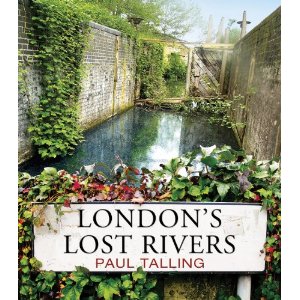
First is ‘London’s Lost Rivers’ by Paul Talling and published by Random House. This is the first serious update of Nicholas Barton’s classic 1950s underground river book and it will be interesting to see what new information about the Fleet, Effra, Westbourne et al that he has uncovered.

Jamrach's Menagerie

The second has been catching my eye in the window of Herne Hill Books every time I walk past it. ‘Jamrach’s Menagerie’ is a novel by Carol Birch published by Canongate.  This is a novelised account of the famous occasion a bengal tiger escaped from London petshop Jamrach’s. It was from this shop that the animal-loving artist Gabriel Dante Rossetti probably purchased the pet wombat, whose death left him so bereft.

Incidentally, if any publishers are reading this and fancy sending me London-themed books to add to my collection, my conscience would have no hesitation in happily accepting them.

How a shoe can teach the Holocaust

It starts with a shoe. An old shoe, scuffed, brown and small. It’s old and battered, and has been carefully re-stitched at the back where the seam has come apart. A classroom of Year Nine schoolchildren are asked what they can tell from the shoe just by looking at it. They agree it once belonged to a boy and that it’s been repaired a few times – perhaps by a family too poor to buy a replacement – but at some point was lost or thrown away.

Then the teacher tells them where the shoe was found, in Poland, outside a village called Oswiecim, and that it probably belonged to a boy from Hungary, who would have arrived there on a train with his parents nearly 60 years ago. After getting off the train, he would have been told to remove his shoes while he went to take a shower from which he would never re-emerge. Oswiecim is the place that we now call Auschwitz.

The Holocaust is a daunting topic for schools. Pupils can be overwhelmed by the sheer scale of the genocide, and troubled by the complex emotions it can raise. For their part, teachers can struggle to define the Holocaust correctly, or explain why it happened and what made it so uniquely horrific.

Which is where the shoe comes in. ‘There are lots of issues when teaching emotional subjects like the Holocaust,’ says Paul Salmons, who created the Holocaust Education Development Programme (HEDP), a course prepared by the Institute of Education to help secondary school teachers. ’It has the potential to raise profound questions and move children very emotionally. This course tries to balance an emotional engagement with a cognitive reflective approach.’

The story of the shoe, explains Salmons, ‘isn’t just intended to get an emotional reaction, it is to raise questions in response to the children’s emotional encounter.’ So after the children are told about the shoe, they are encouraged to ask questions. What happened to the boy’s parents? Why did they allow him to die? Why was he killed at all? From here, a discussion about the Holocaust and its repercussions can begin, with teachers using material taken from the HEDP website. It is a fascinating and intuitive way to introduce the subject, immediately bringing something huge and monstrous down to a level that a child can comprehend.

The course was developed in response to research conducted by the IOE in 2006. This showed that while the Holocaust was widely taught in schools – it has been on the National Curriculum since 1991 – there were many areas where knowledge was lacking. The research also revealed that 77.5 per cent of teachers wanted professional guidance, finding it difficult to convey the enormity of the genocide without inundating children with brutal images.

‘It is important children learn about the Holocaust because of its significance in world history, but it’s equally important not to traumatise them,’ says Salmons. ‘We have a history of human atrocity that’s also a history of forgetting and until the Second World War, nobody tried to analyse man’s capacity for self-annihilation. So we see the Holocaust as pivotal in understanding certain things about human nature and important for children’s social and political education and historical literacy.’

The Jewish Museum

This is done without using images of heaped corpses or film of mass executions. On the first day of the course at London’s Jewish Museum, tutor Kay Andrew tells the 15 teachers that this is ‘not about threatening or graphic images. Traumatic images can be seen as leading material.’

Peter Sullivan, a history teacher at Forest Gate Community School in East London, concurs. ‘These images can actually lead to arguments about holocaust denial – kids will say that they were staged or are of prisoners-of-war who died of natural causes – so we try to use more specific material to avoid pointless arguments.’

Is Holocaust denial really a problem in secondary schools? ‘You do get some of the Muslim kids, not so much in denial, but arguing that they deserved it because of the way they treated Palestinians. A percentage cannot differentiate between Jewish and Israeli and don’t have the life experience to put it into the proper context. It’s not just the Muslim kids, just up the road is Barking and Dagenham where the BNP are active, and when Nick Griffin says “I can’t deny the holocaust because it is illegal to do so” you know exactly what he’s saying. We have to combat that.’

Salmons says ‘The issue is more Holocaust diminishing or trivialisation,’ he says. ‘The way it can be used to suit different agendas or to promote a cause.’ He cites the example of the invasion of Iraq, when ‘there was a tendency to equate Saddam Hussein with Hitler in a fairly unreflective way perhaps designed to mobilise people behind a policy, which should have been argued on the merits of whether it was right or not, not by appropriating something powerful from the past. If young people are aware of what really happened, then they are better equipped to make that judgment for themselves.’

Leon Greenman

The course puts the Holocaust into context. On the first of two days, Andrews covers a number of different topics that have little to do with genocide itself. Teachers look at the diversity of pre-war Jewish life to ensure teachers don’t present the 6 million as a faceless monolith, and are asked to consider different forms of resistance and resilience to escape notions of the Jews as passive victims. The story of Leon Greenman, a British-born Jewish man who lived in Holland and whose family was killed in Auschwitz, runs throughout the course. ‘Leon was taking about his experiences from the very beginning,’ says Andrews. ‘We have archive of him talking to the BBC in 1945. He remained active in anti-fascist politics and received an OBE from the Queen, so you can explore the influence of the Holocaust through the life of this one man.’

The course does not neglect the other Nazi crimes, including the persecution of Jehovah Witnesses, Communists, homosexuals, the disabled and the Roma. Salmons explains, ‘We take an academic definition of what the Holocaust was – that it was the genocide of European Jewry by the Nazis and their collaborators – but you have to look at other victims. They are part of the broader context and a lot of these crimes overlapped, but if you lump them together and call them the ‘Holocaust’ it ceases to have much meaning, because the differences are as important as the similarities. With the genocide of the Roma-Sinti, there is a parallel to the Holocaust but one that has its own name – the Porajmos – and it needs to be studied with its own significance.’

The course is part-funded by the Pears Foundation, a philanthropic venture who have recently invested £1.5 million in the UK’s first Institute for the Study of Antisemitism at Birkbeck and donated funds to London’s Wiener Library, the world’s oldest Holocaust library.

Improved understanding of the Holocaust in schools could help combat increasing anti-Semitism, but Salmons says it isn’t as simple as that. ‘We don’t cover contemporary anti-Semitism, but do try to understand the historical and ideological anti-Semitism of the leading Nazis. But we also explore how you didn’t have to be anti-Semitic to be complicit in genocide, you just had to benefit from it. Many Germans bought the goods of Jewish neighbours in auction, which means they give tacit approval. We hope that young people aren’t racist, but they can still be unwittingly complicit in all sorts of injustices without having any personal or ideological prejudices.’

Inside the Fleet: exploring London’s lost rivers

I wrote this piece for Time Out in 2005 and for some reason it’s never been available online. Until now.

It’s only as the filthy brown water rises above my thigh-high waders and my feet struggle to grip the tunnel’s slimy floor that I realise that drowning in a river of shit after breaking into a London sewer would be a really, really crap way to die.

It all began so well. I found Jondoe and Stoop, two urban explorers who get their kicks investigating drains, lost rivers and derelict buildings, on the internet and asked them if I could come on their next journey beneath the city streets.

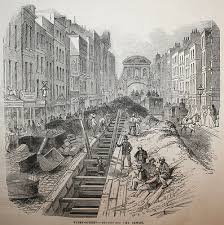
We met near Farringdon. The plan is to explore one of London’s lost rivers, the Fleet, which once flowed from Hampstead to Blackfriars. Although long bricked over, the Fleet, like many of London’s old rivers, still flows underground through a series of pipes and culverts. Joseph Bazalgette integrated these rivers into his sewer system, using them as storm-relief drains to carry overspill into the Thames when the main east-west sewers were swelled beyond capacity. These days, heavy rain can still cause sewage to flow into the river via the Fleet.
Jondoe and Stoop have been in the Fleet before, but turned back when the stench became overwhelming for even these experienced drainers. This time, they are determined to reach the end. They believe no other UK urban explorer has made the trip, largely because it takes considerable planning to find a way into London drains. Urban explorers are driven by a combination of adrenalin and curiosity, and take their hobby seriously. This trip has been months in the planning. They’ve popped many manholes looking for the right entry point, and the weather has to be right – no rain for at least three days before we enter.

In a nearby car park, we change into waders, boiler suits, flourescent vests and hard hats – the latter more for disguise than protection. Carrying a couple of traffic cones, we’re suddenly transformed into construction workers, practically invisible to passers-by. Nobody bats an eyelid as we walk through busy streets to the selected manhole, stick some cones round it, lift the cover and climb down the ladder into the gloom.

We enter a feeder tunnel with a five-foot ceiling, which means we have to abandon our hats and walk with cricked necks. It’s cramped, damp, dank and dirty but doesn’t smell too bad. Stoop and Jondoe glide like skaters along the slippery floor while I splash clumsily behind, using slimy walls to keep my balance. We head downwards along a series of mini-waterfalls. The light and noise that intermittently emerges from the grates overhead suggest we aren’t getting deeper, but simply following the gradient of the road. It’s a curious feeling, being isolated in the dark but with occasional glimpses of London reminding us that normal life continues up above.

Eventually we reach the end of the feeder tunnel and swing into the Fleet itself using broadband cables that make useful subterranean handrails. It stinks in here and the air is heavy with a strange mist. Jondoe points north, to where the Fleet is blocked by the main east-west sewer. Ominous clumps of matter fester in pools all around. ‘Don’t disturb them,’ he says. ‘It’ll be full of gas that just sits there and collects.’
As he speaks, one of the hard hats we’d left by the entry point shoots out of the feeder tunnel on a wave and floats towards the Thames, bobbing along the shallow water that moves sluggishly down the centre of the tunnel.

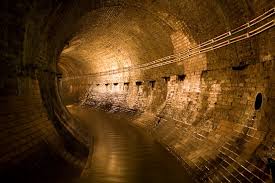
We follow, heading south. The tunnel is around ten feet tall and wide, so we can walk two abreast. It’s about the same size as a tube tunnel. The smell slowly subsides, although lumps of faeces and toilet paper gather in places where they’ve washed against the brickwork. Otherwise, there’s just a trickle of brown water ferrying the odd cotton-bud downriver.

It’s no hellhole, but still a far cry from the Fleet’s sixteenth-century heyday as one of London’s key tributaries, when, flanked by wharves and warehouses, it was a centre of London commerce. It separated Westminster from the City and carried cargo to the Thames, was compared unfavourably with the four rivers of Hades by Ben Jonson, was briefly turned into a canal and then covered in portions from 1732, by which time it was little more than an open sewer.

But this was not the end of it. In 1846, the Fleet exploded, its sewage gasses bursting the street above, rendering King’s Cross Road impassable, destroying Clerkenwell poorhouses and smashing a Thames steamboat against Blackfriars Bridge. This river, it seems, has a habit of coming back to ambush those who thought it dead and buried.

Almost two centuries later, traffic and police sirens are audible overhead, competing with the constant crash of water that flows from numerous side tunnels, feeding the central trickle. Rats stop and stare as we walk past. I nervously keep my torch shining on them until we have moved on.

Before Ludgate Circus, the Fleet splits into two parallel tunnels, directly replicating the pattern of Farringdon Street overhead. Otherwise, it’s impossible to work out exactly where we are. The tunnel heads south, but is full of turns. At one point we notice large iron rings cemented into the wall. They are support for scaffolding, but look like mooring rings. Throughout, the Victorian brickwork is surprisingly beautiful for something that is so rarely seen.


After about two miles of trudging, we emerge into an enormous end chamber, more than 20-feet high and elaborate in design and construction. Two short tunnels lead from here, ending in huge metal flaps, which we assume open directly into the Thames.

After taking pictures, we head back. Immediately, we realise there’s a problem. It’s much harder to walk uphill against the flow of water. On the way down, the water was a stream, heading back, it’s more like a river. We labour onwards and upwards in the dark, but it’s tough work.

Stoop eventually says what we’ve all been thinking. ‘Is it just me,’ he asks, ‘Or is the water getting deeper?’

Water which before barely covered our feet is now above our knees, flooding downhill towards us at pace and rising slowly all the time. Wading into the tide, our clothes are heavy with water and our feet struggle to grip the slimy stone floor. Panicking rats scurry up the walls to get out the way of the bubbling water.

 It’s frightening. Nobody knows we are down here and as our pace slows I begin to ponder our options. Should we press on, or brave a side tunnel, where a ladder may at least take us above water level, so we can sit it out. But how long would that take? And what if the water keeps rising and the side tunnel we’re in doesn’t have access to the street? 

We reach a turn where the water has become a torrent and Stoop tries to brace himself against the tide but instead starts sliding backwards towards me, threatening to skittle us all into the dirty water. For a split second I consider what an undignified death this would make, and with one final effort we press on, forcing ourselves to a point where we can stand without getting knocked off our feet. But we’re exhausted.

Then Jondoe shouts, ‘That’s where we came in!’ It is indeed. We pull ourselves up into the feeder drain via the broadband cable and watch the river below us boil to a frenzy. The Fleet is back with a vengeance. Later Jondoe explains, ‘Somewhere further up the sewer they must have been doing some maintenance and so diverted the flow down the Fleet.’ It is, he says, something he’s never experienced before.

Twenty minutes later, after an exhausting walk through the smaller drain in the course of which I bang my head several times on overhanging pipes and bricks, I haul my battered, sodden body up the ladder and into the sunshine. It’s bright outside. The air smells clean. Half-a-dozen people across the road pay us no heed as we emerge from the manhole and sit slumped in the road, moving only to remove our waders and empty them back down the drain.

We trek back to the car in soaking socks, leaving a trail of footprints behind us.

The Siege Of Sidney Street

My review of the Museum of London Dockland’s exhibition on the Siege of Sidney Street can be read in the New Statesman.

For once, I have little more to add. It’s an excellent exhibition and I recommend heading to Docklands before it ends in April. For more on the siege, you can see Pathe newsreel footage here or read Caroline’s article here.

Or you can watch a clip from the 1960 movie loosely based on the events.

Mucky pics in Victorian London

It can be hard to persuade people to visit historic houses, which makes you wonder why the owners of 18 Stafford Terrace don’t make more of the secrets that are hidden in the attic.

Stafford Terrace in Kensington is also known as Linley Sambourne’s House. Sambourne was a cartoonist for Punch who bought the five-storey terrace in 1875 and decided to decorate it as fashionably as he could, along aesthetic principles. This meant much William Morris wallpaper and exotic furniture. The problem was, Sambourne was not a wealthy man, so he purchased the latter from house clearances and junk shops and to make the former go further, he would cut out bits of wallpaper that were hidden from sight behind paintings and furniture and use them to paper other parts of the house. And he had a lot of paintings and furniture.

When Sambourne died, his son kept it exactly as it had been left, as did the following generations, until Stafford Terrace, now essentially a time capsule of Victorian middle-class life, was purchased by the GLC.

And that is how it has remained. The house is now owned by Kensington & Chelsea and run by nearby Leighton House.  Visitors get to see inside a fascinating interior and learn about the fashions of the Victorian middle-class first-hand.

But there’s more.

Sambourne was a cartoonist, but he also developed an interest in photography. He realised that instead of drawing his caricatures from scratch, he could get people to assume certain positions, photograph them, and then sketch the results. In his backyard he would get the coach-driver to dress as the statue of Eros, or pretend himself to be a tennis player or Roman soldier, using props from around the house. Here’s an example.

But there’s more.

Sambourne also started a Camera Club. Here his subjects tended to be more specialist.

For some reason, Camera Club always took place when Sambourne’s wife was visiting friends in the country.

In the attic of 18 Stafford Terrace, on a very high shelf, are several unmarked volumes packed with this sort of photographic work. Some are displayed in the bathroom for public study.

Mocked up in the same attic room is a demonstration of how Sambourne worked. An easel contains a cartoon of three women on a bicycle, copied from an adjacent photograph of three women pretending to be on a bike. In the photograph, all the women are nude; not so in the cartoon.

But it doesn’t end there.

Sambourne would also take his camera out with him when he was in Hyde Park or mooching around Kensington, and take surreptitious images of passing nursemaids, which he would carefully file as ‘Zoological Studies’. He even purchased a special camera with a secret lens that took pictures at right-angles so his subjects would be completely unaware as to what was going on. He still received a number of warnings for his behaviour.

And he also liked to take pictures of his maid. In bed. Asleep.

There’s nothing quite as creepy as a middle-aged Victorian male, is there?

See also The Man From London and Virtual Victorian.  

Fulham – European champions: how the London football map might have looked

The current hoo-hah over the legacy of the Olympic Stadium and the squabbling between West Ham and Spurs offers an interesting reminder of how different the map of London football could have been.

In 1904, when the new owners of the vast Stamford Bridge athletics stadium in Walham Green decided they wanted to find a football club to play there, the first thing they did was ask Fulham.

Fulham were London’s first professional club and one with some potential, but surely not as long as they stayed in their tiny Craven Cottage stadium, cramped between residential streets and the River Thames. Stamford Bridge, a huge and modern ground, should have been a far more attractive proposition, but the Fulham chairman, Henry Norris, said no.

He would never again demonstrate such caution or traditionalist principles.

The stadium owners, the Mears family, eventually – after some prompting from Frederick Parker’s dog –  decided to form their own club. Chelsea appeared in 1905, and thanks to expansive investment, almost immediately became the biggest club in London, drawing huge crowds that totally overshadowed poor Fulham and the rest of London football.

Norris took stock of this and decided the best thing to do was get the hell out of West London. He hopped over to Arsenal, then a struggling club with small crowds in Woolwich, took one look at the unpromising area and after briefly attempting to merge Arsenal and Fulham agitated instead for a move to North London, much to the fury of the existing and suddenly squeezed Tottenham Hotspur, who began to draw more of their support from East London, where West Ham resided. Tottenham’s overlap between East and North London is what makes the Olympic Stadium semi-logical but also vaguely heretical.

Over in South London, the absence of Arsenal allowed Charlton to step into their shoes, turning  professional at almost the same time as Arsenal crossed the river.  (Hat-tip Darryl, in the comments)

Suddenly, the map of London football had completely changed. Chelsea were the undisputed giants in the west, while Spurs and Arsenal shared domination of the north, with everybody else filling in the blanks. 

Here’s a picture of Norris. Doesn’t he look like a nutter?

But has one man had a greater impact on London football?

Without his intervention, Chelsea wouldn’t exist, Arsenal would still be in Plumstead and Charlton would still be amateurs. Spurs and Fulham would almost certainly be the twin giants of London football. Indeed, Fulham, playing at Stamford Bridge and managed by Herbert Chapman (who Norris was later to recruit at Arsenal) could easily have become one of the biggest clubs in Europe. Fulham, champions of Europe – it could have happened.

Secret London: inside the Black Museum

I first read about the Black Museum when I was a boy, a macabre museum run by the police filled with artefacts taken from their most gruesome cases. I always wanted to visit, but the museum was out of bounds to the public. When I was at Time Out, I asked the Met to let me write about the museum and after some badgering – and to my great surprise – they finally agreed. The result was not quite what I expected. There is an interesting coda to this piece. Upon publication, the press officer phoned me to say how disappointed they were with the tone of the article; at exactly the same time, the Curator sent me an email saying the piece was the best description of the museum he had read. Make of that what you will…

The Curator pulls open a drawer full of shotguns. ‘Which of these are real and which are replicas?’ he asks. I nervously peer inside.
‘Too late,’ he says. ‘You’re dead.’

Welcome to the Black Museum, the Met Police’s private memorial to  London’s worst crimes. The public isn’t allowed inside, and after a half-hour tour, I wish I hadn’t been either.

Death masks and weapons from the Black Museum

The Black Museum (renamed the Crime Museum after complaints from officers in areas with large ethnic minority populations) has been one of the world’s most macabre and inaccessible museums for over a century, acquiring a certain infamy among hardcore Londonphiles and the sort of people who spend their spare time reading ‘The World’s Greatest Serial Killers’.

The museum is closed to the public but, after repeated requests, The Curator has allowed Time Out inside, albeit under duress that he makes no attempt to disguise. From his office in Scotland Yard’s Room 101 (and who says the police have no sense of humour?), where the walls are covered in police badges from forces around the world and shelves stuffed with books such as, er, ‘The World’s Greatest Serial Killers’, The Curator – two parts John Thaw to one part librarian – lays down the law. He doesn’t want to be named or photographed, and if the piece results in people phoning him up to try to get access to the museum, well, he’ll hold me responsible.

Ground rules established, The Curator unlocks the door, and the tour begins. The Crime Museum has been at Scotland Yard since 1874, moving with the Met from Whitehall to Victoria Embankment in 1890 and then Victoria Street in 1967. It was set up by Inspector Neame after an 1869 law allowed the police to retain prisoners’ property for ‘instructional purposes’. Neame felt it was important that police officers could see the tools of the criminals’ trade – a function the museum still fulfils today – and gradually built up the museum’s collection.

In 1877, a reporter from the Observer was refused entry and wrote about Scotland Yard’s ‘black museum’. The name stuck, and the museum became a popular destination for Victorian celebs: Gilbert and Sullivan, Sir Arthur Conan Doyle, Harry Houdini and Laurel and Hardy all had a ghoulish gander.

The room we enter has been mocked up to resemble the original Whitehall museum, with a false fireplace and sash window. The first thing you see is a hangman’s noose, followed by a desk covered with knives and guns, and a chest of drawers topped with a glass case containing submachine guns. An opening leads from this ante-chamber into the museum proper.

We start at the gun drawer. As well as rifles and replica rifles, it contains walking sticks, umbrellas, flick knives and other random bits of metal. The Curator asks me to guess which of these items are guns, pauses for a heartbeat, before stabbing with his finger: shotgun, shotgun, pistol, shotgun, pistol. They’re all guns, the walking stick and umbrella, even the flick knife. And all have been used on London streets. He takes out a walking stick, demonstrates how quickly and easily it converts into a gun and back again, and shuts the drawer firmly.

The Curator is enjoying himself, less begrudging by the minute. He picks up a sword and hands it to me. As I take it by the scabbard, he pulls off the hilt, which is a short, detachable, vicious blade, and imitates gutting me with it, which, he says, is exactly what happened to the police officer who first encountered this duplicitous double-weapon. It’s called the Cop Killer, he says. And, just like that, any lingering sense of fun wafts out the window.

The point of this drawer, The Curator explains, is to show new coppers the dangers they face from disguised weapons (the walking-stick gun et al were legal until 1959).  The inference is clear: anything is a potential weapon.

The Curator is passionate about the museum’s purpose and happiest when discussing the history of crime. Everything that comes into the museum, he emphasises, is for teaching purposes, and not just for cadets. Senior officers come here for briefings and lectures to discover historical parallels of contemporary cases.

We move into a large room with the fusty atmosphere of a regional museum. Display cases that mark out a mazy circuit of London’s criminal history. One of the first is on serial killer Dennis Nilsen, who boiled the flesh of his victims on his stove before poured their fat down his drains. I look at the Nilsen display. It’s a badly stained cooker topped by a battered aluminium cooking pot. I feel sick.

Nilsen’s cooking pot

The rest of the tour passes in a blur. There’s a display on officers killed in the line of duty; the protective apron used by John Haigh, the Acid Bath Murderer; vials of poison; forensic photographs; blood-stained weapons; a crossbow used by the Krays; a ketchup bottle from the Great Train Robbery (‘I can’t talk about that,’ says The Curator cryptically); evidence related to Crippen, Christie and cannibalism; explosives used by Fenian terrorists; the IRA rocket launcher that fired at the MI6 building in 2000; and the tiny ricin-loaded pellet pulled out of Georgi Markov’s leg, where it had been inserted with an umbrella.

It’s a tough tour, not because of any individual items (Nilsen’s cooking pot excepted) but through the accumulated weight of otherwise anodyne objects that collectively represent the many horrible things people have done to each other. It’s a chilling, unsettling experience that sits somewhere between the self-chosen prurience of reading a book about Fred West and the necessary horror of the Imperial War Museum’s Holocaust gallery.

The Curator reassures me that visitors, police officers included, regularly faint during tours, but this is clearly a museum that has been designed by the police, for the police. That point is underlined by one of the last displays, a huge pile of weapons taken from demonstrators at an anti-Vietnam War march in 1968, a so-called peace march comments The Curator, as well as riot shields from Brixton, melted by petrol bombs, and Broadwater Farm, peppered by bulletholes. This is what you are up against, the display says. Trust nobody.

Police at Broadwater Farm

The result is a museum that works on two levels: one is the straightforward practical side that allows policemen to see and handle real evidence and learn how it was used to solve cases, while the other, possibly more important, is psychological, showing the police what the people out there will do to them, and each other, given half a chance. In so doing, it validates the Met’s instinctive suspicion – as embodied by The Curator – of outsiders, the public, the people they protect and serve.

I leave the Crime Museum in a sober mood, sure of only one thing: having tried so hard to get inside, I’m in no hurry to return.

Pussyfoot Johnson and the London mob

My review of Ink And The Bottle, an exhibition about cartoons and alcohol, appears in the Independent.

One of the cartoons at the gallery is based on the story of William ‘Pussyfoot’ Johnson, an American who was active in the temperance movement and came to London on Nov 13, 1919 to give a talk.

Johnson was leader of the Anti-Saloon League and after success in America, he headed to the Old World to spread the anti-drinking word. He argued, ‘There is more bootlegging and more moonshining in Europe than in the whole United States.’

He may have been right. This temperance movement map from 1886 attempted to show the scale of the problem by depicting all of London’s pubs in its ‘Modern Plague of London’ map.

Modern Plague, London

Pussyfoot earned his nickname for his habit of amending laws by stealth, and this did not go down well with the London mob. As one anti-temperance advocate told the New York Times, ‘You know how the majority of Englishmen look upon prohibition and Mr Johnson’s activities? The thought of not being able to have the well-known pint of bitter fills them with horror. The war was terrible enough but it was something that happened before. There have always been wars. Taking away the drinks is attacking the divine rights of the Britisher. I can tell you they don’t like it!’

They certainly didn’t, and decided to do something about it. While Johnson was speaking at Essex Hall, he was captured by medical students from nearby King’s College who dragged him out the buildin, poured a bottle of beer over his head and marched him around the West End chanting ribald songs. It was noted that the police ‘seemed lacking in sympathy with the missionary’.

Johnson was hauled hatless on a stretcher around Regent’s Street, Leicester Square and Oxford Street while the students chanted ‘What won the war? Rum!’ and ‘We’ve got Pussyfoot meow, send him back to America’.

Such larks, what fun and games! 

And so what if Johnson lost his right eye in the incident? The lesson was learnt. Not many people have tried to take the Britisher’s beer away from him since.

Magic mushrooms in Georgian London

I have always considered Green Park to be the dullest of all central London parks. Look. There’s really nothing there. It’s just a very big lawn.

But twas not always this way. High Society, the Wellcome Collection’s superb new exhibition on drugs in culture – which I recently reviewed in New Statesman – includes a great story from 1799 concerning a doctor, Everard Brande, who was called to the London house of a family suffering from some form of poisoning.

Concerned for his sick family, the father had gone out to seek help but was soon found in a confused state, unable to remember where he was going or why. He was rescued by neighbours and eventually the doctor pieced the story together.

The family had been out gathering mushrooms in Green Park, which they had cooked into a broth, and this had upon the parents and four children an extraordinary effect. All were giddy – with high pulse rates and intense breathing – and all were seeing things. While the adults seemed struck by a morbid fear of death, eight-year-old Edward ‘was attacked by fits of immoderate laughter’ and his staring pupils were massively dilated.

After treatment from Dr Brande, the family recovered (aka came down). I’ll never see Green Park in quite the same way again. I’m sure they didn’t. 

For more, see Michael Jay‘s excellent accompanying book.