Category Archives: History

Secret London: the Victorian herbalist

This piece originally appeared in Completely London magazine. 

You don’t expect to find a shop as beautiful as Baldwin’s on the Walworth Road, the grimy but charismatic street that connects Elephant & Castle with Camberwell and is otherwise punctuated by pound shops and bookmakers. ‘We have the greatest range of herbal products in the UK,’ says owner Steve Dagnell proudly, and that is easy to believe. Baldwin’s is lined with aged apothecary drawers stuffed with herbs, gleaming wooden shelves holding big bottles of wood curls, lavender and liquorice and ancient signs that advertise pills ‘for piles, pains in the back, pimples and dizziness’ and tonic mixture ‘for lowness of spirits’.

Baldwin’s has been on this road for 150 years, selling herbs, tinctures, oils, beauty remedies and sarsaparilla to customers – among them celebrities such as Terence Stamp, Michael Caine and Max Bygraves, who came here for his throat sweets – since 1844. It started at No.77, but moved to 173 in 1969, taking many of the original fittings with it. The store is currently run by Dagnell, 57, whose grandfather started work at Baldwin’s in 1918. ‘At that time there were six shops in London, but the others were closing,’ says Dadnell. ‘His first job was to go round all the other shops with a handcart buying back the old stock.’

Dadnell himself began working there in 1981. The store stocks a mind-boggling variety of herbs – everything from agnus castus to yerba santa, including helonias root at £322 per 500g – as well as essential oils, shampoos, body washes and handmade soup. ‘We do an enormous range of essential oils and have developed a cosmetics range based on these,’ says Dadnell. ‘A lot of people use them to make their own shampoo, massage oil and soap.’ It’s a beautiful shop selling beautiful products, the hidden jewel of the Walworth Road.

Baldwin and Co, 171-173 Walworth Road, SE17. 

Five videos of Paul McCartney’s London

Inspired by this marvellous piece of Paul McCartney-related London trivia from Mark Mason, I thought we should look at five classic Macca In London videos on You Tube.

1 Press, 1986
Here’s Macca on the tube in this little known video from 1986. Check out the modestly greying locks, and drink in the 80s atmosphere and the now lost station architecture.

2 Busking, 1984
A dream sequence from Give My Regards To Broad Street features Macca busking outside Leicester Square tube.

3 Give My Regards To Broad Street computer game, 1984
This appalling Commodore 64 game based on the film sees Macca taking a cab around London to a brilliant, blippy 8-bit soundtrack of Band On The Run.

4 London Town, 1978
Paul and Linda take a boat trip down the Thames to promote London Town. Features many bridges and some fish and chips.

5 Oxford Street, 1983
And here’s Macca nipping round the West End in the back of a cab with Lesley Ash.

http://www.youtube.com/watch?v=z6dHRTQH-js


Mind The Map at the London Transport Museum

Ever since the British Library’s London map exhibition in 2007, London museums have learnt to love cartography. The Museum of London’s Hand-Drawn London was a highlight of 2011, and now the London Transport Museum has joined the cool kids with a brilliant new Mind The Map exhibition.

This traces the relationship between transport and maps over the past 150 years or so and offers a brilliantly edited selection of material from the archives. The exhibition space at the museum isn’t vast, but the way it has been used here is superb. The twin focus is on the work of McDonald Gill and Harry Beck. Gill created the Wonderland map, a gorgeous, highly detailed map of London aimed at transport users. Here’s one of his, for Hyde Park.

The exhibition features a number of maps created by Gill – the brother of sculptor Eric Gill – and also this fascinating unfinished map of Temple, showing his working method. He begins with a serious flat plan of the city, before building up layers of impeccably detailed architectural illustration. Then on top of that go the speech bubbles, puns and references that make his maps so fascinating. Please excuse my poor photography.

In this section there are other decorative maps that were used by LT to promote different areas of London. Here is one featuring Cheam, where I grew up.

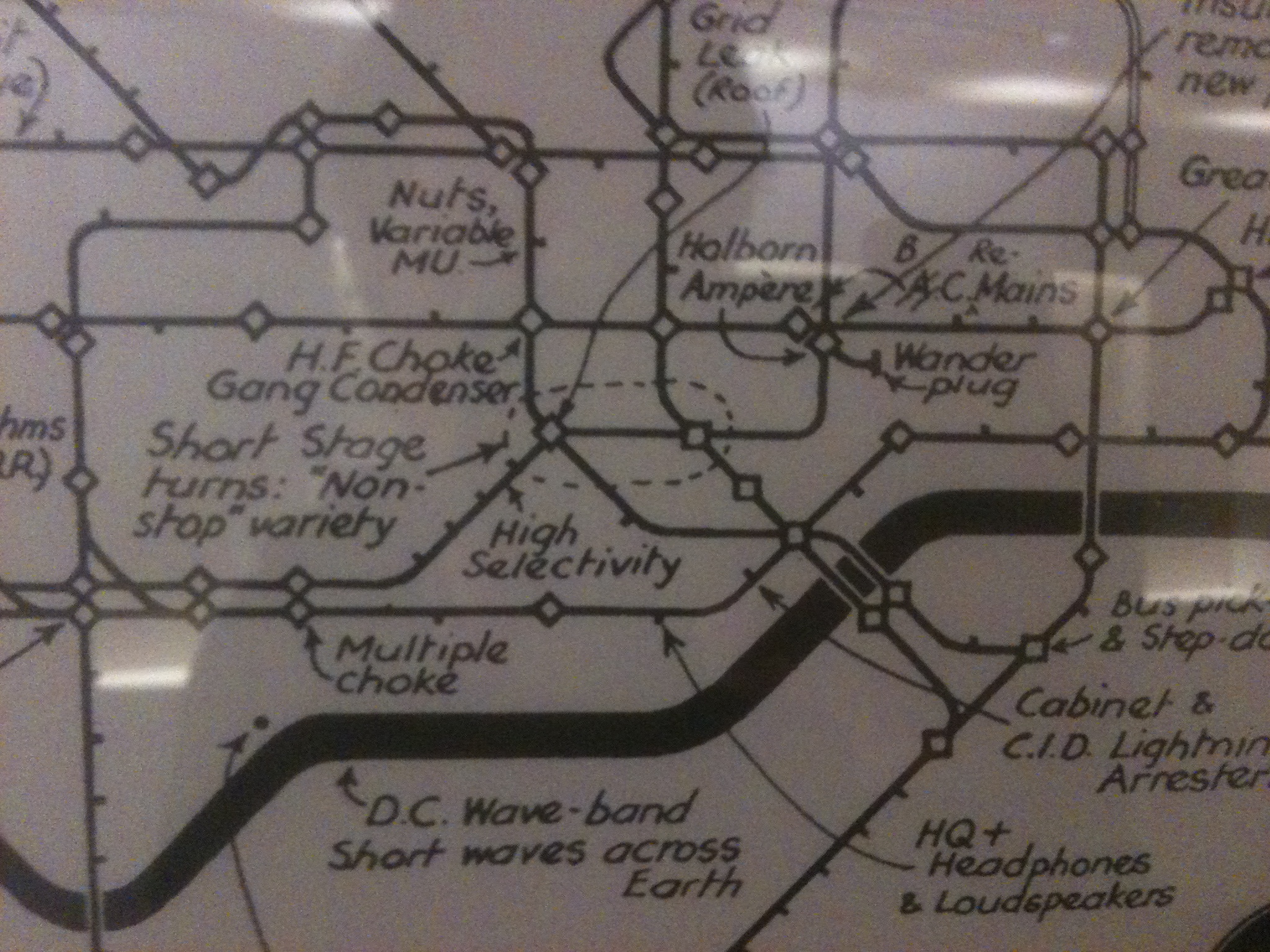
The Beck part of the exhibition is also brilliantly done given how much has already been done on the man who created the modern tube map. A personal highlight was this sketch from the London Transport staff newspaper in 1933, in which Beck gently mocks the popular notion that he got the idea for his diagrammatic map from a circuit board. He has redrawn his tube map as the interior of a transistor radio, thus creating the first mash-up/spoof of his iconic design and pre-dating The Great Bear by several decades.

Speaking of which, the LT Museum have commissioned six new pieces of art for the exhibition, and they are all great, which is quite unusual for these things. Simon Patterson has updated The Great Bear as Saptarishi, Jeremy Wood has created a new ghost map, tracing his movements through GPS and there’s a marvellous ‘Proustian’ map of London by Agnes Poitevin-Navarra.

My Ghost

Most exciting of all is Stephen (The Island) Walter’s new epic undertaking, London Subterranea, a stunningly detailed map of the London beneath our feet, executed in stark black and white and crammed with information and folklore.

When I talked to Walter a few years ago, he expressed a keenness to put The Island behind him despite some interesting related projects that had been suggested to him. I’m delighted that he has since decided to return to London mapping, as he is a master at it. I’m told he’s now working on an A-Z, which will incorporate The Island and London Subterranea.

Other highlights include a copy of the infamous 2009 tube map that omitted the Thames, a gorgeous 1932 enamel map from a station wall and a copy of Finchley Central by The New Vaudeville Band. There’s also a brilliant book by curator Claire Dobbin that accompanies the exhibition. Go see it!

Mind The Map opens 18 May until 28 October 2012. 

Why I hate the Champions League

Who came third the year Arsenal won the league at Anfield in 1989? Does anybody remember? Does anybody care? Indeed, who came fourth in 2007? Third when Manchester United won the treble in 1999?

Unless you’re a fan of Nottingham Forest (1989), Liverpool (2007) or Chelsea (1999), it’s doubtful you’ll be able to answer any of those questions. And rightly so. Because finishing third or fourth is, in the greater scheme of the history of football, nothing to get excited about, it’s not interesting, important or impressive. But thanks to European football’s ridiculous obsession with the Champions League, Arsenal fans are celebrating limping home a distant third as if it is their club’s greatest achievement since the Invincibles, just one that doesn’t come with a trophy or will be remembered by anybody in a year’s time. It’s been a successful season insist fans of the biggest club in London, now seven years now without a cup, because it means they have earned the right to play in the Champions League again (until March, usually).  And they seem to believe it.

Ah, the Champions League, the bloated, vile, venal parasite of European football, with its hideous anthem and putrid stench of self-importance. How I hate this wretched competition. Yet qualifying for it is now deemed to be the greatest achievement of any club, more desired than mere trophies and finals. Clubs with trophy cabinets that used to gleam with silverware are now more interested in securing next year’s income stream, terrified about what might happen to the bank balance if they fail. Henry Norris and Arsene Wenger have more in common than we could have ever imagined when Wenger brought swashbuckling trophy-winning teary-eyed romantic football to the Emirates in 1998. Fuck success, fuck beauty, fuck romance, fuck football: give me the cash.

I don’t get it. I never have. I understand why money is important in football, but that doesn’t mean I want to have my nose rubbed in it. In 2003, Chelsea played Liverpool; the winner would finish third and qualify for the Champions League. This was, in financial terms, the biggest game in the club’s history, I was told by friends. It was more important than a cup final, they said. Well, I’ve been to a few cup finals, and that sir was no cup final. It was a squalid mudfight for cold hard cash, a stripping down of modern football to its ugliest essentials. And yet it was presented as if it was a thing to admire, and people bought into it. Why?

I hated it then and I hated it now, especially as the Champions League’s weight and wealth has expanded, rewarding failure in the rich leagues to the point where it has pretty much destroyed all European domestic football outside of England, Spain, Italy and Germany, and turning the FA Cup and League Cup into heavily sponsored footnotes. 

It’s even turned the Europa League into a joke, in England at least.  Patrice Evra said it was ’embarrassing’ that Manchester United were playing in the Europa this season, something you’d hope would make Uefa take a long, hard look at what they have done, although of course they didn’t. The Europa has its fans, but in reality it’s a sad and unlovable replacement for the splendid streamlined charms of the old Uefa and Cup Winners’ cups.

But nothing can be allowed to compete with the CL’s budget, which throws millions of pounds at so-so teams, encouraging billionaires to buy into the game in a bid to join the bunfight – something Uefa are now trying to ban without acknowledging the root cause, the disproportionate rewards offered by their beloved keynote trophy. Meanwhile, leagues, cups and the dignity and priorities of supporters all disappear beneath the whirling blades of Uefa’s deranged zombie lawnmower.

And now we have come to the extreme logic of the position, where we’re told that the main reason Chelsea should want to win the Champions League final on Saturday is so they can qualify for next year’s Champions League, as if the trophy itself is just something that comes free in a packet of corn flakes, and nobody bats an eyelid. How can this be right? What have Uefa been allowed to do to 57 years of history? And why does nobody appear to care?

Cockney Visions: Writing Britain at the British Library

The British Library’s new exhibition Writing Britain, which runs until 25 September 2012, has big ambitions. It aims to study place and landscape in British literature, looking at how writers and poets have been informed by the land around them, and how their writing has transformed the way we view these spaces.

Phew!

The exhibition is divided into different thematic sections, and includes one on Cockney Visions about London writing, and another on the suburbs, which also has considerable London content.

It’s a remarkably bold concept, but the BL does not shy from a challenge – its exhibition on Liberty a few years ago was one of the most intellectually intense I have ever seen, while the one on Language was similarly involved.

This time, it doesn’t quite pull it off. The problem is the same that blighted last year’s science fiction exhibition – too many books. Entering a BL exhibition is like visiting a first rate antiquarian bookshop, but one were you can’t touch the books and none of them are for sale. It’s great to see these rare and beautiful books, but it’s also incredibly frustrating that you can’t pick them up, feel the pages, smell the history.

Paradoxically perhaps, books are also an insufficient way of examining landscape in the way the exhibition intends. If we can’t actually sit there and read Wuthering Heights, immersing ourself in this extraordinary place the writer has created, we need other ways to make the journey. The most evocative part of the exhibition is the one on the Lake District and Highlands, purely because there are some wonderful paintings on display, which help crystallise our vision of what Wordsworth, Keats and Scott were describing. Conversely, the London section takes in the usual suspects on that well-trod wander from Blake and De Quincey to Alan Moore, Neil Gaiman, Will Self and Iain Sinclair  (and includes a wonderful copy of the London Psychogeographic Society newsletter from the early 90s), but fails to really plunge us into the city of our imagination.

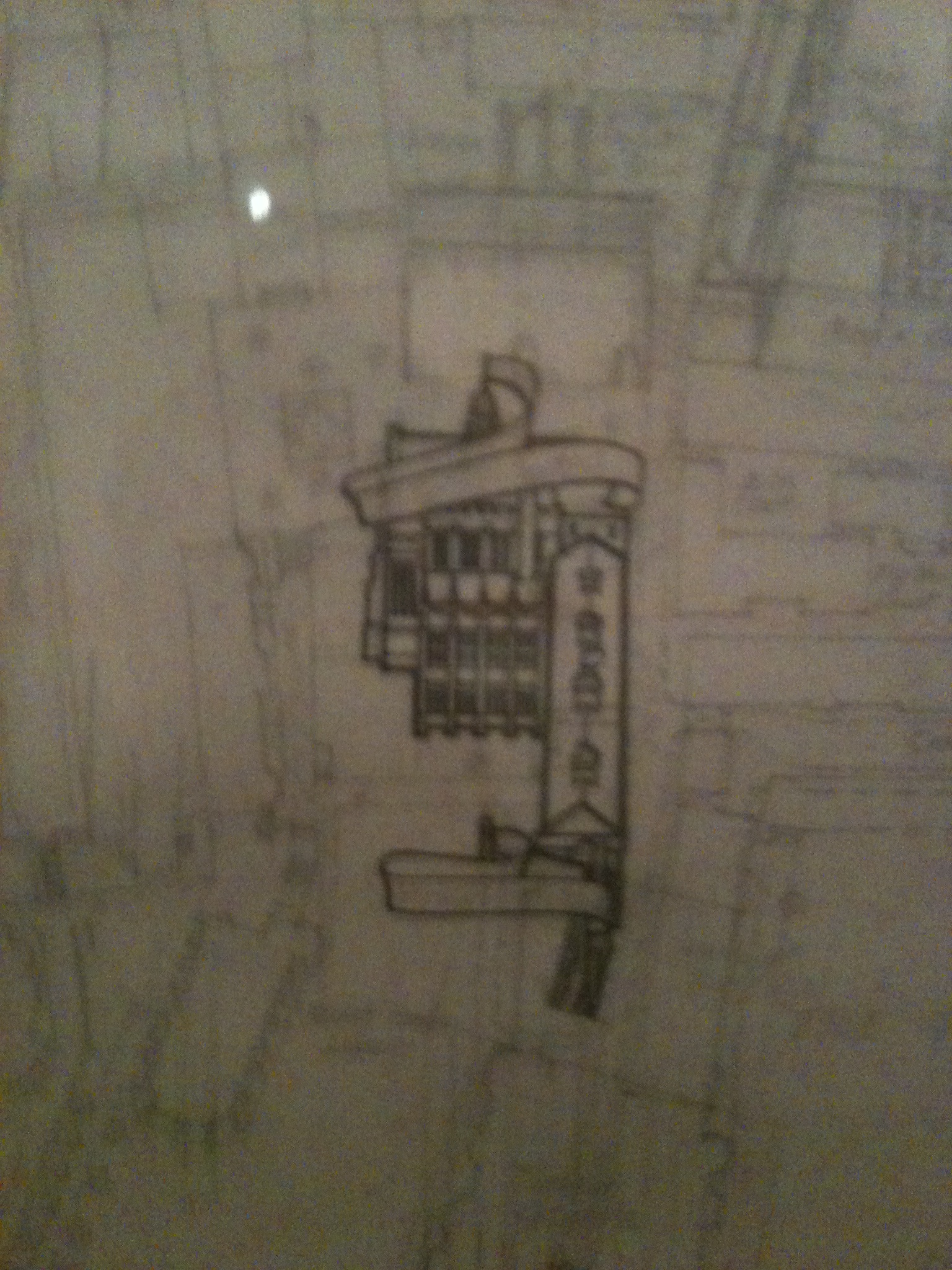
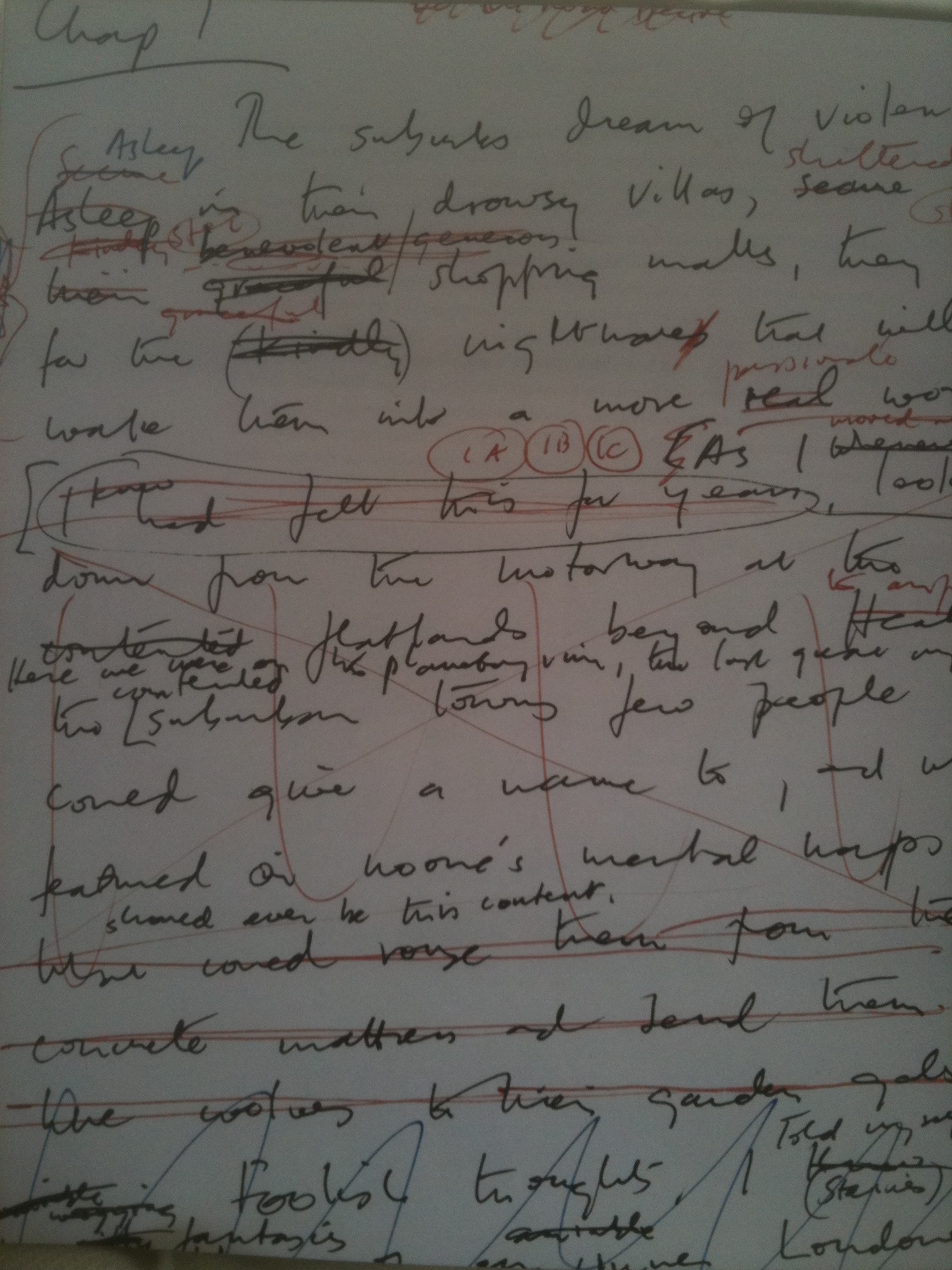
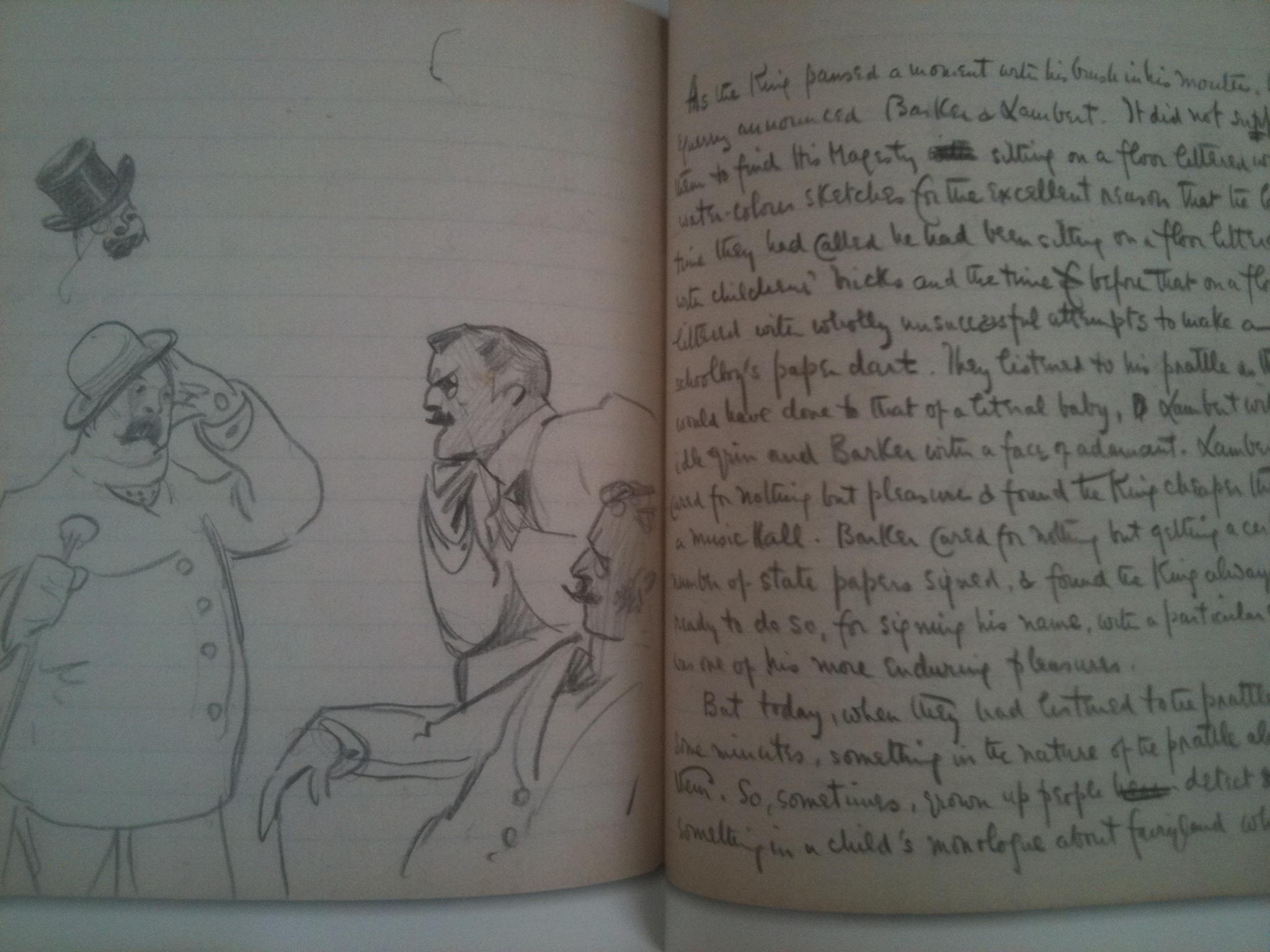
Where the exhibition – and the BL itself – really does excel is when it can produce original manuscripts, diaries and photographs. These messy, scrappy, lovingly flawed items show the writing process in a way a beautifully bound finished book never can. And some of the best of these are to be found in the sections of the exhibition related to London. There’s a sketch by John Betjeman of Dalston Station; an unpublished poem by Evelyn Waugh about the Crystal Palace (complete with Waugh’s drawing of the building); a couple of pages from JG Ballard’s collection, including the heavily amended opening pages to Kingdom Come and Crash; and a lovely drawing by GK Chesterton to accompany his notes for The Napoleon of Notting Hill.

Dalston Station by John Betjeman.

Kingdom Come manuscript

Notes for The Napoleon of Notting Hill by GK Chesterton

I loved also a letter by Conan Doyle sent to his mother from South Norwood, in which he carefully sketched the floorplan of a suburban house he was thinking of buying, and a copy of Pygmalion, which Shaw had phonetically annotated to show how he felt the cockney phrases should be pronounced.

a personal favourite was a draft of Albert Angelo by BS Johnson, showing how Johnson wished a section of one page to be cut out so it would reveal a sentence from later in the book, a brilliant way to create a  flash-forward or pre-cognition.

Best of all, though, was this photograph, which shows JM Barrie, GK Chesterton and George Bernard Shaw dressed as cowboys in 1914. For the full story, read this excellent blog post. It has very little to do with Writing Britain, but it’s bloody marvellous all the same.

Played In London: sport in the city

A series of lectures called Played In London  will take place every Thursday in May on the theme of the history of sport and play in the capital. These will be at The Gallery on Cowcross Street, Smithfield, and promise to take in everything from Tudor tennis to pub darts. They are hosted by the great Simon Inglis, author of the legendary Football Grounds of Great Britain, a candidate for the title of best book ever written.

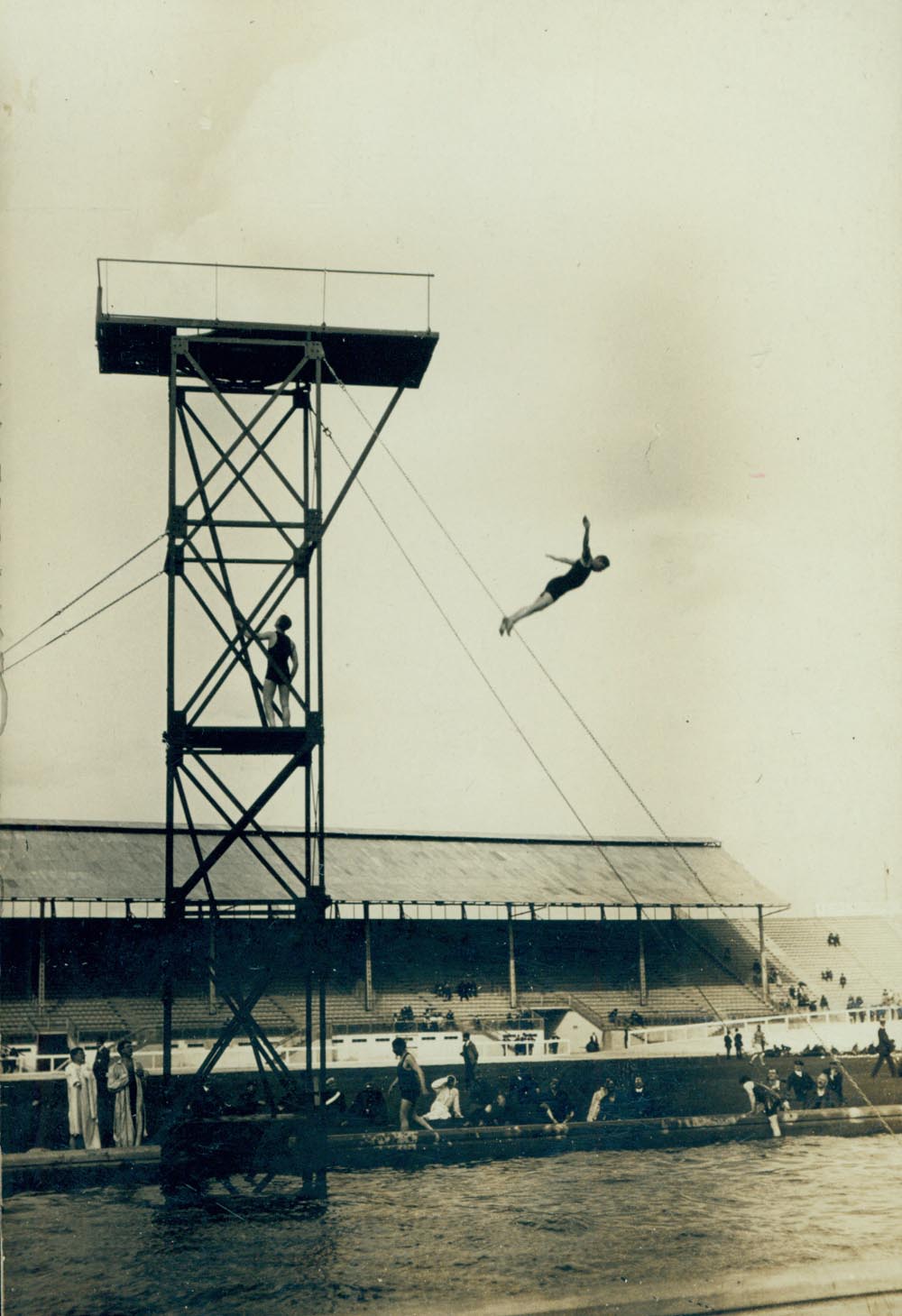
In November, English Heritage will publish a book (Played In London – Charting The Heritage Of A City At Play) on the topic, including lots of brilliant pictures like the one above, featuring the Furnivall Sculling Club, the first rowing club for women on the Thames, or these ones featuring the British swimming team in 1908 and the diving board at White City from that same year.


Secret London: inside Savile Row

I had never gone anywhere near Savile Row until a couple of years ago, when I was asked to write about the Mayfair street’s long history of tailoring for an upmarket style magazine. Given that my greatest fashion claim-to-fame is that Manolo Blahnik’s niece once laughed at my trainers, this was a bit out of my comfort zone and I didn’t feel much better when I walked into Henry Poole and the immaculately dressed owner, Simon Cundey, informed me that ‘any good man should own five to seven suits’. I nodded and smiled nervously – I own one suit and it rarely leaves the closet.

Cundey then gave me a tour of the shop, and I was immediately struck by the contrast between the elegant ground floor where customers are measured up for their new clobber and the basement where most of the work gets done. This long subterranean room was filled with tailors of all ages and nationalities, some making waistcoats, others making pockets or trousers. They were sitting at battered wooden benches, cutting cloth delicately with solid scissors the size of scythes. The sound of sewing machines and portable radios were the only sign that we weren’t in the 19th century. It was a thrill to see an old industry being kept alive in such charismatic fashion, and the fact that most of the tailors were as badly dressed as me, didn’t hurt either. I made a mental note that I’d return, which I did earlier this year for a series of interview with the pocket-makers and trouser-tailors of Savile Row, during the course of which I asked my worst ever question as a journalist: ‘What is your favourite kind of pocket?’.

You can read it all here.

Secret London: the mystery of London’s World War II railings

I recently received this email:

‘Stumbled across your blog recently and wondered if you’d be interested in doing a bit of digging to find out what happened to London’s railings.

During WWII there was a national scrap drive especially active in London where a lot of railings were grubbed up and sent off to be scrapped. I have never been able to find out what really happened with this pre-emptive move to destroy London before the Luftwaffe but it seems that program was more of a public relations exercise rather than of any practical use and the railings were dumped.
I have heard tell of them being dumped in the Thames and being used as ballast for ships leaving the Port of London. It is said that seaport buildings in Guyana and Nigeria still sport rather nice Georgian railings.’
And that was it. In truth, I know little about London railings (image below from Knowledge Of London). I’d also heard the story that were used for scrap metal in the war, and was also aware that in Harleyford Street, SE11, some ARP stretchers used during the war to ferry casualties away from bombsites had been turned into railings (you can see a glimpse of them in Patrick Keiller’s London and they also feature in Peter Ashley’s excellent More London Peculiars).
So I turned to my dog-eared copy of London Street Furniture, which wasn’t much help. ‘Doubtless, railings have their devotees,’ I read. ‘The authors may be nerds, but this is one items of street furniture that even they cannot get excited about.’
Oh.
The section continues: ‘When we were children we heard all about the drive to uproot railings to produce scrap iron to assist the war effort in the early 1940s. We suspect that railings were seized and removed more keenly from working-class districts than from the fronts of the houses of people who had wealth and social and political clout.
Removing railings in WW2 (Imperial War Museum)
I’m not sure this is true, as I have read that railings were removed from many garden squares, making them suddenly accessible to the public (indeed, that is what is happening in the image above).
That the railings were removed is beyond doubt. Here is a typical quote from somebody who had their railings removed during the war, taken from the BBC’s People’s War site.
They took away our railings. Men came and cut the ornamental railing from the copings on the little walls outside of the houses, along the whole length of the road, they were taken away to be melted down to make weapons.
But did they really get melted down? A quick scour of the internet produces this interesting nugget from a WWII forum. It is a letter from 1984 to the Evening Standard and says in full:
I was interested in your item about the railings which are to be replaced in Ennismore Gardens. The tragedy is that so many of London’s railings were pulled down in order to support Britain’s war effort, bearing in mind that they never became the guns and tanks they were intended for.
In fact I believe that many hundreds of tons of scrap iron and ornamental railings were sent to the bottom in the Thames Estuary because Britain was unable to process this ironwork into weapons of war.
Christopher Long Earl’s Court Square, Earl’s Court,
London SW5.
The forum correspondent goes on to add: ‘This information came from dockers in Canning Town in 1978 who had worked during the war on ‘lighters’ that were towed down the Thames estuary to dump vast quantities of scrap metal and decorative ironwork. They claimed that so much was dumped at certain spots in the estuary that ships passing the area needed pilots to guide them because their compasses were so strongly affected by the quantity of iron on the sea-bed.’
A great story, but is it true? If anybody can say for sure, please do let us know.
UPDATE: The fine Johnny L, a noted nerd and jazz lover, points us towards this documentary by Jonathan Meades about Victorian houses.

Meades begins talking about railings after 4min 40secs. At 5min 30 secs he reports:

There aren’t many railings left now in London. This is because in 1940 there were ripped up as part of the war effort. It may have been a morale booster, but it was impractical – the stuff was never melted down and was thrown into the Thames rather unceremoniously off Sheerness on the Isle of Sheppey. The stuff’s still there.’

Forgotten Londoners: Frank Harris, editor, prisoner and pornographer

Frank Harris was an objectionable little man. He was sallow as a gypsy. He had bat ears, dark hair with a crinkle in it that grew low on the forehead, and a truculent mustache. People remarked on the richness of his bass voice. His charm was great, particularly for the opposite sex. He had the gift of gab to a sublime degree and a streak of deep scoundrelism that was the ruin of him.

John Dos Passos, 1963

Frank Harris wrote My Life And Loves in 1922 when he was 68. It was partly about his career as an editor of the Evening News and Saturday Review in London, where he had championed critics like Oscar Wilde and George Bernard Shaw, but it was mainly about sex.

Harris was a rumbustious character with a voice so deep that one of his many mistresses claimed ‘it made her sex open and shut’ when she heard it. His memoir was scandalously candid, and featured several photographs of naked women, to emphasise the point.
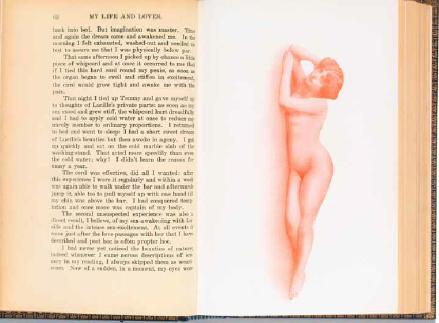
It was these – ‘too much for the English’, Harris later observed – as much as Harris’s candid discussion of sex (he was particularly keen on cunnilingus) that saw the New York Supreme Court rule the book ‘unquestionably obscure, lewd,
lascivious and indecent’ and it was banned in several countries and pretty much did for Harris as a serious writer and journalist thereafter.

It had been a turbulent career. Harris was born in Ireland, educated in Wales and after a series of adventures in America, settled in London in 1882, where he talked his way into newspapers. His greatest triumphs were at the Saturday Review, the London paper he edited in the 1890s, publishing criticism by HG Wells, Shaw and Wilde and gaining a reputation for being unreliably unspoken and outrageously opinionated for a man of his position. He later wrote a biography of Wilde, who surely would have agreed with Harris’s insistence that ‘Modesty is a figleaf for mediocrity’.

As George Bernard Shaw said, ‘He blazed through London like a comet, leaving a trail of deeply annoyed persons behind him.’ Harris was briefly adopted as a Conservative candidate for South Hackney, resigning after he defended Charles Parnell during an adultery scandal. He also defended Wilde during his trial, and suggested he flee the country while out on bail, and took the side of the Boers during the Boer War. 

Years later, Harris looked back on his time as editor with satisfaction. He believed in positive criticism, not handing out brickbats and instructed his critics to celebrate, rather than denigrate. “When I was editor of the Saturday Review,’ he said ‘with the greatest assembly of literary men in history, I had a policy and I believed in sticking to it. There was Shaw and Wells and Rowe and oh, everybody else. I called a dinner and I said: “Gentlemen, it has come to my attention that people have started to call it the Saturday Reviler. Well, this sort of thing doesn’t get us any place. Hereafter the Saturday Review is going to try to find stars, and if it can’t find stars, it won’t merely hurl bricks. What good does it do? Insults, raps, knocks! Mainly lies. Nobody’ll remember them in fifty years. If we can’t do something constructive,” I said, “we won’t do anything.” Well, it worked.’

By 1913, Harris was editing a magazine called Modern Society and was charged with prejudicing a trial after publishing an ongoing divorce case.  ‘It seems to me you have a certain disdain for this court,’ noted the judge during his trial. ‘Oh, if I could only express all the disdain I have,’ replied Harris.

That did it. Harris refused to apologise publicly and was sent to Brixton Prison for contempt. The cartoonist Max Beerbohm visited Harris in Brixton and drew a cartoon, ‘To the best talker in London – from one of his best listeners’. Prints were made and posted all over London in a bid to raise public awareness with the message: ‘This is the man that was sent to prison.’

Harris was released after three months, complaining afterwards that ‘what I suffered most from in prison was lack of books’. Shortly after his release he left London and never lived there again. He died in Nice in 1931.

Max Beerbohm's cartoon of Frank Harris

For more on Harris, visit this excellent Odd Books website.

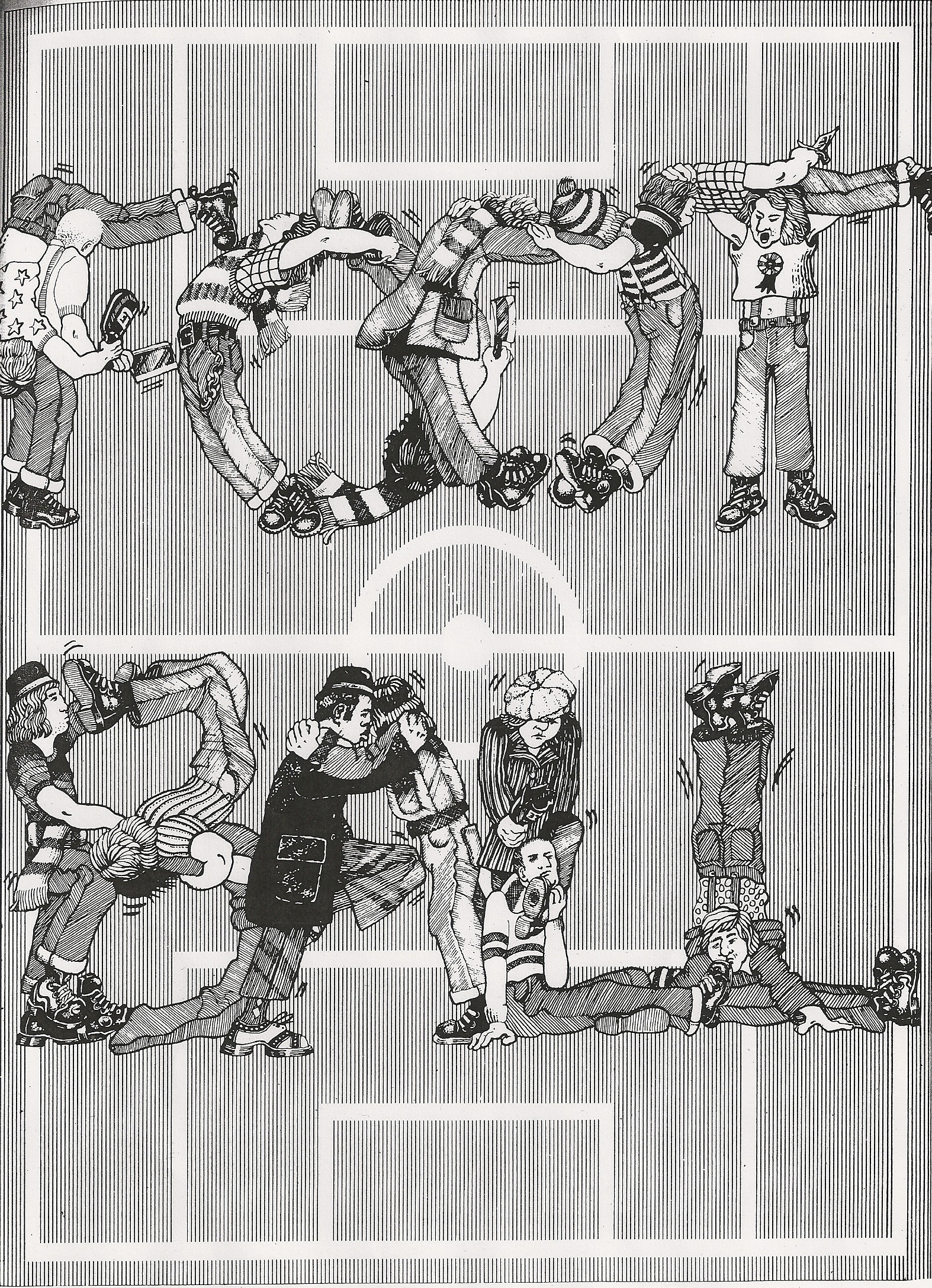
London’s football gangs: 1972

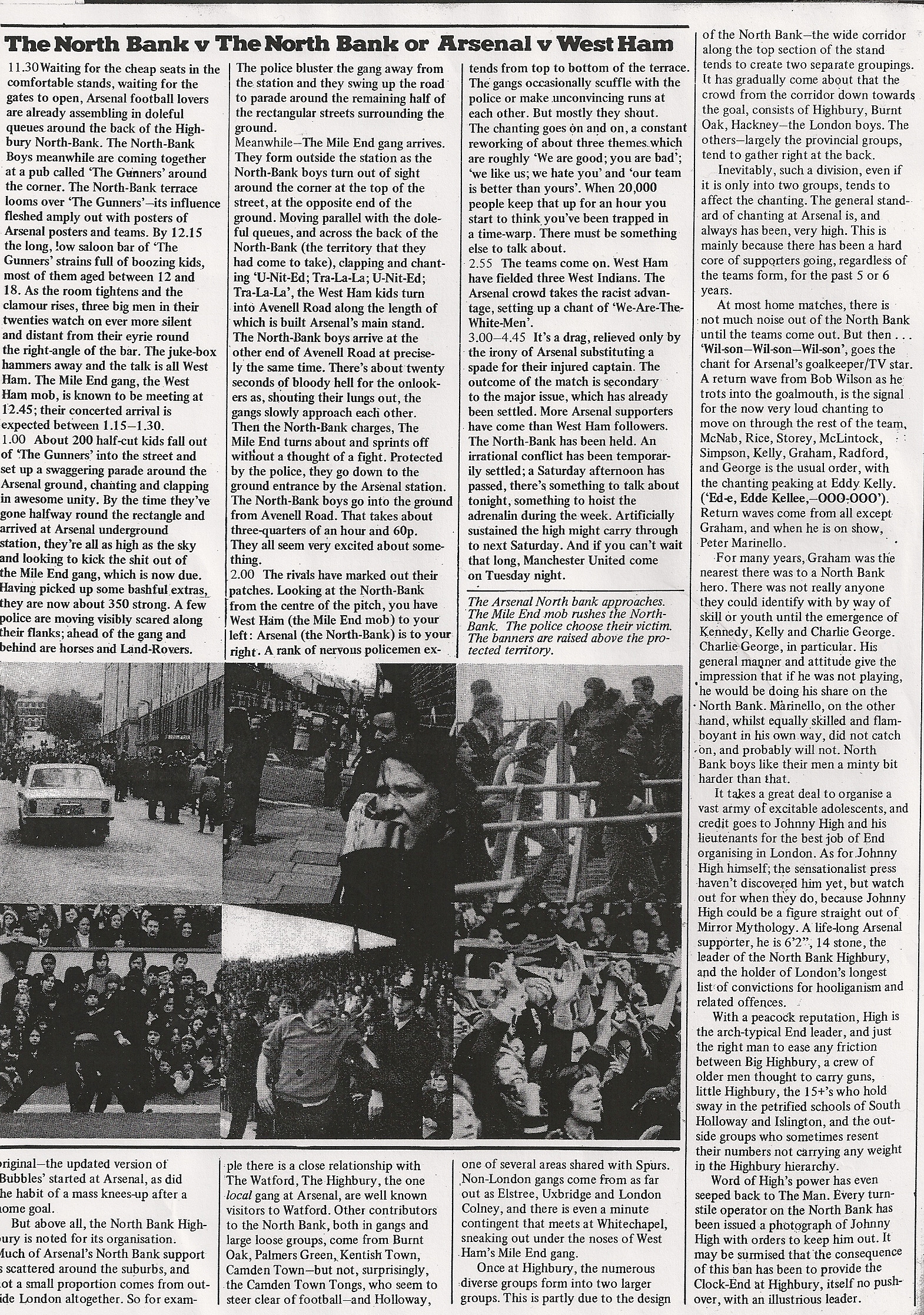
 I’ve mentioned Chris Lightbown’s article on London football gangs a couple of times before, but the piece itself hasn’t been available since it was first published in Time Out in 1972. The section on West Ham was reprinted in the excellent 2008 anthology London Calling, but the full article has been confined to libraries and private collections. Until now.

It is a fascinating read. This is the first time football fan culture had ever been seriously discussed by the press, and it offers a remarkable view of life on the terraces from the terraces, free of any moralism or finger-wagging. It is a thorough and very funny piece of writing, and is probably the first time terrace legends such as Mick Greenaway and Johnny Hoy (although he is called ‘High’ here) ever saw their names in print. It’s analysis of where the different clubs draw on their support is particularly great. 

The writing is very much of its time and place – complete with mention of ‘heads’ and ‘coons’ – and also paints the picture of a time when London terrace culture was very different: the Shed was as loud as the Kop, Arsenal had the most aggressive fans in London and Spurs were just a joke, on and off the pitch. Only West Ham’s identity appears to have remained more or less the same, although older Hammers would doubtless question that.

It is a cracking piece of work. Enjoy.