1 Press, 1986
Here’s Macca on the tube in this little known video from 1986. Check out the modestly greying locks, and drink in the 80s atmosphere and the now lost station architecture.
2 Busking, 1984 A dream sequence from Give My Regards To Broad Street features Macca busking outside Leicester Square tube.
3 Give My Regards To Broad Street computer game, 1984 This appalling Commodore 64 game based on the film sees Macca taking a cab around London to a brilliant, blippy 8-bit soundtrack of Band On The Run.
4 London Town, 1978
Paul and Linda take a boat trip down the Thames to promote London Town. Features many bridges and some fish and chips.
5 Oxford Street, 1983
And here’s Macca nipping round the West End in the back of a cab with Lesley Ash.
I was recently asked to answer a few questions about Secret London by the blogging cabbies at Radio Taxis.
If you are interested in my favourite London building, London landmark and favourite London film and book, head here, where you will be rewarded with a mildly disturbing image of my face.
The British Library’s new exhibition Writing Britain, which runs until 25 September 2012, has big ambitions. It aims to study place and landscape in British literature, looking at how writers and poets have been informed by the land around them, and how their writing has transformed the way we view these spaces.
Phew!
The exhibition is divided into different thematic sections, and includes one on Cockney Visions about London writing, and another on the suburbs, which also has considerable London content.
It’s a remarkably bold concept, but the BL does not shy from a challenge – its exhibition on Liberty a few years ago was one of the most intellectually intense I have ever seen, while the one on Language was similarly involved.
This time, it doesn’t quite pull it off. The problem is the same that blighted last year’s science fiction exhibition – too many books. Entering a BL exhibition is like visiting a first rate antiquarian bookshop, but one were you can’t touch the books and none of them are for sale. It’s great to see these rare and beautiful books, but it’s also incredibly frustrating that you can’t pick them up, feel the pages, smell the history.
Paradoxically perhaps, books are also an insufficient way of examining landscape in the way the exhibition intends. If we can’t actually sit there and read Wuthering Heights, immersing ourself in this extraordinary place the writer has created, we need other ways to make the journey. The most evocative part of the exhibition is the one on the Lake District and Highlands, purely because there are some wonderful paintings on display, which help crystallise our vision of what Wordsworth, Keats and Scott were describing. Conversely, the London section takes in the usual suspects on that well-trod wander from Blake and De Quincey to Alan Moore, Neil Gaiman, Will Self and Iain Sinclair (and includes a wonderful copy of the London Psychogeographic Society newsletter from the early 90s), but fails to really plunge us into the city of our imagination.
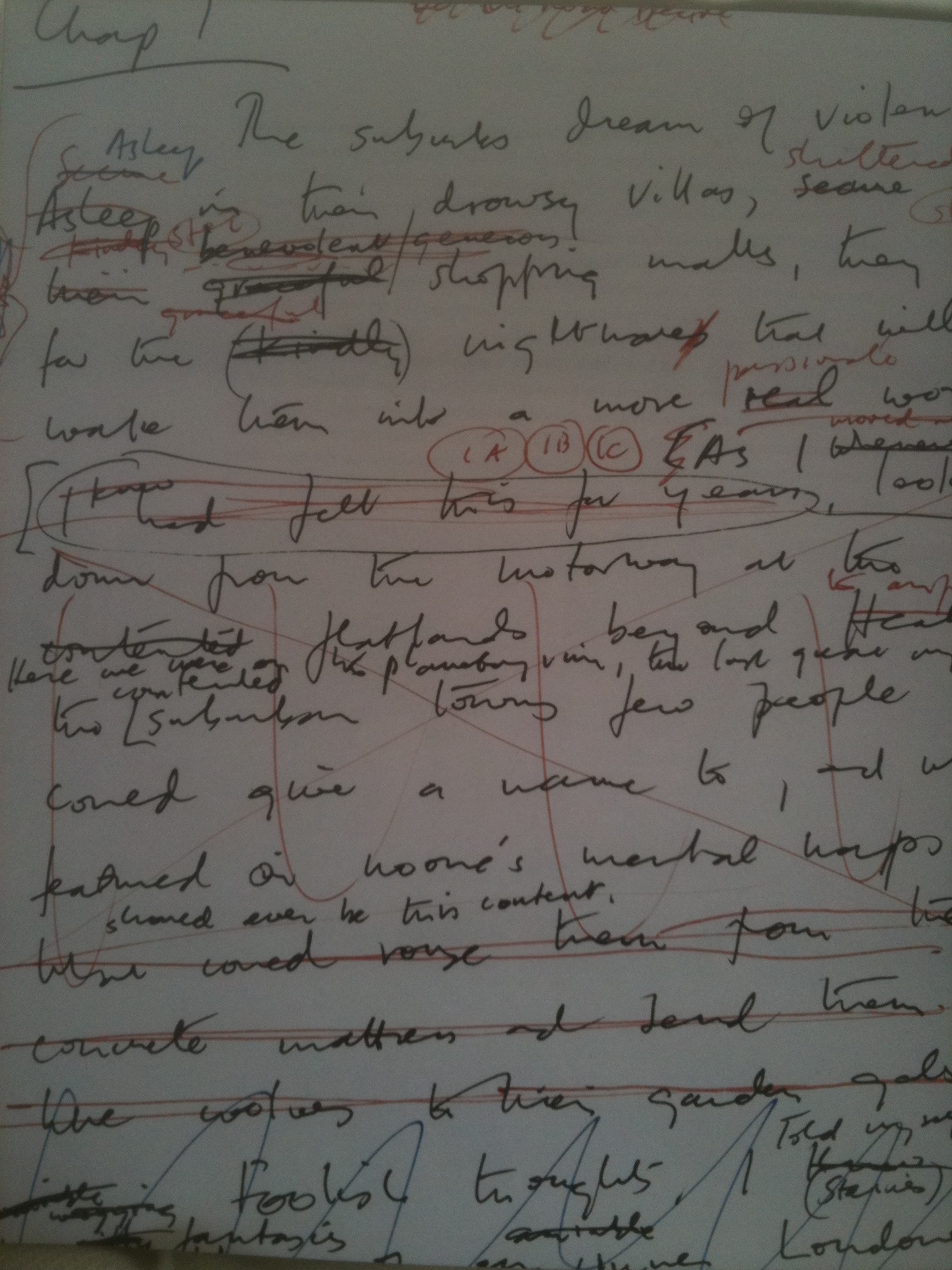
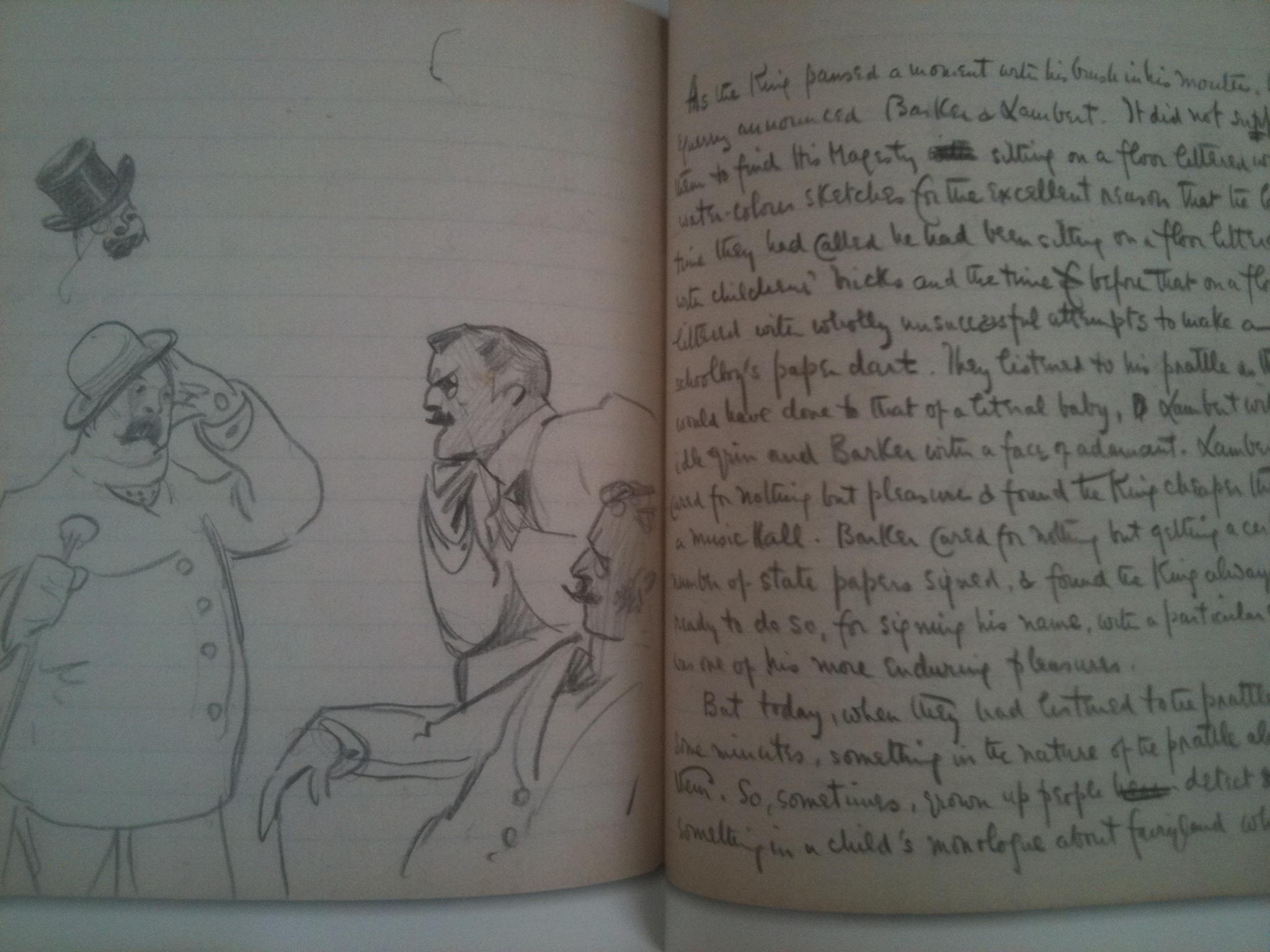
Where the exhibition – and the BL itself – really does excel is when it can produce original manuscripts, diaries and photographs. These messy, scrappy, lovingly flawed items show the writing process in a way a beautifully bound finished book never can. And some of the best of these are to be found in the sections of the exhibition related to London. There’s a sketch by John Betjeman of Dalston Station; an unpublished poem by Evelyn Waugh about the Crystal Palace (complete with Waugh’s drawing of the building); a couple of pages from JG Ballard’s collection, including the heavily amended opening pages to Kingdom Come and Crash; and a lovely drawing by GK Chesterton to accompany his notes for The Napoleon of Notting Hill.
Dalston Station by John Betjeman.
Kingdom Come manuscript
Notes for The Napoleon of Notting Hill by GK Chesterton
I loved also a letter by Conan Doyle sent to his mother from South Norwood, in which he carefully sketched the floorplan of a suburban house he was thinking of buying, and a copy of Pygmalion, which Shaw had phonetically annotated to show how he felt the cockney phrases should be pronounced.
a personal favourite was a draft of Albert Angelo by BS Johnson, showing how Johnson wished a section of one page to be cut out so it would reveal a sentence from later in the book, a brilliant way to create a flash-forward or pre-cognition.
Best of all, though, was this photograph, which shows JM Barrie, GK Chesterton and George Bernard Shaw dressed as cowboys in 1914. For the full story, read this excellent blog post. It has very little to do with Writing Britain, but it’s bloody marvellous all the same.
I, Ludicrous were a two-piece consisting of John Prockter and David Rippingale that came together in South London through a shared love of Crystal Palace and The Fall. Formed in 1985, their greatest moment came on their 1992 album Idiots Savants in the form of a five-minute sinister, synth-led epic about being a football supporter called “We Stand Around”. The song was named Single Of The Week in NME by guest reviewers New Order despite only being available in Germany.
The lyrics are a masterful celebration of the essential pointlessness of terrace culture and football fandom, as this extended excerpt demonstrates:
We stand around in wind and rain, locked in voluntary,
All ages, all male, all swearing, all cold.
We sing and sway we punch the air,
We chant out names, we seek a wave,
In pens we huddle in corners too,
We shout out names we shout abuse.
We travel every Saturday,
We go wherever we play and pay,
spending money we cant afford,
We are the fans we go everywhere.
In groups of two we punch the air,
We sing and sway and dance and swear
We taunt the home fans humorously
The policemen eye us with ill disguised contempt.
We buy the fanzine its a con
Written by some Oxford don
who thinks he knows what’s going on.
But we know everything.
We know how much the players earn
where they live what they drink,
What happened on the Swedish tour
and why the right back was transferred.
We make a scene in every town
Our accents sting our voices loud
Old ladies in shop doors cower
We are the fans we have power?
Some have scars of well aimed boots
Some wear scarves some wear boots
The police escort eyes with ill disguised contempt
The video directed by Prockter that accompanied this minor classic has recently been put on You Tube and, like the song, is a beautiful evocation of football supporting in the late 1980s and early 1990s (the era, incidentally, when I began to attend matches). The opening sequence of floodlights and barbed wire – a typical sight at football grounds of the time – belong firmly to a different era, and here also are the crumbling stadia, the fanzines, the cheap programmes, the train journeys and the aggro. It’s a fine song and a brilliant video: enjoy.
It has come to my attention that a substantial number of people do not realise that the title of My Fair Lady is a pun. It’s a play on the way a Lisson Grove-raised flower girl like Eliza Doolittle might pronounce Mayfair, if she wasn’t really a cockney at all but merely a Hollywood actor pretending to be one. Mayfair/Myfair – the drooping, elongated ‘y’ is a classic, if exaggerated, symptom of the cockney mode of speaking,
Say it yourself in your best, daftest, Eliza Doolittle accent – Mwyyyy Fair. Sounds a bit like Mayfair, doesn’t it? If you don’t believe me, here’s Alan Franks saying the same thing, eventually.
So there you are. Here’s a scene from the film with Audrey showing off her accent at its very worst.
I’ve just come across a treasure trove on You Tube of old Rank Look At Life newsreels, each ten-minutes long and looking at different aspects of London life. There are some real treats to be found, but here are a few I enjoyed when I should have been working, or at least making a cup of tea.
Members only, 1965 – inside London’s private clubs
Coffee bar, 1959 – the new world of Soho’s coffee shops
Goodbye, Piccadilly, 1967 – a portrait of Piccadilly Circus
In Gear, 1967 – an iconoclastic look at Swinging London
Top People, 1960 – the crazy world of highrise living
Shopping By The Ton, 1960 – Covent Garden, Smithfield and Billingsgate markets
Report on a River, 1963 – a love letter to the Thames
Squatting as a 20th-century phenomena originated in the wake of the acute housing shortage after the Second World War. Homeless families began to occupy empty mansion blocks and hotels, including Duchess of Bedford House in Kensington.
Squatters move into Duchess of Bedford House
Some of the squatters of the 1960s took this as their inspiration. Among the most political were the London Street Commune, a group of self-declared space cadets from the streets who were turned into a minor political weapon by a Spart called Phil Cohen, aka Dr John, who had previously been involved with the British Situationist International group, King Mob. The LSC became loosely involved in the counterculture scene and even at one point managed to occupy the offices of the underground newspaper, International Times, believing it was ‘bourgeois’ and needed to be ‘liberated’. They gave up after a few days when they realised they didn’t really understand how to put a newspaper together.
The London Street Commune’s most conspicuous act came when they squatted a vast Park Lane mansion, 144 Piccadilly, at Hyde Park Corner in September 1969. This gained them massive media attention, and the building quickly came to be dubbed ‘Hippy-Dilly’ and attracted vast crowds of largely hostile onlookers. The LSC responded by barricading the front door and creating a ‘drawbridge’ out of wood from one of the ground-floor windows, and asking the Hell’s Angels to protect them.
Around 100 people were said to be living in the building, among them the odd journalist who infiltrated the squat so they could produce salacious copy about the drug-taking ne’er-do-wells. After surviving an attempt by skinheads to ‘take’ the mansion – the LSC threw carpet bowls and balloons filled with ink at the approaching skins – the police decided to take action.
The police moved in on September 21, leading to in the words of the Daily Mirror, ‘The Fall of the Hippy Castle‘. This took place the day after a free festival at Hyde Park, which many of the LSC had attended. The squat was now filled with numerous disparate groups, including Hell’s Angels and French veterans of May 1968, alongside the original Dilly drop-outs, but they were quickly moved out by police, who arrested around 70 of the squatters.
While John Lennon went on TV to offer the displaced squatters a home in the shape of an island off Scotland, the high-profile eviction was greeted with delight by the media. The Times demanded the squatting be made illegal and that hippies be arrested under the vagrancy act. This remarkable Pathe newsreel – with talk of ‘scroungers and drop-outs… snubbing the conventions of decent society… doing the real homeless a disservice’ – demonstrates the prevailing attitude. It is difficult to conceive of broadcast media speaking in such terms today.
In 1972, American film director Sam Fuller wrote a pulp novel about 144 Piccadilly, but the building itself was not to last much longer. It was knocked down in the 1970s and replaced by the ghastly Intercontinental Hotel.
In 1983, just as the band were starting to fall apart, The Clash decided to make a film. But stung by their experiences on the strange but compelling Rude Boy, they decided to make it themselves. They called it Hell W10, filmed it on 16mm silent black and white film, and made the plot up as they went along. The result, understandably, was somewhat bizarre.
‘Let’s make a film!’ said Mick Jones in 2005. ‘We had no other agenda there than that. Everyone put in their time without thinking about it. That was what we did on our time off; we worked! It was totally Joe [Strummer]’s idea. He directed it, he shot it, he did it. And then it was gone. It didn’t even come out!’
Strummer believed the film was lost forever. In 1987, when it looked like he might carve out a new career for himself in the film world, he told an interviewer, ‘I have directed a film myself, a black and white 16mm silent movie and it was a disaster. Luckily the laboratory that held all the negative went bankrupt and destroyed all the stock, so the world can breathe again. I shot without a script. God knows what it was about. I’m the only other one that knew, and I’m not telling.’
In 2002, the film was rediscovered on video tape and re-edited by long-time Clash collaborator Don Letts, who added a fine Clash soundtrack over the top. It is a strange piece indeed, a gangster tale that follows Earl, a musician and small-time hood played by Paul Simonon, who falls foul of the local crime boss called Socrates, ‘The Lord of Ladbroke Grove’, played with some relish by Mick Jones, resplendent in white tux (‘You wanna end up as a pillar in a Canning Town flyover?’ he threatens one lackey). Strummer gives himself a cameo as a corrupt and racist policeman. It’s a cross between The Harder The Come and some of the pulp London crime novels of the 1950s (many of which have been republished by London Books).
Hell W10 also features some cracking period photography of Notting Hill, Paddington and Ladbroke Grove, and weighs in at almost 50 minutes, which suggests it must have taken quite some time to film.
What makes it particularly fascinating is that it was filmed just as the band were starting to go belly up; Topper Headon had already been kicked out for drug abuse, while Simonon and Jones were barely speaking, making their feud in the film a little too close to the truth. Things came to a head within weeks of Hell W10 being made, with Jones sacked from the band in September 1983.
In Letts’s documentary, Westway To The World, both Jones and Strummer confess that the band had simply spent too much time in each other’s company and should have taken a break; if they had done so, hotheads may have had time to cool. Instead, they made a film. Perhaps if they’d had a summer holiday in 1983 rather than fool around with a camera, the band of Jones, Strummer and Simonon might have lasted another few years. Still, it looks like they had fun making it.
Was it worth it? Watch and decide, this is the first of five parts.
Like many adolescent boys who thought they were cleverer than they really were and were scared of girls, I was obsessed with The Smiths and Morrissey.
The Smiths are a Manchester band, but by the time I became a fan, Morrissey had – like so many Northerners – fled the provinces for London where he spent the next few years revelling in the size, confusion and culture of the Big Smoke. Instead of Whalley Range and the Moors Murders, he sang about Earl’s Court and the Krays and as he entered his ‘Glam Nazi’ era he became obsessed with distinctly London aspects of working-class life such as skinheads, West Ham and the Cockney Rejects.
This was Morrissey’s London period; you could argue it began with the Smiths songs London (1987) and Half A Person (1987), and lasted until he was hounded out of the capital for going a bit crap around a decade later. Sure, London still cropped up in later songs – 2004’s Come Back To Camden, for instance – but the love was gone. He would later sound like any other tedious expat whn complaining to the NME that ‘if you walk through Knightsbridge on any bland day of the week you won’t hear an English accent. You’ll hear every accent under the sun apart from the British accent.’ But it was fun while it lasted.
Interesting Drug (1989)
Although Morrissey’s previous solo singles were very London-influenced, this was the first – rather odd – video to be clearly filmed in London. But where? The red bus glimpsed at 1:21 may tell somebody with better eyesight than I. Is it a 34, placing this somewhere between Barnet and Walthamstow? Update: Comments suggest this is Battersea, so not the 34 after all. Maybe the 37?
Our Frank (1991)
A pretty poor song, but the video marks the start of Morrissey’s skinhead obsession – it was not long after this that he took to performing before a skinhead backdrop and brandishing the Union Jack at Finsbury Park. There are lots of buses here, and also a gorgeous ghost sign at 1:47. But where is it shot? Charing Cross Road? The City? Victoria? Anybody? Update: Comments place this definitively as King’s Cross.
We Hate It When Our Friends Become Successful (1992)
I hated this when it came out, but I was wrong because it is brilliant and the video is a treat as Morrissey wanders around a still not-quite-gentrified Wapping with the gang of bequiffed young boys who have put a smile back on his own thin and youthful face. Most Morrissey fans get a kick out of seeing the old boy looking happy, which is why his recent ‘love’ album, Ringleader Of The Tormentors, got such strangely good reviews. The abandoned pub in this video is now the Turk’s Head cafe and you can also catch a glimpse of Oliver’s Wharf, which was one of the first warehouses in the area to be redeveloped into housing.
You’re The One For Me Fatty (1992)
An awful song, but an unmistakable setting as a young skin takes ‘fatty’ on a date, while Moz whines about how ‘all over Battersea’ there’s ‘some hope, and some despair’, over a shot of the power station. Interestingly, a scene from one of Morrissey’s favourite Northern kitchen sink dramas, ‘Saturday Night and Sunday Morning’ was filmed by director Karel Reisz around here, in Culvert Road, Battersea. Of Reisz, we’ll hear more later.
Boxers (1995)
From the start of Morrissey’s decline – and height of his obsession-with-male-physicality – this ho-hum single was filmed at the legendary York Hall, Bethnal Green, as can be seen in the rather elegant closing shots.
Sunny (1996)
Such a terrible song I didn’t know anything about it until now, as I had long lost interest in Morrissey at this point, but it’s filmed in Victoria Park in East London. And the cover featured this iconic Morrissey shot, outside old Kray haunt the Grave Maurice (now, I think a fried chicken shop).
There were many other London influences in Morrissey’s songs at the time, with the Kray-referencing Last Of The Famous International Playboys, the song Spring-Heeled Jim (a reference to the Victorian London monster Spring-Heeled Jack), the song titles Piccadilly Palare and Dagenham Dave, and the album titles Your Arsenal and Vauxhall & I, as Morrissey explored the seamy side of London life. He was also rumoured to be making his first acting appearance at around this time as the South London gangster Charlie Richardson, although sadly that never came to pass.
I’ll leave you with one last example. This clip is of Kennington kids discussing the infamous case of Derek Bentley, who was sentenced to death for his part in the shooting of a policeman in Croydon, and it comes from Karel Reisz’s classic London documentary ‘We Are The Lambeth Boys’. It was sampled by Morrissey for the track Spring-Heeled Jim, which featured on the Vauxhall & I album. How much more London can you get?
For my recent piece in Uncut on the London underground press, I contacted Pete Townshend to ask if he had any memories of the era. His reply was long and illuminating, and is worth reproducing in full.
ME: Pete was a regular at UFO. Was it unusual for somebody so well-known and from a Mod background to go to a hippie club?
PT: I was taken hostage in a sense. My partner Karen Astley (whose pretty face was used for a few UFO posters) was working with her old friends from the Ealing Fashion School – Angela Brown and Annie Dupée. They had a company called Hem & Fringe. They made clothes for various boutiques, but in particular were designing for an adventurous new King’s Road store in the manner of Granny Takes a Trip. It was to be called Gandalf’s Garden. It was a joint effort by Barbara Allen and Michael Rainey I think.
Michael McInnerney was doing the window design, with – I believe – another artist called Dudley Edwards (who had decorated Lennon’s big Rolls Royce in psychedelic style). I had met Mike and Dudley after the Who had played Monterey Pop Festival with Jimi Hendrix in 1967, and I was interested in Meher Baba who they both followed.
The Who then went off on a very long tour supporting Herman’s Hermits, and while we were away there was a widely reported hippy wedding in Hyde Park, Michael McInnerney married Katie, and Karen was there, and in many of the photos. There is also newsreel film of Karen dancing with Barbara Allen and Hoppy. Mike McInnerney worked with Hoppy and Miles on IT. Karen was right in the centre of the hippy scene, and knew a lot of the leading faces of the time. Through her I met Joe Boyd, the producer of The Incredible String Band and Fairport Convention, and Barry Miles and his wife Sue (who was a terrific restaurateur), and Hoppy. I also got to know John Dunbar [Marianne Faithfull’s first husband] and met the other founders of the Indica Bookshop in Southampton Row at a party with the Beatles, but I never went to the shop. The way I remember it is that Paul McCartney was the chief patron of Indica from the Beatles and the pop scene at large. He was passionate about legalising marijuana, and came close to being arrested for some of the things he said. As far as I could see, marijuana and LSD were what the politics of the times revolved around. There may have been more, deeper things, but I never saw much sign of it at the time. Vietnam was big news of course, but sadly not to me. More of my myopic tendencies later.
Michael English was an old friend from Ealing Art College, and his partner was Angela Brown. When I wasn’t performing we hung out together. Michael was developing his air-brushing techniques, but also making silk-screened posters for hippy events with his colleague Nigel Weymouth. Michael and I were extremely close for about a year in 1967, and I became very fond of him. My friendship with Mike McInnerney lasted much longer, and although we don’t see much of each other today, his work on the Tommy artwork went much further than just coming up with cover art. I flew every single Tommy song past him before I played it to Kit Lambert my mentor and Who producer and manager.
I loved the UFO club. Hoppy was always on the door, smiling, welcoming, never spoke about politics although we knew he was involved in trying to get marijuana legalised. On the stairs I often found Mike McInnerney, who would never stop drawing and painting, and sometimes took his work out with him. One night Gustav Metzger who had lectured at Ealing Art College did the acid-based-light-projections for The Soft Machine. In those days Soft Machine were really very jazzy, and I seem to remember they played a few pieces by John Coltrane. I’ve always been a huge fan of Robert Wyatt, and he married one of my friends Alfreda Benge who edited The Lone Ranger, the first film for which I ever made a soundtrack. Pink Floyd were regulars, and I thought they were wonderful, and not just Syd. I’d met Syd at a few parties, and he was already pretty mad, too many trips we all thought. One Pink Floyd night at the UFO a bunch of Mod boys circled me and ridiculed my hippy coat that Karen had made me, and from then on I think I started wearing boiler suits and Doc Martens, attempting to disown both fashions. We had a lot of fun, I had about five LSD trips, one good one, the rest pretty scary. The UFO was a very friendly place, unless you happened to run into Roger Waters. I’m joking, he was friendly enough, but though handsome he was extremely scary looking, and was rather too keen on Karen for my liking, but then a lot of men were.
I am simply name-dropping here, over and over again, because I was not really a part of this scene at all. I just met all these extraordinarily glamorous and friendly people through Karen, then jumped back in the shitty old Who tour bus and went off to play in fucking Morecambe.
Was Pete’s comfort with the counterculture a result of his art school background?
I was not comfortable with it. This is where I confess my myopic nature. I never ever managed to find a sense of place in it. I think when we played Woodstock a year later, and my famous argument happened on stage with Abbie Hoffman, I suddenly realised I simply hadn’t understood how divided society had become by then. This divide was not just between young and old, but between those younger people who saw themselves as political agitators and those who simply wanted to conform, get a job and have a quiet life.
As an artist I operated within the Who as a kind of mirror or commentator, always looking at the local neighbourhood rather than the international scene, trying to give a voice to that part of our audience that seemed most disaffected, but I lost touch completely during the hippy years. Tommy was possibly only accepted from the Who because in hindsight some aspects of the hippy movement had been seen to be counterfeit and bogus. But the spiritual yearning that grew out of the LSD revolution was carried in Tommy, and made a connection somehow.
My art school work had been hugely inspiring, especially with respect to the possibilities of future technology and the way it would affect art. I have always felt I juggled art, technology and spiritual matters fairly well. But those three issues really needed from me an awareness of politics to produce balanced artistic work. That never happened for me. My mostly apolitical protests were rather sullen and sometimes resentful.
Did interviews with International Times allow musicians to reach different audiences or talk about different subjects than was possible with the mainstream press?
Oh yes. But I don’t remember my talk with Miles, I just remember Miles himself, and I adored him. Around that time (1967) I began to specialise in thought-stream interviews, just rapping really. I spoke creatively, sometimes absurdly, often moving into territory I knew little about. Occasionally this system did produce the most wonderful ideas. At other times, looking back, I just sounded out of my depth.
Why did rock stars like Pete and Paul McCartney get involved with IT, UFO and the counterculture scene? What did Pete personally do to help?
It wouldn’t surprise me to hear that Macca got taken hostage as I did, but in his case by his partner Jane Asher. I know that her brother Peter was involved in some way with John Dunbar. We were all part of what we thought would be a new London intelligentsia. In the end it was just a group of young pop stars with extremely pretty girl friends. I can remember one gathering – I think it was at an art opening for Simon and Maryka – where George Harrison was talking about Krishna, Macca about legalising marijuana and Eric Clapton and I were with the artist and lyricist Martin Sharp talking about the Oz Trial. I don’t think I helped at all, but Macca did. He gave money when Hoppy was arrested, and later for the Oz trial I believe.
Did Pete attend or have anything to do with International Times happenings at the Roundhouse or Alexandra Palace?
Yes I went to both events. Michael English and I took LSD and walked all the way to the Roundhouse from his house in Portland Road. A long, wonderful trip, one of the good ones. At the Ally Pally Rave I ‘discovered’ Arthur Brown and started recording him. Kit Lambert got thrown out of the Alexander Palace event. God knows what he did. He was rather posh, maybe he was thought to be too straight, but I got Hoppy to get him back in. The Who actually performed at one of the last IT Roundhouse events, with Elton John’s new band. By that time IT and Hoppy had lost control of the London hippy scene and it was being taken over by the old guard of promoters.




 The Great Wen