I’ve written a review of Rachel Lichtenstein’s very good new book about the Thames Estuary, called Estuary. You can read it here, at Caught By The River.


I’ve written a review of Rachel Lichtenstein’s very good new book about the Thames Estuary, called Estuary. You can read it here, at Caught By The River.
Posted in Archaeology, Books, Fish, Geography, History, Journalism, London, Nature, Place, Walking
Tagged Estuary, Rachel Lichtenstein
I have two events coming up where I will be discussing Battersea Power Station in collaboration with other writers. At the excellent Bookseller Crow shop in Crystal Palace I will be teaming up with Rob Baker of Another Nickel In The Machine for a London Night, where we will talk about low culture and high jinx in London. My talk will focus on some of the finer pop culture moments associated with Battersea Power Station, while Rob will talk about his blog, his book (Beautiful Idiots And Brilliant Lunatics) and the Miss World protest of 1970.
This will take place on Thursday September 15th at 7.30pm, £3.

This will be followed by a London Society event with Owen Hatherley, where we will discuss the redevelopment of Nine Elms and Battersea, and debate the limits of preservation and conservation in a talk titled The Ruin of London. This takes place at the Gallery on Cowcross Street on Sept 20th from 6.30pm.
I reviewed Travis Elborough‘s lovely history of the British public park for Caught By The River.

Travis has previously written excellent books about the Routemaster and London Bridge as well as worked with Saint Etienne/Paul Kelly on their London film (which I’ve still not seen) How We Used To Live.
This time, his scope is a little broader – his history of parks begins with the dawn of urbanisation – but is at its most fascinating when focussing on the 19th century, as cities grew exponentially and parks were needed as never before.
It made me think about my relationship with my nearest park, Brockwell Park, which crops up in the book several times – for instance, as the location of the country’s first One O’Clock Club in 1964, created after an LCC employee was horrified to discover “ten howling babies in their prams abandoned outside Brockwell Park’s playground”, left there by older children who were meant to by looking after their siblings and were instead using the facilities for their own fun.

Brockwell Park is a classic London park in that it covers so much of the history and present of parks. It was formed from a rich man’s land, given to the people for their free use – and within the grounds still stands the austere old Brockwell Hall (now a cafe) and the former kitchen garden. It was landscaped in the Victorian style, with bathing ponds and the kitchen garden made into a formal walled garden, but also has an Art Deco lido as well as more modern facilities such as the BMX track and a superb children’s playground. Here you will also find a bowling green and tennis courts, the remnants of a model village, a lovely miniature railway and the marvellous community greenhouses. During the war, it was used for allotments, barrage balloons and artillery; in the 80s and 90s it became the location for concerts and protests – most memorably, the 1994 Anti-Nazi League concert.
The park still has multiple uses: dog walking, jogging, football, kite flying, BMXing, duck-feeding, picnicking, woods exploring, head-clearing, ice cream eating. It’s where my daughters both learnt to ride their bikes, where they play tennis and meet friends at the playground, in the trees or at the log circle, depending on weather and mood. The park is used for community events – Park Run, film screenings, the Lambeth County Fair – and sometimes also for fundraising, ticketed events and filming, as Lambeth try to balance the annual gap in their budget, a shortfall that means the historic One O’Clock Club is now rarely open.
In Brockwell Park you have the story of all parks, but also a very local and personal one – and it struck me as I read Travis’s book that the best British parks now offer cradle-to-grave facilities but suffer from a similar lack of resources as the rest of the welfare state even though we need them as much as ever before.
The park is at least used and valued, unlike that great modern casualty, the London pub. An excellent history of local pubs – The Pubs Of Herne Hill and Dulwich – has just been published, showing all the pubs in the area that still exist and the many we have lost (including three on Effra Parade alone). A similar history of local parks would be equally treasured.
Posted in Books, Brixton, Film, Herne Hill, History, London, Nature, parks, Place, Politics, Pubs, Walking
Tagged Brockwell Park, Travis Elborough
I will be giving a talk about Battersea Power Station’s failed dreams on Wednesday May 11 at 7pm at Waterstones in Clapham Junction. Further details here. Please come along and ask questions. It’s free.
A lovely review of Up In Smoke is on Caught By The River and I also wrote a long piece in The i Paper this week, exploring the power station’s history through quotes from those involved in its history. It’s pretty thorough and looks great. You can read that here.
Perhaps I should have asked Brian Barnes to knock up some posters? This is one of us from the 1980s.
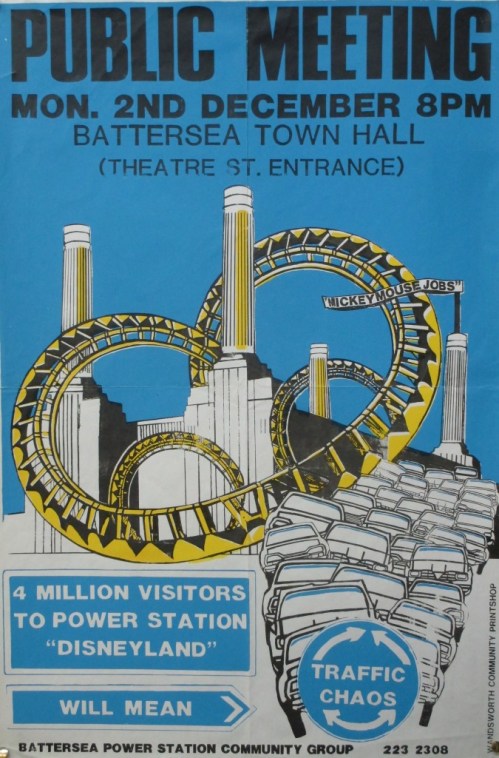
Posted in Architecture, Art, Battersea Power Station, Books, History, Housing, Journalism, London, Politics, Property, Talks, Uncategorized
I was invited on Robert Elms’ Radio London show yesterday to talk about Battersea Power Station.
You can hear me here, from around 1 hr 39 minutes. Thanks to Robert’s team for inviting me on, and for Robert asking such excellent questions. I really enjoyed the discussion.
Listening to Robert Elms’s show in the late 1990s was fundamental to developing my fascination with London so this was quite an exciting event for me. In many ways, the nature of my love for London was more influenced by Elms than it was the likes of Sinclair or Ackroyd.
Incidentally, this was also the first time I had visited the BBC at Portland Place since 1999, when I was one of a handful of journalists invited to see a demonstration of TIVO by the BBC’s Head Of Future, who paused and then continued watching a live weather forecast. Many of us believed we had witnessed a form of witchcraft; one reporter even accused him of manipulating a VHS tape.
I also had a piece in Time Out this week, listing ten things you didn’t know about Battersea Power Station. You can read that here.
Posted in Architecture, Battersea Power Station, Books, History, Housing, Journalism, London, Radio
Tagged Battersea Power Station, BBC Radio London, Robert Elms, Time Out
While I dedicate a chapter of my book about Battersea Power Station, Up In Smoke (now available to purchase from the publisher), to the chaotic photoshoot for Pink Floyd’s Animals album cover, this was not the only time the building has been used in popular culture. Here I’ve listed some of my favourites, but there are dozens more involving Dr Who, Slade, The Jam, Richard III, The Who and The Quatermass Xperiment. It was also used as otherwise anonymous filming locations for numerous TV shows, pop videos and films, including Superman III, Monty Python’s The Meaning of Life, Texas, Manson and The Dark Knight but I’ve chosen the moments that made the building the star.
1 Sabotage (1936)

Hitchcock, a Londoner with a sharp eye for locations, was one of the first directors to note the visual potential of the power station, using it in early scenes of his 1936 film Sabotage. Here the power station has only two chimneys, the second half was not started until 1937 and the final chimney not added until 1955.
2. High Treason (1951)
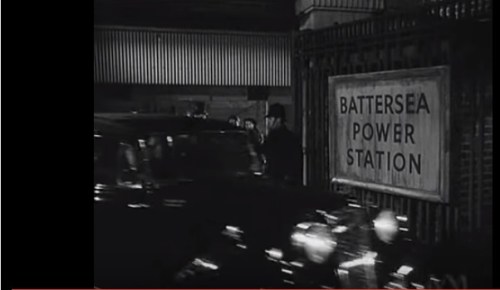
This superior Cold War neo-noir b-movie includes a thrilling climactic scene at Battersea Power Station, where there’s a great shoot-out amid the clanging pipes and hissing steam. Worth seeking out.
3. Up The Junction (1963)

Nell Dunn’s non-fiction collection of writing about Battersea woman is set in the shadow of Battersea Power Station. The poetic back cover blurb for one early edition stated, “Innocence in Battersea lasts as long as the flower remains unsooted by the power station.”
4. Help! (1965)

In The Beatles’ film, the power station is shown blowing a fuse at a critical juncture, causing a black-out and allowing the Fabs to escape their bolthole in Buckingham Palace (“A Well-Known Palace”).
5. Smashing Time (1967)

This goes a step further, with the restaurant at the top of the Post Office Tower revolving so fast it causes the power station to explode. London’s brash newest icon annihilating a venerable predecessor – a metaphor for the 1960s if ever there was.
6. Quark Strangeness And Charm & Lights Out (1977)
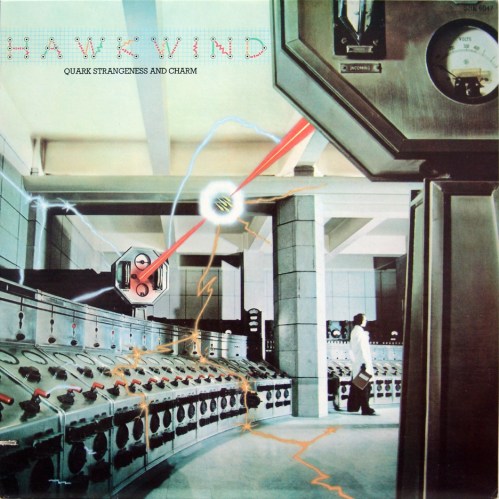
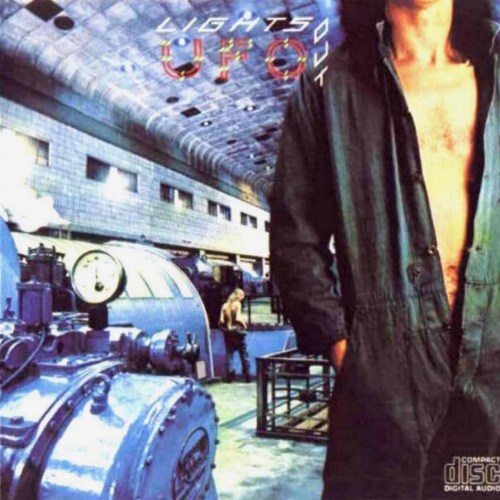
Despite the Animals debacle, album sleeve artists Hipgnosis returned twice more to the power station in 1977, photographing futuristic interior covers for Hawkwind’s Quark, Strangeness And Charm and UFO’s Lights Out.
7. The Borribles (1983)

A wonderfully feral cover for this brilliant 1983 children’s novel about a group of cockney elven urchins – Borribles – who are at war with the Rumbles, a group of rat-like creatures that are thinly disguised Wombles. The action begins in Battersea, hence the power station backdrop. I loved this book as a child, and the cover was part of that initial attraction.
8. Jet Set Willy (1984)

This level of the classic ZX Spectrum computer game was one of the first products to reference both the power station and Algie the flying pig. I played this game endlessly as a child – though I’m not sure I really got the pop culture or architectural references.
9. “You’re The One For Me, Fatty” (1992)
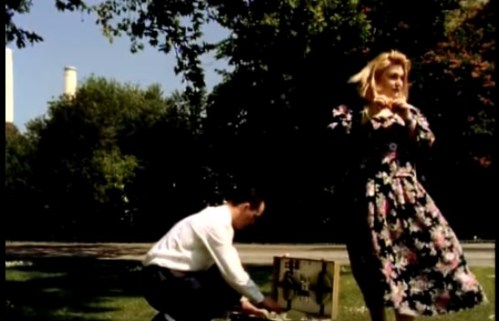
I was obsessed with Morrissey in 1992, and while I didn’t like this song much at the time, I did love the fact the power station featured a couple of times. Now, I think it is one of Morrissey’s finest pop moments, and the shots of the power station still delight me. A couple of years after this, I saw Morrissey play a gig at the power station, although in the dark and funnelled through tunnels, it was impossible to tell that’s where we were. Morrissey was rubbish too.
10. Children of Men (2006)

A striking scene in Children Of Men takes place at the power station, which has been converted into the Ark Of The Arts, containing the world’s most priceless artefacts in this dystopian future London – Alfonso Cuaron, like several other film directors, saw Battersea as the sort of building only a totalitarian could love. Note the pig, flying between the chimneys. The film’s location manager told me, “We wanted strong images that had to represent London but not cheesy London. Using somewhere like Battersea meant there was no question of where you were, it was London but proper London, authentic London.”
Posted in Architecture, Battersea Power Station, Books, Counterculture, Film, History, London, Music, Place, Uncategorized
Tagged Batman, Beatles, Borribles, Children Of Men, Clive Owen, Cybermen, Dr Who, Hawkwind, Help!, High Treason, Hipgnosis, Hitchcock, Jet Set Willy, Monty Python, Morrissey, Nell Dunn, Pink Floyd, Sabotage, Smashing Time, You're The One For Me Fatty
I have a post on Londonist about Dream City, a theme park concept cooked up in 1907 by an American developer for a disused waterworks, a site that was later occupied by Battersea Power Station.
You can read the full story here.

Dream City
The unbuilt Dream City is also the starting point for Alice May Williams’ short film about Battersea Power Station called Dream City: More, Better Sooner produced by the Film And Video Umbrella. The fvu have organised a talk on Friday (April 15) at the Battersea site of the Royal College of Arts by Owen Hatherley called Monetising The Ruin: Batterseas Old And New.
I will be attending the lecture and also selling copies of my book Up In Smoke: The Failed Dreams Of Battersea Power Station.
Posted in Architecture, Battersea Power Station, Blogging, Books, Exhibitions, History, Journalism, London, Place, Politics, Property, Secret London, Talks
Tagged 1907, Battersea Power Station, Dream City, Owen Hatherley, Unbuilt London, waterworks
Up In Smoke: The Failed Dreams Of Battersea Power Station has a release date of April 26.
You can find out more at this website, which also tells you how to get in touch if you want me to do any talks or events.

Expect me to be writing about this a lot more in the next few weeks.
Posted in Architecture, Battersea Power Station, Books, History, Housing, London, Photography, Place, Politics, Property
Tagged Battersea Power Station, book, Up In Smoke
While writing my forthcoming book about Battersea Power Station, I often wondered why nobody had done so before.
The reason, I decided, was that as the various redevelopment projects were never completed, it was a very difficult tale to bring to a close. However, with the latest scheme being backed by serious money and as the buildings around the power station started to rise, it seemed as if the end was finally in sight.
I felt safe.
Too safe…
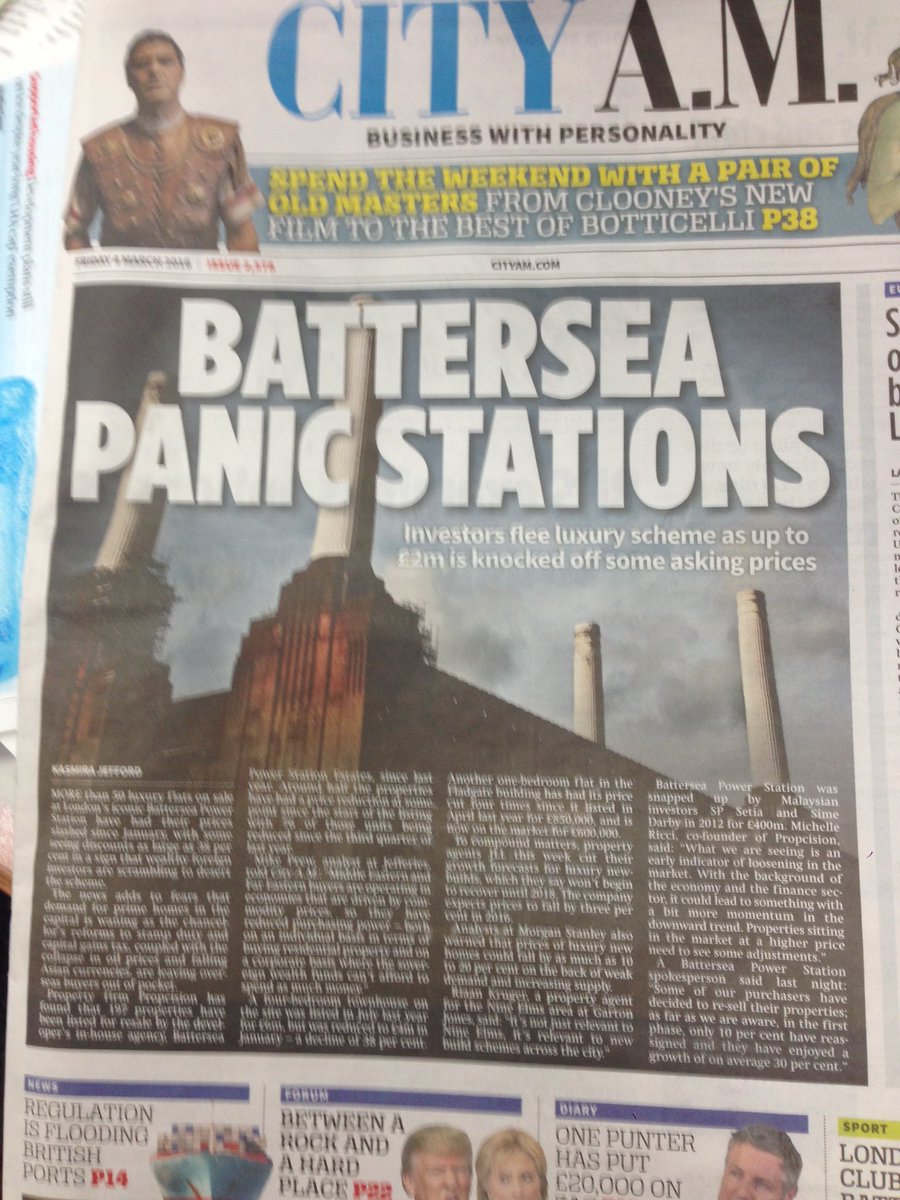
Today a report in City AM confirming what many have been saying for months – that the heat is coming out of the Nine Elms luxury property market, forcing developers to slash prices in a bid to retain the overseas investors on which so many hopes are pinned.
I was told a couple of times that this might happen, most notably when the chief executive of one previous development pointed out that the intensity of development on the Battersea site – not to mention elsewhere in the Nine Elms area, where thousands of similar flats are being built – meant that the Malaysian developers would be effectively competing against themselves on price. Unless it was managed carefully, and if the market ever dipped, there could be problems.
And so it has come to pass.
While those Londoners who decry the over-development of the power station may be excused at being amused by the problems being experienced by the developers, this is bad news for the building itself which is still far from secure: a hollow, roofless shell that is currently lacking three chimneys.
Wandsworth, who have presided over one of the most disastrous redevelopment projects in London for more than 30 years, had allowed the developers to build so many flats in advance of restoration so the developers could flog them to raise capital to pay to fix the power station. If those flats don’t sell, there is a danger that the power station will be left in a worse state than ever.
In these circumstances, demolition would be a serious possibility.
While we should be concerned, I don’t think it’s quite time to panic. The appeal of the Malaysian developers is that they are effectively being bankrolled by the Malaysian state in the shape of the country’s pension fund, which should mean pockets are deep enough to sustain these fluctuations in the property market.
But it does show that nothing is certain when it comes to the story of Battersea Power Station, except uncertainty.
Posted in Architecture, Battersea Power Station, Books, Housing, London, Politics, Property, Recession, Uncategorized
Tagged Battersea Power Station, demolition, Malaysian, Up In Smoke
In the current issue of Uncut, I spoke to write Keiron Pim about his excellent book on David Litvinoff, Jumpin’ Jack Flash. Litvinoff is one of those characters that crops up in all sorts of strange places once you first notice him – in the last few years I’ve read books about the Krays, Performance and Operation Julie, and Litvinoff has featured in all of them as a mercurial, menacing muse. He also appears in Iain Sinclair’s books, but Sinclair is most interested in what he can use Litvinoff to represent – in this case a deliberately unknowable, shadowy figure who flits through London’s secret history, connecting the shadowy worlds of counterculture and crimes.
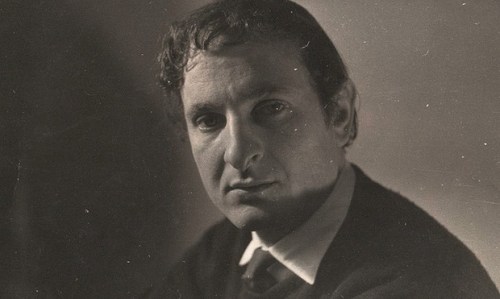
Pim is a journalist, interested in people as people rather than as metaphors, and his book diligently puts flesh on the bones of Litvinoff’s known history, tracing this strange character’s ascent from the Jewish East End and into the worlds of art, crime and music, where he rubbed up against everybody from Lucien Freud to Eric Clapton. It’s said that Litvinoff reached such elevated company he was even invited to Jimi Hendrix’s funeral – the invitation contained a tab of acid that the recipient was meant to take if they couldn’t physically attend.
Litvinoff was an unpredictable chancer who survived on his wits, making money here and there through schemes both legal and not. He worked for the Krays and Peter Rachman, but his defining role, as seen by Pim, is as consultant for Performance, that heady, troubling film that could be the finest ever made in this city. Litvinoff befriended and advised both Edward Fox and Mick Jagger on the ways of the underworld, and supplied his old Soho pal Donald Cammell with ideas for scenes and dialogue. One of the many memorable moments in the film – the shaving of one victim’s head by gangsters – was based on Litvinoff’s own experiences. This was a man who both delivered and received mob justice – and at times, he is unsympathetic to the point of psychopathy – until he discovered a form of salvation through drugs and the woolly world of hippie idealism.

The story is ultimately a tragic one, as Litvinoff increasingly found himself left behind by friends, who could tolerate his wit and weirdness for only so long. He killed himself in 1975 as punk was breaking, and one sense that this movement of chaotic creativity, violence and contradiction would have suited him fine, although Malcolm McLaren may have baulked at the competition.
Given that Litvinoff didn’t actually leave much behind – no books or diaries, photographs or albums, little that is tangible or concrete – it’s difficult to put a pin in what he actually did. In an age in which we are increasingly defined by our jobs – commit a social media faux pas, and you are immediately reported to your employer – that’s strangely unsettling. The brilliant late artist Martin Sharp, a close friend of Litvinoff, makes a case that this needn’t be the case, that Litvinoff, by simply being himself and acting as muse and creative conspirator, did plenty. “It’s hard to earn a living doing it, but he made an enormous contribution to people’s lives,” says Sharp. “It’s not something you can send someone a bill for.”
Posted in Books, Cockney, Counterculture, Crime, Death, Drugs, Film, Gossip, History, Literature, London, Music, Secret London, Sex, Soho
Tagged David Litvinoff, Donald Cammell, Edward Fox, Eric Clapton, Jimi Hendrix, Keiron Pim, Martin Sharp, Mick Jagger, Performance, Rolling Stones
 The Great Wen