Tag Archives: Time Out

Time Out and listings

Time Out went free this week. It wasn’t really a shock, the notion had been knocking around when I worked there, particularly when thelondonpaper and London Lite were stinking up the streets. The success of the free Evening Standard probably sealed the deal. The economics are unarguable: drop the cover price and circulation rises, allowing you to charge more for advertising. If you can simultaneously reduce costs – which they have been doing through regular redundancies – you may have a viable magazine once again. The danger, though, is that once the decision to go free has been made, there’s no going back…

What has it meant for Time Out? Well, the new magazine has less pages but still has plenty of previews, lists, bitty features and clunky ads, with just a couple of longer reads thrown in for us old-fashioned types. What it doesn’t have – along with book reviews –  is listings (at least in any meaningful sense), which was the reason Time Out was invented in 1968. (There’s also no letters page, which is a mistake if they still want to establish that vital personal link with readers, and one I think they will quickly rectify.)

This isn’t really a surprise. Successive TO editors have always struggled with the listings part of their brief: listings are ugly, boring and largely resistant to any sexing up, despite the best attempts of periodic and largely futile ‘redesigns’ (has a redesign of any magazine or newspaper EVER raised circulation?). They are also beyond the control of the editor, who has to leave them to section heads. Even editors who came from within the magazine, and therefore understood the centrality of listings to what Time Out did, didn’t actually appear to like them all that much. They take up valuable space from the exciting things an editor likes to do at the front of the mag and telling a section editor you are cutting their pages is a draaaag.

To make matters worse, listings do not do well when it comes to ‘page views’ or ‘unique users’, the trite and often completely useless method by which the value of anything in print is these days judged. And because people don’t click on listings on the website (for reasons that are so obvious I won’t even bother to explain), the logic goes, they don’t read them in print.

Hmmmmmm.

A number of people have noted that without decent browsable printed listings, Time Out has potentially rendered itself useless, but I don’t want to comment on that. What does interest me is that effect a lack of listings will have London’s smaller venues. The joy of TO‘s listings was that it gave the smallest museum or club as much prominence as the biggest and most well-funded, allowing readers to decide which to visit entirely on the merit of their programming. It’s this that made Time Out absolutely central to the rise of fringe theatre, avant-garde art, clubbing, burlesque and alternative comedy – each scene was created by individuals, but a free listing in Time Out coupled with enthusiastic support from in-the-know section editors took things to another level. Even larger venues have told me they noticed the difference in footfall when they were omitted from listings (by accident or for reasons of space).

Time Out obviously doesn’t have the circulation, and therefore the pull,  it once did and there are other specialist resources for those interested in the esoteric fringes of London’s cultural life, but the loss of listings will surely still be felt by venues that aren’t internet savvy or lack a large marketing department. The solution for many will be a prominent place in the preview part of the existing sections. Time Out‘s section heads will never have been in such demand… And PRs can be a dangerously homogenising bunch.

For more on the new Time Out, here’s Diamond Geezer (positive), Christopher Fowler (not) and Londonist (neutral). 

All aboard the Boris Bus!

Boris Johnson’s much touted new bus launched in London on Monday, and I managed to take a trip on it. It wasn’t easy: the bus left Victoria two hours late after breaking down twice and being slipstreamed by a Routemaster filled with anti-Boris protesters, but the public cared not a jot. Read my piece for Time Out here.

The bus is a classic example of how far bluster and bullshit can carry you, if the public are even half-interested in your vision. This is not a Routemaster, it carries fewer passengers than the bus it is replacing, has cost a fortune to develop, it doesn’t stop fare dodgers, the back platform closes in the evenings and the conductors aren’t allowed to take fares – but it’s still, in my view, a guaranteed vote winner because people like the look of it and aren’t going to look at the downsides too deeply. And maybe they are right, because when all is said and done, a fleet of these on London streets in a few years won’t look too shabby, and all the complaints – accurate as they may be – will look like so much narrow-minded nitpicking.

New Bus for London

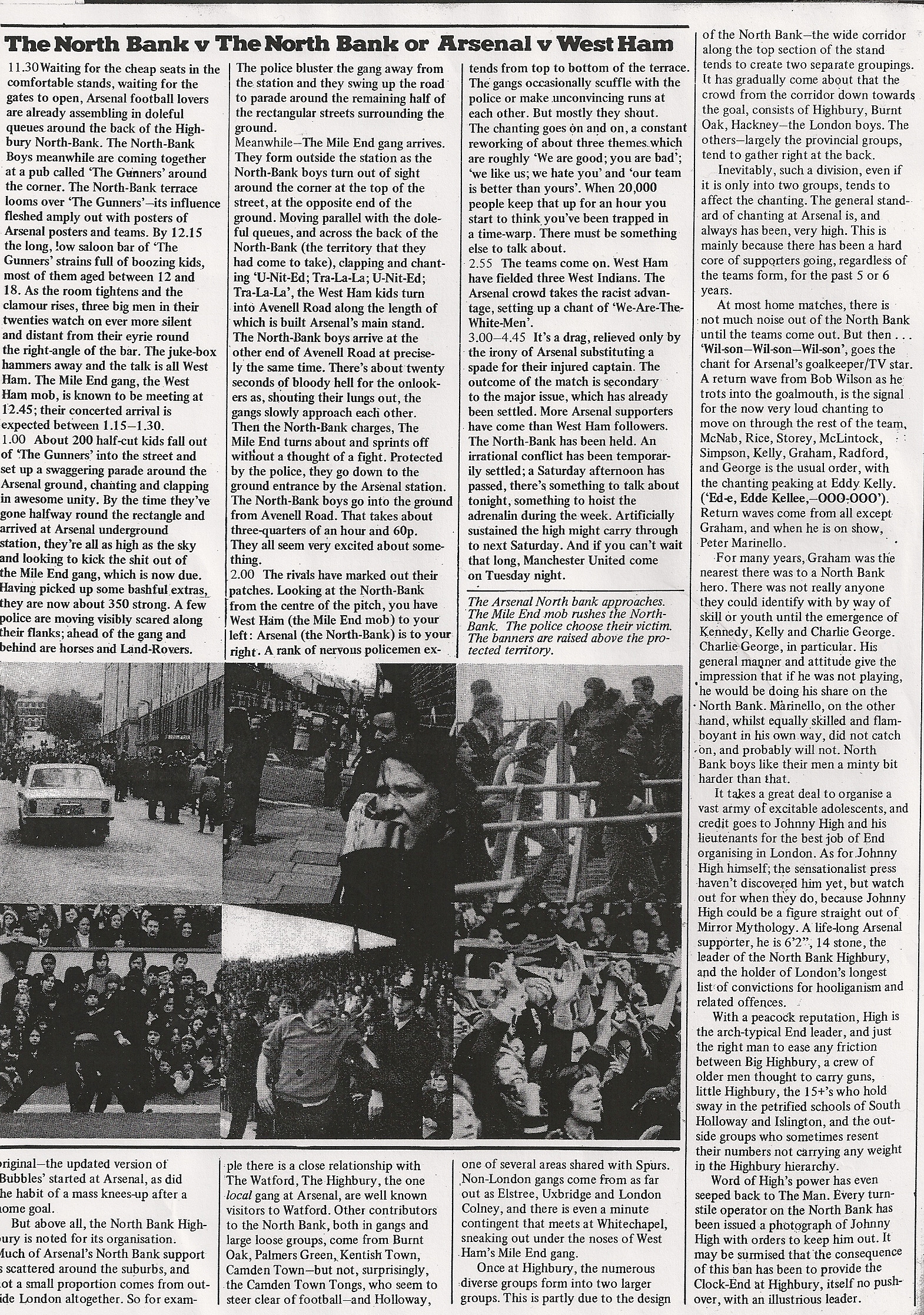
London’s football gangs: 1972

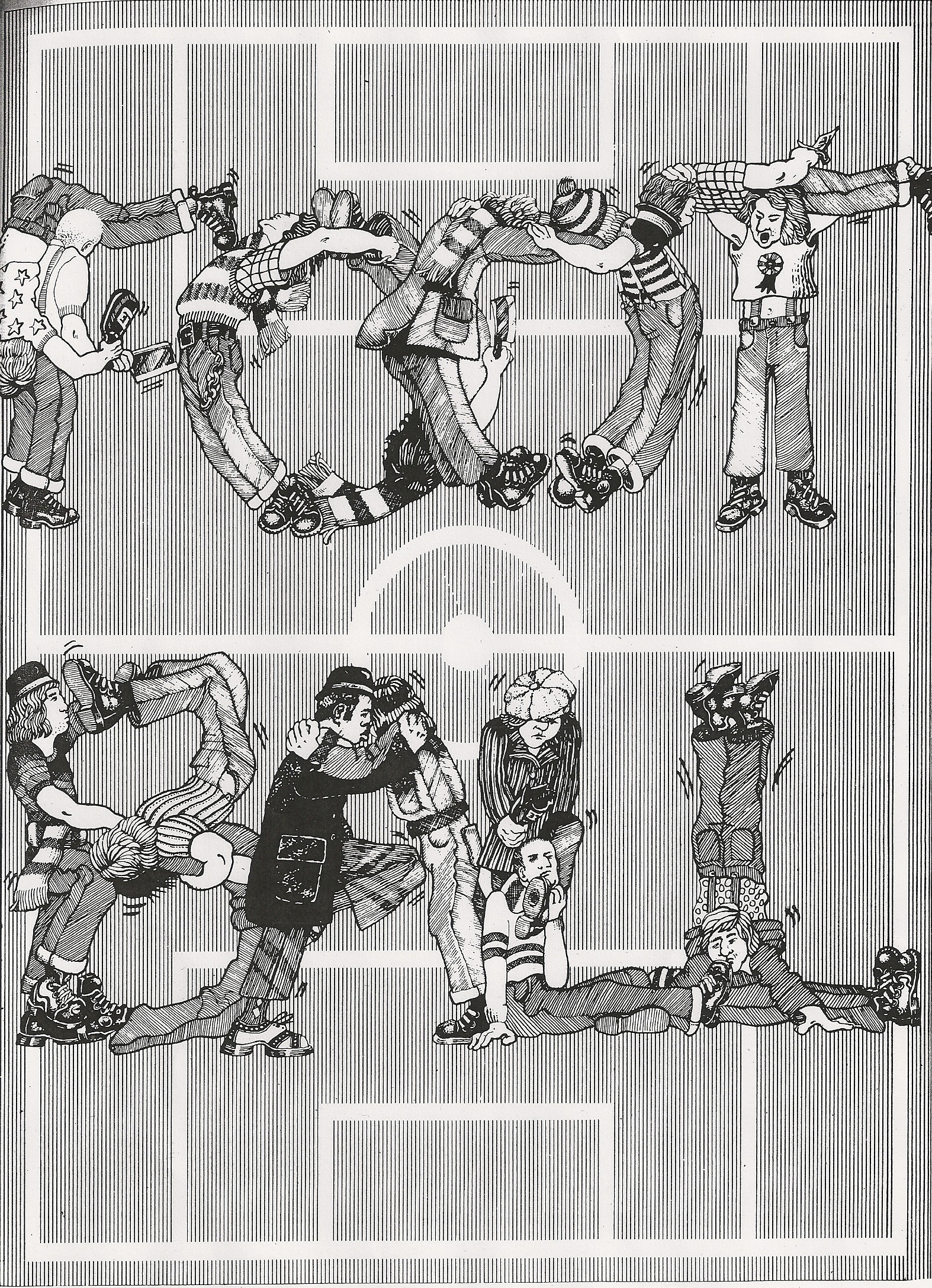
 I’ve mentioned Chris Lightbown’s article on London football gangs a couple of times before, but the piece itself hasn’t been available since it was first published in Time Out in 1972. The section on West Ham was reprinted in the excellent 2008 anthology London Calling, but the full article has been confined to libraries and private collections. Until now.

It is a fascinating read. This is the first time football fan culture had ever been seriously discussed by the press, and it offers a remarkable view of life on the terraces from the terraces, free of any moralism or finger-wagging. It is a thorough and very funny piece of writing, and is probably the first time terrace legends such as Mick Greenaway and Johnny Hoy (although he is called ‘High’ here) ever saw their names in print. It’s analysis of where the different clubs draw on their support is particularly great. 

The writing is very much of its time and place – complete with mention of ‘heads’ and ‘coons’ – and also paints the picture of a time when London terrace culture was very different: the Shed was as loud as the Kop, Arsenal had the most aggressive fans in London and Spurs were just a joke, on and off the pitch. Only West Ham’s identity appears to have remained more or less the same, although older Hammers would doubtless question that.

It is a cracking piece of work. Enjoy.

‘Ladies who bus’

This is a piece I wrote for the Speed issue of the excellent Completely London magazine. 

Sometimes, it feels like there are few slower ways of getting round London than by public transport. And the bus –so often a victim of roadworks and burst water mains – can be the slowest of all. But for some, that slowness is part of the attraction. Jo Hunt (67), Mary Rees (68) and Linda Smither (64) are ‘ladies who bus’. Since March 2009, they have been taking all of London’s buses in numerical order, starting at No 1, travelling each route from one end to the other, and then writing about it on their blog. As a way to pass the time, it is a distinctively London thing to do. There are, after all, over 500 routes in London; more if you include those that start with letters, like the A10 or X68.

File:London Bus route 23.JPG

‘It began when I retired from my last job,’ says Jo, the head buskateer and a former teacher. ‘People asked what I was going to do. I said I’d just loll about or play computer games, but then I decided I’d get every bus in London.’

From that moment of whimsy came a plan, which became a blog and has now evolved into something like a mission. Jo, Mary and Linda have acquired matching sweatshirts with their blog address on it – these proved to be handy in winter when one bus’s central heating was broken – and they have printed business cards to hand to drivers at the end of journeys to explain what they are up to. Online, they have built up a following among London nerds and bus enthusiasts.

Jo got the idea when she got on a bus and saw it was terminating at Ponder’s End. ‘I thought, “Where’s Ponder’s End?”’ and elected to find out. ‘Then I thought if I was going to do one, I should do them all, and if I was going to do them all, I should do them in the right order.’ Linda and Mary were both ready for retirement as well, so – armed with their Freedom Passes –they agreed to come along. Jo’s son created a blog, and 200 buses later we are now travelling by bus from Brixton to Mitcham on one of the hottest days of the year.

And here I must make a confession. I also spent a couple of years on the buses, writing a weekly column for Time Out about exactly this topic – taking every bus in London in numerical order, from end to end. Well, it started as a weekly column, but soon lethargy took over, the column became fortnightly and then monthly and in the end I never made it further than the low 60s. Jo, Linda and Mary have persevered, resolve stiffened by each other’s company – and by Jo’s determination to complete the task. ‘Jo is the leader,’ confesses Mary. Jo plans each route a week in advance, working out how they are going to get to and from the stops that bookend the route, and she and Linda take turns writing them up on the blog.

But they are clearly enjoying themselves as well. There is much to appreciate about a lazy morning spent taking a bus for no other reason than the sheer fun of travel, watching London knit together while everybody outside rushes about their daily business without time to stop and absorb the city around them. As we slip languidly through south London streets, the trio note familiar landmarks and reminisce about other routes that have passed this way. They are also able to recall what an area was like 5, 10, 20, even 40 years previously. ‘It’s evocative,’ says Linda of the experience of revisiting old haunts. She also comments on how they have watched London change in the two-and-a-half years they’ve been doing the routes. When they began, the Strata Tower at Elephant & Castle was a building site – now it’s one of the tallest buildings in London. A rapid transformation, observed at leisure.

They are fascinated by London’s arcane history of– such as the Balham estate we pass that was reported to be Hitler’s choice for a home if he successfully invaded Britain – but also by the present, especially in Tooting, as South Indian restaurants slowly give way to West African clothes shops and Mary contemplates hopping off to pick up three crates of mangoes for £10.

London as seen by bus is a city of delights and surprises. ‘I’ve been surprised at how good the drivers are,’ says Jo. ‘I’ve really enjoyed being able to understand how London ties together. And sometimes you’ll be bumbling along and then suddenly you are in the country, surrounded by green. It’s like you’ve reached the end of the world.’ Or the end of London, which sometimes feels like much the same thing.

London’s lost rivers

There is almost endless fascination with London’s lost rivers, as can be seen with the publication of Paul Talling‘s fine – if brief – new book on the subject. I have written about them a number of times and this article first appeared in Time Out in 2008.

Londoners love what they cannot see. Take the excitement that is generated by ‘ghost tube stations’ such as Museum and Aldwych that sit unused beneath our feet and can occasionally be glimpsed from trains. Yet people rarely blink when they descend escalators into the remarkable interiors of busy, living stations. Concealment and abandonment excited the mind more than the here and now.

So it is with London’s lost rivers. Anybody can check out the quirky Lea or watch the Wandle weave serenely past Merton Savacentre, but mention Brixton’s Effra or the City’s Walbrook rivers and the eyes of a certain sort of Londoner will light up, and a torrent of trivia about lost rivers will gush forth. This is an interest that can take us to unusual places. When Design for London recently mounted London Open City, an exhibition about creating new spaces in the capital, the idea of restoring buried rivers got people talking. The Sunday Times claimed Boris Johnson was going to greenlight the scheme and Peter Bishop, then director of Design for London, said: ‘When these rivers are opened up, Londoners will be absolutely amazed.’

Which was great news for James Bowdidge, a property developer with a yen for the Tyburn. ‘As soon as I learnt about it, I became fascinated with the old river and the way you could see it in street patterns,’ says Bowdidge, who channelled his enthusiasm into a curious project – ‘an angling society for a river that didn’t exist’. The Tyburn Angling Society, an irregular supper club, was born – Ken Livingstone attended their 600th anniversary dinner, 600 being a number they plucked out of thin air.

So far, so whimsical.

However, Bowdidge – a London buff with half an eye on property prices – has also looked into raising the Tyburn, which was covered in 1750 but still meanders underground from Hampstead to Westminster. ‘I asked an architect to draw up plans of the building that would have to go. We write to Westminster City Council about it every now and then. But they are sceptical because this particular plan requires the demolition of their headquarters.’

Now Bowdidge’s hope is renewed. ‘If you look at the planning statement the Mayor brought out, you can see a degree of support for this sort of project. And now the subject is live it’s worth thinking about seriously – what could you do? There’s no reason why you couldn’t reinstate the river through Regent’s Park. You don’t have to demolish billions of pounds of property, there are places where you could really bring it back if you looked at it pragmatically.’

Well, perhaps. The notion that Boris has gleefully embraced the scheme is not supported by the raised-eyebrows reaction of a GLA spokesperson, who told me: ‘Opening up parts of London’s subterranean river networks is one of many ideas proposed at the exhibition… As with all the ideas designed to stimulate thinking, a full study would need to be undertaken before any could be taken forward.’

In other words: Never. Gonna. Happen.

At least, not with the Mayor’s money. But there are always other pockets to pick. In 2003, the Environment Agency rescued the Quaggy, a tributary of the Ravensbourne, from an underground culvert in Kidbooke’s Sutcliffe Park, and there are plans to restore the Ravensbourne itself in Lewisham town centre, paid for by a regeneration group called Urban Renaissance in Lewisham (which includes the Quaggy Waterways Action Group). Architect Will Alsop has floated a similar scheme for Croydon, where a branch of the Wandle is interred. He says, ‘The buried river thing Boris is banging on about is a really good idea. In Croydon, the Wandle was only buried in 1967 so you can easily bring it back in patches: ponds or lakes or some elements of river. And you don’t even have to bring them back; you can leave some underground and go and see them there.’

Which brings us neatly to the most interesting scheme, that of Nick Robertson, a designer and London obsessive who once walked the Thames from source to sea with Peter Ackroyd (‘every Saturday for a year’) and harbours a fascination for the Fleet. Bowdidge refers to the infamously filthy Fleet as ‘the ditch’, and Robertson does not disagree. ‘There’s nothing artistic about the Fleet,’ he says. ‘It was bricked up for good reason. He’s right to call it a ditch. But some ditches are worth celebrating.’

Robertson’s plan was ‘the confluence of several ideas’. One was a walk he completed along the course of the Fleet – ‘it was a river route, you could see it in street names, and in the topography and geology; a river that wasn’t there, but was.’ A second influence was an exhibition at the Royal Academy in 1996 called ‘Living Bridges’, which author Stephen Bayley has said marked the ‘moment when bridges have become showpieces of architects rather than engineers’. And the third was a visit to the Monument, the column raised by Wren and Hooke in 1677 to commemorate the Great Fire.

Robertson explains: ‘What interested me about the Monument was that it wasn’t representational. You climbed this big Doric column and saw what you saw, which was the extent of the destroyed city. The Monument is not the monument – what you see, the rebuilt city, is the monument. Stylistically, it’s of its time but conceptually, it’s way ahead.’

Robertson and an architect friend Iain Johnston explored options. ‘We discussed whether it was a good idea to open up the river and very quickly dismissed it because most plans to open up the hidden river are missing the point. The point is this river is covered. That’s what is interesting. To open it up is to ignore the historical process. And it’s ignoring the mystery, the charm. If you opened up the Fleet, it would regress to what it was, an urban river: charmless, shit-filled.’

Instead, Robertson ‘thought it would be interesting to have a bridge that went underground and the obvious site was Ludgate Circus because that was the site of the Fleet Bridge and Wren’s bridge when he tried to turn the Fleet into a canal.’ They designed a subterranean chamber that went under the road and had a glass floor through which visitors could observe the still-living Fleet. ‘A warped bridge over a warped bridge’.

He sent his proposal to the head of Thames Water where, as far as he knows, it still resides. The Fleet and the Tyburn were incorporated into Joseph Bazalgette’s sewer system in the 1860s and both Bowdidge and Robertson have blagged trips underground with Thames Water sewer workers. Says Robertson: ‘One of the things I found most interesting was the amount of decoration. The designers stopped and thought what they were doing even though nobody was going to see it – it’s effectively dressing up shit.’

It’s true. London river-sewers are artfully constructed, beautiful things that deserve celebration, both for what they are now and what they used to be. The Guardian’s Ian Jack disagrees. When confronted with Bowdidge’s cheerful scheme of tree-lined tributaries, he wrote that the Tyburn was a ‘sewer owned by Thames Water and more remotely by pension funds in Canada and Australia. It has been a sewer for hundreds of years as part of a combined system, far too expensive to separate, that carries rainwater and human waste.’

And that’s that. Robertson at least sees a way past this brutal approach, and while his Fleet Bridge is the sort of imaginative scheme destined to go nowhere, he also believes the Fleet should be remembered in simpler ways, such as surface markers along its course of which there are none. It seems London is ashamed of its lost rivers, or at least of its treatment of them.

‘The Fleet is something London has buried,’ says Robertson. ‘So it appeals to people who feel strongly about the occluded side of London history.’ The best way to deal with it, he thinks, is to go down and confront this ‘trapped nerve’.

‘It was once a bubbling brook of bucolic bliss, then it turned into an open sewer, then it was bricked up,’ he says. ‘Now it needs to recreate itself in a different way. To open it up is to miss the point, pandering to a nostalgic view of London. London should never be nostalgic.’

Spoken like a true Ballardian (and Ian Jack would surely approve), but everybody, even a ruthless modernist, is allowed to look back every now and then and wonder. So Robertson tells me to head up Farringdon Road and down Ray Street towards Back Hill. There, in the road outside The Coach & Horses, is a grill, and ‘when you stand over it,’ says Robertson, ‘you can hear the Fleet belting beneath your feet.’

So it does, the magnificent sound of a torrent of water battering its way downhill directly beneath London streets. Sewer or river, call it what you will, but the Fleet lives on. Deep waters run still.

Inside the Fleet: exploring London’s lost rivers

I wrote this piece for Time Out in 2005 and for some reason it’s never been available online. Until now.

It’s only as the filthy brown water rises above my thigh-high waders and my feet struggle to grip the tunnel’s slimy floor that I realise that drowning in a river of shit after breaking into a London sewer would be a really, really crap way to die.

It all began so well. I found Jondoe and Stoop, two urban explorers who get their kicks investigating drains, lost rivers and derelict buildings, on the internet and asked them if I could come on their next journey beneath the city streets.

We met near Farringdon. The plan is to explore one of London’s lost rivers, the Fleet, which once flowed from Hampstead to Blackfriars. Although long bricked over, the Fleet, like many of London’s old rivers, still flows underground through a series of pipes and culverts. Joseph Bazalgette integrated these rivers into his sewer system, using them as storm-relief drains to carry overspill into the Thames when the main east-west sewers were swelled beyond capacity. These days, heavy rain can still cause sewage to flow into the river via the Fleet.
Jondoe and Stoop have been in the Fleet before, but turned back when the stench became overwhelming for even these experienced drainers. This time, they are determined to reach the end. They believe no other UK urban explorer has made the trip, largely because it takes considerable planning to find a way into London drains. Urban explorers are driven by a combination of adrenalin and curiosity, and take their hobby seriously. This trip has been months in the planning. They’ve popped many manholes looking for the right entry point, and the weather has to be right – no rain for at least three days before we enter.

In a nearby car park, we change into waders, boiler suits, flourescent vests and hard hats – the latter more for disguise than protection. Carrying a couple of traffic cones, we’re suddenly transformed into construction workers, practically invisible to passers-by. Nobody bats an eyelid as we walk through busy streets to the selected manhole, stick some cones round it, lift the cover and climb down the ladder into the gloom.

We enter a feeder tunnel with a five-foot ceiling, which means we have to abandon our hats and walk with cricked necks. It’s cramped, damp, dank and dirty but doesn’t smell too bad. Stoop and Jondoe glide like skaters along the slippery floor while I splash clumsily behind, using slimy walls to keep my balance. We head downwards along a series of mini-waterfalls. The light and noise that intermittently emerges from the grates overhead suggest we aren’t getting deeper, but simply following the gradient of the road. It’s a curious feeling, being isolated in the dark but with occasional glimpses of London reminding us that normal life continues up above.

Eventually we reach the end of the feeder tunnel and swing into the Fleet itself using broadband cables that make useful subterranean handrails. It stinks in here and the air is heavy with a strange mist. Jondoe points north, to where the Fleet is blocked by the main east-west sewer. Ominous clumps of matter fester in pools all around. ‘Don’t disturb them,’ he says. ‘It’ll be full of gas that just sits there and collects.’
As he speaks, one of the hard hats we’d left by the entry point shoots out of the feeder tunnel on a wave and floats towards the Thames, bobbing along the shallow water that moves sluggishly down the centre of the tunnel.

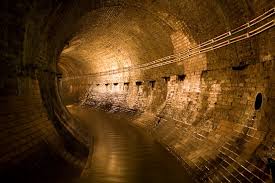
We follow, heading south. The tunnel is around ten feet tall and wide, so we can walk two abreast. It’s about the same size as a tube tunnel. The smell slowly subsides, although lumps of faeces and toilet paper gather in places where they’ve washed against the brickwork. Otherwise, there’s just a trickle of brown water ferrying the odd cotton-bud downriver.

It’s no hellhole, but still a far cry from the Fleet’s sixteenth-century heyday as one of London’s key tributaries, when, flanked by wharves and warehouses, it was a centre of London commerce. It separated Westminster from the City and carried cargo to the Thames, was compared unfavourably with the four rivers of Hades by Ben Jonson, was briefly turned into a canal and then covered in portions from 1732, by which time it was little more than an open sewer.

But this was not the end of it. In 1846, the Fleet exploded, its sewage gasses bursting the street above, rendering King’s Cross Road impassable, destroying Clerkenwell poorhouses and smashing a Thames steamboat against Blackfriars Bridge. This river, it seems, has a habit of coming back to ambush those who thought it dead and buried.

Almost two centuries later, traffic and police sirens are audible overhead, competing with the constant crash of water that flows from numerous side tunnels, feeding the central trickle. Rats stop and stare as we walk past. I nervously keep my torch shining on them until we have moved on.

Before Ludgate Circus, the Fleet splits into two parallel tunnels, directly replicating the pattern of Farringdon Street overhead. Otherwise, it’s impossible to work out exactly where we are. The tunnel heads south, but is full of turns. At one point we notice large iron rings cemented into the wall. They are support for scaffolding, but look like mooring rings. Throughout, the Victorian brickwork is surprisingly beautiful for something that is so rarely seen.


After about two miles of trudging, we emerge into an enormous end chamber, more than 20-feet high and elaborate in design and construction. Two short tunnels lead from here, ending in huge metal flaps, which we assume open directly into the Thames.

After taking pictures, we head back. Immediately, we realise there’s a problem. It’s much harder to walk uphill against the flow of water. On the way down, the water was a stream, heading back, it’s more like a river. We labour onwards and upwards in the dark, but it’s tough work.

Stoop eventually says what we’ve all been thinking. ‘Is it just me,’ he asks, ‘Or is the water getting deeper?’

Water which before barely covered our feet is now above our knees, flooding downhill towards us at pace and rising slowly all the time. Wading into the tide, our clothes are heavy with water and our feet struggle to grip the slimy stone floor. Panicking rats scurry up the walls to get out the way of the bubbling water.

 It’s frightening. Nobody knows we are down here and as our pace slows I begin to ponder our options. Should we press on, or brave a side tunnel, where a ladder may at least take us above water level, so we can sit it out. But how long would that take? And what if the water keeps rising and the side tunnel we’re in doesn’t have access to the street? 

We reach a turn where the water has become a torrent and Stoop tries to brace himself against the tide but instead starts sliding backwards towards me, threatening to skittle us all into the dirty water. For a split second I consider what an undignified death this would make, and with one final effort we press on, forcing ourselves to a point where we can stand without getting knocked off our feet. But we’re exhausted.

Then Jondoe shouts, ‘That’s where we came in!’ It is indeed. We pull ourselves up into the feeder drain via the broadband cable and watch the river below us boil to a frenzy. The Fleet is back with a vengeance. Later Jondoe explains, ‘Somewhere further up the sewer they must have been doing some maintenance and so diverted the flow down the Fleet.’ It is, he says, something he’s never experienced before.

Twenty minutes later, after an exhausting walk through the smaller drain in the course of which I bang my head several times on overhanging pipes and bricks, I haul my battered, sodden body up the ladder and into the sunshine. It’s bright outside. The air smells clean. Half-a-dozen people across the road pay us no heed as we emerge from the manhole and sit slumped in the road, moving only to remove our waders and empty them back down the drain.

We trek back to the car in soaking socks, leaving a trail of footprints behind us.

How to tell the Story of London

The Story of London festival was introduced by Boris Johnson last year and immediately came under a lot of fire. Here’s something from Boris Watch plus stern words from Diamond Geezer.  

The festival is not a bad idea. It’s intended to cover the history of London in a way that includes all boroughs, all ages, all races and all genders – a riposte to Ken Livingstone’s habit of staging festivals for different minority groups at a Balkanised Trafalgar Square.

But it doesn’t work.

Part of the problem is publicity, and this is of the mayor’s own doing. In 2009, there was little or no attempt to promote the nascent festival by the city’s tourist office because their funding had just been slashed by Boris and they pretty much refused to help. 

The organisers then had to take their minute budget to Time Out, where I ended up knocking up a few pages to pull out of the middle of the mag that due to a hilarious production error did not actually pull out. It was nothing like the sort of lavish inserts the company can produce when given some cash and time. 

The other problem is that London already has loads of festivals – Open House, Meltdown, the London Film Festival, London Design Festival, the City of London Festival and dozens more – while institutions such as the Bishopsgate Institute regularly put on fantastic cultural events. And that’s before we even bring in the other museums, universities, galleries and scientific institutions.

 The Story of London simply does not have a distinct identity to compete with these established players.

With barely a niche to be found in London’s crowded cultural calender, Story of London has taken to hijacking and rebranding existing events, which doesn’t impress anybody. And they are so busy doing this they forget to organise any showpiece events that would help to give the festival a character of its own. Plus, they don’t have any money.

The result is a bit of a mess.

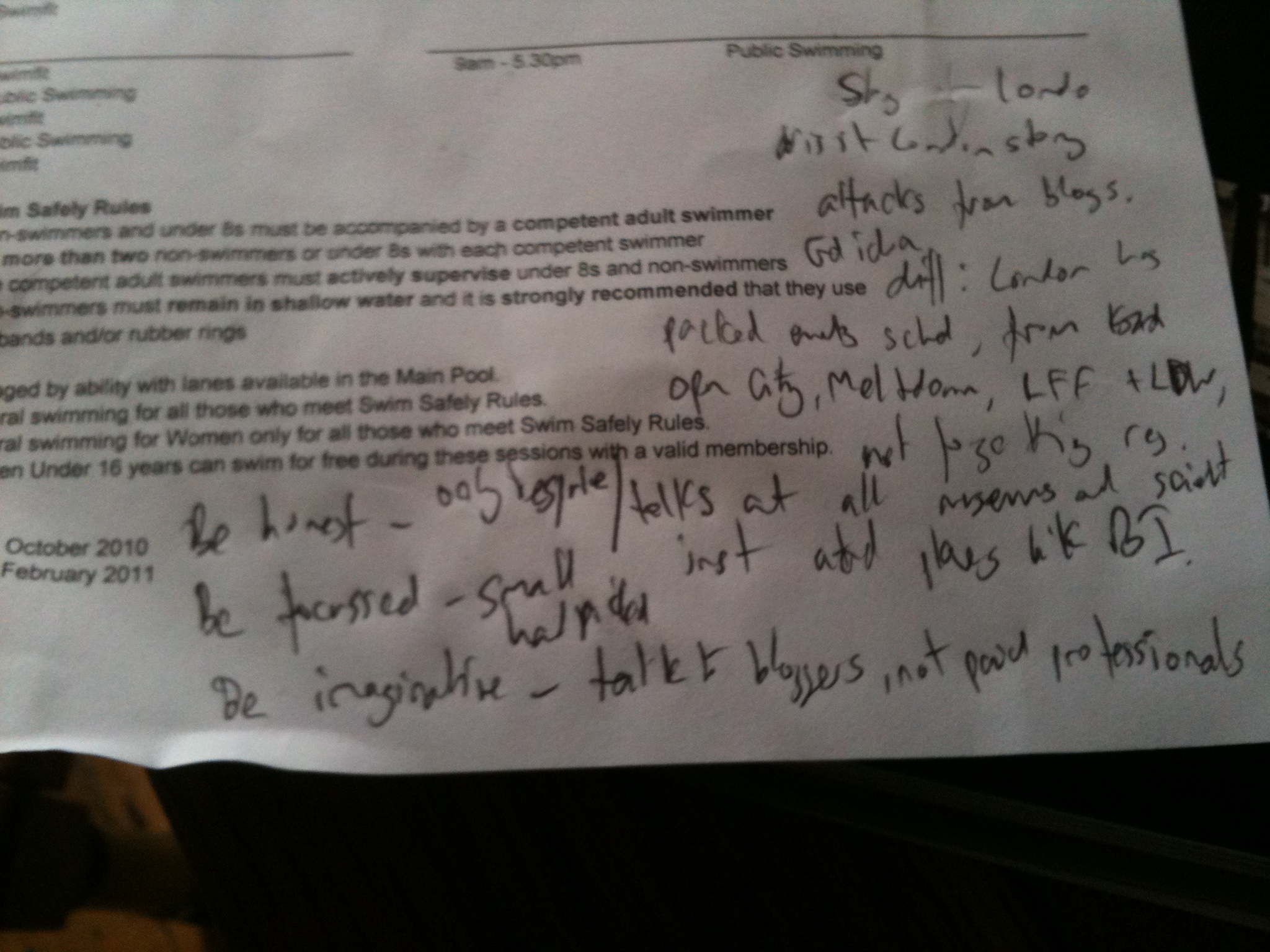
So what could they do? Fortunately for them, I was able to scribble a few suggestions on the back of a press release in between playing Secret of Monkey Island on my phone and wondering why I’ve rarely heard of a single person who appears in the Standard’s Londoner’s Diary.

  • Be honest – don’t hijack events that have nothing to do with you as it just looks cheap. And if you insist on this policy, it means that desperate organisers of terrible events will attempt to smuggle their substandard fare into your festival and you’ll have no way of keeping them out.
  • Bespoke – ensure that anything carrying the Story of London banner is new and brilliant and has genuinely been arranged specifically for the festival. That makes it fresh and makes it exciting and should ensure that you can keep an eye on the quality control.
  • Be focused – find a theme and stick to it. Make it broad and make sure that every borough has at least one institution participating. Narrow the time frame so it all takes place on a single weekend. Keep it tight at first and let it grow organically. At the moment it is a big blancmange of a festival when it should be as tight and pretty as an avocado stone.
  • Be clever – one of the best festivals the mayor currently has at his disposable is the Thames Festival, so hook the whole thing round that. A wee bit of rebranding – and yes, this is hijacking, but it’s hijacking with a point – and you have a ready-made spectacular way to close the weekend with the annual fireworks display.
  • Be imaginative – the guys from the Londonist website are already involved in one small event, but why not ask them to think up something big and crazy? These – and other – bloggers live and breath London in a way few paid professionals can compete with, so talk to them. They may not be interested, they may have terrible ideas, they may have no ideas, but they may just come up with a couple of events that curators and pros can turn into something special. Because at the moment, as Ian Visits says, the Story of London is just ‘a way for a lot of venues who are already planning to do something to get involved in a joint media campaign’.

And that’s as far as I got. LeChuck was causing all sorts of problems and I had to Google Laura Weinstock. But hey, it’s a start.

Slime Out: the sequel

I wrote recently about the hate letter I received at Time Out a few years and how it changed my outlook on writing (Like A Demented Seagull: How Hate Mail Changed My Life).

At the end of the post I said that this prolific writer of hate mail, who had rather wittily rechristened the magazine Slime Out, had stopped sending his bile-laden missives to Tottenham Court Road.

Not so, it seems. A former colleague recently contacted me to say:

‘I didn’t want to leave a comment because I’m genuinely afraid he might read it and target me. But I can tell you that he didn’t stop writing the postcards. We have received three or four in the last year. They’re not as personally offensive about individual staff any more, but still mental. I imagine him to look like Buffalo Bill from ‘Silence Of The Lambs’.’

So he’s still out there, reading a magazine he despises and making sure they know it. Somehow, I find this reassuring, and I’m sure these days he has plenty to write about.

This might also be a good time to mention the best ‘hate’ letter I received. This was before I was neutered, when I still prided myself on writing vicious, witty, scathing criticism of anything that came into my sights.

It asked simply: ‘Peter Watts. Is he a short man?’

It still stings.

Like a demented seagull: how hate mail changed my life

This is a letter I received several years ago. It begins ‘Dearest Peter, why don’t you just go and drown in your own shit’, goes on in a similar vein for six impeccably crafted pages before signing off ‘U.R.A. Deadman’. It was written by a mad man and it changed my life.

At the time, I prided myself on writing savage, pithy reviews for Time Out (rechristened Slime Out by the writer). I was vicious and splenetic, with the self-righteous confidence of a 20-year-old who believes they have invented authenticity and everybody else is a fool and a fraud. I verbally annihilated such high-profile targets as Toploader’s second album, anybody who ever appeared on Channel 5, ‘Grumpy Old Men’, Lord Robert Winston and Vigo Mortensen’s chin. 

Mr U Deadman (possibly not his real name) had noted my work and enraged by a particularly malicious piece I had written deriding the ridiculous sport of rugby union (clue: the section was titled ‘Rant’), decided it was time for payback. And how.

Much of what he wrote was plain wrong. The man was unbalanced, a bit racist and rather scary. He had extraordinary recall of past Time Out writers, many of whom I had never heard of, whose supposed sins (and, more worryingly, physical appearances) he would discuss at length. 

He also had a wicked turn of phrase. The key paragraph was the following, a rhetorical question that inadvertently changed everything. He asked me:

‘Are you looking forward to your retirement, to the day when you can look back over your working life and think “I slagged people off. That’s what I did with my life. I spent years – in fact, decades – SLAGGING PEOPLE OFF… screaming relentlessly like a demented SEAGULL. I was Slime Out’s top hatchet man in 2003. No-one else could touch me. Not even Lewis”?’

(The latter is a reference to the internationally respected music critic John Lewis, who was also a bit of a meanie back in the day.)

At the time, I laughed it off as the witterings of a deranged sociopath – albeit one with lovely script and excellent phrasing – but it also made me think. Yes, I could be funny, I could wind people up, but really what was the point? At around the same time I proudly showed my girlfriend a furious review I’d written about some vacuous celeb-loaded TV show about dancing and she wasn’t just unimpressed, she looked at me as if I had crapped in her handbag. Being cruel, I realised belatedly, wasn’t nice, or cool, or clever. Well, it was clever, but not in a nice or cool way.

I should have known this already, after the Jason Lee incident at the Sunday Times, when a throwaway comment about a haircut in my TV column was appropriated by ‘Baddiel and Skinner’s Fantasy Football’ with unfortunate repercussions for the career of an innocent pineapple.

So I changed. I stopped reviewing terrible films, only wrote about albums I liked and threw my TV set in the canal. I started to spend more time thinking about the things I enjoyed and wanted to recommend, and less time thinking about funny ways to slag off things I thought were crap.

I probably became more boring and less memorable as a writer, because there are few things more intoxicating than a really wicked piece of invective (pace Brooker), but I think it made me a better writer. I definitely became a happier person. And I still  have no desire to be the sort of person who uses their privileged space in magazines, newspapers and websites to wind-up readers and make asinine generalisations, even if that is the easy way to get noticed (pace a list far too long to mention).

The mysterious mad letter writer continued to treat Time Out to his acidic thoughts, occasionally in the form of epics like the above but usually as mellower postcards, mainly focused on music. He barely mentioned me again, although Lewis got it in the neck a couple of times, and rightly so.

He stopped writing to Time Out completely about a year ago and I often wondered what happened to him. Did he merely cancel his subscription like so many others (to drive off an obsessive, that is impressive), did he get some new, better,  medication, or did something tragic befall him, not entirely unlikely given his clearly troubled mind?

I hope he is okay. I hope he is a happy. And I’ll always keep his letter to remind me of what I never want to become.

Update: Slime Out: The Sequel.

On the buses again

My free Time Out travelcard has run out. This is the one thing I have been dreading since I left the magazine. No more cheeky one-stop tube hops, no more quick bus rides up the hill because I’m feeling lazy. I’ll even have to reacquaint myself with the actual cost of bus and tube fares, plebeian knowledge I have long disregarded. From now on, every journey on public transport has to be justified. My feet are in for a hell of a beating.

I was the same last time I was freelancer, when I first become heavily involved with the London bus. Time-rich and cash-poor, I could afford to take meandering bus trips across London rather than more expensive and direct journeys by tube, and came to appreciate the London bus in all its magnificence. A few years later, armed with a Time Out travelcard and newly installed as features writer, I attended a brainstorming meeting with the editor, who wanted some new ideas for the Big Smoke section. He picked up a copy of Time Out Manchester (a collectors’ item as it was the only issue they produced) and showed me a column called Bus Bingo, in which the writer took a random Mancunian bus every week. Nice concept, I said in one of those ‘monkey tennis’ moments familiar to any journalist, but how about I, er, take every bus in London in numerical order? And so a column was born.

It seemed popular. I don’t go to many parties, but when I did I was frequently introduced as ‘the bloke who was doing the buses for Time Out‘. And people would regale me with tales of terrible bus trips, or rhapsodise about their favourite routes. (Thinking about it, this could be one of the reasons why I don’t get invited to many parties.) People wrote to the mag saying they were collecting each column, or complaining if I gave a favoured bus an unfair review. Plus it got me out the office.

But all good things and all that. We got a new editor, who in our first meeting asked me how long the bus column would go on for. ‘Well,’ I told him, ‘there are at least 500 routes in London, and that’s before you consider night buses and the ones with number prefixs. And I’m only on No 60.’

He looked aghast, the facial expression of a man who had spent a decade taking taxis on an Emap expense account and fully endorsed the old Tory maxim that anybody who took the bus was a loser. He couldn’t understand why anybody would want to travel by bus, let alone write about it, let alone read about it.

The nail in the coffin came when I, perhaps inadvisably given the prevailing mood, commissioned a full-page piece interviewing three other people I had discovered who were also taking buses in numerical order, a pensioner, an artist and a blogger, who I dubbed ‘Buskateers’, a word that has inexplicably failed to make it into the Oxford English Dictionary.

And so the column was scrapped before I got a chance to fruitily ponder the 69, or settle scores on my old school route of the 127.

London wept, and then went back to reading about 50 Essential Hidden East London Cheap Eat Sex Markets For The Summer. And now I’m back on the buses, although not in numerical order and only if it is too far to walk.

(For more bus appreciation, these three pensioners are taking One Bus At A Time, while Ben at Route 1 To 499 pledges to take every bus in London, albeit in no particular order.)