Role models: Pete Doherty and the death of Robin Whitehead

On Sunday, the Observer published my interview with Jake Fior about Pete Doherty and Robin Whitehead.

The story has generated some interest and other newspapers have followed up on it, with more to come, but away from the lurid headlines the key quote is probably this.

‘It’s something the Rolling Stones learnt after Altamont,” Fior says: “You have a duty of care to your audience. If you break down boundaries [with guerilla gigs] it causes new problems, especially if your music appeals to the young and alienated. You can’t have people in your entourage who are likely to overreact with fans. Pete’s lifestyle choices are his own business, but he has a responsibility to keep them to himself.

I am not a great fan of the idea that celebrities should be considered role models, but think this could be an exception.

‘My heart’s in the highlands, wherever I go’

I’ll be taking a break from the blog while I go to Scotland. Speaking of which, I’ve never really got my head round Rabbie Burns, but this statue in Victoria Embankment Gardens is rather lovely.

Sadly, it’s no match for the nearby attractions of the remarkable York Watergate…

London’s finest camel…

Or the weeping bare-breasted maiden who thrashes impotently (and rather fetchingly) at the memorial for Victorian composer Arthur Sullivan.

I’m sure many of you will feel this way about my absence, but don’t worry, I’ll be right back… after a few of these.


Secret London: Toulouse-Lautrec in Catford

Say what you like about South London, but it clearly has something about it. Why else would a trinity of the world’s greatest 19th-century artists have come here?

You probably know about Vincent Van Gogh’s time in Brixton because of the play from a few years ago. Van Gogh lodged in Hackford Road, Brixton in 1873 and regularly walked from there to Covent Garden where he worked as an art dealer.

This is the only surviving picture he sketched during this period It’s of the Georgian houses on Hackford Road itself.

Van Gogh also lived in Isleworth in 1876, at 160 Twickenham Road, when he later returned to London as a teacher. Hackford Road now has an English Heritage blue plaque for Van Gogh, and there used to be a Van Gogh Cafe on Brixton Road, but it’s closed down.

Camille Pissarro painted around a dozen pictures of Sydenham and Dulwich during his time in South London in 1870. I particularly like this one, of Lordship Lane Station.

As Michael Glover writes in the Independent: ‘The painting shows us a new kind of modernity. Here is London being mightily transformed by the growth of housing and the ever onward thrust of the railways in the second half of the 19th century.’ Pissarro lived at No 77 Westow Hill and then on Palace Road, and married at Croydon Registry Office. He returned to London a number of times. Lordship Lane station was demolished in 1954. A non-English Heritage blue plaque adorns the site of his house on Westow Hill and a restaurant called Pissarro is in Chiswick, but I’m pretty sure that’s named after his son Lucien.

Best of all, though, is the fact that Henri de Toulouse-Lautrec did time in Catford in 1896. The diminutive brothel-loving soak was a huge fan of cycling and in 1896 was asked by a company called Simpson to work on a poster for their new bike, which used a new type of chain. This, according to Wiki, ‘was composed of linked triangles forming two levels. The inner level was driven by the chainring and the outer drove the rear cog. Instead of teeth, the chainring and cog had grooves into which the rollers of the chain engaged.’

I’m not sure what that means, and probably neither did Lautrec, so he came to the newly built Catford Velodrome to watch the bike in action during special races, set up by Simpson to advertise their product. Lautrec produced a couple of images during his visit. The poster was one of the last he designed before his death in 1901.

The velodrome was knocked down in the 1990s and there is no trace of it left (it’s location was approximately around Sportsbank Road), but there is at least a brasserie in Kennington called Toulouse-Lautrec.

But perhaps Toulouse-Lautrec had more influence on Catford than we may have thought?

Consider this, a famous poster advertising one of Lautrec’s favourite clubs by one of his contemporaries and very much in Lautrec’s style.

And this.

If you do not wish to go all the way to Catford to pay homage, an exhibition of Lautrec’s work goes on display later in June at the Courtauld Gallery at Somerset House, where you can also see Pissarro’s lovely picture of Lordship Lane Station.

London, JFK and Profumo

As fans of conspiracy theories know, there is always a connection if you look hard enough, and the one between JFK and the Profumo Scandal is particularly intriguing.

The connection is called Mariella, or Maria, Novotny. Different sources give her different places of birth – London, Sheffield, Prague – but most agree that she was really called Stella Capes. She almost certainly wasn’t the niece of former Czech President Antonin Novotny as she claimed, nor had she spent four years in a Soviet camp. But what’s undeniable is that she lived quite the life.

It was Novotny who hosted the infamous Man In The Mask orgy in an apartment in Hyde Park Square in December 1961, where various members of high society consorted with glamorous woman such as Mandy Rice-Davies and Christine Keeler. Novotny, who called the party The Feast of Peacocks after what had been served for dinner (she also cooked badger), spent much of the evening wearing a corset in bed with a whip and six men. Stephen Ward, the mysterious society osteopath, was there wearing socks and nothing else. Everybody else – among them actors, MPs and judges – was naked except for a man wearing a gimp mask, who was tied between two pillars and whipped by everybody on entry. There has been much speculation as to his identity, with names including minor royalty and Cabinet Ministers, but he has never been named.

The Feast Of The Peacocks became public knowledge after featuring in Lord Denning’s 1963 report into the security implications of the Profumo Scandal. This was written in the wake of Conservative Minister John Profumo’s resignation from the Cabinet following revelations regarding his relationship with Keeler and Keeler’s relationship with Soviet naval attach Eugene Ivanov.

This was not the first political scandal Novotny was at the centre of. Wherever she was born, she had moved to London in 1958 to become a model, and was soon performing as a topless dancer in Soho.

In 1960, she married. Her husband, Horace ‘Hod’ Dibben was in his 50s and moved in serious company. He ran the Black Sheep Club in Piccadilly and knew both the Duke of Kent and the Krays. He was a sado-masochist and a friend of Stephen Ward. Through Hod, Novotny met Harry Towers, a mysterious and sinister figure, who persuaded her to go to New York for some modelling work.

Novotny was soon operating as a prostitute in New York, with Towers as her pimp. Before long Towers had introduced her to Peter Lawford, the film star and John F Kennedy’s brother-in-law whose main responsibility was to find willing women for the insatiable President.  Novotny was soon sleeping with JFK. On one occasion she and fellow prostitute Suzy Chang were asked to dress as nurses, with JFK the patient.

In May 1961, Novotny was deported from the US, returning to London on the Queen Mary where she began hosting her memorable parties. Guests are said to include everybody from Bobby Moore to Felix Topolski. She was also introduced by Ward to both Ivanov and Profumo before Keeler, but nothing developed from this. Novotny believed she had been used to ‘get’ JFK and was wary of the same thing happening again. Keeler was not so smart.

When the Profumo Scandal broke, JFK was said to be fascinated by it, demanding to be kept informed of ongoing events, at least in part because of his own tenuous connection. Robert McNamara, the US Defence Secretary, knew all about the President’s dalliances with this prostitute who claimed to be from Eastern Europe and said ‘he felt like he was sitting on a bomb’. On June 23, one American newspaper even hinted at the President’s involvement, until his brother Robert Kennedy forcefully intervened and the story was dropped. Nobody picked it up and the President took his secret to the grave.

What to make of this? Some believe the fact Novotny was connected to JFK and Profumo was no coincidence and here you could go down a rabbit warren of theories and counter-accusations. One argument is that Novotny was part of a honey trap operation, run by Lyndon Johnson’s office by Towers and Ward with the assistance of the sex-obsessed FBI, aimed at blackmailing powerful men in Britain and America. Others claim it was a KGB sting – Novotny claimed Czech heritage and Chang was Chinese – and Towers was using his women to try to infiltrate the United Nations. Still others  say Ward and Towers were working for MI5 to entrap Ivanov. Conspiracy journal Lobster has more. This stuff could drive you insane.

Novotny later worked for the police in same capacity, and was used to help bring down gangster Charles Taylor. She died of an overdose in 1983. Some, including Christine Keeler, claim it was murder. Novotny had attempted to write a book about her life shortly before her death, but mysterious things kept happening to her and the ghostwriter, causing them to nervously end the project. After her death, her house was burgled and her diaries disappeared.

She did write a book in 1971. It is a fictionalised account of her adventures called King’s Road and one of the worst books I’ve ever read. You can get it on Amazon for 14p.

The Monkees and Alf Garnett

I have a piece in the latest issue of Uncut magazine about the making of The Monkees 1967 hit “Alternate Title”, originally titled “Randy Scouse Git”.

The song was the band’s biggest hit in the UK reaching No 2 in the chart, which seems pretty appropriate given that it was written in London and is full of London references.  When Mickey Dolenz said it was called “Randy Scouse Git”, the English Monkee, Davy Jones, was a little perturbed. ‘They asked me what it meant,’ he told me, ‘and I tried to explain, but they just didn’t get it.’

Dolenz wrote the song during a visit to the UK. As he explains: ‘We were in London doing press and the Beatles threw us a big party . We were staying at the Grosvenor. Mike Nesmith and I had turned up on Top of the Pops to surprise everybody by saying hello – they’d smuggled us in in the boot of a car. That’s where I met my first wife Samantha who was a Top Of The Pops DJ, the record girl. We must have had a party and the next morning there were still a few people hanging around and Mama Cass was in town, and the Beatles were huge and I’d met this girl and I just start doodling with the guitar and singing about Samantha and my friend in the room and the waiter who came in with breakfast and the girls outside screaming day and night. It was like a diary, word association. There’s no deep hidden meanings in there.

It was an amazing experience in London. I am told I had a great time. And of course I met Samantha and we had a massive love affair.  Lots of stuff was going on. Brian Jones hid in one of our rooms when he was hiding from police and we got a letter from Princess Margaret asking if we could keep the fans quiet because she could hear them screaming over in the palace.

‘I must have been watching TV and Till Death Us Do Part was on and Alf Garnett called the kid, Tony Booth [later Tony Blair’s father-in-law], a “randy Scouse git”. I had no idea what it meant, no clue, but I thought it was funny. He said that line right in the middle of me writing the song and as was the way in those days I was just spontaneous –  ‘Wow man, what a cool title!’ – and wrote it down.’

So that is how you go from this…

…to this…

Mudlarking

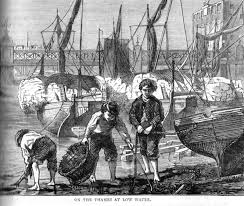
Last winter, I went mudlarking on the Thames shore. This is an edited version of the article I subsequently wrote for Eurostar (image below from Knowledge Of London).

You’ll see them at low tide, wandering alone with bent necks along the damp and desolate mudflats of the Thames. These are the mudlarks: amateur archaeologists, beachcombers and scavengers who delight in rediscovering lost detritus from London’s past. Although they are wearing waders and carrying metal detectors, they look much like giant birds, storks or herons, as they walk with heads bowed and eyes fixed on the floor, scrutinising the mud and pebbles for hidden treasure. They’ll occasionally scratch at the surface with an extended toe if they see something they fancy. And then they’ll pounce, darting down to peck something from the ooze, before deciding whether to add it to the day’s hoard.

The tidal Thames has been described as ‘London’s largest and richest archaeology site’ and it’s certainly the longest in the country, stretching from the Thames Barrier to Teddington Lock. For centuries, the river in central London was used by boats bringing cargo from all over the world. Thousands of people worked in these docks and warehouses, and items that have fallen from boats or pockets or been casually discarded by Tudor dockers are still lodged in the London mud, waiting to be revealed whenever the tidal river withdraws.

Mudlarks have been prowling here for centuries. In Georgian and Victorian times, they were the desperately poor searching for things to eat or sell. By the 1960s, the term referred to unofficial archaeologists who formed the Society Of Thames Mudlarks in 1980. A few years later the Port of London Authority (PLA) – the body in charge of the river – offered the mudlarks licences to dig on the foreshore in return for having their finds officially recorded by the Museum of London. The mudlarks have thus helped build an unparalleled record of everyday life on a medieval river.
Ian Smith is one of them. His patch is the north bank of the Thames between London and Southwark Bridges, outside Customs House, where pre-Victorian cargo ships would have been checked for contraband. This was once the Pool of London, the main unloading point for boats that could not fit between the pillars of old London Bridge, and a place rich in treasures. ‘I started in 1973 as a schoolboy,’ says Smith on a bracing winter morning. ‘I grew up in Battersea and saw a TV show about a man who found these old clay pipes in the Bristol Channel. So I came down to see what I could find. I spent about a year working down the river bit-by-bit until I got to Blackfriars where I saw this group of people, a little cluster of them, and I went over with my collection of pipes. And where they’d been poking about there were pipes everywhere, loads of them, they were just ignoring them and looking for other stuff. So I started chatting and that’s how I got started.’

The thick black mud of the Thames conceals rich treats, everything from prehistoric flints to Victorian toys. The mud is anaerobic – without oxygen – so preserves just about anything. Kate Sumnall works for the Museum of London and the Portable Antiquities Scheme as a Finds Liaison Officer; it is her job to manage the licence scheme and register everything the mudlarks find. She says, ‘London is different to most places in terms of the preservation and the proportion. You wouldn’t get iron daggers in a field, it would be eroded, but Thames mud is anaerobic so things don’t decay. And you also don’t have aggressive chemicals and ploughs, which damage items in the ground. You can still find medieval leather in the Thames.’

Smith believes the Thames has three other benefits. ‘London is almost unique,’ says Smith. ‘Most rivers aren’t tidal, so that’s one thing, but you’ve also got the river going through the centre of town rather than round the outside. And the third thing is that in the Victorian era all the docks got moved over to the Isle of Dogs, so that means the early stuff has been left in the ground rather than dredged away centuries ago.’

This is what makes the Thames such a popular and lucrative haunt for the mudlarks. There are around 50 with official permits, granted by the PLA after an individual has spent at least two years on the foreshore getting experience and demonstrating a history of recording their finds. ‘The mudlarks have huge value,’ says Sumnall. ‘They have sold us entire collections in the past and these have gone on to form a crucial part of the museum. But they are also immensely helpful in recording where things are discovered over time, which helps build up a bigger picture of London history.’

When Sumnall is contacted by somebody who wants to be a mudlark, she’ll often put them in touch with Smith, who has an unrivalled knowledge of the river and its secrets, knowing where to look and when. At low tide, he clambers down the steps on to the foreshore carrying the tools of his trade – a bucket and spade and a battered metal detector wrapped in waterproof plastic – to begin his hunt. After just a few minutes he returns with a 13th-century arrowhead, 16th century pipes, medieval buttons and a shard of Tudor pottery. But this is bric-a-brac to an experienced mudlark. Smith, an antiques dealer by trade, specialises in medieval pewter pilgrims badges which were sold at points of pilgrimage, but has found all sorts of things. ‘I found a hoard of forged coins from 1470,’ he says. ‘People would clip a bit of silver off the edges of coins and these forgers must have been chased so they flung the bag of coins into the river to get rid of it and I found it centuries later.’

London’s history as a world port dates back to the Roman era, which can make for interesting finds. Sumnall tells the story of a bone harpoon that they originally thought came from the Stone Age, but after carbon dating turned out to be from around 1650. ‘That really threw us, but we realised it came from a part of the foreshore where the whaling docks were located and it’s possible it came from an Arctic civilisation and arrived in London on a whaling ship. But obviously we can’t be sure.’
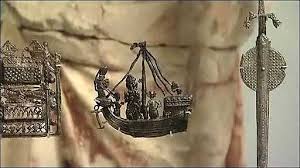
Another recent discovery was a 400-year-old lead toy coach, found by a London decorator, Albert Johanessen, who says his most important equipment is not a metal detector but ‘his eyes and a stout pair of wellies’. Smith possesses these, but after 40 years of mudlarking is realistic about what he’s going to find. ‘You’re never going to find treasure like the Staffordshire Hoard because nobody is going to bury gold in a river, but you find ordinary everyday stuff that people chuck away: tools, rings, badges, glass and pottery.’

You certainly find a lot of clay pipes. These carpet the foreshore in London, thousands of them dating back to the sixteenth century when tobacco was first introduced to the capital. The pipes were sold pre-filled and although they were reusable were often discarded, thrown into the river by those who worked in the docks. These 400-year-old fragments are fascinating to newcomers but to the trained eye are more like Tudor cigarette ends and rarely get taken to the museum to be registered.

But there is one Londoner who is interested. Jane Parker is a designer who last year began to collect pipes to make into necklaces and bracelets. She currently sells them on her website but hopes to get a stall at a London market soon. ‘I went to the Museum of London Docklands (in Canary Wharf) and afterwards walked to the river,’ explains Parker. ‘The tide was out so I went down on to the beach. I saw these clay pipe stems and decided I’d make something from them and started making them for friends who had left London as a momento.’

Parker doesn’t have a PLA licence, which means she can’t dig but is allowed to collect anything from the surface. With pipes that’s all she needs. At the right spot, Parker reckons she can pick up 400-500 usable pipe stems in an hour. ‘I want stems that have been pummelled by the tide, and are soft and worn at the ends. The smaller and finer, the newer they are. Some of them have a line down the middle that show they’ve been cast in a mould, while the bigger, chunkier ones are hand-made, the holes aren’t centred and they aren’t smooth.’

You can also see the fruits of the foreshore in a special display at the Museum of London devoted to items found in the river, covering everything from prehistoric axes to medieval skulls. The museum takes in around 1,000 items a year from the mudlarks and despite Smith’s belief that ‘the best times are over, so much has already been found’, Sumnell thinks there’s still plenty to discover. ‘We’re definitely finding different things,’ she says. ‘They heyday of the pilgrim badges may have passed but we’re seeing more Roman stuff than I can keep up with, especially in areas of heavy erosion. There’s still a lot of interest in mudlarks, and we’re always getting new ones.’ A new generation itching to uncover the secrets of the Thames.

Small is beautiful: maps and models in London exhibitions

I’ve written before about my dislike of blockbuster exhibitions so was interested to read this piece by Stephen Moss the other day about how the age of the blockbuster may be coming to an end.  It may be wishful thinking, but support for his view comes from some surprising places.

Ken Arnold, the creative force behind the Wellcome Collection, recently told me that ‘Blockbusters are a depressingly greedy way to view exhibitions’. Arnold criticised the idea that any institution would want to cover a subject so definitively it left no avenues for others to explore, and also bemoaned the very experience of a blockbuster, which is often so unfulfilling for the spectator, who is shunted in and out on a timed ticket, having only seconds to view key works of art from behind a throng of tourists and daytrippers.

Small exhibitions might not get the column inches and posters on the tube, but they are often far more thoughtful, unusual and creatively curated. There are two crackers on display in London at the moment, and I’ve reviewed both of them. The Petrified Music of Architecture at the Sir John Soane Museum is a wonderful collection of tiny Victorian models of European cathedrals – I wrote about it for the New Statesman.

The Hand-Drawn London exhibition at the Museum of London is even better. Curated by the Londonist website, it features 11 idiosyncratic maps of London drawn by locals, and is one of the best exhibitions I’ve seen for a while. I reviewed it for the Independent.

Go and see them both.

Secret London: The London Thirteen Club

The London Thirteen Club was set up as an ‘antidote to superstition’ by Camberwell historian William Harnett Blanch in the 1890s.

It met on the 13th of every month in Holborn. There were thirteen dinner tables each with thirteen settings and diners wore green ties with toy skeletons in their buttonholes. Meals were served by two cross-eyed waiters, who announced dinner was to start by smashing two mirrors.

To get to the dining room, guests had to follow an undertaker underneath a ladder and then sit at tables decorated with a centrepiece featuring a black cat, peackcock feather and witch’s cauldrons. They were asked to spill salt before they could begin eating.

The club had numerous members, including leading journalists and politicans, and their membership fees were distributed to the poor of Southwark. Oscar Wilde, however, refused to join saying that ‘I love superstitions. They are the opponent of common sense.’

Despite this public flouting of superstitions, the London Thirteen Club had a very low mortality rate – only one member died, and he’d failed to pay his fees. As it was pointed out by some, ‘It is actually rather lucky to belong the Club.’ Read more here.

Happy Friday 13th, readers.

Six London landmarks in music videos

1 ‘Golden Brown’ by The Stranglers at Leighton House.

2 ‘Wannabe’ by The Spice Girls at Midland Grand Hotel.

3 ‘No Way No Way’ by Vanilla at Brockwell Lido.

4 ‘Blood In My Eyes’ by Bob Dylan at Camden Market.

5 ‘Hey Boy Hey Girl’ by Chemical Brothers at the Natural History Museum.

6 ‘The Medal Song’ by Culture Club at Stamford Bridge.

Bin Laden world exclusive from Herne Hill