Category Archives: Politics

Death and collecting

The Wellcome Collection is currently showing a typically absorbing exhibition titled Death, but it’s not really about that at all. It features work from a private collection, that of Richard Harris, and largely consists of skulls and skeletons, many of which are actually rather lifelike.

In fact, despite its arresting title, this is in many senses a rather squeamish, clean exhibition. There’s no dying, no decomposition, no pain, little mourning or God. There are no worms eating dead bodies, no cancer destroying live ones. It’s not even particularly morbid. It’s more about one man’s obsession with the human skeleton, stripped of flesh and cleansed of blood, sinew and memory, as portrayed by a number of very beautiful works of art over the centuries. If you want a more gruesome, more real, idea of death, try the Museum of London’s Doctors, Dissection and Medicine Men.

Collection owner Richard Harris stands in front of a work my Mexican artist Marcos Raya called Family Portrait : Wedding  at the 'Death: A Self-portrait' exhibition at the Wellcome Collection on November 14, 2012 in London, England. The exhibition showcases 300 works from a unique collection by Richard Harris, a former antique print dealer from Chicago, devoted to the iconography of death. The display highlights art works, historical artifacts, anatomical illustrations and ephemera from around the world and opens on November 15, 2012 until February 24, 2013.

It is tempting to speculate why Harris is so fascinated with his particular idea of death – why so clinical? Why so safe? – but it’s also ultimately rather pointless. In his excellent essay on collecting, Unpacking My Library, Walter Benjamin noted that ‘‘Collectors, like artists, operate out of unconscious motives, and so we cannot be known to ourselves.’ A collection can be about anything, and may reflect a personal interest or a psychological flaw, but the reasons behind their creation are rarely as interesting as you may hope.

What is intriguing about Harris’s love for skulls is that collections are often built as a defence against death itself, a way for the collector to claim mortality for himself in the form of something that will exist after he no longer does so (even if most collections end up being broken by families who lack the passion or obsession to keep them intact). Collections are also about memory, a way for the collector to freeze a moment in time. Every item represents a second, an hour, a week, a month – however long it took to locate and acquire – in the collector’s life that he can look at and recollect for years to come.

A collection is also about surrounding yourself with cool things that you like, although whether this ever makes the serious collector happy is a moot point. In his study of the collecting impulse, To Have And To Hold, Phillip Blom astutely notes that ‘For every collector, the most important object is the next one’, an acknowledgement that the collector will never be satisfied by what they have, as their next acquisition could be the big one, the one that completes the collection, or sends it off in an exciting new direction. This will never happen, of course, locking the collector in a spiral of anticipation and disappointment.

All of this is true whatever is being collected, whether it’s sick bags from aeroplanes, James Bond first editions or things that might be haunted. And just about anything can be collected, if you have the right kind of imagination. My friend Carl Williams, who deals in the counterculture, talks about his idea of collecting around ‘the sullen gaze’, that look of cruel insolence and careless superiority perfected by William Burroughs but which can be traced to many others, putting arresting flesh on Harris’s ambivalent skull.

At Speakers’ Corner

This article was first published in Time Out in 2006. I am posting it after hearing about Sounds from the Parka partnership between On the Record and Bishopsgate Institute that is hoping to record an oral history of Speakers’ Corner. Photos by Chris Kennett. 

This London curiosity grew out of revolt, when Edmund Beales led the Reform League to Hyde Park in 1866 to complain about the lack of a vote for working men. The marchers were blocked from entering the park by police and a small but interesting riot developed. The Reform League continued to meet at Marble Arch to test their right to hold public meetings in the park. In 1872, the government relented and granted the right to assembly and free speech in this corner of Hyde Park. The Met promptly responded by turning Marble Arch into a tiny police station to keep an eye on the rabble below.

(1968) credit, Chris Kennett

On a sunny Sunday in October, the rabble are out in force with a dozen speakers taking their spots, espousing black power, Islamism, Christian atheism and much else that is vocal but indeterminable. The two largest crowds gather directly opposite each other on either side of the path. One is engaged in raucous religious debate, slinging insults about the Koran and Bible back and forth, and occasionally taking time out from happily lambasting each other to heckle the speakers, a Christian, a secularist and a Muslim, who each take their turn upon the platform. It’s the sort of ferocious debate about Islam and freedom that the newspapers tell us we don’t dare have in public.  Across the way, a striking young man has drawn a larger but less vocal crowd to hear him eloquently espouse familiar but fervent criticism of the Iraq War.

Nikolai Segura has been coming to Speakers’ Corner on-and-off for seven years, and then on a weekly basis for the last 12 months, during which time he’s become one of the Corner’s regular hecklers. ‘I’ve been heckling for a year,’ he says. ‘It makes a show for the crowd, but it also sends the message that this is a place that exemplifies freedom of speech.’

A couple of weeks ago he was heckling a speaker when ‘some Muslims came up to me and said there were extremists in the park who would kill me for what I was saying,’ he says. Segura’s response was bold. He has returned to the park wearing a Muhammad-baiting T-shirt (‘There’s a picture of the prophet on the back of this shirt… only kidding [please don’t kill me])’, and today he gets on the stepladder to speak himself for the first time. The resulting debate is ferocious, spiteful and fascinating.

Religious debate has been a feature of Speakers’ Corner since before it even existed – many of those executed at nearby Tyburn were Catholics, who used their final speech to try to convert the crowd . But the unmistakable change in overall tone from political to theological – the ‘three Abrahamic religions shouting at each other’ as Segura puts it – was first noticed by speaker Terminator 24 [T24] 25 years ago.

‘It’s changed a lot,’ he says. ‘During the Cold War it was a lot of social democrats, trade unionists, socialists and many intellectuals. But after 1979 international relations affected Speakers’ Corner and the revolution in Iran saw a change. It became more aggressive, more religious. And after 1989 there were even fewer universal, social democratic presentations and more nationalism and fundamentalism. It mirrors how the world changes.’

(1972) credit, chris kennett

Heiko Koo, who runs the Speakers’ Corner website, believes the debate there is genuine. ‘All speakers get information from each other and people in the audience and from the internet, so ideas and theories get spread around and I’ve seen them change the mind of some speakers,’ he says.

T24, like Segura, started in the crowd before progressing up the ladder. ‘I came here and started to ask questions, and the speakers were very abusive, so I thought: That’s not the way; if I were speaking, I would not be oppressive and tyrannical. Now, when I talk, I leave it open, without judgment, express a thought and let others join in. It’s unique, very special here. I love being with real people, seeing their expressions, their laughter, their frustrations and anger. I love it here. The open space, it’s free and,’ a pause for effect, and to have a swig of coke, ‘I have nothing else to do.’

Sounds from the Park is  organising a reminiscence event at the Bishopsgate Institute on 8th December for everyone with memories of Speakers’ Corner.

Pot in Hyde Park and the death of Stephen Abrams

Steve Abrams, a key member of the London 1960s counterculture, died last week. Abrams was principally responsible for the above advert, which ran in The Times in July 24 1967 declaring that ‘The law against marijuana is immoral in principle and unworkable in practice’.

The advert was paid for by Paul McCartney and was signed by numerous celebrities, including all four Beatles, Francis Crick, Graham Greene, David Dimbleby, Jonathan Miller, Brian Walden and many others.

Abrams told Jonathon Green in ‘Days In The Life‘ that ‘After the ad came out  a friend of mine got on the train and delighted at each stop in watching people opening their copy of The Times and their expressions of disbelief. So wonderful was this that when he got to Victoria he took another train back and did it again just to watch.’

It is less well known that Abrams was also involved in Timothy Leary’s experiments with psilocybin, taking the drug at Harvard for Leary in 1961. Abrams then described his experience as ‘very pleasant’, giving him ‘tremendous insight’ even if it was ‘somewhat alien’, and he was ‘very eager’ to try it again, which he most certainly did.

After the  The Times advert, Abrams co-organised a pro-pot rally at Hyde Park in 1967. Everybody got very high, including guest Allen Ginsberg, who wore a virulent psychedelic shirt given to him the day before McCartney and was warned by police for disturbing the peace by playing his harmonium.

Beats in London

When Ned Polsky wrote Hustlers, Beats And Others his pioneering sociological study of the Beat subculture as it was in 1960, he was scathing of their literary value. ‘Most beat literature is poor when it is not godawful,’ he opined. ‘And this is certainly true of its best-publicised examples, which have been surpassed by even the minor Victorians: James Thomson’s poetic howl of urban despair, The City of Dreadful Night, is greater by far than anything Ginsberg offers, and in on-the-road literature the genuine gusto of George Borrow is preferable to the faked-up fervour of Kerouac.’

Stinging stuff – and that faked-up charge must have hurt – but times change, and while the Beats are still an acquired taste, one can’t image George Borrow being the subject of a special exhibition at the British Library, as is currently the case with Jack Kerouac.

On The Road: Jack Kerouac’s Manuscript Scroll is a small but welcome look at the basics of Beatery, offering an overview of the main protagonists – Kerouac, Burroughs, Ginsberg, Corso (the only one Polsky rates) – and trying to explain where they fitted within the American literary tradition. The exhibition is illustrated by photographs, many of the American landscape as explored in On The Road, but also of the writers themselves. I particularly liked this shot of William Burroughs, dressed like a fugitive Nazi, hand shielding eyes from the sun as he stares back with clinical impassivity. Burroughs is possibly the most photogenic writer there has ever been.

The main exhibit, though, is the extraordinary scroll on which Kerouac wrote a key draft for On The Road. You do not have to like the book – and I don’t, particularly – to appreciate the sheer thrilling insanity of this object, 120 feet of closely typed pages, filled with ‘spontaneous prose’ and occasional pencil marks. I have never seen a manuscript like it.

Kerouac’s second novel has been described as the book that ‘started
a whole new youth culture of which drugs were an accepted part’, so sodden is it in dope and speed. It was based on a series of road trips Kerouac took with
Neal Cassady (the pair are reinvented as Sal Paradise and Dean Moriarty respectively) between 1947 and 1950, and most of the characters are based on Kerouac’s friends. Mythology states that it was written in a three-week
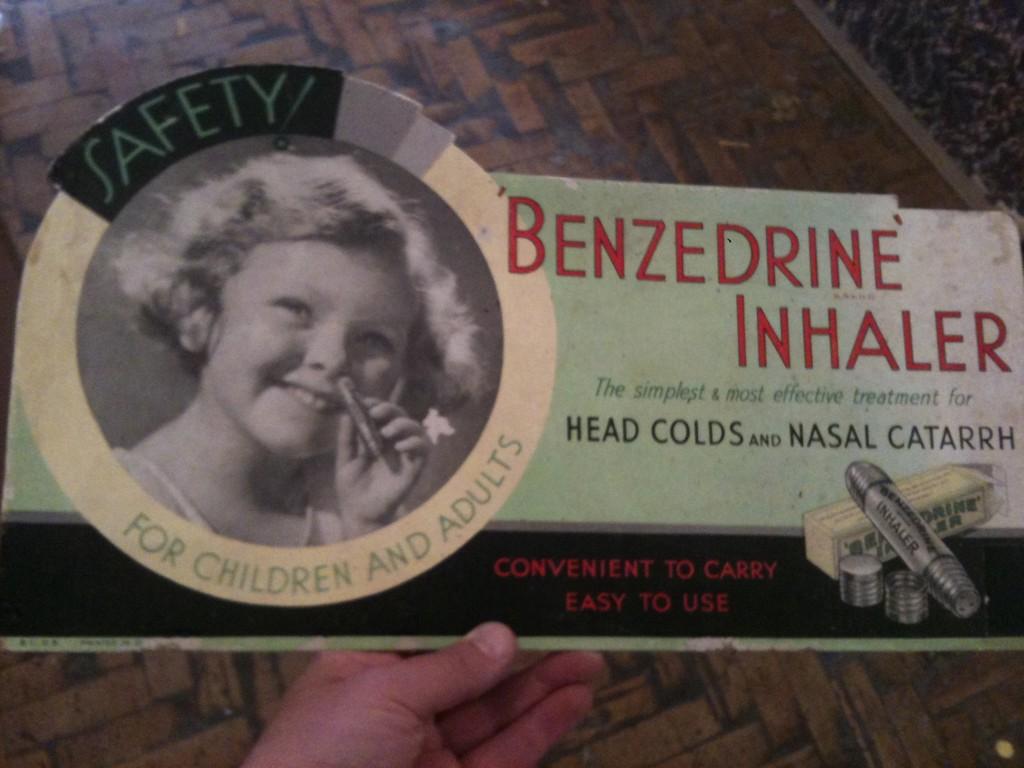
splurge fuelled by coffee and Benzedrine, but Kerouac actually began it as early as 1948, when he also came up with the title. He spent a while searching for a voice, but eventually settled upon a stream-of-consciousness, jazzy, impressionistic style. This was inspired by a 40,000-word letter written to him Cassady, a charismatic sociopath described by his biographer as ‘a slim hipped hedonist who could throw a football seventy yards, do fifty chin-ups at a clip and masturbate six times a day’. Cassady was trouble; he was also said to have ‘one of the greatest minds I’ve ever known’, by a friend of writer Ken Kesey.

Kerouac sat down to write his famous ‘scroll’ draft on 2 April 1951 on a 120-feet sheet of paper that had belonged to Bill Cannastra, a wild-living friend who had been decapitated after sticking his head out of a New York train window.
Kerouac spent many years rewriting the manuscript as he tried to find a publisher, and it was eventually brought out by Viking in September 1957 – Kerouac belatedly considered renaming it Rock and Roll Road
to catch the spirit of the time – and immediately received an ecstatic review in the New York Times, which claimed it was ‘the most important utterance yet made by the generation Kerouac himself named years ago as Beat’.

On The Road is one of the most important books of the post-War era, but it’s questionable how much it influenced English culture given that it is such a specifically American book on such an American topic written in the American vernacular. London was more taken by Burroughs and Ginsberg, both of whom would spend extensive time in the city while Kerouac only visited for a few days in the 1940s when serving in the Navy. By 1959, Barry Miles, Jeff Nuttall, Michael Horovitz and the rest of the British counterculture scene were soon discussing, publishing, imitating and eulogising the Beat poets. 

Being more of a philistine, though, I prefer the exploitation stuff. Tony Hancock frequently mocked Beatnik culture, notably in The Poetry Society.

Hancock: You see, Sidney, we are a collection of kindred spirits who are all revolting against the Establishment.

Bill: How long have you been at it?

Hancock: Three days.

I also like Colin Wilson’s often sardonic but hugely charismatic novel, Adrift In Soho, which has that time-honoured plot of a young ingenue coming to London and getting drawn into a curious sub-culture, in this case the Beats. It is apparently currently being made into a film.

But the pull of the Beats, that desire to be different, was probably best expressed by Hancock again, in the opening scenes to his film, The Rebel. ‘Where are we going?’ It’s what Kerouac was asking, and it’s what Hancock wanted to know as well. Well, where?

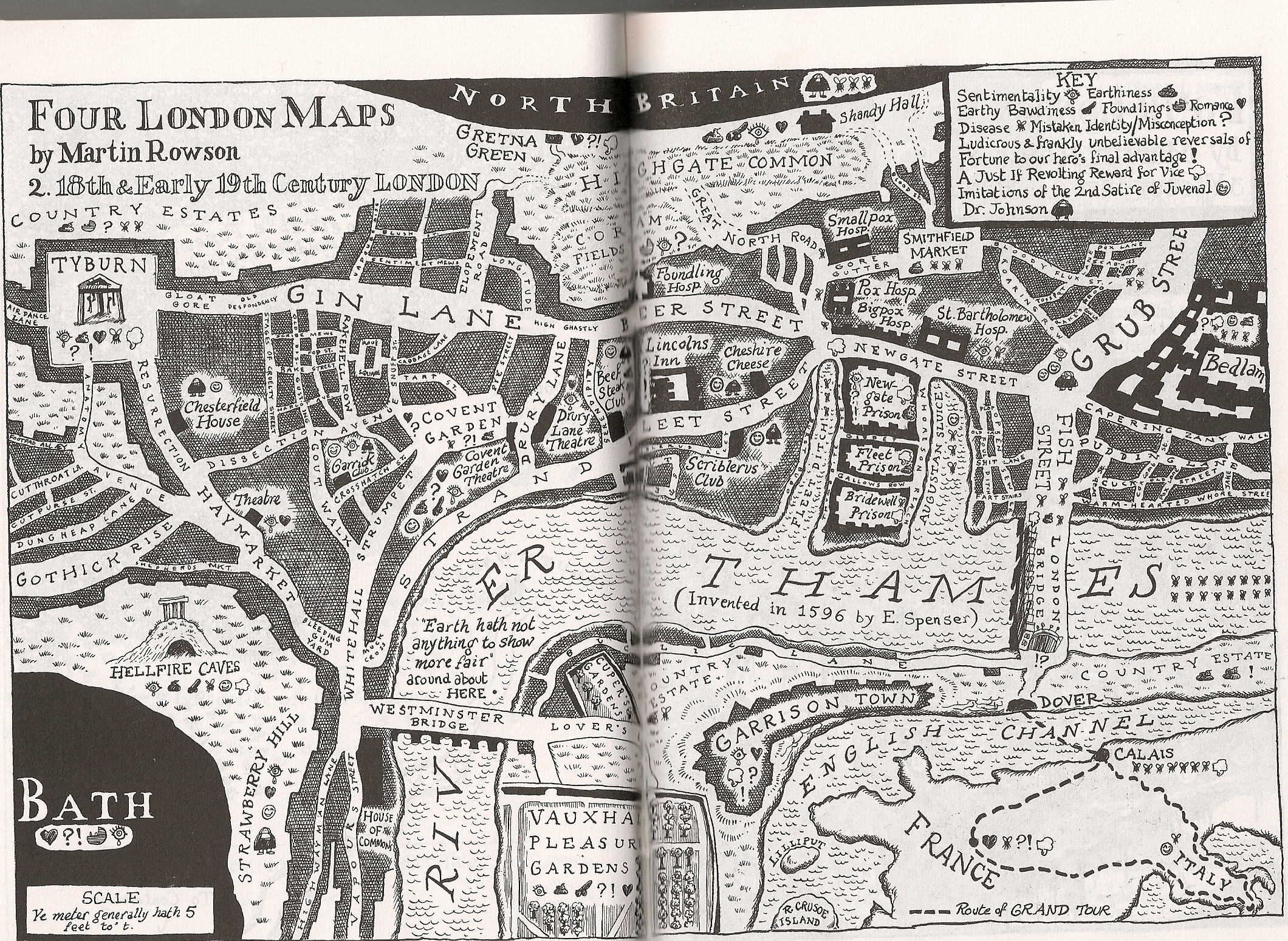
Four literary London maps

These four maps of literary London were drawn by Martin Rowson for the rather wonderful 1999 London issue of Granta magazine.

Chaucer’s London

Georgian London

Victorian London

Modern London

Brixton Bugle: the future of local newspapers?

Even in these days of live blogs, hyperlocal websites and social media, it can be easy to miss news stories. While national attention focuses disproportionately on a handful of big stories – whether that be tweeting footballers or dead paedophiles – smaller bits of news, especially local news, can fall through the gaps of newspapers that often seem to be more interested in filling their pages with the contrived comments of tedious columnists so snobbish, banal and privileged they could be auditioning for a lead role in the next Ian McEwan novel. And the time spent registering a new profile so you can leave an angry comment about their latest inanities makes it difficult for the average person to find those precious seconds when they can check out and absorb the content of a website devoted to your local area.

This is where the traditional local newspaper used to step in, but, er, well let’s not talk about that. But in Brixton, there is a solution. The Brixton Bugle is a monthly free newspaper (affiliated to the Brixon Blog) that rounds up all the most important news in Brixton, Herne Hill, Tulse Hill and Loughborough Junction. Around 7,000 copies are published and handed out for free outside the tube once a month or given to local shops. And it’s really rather good, occasionally breaking news that the bigger but less focused South London Press can easily miss. Visually it can still be a bit shonky, but the content is good and it is easily the best way of keeping locals abreast of the changes, both large and small, taking place in Brixton (such as the plans to knock down the local Rec Centre), especially since the council’s own free paper was scrapped.

This sort of grassroots, hyperlocal newspaper, with low distribution costs, small staff, funded by local advertising and with close and committed connections to the area in which it operates has real potential, which is presumably why the Lebedevs’ Journalism Foundation has given the Bugle a grant and mentoring support.

There are plenty of London areas – the south-east for instance, or Barnet – that do not receive the attention they deserve from the existing print media, but which have strong blogging communities. Their work is impressive and they often get lots of attention when they break big stories, but there is still nothing quite like print for keeping an entire community – not just political nerds and news junkies – involved and aware of local developments that do not have headline-grabbing power. Will they heed Brixton’s trumpet call? Here’s hoping.

My interview with Brixton Bugle co-editor Tim Dickens for Completely London

Punk at the Hayward: curate and destroy

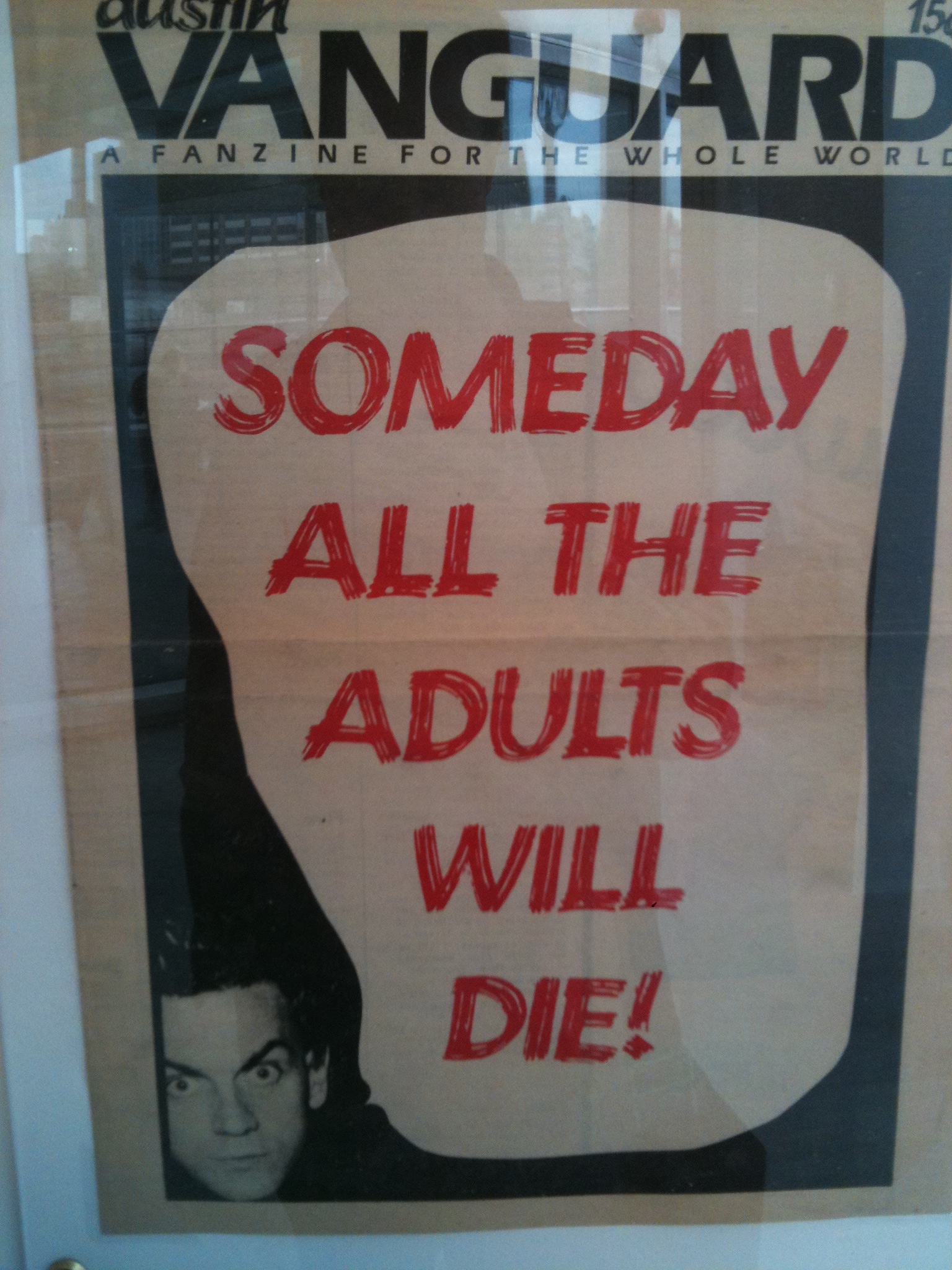
Does any music form have as curatorial approach to its own history as punk? In many ways that is understandable, as the graphic art that came out of the punk movement is as interesting as most of the music, while many of the scene’s key movers always saw themselves as part of a cultural avant-garde that went back to the Symbolists and still wish to emphasise that. One of the most prominent of these voices is Jon Savage, and he has co-curated an exhibition at the Hayward Gallery on punk called Someday All The Adults Will Die.

Despite punk now being nearly 40 years old and having been curated like a dead horse for several decades, it still has a visceral and visual appeal to many – and not necessarily the people you may expect. When I visited the gallery, most of my fellow visitors appeared to be in their 20s: this was clearly not simply an excuse for a nostalgic wander back through adolescence by men suffering a mid-life crisis. The kids dug it.

It’s a wide-ranging exhibition, with sections devoted to seven-inches, cassettes, posters, flyers and fanzines, including Savage’s own London’s Outrage.

My favourite stuff tended to be the less predictable such as pre-punk items involving the Diggers, who co-existed awkwardly with the hippies in San Francisco in 1966 and 1967, as these mimeographs demonstrate.

There was also items reflecting Savage’s fascination with Situationism, including this King Mob poster. Malcolm McLaren was loosely affiliated to King Mob.

I also liked the items relating to Suburban Press, the witty and brilliant pre-punk/Situationist publishing house created by Jamie Reid.

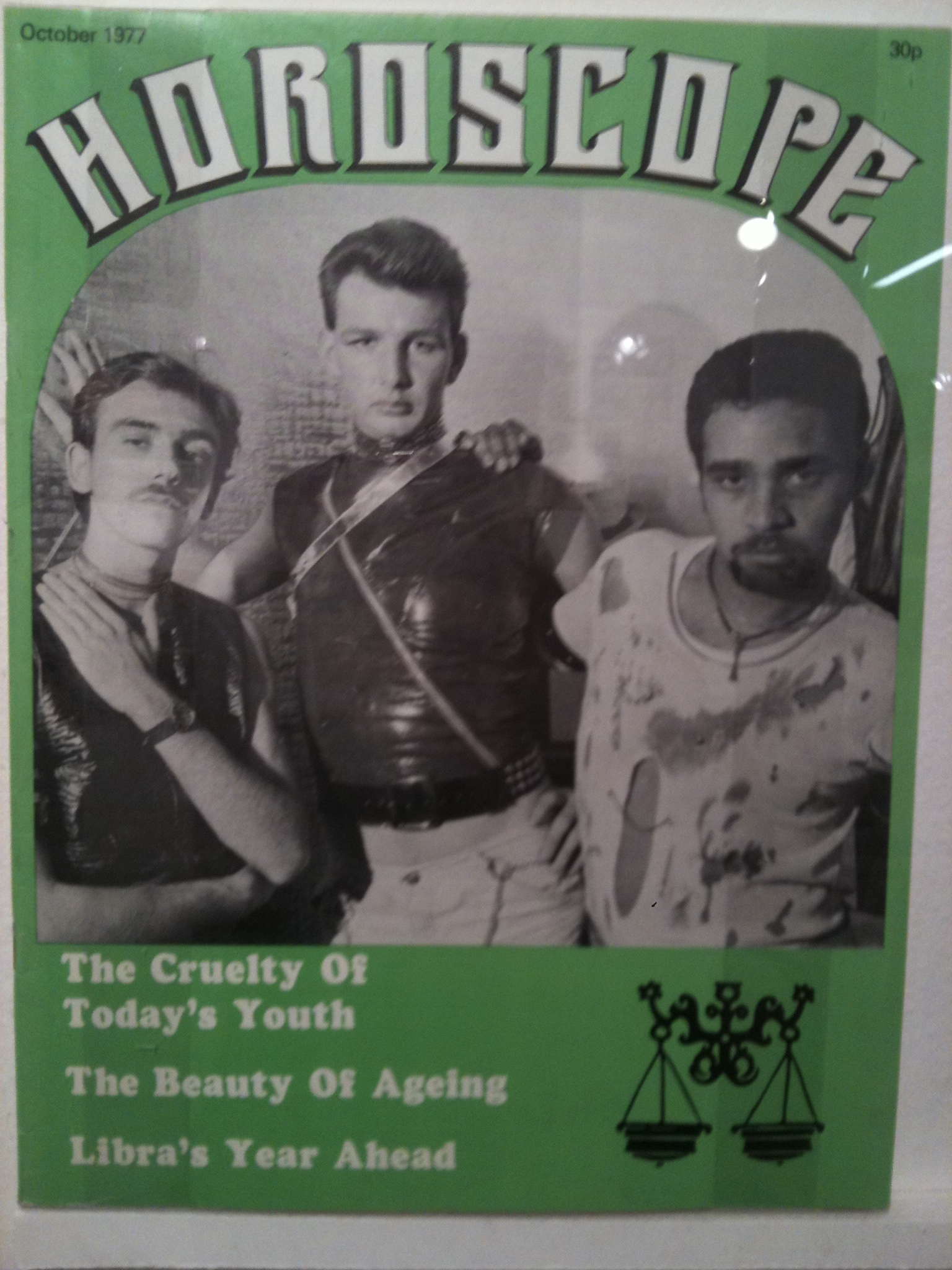
And, finally, I loved the handful of contemporary examples demonstrating how the mainstream tried to cash-in on punk with things like a punk-themed horoscope magazine and punk pulp fiction. Such money-grabbing tactics, it must be noted, have since been refined somewhat…

Someday All The Adults Will Die is at the Hayward until November 4.

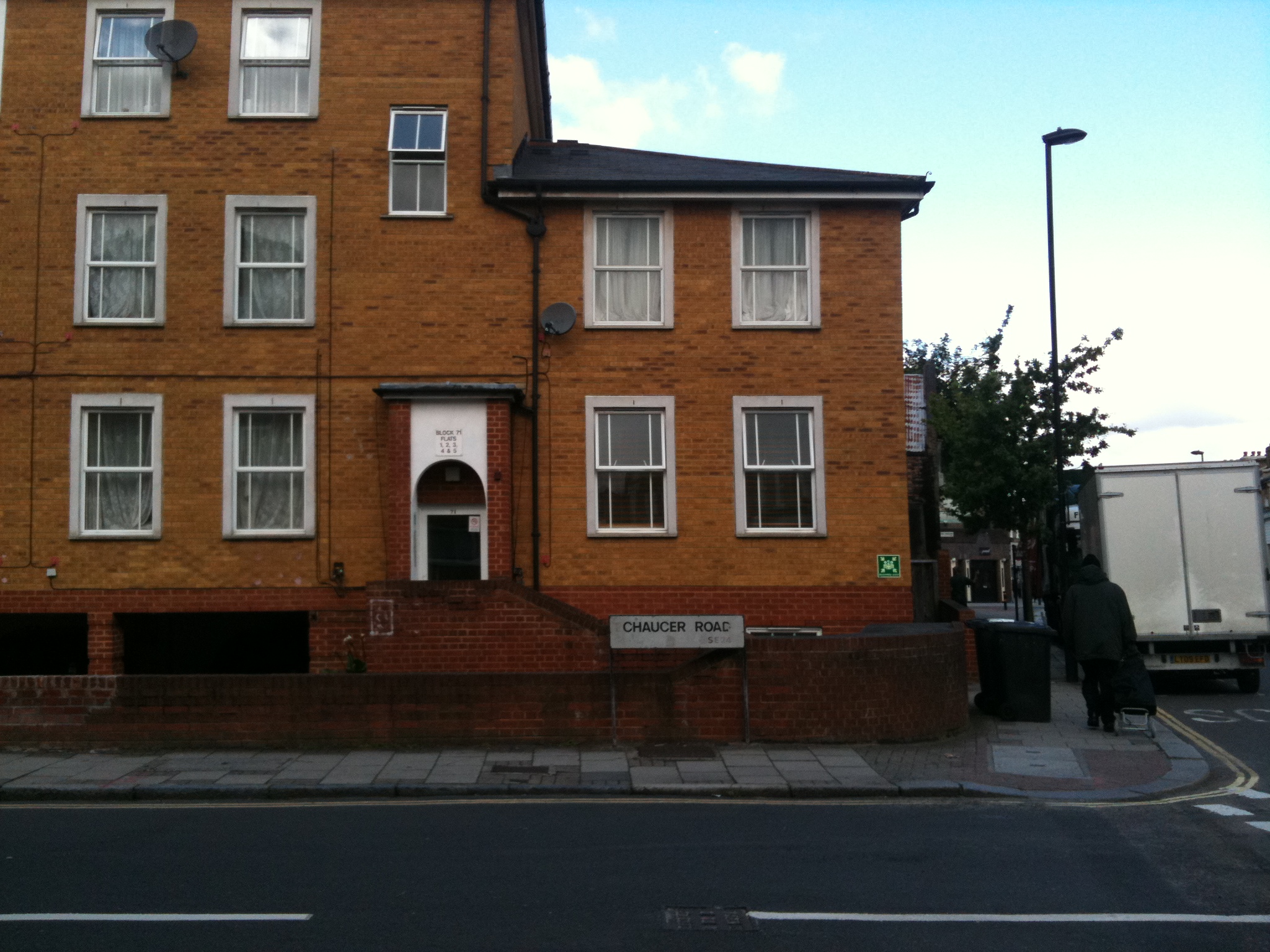
Brixton riots in SE24: then and now

Chaucer Road, SE24 after the 1981 Brixton riots

Chaucer Road, SE24 in 2012

The top picture is taken from Taschen’s superb new book of London photographs, London: Portrait of a City.

Une saison en Camden: Rimbaud and Verlaine in Victorian London

I am an ephemeral and a not too discontented citizen of a metropolis considered modern because all known taste has been avoided in the furnishings and the exterior of the houses as well as in the plan of the city. Here you would fail to detect the least trace of any monument to superstition.

Arthur Rimbaud on London in Illuminations

Getting a face full of wet fish is usually associated with Monty Python at Teddington Lock rather than French poets in North London, but such is the warping power of Camden Town. Arthur Rimbaud and Paul Verlaine were the Gallic rhymers in question. The pair enjoyed a tempestuous relationship in a variety of London addresses, which culminated in the aforementioned fish-slapping incident in Camden.

rimbverl

They had arrived in London in September 1872 after fleeing scandal in Paris. Rimbaud was 17, Verlaine ten years older, married with a child. Verlaine’s brother-in-law described Rimbaud as ‘a vile, vicious, disgusting little schoolboy’, but Verlaine found him an ‘exquisite creature’ probably for much the same reasons. At first they settled in Howland Street in Fitzrovia. They became part of Soho’s expat anarchist dissident set, reportedly attending meetings helmed by Karl Marx in Old Compton Street, drinking heavily, taking hash and opium (Rimbaud advocated ‘derangement of all the senses’) and keeping warm at the British Museum, where Rimbaud’s name  – but not Verlaine’s – was later added to the Reading Room roll of honour. Neither were particularly politically motivated, but the anti-establishment environment would undoubtedly have appealed to the outlaw couple.

Drawing by Verlaine of Rimbaud in Canon Street

They both loved London. Rimbaud felt that by comparison Paris looked like nothing more than a ‘pretty provincial town’ and loved the ‘interminable docks’, while Verlaine was captivated by the ‘incessant railways on splendid cast iron bridges’ and the ‘brutal, loud-mouthed people in the streets’. Together they travelled on the river, visited Hampstead Heath and rode the newly opened underground railway. They visited Hyde Park Corner, Madame Tussaud’s, the National Gallery and the Tower Subway (‘It stinks, it’s hot and it quivers like a suspension bridge, while all the while you hear the sound of the enormous volume of water,’ they reported back).

They wrote as well. Parts of Rimbaud’s Illuminations and Une Saison en Enfer were written in London, and his relationship with Verlaine is recorded in the latter’s lines: ‘On several nights, his demon seized me, we rolled around together, I wrestled with him!—At nights, often, drunk, he lies in wait in the streets or in the houses, to frighten me half to death… In the hovels where we used to get drunk, he would weep at the sight of those around us, miserable beasts…’ Verlaine was also influenced by the hectic modernity of the docks, and wrote a poem about Regent’s Canal.

Their sojourn in Fitzrovia was briefly commemorated with a plaque written in French and erected in 1922, although it only mentioned Verlaine – Rimbaud’s name was omitted on grounds of morality. Unfortunately, the street numbers had changed by this time, so the plaque on No 34 was almost certainly commemorating the wrong house. These defects were solved in 1938 by simple means – the house was demolished. It’s said the plaque was saved from destruction, but if so it has long since been lost.

There is a plaque for their next house however, left by ‘unknown hand’ according to Simon Callow. This is on their residence at 8 Great (now Royal) College Street, which they moved to in May 1873, living in two rooms on the top floor for three months. Here the pair’s self-destructive instincts really blossomed. They argued relentlessly, and often fought physically. This reached its nadir one July morning when Verlaine returned from Camden market carrying fresh fish and olive oil. It was a hot day and Verlaine had a hangover, but Rimbaud, watching from an upstairs window, was unsympathetic. He laughed and bellowed, ‘Ce que tu as l’air con!’ (‘What a cunt you look!’). Verlaine responded with a kipper in the face (hurt, he later wrote to a friend rather pathetically,  ‘I retaliated, because, I can assure you, I definitely did not look ridiculous’), packed his bags and fled to Brussels. Rimbaud eventually followed, only to receive two bullets in his wrist for his troubles.

Verlaine was sentenced to two years in prison, which he spent in part reading Une Saison en Enfer, and that was pretty much the end of that relationship. Rimbaud returned to London in 1874, living at Stamford Street, SE1 with the poet Germain Nouveau and later taking a room at No 12 Argyll Square in 1875. He then disappeared for four months – biographers still speculate about whether he was in Scotland, Scarborough or Reading. He barely wrote another word and died, one-legged, in 1891. Verlaine also returned to England, teaching in Boston and Bournemouth, before returning to Paris where he succumbed to alcoholism and died in 1896. Camden can do that.

Photo by Dornac of Paul Verlaine in the Café François 1er in Paris on May 28, 1892

HG Wells, My White Bicycle and hygienic seats: a brief history of cycling in London

This piece is in the current issue of BMI Voyager. The photo of Herne Hill Velodrome is via Adrian Fitch

It’s unlikely that any of the world’s top cyclists will be thinking about London’s history with the bike when they set off from the Mall for the gruelling 250km Olympic road race on Saturday (July 28th), but if they do pause for thought, they’re starting from the right place. The route will take cyclists through Putney, Richmond and Hampton Court deep into the scenic Surrey countryside of Woking and round Box Hill, but it starts and finishes near Hyde Park, which is where cycling in the UK first really took off.

Cycling had premiered in Battersea Park in the 1880s, but it was in Hyde Park that the great Victorian cycling craze went overground in the 1890s. London was still a horse-happy city at the time, so when 2,000 cyclists – mainly women, dressed demurely with natty bonnets– formed a parade to cycle round the park in the spring of 1896, those on horseback didn’t know quite what to make of it. Bicycles were still a new thing. Penny-Farthings had been around for a while, but were about as common a sight in Victorian London as they are now, and it took the invention of the ‘safety bicycle’ – one with wheels the same size and pneumatic tyres – in the 1880s for that to change. Indeed, such was the enthusiasm with which women took up cycling, that Victorians were torn between trying to find ways to make money out of it, and trying to ensure it was morally appropriate. With typical Victorian ingenuity, they managed to do both – the Chaperon Cyclists’ Association supplied female escorts for solo women cyclists for 3s 6d an hour, while to avoid any dangerous friction you could purchase special ‘hygienic’ bike seats, which had a modest dip in the area where a lady’s genitalia would usually meet the saddle.

Hygienic seat or not, this was, almost without exception, a hobby enjoyed by the upper classes – the Lady Cyclists Association of 1895 was founded by the Countess of Malmesbury – and the Olympic road race aptly passes through some of the poshest areas of London, along the luxury-lined Knightsbridge and down through the smart streets of Chelsea to Putney Bridge. In 1896, the Countess wrote wittily in The Badminton Magazine about the dangers of cycling around these very Belgravia streets thanks toa new sport’ devised by Hansom Cab driver: ‘chasing the lady who rides her bicycle in the streets of the metropolis’ excited by the ‘petticoat which “half conceals, yet half reveals”… I cannot help feeling that cycling in the streets would be nicer, to use a mild expression, if he’d not try to kill me.’

It wasn’t until 1934 that a solution to this perennial problem arrived, when the UK’s first bike lane was opened not far from where the road race course makes its progress through West London. This specialist cycle lane stretched for two-and-a-half miles alongside the Western Avenue and was a belated response to the scarcely believable statistics that recorded 1,324 deaths of cyclists on British roads the previous year. Despite these awful figures, cycling groups opposed the innovation, arguing bikes should not be forced to give up their place on the road to the new-fangled motor car. It’s not an argument they were ever likely to win.

Roads will be close to traffic on July 28, however, and as the Olympic cyclists make their way towards the river, they will pass Kensington Olympia, the huge exhibition hall built in 1883 and used for all manner of spectacular entertainment –promoters would think nothing of flooding the arena to recreate Venice In London, for instance. Anything fashionable was fair game and cycling races were held here during the 1890s. A mixed-tandem race – one male rider and one female – attracted huge crowds in January 1896. Weird events like this were common at the time –the Crystal Palace in Norwood hosted a bicycle polo international in 1901 between Ireland and England (Ireland won 10-5).

After crossing Putney Bridge, the race continues through Putney, where one of London’s many Victorian velodromes was once located, drawing crowds of 10,000. Putney also featured in one of the first cycling novels, The Wheels of Chance, by HG Wells, a writer who always had an eye for a new invention. In it, the hero, Mr Hoopdriver, leaves his dull job in Putney to go on a cycling holiday on the South Coast following a route out of London very similar to the one that will be taken by the Olympic racers. The race later passes through Woking, where Wells lived and set part of War Of The Worlds – Woking has boasted a huge statue of a tripod since 1998.

From Putney, the cyclists whizz through lovely Richmond – mind the deer! – before hitting the river at Twickenham, where they pass Eel Pie Island, nexus of London’s mid-1960s rock ‘n’ roll revolution. Numerous legendary bands played shows at the charismatic old dancehall on this tiny island in the Thames, including the Rolling Stones, the Yardbirds, Eric Clapton, Jeff Beck and Rod Stewart. Among them was Tomorrow, one of England’s first psychedelic bands (featuring Steve Howe, later of prog-monsters Yes), whose 1967 single “My White Bicycle” was a big counterculture hit in 1966. This splendid slice of trippy frippery was written in homage to the pro-cycling scheme launch by Dutch anarchist collective Provo, who left 50 unlocked white bicycles all over their home city of Amsterdam in 1965, inviting the public to enjoy ‘free communal transport’ and rid themselves from the tyranny of the automobile. The Dutch police swiftly impounded the offending bikes, but the idea finally caught on in recent years in the form of the Paris bike-sharing scheme, Vélib. This idea was appropriated by London in 2010 and came to be christened Boris Bikes after London’s mayor, Boris Johnson, who inherited the scheme from his predecessor Ken Livingstone.

Boris Bikes can be hired by anybody with a chip and pin card at around 500 docking stations in central London. The bikes come without helmet or lock and are pretty hefty, but they are a fairly common sight in London. Although there is an ‘access fee’ (£5 for a week), the first 30-minutes of any ride are free, so smart users hop between docking stations and effectively ride around London for next to nothing. It’s all part of a belated attempt to make London a more-bike friendly city – four giant bike lanes, the blue-painted Cycle Superhighways, have alsobeen created in key commuter routes, with four more planned for 2013. If you want to borrow a Boris Bike to follow the 2012 road race route be careful, as there are few docking stations outside central London and costs soon mount if you go over the initial 30 minutes – while the fines for a late return are high.

From Twickenham, the race heads through Bushy Park and passes the Tudor palace of Hampton Court, before disappearing into the Surrey countryside. After a tour of the Surrey hills, the cyclists will then make the return journey, via Kingston, to the Mall. Sadly, then, there is no time to head to south-east London, where there are a couple of other prime London cycling landmarks. The first is the Herne Hill Velodrome, tucked behind suburban houses down a quiet street near Dulwich. This is the last stadia from the 1948 London Olympics still in use today. Built in 1891, the velodrome had all but closed during the Second World War but was brought out of retirement when London was awarded the 1948 games. It’s had a few scares since then – the gorgeous Victorian grandstand has been a no-go area for years – but was recently awarded £400,000 of Olympic legacy money and plans are afoot to construct a new grandstand, cafe and gym. The venue has played its part in nurturing the latest breed of British champion – Tour de France winner Bradley Wiggins raced here.

Herne Hill Velodrome

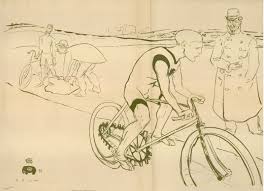
While Herne Hill lives on, the velodrome at Catford was demolished in the 1990s. Like the stadia at Putney and Herne Hill, this was built in the 1890s, when it attracted a very special guest. Absinthe-soaked dwarf artist Henri de Toulouse-Lautrec is usually associated with the Montmartre area of Paris, but in 1896 he turned up in the particularly drab suburb of Catford. Lautrec was a cycling fan, and had been asked by a company called Simpson to design a poster for their bike, which used a new type of chain. Lautrec was taken to the newly built Catford Velodrome to watch the bike in action during special races, set up by Simpson to advertise their product, and he produced a couple of images during his visit. The poster was one of the last he designed before his death in 1901, just as the Victorian bike craze was coming to an end.