Category Archives: Politics

Parks and pubs

I reviewed Travis Elborough‘s lovely history of the British public park for Caught By The River.

cover.jpg.rendition.460.707

Travis has previously written excellent books about the Routemaster and London Bridge as well as worked with Saint Etienne/Paul Kelly on their London film (which I’ve still not seen) How We Used To Live.

This time, his scope is a little broader – his history of parks begins with the dawn of urbanisation – but is at its most fascinating when focussing on the 19th century, as cities grew exponentially and parks were needed as never before.

It made me think about my relationship with my nearest park, Brockwell Park, which crops up in the book several times – for instance, as the location of the country’s first One O’Clock Club in 1964, created after an LCC employee was horrified to discover “ten howling babies in their prams abandoned outside Brockwell Park’s playground”, left there by older children who were meant to by looking after their siblings and were instead using the facilities for their own fun.

brockwell-lido-01

Brockwell Park is a classic London park in that it covers so much of the history and present of parks. It was formed from a rich man’s land, given to the people for their free use – and within the grounds still stands the austere old Brockwell Hall (now a cafe) and the former kitchen garden. It was landscaped in the Victorian style, with bathing ponds and the kitchen garden made into a formal walled garden, but also has an Art Deco lido as well as more modern facilities such as the BMX track and a superb children’s playground. Here you will also find a bowling green and tennis courts, the remnants of a model village, a lovely miniature railway and the marvellous community greenhouses. During the war, it was used for allotments, barrage balloons and artillery; in the 80s and 90s it became the location for concerts and protests – most memorably, the 1994 Anti-Nazi League concert.

The park still has multiple uses: dog walking, jogging, football, kite flying, BMXing, duck-feeding, picnicking, woods exploring, head-clearing, ice cream eating. It’s where my daughters both learnt to ride their bikes, where they play tennis and meet friends at the playground, in the trees or at the log circle, depending on weather and mood. The park is used for community events – Park Run, film screenings, the Lambeth County Fair – and sometimes also for fundraising, ticketed events and filming, as Lambeth try to balance the annual gap in their budget, a shortfall that means the historic One O’Clock Club is now rarely open.

In Brockwell Park you have the story of all parks, but also a very local and personal one – and it struck me as I read Travis’s book that the best British parks now offer cradle-to-grave facilities but suffer from a similar lack of resources as the rest of the welfare state even though we need them as much as ever before.

The park is at least used and valued, unlike that great modern casualty, the London pub. An excellent history of local pubs – The Pubs Of Herne Hill and Dulwich – has just been published, showing all the pubs in the area that still exist and the many we have lost (including three on Effra Parade alone). A similar history of local parks would be equally treasured.
 

Waterstones event

I will be giving a talk about Battersea Power Station’s failed dreams on Wednesday May 11 at 7pm at Waterstones in Clapham Junction. Further details here. Please come along and ask questions. It’s free.

A lovely review of Up In Smoke is on Caught By The River and I also wrote a long piece in The i Paper this week, exploring the power station’s history through quotes from those involved in its history. It’s pretty thorough and looks great. You can read that here.

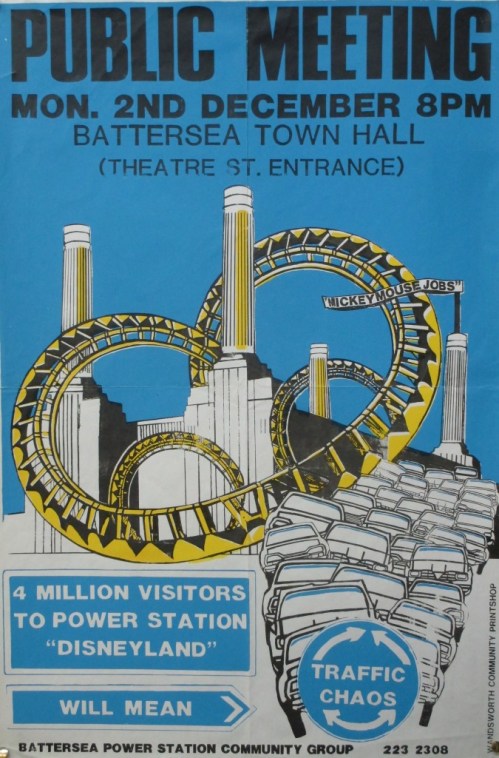
Perhaps I should have asked Brian Barnes to knock up some posters? This is one of us from the 1980s.

BPSCG 1988 from Spectacle blog

Dream City – London’s unbuilt Edwardian theme park

I have a post on Londonist about Dream City, a theme park concept cooked up in 1907 by an American developer for a disused waterworks, a site that was later occupied by Battersea Power Station.

You can read the full story here.

bl19982.tif

Dream City

The unbuilt Dream City is also the starting point for Alice May Williams’ short film about Battersea Power Station called Dream City: More, Better Sooner produced by the Film And Video Umbrella. The fvu have organised a talk on Friday (April 15) at the Battersea site of the Royal College of Arts by Owen Hatherley called Monetising The Ruin: Batterseas Old And New.

I will be attending the lecture and also selling copies of my book Up In Smoke: The Failed Dreams Of Battersea Power Station.

Up In Smoke

Up In Smoke: The Failed Dreams Of Battersea Power Station has a release date of April 26.

You can find out more at this website, which also tells you how to get in touch if you want me to do any talks or events.

UpInSmoke

Expect me to be writing about this a lot more in the next few weeks.

Power station problems

While writing my forthcoming book about Battersea Power Station, I often wondered why nobody had done so before.

The reason, I decided, was that as the various redevelopment projects were never completed, it was a very difficult tale to bring to a close. However, with the latest scheme being backed by serious money and as the buildings around the power station started to rise, it seemed as if the end was finally in sight.

I felt safe.

Too safe…

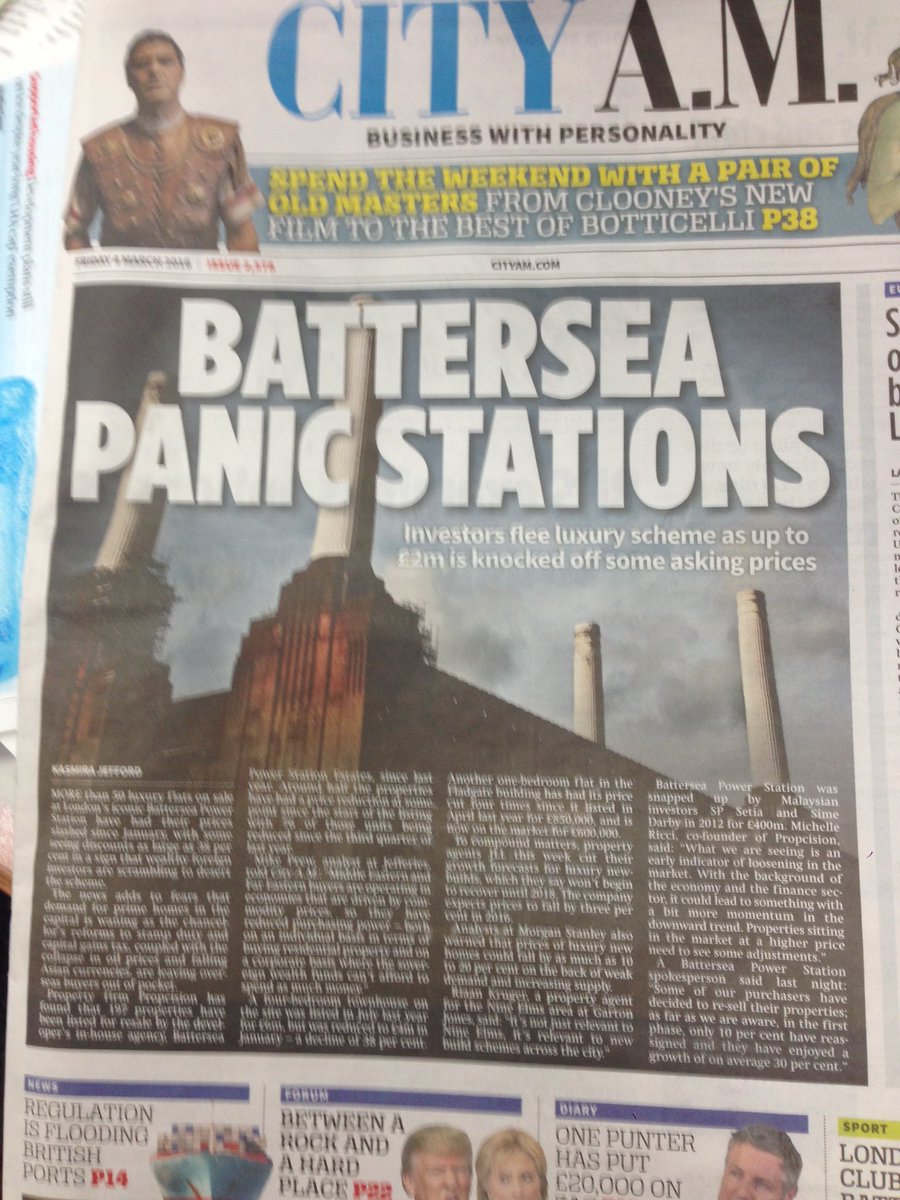
Today a report in City AM confirming what many have been saying for months – that the heat is coming out of the Nine Elms luxury property market, forcing developers to slash prices in a bid to retain the overseas investors on which so many hopes are pinned.

I was told a couple of times that this might happen, most notably when the chief executive of one previous development pointed out that the intensity of development on the Battersea site – not to mention elsewhere in the Nine Elms area, where thousands of similar flats are being built – meant that the Malaysian developers would be effectively competing against themselves on price. Unless it was managed carefully, and if the market ever dipped, there could be problems.

And so it has come to pass.

While those Londoners who decry the over-development of the power station may be excused at being amused by the problems being experienced by the developers, this is bad news for the building itself which is still far from secure: a hollow, roofless shell that is currently lacking three chimneys.

Wandsworth, who have presided over one of the most disastrous redevelopment projects in London for more than 30 years, had allowed the developers to build so many flats in advance of restoration so the developers could flog them to raise capital to pay to fix the power station. If those flats don’t sell, there is a danger that the power station will be left in a worse state than ever.

In these circumstances, demolition would be a serious possibility.

While we should be concerned, I don’t think it’s quite time to panic. The appeal of the Malaysian developers is that they are effectively being bankrolled by the Malaysian state in the shape of the country’s pension fund, which should mean pockets are deep enough to sustain these fluctuations in the property market.

But it does show that nothing is certain when it comes to the story of Battersea Power Station, except uncertainty.

Navvies, landlords and protest

I’ve written three pieces elsewhere recently.

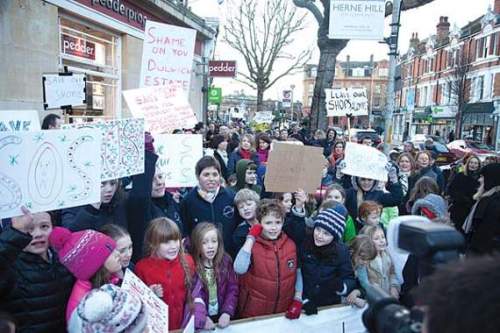
For Londonist, I wrote about the battle in Herne Hill between independent shops and the local landowner, Dulwich Estates, who some feel are taking more away from the community than they put in. A protest last week saw several hundred Herne Hillians march from the station to the local toy ship, which was forced out by a huge increase in rent. Several other tenants told me they feared they’d also be forced to move in the next year.

m5746


For Apollo, I wrote about a new exhibition of posters from Berkeley in 1970, when students protested about the ongoing Vietnam War and also the deaths of four student protesters on a campus in Kent State.


And for Waterfront, I wrote about the life of the navvies in London. I was intrigued by the urban legend that the four pubs in Camden with castle in the title – the Edinboro, Windsor, Dublin and Pembroke – were built for the navvies, to ensure separate nationalities drank apart and didn’t scrap. It quickly became apparent that the story wasn’t true, but as I researched the life of the navvies, I began to understand how the myth was raised and also learnt a lot about this tough breed of migrant worker.

It’s all glass here now – the taming of St Giles and death of the West End

I have a piece in today’s Guardian about the disappearing London district of St Giles, for centuries a hive of villainy and low entertainment but which is now, finally, being aggressively domesticated by developers with no love of vernacular architecture or fun.

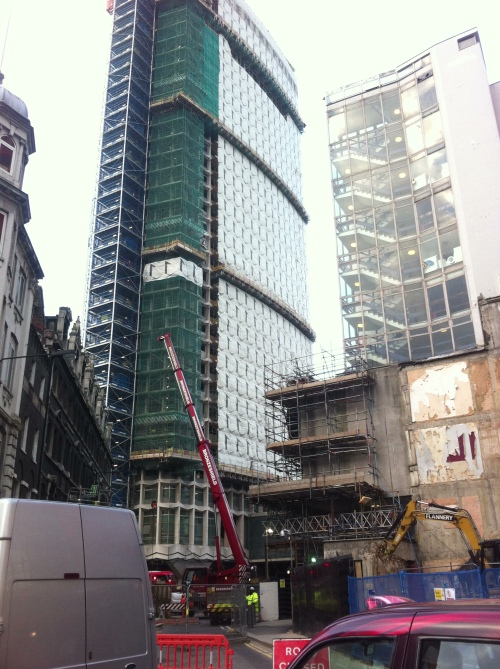
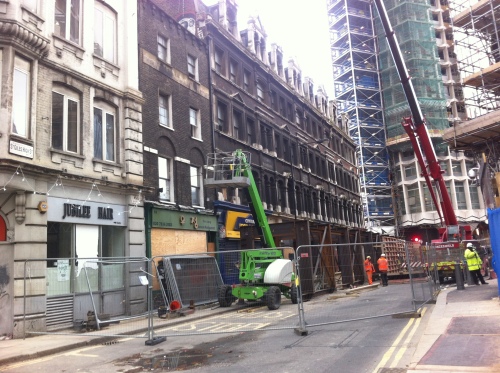
Last year, while walking round this junction of Tottenham Court Road, Charing Cross Road and Oxford Street, I was assailed by pneumatic drills, wrecking balls and nostalgia. This used to be my territory, where I’d play after working at Time Out on Tottenham Court Road, and now much of it was unrecognisable. The cafes, bars, restaurants and clubs that I’d known so well were gone. But this wasn’t simply a case of the passage of time and changing fashion causing old haunts close down – that I could accept, more or less. Here the buildings themselves had been pulled apart so nothing new or interesting could take their place.

Even Time Out‘s old office had been demolished, developers deciding that rather do any actual developing and modernise the entirely usable existing structure, it was easier to knock it down and start again. This was happening over and over, wherever I looked. It was like armaggedon, a building site several miles square, pouring concrete over memories and salting fertile ground.

With this wholesale demolition, the character of an entire area was being irrevocably and deliberately erased. People have been saying the West End was dead for decades, but in the borderland of St Giles something of the old  Soho and Covent Garden still lingered. Now, it’s gone. If it’s fun you want, give Zone One a skip. It’s all glass here now.

IMG_4940 IMG_4929 IMG_4932 IMG_4938 IMG_4932 IMG_4927 IMG_4925 IMG_4923


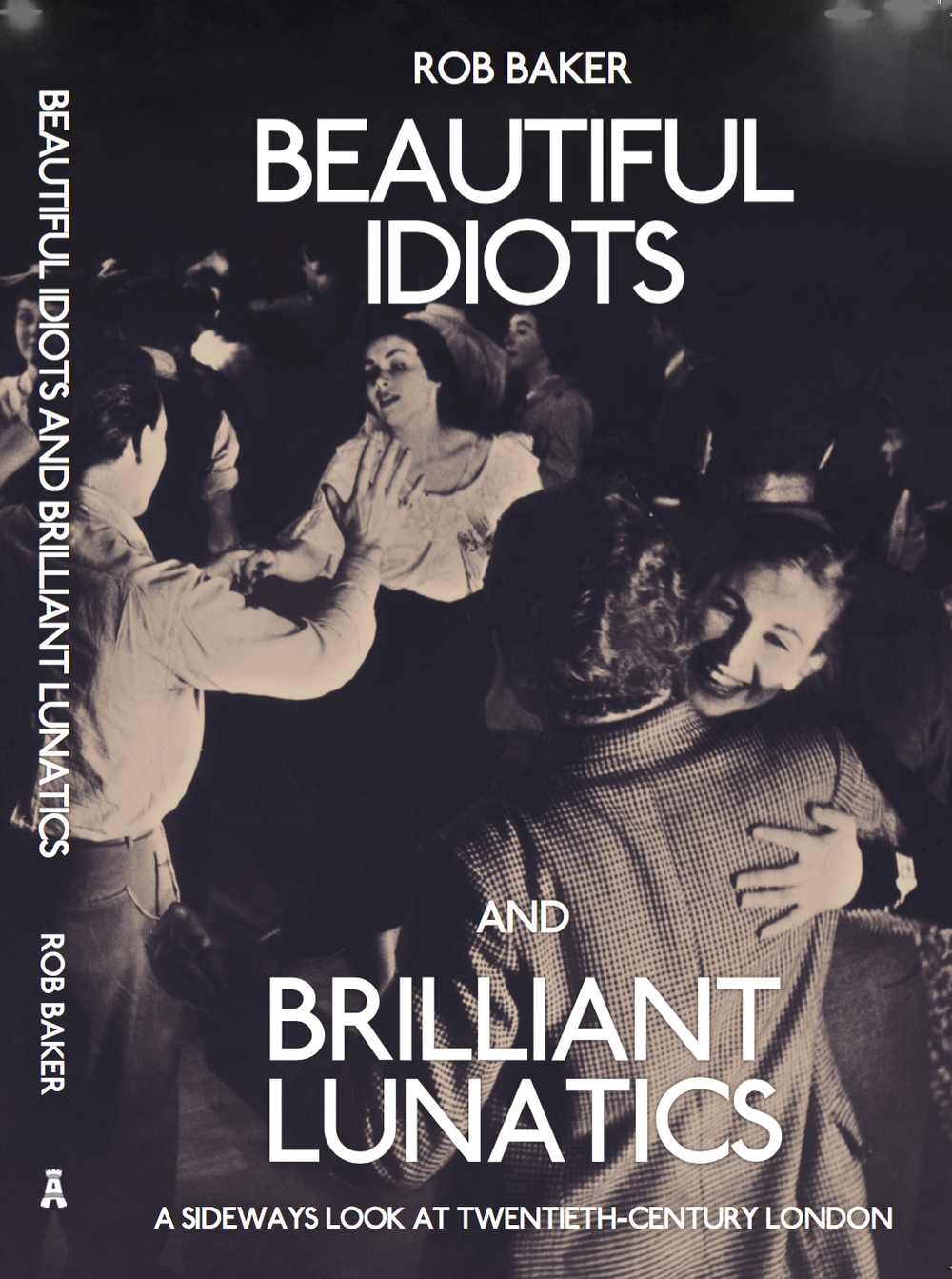
Beautiful Idiots and Brilliant Lunatics by Rob Baker

For several years, Rob Baker has written one of London’s best blogs, Another Nickel In The Machine, which explores the cultural history of London’s 20th century in a unique way. Rather than focus on, say, a musical genre or a particular locale or an identifiable concept such as celebrities or architecture, Baker simply finds great stories and researches the shit out of them. And now he’s turned it into an excellent book: Beautiful Idiots and Brilliant Lunatics.

As with his blog, Baker doesn’t pretend to find a unifying theme to artificially define the richness of his material, instead relying on his natural instincts to identify a good story and tell it for just the right amount of time. This is crucial. Some of these chapters cover some pretty big subjects – the Krays, Lord Haw-Haw, Christine Keeler, Pop Art – but Baker always manages to find a new angle without going on too long: for instance, his piece on Pop Art concentrates on Pauline Boty and the Anti-Ugly Movement while he looks at Blow-Up through a street in Stockwell that appears in the film. He’s brilliant at detail – clothes, weather, atmosphere, quotes – and tightly wound narrative (the section on the escape of spies Burgess and Maclean could come from a thriller), but he also loves exploring interesting tangents.

But his real skill is contextualising individuals within their era or locality. So his chapter on Benny Hill tells us much about the post-war comedy scene at the Windmill as well as Hill’s own rise and sad decline, the Profumo Scandal chapter is also about Soho and the Flamingo club in the early 1960s while the section of Winifred Atwell takes in Atwell’s strange career as a popular black performer but also the history of Brixton, where she lived.

This is essentially, the book of the blog, with several of the same stories, only expanded with new research. The blog also features great photography, just the right amount of which is reproduced here, including a cracking cover shot from the 100 Club, a venue that increases in importance with each year it avoids closure. Collectively, these photos and historical essays build a picture of London that captures some of the city’s chaotic sensibility far more truthfully than a conventional or even psychogeographical history, which will try and draw dry parallels between then and now, sometimes with lamentable results. Instead, Baker simply tells a story and then leaves you to think about what it means, if anything.

Some of these yarns I knew nothing about, such as the strange days James Earl Ray spent in Earl’s Court after assassinating Martin Luther King, or the spiv murder of Warren Street, or Charlie Chaplin’s wonderful return to Lambeth in 1921. Others I was familiar with, but still learnt more about, such as the plans to redevelop Covent Garden in the 1960s that was stopped by protesters – in the current climate, I wonder, would a similar protest have any success at all?  The net result is like being rattled round the London decades by a raconteur with a time machine, a sort of blue badge Doctor Who, who tells a story with wit and panache before whizzing you off to his next unpredictable destination.

Save the Half Moon in Herne Hill

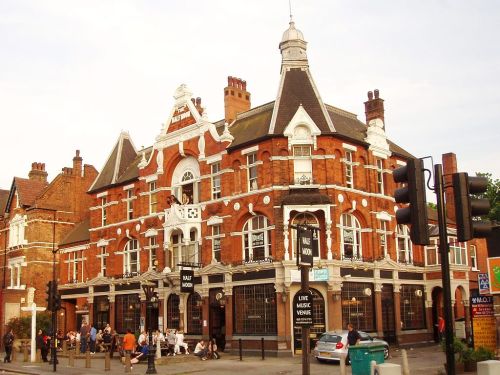
There has been a hole in the centre of Herne Hill since August 2013. That’s when a water main flooded Half Moon Lane closing most of the businesses. All eventually reopened (although some subsequently closed again, defeated by the insurance process) except what’s arguably the most important one: the Half Moon pub, a glorious gargantuan neo-Gothic late Victorian Grade II-listed pub that should be Herne Hill’s crown jewel but has instead been allowed to fester for more than two years, to the lasting shame of landlords Dulwich Estate. This is a fine London pub, which opened in 1896 – a pub has been on the site since the 17th-century – and has featured in graphic novels by Alan Moore, hosted gigs by U2 and Frank Sinatra, comedy shows by Eddie Izzard, and whose former drinkers include Dylan Thomas, who took the name of Under Milk Wood from the nearby Milkwood Road. Now, it’s dead, boarded up, dilapidated and rotting from within.

So how has this come to pass?

half moon

Locally, rumour and counter-rumour have swirled about its fate. The chief sticking point is that there are several floors above the pub – these once contained boxing a gym where I spent an exhausting three minutes being chased round the ring by a former middleweight champion – that represent a huge financial opportunity. Attempts to convert them into residential flats went nowhere and it’s said that Dulwich Estate, who look after the interests of the wealthy nearby private schools as well as a couple of other pubs, wish to turn it into some kind of boutique hotel as they are doing with the Crown and Greyhound in Dulwich Village.

This would almost certainly spell the end of live music at the large function room attached to the pub. This 200-capacity room has a surprisingly rich history as a London venue, as I discovered when talking to Peter Blair, who is leading the Save The Half Moon campaign with the Herne Hill Forum, fed up of the secrecy, silence and endless rumours.

Last week, Blair submitted to Southwark papers that would see the Half Moon listed as an Asset of Community Value that focus on its history as a music venue. He believes that while the pub will eventually reopen – because of the listing status, Dulwich Estate can’t really do anything else with the handsome ground floor bars – the live music component needs to be understood, celebrated and protected. The closure of London’s live venues has reached such epidemic proportions that even the mayor wants to do something about it.

“To have one of south London’s few independent live music venues shut in this way is terrible,” he says. “It’s the flagship of Herne Hill and it just sits there empty on the corner.”

Campaigners have been exploring the pub’s history and have discovered it was a crucible for London’s live blues scenes in the 70s – sessions featured an array of musical talent from the most popular bands of the era including members of the Jeff Beck Band, Rory Gallagher band, Thin Lizzy, and 7th Wave. An account of its history can be seen in this film.

It remained a music venue for the next four decades. In 1980, U2 played an early gig. In the 90s, the house PA was owned by Alabama 3 and gigs included Big Joe Turner and Geno Washington. More recently it hosted Devon Allman from The Allman Brothers and guitarist Albert Lee.

“It’s been a live music venue since the 60s and we can’t lose that live music function,” says Blair. “It has such a great history and was a great venue. Everybody I’ve spoken to says it was such a special place to play. This is a local community pub but it’s also much more than that.”

Damn straight: Leslie Nielsen even filmed a commercial in there.

If the campaigners win their bid to get the pub listed as an Asset Of Community Value, it will mean Dulwich Estate will have to consult the Herne Hill Forum over their plans, finally bringing them out into the open. “Out understanding at this point is that they wish to use the function room as a restaurant,” says Blair. “We want them to explain their plans in full, and to ensure live music is a key component of the new pub, whenever it opens. If it is converted as a hotel, how will that effect the music venue? We have no intention of making it unviable but we want to know what it will be when it opens.” The campaigners have no interest in purchasing the venue, which would cost a fortune but have been in discussion with the nearby Ivy House, who used Asset of Community Value status to purchase their local pub from developers.

There’s also the question of when it reopens. While Dulwich Estate is said to be in negotiations with several pub chains – “everybody you speak to has a different name” – it’s unlikely to open in the next 12 months. Since it closed, no restoration has taken place at all and it’s said the pub, which was at the very centre of the flood and thus under water for some time, is in very poor condition. It seems astonishing that a listed venue can be left to rot by a landlord that is supposed to have local interests at heart, especially when one presumes there is insurance money on hand to fix the damage.

It’s a sad state of affairs for what should be a south London landmark.

To keep up to date with the campaign, see the Facebook group.

The Black Museum at the Museum Of London

The Museum of London’s new exhibition is undoubtedly something of a coup. Crime Museum Uncovered features around 600 items from the Met Police’s private museum, once known as the Black Museum but now renamed the Crime Museum. I visited the Crime Museum at Room 101 in Scotland Yard several years ago and wrote about the experience here.

What’s fascinating is the differences between the way a public museum like the MoL treats the same objects as the police museum. The shelf above is from Scotland Yard. It is located in an ante room before the museum proper and contains a selection of weapons seized on the streets of London, and above that a dozen or so death masks taken of the heads of executed prisoners. This is pretty much the first thing visitors to the museum will see and the ensemble is like a whack on the head with a cosh. It says London is full of criminals, this is how they will try to kill you and this is what we will do to them when they are caught.

At the MoL, the same material is treated much more sensitively. Only six or so weapons are exhibited, and these are placed neatly in a clean glass box rather than scattered higgledy-piggledy over an old table. The heads are also on exhibition, but some distance removed from the weapons, creating a disconnection between crime and punishment.

That is, perhaps, the only way the MoL could present this exhibition. I’ve said before that the Crime Museum as curated by the police is entirely inappropriate for the public and I’m not entirely sure it’s appropriate for the police as it is deliberately created to cultivate an air of suspicion bordering on the paranoid, a repeated insistence that the streets are not safe for policeman, that anybody could be out to kill you, using anything from an umbrellas to a telephone. It’s an attitude that goes some way towards explaining the deaths of numerous Londoners at the hands of the police.

The MoL also has to fill in some of the blanks at Scotland Yard. The Crime Museum is ostensibly a teaching museum  – it shows coppers the history of crimes and how they have been solved. But the cases at Scotland Yard contain little explanatory detail – that is provided orally by the curator. At the MoL, by contrast, there is a fairly thorough, detached but instructive look at a selection of important crimes, showing what they have revealed about forensics, police procedures, detective work and criminality (many of the cases, too many, concern crimes against women). They also touch on several of the most significant crimes of the era, including the Krays, the Richardson, Derek Bentley, Dr Crippen, Christie and the Acid Bath Murderers. It’s all very carefully selected and brilliantly explained, with items well chosen to both inform and occasionally horrify. This is easily the best part of the exhibition.

Gloves worn by John Haigh to dissolve the body of Mrs Olive Durand-Deacon, 1949 © Museum of London

Gloves worn by John Haigh to dissolve the body of Mrs Olive Durand-Deacon, 1949 © Museum of London

The MoL then breaks away from these individual crimes to look at broader themes, such as concealed weapons, drugs, forgery, armed robbery and espionage. While the focus on individual crimes does not include anything from after 1975 to avoid distress to victims’ relatives – which means the infamous Dennis Nilsen cooking pot isn’t on show thankfully – the exhibits on broader themes go right up to the present day. That is largely so they can show items related to the July 2005 bombings in the form of reconstructions of the homemade rucksack bombs, something I found particularly unnecessary as these weren’t even from the crime scenes, which is a core part of the Crime Museum’s relevance. Authenticity is absolutely vital here – it is the raison d’etre of the entire collection – and if the items are not original, you leave yourself open to accusations of Chamber of Horrors style ghoulishness.

It’s a rare misstep from an otherwise sensitive exhibition, that ends with an excellent film in which policeman, curators, crime victims and professors discuss crime, the museum and its role in police life.

the first criminals to be convicted in Great Britain for murder based on fingerprint evidence, 1905 © David Gill/Museum of London

the first criminals to be convicted in Great Britain for murder based on fingerprint evidence, 1905 © David Gill/Museum of London

So that’s all good, but I still came out of the Museum of London exhibition with mixed feelings.

It goes right back to the start. The exhibition begins with a “reconstruction” of the original Victorian museum. But this is a reconstruction in the very loosest sense – basically, it means the items are old but they are being presented in a very modern way. That is far removed not only from the Victorian museum but also from the contemporary Scotland Yard museum, which does not look, feel or smell modern at all. The Crime Museum is old-fashioned, cluttered, chaotic and deeply depressing, and a genuine piece-by-piece reconstruction, or even a photograph of the current Scotland Yard museum, would have been a real benefit, as otherwise it’s impossible to discern the peculiar atmosphere of the place. Without it, the MoL are sanitising not just the nature of crime – which is excusable – but also the nature of policing, which is not. That after all goes to the heart of what the Crime Museum is about, who it is for and what that means to Londoners, and it’s something that is entirely absent from this exhibition – the one hint comes from the only item relating to the long history of riots in London, which is a police shield from Broadwater Farm that’s been burnt by a petrol bomb. What does that tell you about the way the police regard these inner city riots?

The Museum of London have produced a fascinating, thoughtful and thought-provoking reimagining of the Crime Museum’s contents that explores the nature of crime and law enforcement in London, but it does not tell the full story of the Crime Museum. I imagine Scotland Yard will be very pleased about that indeed.