Category Archives: Photography

Secret London: dealing with the counterculture at Maggs

This article originally appeared in Dazed And Confused magazine in February 2012.

Maggs Bros Ltd rare bookshop is an unlikely place to encounter the counterculture. For a start, it’s located on one of London’s poshest squares in Mayfair, the heart of the establishment, and even boasts a Royal warrant just inside the front door. Inside No 50 Berkeley Square – an imposing Georgian terrace once described as ‘the most haunted house in London’ – earnest young men in expensive suits sit at desks covered in large old brown books, which they flog to largely millionaire collectors that occasionally step through the front door.

But round the back, a different world awaits. Carl Williams works in an office converted from the stable block, in a room that is full of wonders. Come here at the right time and you will find boxes full of punk fanzines sitting on chairs draped with Republican flags from Spanish Civil War. Ask Williams nicely and he may show you brooches made by junkie poet Alexander Trocchi from used heroin needles, a complete set of ‘Anti-Monopoly’ board games or a pamphlet drawn by Latvian anarchist Peter the Painter, the shadowy figure behind the Sidney Street Siege of 1911. This recent catalogue will give you an idea of the material. 

Aleister Crowley

Williams, a fast-talking Yorkshireman , is one of the few booksellers who deals in items related to the counterculture, a nebulous term which covers politics, the occult, avant-garde art, film and literature, drug culture, rock and roll and alternative lifestyles. The interesting stuff, in other words. ‘There’s no guide to the counterculture,’ says Williams. ‘It’s not doctrinal. It’s whether something has the right feel, the way it looks, where it came from. It’s folk art, it’s the Watts Towers, it’s Austin Osman Spare, it’s Aleister Crowley. It’s not like Marxism where everybody knows the key texts. There are things in the counterculture that are still being discovered. There are things lost in libraries that will take it in a completely new direction.’ And it isn’t just books: Williams deals in paintings, posters, games, clothes and records. The only requirements are that Williams can locate it somewhere within his own concept of the counterculture, and that he can sell it. He also puts on occasional shows in the gallery beneath his office, such as the recent Lost Rivers exhibition.

Williams was born in 1967 – ‘the autumn of love’ – in Scarborough. Despite failing his O-Levels, he went to the LSE to read sociology, where he discovered the library and ‘read indiscriminately’. In 1997, after a decade of odd jobs and working in book shops, Williams returned to the LSE to do a Masters just as the library was selling off its old stock during a refurbishment. Almost by accident, Williams became a ‘runner’, a pejorative term that describes something which, in essence, all book dealers do. ‘Running is a pre-internet term, now it’s much more transparent, but it means taking a book quickly from one dealer or auction house, to another dealer or collector and selling it for more money than you paid,’ says Williams. ‘The idea is that you get it from A to B without B finding out how much you paid A.’

RED FESTIVAL 77 POSTER

With the LSE library at his disposal, Williams was blessed with early success. ‘I was able to sell all these political economy and philosophy books,’ he says. ‘But although I knew the books I didn’t really know what they were worth. I realised this when I took one dealer the first Western European edition of the Koran, and walked out with £500 when it must have been worth thousands.’

As the stock from the LSE ran out, Williams began frequenting other dealers and auction houses to find sellable books. In February 1999, he wandered into Bloomsbury Book Auctions, where he picked up a book from 1864 called The Pure Logic Of Quality by William Stanley Jevons. ‘Jevons thought this book would revolutionise how we understood logic, but he only sold six copies,’ says Williams. ‘I’d never seen one outside a library. I took it to a dealer, Pickering and Chatto, and a man called Jolyon Hudson asked if he could keep it for a day or two.’

Hudson recognised the book had been stolen from the London Library. The police were notified and Williams’s discovery unravelled what the Guardian described as ‘the most systematic plundering of Britain’s great libraries ever carried out by an individual’. William Simon Jacques, a dealer, had stolen books worth more than £1 million. He was eventually sentenced to four years in prison. (Jay Rayner covered the story here.)

‘I was devastated,’ says Williams, ‘because I thought I’d tried to sell a stolen book, but it turned out to be a blessing because Hudson told the Guardian that I had behaved impeccably and that gave me an entry into the higher levels of the trade.’

Williams began working at Maggs Bros, selling books on the internet and looking after the catalogue. ‘I got to know the customers. There was one guy who had been coming in for 20 years. He’d usually walk out with a travel book, but one day they asked this guy what he actually wanted and he said he wanted books on drugs.’

The man was Julio Mario Santo Domingo, a Colombian billionaire, and Williams sold him a painting made by a Mexican artist after he had been injected in the neck with LSD. Santo Domingo was in the process of putting together one of the great private collections of drug books and paraphernalia, a stunning selection of material that ranges from ancient books about Chinese opium smoking to a bicycle that belonged to Syd Barrett. ‘I worked for Julio [who died in 2009] for three years,’ says Williams. ‘His collection is one of the great untold stories of the 21st century. It’s not just drugs, it’s sex, rock and roll, the occult, erotica and art. And it’s not just books. It’s everything.’

Santo Domingo had a remarkably open concept of what to collect, not just concentrating on the old and valuable but hovering up anything with drug connections. ‘Somewhere in it is a McDonalds coffee stirrer from the 1970s,’ says Williams. ‘It looked like a coke spoon, just in plastic rather than silver. There were press rumours that it was the hillbilly coke spoon and so McDonalds discontinued the range, but I found an original. What do you do with that? Sotheby’s don’t want it, Christie’s don’t want it. But it’s gold. So that’s what I do.’

McDonald's coffee stirrer

Williams operates in a rarefied world, selling unusual and arcane items to billionaires and academic institutions. Some are interested in the subject, others are professional collectors, and still more are collectors who collect other people’s collections, as investments and for the pleasure of ownership. ‘It’s a very small world of dealers and a very large world of buyers, who work on the basis that they should buy now when it is relatively cheap and is all still out there,’ says Williams. ‘And some of it is cheap. The 1960s stuff isn’t because it is more mainstream and the top Beat stuff is far too expensive, although I’ll still buy manuscripts.’

New items are acquired from auctions and the internet, book fares, private sellers and other dealers. A recent haul brought in the first issue of Heat Wave, a British Situationist International magazine written in 1966, which nobody has seen outside the British Library for decades. There’s a file full of items William Burroughs collected during his short-lived immersion in the Church of Scientology. There are four skeletal marionettes that used to live in an amusement arcade in Hastings. There are posters of Black Panther Bobby Seale, complete collections of short-lived No Wave fanzines, cloth bags designed by Yoko Ono and the programme from Michael Clark and The Fall’s collaboration on the ballet ‘I Am Curious Orange’, which took place at Sadler’s Wells in 1988. And there are books, loads of them, by Richard Neville and BS Johnson and Gregory Corso and Timothy Leary. Some of this stuff is hard to sell, partly because it’s difficult to know how much it is worth – ‘there simply isn’t a precedent for some of these things, so you’ve nothing to compare it with.’


Williams found his niche with a little help from Edward Maggs, the man who inherited the family firm. ‘There might have been something brewing in Ed’s mind that we needed to cover this demographic,’ says Williams. ‘It really began when I started cataloguing all this proto-counterculture American Beat stuff from the 50s and it did really well, I sold about 80% of it. I designed a catalogue based on Ginsberg’s Howl, the same size and typeface. It did well, people liked it and I realised I had the right skills for the subject.’

And what are those skills? Williams pauses. ‘It’s judo,’ he says. ‘I have one real ability. I can pick up a book, look at the front, open it, look at the back and I can usually understand what that book is about, condense it, understand where it came from and put a price on it before I’ve put it down. That’s not a talent many people have. It’s like judo, you’re fighting an opponent who is much bigger than you but you don’t need take on the whole thing at one time if you are going to defeat it. It’s an intellectual work-out every day. I have to explain each item, do the research, understand its value, and then I try and sell it.’

Unstable at Maggs Bros Gallery is on until June 8, 2012.
Bowie, Burroughs and the stage production of Ziggy Stardust

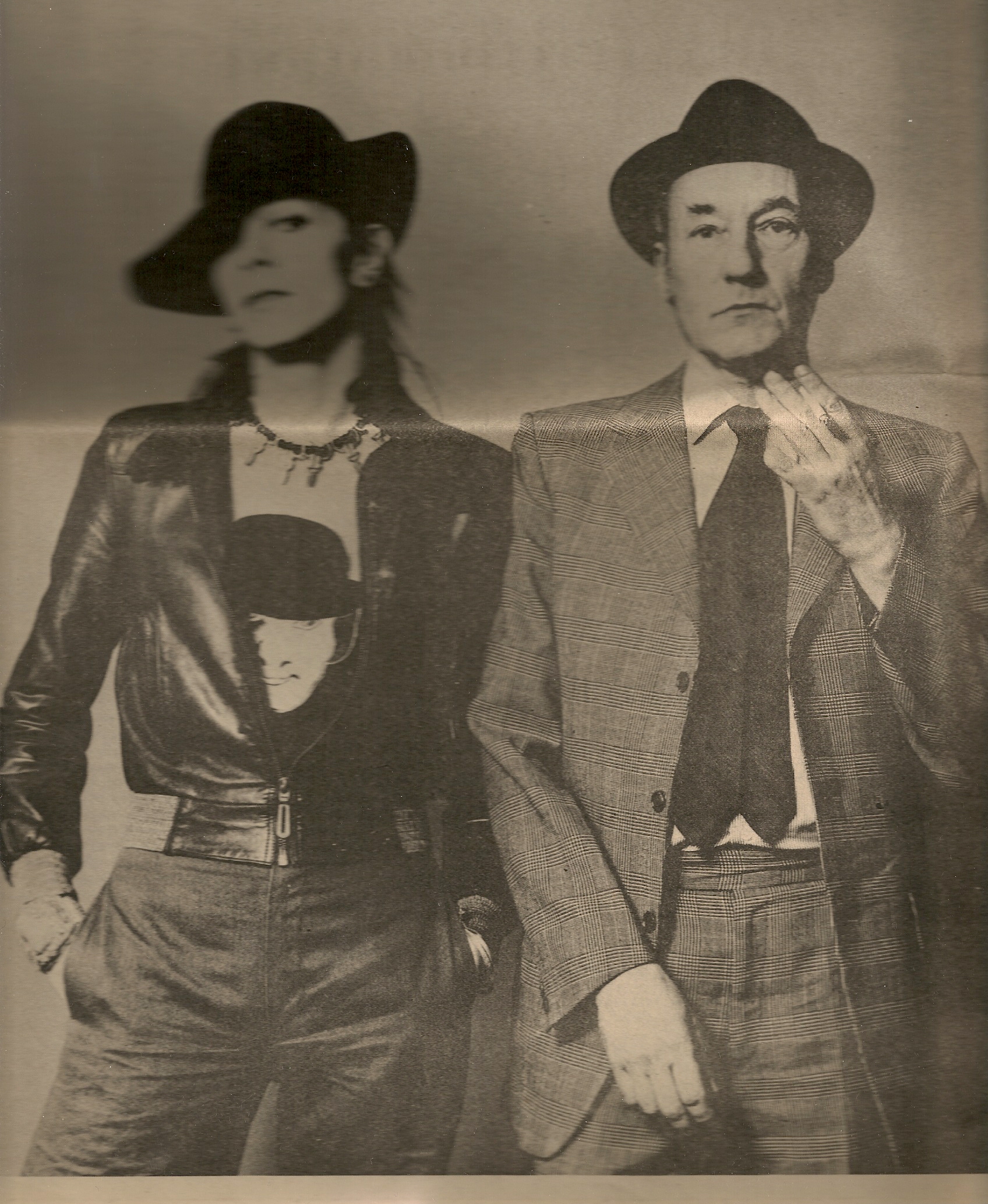
In December 1973, Rolling Stone journalist Craig Copetas brought together David Bowie and William S Burroughs in London for an interview. The piece was published in February 1974, around the time Burroughs returned to America, having finally had enough of the English climate and licensing laws. A wonderful photograph by Terry O’Neill captures the two icons together.

The interview itself isn’t quite as captivating. Bowie had only read one of Burroughs’ books (Nova Express), while Burroughs had only listened to two of Bowie’s songs (“Five Years” and “Starman”). This is my favourite exchange:

Burroughs: What is your inspiration for writing, is it literary?

Bowie: I don’t think so.

Burroughs: Well, I read this “Eight Line Poem” of yours and it is very reminiscent of TS Eliot.

Bowie: Never read him.

During the two-hour conversation in Bowie’s home, Bowie did most of the talking. At one point he discusses in length his plans for a theatrical or television production of Ziggy Stardust, which had been released two years before (and in June 2012 celebrates its 40th anniversary).

It’s worth repeating this section in full, as it is one of the fullest explanations of the story behind the Ziggy concept.

Bowie: Nova Express really reminded me of Ziggy Stardust, which I am going to be putting into a theatrical performance. Forty scenes are in it and it would be nice if the characters and actors learned the scenes and we all shuffled them around in a hat the afternoon of the performance and just performed it as the scenes come out. I got this all from you Bill… so it would change every night.

Burroughs: That’s a very good idea, visual cut-up in a different sequence…. Could you explain this Ziggy Stardust image of yours? From what I can see it has to do with the world being on the eve of destruction within five years.

Bowie: The time is five years to go before the end of the earth. It has been announced that the world will end because of lack of natural resources. Ziggy is in a position where all the kids have access to things that they thought they wanted. The older people have lost all touch with reality and the kids are left on their own to plunder anything. Ziggy was in a rock-and-roll band and the kids no longer want rock-and-roll. There’s no electricity to play it. Ziggy’s adviser tells him to collect news and sing it, ’cause there is no news. So Ziggy does this and there is terrible news. “All The Young Dudes” is a song about this news. It is no hymn to the youth as people thought. It is completely the opposite.

Burroughs: Where did this Ziggy idea come from, and this five-year idea? Of course, exhaustion of natural resources will not develop the end of the world. It will result in the collapse of civilization. And it will cut down the population by about three-quarters.

Bowie: Exactly. This does not cause the end of the world for Ziggy. The end comes when the infinites arrive. They really are a black hole, but I’ve made them people because it would be very hard to explain a black hole on stage.

Burroughs: Yes, a black hole on stage would be an incredible expense. And it would be a continuing performance, first eating up Shaftesbury Avenue.

Bowie: Ziggy is advised in a dream by the infinites to write the coming of a starman, so he writes “Starman”, which is the first news of hope that the people have heard. So they latch on to it immediately. The starmen that he is talking about are called the infinites, and they are black-hole jumpers. Ziggy has been talking about this amazing spaceman who will be coming down to save the earth. They arrive somewhere in Greenwich Village. They don’t have a care in the world and are of no possible use to us. They just happened to stumble into our universe by black-hole jumping. Their whole life is travelling from universe to universe. In the stage show, one of them resembles Brando, another one is a Black New Yorker. I even have one called Queenie the Infinite Fox.

Now Ziggy starts to believe in all this himself and thinks himself a prophet of the future starman. He takes himself up to incredible spiritual heights and is kept alive by his disciples. When the infinites arrive, they take bits of Ziggy to make themselves real because in their original state they are anti-matter and cannot exist in our world. And they tear him to pieces on stage during the song “Rock ‘n’ Roll Suicide”. As soon as Ziggy dies on stage the infinites take his elements and make themselves visible. It is a science fiction fantasy of today and this is what literally blew my head off when I read Nova Express, which was written in 1961. Maybe we are the Rodgers and Hammerstein of the seventies, Bill!

Burroughs: Yes, I can believe that. The parallels are definitely there, and it sounds good.

The Rodgers and Hammerstein of the 1970s never collaborated, unfortunately. You can read a full transcript of the Bowie-Burroughs interview – including discussions of German porn, Lou Reed, Andy Warhol, science fiction and Mick Jagger (‘Jagger is most certainly a mother figure. He’s not a cockadoodledoo; he’s much more like a brothel-keeper or a madame,’ says Bowie) – here.

Pole to pole: more forgotten London street furniture

Some months ago, Russell Miller noticed that London was filled with metal posts that are left embedded in the ground long after the signs they once supported are taken away. So he began to photograph them for his website, taking particular interested in the way people walk past these rusting remnants without even noticing. And then he told me about it.

I think they are great. Here are a few examples, but for more check out Russell’s website – We Do This Because We Forget.


My favourite thing in London

The other day, I saw this board outside the Big Red Bus tourist shop near the British Museum and decided straight away that it might be my favourite thing in London. It was so striking, with such a warped sense of perspective and bizarre mishmash of London stereotypes.

I wanted it.

I decided that I would go inside and ask how much it would cost to buy it, but first I stopped and looked at it awhile. Questions entered my head.

What is a Grenadier Guard doing outside Downing Street? If he’s not on duty, why is he wearing his uniform and if he is on duty, which he shouldn’t be, why is he holding the hand of a small foreign bear? What is Paddington Bear doing so far from his comfort zone of Paddington without Mr Brown or any of the Brown family? Why is Paddington Bear standing behind the Grenadier Guard in that curious position? Are Paddington Bear and a Grenadier Guard even particularly relevant symbols of London life in 2012? And is it just me, or does the whole ensemble look rather like a surreal take on something you might see on Crimewatch featuring a stranger caught on CCTV camera leading a small child away from a shopping centre?

I still wanted it though, maybe now more than ever.

While I was plucking up the courage to go inside an ask, two Italian tourists came strolling down the road. They saw the board, giggled, then handed me their camera and asked if I could take their picture. After arguing over who would be the bear and who would be the guard, they poked their heads through the holes. I took a photograph, they thanked my fulsomely and moved on, laughing and chatting, relishing this rare free moment of childish fun in the sterling-sapping city.

I realised then that the need of London’s tourists was greater than mine. I could always come back, but they would only ever have their photographs. I went home, contented.

Hawksmoor at the Royal Academy: bunkum and brilliance

As the adverts all over the tube let us know, there’s currently a big David Hockney exhibition at the Royal Academy. Less well advertised, but far more compelling from a London point of view, is the same gallery’s fine show on the fascinating architecture of Nicholas Hawskmoor.

This takes place in the Architecture Space – a nice name for a small corridor near the restaurant – and features a short introduction to the architect, alongside photographs and paintings (photographed, not originals) of key works that feature or reference Hawksmoor’s work.

Leon Kossoff's Christchurch, Spitalfields

Hawksmoor, who specialised in hefty Baroque churches, is not an architect to everybody’s taste. In 1734, James Ralph argued that Christchurch was ‘beyond question, one of the most absurd piles in Europe’.  His reputation was resuscitated by Kerry Downes in 1959, who insisted of his churches that ‘they will repel us or fascinate us, but we cannot escape from their strange, haunting power’. This has been a mantra repeated by writers in the following years.

I actually find it quite easy to escape their powers, strange, haunting or otherwise, but this supposed mysterious attraction of Hawksmoor churches is now almost impossible to ignore or deny. It has been repeated so many times, it’s become fact, as Hawksmoor became the anointed architect for a certain type of London writer, the Peter Cook to Sir Christopher Wren’s Dudley Moore. I admire Hawksmoor’s churches, but don’t see them as particularly profound or unsettling.

Charles Hardaker's Hawksmoor Baroque, St Mary Woolnoth, London

Among the first to take up this theme was Iain Sinclair who wrote about Hawksmoor in King Lud (1975). A quote from the book is reproduced on the wall, and it offers a perfect illustration of what I dislike about the psychogeographic way of seeing London: ‘From what is known of Hawksmoor it is possible to imagine he did work a code into the buildings, knowingly or unknowingly, templates of meaning, bands of continuous ritual.’

‘From what is known’; ‘possible to imagine’; ‘knowing or unknowing’. Make it up as you go along, in other words. There’s nothing wrong with this, of course, but I do resent the way it is elevated above all other forms of London writing.

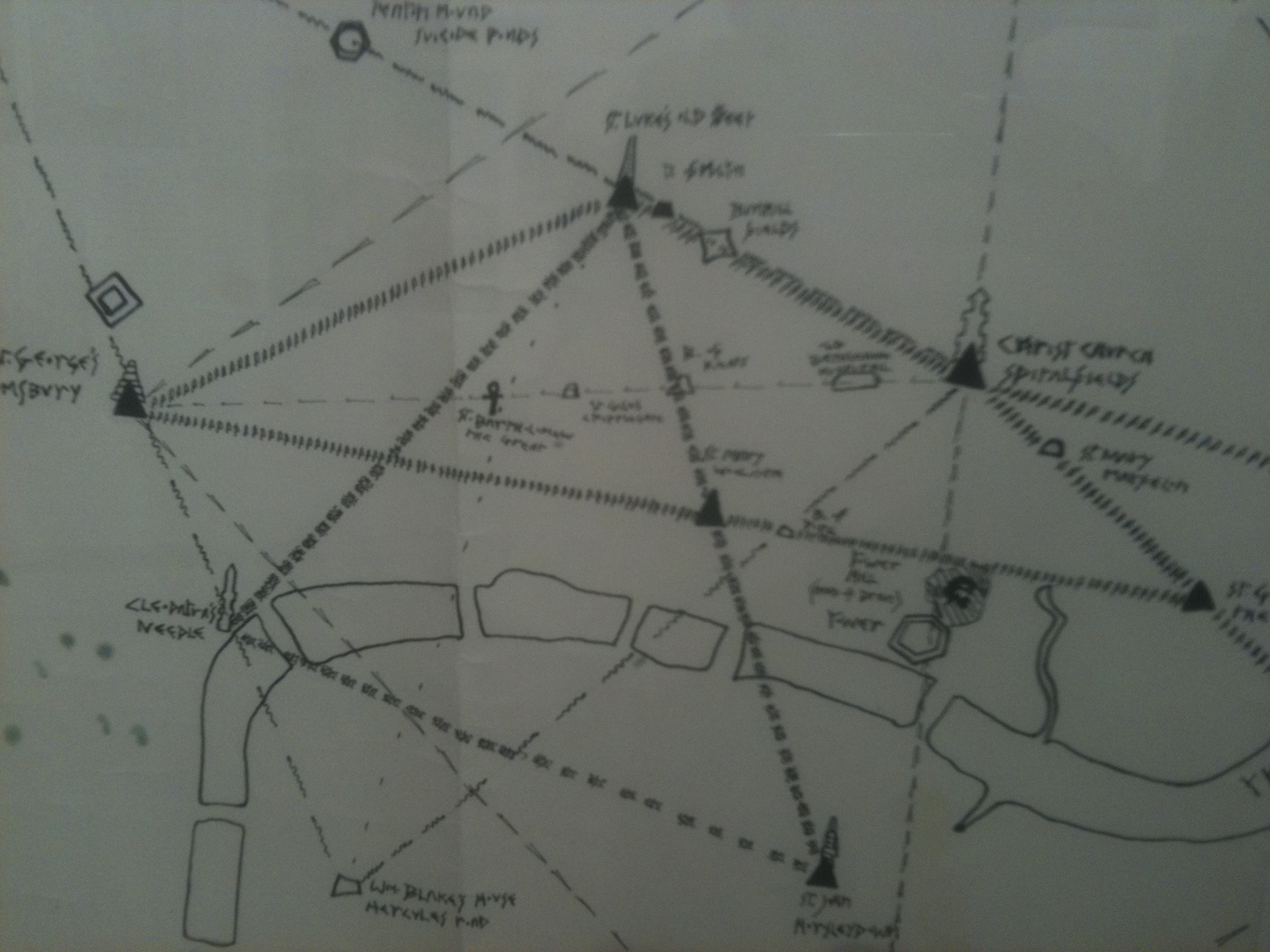
Sinclair has made a career out it, and he does it so well you could almost believe he takes it seriously. A fascinating map drawn by him features in the exhibition, showing his hand-drawn connections between London buildings, and there’s also a great film in which he talks eloquently about his relationship with Hawksmoor, which began when he was a gardener employed by Tower Hamlets to mow the churchyard grass at St Anne, Limehouse. Sinclair is a wonderful speaker, and spins a fine yarn here.

Sinclair's map for King Lud

After Sinclair came Ackroyd and Alan Moore, both of whom woves tales of occultish imagination around this indefinable mystery of Hawksmoor churches. Nonsense clearly, but at least it gave us the majestic From Hell, which features prominently in the exhibition.

From Hell featuring Christchurch, Spitalfields

All this bunkum gets space in the exhibition, but I found much else to entertain besides. There are wonderful photographs and prints of Hawksmoor buildings in many different styles and from varied eras, and also a passionate film by Ptolmy Dean, explaining – quite successfully – the attractions of the easily overlooked St Mary Woolnoth near the Bank of England.

The most interesting element, however, were the photos that drew attention to the parallels between Hawksmoor’s work and more recent buildings. We see a comparison of St Mary Woolnoth and Poultry in the City, and another between St Anne, Limehouse and the National Theatre. It might not be as sexy as psychogeography, but there’s nothing wrong with a bit of straightforward architectural history every now and then.

paul_0133fw.jpg

Celia Paul's St George, Bloomsbury

Secret London: photos of lost rivers and abandoned London

Lovers of London urban landscape, lost rivers, photography and, for want of a better word, psychogeography, should be aware of a forthcoming exhibition, From The Westbourne To The Wandle at Maggs Bros gallery.

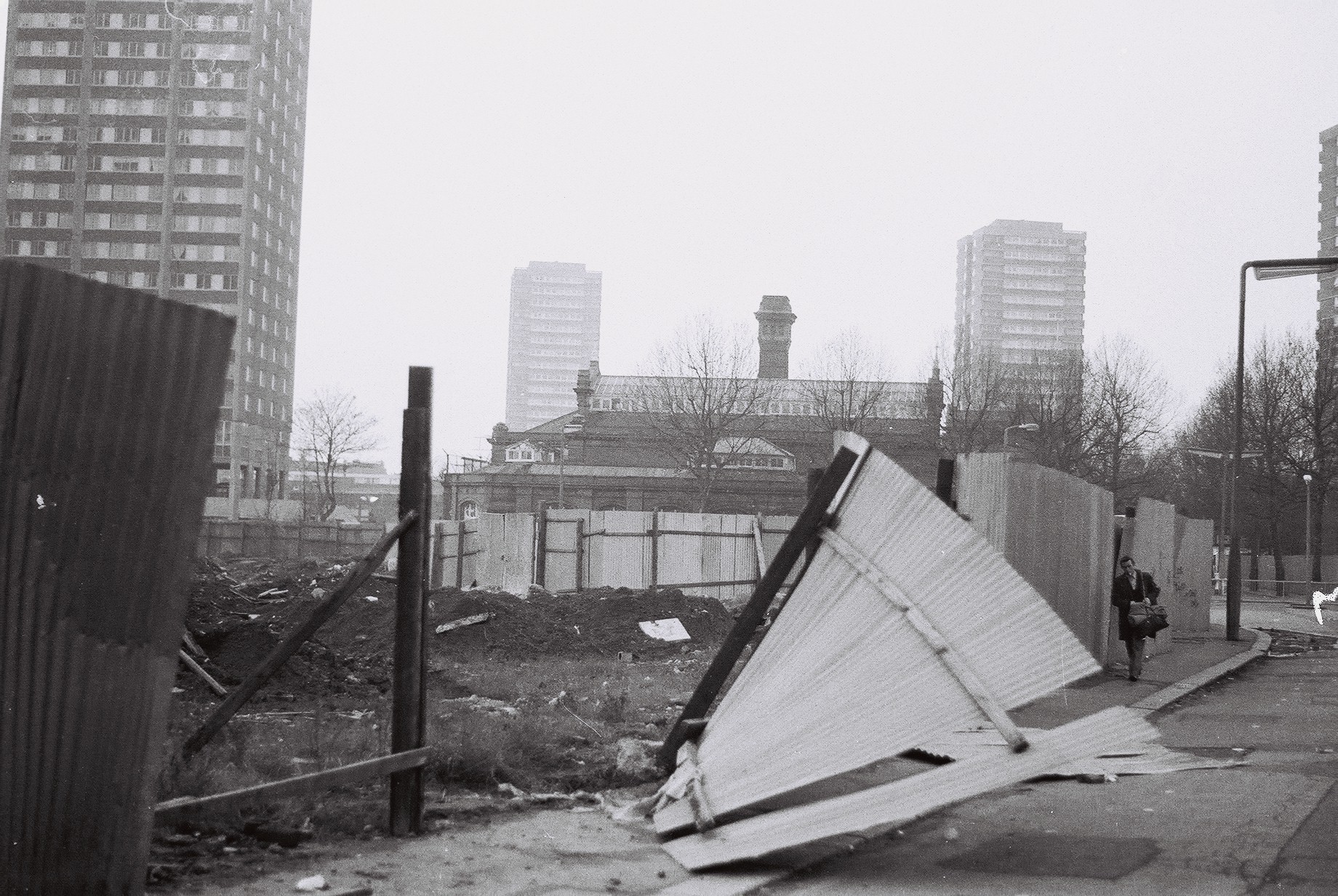
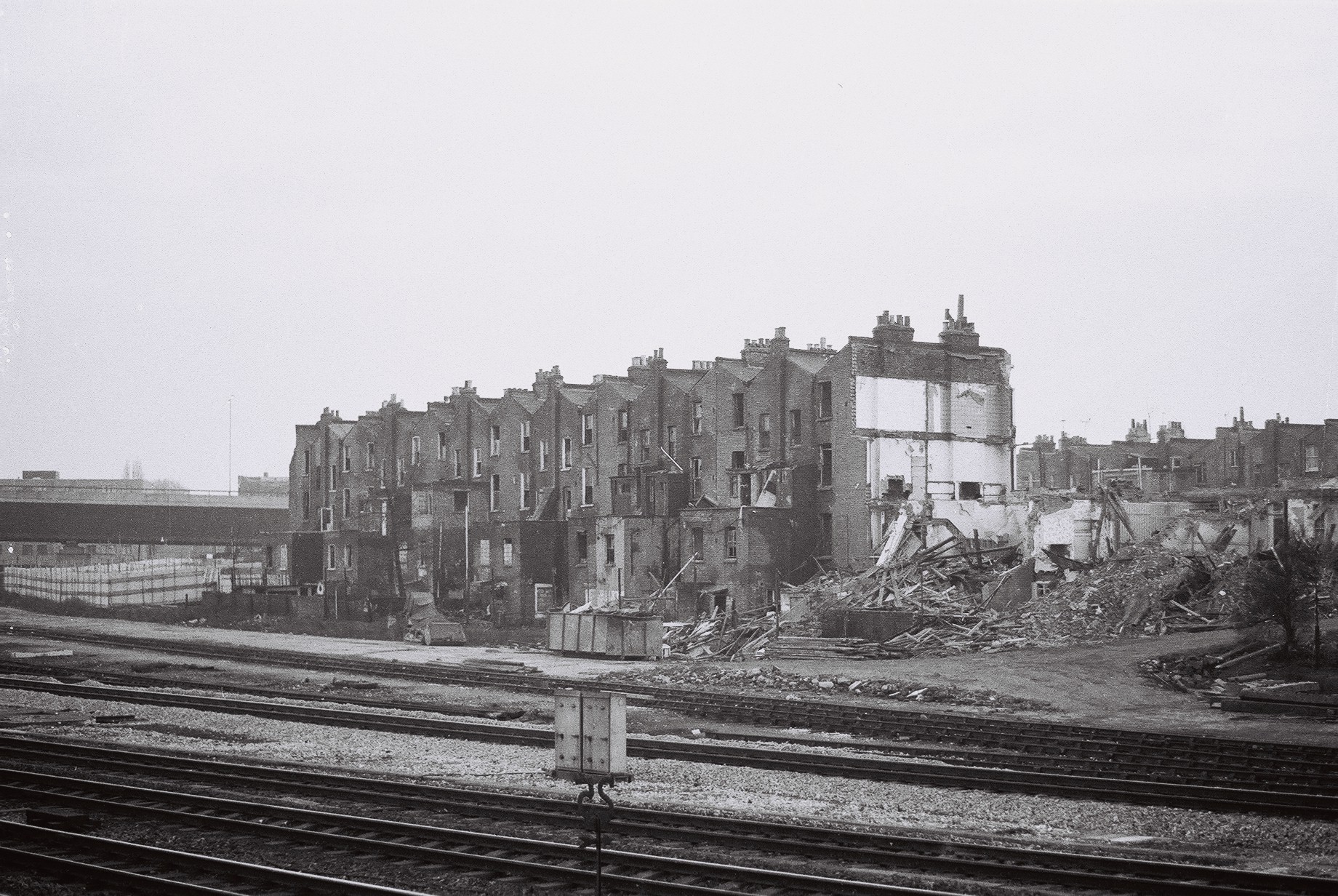
Curated by counterculture bookdealer Carl Williams, this brings together the work of two London photographers and writers, Jon Savage and SF Said. Savage is best known as a music writer, but in 1977, inspired by JG Ballard, he set out to photograph the urban wastelands of West London, taking a sequence of stunning black and white pictures of the lost land beneath the Westway.

He has written, ‘In its emptiness, austerity and gloom, it is an interzone waiting for something to happen, for the beasts to be unleashed. This was how London felt at the time: coming, coming, coming down – like a speed hangover merging into an apocalypse. But in there was also a sense of possibility that new ways of thinking might grow from this emptiness – like the scented buddleia on the bombsites.’

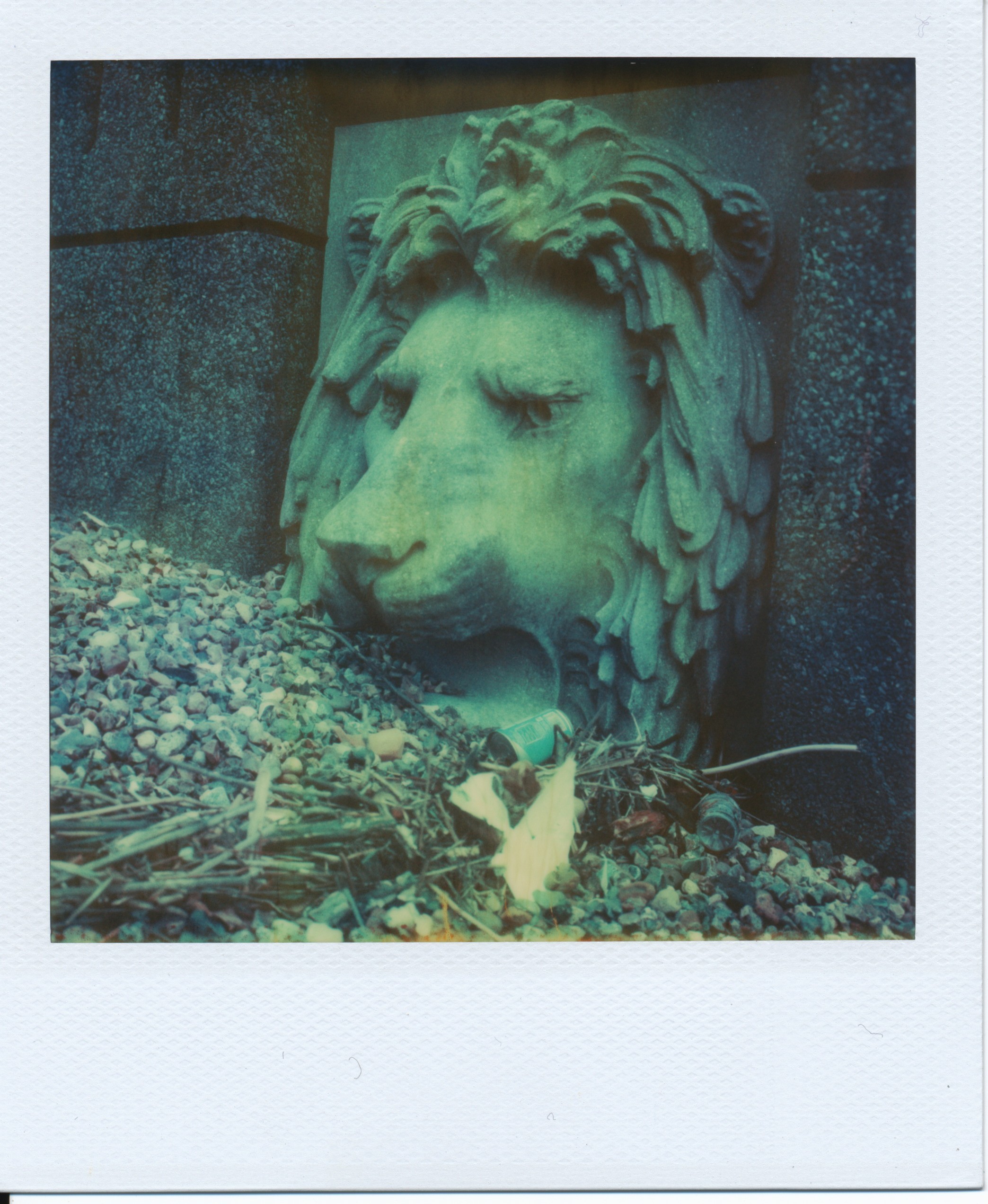
SF Said’s picture were taken for last year’s excellent Lost London Rivers book. Said shoots on Polaroid, which he describes as like a ‘photographic time machine’ and says he wants to ‘capture the dreams that a place might have of itself, or the memories that it stores under layers of time’.

He uses expired film, which can create strange, mesmeric effects and explains ‘as their chemical layers decay, they start to produce strange flame-like swirls and flickering light leaks that go even further into dreamlike realms.  These hallucinatory effects are unpredictable and random; sometimes they ruin a picture.  But when you’re lucky and it all comes together, I think they give you something magical that you could never get any other way.’

The exhibition is at the gallery at Maggs Bros, 50 Hays Mews, W1J 5QJ from March 22 to April 19.

Muhammad Ali in Tulse Hill, 1974

In 1974, this picture was taken of Muhammad Ali at Tulse Hill Comprehensive, sparring with a schoolboy.

But how did the world heavyweight champion – and one of the most famous men in the world – end up in a South London state school shortly after the Rumble In The Jungle with George Foreman in Zaire?

Well, he was invited by civil rights campaigner Paul Stephenson, who was on the school’s board of governors and thought it would be a good idea to ambush Ali in the lobby of the Hyde Park Hilton and suggest he come to the school assembly.

We continued to chat and he wanted to know how much I’d pay him. I looked him straight in the eye and said: ‘Muhammad, I haven’t got a dollar.’ He responded ‘Not even a dime? You have more nerve than Frazier.’

The full story is here, and it’s a cracker.

Dickens And London at the Museum of London

This review was published in the Independent last week but has not surfaced online.

It’s going to be hard to avoid Charles Dickens in the next few months. The writer will be everywhere, as publishers, programmers and producers commemorate the 200th anniversary of his birth on February 7, 2012. The best celebration of Dickens’s legacy could be this illuminating exhibition at the Museum of London. It’s an imaginative look at a familiar subject, and represents the best of what a museum can do.

This is no staid trawl through Dickens’s back catalogue but a vivid evocation of Victorian life based around themes from his books, from poverty to innovation. Sure, the big objects like Dickens’s writing desk or his manuscript for Great Expectations are there to grab the attention, but this drama is complemented by Victorian minutiae, the fascinating bric-a-brac of everyday life, everything from rent arrears books and mourning wands (wooden sticks carried by footmen ahead of funeral processions) to clay pipes, Punch and Judy puppets, model trains and Dickens’s soup ladle.

The exhibition is more than objects. There are mournful photographs of Victorian buildings that Dickens wrote about but have since disappeared, and a short film by William Raban that meanders around modern London while an actor recites Night Walks, Dickens’s essay about the sleeping city, drawing subtle parallels between his time and our own. The film is a rare chance to wallow in Dickens’s own voice, but neither this nor the manuscripts are quite as impressive as Dickens’s reading copy of Oliver Twist. This is the book he used on reading tours towards the end of his life; words and sentences are underlined for emphasis, and melodramatic stage directions (‘Action’, ‘mystery’, ‘terror to the end’) are scrawled in the margins.

The Strand, Looking Eastwards from Exeter Change, London

Most rewarding of all, though, is the art. There’s classically sentimental Victoriana, such as William MacDuff’s Shaftesbury, which shows two urchins looking in a shop window like something by Norman Rockwell. There’s the fascinating documentary sketches of George Scharf’s, who drew the people he saw on streets acting as human advertisements, in colourful costume and carrying eye-catching signs for shows and products. And there are many detailed depictions of Victorian street life, which owe a clear debt to Hogarth. Phoebus Levin’s ‘Covent Garden Market’, Caleb Robert Stanley’s ‘The Strand, Looking Eastwards From Exeter Change’ and especially Edmund John Niemann’s ‘Buckingham Street’ portray a city of energetic bustle, cobbled streets and vicious contrasts of wealth that are the visual embodiment of what we still call Dickensian London.

Museum of London, 150 London Wall, EC2Y 5HN (020 7001 9844). Until June 10, 2012. Admission £8 (£7 advance booking); concs £6 (£5 advance booking).

Buckingham Street, Strand, London

Drugs and dead babies at the Queen’s bookshop

Maggs Bros is a posh antiquarian bookseller on Berkeley Square that has a Royal Warrant and is supposed to occupy the site of the most haunted house in Britain, but it is also home to a small contemporary art gallery, located out the back and accessed via 50 Hays Mews.

The latest show is being curated by New Artists and features photographs by Richie Culver taken of London crackhouses. These are loosely based on Gustave Dore’s engravings of Victorian opium dens.

Opium Smoking

The exhibition also features Polaroids by Shorvon & Hunter that explore the demise of the Polaroid and newspapers as forms of media. It’s definitely worth a look if you are in the area before it closes on Monday, December 5.

If you do, you should also pop upstairs to see a selection of some items that Maggs’s counterculture expert Carl Williams is currently selling. These include photographs of William Burroughs taken by Brion Gysin in Paris and an extraordinary mural taken from an American street gang club house. You could also pick up a copy of Carl’s latest catalogue to see if he has anything you fancy, whether it be items to do with Crowley, punk or the Weathermen. Last time I visited, he showed me some pictures he’d just acquired of dead Victorian babies, but don’t let that put you off.

William Burroughs and the strange demise of London’s first espresso bar

In 1953, a momentous event occurred in Soho. London’s first proper coffee shop – one equipped with a Gaggia coffee machine – opened at 29 Frith Street. This was a place where teenagers too young for pubs could come and gather, and it is said by some that the introduction of this coffee bar prompted the youth culture explosion that soon changed social life in Britain forever.

Inside the Moka Bar

The Moka was an instant success, selling over a thousand cups of coffee a day. The author John Sutherland recalls, ‘the Gaggia machine, a great burbling, wheezing, spluttering monster, would grudgingly excrete some bitter caffeinated essence.  It would be swamped with steamed-milk foam and dusted with chocolate to form its ‘cappuccino’ hood… Glass cups and brown sugar (lots of it) were de rigueur.  Frankly, 50s espresso was no taste thrill.  But it felt smart as hell.’

By 1972, coffee bars where everywhere and the teenage revolution was firmly established. At this time, the author of ‘Naked Lunch’, former junkie and all-round Beat legend William S Burroughs was living in London, quietly going about his business in St James’s. He lived in Dalmeny Court, Duke Street, and loved the plush gentlemen’s shops of the area, not to mention the ‘Dilly Boys‘, young make prostitutes who hustled for clients outside the Regent Palace Hotel.

Although Burroughs was fond of the finer things in life – he got his shoes from John Lobb, hat from Locke’s and bought most of his food in Fortnum and Mason’s – he did at some point stumble into the Moka Bar, and was not impressed by what he found.

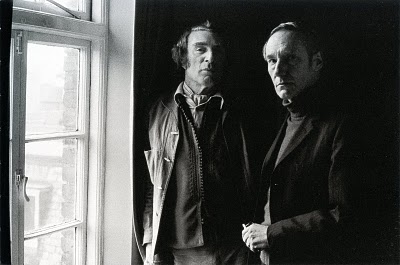
Burroughs and friend Brion Gysin in London

Burroughs at this time was getting sick of London – sick of the licensing laws, sick of the crap food and small drinks, sick of the weather, the terrible service and sexual hypocrisy. He was also sick of the Moka, which he believed responsible for an ‘outrageous and unprovoked discourtesy and poisonous cheesecake’.

The Church of Scientology, Fitzroy Street

Burroughs decided to mount a sound-and-image attack. He had previously launched one of these against the Church of Scientology, of which he had been a member, turning up at their headquarters at 37 Fitzroy Street every day, taking photographs and making sound recordings. He believed that ‘as soon as you start recording a situation and playing them back on the street, you are creating a new reality’ and that repeated exposure to such an attack would lead to ‘accidents, fires and removals’. After a few weeks, the Scientologists did indeed move, round the corner to 68 Tottenham Court Road.

Photo taken by Burroughs during the operation

On August 3, 1972, Burroughs turned his attention to the Moka. He would stand outside every day taking photos and making recordings by tape, and then return the next day to play the previous days recordings. Burroughs was convinced he was winning. ‘They are seething in there,’ he said. ‘I have them and they know it.’

On October 30, 1972, the Moka Bar closed.