Category Archives: Museums

Underground again at Aldwych


Transport for London allowed Aldwych station one of its periodic reopenings this weekend, with 1940-themed tours of the station and platform to commemorate the 70th anniversary of the Blitz.

The tours – which are completely sold out so don’t even try – were arranged to complement the Under Attack exhibition at the London Transport Museum, as explained by museum director Sam Mullins in this BBC clip.

As a part-time moleman who has never been inside Aldwych, I was down there like a greedy ferret in a goldmine. Aldwych, a pointless spur on the Piccadilly Line, closed in 1994 and its history can be read at the wonderful Subterranea Britannica or Abandoned Stations. Ian Visits and Diamond Geezer also have posts about the station.

I’ve wanted to get inside it for ever such a time.
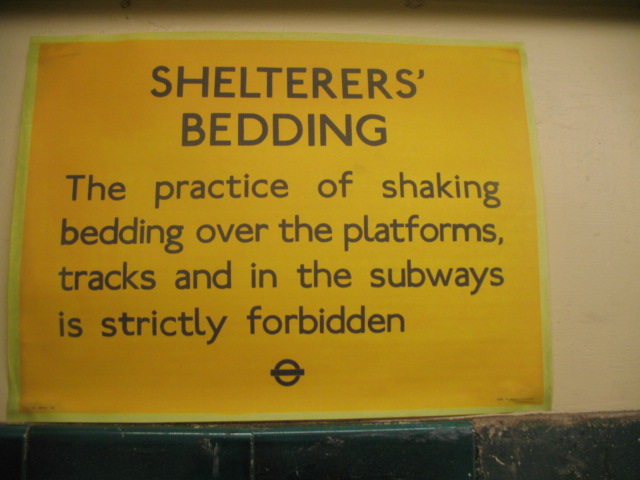
The tours begin in the neat but spartan ticket office, which is decorated with a number of wartime posters giving instruction about shelters and the blackout. You are greeted by an actor playing an Air Raid Precautions officer, whose monologue is interrupted by the forbidding wail of an air raid shelter. You meet three more such actors in the course of the tour, the best being the 1940s housewife who sits in the train down on the platform and can be quite saucy if you ask the right sort of questions.

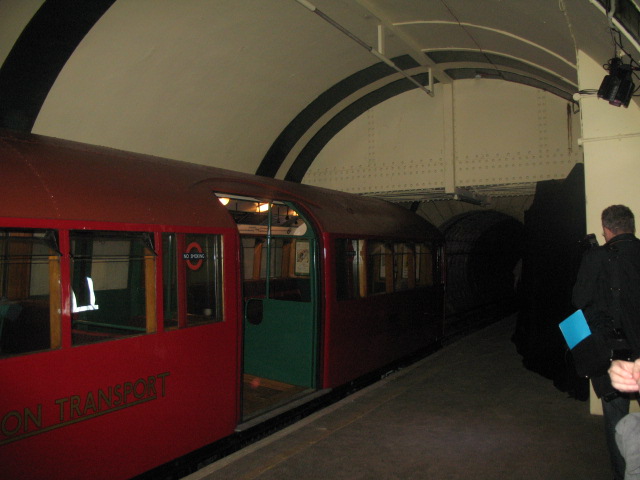
The chance to poke around the station and listen to actors recreating 1940s stereotypes is all well and good, but the star of the show is undoubtedly the 1938 train that has been brought out of retirement for the occasion.


I’m no train nerd, but this one is a beauty, as I’m sure better photographers than I will record this weekend.
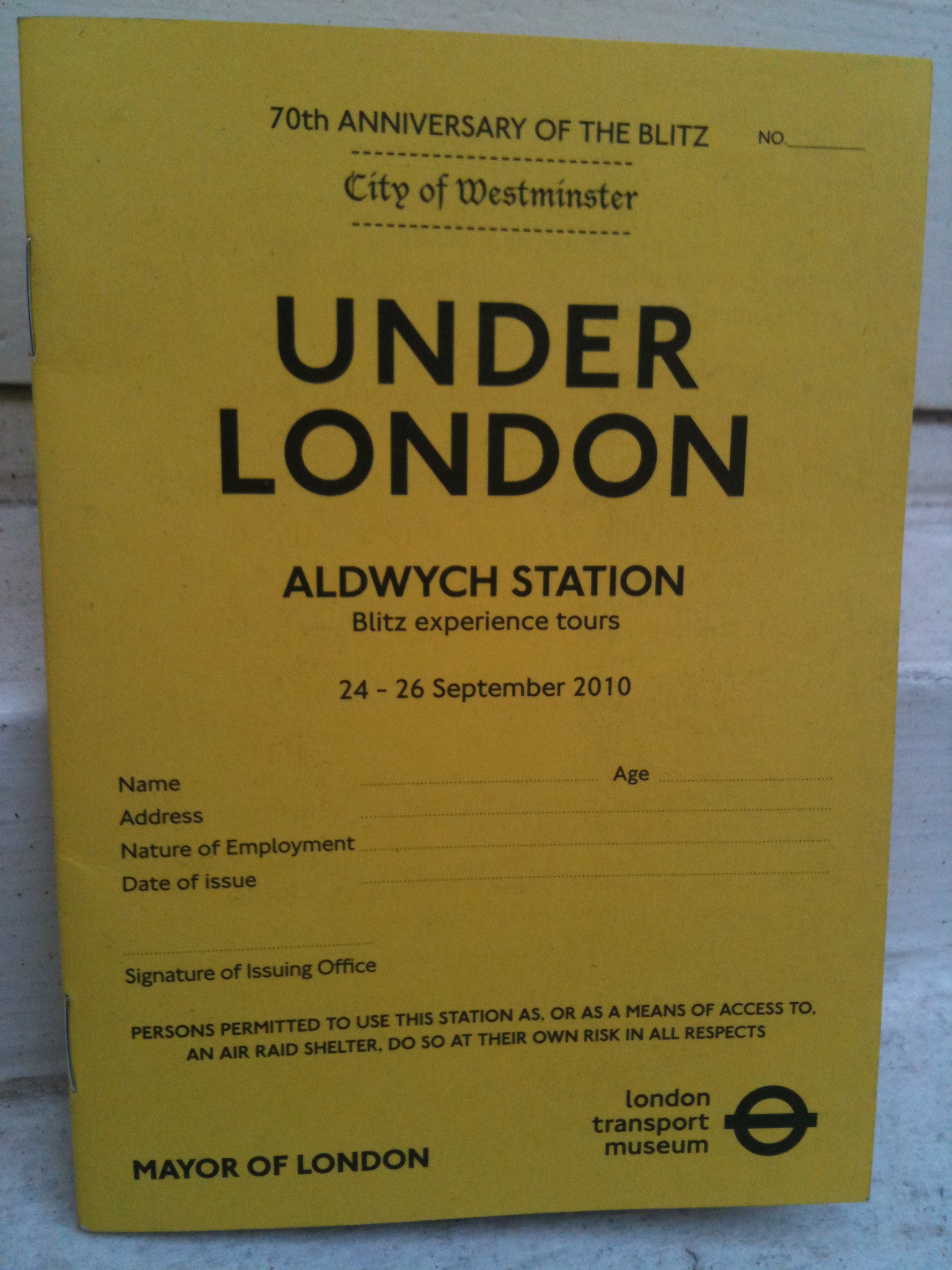
The other highlight is this cracking little souvenir book about Aldwych and the Blitz that is given to everybody who goes on the tour.
The tour ends with a deafening reconstruction of an aerial bombardment, with impressive sound and light, before the all-clear sounds and allows you to climb the steps back to the surface (no lifts or escalators, so prepare for a walk).

A recreation of the ‘Blitz experience’ is an almost impossible thing to pull off for obvious reason and this is neatly done in the circumstances, although it might have been nice to have bunks on the platform to give more of a flavour of what it was like to cower down there for a night.

Interest in the tours have been so great – an estimated 3,000 people will take part this weekend – that the London Transport Museum believe public tours of Aldwych will be reintroduced on an irregular basis in the future.

So that’s one ambition sated, only for another to take its place. Earlier this week I was talking to a curator at the LTM, who told me of his recent tour round Down Street, another abandoned station with wartime connections. It is, he told me, in ‘fabulous condition’. Anybody interested?

Diaghilev at the V&A

Two months ago I knew diddly about Diaghilev. Since then I’ve written two features about him – including this in the Independent On Sunday – and can confidently assert that this Russian-born impressario changed the face of ballet in the early twentieth century when his company, the Ballets Russes, enlisted artists and composers like Picasso, Matisse and Stravinsky to showcase the work of groundbreaking dancers and choreographers like Nijinsky and Massine. Such is the magic of journalism.

The occasion is the V&A’s big autumn exhibition, Diaghilev and the Golden Age of the Ballets Russe, which opens on September 25. It’s an incredibly rich exhibition, crammed with memorabilia and costumes and images and music. Highlights include the astonishing, undanceable costumes from Parade, Picasso and Cocteau’s ‘Cubist ballet’, the monumental back cloth from ‘The Firebird’, and a wonderful bust of Nijinsky that captures his odd features.

I’m not a great fan of the ‘blockbuster’ exhibition as they are rarely as satisfying and intelligent as intimate displays at the more thoughtful museums, but this one is a real cracker, demonstrating decades of learning and showcasing a marvellous collection of costumes bought in auction and secured in the V&A’s vaults for just such an occasion.

(There’s a nice piece here from Diaghilev’s biographer about the Russian’s relationship with London.)

Why is there no London monument for the Blitz?

‘When I reached the end of Milk Street, I looked out towards Moorfields across an area of devastation so final and complete that the memory of it will always rise in my mind whenever I hear the word Blitz. There is a savagery, a fury and a hideous wickedness about the ruins of London – and of Berlin also – that chills the heart.’

From HV Morton’s ‘In Search of London’

The Blitz began on September 7th, 1940, seventy years ago today, when London was attacked by 300 German bombers. It lasted three months as London was bombed for 57 consecutive nights. Between September 7 and May 11, 1941, 18,800 tonnes of high explosive was dropped on Holborn, the City, Westminster, Shoreditch, Southwark and Stepney. Up to 20,000 Londoners were killed, many thousands were wounded and 3.5 million houses were damaged or destroyed.

And yet, astonishingly, London – a city of a thousand statues – still does not have a single worthwhile monument to the citizens who suffered the Blitz.

The story of the Blitz is a familiar one – see this wonderful propaganda film for an emotional contemporary look at London under attack – and while the ‘Blitz Spirit’ narrative can be trite and over-mythologised, there was undoubtedly some truth to it. Londoners had to deal with the Blitz in part because they had no other choice, but there is evidence that Londoners did more than just survive, they almost relished the battering they received. As  Humphrey Jennings wrote at the time, Londoners were ‘secretly delighted with the privilege of holding up Hitler’, while Phillip Ziegler said in ‘London At War’ that ‘Londoners made a deliberate attempt to seem nonchalant and unafraid’.

Peter Ackroyd suggests that Londoners might have been able to cope because of spiritual kinship with the destruction of the Great Fire, an idea that HV Morton pre-emptively pooh-poohs in his elegiac 1951 classic ‘In Search of London’. ‘The Fire was an accident and it lasted a matter of days. The Blitz was the deliberate attempt of an enemy to subdue a city whose watchword has always been freedom… the effect of these two events upon the population cannot be compared.’

Yet while London has a Monument for the Fire, it still does not properly commemorate those who experienced the Blitz. There’s a small park in Wapping, a couple of minor plaques – one by St Paul’s, near the firefighters monument, and one in St James’s Churchyard on Piccadilly – and dozens of plaques to individual explosions.

But there is no single iconic statue or monument prominently placed and devoted to the citizens of London in the manner of that for, say Animals In War, or any of the numerous monuments for different branches of the armed forces (Bomber Command are the latest).

This was first pointed out to me in 2006  during an interview with Jack Lohman, the Director of the Museum of London, and his museum does now contain a stunning WWII tribute. The Blitz room is a single stark shadowy space, with an unexploded bomb hanging from the ceiling. The walls show still images of the Blitz, while survivors recount their experiences on audio. It’s incredibly moving, but it isn’t enough.

Why doesn’t London pay sufficient tribute to its Blitz Spirit? I asked Jane Furlong, project co-ordinator of the UK National Inventory of War Memorials, and her answer boiled down to one word:  politics.

Furlong told me: ‘As with all memorials, it’s down to whether individual groups or people want to commemorate something. Also, is there a need of it among those who lived to tell the tale? There are lots of service veterans who want to make sure what they did is never forgotten and a memorial is the best way to do that and so they can go away and organise and make sure it happens. It is all down to having that desire, the community needs to take the lead.’

Bomber Command is a ready-made community that can easily mobilise to commemorate their place in history; London’s civilians are not. Of course, that didn’t stop the Animals In War memorial from getting built, but they managed to enlist the high-profile support of patrons such as the Princess Royal, Kate Adie, Vera Lynn and Joanna Lumley. 

If London is to get the Blitz Spirit memorial it deserves – a dignified sculpture in a prominent public place, dedicated to all Londoners who experienced the Blitz – it requires somebody to take the initiative. And that, ironically, would chime against the spirit of the Blitz: one of exaggerated nonchalance at what took place over London in the winter of 1940-1941.

So it seems for now that the sad and powerful room at the Museum of London and an easily overlooked plaque in the shadow of St Paul’s are the best we are going to get. 

But I think that is a great shame and that ordinary working Londoners, as Ken Livingstone might put it, deserve better.

My London Library: No 2 – London’s Bridges

  • Title London’s Bridges by Peter Matthews (2008, Shire).
  • Cost Free.
  • Bought from Author.
  • Genre Straight history.

The endearingly honest opening line says all you need to know about this historical overview of London’s crossing points. ‘In 1938,’ Matthews reports, ‘an article in the Times observed that: ‘The people of London have a reputation for taking no interest in their bridges’.’

I bet the publisher loved reading that.

It’s a lovely book though, wordy but not too long, nicely illustrated and ruthlessly factual. Bonus points for including non-road bridges such as Grosvenor Railway Bridge.

There’s some great trivia to be found: ‘In 1873, the Royal Humane Society set up a 24-hour ‘receiving host’ by the northern end of Waterloo Bridge, manned by a doctor who would attempt to revive any suicide victims brought to him, and in 1875 alone 21 people were saved by this method’.

The author, Peter Matthews is a proper London nerd and runs the bookshop at the Museum of London, so you can be fairly sure you’ll be able to pick up a copy there.

Verdict Solid reference tome.

Jimi Hendrix in the suburbs

Jimi Hendrix’s London flat overlooking Mayfair’s Brook Street is opening to the public tomorrow (August 25th) for the Hendrix In Britain exhibition. The exhibition – which is being mounted by the Handel House Museum (Hendrix and Handel were temporally dislocated neighbours) – is a cosy affair, amounting to a costume, a guitar, some great photos, handwritten lyric sheets, posters (‘The Fabulous Walker Brothers/Cat Stevens/Jimi Hendrix/Englebert Humperdinck’), notes, including directions to the Isle of Wight for the famous festival, and his death certificate (’cause of death: vomit’).

Hendrix’s actual flat is now the Handel House Museum offices, but they will be moving out for two weeks in September so the public can have tours of the quite spacious flat Hendrix lived in with his girlfriend Kathy Etchingham. The museum hopes to open this flat to the public permanently when they manage to raise sufficient funding and get all the hash burns out of the carpets.

My favourite part of the exhibition was the giant map of Hendrix’s London that takes up one wall, with stickers donating key venues, hotels and apartments. Opposite is a list of the major concerts Hendrix played during his three years in London before his death. I was pleased to note that alongside the more famous clubs – Scotch of St James, the Marquee, the Astoria and the Royal Albert Hall – Hendrix found time to play the suburbs, including Bromley Court Hotel, Ricky Tick in Hounslow, Upper Cut in Forest Gate, the Ram Jam Club on Brixton Road, Granada Theatre in Tooting, Star Hotel in Croydon, Bluesville ’67 on Green Lanes,  and the Orchid Ballroom, Purley.

Hendrix in Purley, now that’s a side of swinging London you don’t hear much about these days.

Skin at the Wellcome Collection

My review of the Wellcome Collection‘s new exhibition Skin is in the New Statesman this week. Read it here.

Cunningly, I snuck the key phrase into the very opening paragraph:

‘Generally, museums put on exhibitions so that people can learn about things they don’t already know. The Wellcome Collection does almost the reverse: it prefers to start with something that is familiar – in this case, skin – and make it unfamiliar.’

Skin is another very good exhibition from the Wellcome, who stand almost unique among British galleries and museums as a body that is so rich they have no requirement to go cap-in-hand to the public purse or to private sponsors, and consequently have no need or desire to dumb down or exhibit tedious ‘blockbusters’ (I’m looking at you, British Museum) in a bid to pull a cash-and-existence-justifying audience through the door.

Few establishments are so fortunate and few curators would know what to do with themselves if given this sort of creative and intellectual freedom. 

Arts funding is going to take a proper kicking over the next few years. The Wellcome Collection will provide rare shelter from the storm, and one with free wi-fi, a bookshop and Peyton & Byrne cakes. What more can you ask for?

Museum of London reopening

My review of the Museum of London reopening appeared in yesterday’s Independent On Sunday. The museum has refurbished its entire collection from the Great Fire to the present day, something that necessitated closing down the lower-ground floor of the museum for four years. I’ve been on site at a number of times during the refurbishment, so had a good idea of what was intended, but was still hugely impressed (and, in a strange way, rather relieved as so many things can go wrong with these things) by the final result.

The museum now has a great blend of the old and new, with some genuinely impressive modern interactive but also loads of good old-fashioned things in cases. Check it out when it opens to the public on Friday May 28 (it is opening till 9pm on the first day). 

I suppose that a museum ideally wants the visitor feel they’ve ‘got it’ after just one visit, but not ‘got it’ so much that they won’t come back . They don’t want people to be so overwhelmed by information they can’t see what story the museum is telling, but they equally don’t want them to feel they’ve absorbed it all in one go, seen everything there is to see and so never bother returning. The Museum of London, I think, pulls off this delicate balancing act, while also being lots of fun, which is something every good museum wants and needs to be. 

Museum nerds might note that they also manage to subtly highlight a couple of their less appreciated areas of expertise – the excellent costume collection, which gets two strong displays – and their outstanding collection of oral history, which is used to tell the story of the Blitz.

I am particularly interested in oral history. These first-hand recollections from largely ordinary Londoners could be vitally important to future historians, and the museum continues to expand its collection at an impressive rate. One thing I firmly believe is that everybody has a fascinating story to tell, they just don’t always realise what it is about their lives that makes them unique and therefore interesting. Most people are too self-conscious when they write, so oral history is the best way to break down this barrier and capture those stories before they disappear forever.

Finally (and no, I’m not on the payroll), the museum also has a very good (and free) new iPhone app. Check it out here.

Magnificent Maps at the British Library

The British Library currently has an excellent new exhibition about maps called Magnificent Maps. I reviewed it for New Statesman (get me), and tried to focus on the sort of political aspects of the maps on display that would appeal to the generally Labour-supporting readers of the New Statesman, seeking any sort of diversion from the electoral massacre they had recently witnessed.

Diamond Geezer also took inspiration from contemporary politics with his review. He wins, I think.

The highlight of the exhibition for many Londoners will undoubtedly be Stephen Walter’s incredible idiosyncratic The Island, which you can study in detail here. This is a very personal and witty look at London by an artist. I particularly like the rather condescending but still satisfying comment he puts next to Herne Hill – ‘If I lived south of the river it would be here’. What finer praise could a North Londoner offer?

If you like maps a lot, you should also check out the hand-drawn gallery at Londonist. A little bird tells me that these may soon get a museum exhibition of their very own.

War (museums), what are they good for?

After last week’s trip to the Imperial War Museum North, this week I was at its southern sibling, the original IWM in Lambeth.

I always look forward to a trip to the IWM, not because I have a particular fondness for military memorabilia – although I did have a youthful obsession with the novels of Sven Hassel and still go weak at the knees at any mention of Colditz (it’s not my favourite prisoner of war camp, but I won’t go any further because I’ve probably already put you off with the words ‘favourite prisoner of war camp’) – but because the IWM has a well-deserved reputation, round my house at least, for putting on the best exhibitions in London. Only the Wellcome Collection can compare.

Their latest, opening in time for half-term, is the Ministry of Food about WWII rationing. Not the most promising subject, at least not until placed in the IWM’s capable hands. This, remember, is the museum that managed to make a subject as dull as camouflage not just interesting but fascinating and essential.

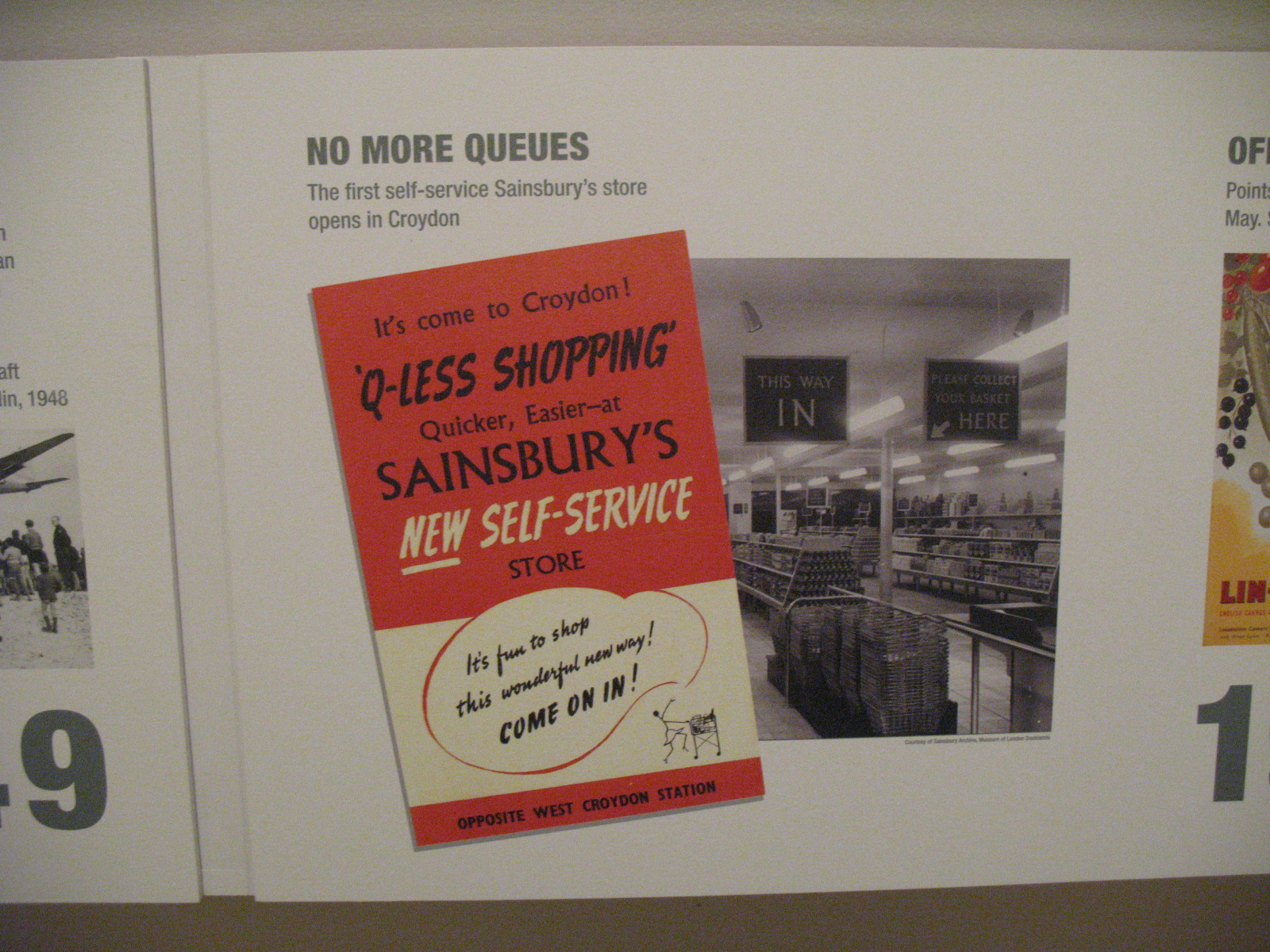
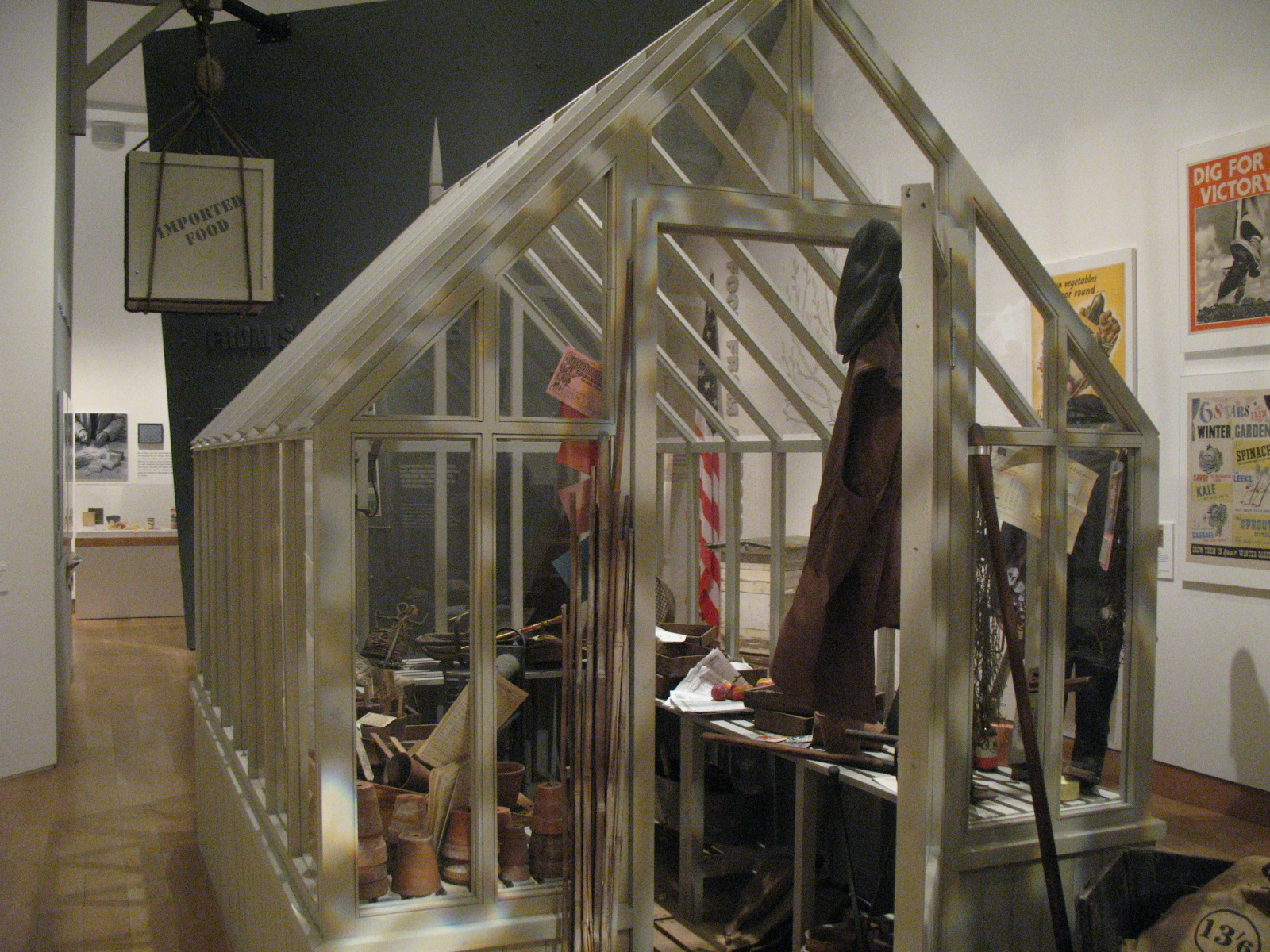
Starting with the land girls and ending with the arrival of Sainsbury’s in Croydon (pictured above), the exhibition looks at just about every aspect of food production during the war. There is a great selection of photos, paintings, posters and props, and also some terrific larger set-pieces such as a full-size greenhouse and a beautifully stocked walk-in wartime shop, a snapshot of which can be seen at the very top. The canteen is also running ration-themed food including mock goose, made with butter and marmite, although there is real food if that sounds a bit much.

It was educational, interesting, accessible, intelligent and fun – all those things an exhibition should be, but so often aren’t. And by that, I include most of those yawnsome chin-stroking ‘blockbuster’ exhibitions at the major museums that always get rave reviews even though everybody you talk to admits they found them a little dull.

No chance of that here. Look, it’s a greenhouse!

London’s museums face a tough time over the next couple of years, with severe budget cuts expected. At more than one museum, staff members have told me that they are expecting to take a hit whoever wins the general election ‘because they aren’t schools or hospitals’. Perhaps that’s as it should be and museums shouldn’t expect to be subsidised, but temporary exhibitions could easily suffer. They are expensive to mount and the bean-counters can be frustratingly short-sighted when it comes to the concept of long-term added value.

So go see Ministry of Food because a) it’s the right thing to do; b) it’s really very good indeed; c) you’ll discover a lovable character called ‘Potato Pete’. I wonder if he likes crisps?