Category Archives: Museums

How a shoe can teach the Holocaust

It starts with a shoe. An old shoe, scuffed, brown and small. It’s old and battered, and has been carefully re-stitched at the back where the seam has come apart. A classroom of Year Nine schoolchildren are asked what they can tell from the shoe just by looking at it. They agree it once belonged to a boy and that it’s been repaired a few times – perhaps by a family too poor to buy a replacement – but at some point was lost or thrown away.

Then the teacher tells them where the shoe was found, in Poland, outside a village called Oswiecim, and that it probably belonged to a boy from Hungary, who would have arrived there on a train with his parents nearly 60 years ago. After getting off the train, he would have been told to remove his shoes while he went to take a shower from which he would never re-emerge. Oswiecim is the place that we now call Auschwitz.

The Holocaust is a daunting topic for schools. Pupils can be overwhelmed by the sheer scale of the genocide, and troubled by the complex emotions it can raise. For their part, teachers can struggle to define the Holocaust correctly, or explain why it happened and what made it so uniquely horrific.

Which is where the shoe comes in. ‘There are lots of issues when teaching emotional subjects like the Holocaust,’ says Paul Salmons, who created the Holocaust Education Development Programme (HEDP), a course prepared by the Institute of Education to help secondary school teachers. ’It has the potential to raise profound questions and move children very emotionally. This course tries to balance an emotional engagement with a cognitive reflective approach.’

The story of the shoe, explains Salmons, ‘isn’t just intended to get an emotional reaction, it is to raise questions in response to the children’s emotional encounter.’ So after the children are told about the shoe, they are encouraged to ask questions. What happened to the boy’s parents? Why did they allow him to die? Why was he killed at all? From here, a discussion about the Holocaust and its repercussions can begin, with teachers using material taken from the HEDP website. It is a fascinating and intuitive way to introduce the subject, immediately bringing something huge and monstrous down to a level that a child can comprehend.

The course was developed in response to research conducted by the IOE in 2006. This showed that while the Holocaust was widely taught in schools – it has been on the National Curriculum since 1991 – there were many areas where knowledge was lacking. The research also revealed that 77.5 per cent of teachers wanted professional guidance, finding it difficult to convey the enormity of the genocide without inundating children with brutal images.

‘It is important children learn about the Holocaust because of its significance in world history, but it’s equally important not to traumatise them,’ says Salmons. ‘We have a history of human atrocity that’s also a history of forgetting and until the Second World War, nobody tried to analyse man’s capacity for self-annihilation. So we see the Holocaust as pivotal in understanding certain things about human nature and important for children’s social and political education and historical literacy.’

The Jewish Museum

This is done without using images of heaped corpses or film of mass executions. On the first day of the course at London’s Jewish Museum, tutor Kay Andrew tells the 15 teachers that this is ‘not about threatening or graphic images. Traumatic images can be seen as leading material.’

Peter Sullivan, a history teacher at Forest Gate Community School in East London, concurs. ‘These images can actually lead to arguments about holocaust denial – kids will say that they were staged or are of prisoners-of-war who died of natural causes – so we try to use more specific material to avoid pointless arguments.’

Is Holocaust denial really a problem in secondary schools? ‘You do get some of the Muslim kids, not so much in denial, but arguing that they deserved it because of the way they treated Palestinians. A percentage cannot differentiate between Jewish and Israeli and don’t have the life experience to put it into the proper context. It’s not just the Muslim kids, just up the road is Barking and Dagenham where the BNP are active, and when Nick Griffin says “I can’t deny the holocaust because it is illegal to do so” you know exactly what he’s saying. We have to combat that.’

Salmons says ‘The issue is more Holocaust diminishing or trivialisation,’ he says. ‘The way it can be used to suit different agendas or to promote a cause.’ He cites the example of the invasion of Iraq, when ‘there was a tendency to equate Saddam Hussein with Hitler in a fairly unreflective way perhaps designed to mobilise people behind a policy, which should have been argued on the merits of whether it was right or not, not by appropriating something powerful from the past. If young people are aware of what really happened, then they are better equipped to make that judgment for themselves.’

Leon Greenman

The course puts the Holocaust into context. On the first of two days, Andrews covers a number of different topics that have little to do with genocide itself. Teachers look at the diversity of pre-war Jewish life to ensure teachers don’t present the 6 million as a faceless monolith, and are asked to consider different forms of resistance and resilience to escape notions of the Jews as passive victims. The story of Leon Greenman, a British-born Jewish man who lived in Holland and whose family was killed in Auschwitz, runs throughout the course. ‘Leon was taking about his experiences from the very beginning,’ says Andrews. ‘We have archive of him talking to the BBC in 1945. He remained active in anti-fascist politics and received an OBE from the Queen, so you can explore the influence of the Holocaust through the life of this one man.’

The course does not neglect the other Nazi crimes, including the persecution of Jehovah Witnesses, Communists, homosexuals, the disabled and the Roma. Salmons explains, ‘We take an academic definition of what the Holocaust was – that it was the genocide of European Jewry by the Nazis and their collaborators – but you have to look at other victims. They are part of the broader context and a lot of these crimes overlapped, but if you lump them together and call them the ‘Holocaust’ it ceases to have much meaning, because the differences are as important as the similarities. With the genocide of the Roma-Sinti, there is a parallel to the Holocaust but one that has its own name – the Porajmos – and it needs to be studied with its own significance.’

The course is part-funded by the Pears Foundation, a philanthropic venture who have recently invested £1.5 million in the UK’s first Institute for the Study of Antisemitism at Birkbeck and donated funds to London’s Wiener Library, the world’s oldest Holocaust library.

Improved understanding of the Holocaust in schools could help combat increasing anti-Semitism, but Salmons says it isn’t as simple as that. ‘We don’t cover contemporary anti-Semitism, but do try to understand the historical and ideological anti-Semitism of the leading Nazis. But we also explore how you didn’t have to be anti-Semitic to be complicit in genocide, you just had to benefit from it. Many Germans bought the goods of Jewish neighbours in auction, which means they give tacit approval. We hope that young people aren’t racist, but they can still be unwittingly complicit in all sorts of injustices without having any personal or ideological prejudices.’

The Siege Of Sidney Street

My review of the Museum of London Dockland’s exhibition on the Siege of Sidney Street can be read in the New Statesman.

For once, I have little more to add. It’s an excellent exhibition and I recommend heading to Docklands before it ends in April. For more on the siege, you can see Pathe newsreel footage here or read Caroline’s article here.

Or you can watch a clip from the 1960 movie loosely based on the events.

Mucky pics in Victorian London

It can be hard to persuade people to visit historic houses, which makes you wonder why the owners of 18 Stafford Terrace don’t make more of the secrets that are hidden in the attic.

Stafford Terrace in Kensington is also known as Linley Sambourne’s House. Sambourne was a cartoonist for Punch who bought the five-storey terrace in 1875 and decided to decorate it as fashionably as he could, along aesthetic principles. This meant much William Morris wallpaper and exotic furniture. The problem was, Sambourne was not a wealthy man, so he purchased the latter from house clearances and junk shops and to make the former go further, he would cut out bits of wallpaper that were hidden from sight behind paintings and furniture and use them to paper other parts of the house. And he had a lot of paintings and furniture.

When Sambourne died, his son kept it exactly as it had been left, as did the following generations, until Stafford Terrace, now essentially a time capsule of Victorian middle-class life, was purchased by the GLC.

And that is how it has remained. The house is now owned by Kensington & Chelsea and run by nearby Leighton House.  Visitors get to see inside a fascinating interior and learn about the fashions of the Victorian middle-class first-hand.

But there’s more.

Sambourne was a cartoonist, but he also developed an interest in photography. He realised that instead of drawing his caricatures from scratch, he could get people to assume certain positions, photograph them, and then sketch the results. In his backyard he would get the coach-driver to dress as the statue of Eros, or pretend himself to be a tennis player or Roman soldier, using props from around the house. Here’s an example.

But there’s more.

Sambourne also started a Camera Club. Here his subjects tended to be more specialist.

For some reason, Camera Club always took place when Sambourne’s wife was visiting friends in the country.

In the attic of 18 Stafford Terrace, on a very high shelf, are several unmarked volumes packed with this sort of photographic work. Some are displayed in the bathroom for public study.

Mocked up in the same attic room is a demonstration of how Sambourne worked. An easel contains a cartoon of three women on a bicycle, copied from an adjacent photograph of three women pretending to be on a bike. In the photograph, all the women are nude; not so in the cartoon.

But it doesn’t end there.

Sambourne would also take his camera out with him when he was in Hyde Park or mooching around Kensington, and take surreptitious images of passing nursemaids, which he would carefully file as ‘Zoological Studies’. He even purchased a special camera with a secret lens that took pictures at right-angles so his subjects would be completely unaware as to what was going on. He still received a number of warnings for his behaviour.

And he also liked to take pictures of his maid. In bed. Asleep.

There’s nothing quite as creepy as a middle-aged Victorian male, is there?

See also The Man From London and Virtual Victorian.  

Secret London: inside the Black Museum

I first read about the Black Museum when I was a boy, a macabre museum run by the police filled with artefacts taken from their most gruesome cases. I always wanted to visit, but the museum was out of bounds to the public. When I was at Time Out, I asked the Met to let me write about the museum and after some badgering – and to my great surprise – they finally agreed. The result was not quite what I expected. There is an interesting coda to this piece. Upon publication, the press officer phoned me to say how disappointed they were with the tone of the article; at exactly the same time, the Curator sent me an email saying the piece was the best description of the museum he had read. Make of that what you will…

The Curator pulls open a drawer full of shotguns. ‘Which of these are real and which are replicas?’ he asks. I nervously peer inside.
‘Too late,’ he says. ‘You’re dead.’

Welcome to the Black Museum, the Met Police’s private memorial to  London’s worst crimes. The public isn’t allowed inside, and after a half-hour tour, I wish I hadn’t been either.

Death masks and weapons from the Black Museum

The Black Museum (renamed the Crime Museum after complaints from officers in areas with large ethnic minority populations) has been one of the world’s most macabre and inaccessible museums for over a century, acquiring a certain infamy among hardcore Londonphiles and the sort of people who spend their spare time reading ‘The World’s Greatest Serial Killers’.

The museum is closed to the public but, after repeated requests, The Curator has allowed Time Out inside, albeit under duress that he makes no attempt to disguise. From his office in Scotland Yard’s Room 101 (and who says the police have no sense of humour?), where the walls are covered in police badges from forces around the world and shelves stuffed with books such as, er, ‘The World’s Greatest Serial Killers’, The Curator – two parts John Thaw to one part librarian – lays down the law. He doesn’t want to be named or photographed, and if the piece results in people phoning him up to try to get access to the museum, well, he’ll hold me responsible.

Ground rules established, The Curator unlocks the door, and the tour begins. The Crime Museum has been at Scotland Yard since 1874, moving with the Met from Whitehall to Victoria Embankment in 1890 and then Victoria Street in 1967. It was set up by Inspector Neame after an 1869 law allowed the police to retain prisoners’ property for ‘instructional purposes’. Neame felt it was important that police officers could see the tools of the criminals’ trade – a function the museum still fulfils today – and gradually built up the museum’s collection.

In 1877, a reporter from the Observer was refused entry and wrote about Scotland Yard’s ‘black museum’. The name stuck, and the museum became a popular destination for Victorian celebs: Gilbert and Sullivan, Sir Arthur Conan Doyle, Harry Houdini and Laurel and Hardy all had a ghoulish gander.

The room we enter has been mocked up to resemble the original Whitehall museum, with a false fireplace and sash window. The first thing you see is a hangman’s noose, followed by a desk covered with knives and guns, and a chest of drawers topped with a glass case containing submachine guns. An opening leads from this ante-chamber into the museum proper.

We start at the gun drawer. As well as rifles and replica rifles, it contains walking sticks, umbrellas, flick knives and other random bits of metal. The Curator asks me to guess which of these items are guns, pauses for a heartbeat, before stabbing with his finger: shotgun, shotgun, pistol, shotgun, pistol. They’re all guns, the walking stick and umbrella, even the flick knife. And all have been used on London streets. He takes out a walking stick, demonstrates how quickly and easily it converts into a gun and back again, and shuts the drawer firmly.

The Curator is enjoying himself, less begrudging by the minute. He picks up a sword and hands it to me. As I take it by the scabbard, he pulls off the hilt, which is a short, detachable, vicious blade, and imitates gutting me with it, which, he says, is exactly what happened to the police officer who first encountered this duplicitous double-weapon. It’s called the Cop Killer, he says. And, just like that, any lingering sense of fun wafts out the window.

The point of this drawer, The Curator explains, is to show new coppers the dangers they face from disguised weapons (the walking-stick gun et al were legal until 1959).  The inference is clear: anything is a potential weapon.

The Curator is passionate about the museum’s purpose and happiest when discussing the history of crime. Everything that comes into the museum, he emphasises, is for teaching purposes, and not just for cadets. Senior officers come here for briefings and lectures to discover historical parallels of contemporary cases.

We move into a large room with the fusty atmosphere of a regional museum. Display cases that mark out a mazy circuit of London’s criminal history. One of the first is on serial killer Dennis Nilsen, who boiled the flesh of his victims on his stove before poured their fat down his drains. I look at the Nilsen display. It’s a badly stained cooker topped by a battered aluminium cooking pot. I feel sick.

Nilsen’s cooking pot

The rest of the tour passes in a blur. There’s a display on officers killed in the line of duty; the protective apron used by John Haigh, the Acid Bath Murderer; vials of poison; forensic photographs; blood-stained weapons; a crossbow used by the Krays; a ketchup bottle from the Great Train Robbery (‘I can’t talk about that,’ says The Curator cryptically); evidence related to Crippen, Christie and cannibalism; explosives used by Fenian terrorists; the IRA rocket launcher that fired at the MI6 building in 2000; and the tiny ricin-loaded pellet pulled out of Georgi Markov’s leg, where it had been inserted with an umbrella.

It’s a tough tour, not because of any individual items (Nilsen’s cooking pot excepted) but through the accumulated weight of otherwise anodyne objects that collectively represent the many horrible things people have done to each other. It’s a chilling, unsettling experience that sits somewhere between the self-chosen prurience of reading a book about Fred West and the necessary horror of the Imperial War Museum’s Holocaust gallery.

The Curator reassures me that visitors, police officers included, regularly faint during tours, but this is clearly a museum that has been designed by the police, for the police. That point is underlined by one of the last displays, a huge pile of weapons taken from demonstrators at an anti-Vietnam War march in 1968, a so-called peace march comments The Curator, as well as riot shields from Brixton, melted by petrol bombs, and Broadwater Farm, peppered by bulletholes. This is what you are up against, the display says. Trust nobody.

Police at Broadwater Farm

The result is a museum that works on two levels: one is the straightforward practical side that allows policemen to see and handle real evidence and learn how it was used to solve cases, while the other, possibly more important, is psychological, showing the police what the people out there will do to them, and each other, given half a chance. In so doing, it validates the Met’s instinctive suspicion – as embodied by The Curator – of outsiders, the public, the people they protect and serve.

I leave the Crime Museum in a sober mood, sure of only one thing: having tried so hard to get inside, I’m in no hurry to return.

Stoney Jack and the Cheapside Hoard

The Cheapside Hoard is one of the great treasures of the Museum Of London. A vast collection of Tudor jewellery, it was found by two workmen in the cellar of a house on Cheapside in 1912 and eventually made its way into the museum’s collection.

The story is a fascinating one, outlined in HV Morton‘s seminal London history ‘In Search Of London’.

Morton, a journalist and insatiable London enthusiast with the knack of knowing not so much the right people as the really interesting ones, begins by describing GF Lawrence, ‘or Stoney Jack as he was known by every navvy who worked in the City’.

Stoney Jack was an asthmatic antiques dealer with a shop on West Hill, Wandsworth. He also had a job as Inspector of Acquisitions at what was then called the London Museum, based in Lancaster House, St James’s.

Since the 1970s, every building site in the UK must by law be visited by a team of archaeologists to ensure no great treasures are missed, but in Lawrence’s time there was no such requirement. Lawrence’s job then was ‘to haunt every demolition site in the City and make friends with the navvies, so that they would bring to him anything that had been found during excavation’.

Morton writes that there was a lot of building work taking place at this time and Lawrence knew it may be the last chance to find any antiquities that might still be hidden in the soil. In his not entirely public-spirited determination to ensure nothing crucial was lost, workmen received rudimentary archaeological training during ‘mysterious transactions behind hoardings and in the tap rooms of City public-houses’.

In this way, Lawrence was able to purchase items from ‘a procession of navvies with mysterious objects wrapped in spotted handkerchiefs’ and flog them on to the London Museum, earning himself a tidy profit. Anything the museum didn’t buy, went into his shop. And even if the navvies brought him something worthless, he always gave them enough cash to buy a pint of beer. In this way, he built up much of the Roman and Medieval collection that is now in the Museum of London.

Morton continues:

I cannot count the times I have been present when navvies have appeared and passed their treasures across the counter with a husky, “Any good to yer, guv’nor?” I have seen handkerchiefs unknotted to reveal Roman pins, mirrors, coins, leather, pottery and every kind of object that can lie concealed in old and storied soil.

I was with him one day when two navvies handed over a heavy mass of clay found beneath a building in Cheapside. It was like an iron football, and they said there was a lot more of it. Sticking in the clay were bright gleams of gold. When they had gone, we went up to the bathroom and turned the water on to the clay. Out fell pearl earrings and pendants and all kinds of crumpled jewellery. That was how the famous hoard of Tudor jewellery, the Cheapside Hoard, was discovered.’

Morton recalls that for this great find, now worth millions, Stoney Jack received a thousand pounds. For their part, the navvies were rewarded with ‘something like a hundred pounds each, and I was told that these man disappeared, and were not seen again for months!’

Gertcha to the British Library, for Viz, Austen and Evolving English

I’ve seen three new exhibitions since being bored senseless by the British Museum’s Book of the Dead, and all of them are vastly superior to that banal blockbuster.

While the British Museum takes a complacent Tesco-like approach of pile it high and intimidate people with sheer weight of history, the Imperial War Museum, Wellcome Collection and British Library all have to work a little harder to get any attention and the results are far more satisfying.

Take Evolving English at the British Library, a superb exhibition about the history of the English language that offers both intelligence, insight and, most tellingly, the cheerful sense of humour that is lacking from Great Russell Street.

There are showstopping exhibits here, such as manuscripts of Jane Austen’s ‘Persuasion’ and Joyce’s ‘Finnegans Wake’ and a copy of ‘Beowulf’, while the curators were ecstatic about a cabinet that featured side-by-side four historic bibles – the Wycliffe, Tyndale, Book of Common Prayer and King James.

But there are also wilder treats hidden in the margins.

One section on the differences between spoken and written English was illustrated by letters from schoolchildren to their teacher, my beloved BS Johnson, written in a glorious mixture of slang, formality and stream of consciousness that later found their way verbatim into his novel ‘Albert Angelo’. (‘Mr Johnson has a poor outlook towards us, calling us peasants and other insulting names of which we would like to contradict… Mr Johnson on the whole although he isn’t all there is a rotton teacher but not proffesionally for he teaches well… in school Mr Johnson is an authentic nit.’)


The section on profanity is illustrated with a copy of ‘Lady Chatterley’s Lover’ and a copy of Viz, while you can explore London English by reading extracts from Charles Dickens or you can just listen to ‘Gertcha!’.

London English, we are reminded, adopts words from many different cultures and I was intrigued to learn about the history of the Black London idiom ‘aksed’ for ‘asked’. This apparently originated in south-west England and found its way to the Southern US states and the Caribbean through emigration, before returning to London via the West Indian diaspora. Take it away, Smiley Culture.

Being brave in SE8: Extraordinary Heroes at the Imperial War Museum

Have you ever heard of Geoffrey Keyes and Operation Flipper?

I hadn’t until this week, when I learnt that Keyes was a Second World War commando who led a team 400km behind enemy lines in North Africa in a bid to assassinate Erwin Rommel. The group evaded guards around the perimeter fence and got inside the house used as the German HQ, but as they entered a ground-floor room Keyes was shot and killed. Rommel wasn’t even in the house at the time.

Keyes was awarded a posthumous Victoria Cross and his story is ripe for a film, but this is the first I’d heard of it.

The new Extraordinary Heroes gallery at the Imperial War Museum is full of such remarkable tales, 243 in all, each tied to either a Victoria or George Cross. 164 of these medals belong to Michael Ashcroft, the Tory party donor, who has also forked out £5m for a new gallery to house them – the first permanent gallery at the museum for a decade. Well, I guess it beats paying tax.

The gallery is a great example of how with a bit of thought a museum can make a lot out of a little. The exhibits – the medals – are not much to look at, and the VC itself is almost parodically tasteful, a modest thing of dull brass (it’s made of gun metal) with a sober ribbon the colour of dried blood. There are numerous medals on display here, and the VC is always the least conspicuous of the lot.

But the curators have done wonders with this unpromising material, emphasising the extraordinary stories behind each medal with frugal but compelling text and embellishing some of the tales with props such as the diving suit worn by James Magennis when placing mines on a target in 1945 or a portrait of recent VC awardee Johnson Beharry taken by Don McCullin.

Johnson Beharry VC by Don McCullin, 2010 - Imperial War Museum

 There’s wit here as well such as a stuffed white rabbit to represent the codename of spy Forest Yeo-Thomas or the surprisingly effective touch-screen version of some of the stories told in Victor comic style. The IWM uses these informal touches confidently, never lapsing into poor taste and aware that excessive sobriety can be just as offputting.

While the bravery of these men and women is moving, the circumstances are often maddening. Many medals were awarded during the carnage of Gallipoli, and there was something about the story of Alfred Wilkinson, a Private who was awarded a VC for delivering a message during the First World War after four previous messengers had died, that somehow summed up all that is most horrific and pointless about that conflict.

Some medals were awarded in peacetime. An 11-year-old girl was given a George Cross in Canada in 1916 for fighting off a cougarm, while Harry Wilson was awarded a GC in 1924 for saving the lives of his colleagues in a flooded colliery.

And, bringing it all back home, a George Cross was awarded for bravery in South London after unarmed PC Tony Gledhill chased a car filled with armed robbers from Creekside Street, Deptford into Rotherhithe. Gledhill’s car was shot at around 15 times by the robbers before he confronted them on foot and eventually subdued the men, securing the conviction of four criminals, including John McVicar.

There’s always a London connection if you look hard enough.

Book of the dead dull: against blockbuster exhibitions

A new British Museum exhibition opens this week and it’s already a guaranteed success. But that doesn’t mean it’s any good.

I went to the press view of the Egyptian Book Of The Dead and afterwards felt much the same as I do after every British Museum exhibition: overwhelmed and underimpressed. But I knew that all the big reviewers would give it a knee-jerk five stars – and sure, enough, before I’d even got home, the first suitably awestruck review was in. Meh.

So why was I so bored, and am I on my own with this? Well, the exhibits are undoubtedly important and fascinating – papyrus and artefacts taken from Egyptian tombs, many dating back more than 3,000 years, which together tell the story of the Egyptian belief in the afterlife. But, gawd, ain’t there a lot of it? And why does the exhibition space look so bloody boring?


The British Museum has an incredible talent at taking something potentially fascinating and kicking all the life out of it through stuffy, unimaginative presentation and a conviction that more is better – and getting away with it every time. 

At Book Of The Dead we get acres – and I really mean acres – of stuffy captions and endless cases containing aged papyrus covered in hieroglyphs, with only the odd gaudy mummy case by way of variation. After seeing the first room, I felt I’d seen it all and would have had a more enjoyable experience sitting down with a cup of a tea and reading a good book on the subject. But I still had another dozen rooms to trudge round. Exhibitions are meant to bring a topic to life, but this was deadening. And I was lucky enough to be there when it was relatively empty – for the average punter, it must be chaos.

I’m not sure I’m entirely out on my own here – on my way into the exhibition I bumped into a friend coming out, and he said much the same thing, as did Time Out Art on Twitter. But the British Museum’s methods clearly convince most of the reviewers and they certainly draw the crowds; these are, after all, two of the constituents museums most need to impress. 

As a lover of museums, though, I cannot help feel that the BM is doing the art of exhibitions a disservice. There is none of the thoughtful wit of the Imperial War Museum, or the layered smarts of the Wellcome Collection, or the sheer intellectual depth of the British Library, all three of whom have new exhibitions opening next week that will not get anything like the attention of the BM.

The British Museum make museum-going into something worthy rather than fun. My fear is that thousands of people will push through heaving crowds to see this exhibition drawn by fawning publicity and out of a sense of duty, before emerging battered and bored, vowing to never visit another museum until the next blockbuster rolls into town. That really would be a shame.

Jeremy Deller’s Baghdad car at the Imperial War Museum

If the V&A’s latest exhibition demonstrates that big can be beautiful, the new acquisition at the Imperial War Museum shows that small can be profound.

It’s a car, badly damaged and barely recognisable, that was caught in a suicide bomb blast in Baghdad in 2007. The artist Jeremy Deller got hold of it and toured it across America on the back of a truck in the company of a US soldier and an Iraqi citizen for a piece entitled It Is What It Is. Now, shorn of any artistic element, it is on display at the Imperial War Museum. My review in the New Statesman can be read here.

After interviewing Deller, I avoided reading too much about the car before I wrote the piece other than this by Jonathan Jones in the Guardian. Jones, I think, slightly overdoes his praise – is it really true that ‘a dismembered body is what you immediately think of when you come into the museum and see a car’? – while the commentators beneath the line seem obessessed with the pointless and hoary argument about ‘what is art’.

They’ll never be able to answer that question from behind their computer screens because this compelling and thought-provoking piece needs to be seen on location and in context to be fully appreciated. It’s a fine and valuable addition to the IWM’s collection and makes a fascinating footnote in the history of war art.

Oh, and Jeremy Deller is one of the nicest famous people I have ever interviewed, right up there with Graham Taylor, the former England manager, belittled turnip and little appreciated ballet enthusiast.

How to tell the Story of London

The Story of London festival was introduced by Boris Johnson last year and immediately came under a lot of fire. Here’s something from Boris Watch plus stern words from Diamond Geezer.  

The festival is not a bad idea. It’s intended to cover the history of London in a way that includes all boroughs, all ages, all races and all genders – a riposte to Ken Livingstone’s habit of staging festivals for different minority groups at a Balkanised Trafalgar Square.

But it doesn’t work.

Part of the problem is publicity, and this is of the mayor’s own doing. In 2009, there was little or no attempt to promote the nascent festival by the city’s tourist office because their funding had just been slashed by Boris and they pretty much refused to help. 

The organisers then had to take their minute budget to Time Out, where I ended up knocking up a few pages to pull out of the middle of the mag that due to a hilarious production error did not actually pull out. It was nothing like the sort of lavish inserts the company can produce when given some cash and time. 

The other problem is that London already has loads of festivals – Open House, Meltdown, the London Film Festival, London Design Festival, the City of London Festival and dozens more – while institutions such as the Bishopsgate Institute regularly put on fantastic cultural events. And that’s before we even bring in the other museums, universities, galleries and scientific institutions.

 The Story of London simply does not have a distinct identity to compete with these established players.

With barely a niche to be found in London’s crowded cultural calender, Story of London has taken to hijacking and rebranding existing events, which doesn’t impress anybody. And they are so busy doing this they forget to organise any showpiece events that would help to give the festival a character of its own. Plus, they don’t have any money.

The result is a bit of a mess.

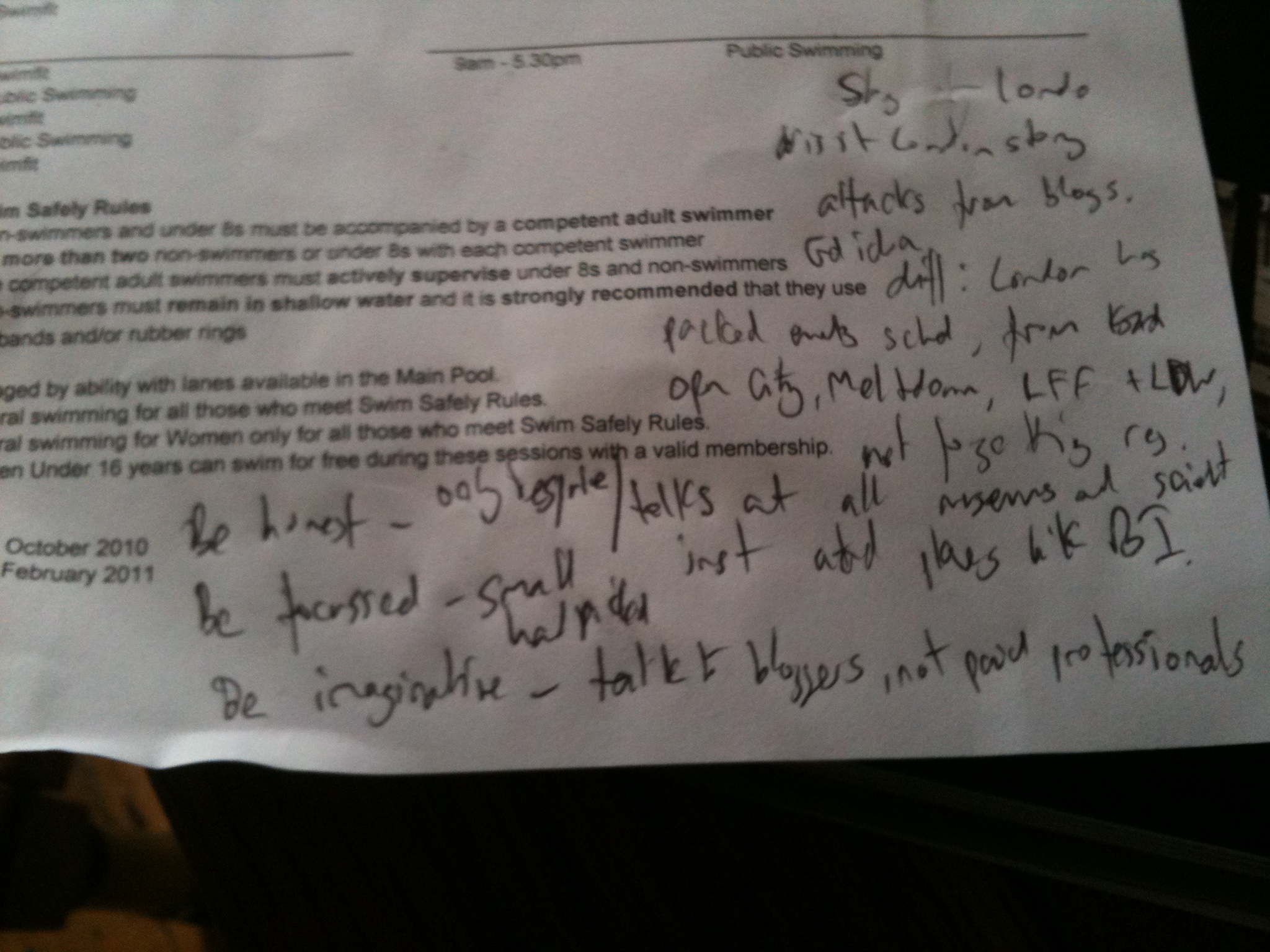
So what could they do? Fortunately for them, I was able to scribble a few suggestions on the back of a press release in between playing Secret of Monkey Island on my phone and wondering why I’ve rarely heard of a single person who appears in the Standard’s Londoner’s Diary.

  • Be honest – don’t hijack events that have nothing to do with you as it just looks cheap. And if you insist on this policy, it means that desperate organisers of terrible events will attempt to smuggle their substandard fare into your festival and you’ll have no way of keeping them out.
  • Bespoke – ensure that anything carrying the Story of London banner is new and brilliant and has genuinely been arranged specifically for the festival. That makes it fresh and makes it exciting and should ensure that you can keep an eye on the quality control.
  • Be focused – find a theme and stick to it. Make it broad and make sure that every borough has at least one institution participating. Narrow the time frame so it all takes place on a single weekend. Keep it tight at first and let it grow organically. At the moment it is a big blancmange of a festival when it should be as tight and pretty as an avocado stone.
  • Be clever – one of the best festivals the mayor currently has at his disposable is the Thames Festival, so hook the whole thing round that. A wee bit of rebranding – and yes, this is hijacking, but it’s hijacking with a point – and you have a ready-made spectacular way to close the weekend with the annual fireworks display.
  • Be imaginative – the guys from the Londonist website are already involved in one small event, but why not ask them to think up something big and crazy? These – and other – bloggers live and breath London in a way few paid professionals can compete with, so talk to them. They may not be interested, they may have terrible ideas, they may have no ideas, but they may just come up with a couple of events that curators and pros can turn into something special. Because at the moment, as Ian Visits says, the Story of London is just ‘a way for a lot of venues who are already planning to do something to get involved in a joint media campaign’.

And that’s as far as I got. LeChuck was causing all sorts of problems and I had to Google Laura Weinstock. But hey, it’s a start.