Category Archives: Museums

Mudlarking

Last winter, I went mudlarking on the Thames shore. This is an edited version of the article I subsequently wrote for Eurostar (image below from Knowledge Of London).

You’ll see them at low tide, wandering alone with bent necks along the damp and desolate mudflats of the Thames. These are the mudlarks: amateur archaeologists, beachcombers and scavengers who delight in rediscovering lost detritus from London’s past. Although they are wearing waders and carrying metal detectors, they look much like giant birds, storks or herons, as they walk with heads bowed and eyes fixed on the floor, scrutinising the mud and pebbles for hidden treasure. They’ll occasionally scratch at the surface with an extended toe if they see something they fancy. And then they’ll pounce, darting down to peck something from the ooze, before deciding whether to add it to the day’s hoard.

The tidal Thames has been described as ‘London’s largest and richest archaeology site’ and it’s certainly the longest in the country, stretching from the Thames Barrier to Teddington Lock. For centuries, the river in central London was used by boats bringing cargo from all over the world. Thousands of people worked in these docks and warehouses, and items that have fallen from boats or pockets or been casually discarded by Tudor dockers are still lodged in the London mud, waiting to be revealed whenever the tidal river withdraws.

Mudlarks have been prowling here for centuries. In Georgian and Victorian times, they were the desperately poor searching for things to eat or sell. By the 1960s, the term referred to unofficial archaeologists who formed the Society Of Thames Mudlarks in 1980. A few years later the Port of London Authority (PLA) – the body in charge of the river – offered the mudlarks licences to dig on the foreshore in return for having their finds officially recorded by the Museum of London. The mudlarks have thus helped build an unparalleled record of everyday life on a medieval river.

Ian Smith is one of them. His patch is the north bank of the Thames between London and Southwark Bridges, outside Customs House, where pre-Victorian cargo ships would have been checked for contraband. This was once the Pool of London, the main unloading point for boats that could not fit between the pillars of old London Bridge, and a place rich in treasures. ‘I started in 1973 as a schoolboy,’ says Smith on a bracing winter morning. ‘I grew up in Battersea and saw a TV show about a man who found these old clay pipes in the Bristol Channel. So I came down to see what I could find. I spent about a year working down the river bit-by-bit until I got to Blackfriars where I saw this group of people, a little cluster of them, and I went over with my collection of pipes. And where they’d been poking about there were pipes everywhere, loads of them, they were just ignoring them and looking for other stuff. So I started chatting and that’s how I got started.’

The thick black mud of the Thames conceals rich treats, everything from prehistoric flints to Victorian toys. The mud is anaerobic – without oxygen – so preserves just about anything. Kate Sumnall works for the Museum of London and the Portable Antiquities Scheme as a Finds Liaison Officer; it is her job to manage the licence scheme and register everything the mudlarks find. She says, ‘London is different to most places in terms of the preservation and the proportion. You wouldn’t get iron daggers in a field, it would be eroded, but Thames mud is anaerobic so things don’t decay. And you also don’t have aggressive chemicals and ploughs, which damage items in the ground. You can still find medieval leather in the Thames.’

Smith believes the Thames has three other benefits. ‘London is almost unique,’ says Smith. ‘Most rivers aren’t tidal, so that’s one thing, but you’ve also got the river going through the centre of town rather than round the outside. And the third thing is that in the Victorian era all the docks got moved over to the Isle of Dogs, so that means the early stuff has been left in the ground rather than dredged away centuries ago.’

This is what makes the Thames such a popular and lucrative haunt for the mudlarks. There are around 50 with official permits, granted by the PLA after an individual has spent at least two years on the foreshore getting experience and demonstrating a history of recording their finds. ‘The mudlarks have huge value,’ says Sumnall. ‘They have sold us entire collections in the past and these have gone on to form a crucial part of the museum. But they are also immensely helpful in recording where things are discovered over time, which helps build up a bigger picture of London history.’

When Sumnall is contacted by somebody who wants to be a mudlark, she’ll often put them in touch with Smith, who has an unrivalled knowledge of the river and its secrets, knowing where to look and when. At low tide, he clambers down the steps on to the foreshore carrying the tools of his trade – a bucket and spade and a battered metal detector wrapped in waterproof plastic – to begin his hunt. After just a few minutes he returns with a 13th-century arrowhead, 16th century pipes, medieval buttons and a shard of Tudor pottery. But this is bric-a-brac to an experienced mudlark. Smith, an antiques dealer by trade, specialises in medieval pewter pilgrims badges which were sold at points of pilgrimage, but has found all sorts of things. ‘I found a hoard of forged coins from 1470,’ he says. ‘People would clip a bit of silver off the edges of coins and these forgers must have been chased so they flung the bag of coins into the river to get rid of it and I found it centuries later.’

London’s history as a world port dates back to the Roman era, which can make for interesting finds. Sumnall tells the story of a bone harpoon that they originally thought came from the Stone Age, but after carbon dating turned out to be from around 1650. ‘That really threw us, but we realised it came from a part of the foreshore where the whaling docks were located and it’s possible it came from an Arctic civilisation and arrived in London on a whaling ship. But obviously we can’t be sure.’

Another recent discovery was a 400-year-old lead toy coach, found by a London decorator, Albert Johanessen, who says his most important equipment is not a metal detector but ‘his eyes and a stout pair of wellies’. Smith possesses these, but after 40 years of mudlarking is realistic about what he’s going to find. ‘You’re never going to find treasure like the Staffordshire Hoard because nobody is going to bury gold in a river, but you find ordinary everyday stuff that people chuck away: tools, rings, badges, glass and pottery.’

You certainly find a lot of clay pipes. These carpet the foreshore in London, thousands of them dating back to the sixteenth century when tobacco was first introduced to the capital. The pipes were sold pre-filled and although they were reusable were often discarded, thrown into the river by those who worked in the docks. These 400-year-old fragments are fascinating to newcomers but to the trained eye are more like Tudor cigarette ends and rarely get taken to the museum to be registered.

But there is one Londoner who is interested. Jane Parker is a designer who last year began to collect pipes to make into necklaces and bracelets. She currently sells them on her website but hopes to get a stall at a London market soon. ‘I went to the Museum of London Docklands (in Canary Wharf) and afterwards walked to the river,’ explains Parker. ‘The tide was out so I went down on to the beach. I saw these clay pipe stems and decided I’d make something from them and started making them for friends who had left London as a momento.’

Parker doesn’t have a PLA licence, which means she can’t dig but is allowed to collect anything from the surface. With pipes that’s all she needs. At the right spot, Parker reckons she can pick up 400-500 usable pipe stems in an hour. ‘I want stems that have been pummelled by the tide, and are soft and worn at the ends. The smaller and finer, the newer they are. Some of them have a line down the middle that show they’ve been cast in a mould, while the bigger, chunkier ones are hand-made, the holes aren’t centred and they aren’t smooth.’

You can also see the fruits of the foreshore in a special display at the Museum of London devoted to items found in the river, covering everything from prehistoric axes to medieval skulls. The museum takes in around 1,000 items a year from the mudlarks and despite Smith’s belief that ‘the best times are over, so much has already been found’, Sumnell thinks there’s still plenty to discover. ‘We’re definitely finding different things,’ she says. ‘They heyday of the pilgrim badges may have passed but we’re seeing more Roman stuff than I can keep up with, especially in areas of heavy erosion. There’s still a lot of interest in mudlarks, and we’re always getting new ones.’ A new generation itching to uncover the secrets of the Thames.

Small is beautiful: maps and models in London exhibitions

I’ve written before about my dislike of blockbuster exhibitions so was interested to read this piece by Stephen Moss the other day about how the age of the blockbuster may be coming to an end.  It may be wishful thinking, but support for his view comes from some surprising places.

Ken Arnold, the creative force behind the Wellcome Collection, recently told me that ‘Blockbusters are a depressingly greedy way to view exhibitions’. Arnold criticised the idea that any institution would want to cover a subject so definitively it left no avenues for others to explore, and also bemoaned the very experience of a blockbuster, which is often so unfulfilling for the spectator, who is shunted in and out on a timed ticket, having only seconds to view key works of art from behind a throng of tourists and daytrippers.

Small exhibitions might not get the column inches and posters on the tube, but they are often far more thoughtful, unusual and creatively curated. There are two crackers on display in London at the moment, and I’ve reviewed both of them. The Petrified Music of Architecture at the Sir John Soane Museum is a wonderful collection of tiny Victorian models of European cathedrals – I wrote about it for the New Statesman.

The Hand-Drawn London exhibition at the Museum of London is even better. Curated by the Londonist website, it features 11 idiosyncratic maps of London drawn by locals, and is one of the best exhibitions I’ve seen for a while. I reviewed it for the Independent.

Go and see them both.

Six London landmarks in music videos

1 ‘Golden Brown’ by The Stranglers at Leighton House.

2 ‘Wannabe’ by The Spice Girls at Midland Grand Hotel.

3 ‘No Way No Way’ by Vanilla at Brockwell Lido.

4 ‘Blood In My Eyes’ by Bob Dylan at Camden Market.

5 ‘Hey Boy Hey Girl’ by Chemical Brothers at the Natural History Museum.

6 ‘The Medal Song’ by Culture Club at Stamford Bridge.

Marf: City Blues at the Guildhall Art Gallery

My review of Marf: City Blues, an exhibition at the Guildhall Art Gallery, appears in the Independent.

The Guildhall in the City is an appropriate venue for a series of cartoons about the financial crisis of 2008 and its aftermath. Marf is Canadian, but her cartoons are all set in London, and the Gherkin, St Paul’s and the tube all make appearances. The exhibition is on until June 20.

The Guildhall has recently become a free venue, which is slightly contrary to current trends, but the City of London has always done things a bit differently. It has a wonderful collection of London-related paintings, and is definitely worth a visit, and there are also plans to host regular paid-for temporary exhibitions. Marf, however, is free. The intention is that local workers, who are overwhelmingly from the financial services, will come to the gallery in their lunchtime to nose around.

I wonder what they will make of cartoons like the following when they do? Water off a duck’s back, probably.

Maps round-up

A quick post on maps. I have a small piece in the Independent about the Museum of London and Londonist’s forthcoming collaboration, Hand-Drawn London. This exhibition, opening on April 21, features maps drawn by Londoners.

I submitted a map drawn by four-year-old daughter of her daily walk to nursery, but it was harshly rejected. I have reproduced it here.

I have also been posting fairly regularly on maps at the Time Travel Explorer blog. Recent posts have included one on London’s first lido and another on London’s forgotten exhibition.

Cult Of Beauty at the V&A

The V&A’s Cult of Beauty exhibition opened over the weeked. You can read my feature on the Aesthetic movement in the Independent on Sunday.

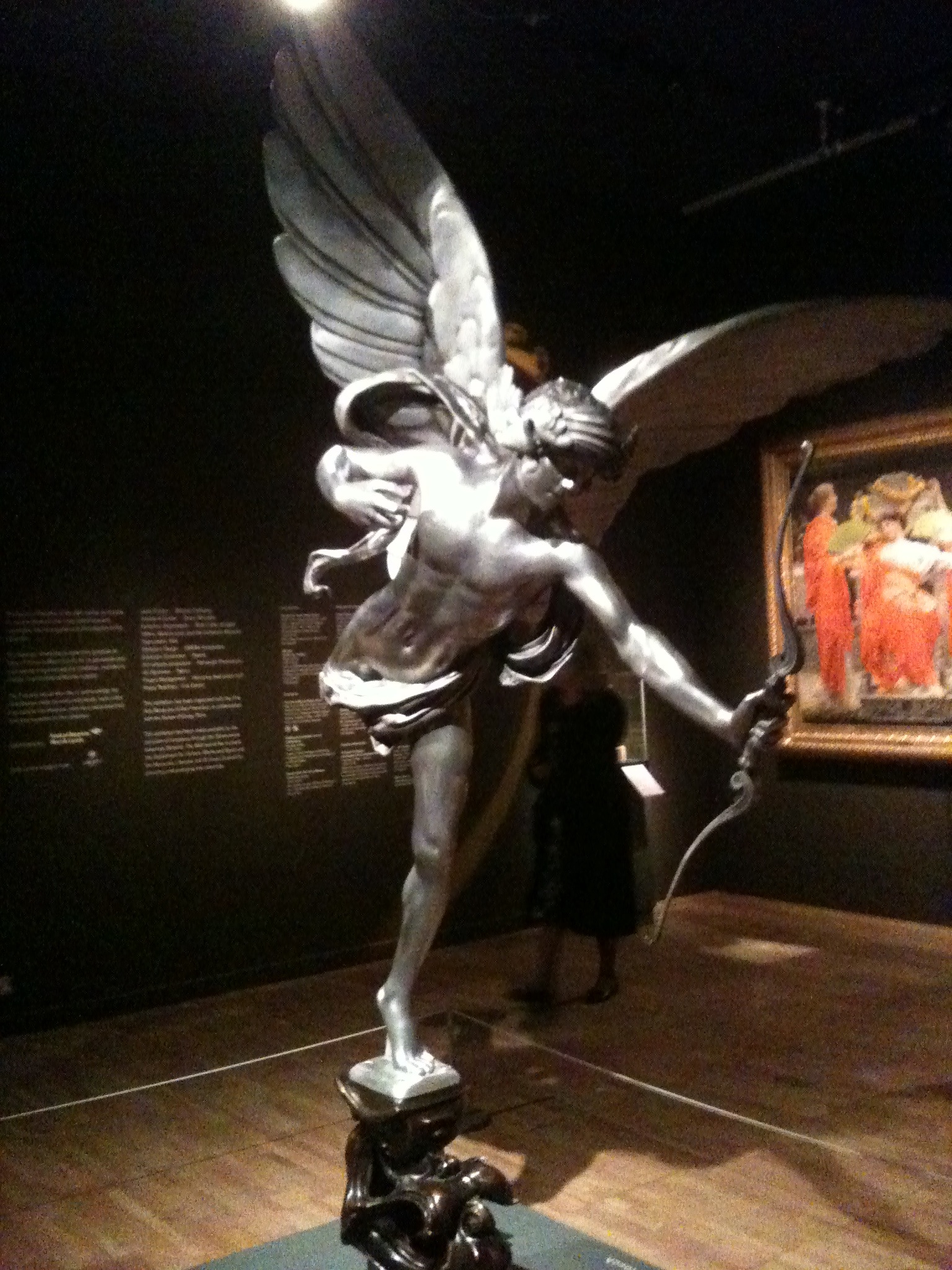
The highlight of the exhibition comes right at the end. Alfred Gilbert’s statue of Eros, or to be more precise Anteros, or to be even more precise, The Angel of Christian Charity, is easily overlooked in its usual home of Piccadilly Circus, located as it is in the second worst place in all of London. But lowered to eye level and removed of surrounding neon, tourists and traffic, it turns out to be a figure of real beauty, simultaneously delicate and robust, and gleaming in its shiny aluminium (this is a recent cast).

The rest of the exhibition is similarly eye-catching, as you wander round the gallery following what seems to be an endless procession of portraits of dark-haired, brown-eyed women painted between 1860 and 1900 by the Aesthetes. William Brown, the fictitious schoolboy and one of my chief inspirations, always admitted a soft spot for a certain kind of women: dark-haired, brown-eyed and dimpled. He was clearly inspired by the Aesthetes.

Midsummer

Among the moles at the Grant Museum

My short piece about the recently reopened Grant Museum of Zoology appears in today’s Independent.

If you haven’t been to the Grant Museum in either its old or new guises, do go and check it out one lunch break. This is the only museum in the country where you can see 18 baby moles stuffed in a sweet jar.

It also has one of only seven quagga skeletons that are known to exist in the world. The discovery of the quagga says much about the delightful way the Grant goes about its business.

The museum had two zebra skeletons, but curators were convinced that one was actually a quagga, so in the 1970s they got an expert to make the requisite calculations.  To their delight it turned out that one of the zebras was indeed a quagga, and this was unveiled to great publicity. However, less happily, it seemed that the other zebra was actually a donkey. Both are now displayed in the new museum, the quagga in pride of place near the entrance, the donkey out of sight on the first-floor balcony. But zebras, there are none.

Grant Museum of Zoology, UCL, Rockefeller Building, 21 University Street, WC1E 6DE. Open Mon-Fri, 1-5pm.

Five unknown London pleasures

1 London’s first artificial ice rink
The Glaciarium opened in 1842 at the Baker Street Bazaar near Portman Square. The backdrop was ski chalets and snow-capped mountains, the ‘ice’ was churned-up hogs’ lard and sulphur. On hot days it smelt of cheese. It closed in 1844.

2 The clown and the geese
In 1884, a clown called Barry was watched by a huge crowd as he sailed down the Thames from Vauxhall to Westminster in a washtub pulled by four geese.

3 One-legged cricket
In 1796, Montpelier Gardens in Walworth hosted a cricket match between eleven one-armed Greenwich pensioners and eleven one-legged Greenwich pensioners. Interest was so great that a fence was broken and spectators fell through a stable roof. The match was drawn, but the one-legged team won a replay, earning themselves 1,000 guineas.

4 London’s first public museum
This was opened in a coffee house near Chelsea Old Church in 1695 by James Salter, a former servant of Hans Sloane, the man whose collection later formed the British Museum. Sloane reputedly handed Salter – renamed Don Saltero – some of the less important of his 80,000 objects, including a giant’s tooth,  a necklace made of Job’s tears and a bonnet that belonged to Pontius Pilate’s wife’s chambermaid’s sister (it actually came from Bedford).

5 The Peace of 1814
On Monday August 1, 1814, London celebrated the abdication of Napoleon Bonaparte with a series of festivities. It began with a balloon ascent at Green Park; the balloon was captured by the winds and sent towards the Estuary until the ballooneer cut a hole and landed on Mucking Marshes near Tilbury. Next came a miniature Battle of the Nile on the Serpentine, followed by a firework display in Green Park, for which John Nash had designed a new pagoda. Sadly this caught fire, killing two people. The crowd applauded, assuming it was all part of the fun.

All these came from Pleasures of London, a book available at the Museum of London bookshop for £30. It is my new favourite London book. It should have been published in 1992, but was delayed repeatedly and by the time it was published by the London Topographical Society in 2009 the authors, Felix Barker and Peter Jackson, had both died.

What the pair had created was an endlessly browsable book on all the fads and fancies that have occupied Londoners leisure since the Dark Ages, from Frost Fairs to black-faced minstrels, lidos to the Great Exhibition. There are brilliant throwaways  – such as those mentioned above – as well as short but thorough looks at things like music halls, pleasure gardens (which I still don’t get the point of), museums and the origins of sports like cricket, football and boxing.

Buy it.

Stamford Bridge in 1979

For people like me, there are few things more emotive than an empty football ground, filmed in 1979 in flickery Super-8 and overlayed by a haunting soundtrack. It’s like Simon Inglis’s first volume of ‘Football Grounds Of Great Britain’ come to life.

Check out loads more here.

London Street Photography at Museum of London

My review of the Museum of London’s excellent London Street Photography exhibition appears in the Independent today.

Street photography – the snatched and unposed glimpse of everyday life – is a fascinating genre even if it is never quite as authentic as it appears. Many of the strongest images in the exhibition reminded me of those Victorian journalists who investigated the slums of working-class London life in the 1880s and 1890s, reporting back in horror on what they found to their middle-class readers.

Thanks to these pioneeers, we now have evocative visual records of London life. My favourite were probably the images Roger Mayne took in the late 1950s to record the streets in West London that were scheduled to be demolished and replaced by Trellick Tower. A book of Mayne’s photographs has just been republished and can be purchased at the Museum of London bookshop, along with the excellent accompanying book for the exhibition.