Category Archives: London

Secret London: the Science Museum’s palace of pills

© Science Museum/SSPL

Time Out recently asked me to contribute to a piece on London’s 10 weirdest museum exhibits (something I’ve blogged about previously). My favourite previously overlooked discovery was the above ‘Palace Of Pills’ at the Science Museum.

This extraordinary sculpture, constructed from old pills, medicine bottles and syringes, was made for a campaign run by the East London Health Project between 1978 and 1980. The ELHP was a coalition of health worker unions and local Trades Councils who were campaigning against cuts to the NHS as well as highlighting other healthcare issues facing Londoners in the late-70s. This was the first time the NHS had really come under sustained attack from any political party since it was formed in the aftermath of the Second World War.

The Palace of Pills was created by artists Peter Dunn and Loraine Leeson, who built the sculpture in their studio using old pill bottles that they acquired from the ELHP’s partners working in the health service. They then photographed it for a poster that was displayed in waiting rooms and doctor surgeries.

‘We did eight posters,’ Leeson told me. ‘The Palace of Pills was made for a poster that talked about how the drug companies were dominating what was happening in health, and for reasons of profit not health.’ The model was too big for the studio and already starting to deteriorate when the Science Museum asked if they could have it. ‘They saw it as a curiosity but I’m delighted it still exists,’ she says. Leeson and Dunn took the experience into creating posters for further pioneering campaigns against the redevelopment of Docklands.

Jimmy Page, Aleister Crowley and the curse of Eddie And The Hot Rods


For the full story of the curse of “Do Anything You Wanna Do”, see my interview with the band in this month’s issue of Uncut magazine. 

It’s easy to turn your nose up at any mention of Aleister Crowley, especially if you have little interest in the occult and esoteric world in which he thrived. But to do so means ignoring the man’s often brilliant writing – his Diary of A Drug Fiend is a superior pulp classic, for instance – and also missing out on some of the greatest anecdotes of the 20th century.

For the uninitiated, Crowley (1875–1947) was a British writer who used sex, drugs and magic –often simultaneously – to try to attain altered states of mind and who achieved such a level of notoriety for his activities that he was brandished the ‘wickedest man in the world’. If not wicked, he was certainly a character. As well as signing his letters ‘666’ and conducting numerous affairs with lovers of both sexes, he climbed mountains, wrote pornographic poetry, fraternised with novelists, artists and spies and attempted to write a new American national anthem.

To give a flavour of Crowley’s often bizarre intersections with normal society, in the early days of the Second World War he was tapped up by British intelligence officer Ian Fleming, who asked him to take part in an ‘occult disinformation plot’ against Adolf Hitler’s deputy Rudolf Hess, a fervent believer in astrology and the occult. Crowley was keen, but the plot was ultimately shelved; Fleming, however, later used Crowley as the model for villain Le Chiffre in his first James Bond novel, Casino Royale, in 1953. Another fan of Crowley was Scientology founder L Ron Hubbard. It is claimed Hubbard took part in ‘sexual magick’ (magick was a term favoured by Crowley) with a couple called Jack and Betty Parsons in an attempting to create a magical child, thus fulfilling a prophecy from Crowley’s The Book Of The Law. Crowley was not impressed, writing in one of his typically entertaining letters: ‘Apparently Parsons or Hubbard or somebody is producing a Moonchild. I get fairly frantic when I contemplate the idiocy of these louts.’

Crowley was bisexual and a heavy drug user, eventually becoming addicted to heroin. He also enjoyed peyote, handing it out at parties. On one occasion in New York he gave some to the novelist Theodore Dreiser, who became uncomfortable and asked if there was a doctor in the area. ‘I don’t know about a doctor,’ said Crowley, ‘But there’s a first-class undertaker on the corner of 33rd and 6th.’

This freeness with sex and drugs saw Crowley embraced by the rock and roll generation, particularly after he appeared on the cover of Sgt Pepper. But the story behind another of Crowley’s cover appearances is not so well known. In 1977, Essex rockers Eddie And The Hot Rod wrote a song that was partly inspired by Crowley’s famous motto: ‘Do what thou wilt is the whole of the law’. The band rewrote this as “Do Anything You Wanna Do”, a spirited ode to self-empowerment, and attached the lyrics to a perky pop tune that quickly reached the Top Ten. It was engineered by a young Steve Lillwhite, who recorded it at Island’s studio in Notting Hill.

In recognition of his contribution to the song’s genesis, the band decided to put Crowley on the cover of the single. But they also felt his glowering visage was not really in the spirit of the band, so manager Ed Hollis (brother of Talk Talk’s Mark) attached a slightly comical pair of Mickey Mouse ears to Crowley’s head.

EDDIE_AND_THE_HOT_RODS_DO+ANYTHING+YOU+WANNA+DO+-+PS-447606

Great cover, big mistake. According to rumour, this image soon came to the attention of Jimmy Page, a Crowley apostle who lived in the Crowley’s old house, had a vast collection of Crowley paraphernalia and was fascinated by the occult. Page had orchestrated the Crowley-influenced occult symbolism that adored Led Zeppelin’s fourth album, which incidentally was also record at Island Studios.

The band were told that Page placed a curse upon Eddie And The Hot Rods for their disrespectful treatment of the Great Beast. From that moment, the band were plagued by problems. They were dropped by their label, their manager became hooked on heroin and they never bothered the higher reaches of the chart again. From behind his Mickey Mouse ears and with the help of satanic rock royalty, Crowley had got his revenge. As bassist Paul Gray told me, ‘Weird shit happened after that. A lot of people said we shouldn’t have fucked about with Crowley.’

The last bus to London Bridge

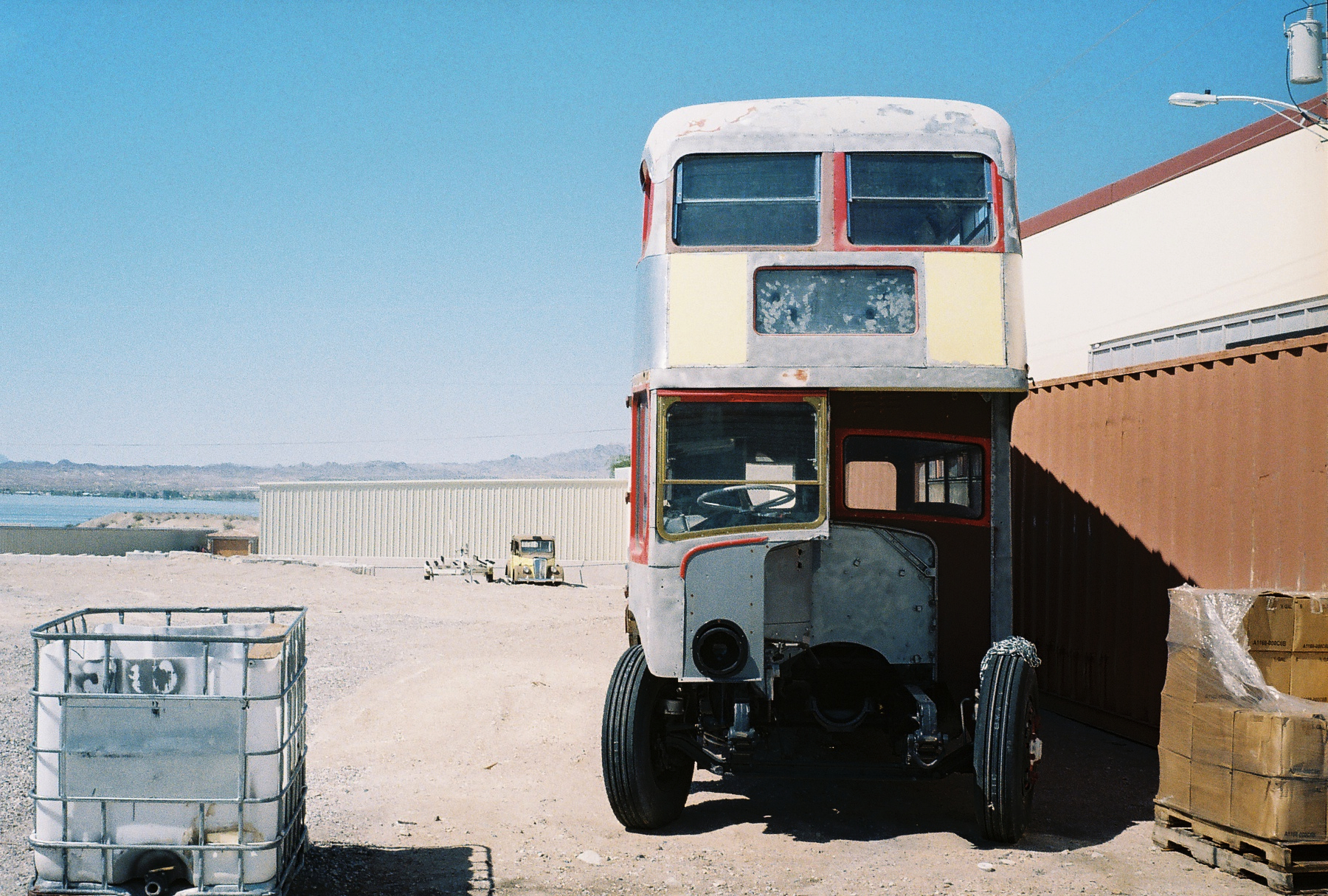
In the previous post, I linked to The Special London Bridge Special from 1972, which features Tom Jones travelling on a No 13 bus to Lake Havasu City, Arizona, where London Bridge had just been sold. Incredibly, that bus is still in Arizona but it isn’t in quite the same condition as the bridge.

BUS-CABINDISTANCE-COLOUR

Thanks to Travis Elborough for the picture. Travis – who has just published London Bridge In America: The Tall Story of A Translantic Crossing – also pointed me in the direction of this marvellous song by Cilla Black, lamenting love and the loss of London Bridge.

The Special London Bridge Special

This sensational slice of ham and song was made in 1972 to celebrate the purchase of London Bridge by an American theme park. It features a bizarre cast that includes Tom Jones, Rudolf Nureyev, The Carpenters, Kirk Douglas, Charlton Heston and Terry-Thomas and is basically the film the Olympic opening ceremony could have been.

It’s all here, but watch the intro especially, featuring Tom Jones singing his way round various London landmarks before engaging in a small slice of double entendre on a No 13 bus.

Secret London: Davenports Magic Shop

It’s a surprise that Davenports has managed to make it on to the Harry Potter tourist trail given the shop is so damned hard to find. You could walk around the dank subways that link Charing Cross and Trafalgar Square for years without stumbling across it, and then one day you’ll turn a corner and whamkazaam, there it is, right in front of you, looking like it’s appeared out of thin air. Well, what do you expect from a magic shop?

Davenports isn’t any old magic shop (if there even is such a thing), it’s the oldest family magic shop in the world, owned and run by a Davenport for four generations and eyeing up a fifth. It began in the East End in 1898 and its heyday was probably the 1950s and 1960s, when it was based first on New Oxford Street and then Great Russell Street opposite the British Museum. The shop, staffed by magicians only too happy to demonstrate their art, became such a draw for tourists they decided to take themselves off the beaten track and into the tunnels around Trafalgar Square. In the move, Davenports took with them much of the stock, some of the fixtures and all of the atmosphere – walk inside and you step back in time, to late Victorian London, when Davenports was founded and magic was experiencing its first golden age, moving from games of find-the-lady on shadowy street corners into the glamorous Music Hall theatres that dominated popular entertainment.

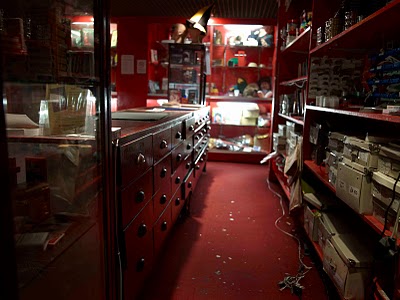
The vast front window is the first sign that you’ve stumbled upon a refugee from the past. It is crowded with wands, juggling balls, posters advertising old magic shows, ventriloquist dummies, ropes, boxes, cards, red Indian headdresses and a giant dog bone. Enticing no? Opening the door triggers a satisfyingly meaty ‘dong’ from a hidden bell and reveals a small red-hued, slightly creepy interior. Most of the stock, old and weird, is kept in wall-mounted cabinets behind glass doors. The wooden shelves behind the counter are covered with fading handwritten signs – ‘Whoopee Cushion, £1’ –in front of which a young clerk demonstrates sleight-of-hand tricks, pausing only to sell invisible thread and a pack of cards. He pauses between tricks, and I jump in to ask if there is anybody I can talk to about the shop’s history. He disappears, not in a puff of smoke, but round the back, and re-emerges with a neat old lady, wearing a clerk’s apron. This is Betty Davenport, granddaughter of founder Lewis Davenport. ‘I started working here in 1948,’ she tells me, ‘when I was 14 and green as grass.’ Betty has run the business since 1960 and still comes in every afternoon to keep an eye on things. She intends to keep it in the family. One son, Bill, already helps run the business while another, Reg, is a performer, and there are three grandchildren being groomed to take over. Betty has high hopes for the youngest, now seven and doing tricks since he was five. ‘Young boys are inclined to be interested in magic anyway,’ she says, ‘it’s just that when they get older, other things can get in the way.’

Unarguable, and with that thought, conversation peters out. I go back to watching the clerk perform, his brow furrowed in concentration, desperate to get things right and show that in his case those mysterious ‘other things’ were firmly pushed to one side. Davenports has a curiously sober air for a room that’s full of rubber chickens and itching powder. This is a place for serious wizardry, where illusion is business. It’s more like a library than a joke shop. Another customer walks in and starts talking about the art, and I can sense my presence as a non-magician has been noticed. Is it just me, or is there a fear in the room I might hear something I shouldn’t, a trick, as it were, of the trade? So I bid farewell to Betty, close the door and retrace my steps back through the underground passages of Charing Cross, wondering all the while whether Davenports will even be there when I return.

Inside London’s super-prime houses

I wrote this article in 2011 for Gulf Life about London’s super-prime property market.

They call it super-prime. That’s the end of the London property market that starts at £15 million and goes as high as £150 million. It’s a market that operates in isolation from the rest of London and it’s one that is dominated by an international clientele, with buyers jetting in from the booming economies of the Far East, Russia and the Middle East. So what do they get for their bucks?

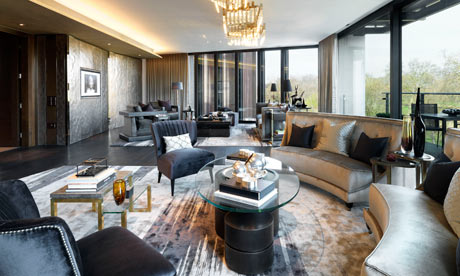
‘Buyers at this end of the market all have five demands,’ says Giles Hannah, who oversees the European operation of Christie’s Great Estates, the property branch of the venerable auction house, ‘security, space, parking, location and luxury features.’ Christie’s is currently selling a mansion on Cornwall Terrace, a dramatic John Nash-designed sweeping terrace overlooking Regent’s Park. It boasts six bedrooms, a home cinema, gym, steam room, study, state-of-the-art kitchen, mews house for staff, garage with blast-proof doors and majestic views of a royal park. Floors are covered by Italian marble, dark oak or silk carpet, there’s a chill room for furs and the walls are covered with paintings by Picasso and Damien Hirst on loan from the auction house. It’s yours for around £30 million.

‘This property was bought and developed in 2008,’ explains Hannah. ‘There are eight on the terrace and they are being released house by house into the market. London remains a key place to buy and although it’s been a difficult market since 2008, there are enough international buyers around. There are 1,100 billionaires in the world, all capable of purchasing a £30m house in any climate.’

The address they all want is Knightsbridge, which partly explains the prices fetched at One Hyde Park, a development by Christian and Nick Candy. One Hyde Park is a gleaming Richard Rogers-designed tower of luxury that sits almost above Knightsbridge tube, with Hyde Park on one side and Harvey Nichols on the other. A penthouse is said to have sold for more than £100 million and, according to Savills, the selling agent, 60 per cent of the 86 apartments have been snapped up.

A five-bedroom apartment costs upwards of £50m and takes up an entire floor – around 10,000 square feet. The hallway stretches the length of the flat from master bedroom to reception room, one end overlooking the park, the other Knightsbridge. To give an idea of the scale, a baby grand piano in the corner of the living room looks like a coffee table. Off the corridor are a further four bedrooms, two reception rooms, a TV room, study, dining room and two kitchens (one for staff). The building contains a squash court, 22-metre pool, games room, party room and meeting room.

‘You don’t need to leave the development,’ says Ned Baring, Associate Director of Savills. ‘You can live, work and play here. What makes this different to other complexes is that we have 50 dedicated staff at the Mandarin Hotel next door who can provide any service you need, from setting up a dinner party to doing your dry-cleaning. It’s like living in the best hotel in the world, but with your own private residences.’

The Candy brothers have invested a fortune in One Hyde Park – how much, nobody will say– banking on continued high demand for super-prime London property. ‘In the morning you can speak to Asia and in the afternoon you can speak to New York,’ says Baring. ‘There aren’t many cities where you can do that. You might not be here 365 days, but you need to be here.’

Hannah says much the same, ‘Your average Christie’s client will be ultra-high worth and may use this property just a couple of times a year. They’ll also have a place in the south of France, one in New York and a chalet in Courchevel.’

If the ostentation of One Hyde Park doesn’t appeal, a short stroll away – but crucially, still in Knightsbridge – you’ll find the discreet charm of Ovington Square, a classic London garden square located between South Kensington, and Chelsea. ‘This part of Knightsbridge is very popular with Middle Eastern buyers, especially from Qatar, Lebanon, Syria and the UAE,’ says Noel De Keyzer of Savills. ‘They like traditional houses, and will come in the summer to avoid the heat at home.’

The house, refurbished in 2008, was recently rented by a Lebanese family (another renter was Bill Gates), but is now on the market for just under £20 million. The selling point is the vast two-floor pre-war extension taking up the entire back garden, itself the size of a normal house. This holds the reception room and master bedroom. The five-bedroom house also has a sub-basement beneath the lower-ground-floor kitchen, containing a gym and steam room.

‘This end of the market stayed very strong in 2008,’ says De Keyzer. ‘But in 2009, it was dead. People weren’t buying. It picked up again in March 2010, helped by weak sterling.’ The problem now is one of supply. ‘There will be an acute shortage of properties in 2011,’ says De Keyzer. ‘A lot of vendors don’t think they’ll realise their expectation because the super-prime market is still 10 per cent below its peak in 2008. You are dealing with very affluent people who have no need to sell in an uncertain market, and if they’re selling to buy somewhere else, they have nowhere to go.’

There are, according to Hannah, only three developments ready for the super-prime market: Cornwall Terrace, One Hyde Park and The Lancasters. The latter is a fascinating project on the north side of Hyde Park in Bayswater. A regal Victorian terrace has been transformed. The old building behind the gorgeous Grade II-listed facade has been knocked down and replaced by an impressive new complex of 77 apartments, retaining the original front with its huge windows and exceptional views of Hyde Park.

‘These buildings were built in the same style and grandeur as Belgravia,’ says Mark Cherry of Minerva, joint developers with Northacre. ‘It was a high-profile wealthy area and is now going through a revival. Some people will only buy Mayfair and Knightsbridge, but others will want better lifestyle and better buildings, so they will come here. We’re offering a high-level of service for people that expect high service, with three concierges on site at all time. I spoke to somebody who was moving from a mansion block and they said they want to be in a building where the pipes don’t rattle and they don’t have to rely on a single elderly grumpy porter. People want classic British houses with American-style service.’

The surprising thing about all four properties is how similar they are. All are decorated in dark masculine colours. All have Gaggenau kitchens and Crestron systems to control sound, security and lighting. None have gardens. All have flat-screen TVs in the walls of every room. The houses have lifts – ‘Middle Eastern clients don’t like using the stairs,’ says Hannah – while the apartments encourage ‘lateral’ living. There are separate bedrooms and entrances for staff–at The Lancasters and One Hyde Park, some clients also purchase a separate apartment for staff. All have serious security, and all have space. Lots of space. The most breathtaking is One Hyde Park, the best views are from The Lancasters and Cornwall Terrace and the most charming is Ovington Square.

The properties can even be sold fully furnished. ‘The keyword is “turnkey”,’ says De Keyzer. ‘International clients are busy and want to move in straightaway with their suitcases.’ That’s not to say they’ll rush to make the purchase. ‘They’ll look at everything available,’ says Hannah. ‘They like to have choice. This isn’t a financial purchase, it’s a personal one.’

The super-prime market is very lucrative for estate agents. ‘It’s competitive, but in the £10 million-plus range Savills and Knight Frank have more than 50 % of the market between us,’ says De Keyzer. ‘That’s because we are international companies with very good contacts. Our fees are 2.5% for sole agency and 3% joint agency but it’s negotiable. We can afford low fees because our values are higher and we have a large turnover of properties. In London the average house is sold every five years, but on the continent people hold on to property for generations.’

That could be about to change. ‘Over the last few years, the lack of property has become apparent,’ says Hannah. ‘The best properties have been bought by international clients and they won’t be traded for many years. People who purchase a premier address will keep it as an asset for a while.’

Because of this, Hannah anticipates good times lie ahead. ‘London is London, arguably the centre of the world and a major financial hub,’ he says. ‘Clients need to be here, they want to be here, they understand the tax implications and they have good accountants. We’re expecting 30% growth over the next three years.’

Cherry agrees. ‘The market at this level is strengthening. Because people want certain key locations, the market can never be saturated, there are listings, conservation areas, it takes ages to get planning permissions and there are strict limits on tall buildings – it’s a very good market to be in.’ If you can afford it, obviously.

Time Out – logo-agogo

As has been reported elsewhere, the big glowing Time Out sign came down this week from the front of the TO office in Tottenham Court Road where it has lived since around 1993. It has gone into storage, ahead of a proposed office move and will at some point, we are promised, be restored to wherever the magazine ends up next. I hope it does. This is, after all, one of London’s few bursts of neon and probably the only one that is halfway decent to look at.

That’s because the logo is a design classic, the work of Pearce Marchbank, an art school student who drifted into the more agitated end of the counterculture after the Grosvenor Square anti-Vietnam demo. ‘The impact on me,’ he said, ‘Was blowing away all that love and peace shit which I thought was bollocks and complete pretence.’

After working on Friends, Marchbank was asked by Time Out founder Tony Elliott to redesign his shambolic magazine. ‘I hated the unadventurous way it looked,’ said Marchbank. The entire magazine was redesigned, with the logo being created at the last minute on a Sunday afternoon in November 1970. ‘It was supposed to look like an out-of-focus neon light,’ Marchbank explained. ‘It was Letraset Franklin Gothic, shot out of focus so it had a glowing fuzziness to it. I put a negative over the positive and the gap between the two made the glowing neon outline, which I shot in line then again out of focus. It was deliberately transparent, so the cover images could read through it, as if it were on the glass of a window.’

This distinctive, blurry effect was intended to be a short-term solution, but Elliott refused to change it. It was a wise decision although not everybody liked the new look. One reader wrote in asking if the magazine could include a pair of glasses with each issue as the typeface was now too small to read.

TOAllNight

Marchbank continued to work for the magazine on-and-off throughout the 1970s creating some of the best covers in the history of publishing. He was back there in 1981 when it imploded in a series of strikes, stand-offs and occupations between staff and management over wages and the historic equal-pay system. As Elliott attempted to regain control he learnt that the logo – which was now being branded all over London and which the strikers were hoping to claim as their own – actually belonged to Marchbank.

Elliott called Marchbank, saying ‘I want you to write me a letter saying you’re giving the logo to me.’ Marchbank figured it was probably worth as much as £100,000 but, strapped for cash and short of time, asked Elliott for a mere £2,000.

‘What? £2,000! How can you do this to me after all the things I’ve done for you?’

The conversation ended. Shortly afterwards, however, Marchbank was offered a job with Richard Branson’s new London magazine, Event. As his parting gift, he presented all rights to the logo to Elliott. To turn into a real piece of neon was both a no-brainer and a stroke of genius. I hope one day the sign will be back above the door in some London street – if not, I’m sure it’ll fetch more than £2,000 on eBay.

Image

Lambeth Surrealism

pix 006

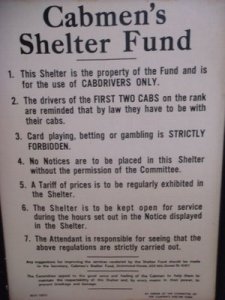
Secret London: inside a cabmen’s shelter

File:London taxi shelter.jpg

This piece was published in Time Out in March 2006.

You must have noticed them: jolly green garden sheds that squad in odd spots of London like displaced emerald Tardises, steam coming out the windows and queues of black cabs lining the streets outside. These are London’s few remaining cabmen’s shelters – 13 in all, for 23,000 drivers – places where cabbies can gather to enjoy tea and sympathy away from the hopeful eyes and raised arms of the stranded, late and lazy who make up their regular custom. The Russell Square shelter is the domain of Maureen, 52, who runs a tight ship, keeping an eye on regulars like Ken (‘Say I’m 21’) and Malcolm (‘I’ve been a cabbie for 37 years. That’s all you need to know’).

‘These places are very interesting to the outsider,’ I say, by way of introduction.

‘They’re even more interesting when you’re on the inside,’ Malcolm replies.

He and Ken come in every day, more or less, to swap tales of fares and roadworks, grumble about Ken Livingstone, talk football, and have something to drink and a bite to eat. They’re keeping alive a long tradition. The Cabman’s Shelter Fund was created by Sir George Armstrong, a newspaper publisher who get fed up waiting for cabs in the rain when drivers had decamped to the nearest pub. He started a fund to supply drivers with a place to get out of the cold and enjoy a cheap meal without straying from the cab stand. The first shelter, erected in 1875, was located on the stand nearest his house (in Oxford). Because the shelters stood on a public highway, the police stipulated they weren’t allowed to be any larger than a horse and cart. At their peak, there were more than 60 in London. Although meant for cabbies, the public could also pop in. Ernest Shackleton was said to frequent the Hyde Park Corner shelter, while the Piccadilly one was nicknamed the ‘Junior Turf Club’ by bright young things, who smuggled in champagne despite the strict teetotal licensing regulations.

Their number declined after WWII as they fell victim to bombs and road-widening schemes, but for a time where a notable feature of London life. HG Wells wrote about ‘the little group of cabmen and loafers that collects around the cabmen’s shelter at Haverstock Hill’, while PG Wodehouse went into greater detail in ‘The Intrusion of Jimmy’ in 1910.

‘Just beyond the gate of Hyde Park… stands a cabmen’s shelter. Conversation and emotion had made Lord Dreever thirsty. He suggested coffee as a suitable conclusion to the night’s revels…. The shelter was nearly full when they opened the door. It was very warm inside. A cabman gets so much fresh air in the exercise of his duties that he is apt to avoid it in private life. The air was heavy with conflicting scents. Fried onions seemed to have the best of the struggle, though plug tobacco competed strongly. A keenly analytical nose might also have detected steak and coffee.’

Food, warmth and companionship are the key. As WJ Gordon wrote in 1893’s The Horse World of London: ‘The cabman is not so much a large drinker as a large eater. At one shelter lately the great feature was boiled rabbit and pickled pork at two o’clock in the morning, and for weeks a small warren of Ostenders was consumed nightly.’

The menu doesn’t stretch to rabbit now, with cabbies preferring tucker that is more in keeping with what a tired cabbie needs, and prices to match. Tea and coffee are 50p. Hot food starts at a quid.

Maureen We do soup, sarnies, fry-ups, curries, jackets… I know what everybody wants. I know everybody who comes in, what he eats and what he don’t eat. Malcolm here had boiled eggs with cucumber in rolls. Except Wednesday. He has baked beans on toast on Wednesday. Ken, he don’t eat nothing. He has a cup of tea.

Time Out You don’t eat here?

Ken No! And I haven’t been in hospital either. Look at the pictures: there’s three up there, four, five, six. All dead. And they used to eat in here.

Malcolm That’s why we’ve got the sign up there: ‘God’s waiting room.’

TO It’s for older cabbies then?

Ken No, anyone can use it. We have one young lad comes in – how old’s Gary, Maur?

Maureen Forty-four. Some of the other shelters are very cliquey – no, I won’t tell you which. If a stranger comes in, they’ll say, ‘You can’t sit there, it’s so-and-so’s seat.’ But we’re not like that.

Malcolm We just check ’em straight out.

Maureen No, we’re friendly here.

TO There’s lots of Arsenal flags, do you have to be an Arsenal fan?

Ken We get a lot of Arsenal, unfortunately.

Malcolm The Tottenham fans get in and out early.

Ken We let the Arsenal in here ‘cos they’re not allowed in the other shelters.

Maureen This one’s been going since 1901. It used to be in Leicester Square, but moved up here.

Ken That was in 1960-something. When I started cabbing in 1967, it was in Leicester Square. I reckon it moved in around 1969.

Malcolm They’re not all the same size.

Maureen They’re similar, but some are longer or wider. They never used to look like this inside though. They used to have seating all round the sides and a big square heater in the middle. People would bring their own food to cook, but there was no kitchen – it was really for keeping warm. Now it’s more like a caravan, with a kitchen at one end and tables at the other.

TO I read they were originally built to keep cabbies out of pubs.

Ken Well, that didn’t work did it?

TO Can non-cabbies come in here?

Ken Builders come in sometimes and have a cup of tea, but if it gets crowded they have it away and let the drivers in.

Malcolm Cabbies get priority. 

TO Who owns this one?

Maureen I rent it off the Trust Fund. I pay the rent and the bills out of what I make. It’s all right in the summer, but in winter it gets very cold. Once you start letting people in, it’s okay, and in the summer we have all the doors open or sit outside. We get heat from the ovens as well.

Ken That’s why they have us two come in here before the rest, to warm it up.

TO What are your opening hours?

Ken That’s a sore point.

Malcolm When she wakes up.

Maureen These are the only two who come in at this time, so I open for them.

Ken We’re up early – we go out at 4.30 or 5am. The others don’t start till seven or eight, so they don’t want a cup of tea or a sandwich until about 12 but we get hungry before. I eat elsewhere. I ate here once and was laid up for two years.

TO When do you close?

Maureen About half-five. We get some people sitting here all day.

Malcolm We get a lot of people that put their head round the door looking for cabs or information.

Maureen There’s a bloke from Holland who’s fascinated with black cabs. He comes over now and then to talk. We get people all the time. Who’s that bloke off the radio who talks and talks?

Ken Robert Elms

Maureen Yeah, he’s been in here.

Ken And what’s-his-name, Ricky Gervais, he’s always walking past, says hello. Angela Rippon popped here head in the other day.

Maureen And then there’s that bleeding Madonna. She came in to try and get a cab.

TO Do you get any women cabbies?

Maureen Yeah, we’ve got Marion. But they don’t seem to stay – they have one look and go straight out again. We’ve too many nutters. We’ve Mad Bob, Cockhead, the Village Idiot…

Ken We’re all different in here and we’ve all got our stories.

Malcolm We come in to keep track of who is alive and who is dead.

Maureen You’d be surprised how many we can fit inside. It holds ten or 12 sitting but for Christmas dinner we have 30 or 40 standing inside.

Ken We get slung out, me and Malcolm. It’s better anyway  – if anybody’s going to get a turkey with bird flu, it’s Maureen.

Maureen doesn’t rise to the bait. She’s used to it. And, as it has every day for more than 100 years, the hut fills with the smell of fried onions. The cabbies start to file in for lunch, and I have it away to let them grumble, joke and eat in peace.
The nature of London: Clay by Melissa Harrison

‘It wasn’t much of a park, really, more a strip of land between the noisy high road and the flats… Despite its size and situation the strip of grass was beautiful – if you had the eyes to see. The Victorians had bequeathed it an imaginative collection of trees; not just the ubiquitous planes and sycamores, and not the easy-care lollipops of cherries either, but hornbeams, service trees, acacias and Turkey oaks with bristly acorn caps like little sea anemones. It was alive with squirrels, jays and wood mice, while in spring thrushes let off football rattles from the treetops, and every few summers stag beetles emerged to rear and fence and mate, and begin another perilous generation among the logs that were left to decay here and there by government decree.’

‘Clay’ by Melissa Harrison

Next to my computer is a small round stone my daughter brought to me from the garden. If I was to pick it up and throw it at the bookshelf, I could hit any of a dozen novels set in London,  all of which carefully detail the grimy, grey, green-free streets of the post-industrial capital. They could be set in Soho (‘Adrift in Soho’ by Colin Wilson) or Kennington (‘London Belongs To Me’ by Norman Collins), Bloomsbury (‘Scamp’ by Roland Camberton) or Bethnal Geen (‘King Dido’ by Alexander Baron). I love some of these books dearly (all of the above) while others I find unforgivably bad (er, ‘Saturday’ by Ian McEwan) but they all inhabit essentially the same milieu – a London of narrow streets and Victorian houses that block out the sky, paved streets, traffic, pubs, smoke and people. This is the written London, or at least the London most experienced by writers in London which they then transfer to the page at the exclusion of almost anything else.

dfgdf 002

None of them, then, do what Melissa Harrison has done with ‘Clay’, which is write a novel about nature in London. The plot, a slight but melancholic meditation on freedom, is really just a MacGuffin for this, Harrison’s real heroine. There are a number of non-fiction books enthusing at the way trees, weeds, flowers, foxes and immigrant parakeets coexist alongside largely uninterested Londoners – try ‘The Unofficial Countryside’ by Richard Mabey or ‘Scrap’ by Nick Papadimitriou – but by placing nature so firmly in the foreground of her novel – and the book is rich with descriptions on each page of everything from pine cones and owl pellets poo  [Harrison tells me that owl pellets aren’t poo] to rain clouds and long grass –  Harrison has managed to achieve what every London fiction writer surely dreams of: she makes you look at the city around you with freshly opened eyes.

I am perhaps a little biased – and not just because I know Harrison through Twitter (where she introduced herself to me by announcing she’d varnished a duck). The book is set in a part of London that I know already, a park based on Rush  Common, a strange, thin, scraggy strip of parkland that follows Brixton Hill from St Matthew’s church down towards the prison. I’ve always thought it a scrawny, rather pointless piece of grass but through her characters – a small boy called TC, a Polish farmer called Jozef and a grandmother Sophia – Harrison shows how much life can be concealed a short walk from a traffic-clogged A road. It gives an unexpectedly life-affirming twist to an otherwise sad but beautiful book, that resonates far louder than its slim size would suggest. Is it a new London genre? It’s certainly a welcome change from the norm, though I doubt whether many other writers would have the knowledge, passion and skill to recreate it so impressively.