Category Archives: History

Underground again at Aldwych


Transport for London allowed Aldwych station one of its periodic reopenings this weekend, with 1940-themed tours of the station and platform to commemorate the 70th anniversary of the Blitz.

The tours – which are completely sold out so don’t even try – were arranged to complement the Under Attack exhibition at the London Transport Museum, as explained by museum director Sam Mullins in this BBC clip.

As a part-time moleman who has never been inside Aldwych, I was down there like a greedy ferret in a goldmine. Aldwych, a pointless spur on the Piccadilly Line, closed in 1994 and its history can be read at the wonderful Subterranea Britannica or Abandoned Stations. Ian Visits and Diamond Geezer also have posts about the station.

I’ve wanted to get inside it for ever such a time.
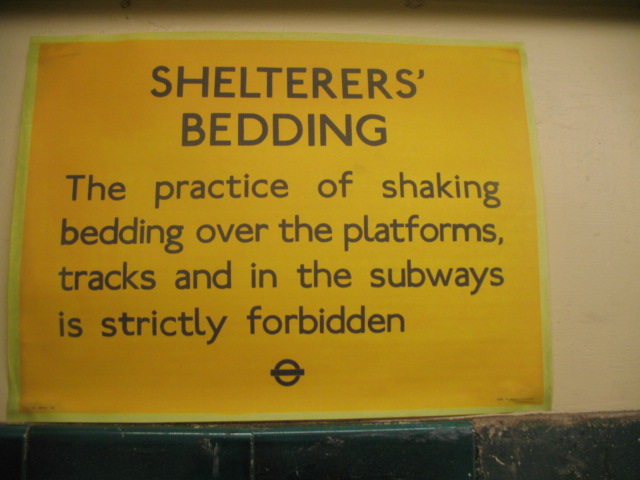
The tours begin in the neat but spartan ticket office, which is decorated with a number of wartime posters giving instruction about shelters and the blackout. You are greeted by an actor playing an Air Raid Precautions officer, whose monologue is interrupted by the forbidding wail of an air raid shelter. You meet three more such actors in the course of the tour, the best being the 1940s housewife who sits in the train down on the platform and can be quite saucy if you ask the right sort of questions.

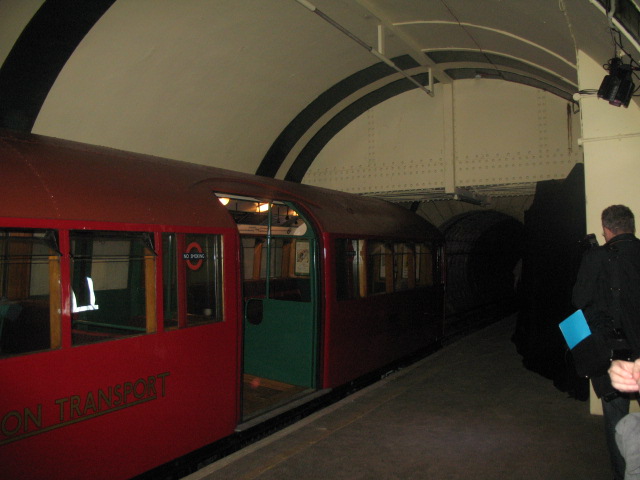
The chance to poke around the station and listen to actors recreating 1940s stereotypes is all well and good, but the star of the show is undoubtedly the 1938 train that has been brought out of retirement for the occasion.


I’m no train nerd, but this one is a beauty, as I’m sure better photographers than I will record this weekend.
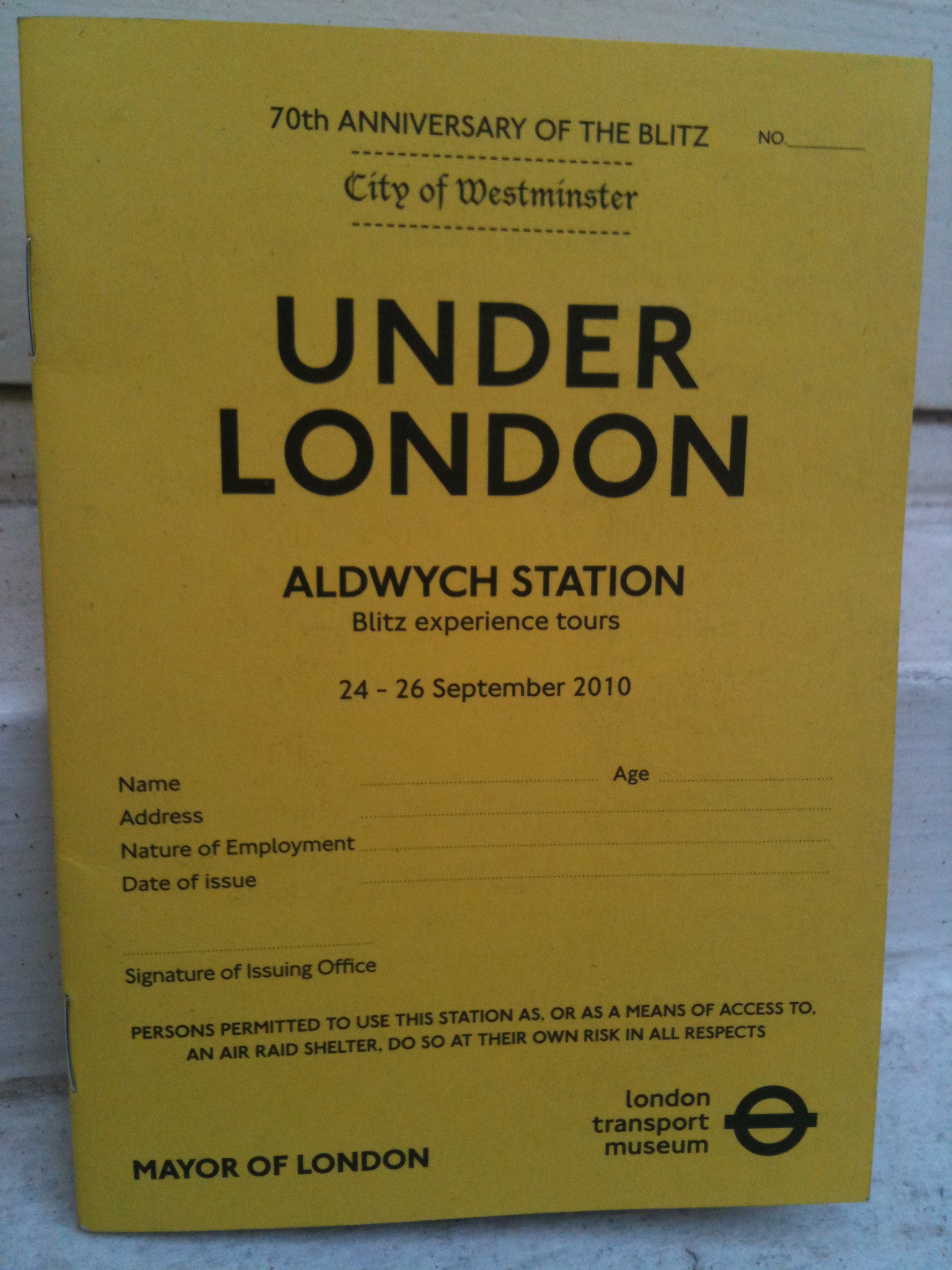
The other highlight is this cracking little souvenir book about Aldwych and the Blitz that is given to everybody who goes on the tour.
The tour ends with a deafening reconstruction of an aerial bombardment, with impressive sound and light, before the all-clear sounds and allows you to climb the steps back to the surface (no lifts or escalators, so prepare for a walk).

A recreation of the ‘Blitz experience’ is an almost impossible thing to pull off for obvious reason and this is neatly done in the circumstances, although it might have been nice to have bunks on the platform to give more of a flavour of what it was like to cower down there for a night.

Interest in the tours have been so great – an estimated 3,000 people will take part this weekend – that the London Transport Museum believe public tours of Aldwych will be reintroduced on an irregular basis in the future.

So that’s one ambition sated, only for another to take its place. Earlier this week I was talking to a curator at the LTM, who told me of his recent tour round Down Street, another abandoned station with wartime connections. It is, he told me, in ‘fabulous condition’. Anybody interested?

Maps and apps


Some months ago, I heard about the Time Travel London Explorer app, a nifty iPhone application that allows you to layer different historical maps of London on top of each other, so you can use GPS to see how the street you are standing in has changed (or not) since 1746.

I was so excited I went out and bought an iPhone in anticipation and wasn’t disappointed when the app was finally completed. It features four different maps – Rocque 1746, Horwood 1799, Greenwood 1830 and Stanford 1862 – as well as lots of easily searchable historical information and photographs of London, along with audio guides. You can read a review here.

It’s a bit like the Museum of London’s Street Museum app only better as fading in from one historic map to another is fun and informative.

The Time Travel Explorer website features a blog about mapping and London history written by myself and M@ from Londonist. If this is the kind of thing that gets you going – and really, how could it not? – go check us out.

Why is there no London monument for the Blitz?

‘When I reached the end of Milk Street, I looked out towards Moorfields across an area of devastation so final and complete that the memory of it will always rise in my mind whenever I hear the word Blitz. There is a savagery, a fury and a hideous wickedness about the ruins of London – and of Berlin also – that chills the heart.’

From HV Morton’s ‘In Search of London’

The Blitz began on September 7th, 1940, seventy years ago today, when London was attacked by 300 German bombers. It lasted three months as London was bombed for 57 consecutive nights. Between September 7 and May 11, 1941, 18,800 tonnes of high explosive was dropped on Holborn, the City, Westminster, Shoreditch, Southwark and Stepney. Up to 20,000 Londoners were killed, many thousands were wounded and 3.5 million houses were damaged or destroyed.

And yet, astonishingly, London – a city of a thousand statues – still does not have a single worthwhile monument to the citizens who suffered the Blitz.

The story of the Blitz is a familiar one – see this wonderful propaganda film for an emotional contemporary look at London under attack – and while the ‘Blitz Spirit’ narrative can be trite and over-mythologised, there was undoubtedly some truth to it. Londoners had to deal with the Blitz in part because they had no other choice, but there is evidence that Londoners did more than just survive, they almost relished the battering they received. As  Humphrey Jennings wrote at the time, Londoners were ‘secretly delighted with the privilege of holding up Hitler’, while Phillip Ziegler said in ‘London At War’ that ‘Londoners made a deliberate attempt to seem nonchalant and unafraid’.

Peter Ackroyd suggests that Londoners might have been able to cope because of spiritual kinship with the destruction of the Great Fire, an idea that HV Morton pre-emptively pooh-poohs in his elegiac 1951 classic ‘In Search of London’. ‘The Fire was an accident and it lasted a matter of days. The Blitz was the deliberate attempt of an enemy to subdue a city whose watchword has always been freedom… the effect of these two events upon the population cannot be compared.’

Yet while London has a Monument for the Fire, it still does not properly commemorate those who experienced the Blitz. There’s a small park in Wapping, a couple of minor plaques – one by St Paul’s, near the firefighters monument, and one in St James’s Churchyard on Piccadilly – and dozens of plaques to individual explosions.

But there is no single iconic statue or monument prominently placed and devoted to the citizens of London in the manner of that for, say Animals In War, or any of the numerous monuments for different branches of the armed forces (Bomber Command are the latest).

This was first pointed out to me in 2006  during an interview with Jack Lohman, the Director of the Museum of London, and his museum does now contain a stunning WWII tribute. The Blitz room is a single stark shadowy space, with an unexploded bomb hanging from the ceiling. The walls show still images of the Blitz, while survivors recount their experiences on audio. It’s incredibly moving, but it isn’t enough.

Why doesn’t London pay sufficient tribute to its Blitz Spirit? I asked Jane Furlong, project co-ordinator of the UK National Inventory of War Memorials, and her answer boiled down to one word:  politics.

Furlong told me: ‘As with all memorials, it’s down to whether individual groups or people want to commemorate something. Also, is there a need of it among those who lived to tell the tale? There are lots of service veterans who want to make sure what they did is never forgotten and a memorial is the best way to do that and so they can go away and organise and make sure it happens. It is all down to having that desire, the community needs to take the lead.’

Bomber Command is a ready-made community that can easily mobilise to commemorate their place in history; London’s civilians are not. Of course, that didn’t stop the Animals In War memorial from getting built, but they managed to enlist the high-profile support of patrons such as the Princess Royal, Kate Adie, Vera Lynn and Joanna Lumley. 

If London is to get the Blitz Spirit memorial it deserves – a dignified sculpture in a prominent public place, dedicated to all Londoners who experienced the Blitz – it requires somebody to take the initiative. And that, ironically, would chime against the spirit of the Blitz: one of exaggerated nonchalance at what took place over London in the winter of 1940-1941.

So it seems for now that the sad and powerful room at the Museum of London and an easily overlooked plaque in the shadow of St Paul’s are the best we are going to get. 

But I think that is a great shame and that ordinary working Londoners, as Ken Livingstone might put it, deserve better.

My London Library: No 2 – London’s Bridges

  • Title London’s Bridges by Peter Matthews (2008, Shire).
  • Cost Free.
  • Bought from Author.
  • Genre Straight history.

The endearingly honest opening line says all you need to know about this historical overview of London’s crossing points. ‘In 1938,’ Matthews reports, ‘an article in the Times observed that: ‘The people of London have a reputation for taking no interest in their bridges’.’

I bet the publisher loved reading that.

It’s a lovely book though, wordy but not too long, nicely illustrated and ruthlessly factual. Bonus points for including non-road bridges such as Grosvenor Railway Bridge.

There’s some great trivia to be found: ‘In 1873, the Royal Humane Society set up a 24-hour ‘receiving host’ by the northern end of Waterloo Bridge, manned by a doctor who would attempt to revive any suicide victims brought to him, and in 1875 alone 21 people were saved by this method’.

The author, Peter Matthews is a proper London nerd and runs the bookshop at the Museum of London, so you can be fairly sure you’ll be able to pick up a copy there.

Verdict Solid reference tome.

Jimi Hendrix in the suburbs

Jimi Hendrix’s London flat overlooking Mayfair’s Brook Street is opening to the public tomorrow (August 25th) for the Hendrix In Britain exhibition. The exhibition – which is being mounted by the Handel House Museum (Hendrix and Handel were temporally dislocated neighbours) – is a cosy affair, amounting to a costume, a guitar, some great photos, handwritten lyric sheets, posters (‘The Fabulous Walker Brothers/Cat Stevens/Jimi Hendrix/Englebert Humperdinck’), notes, including directions to the Isle of Wight for the famous festival, and his death certificate (’cause of death: vomit’).

Hendrix’s actual flat is now the Handel House Museum offices, but they will be moving out for two weeks in September so the public can have tours of the quite spacious flat Hendrix lived in with his girlfriend Kathy Etchingham. The museum hopes to open this flat to the public permanently when they manage to raise sufficient funding and get all the hash burns out of the carpets.

My favourite part of the exhibition was the giant map of Hendrix’s London that takes up one wall, with stickers donating key venues, hotels and apartments. Opposite is a list of the major concerts Hendrix played during his three years in London before his death. I was pleased to note that alongside the more famous clubs – Scotch of St James, the Marquee, the Astoria and the Royal Albert Hall – Hendrix found time to play the suburbs, including Bromley Court Hotel, Ricky Tick in Hounslow, Upper Cut in Forest Gate, the Ram Jam Club on Brixton Road, Granada Theatre in Tooting, Star Hotel in Croydon, Bluesville ’67 on Green Lanes,  and the Orchid Ballroom, Purley.

Hendrix in Purley, now that’s a side of swinging London you don’t hear much about these days.

Yes, Fabio: the eternal sitcom that is English football

A few years ago, during a BBC attempt to find the nation’s best sitcom, Armando Ianucci was asked to make the case for ‘Yes, Minister’. In the excellent documentary that followed, Ianucci discovered that one of the reasons ‘Yes, Minister’ holds up so well is that the creators went back over the news archives for the past 50 years and analysed what stories recurred, and than based their episodes around these themes – the special relationship, the EU, expenses and honours scandals, arts funding, civil service waste. Hence it still seems fresh and relevent today.

Ianucci went on to nick this idea wholesale for ‘The Thick Of It’.

You can very easily do the same thing when writing about English football. When I was researching a piece on 40 years of London football for Time Out‘s (very fine) ‘London Calling’ book, I discovered familiar arguments being made twenty or thirty years ago.

‘Football has been taken away from its natural community, commercialised and given the worst trappings of Hollywood by the mediam,’ wrote Peter Ball in 1974. What would he make of it now?

The same writer than analysed the national team’s failings in 1980 and surmised that ‘The English game does not enhance the development of technique, nor of flair players, who tend to be regarded with suspicion.’

The more things change, the more they stay the same.

I was reminded of this when I was handed half-a-dozen old newspapers from 1973, covering the aftermath of England’s infamous World Cup failure at the hands of Poland. England had followed up that result with a 1-0 defeat at Wembley against Italy in November, prompting some very familiar comments in the papers.

‘Now England need a substitute for Alf’, said the Daily Mail (and press nerds will be interested to note that the hated ‘Now’ to pad out a headline was already in use at this time).

Alf Ramsey was quoted as saying the result was ‘unbelievable’ and insisting that ‘only the Press asks me if I want to resign. It is none of their business.’

On it goes. He told London’s Evening News that ‘soccer must change at club level if England are to show more skill in internationals’ and pointed out that ‘people say we need more skill, but this has been said for years’. Alan Hardaker, secretary of the Football League, was ready with the platitudes, ‘We must all buckle down to the job in hand. To strengthen our game at domestic level and through that our standing at national level.’

Even the Italian manager, Ferruccio Valcareggio, had a view we can recognise: ‘You must have flair and only Osgood appeared to have this.’

But the press weren’t interested in excuses, they wanted blood. And they got it. Ramsey lasted one more game, a 0-0 draw against Portugal, before he was sacked. Astonishingly, England’s internationals didn’t suddenly develop greater flair and technique as a consequence.

And who scored the crucial goal for Italy that night in November? Do I really need to say? Arrivederci Fabio, it was always going to end this way, eventually.

Connections: Boris bikes, psychedelic rock and Dutch anarchists

This week, I interviewed Top Topham, founder member of the Yardbirds. At one point he told me: ‘I also remember seeing Keith West’s Tomorrow, who had Steve Howe (later with Yes) on guitar. He was brilliant, a completely different style. They were a very interesting experimental band. ‘My White Bicycle’ was quite infectious, very ahead of its time.’

Tomorrow were a fascinating mid-60s band who had close ties with the London counterculture, regularly performing at head venues like the UFO Club and the Roundhouse.

‘My White Bicycle’ was inspired by the Dutch anarchist group the PROVOS. Counterculture writer Stewart Home explains:

‘The PROVOS announced in a leaflet that white bicycles would be left unlocked throughout the city for use by the general population. The prototype of this ‘free communal transport’ was presented to the press and public on 28th July 1965 near the statue of Lieverdja. The plan proved an enormous success as a ‘provocation against capitalist private property’ and ‘the car monster’, but failed as a social experiment. The police, horrified at the implications of communal property being left on the streets, impounded any bicycle that they found left unattended and unlocked.’

You can read more about the PROVOS at the British Library. Here’s a nice picture of them and their bikes from the International Institute of Social History.


I wonder if Boris Johnson knows that his bike scheme is at least indirectly inspired by a bunch of sixties anarchists?

The Old London Underground Company


Dave Hill at the Guardian has this interesting post about Ajit Chambers, the man who wants to help Londoners get into disused underground stations.

I have been in contact with Chambers since 2009, when he first sent me a teasing business card in the post to promote his idea of turning old underground stations into tourist attractions. One thing that has always impressed me about Chambers is his determination to succeed despite the tremendous obstacles in his way (basically, TfL are incredibly reluctant to open old stations to anyone, let alone to give an outsider access to such prime assets).

I interviewed Chambers last month for a feature that runs in the June edition of Metropolitan, the new (excellent) magazine for Eurostar passengers. He told me then that his motto is ‘proving things can work by doing them without asking’ and his decision to bushwhack Boris Johnson and Anthony Browne at a conference for small businesses is a perfect illustration of how he goes about his work. No wonder TfL are ruffled.

Chambers got his idea on Valentine’s Day 2009, when he was looking for something to do with his wife that was ‘more exciting that just sitting in a restaurant with loads of other couples. I wanted an adventure, something like a first date, and I thought there must be loads of secret doors all over London just waiting to be opened. So I started researching and discovered the abandoned stations.’

He has identified 26 sites he wants to pursue with a view to opening each one as a venue with three revenue streams – as a museum, as storage and as a space for entertaining. This is astonishingly ambitious and he is so far being stymied by TfL, so he is trying to circumvent them by purchasing the deep-level shelter at Chancery Lane (pictured above) – which I wrote about after visiting in 2008. This would be a terrific venue, as it has a fascinating back story, is wonderfully evocative and lies at the heart of a network of underground spaces.

I hope he succeeds. Londoners have a tremendous thirst for the mysterious parts of the city that lie beneath their feet – the weekend opening of Brunel’s Thames Tunnel earlier this year proved to be extraordinarily popular – and a dedicated museum to Subterranean London would be possibly the most exciting to happen in this city ever (although I may be biased in this view).

Chambers is determined, as Boris and Browne are soon to discover, and I would never bet against him. ‘I’m not going to give up,’ he told me. ‘There’s no stopping me. And as soon as people realise that they seem to come on board pretty quickly.’

Update There is some discussion about the feasibility of Chambers’s plan at Annie Mole‘s blog.

The funfair

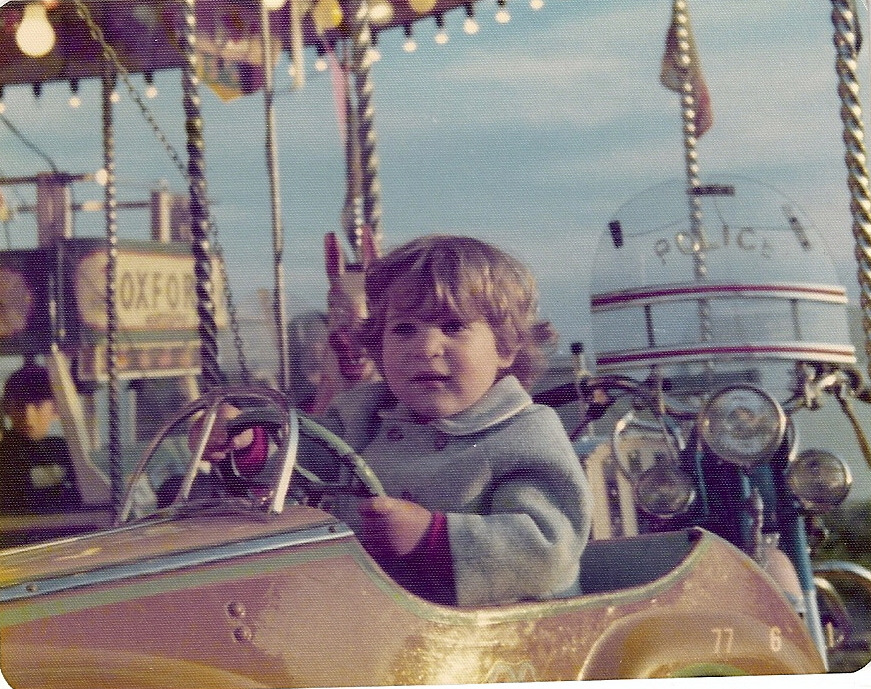
This week, I went to the fair at Brockwell Park. I don’t have a picture of that, but here’s me at another funfair in 1977. I was not a particularly pretty child, nor a thin one, nor one that actually looked all that much like a boy. And what is that coat I’m wearing? But along with a photograph of me and my dad riding the dodgems taken a year later – me marginally cuter, he like the Brummie James Dean – it is one of my favourite images from my youth.

That’s because it was taken at the Epsom Derby funfair, where we went as a family every year. It is almost impossible for an adult to now understand how exciting the funfair is to a small child – the colour and clatter of the rides, the sweet smell of popcorn, onions and candy floss, the sheer thrill of being outside after dark – but this picture brings a lot of that back to me. It’s a pure pleasure, one without any compromises or guilt. By contrast, most grown-up fun tends to come with the feeling that one is doing something one shouldn’t, and will pay for it later, either with a hangover or an empty wallet. Or perhaps that’s just the Catholic in me talking.

When I was a teenager, fairs were still about thrillseeking, just in a different way. There were the rides of course, but now it was more because this was were you went to meet girls (or watch your friends meet girls, or watch your friends talk about how they’d like to meet girls). You also went along in fear/search of some real danger – the possibility of getting chased round the park by the semi-mythical Roundshaw gang, who supposedly spent every evening roaming the borough, looking for people to beat up. Such bifftastic activity has been circumvented by the organisers of the Brockwell Park fair, who have a ‘No Gangs’ notice prominently displayed and a police van on constant vigil. I’m not sure whether this is a good or a bad thing. The parent says ‘good’, the teenager says not.

And it’s as a parent that I take my daughter to the funfair every time it comes to Brockwell Park. That’s partly for her sake, because she loves it so much, but it’s also partly for me, because I want to remember what it’s like to feel this way.

Here she is last week, on a violently orange airplane.


I read an article last week about the dishonesty of most funfairs, how it is impossible to win any prizes and the whole thing is essentially a tiny, tacky, travelling confidence trick. It’s very difficult to visit the fair as an adult and not see the sleaziness. But to a child, unaware that the coconut might be glued to the stand, this is paradise. It is wonderful to witness, but also slightly depressing, because it is impossible to share in the innocence, to see the funfair through an eye unstained by prejudice.

My daughter had more fun at Brockwell Park funfair than I think it is possible for an adult to comprehend, when everything is costed in terms of money and time. I hoped that when I went with her, I’d vicariously absorb some of her glee. And I was happy to see her happy, but I also ended up wallowing in nostalgia and misremembered romance. Is that such a bad thing?

This guy knows what I mean, or at least I used to think he did.

To whom it may concern: Poetry Incarnation at the Royal Albert Hall

The new issue of Uncut magazine contains my feature about the International Poetry Incarnation, which took place 45 years ago this month on June 11, 1965. It begins like this:

Allen Ginsberg is drunk. Big, bald and bearded, like a Jewish bear stuffed in a suit, the beat poet stands tall in the Royal Albert Hall, London’s sacred haven of the high arts, and proclaims to 7,000 fellow thinkers:

“Fuck me up the asshole”.

In the crowd was Heathcote Williams, the future poet, playwright and artist. Williams recounts what happened next: “A man with a bowler hat, beside himself with anger, shouted out: ‘We want poetry. This is not poetry’, and Ginsberg retorted, looking up towards the gods: ‘I want you to fuck me up the asshole.’”

And it goes on in a similar manner for another 2,400 words. If you think that sounds like fun, head down to your local newsagent now.

The International Poetry Incarnation – which featured Allen Ginsberg, Adrian Mitchell, Gregory Corso and Michael Horovitz – is said to be the moment that signalled the arrival of the 1960s counterculture movement in London. However, in ‘White Heat’, his otherwise splendid history of the 1960s, Dominic Sandbrook writes dismissively: ‘Seven thousand people was indeed an enormous attendance… on the other hand, it was still considerably smaller than the typical crowd for a Second Division football match… to millions of people, the event meant absolutely nothing. What is more, it had not even been a very good reading.’

Oh, really? Watch this extraordinary clip of Adrian Mitchell from Peter Whitehead’s film of the reading, ‘Wholly Communion’, and tell me it has the same impact as Torquay vs Rochdale.