Category Archives: History

Secret London: the Mail Rail

A group of Urban Explorers have managed to get inside what some people consider the holy grail of subterranean London – the Mail Rail. This is the mini-underground railway that used to take letters along tracks to different station/sorting offices located deep beneath London streets.

The Mail Rail stretches from Paddington to Whitechapel and is still more or less intact, despite having been mothballed nearly a decade ago in 2002. Silent UK managed to gain access and then explored the full length from the track, investigating and photographing nine stations along six miles of track.

Read the lot here – it’s an extraordinary story.

You can watch a film about Mail Rail here.

Secret London: finding bits of lost London Bridge

When Old London Bridge was demolished in 1831, it was decided with typical Victorian frugality to sell off some of the old bits and bobs of stonework. Although they were ostensibly part of the medieval bridge, they had largely been added during an 18th-century reconstruction. The best surviving examples are the old stone alcoves.

There were originally 14 of these covered domes at the end of the piers. They looked rather like curved stone bus shelters and were so sturdy and useful that four still survive.

Two now stand in Victoria Park, having arrived here some time in the 1860s and offering a pleasant seat from which to view passing parklife or shelter from London rain.

One other stands in isolation in a courtyard in the grounds of Guy’s Hospital (now with a statue of John Keats as the London Historians blog explains), while the fourth, somewhat bizarrely, has ended up in the garden of a block of flats in East Sheen. This is the Courtlands Estate, and there were originally two alcoves, or ‘porter’s rests’, but one ‘disappeared’ during renovation in the 1930s, as did some balustrading from the Bridge that was used as a wall. Further balustrading was taken to Herne Bay, but this was lost in the storm of 1951.

An arch from the bridge was discovered in 1921 during the rebuilding of Adelaide House, but this was deemed too expensive to preserve and was destroyed. One stone, though, survived, and is now preserved in the churchyard of St Magnus the Martyr.

One final bit of the bridge that survives can be seen above the door of the King’s Arms on Newcomen Street in Borough. This was the coat of arms that had been added to Stonegate – the bridge tollgate – during rebuilding in 1728 but was demolished in 1760.

Update Since writing this I have learnt of more rescued balustrades from Old London Bridge. These sit in Myddleton House Gardens in Enfield alongside a piece of the original St Paul’s Cathedral, which burnt down in 1085.

Maps round-up

A quick post on maps. I have a small piece in the Independent about the Museum of London and Londonist’s forthcoming collaboration, Hand-Drawn London. This exhibition, opening on April 21, features maps drawn by Londoners.

I submitted a map drawn by four-year-old daughter of her daily walk to nursery, but it was harshly rejected. I have reproduced it here.

I have also been posting fairly regularly on maps at the Time Travel Explorer blog. Recent posts have included one on London’s first lido and another on London’s forgotten exhibition.

London’s seven statues of shame

When Mohamed ‘Al’ Fayed unveiled an extraordinary tribute to Michael Jackson at Craven Cottage, seasoned statue-watchers found themselves embroiled in a furious debate. Was this London’s worst statue?

And then there are these: London’s statues of shame.

7. Peter The Great in Deptford
Because it is silly.

6 Queen Victoria at Buckingham Palace
Pompous and bloated.

5 Charles II at Soho Square
For its condition as much as its, er, execution. But even if this wasn’t horribly weathered, I reckon it would look a bit shit.

4 Oscar Wilde at Charing Cross
Disturbing. Like somebody tried to find the face of Jesus in a puddle of vomit.

3 Nelson Mandela at Parliament Square
I know, let’s imagine one of the great icons of the modern era, as if he was a THUNDERBIRDS PUPPET!

2. Horse’s head at Marble Arch
Stupid. Not to be confused with the almost as ridiculous Animals at War statue down the road on Park Lane.

1 The Meeting Place at St Pancras
Widely acclaimed as the worst statue in London, this monstrosity was brought to you by the same person responsible for the hideously smug Queen Mother statue on the Mall.

For a forensic analysis of this statue and its faults, I point you towards Christopher Fowler‘s excellent critique of its numerous deficencies.

But the question remains: is Jacko worse than this?

Cult Of Beauty at the V&A

The V&A’s Cult of Beauty exhibition opened over the weeked. You can read my feature on the Aesthetic movement in the Independent on Sunday.

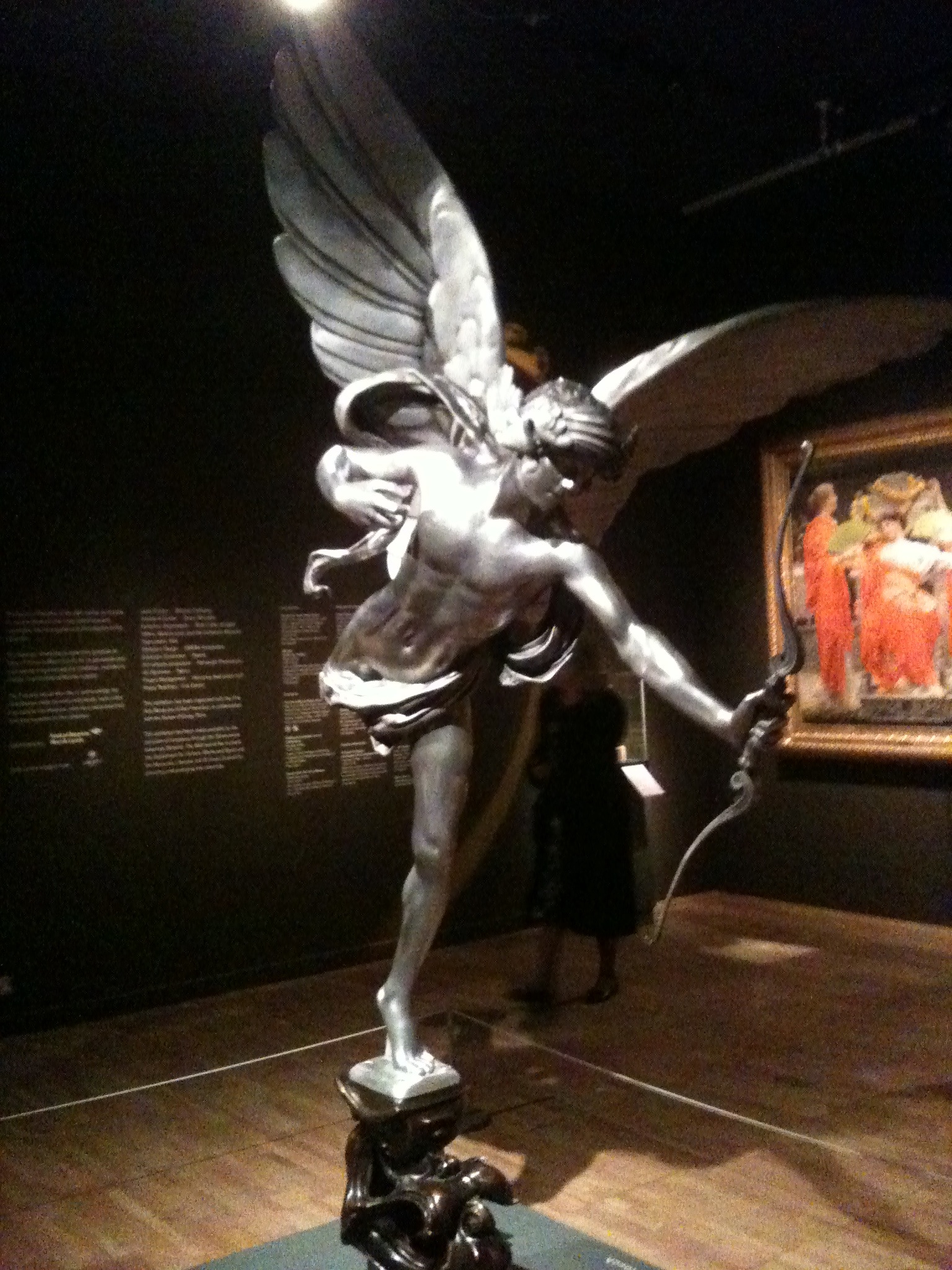
The highlight of the exhibition comes right at the end. Alfred Gilbert’s statue of Eros, or to be more precise Anteros, or to be even more precise, The Angel of Christian Charity, is easily overlooked in its usual home of Piccadilly Circus, located as it is in the second worst place in all of London. But lowered to eye level and removed of surrounding neon, tourists and traffic, it turns out to be a figure of real beauty, simultaneously delicate and robust, and gleaming in its shiny aluminium (this is a recent cast).

The rest of the exhibition is similarly eye-catching, as you wander round the gallery following what seems to be an endless procession of portraits of dark-haired, brown-eyed women painted between 1860 and 1900 by the Aesthetes. William Brown, the fictitious schoolboy and one of my chief inspirations, always admitted a soft spot for a certain kind of women: dark-haired, brown-eyed and dimpled. He was clearly inspired by the Aesthetes.


Among the moles at the Grant Museum

My short piece about the recently reopened Grant Museum of Zoology appears in today’s Independent.

If you haven’t been to the Grant Museum in either its old or new guises, do go and check it out one lunch break. This is the only museum in the country where you can see 18 baby moles stuffed in a sweet jar.

It also has one of only seven quagga skeletons that are known to exist in the world. The discovery of the quagga says much about the delightful way the Grant goes about its business.

The museum had two zebra skeletons, but curators were convinced that one was actually a quagga, so in the 1970s they got an expert to make the requisite calculations.  To their delight it turned out that one of the zebras was indeed a quagga, and this was unveiled to great publicity. However, less happily, it seemed that the other zebra was actually a donkey. Both are now displayed in the new museum, the quagga in pride of place near the entrance, the donkey out of sight on the first-floor balcony. But zebras, there are none.

Grant Museum of Zoology, UCL, Rockefeller Building, 21 University Street, WC1E 6DE. Open Mon-Fri, 1-5pm.

Celebrating the noble tradition of defacing London statues

It seems to happen every time a march or protest takes place in London. A much-loved statue or monument is defaced, horrifying the sort of people who are horrified by this sort of thing while the rest of us wonder why nobody’s got round to throwing a bucket of paint at that godawful Animals At War monstrosity on Park Lane.

On Saturday, after the TUC and some kids dressed in black marched through the London to complain about stuff, it was the turn for the Landseer lions at Trafalgar Square to take a pasting.

While the statue of Charles I received a more artful reimagining.

Interestingly, this Charles I statue had already been manhandled by the mob – albeit inadvertently – way back in 1867 when a reporter climbed the statue to get a better view of a passing protest and used the sword to steady himself. The sword promptly fell off and disappeared into the crowd, never to be seen again.

Most people think that this habit of deliberately defacing certain statues is a recent thing, dating back to the inarguably splendid Winston Churchill turf mohican on May Day 2000.

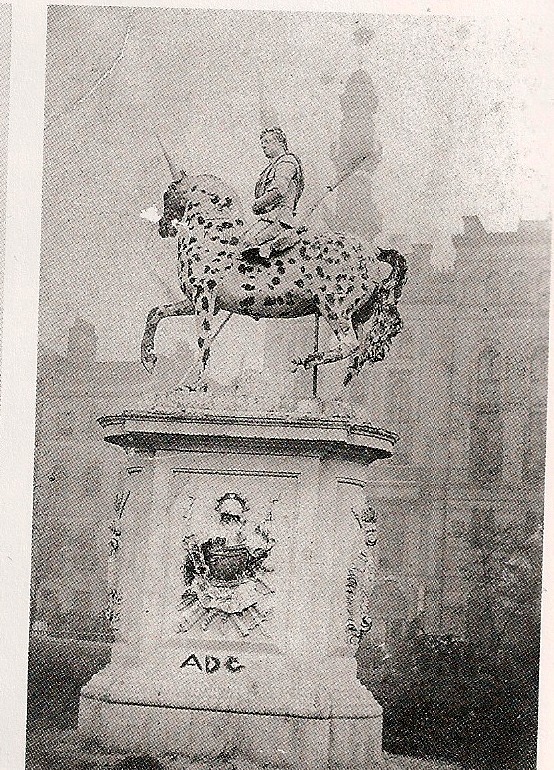
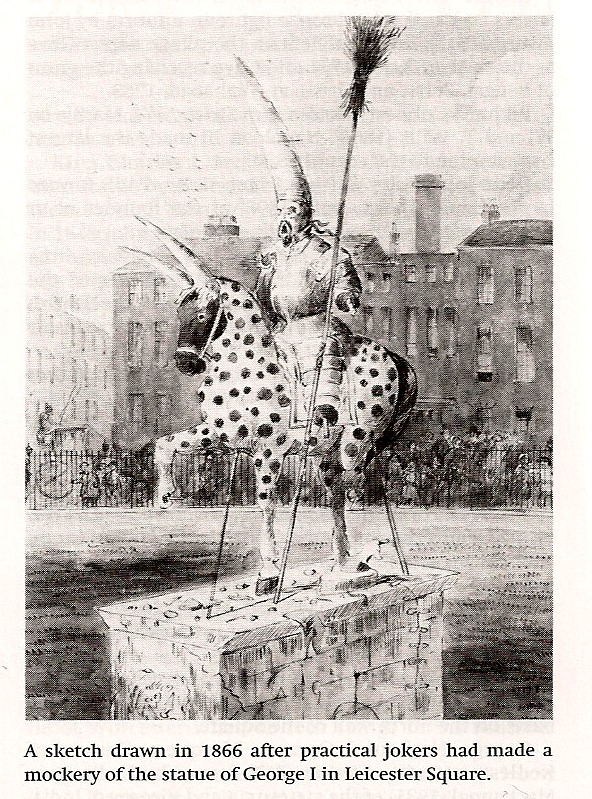
But the London mob has a rich tradition of dressing up (or down, depending on your viewpoint) London statues. My favourite example is the treatment dished out to the statue of a mounted George I, which was cast in 1716 and placed in Leicester Fields in 1784. This received serious punishment over the years as children clambered all over it, so both horse and rider lost bits, and at one point the poor king was without head, legs and arms. But worse was to come.

In October 1866, after the state of the statue had been discussed in the Times, guerilla jokers attacked the statue at night, painting black spots all over the horse, replacing the lance with a broomstick and putting a dunce’s hat from the nearby Alhambra Theatre on George’s bonce. Crowds flocked to see the spectacle. It was cleaned up, but eventually sold for £16 and pulled down in 1872.

As British History online website comments: ‘It would be almost impossible to tell all the pranks that were played upon this ill-starred monument, and how Punch and his comic contemporaries made fun of it, whilst the more serious organs waxed indignant as they dilated on the unmerited insults to which it was subjected.’

Nothing changes, once again.

Five unknown London pleasures

1 London’s first artificial ice rink
The Glaciarium opened in 1842 at the Baker Street Bazaar near Portman Square. The backdrop was ski chalets and snow-capped mountains, the ‘ice’ was churned-up hogs’ lard and sulphur. On hot days it smelt of cheese. It closed in 1844.

2 The clown and the geese
In 1884, a clown called Barry was watched by a huge crowd as he sailed down the Thames from Vauxhall to Westminster in a washtub pulled by four geese.

3 One-legged cricket
In 1796, Montpelier Gardens in Walworth hosted a cricket match between eleven one-armed Greenwich pensioners and eleven one-legged Greenwich pensioners. Interest was so great that a fence was broken and spectators fell through a stable roof. The match was drawn, but the one-legged team won a replay, earning themselves 1,000 guineas.

4 London’s first public museum
This was opened in a coffee house near Chelsea Old Church in 1695 by James Salter, a former servant of Hans Sloane, the man whose collection later formed the British Museum. Sloane reputedly handed Salter – renamed Don Saltero – some of the less important of his 80,000 objects, including a giant’s tooth,  a necklace made of Job’s tears and a bonnet that belonged to Pontius Pilate’s wife’s chambermaid’s sister (it actually came from Bedford).

5 The Peace of 1814
On Monday August 1, 1814, London celebrated the abdication of Napoleon Bonaparte with a series of festivities. It began with a balloon ascent at Green Park; the balloon was captured by the winds and sent towards the Estuary until the ballooneer cut a hole and landed on Mucking Marshes near Tilbury. Next came a miniature Battle of the Nile on the Serpentine, followed by a firework display in Green Park, for which John Nash had designed a new pagoda. Sadly this caught fire, killing two people. The crowd applauded, assuming it was all part of the fun.

All these came from Pleasures of London, a book available at the Museum of London bookshop for £30. It is my new favourite London book. It should have been published in 1992, but was delayed repeatedly and by the time it was published by the London Topographical Society in 2009 the authors, Felix Barker and Peter Jackson, had both died.

What the pair had created was an endlessly browsable book on all the fads and fancies that have occupied Londoners leisure since the Dark Ages, from Frost Fairs to black-faced minstrels, lidos to the Great Exhibition. There are brilliant throwaways  – such as those mentioned above – as well as short but thorough looks at things like music halls, pleasure gardens (which I still don’t get the point of), museums and the origins of sports like cricket, football and boxing.

Buy it.

Stamford Bridge in 1979

For people like me, there are few things more emotive than an empty football ground, filmed in 1979 in flickery Super-8 and overlayed by a haunting soundtrack. It’s like Simon Inglis’s first volume of ‘Football Grounds Of Great Britain’ come to life.

Check out loads more here.

Waxworks at war

The other day I headed to London Bridge to investigate Winston Churchill’s Britain at War Experience, a peculiar attraction on Tooley Street next to the London Dungeon that opened in 1992.

This strange place attempts to recreate the experience of wartime London feels rather like a private collection of eccentric memorabilia that has been thrown together in a space under a railway arch. There are no shiny monitors and well-lit cases; some of the labels are handwritten.

I quite liked it, although not at the £13 it would have cost if Laura at About London hadn’t got me in for free.

It begins with a film screened in a mocked-up air raid shelter, features various displays about life in London during the war (evacuation, fashion, rationing, entertainment, land girls), has a real Anderson Shelter to sit in and ends with a gloriously dramatic and gruesome life-size reconstruction of a bombed pub, complete with smoke and severed limbs.

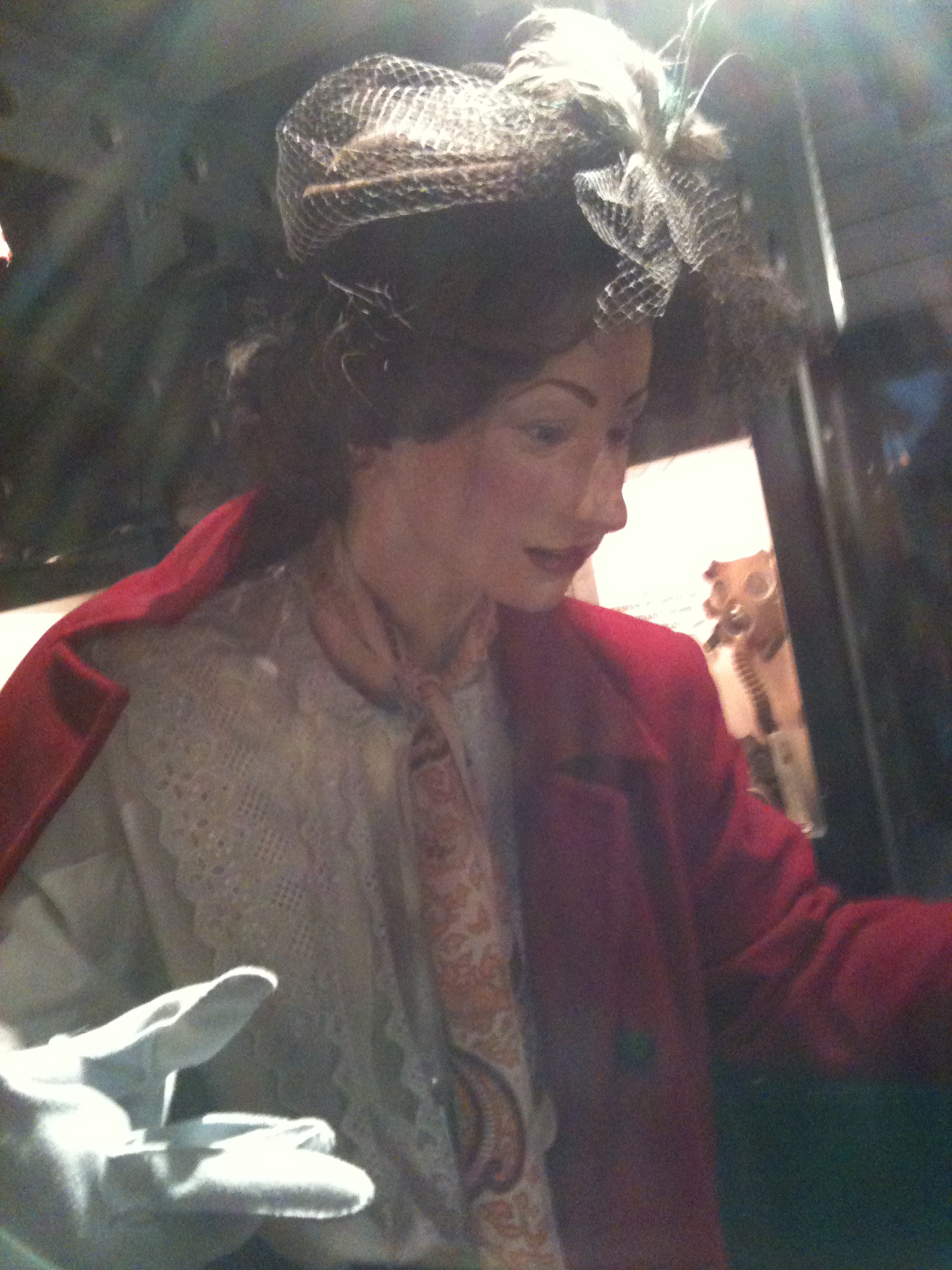
What I liked best, were the waxworks. You don’t get many waxworks in museums these days but there are loads at the Britain At War Experience and they are mostly terrible. Unfortunately, I only managed to photograph a couple, missing out on the frightening one of a small child asleep in an air-raid shelter, looking like a little corpse, and also a brilliant Winston Churchill with a head the size of Gibraltar (this may in fact be physically accurate).

But here are the ones I got.

This one is quite normal. It’s a man using a switchboard. It shows what they can do with waxworks when they put their mind to it.

But then they get progressively weirder. This woman with a massive nose is demonstrating wartime fashion, although I think she is actually a man who dresses like a woman to avoid war service and because he likes the freedom it offers him.

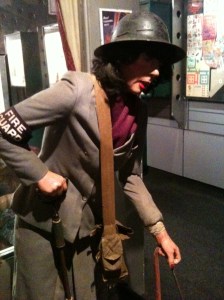
This woman is a fire warden with a bad back. 
At the end, in the bombed pub, this woman can be seen bravely selling tea even though she has clearly suffered terrible burns and should be taken to the nearest hospital. This could be to demonstrate the implacability of London spirit during the Blitz, or it could be because they ran out of artificial hair.

So there you go, if you like weird wartime waxworks and have thirteen quid to spare, get down to Tooley Street before they all come alive and take over the London Bridge Quarter.