Category Archives: History

Slade in London

I have a piece in the latest Uncut magazine about Slade, the glam rock bovver boys who became the most successful British group of the 1970s.

Slade were proud Black Country band – all raised in and around Wolverhampton and Walsall – and they never really took to life in  London, something that may have explained why it took them so long to break through. As Don Powell, the drummer, told me, ‘We didn’t really feel comfortable in the London scene when we could just be in the pub with our mates in Wolverhampton.’ Even today, all four remain wonderfully faithful to their roots and have the flattest vowels of any band I have ever interviewed.


But London still had an impact on their career. In 1966, beanpole producer Kim Fowley spotted the band – then called the N’Betweens – playing Tiles nightclub in Oxford Street and promptly hustled them into the recording studio. This was the result.

Tiles was a Mod club. John Peel played there once but his hippie tunes didn’t go down too well with the audience and he recalled: ‘It was certainly not the kind of place where they wanted to hear what I was doing. And there were waves of irate customers coming up over the footlights to try and persuade me to play whatever it was they wanted me to play. Which certainly wasn’t the Grateful Dead and Jefferson Airplane and Country Joe and the Fish or whatever I was playing. They didn’t like me at all.’

This terrific Pathe newsreel shows The Animals playing at Tiles, and it was ex-Animal Chas Chandler who gave Slade their next big break after he saw them performing at Rasputins on Bond Street. Noddy Holder told me, ‘Chas wanted to see us live. So we were booked to play a tiny place called Rasputins in Bond Street and we played our usual set there. People stopped dancing to watch us, which didn’t really happen at the time, and as Chas came down the stairs he said we were that good he thought it was a record being played. He thought it was fantastic and signed us the next day, no second thoughts. We started working a lot of London clubs and bigger venues around the country.’

Thereafter, Slade became regulars on the London circuit, and were the first band to book Earl’s Court (Bowie played a show before them, but had booked it after Slade). While Bowie’s show was plagued by sound problems, Slade were able t learn from his mistakes and their concert was deemed a great success.

Their favourite venue was probably the Top of the Pops studio in Elstree, where their rabble-rousing songs and remarkable outfits meant they practically became the house band.

Sadly, though, two of their greatest London moments have been lost forever. As one fan writes here, the band recorded two promo videos for Top of the Pops, one at Chessington Zoo for “Look Wot You Dun” and another at Greenwich Observatory for “Gudbuy T’Jane”. Both films have been wiped and seem to  be lost, among with many other studio Top of the Pops appearances.

Finally, here’s the band just before they made it. Still known as Ambrose Slade, this promo for their first album was filmed in Euston Station. The band had recently come out of their skinhead phase, and are nothing like the colourful eccentrics they would soon become.

Walking London: rivers and tubes

‘What a bounteous banquet of costly viands is spread before an ardent-minded, grateful-spirited Perambulator!’ Old Humphrey’s Walks In London

‘One must perambulate early and late in all weathers, to know a little about London’. The London Perambulator

London is a gift for those who wander. Sometimes you can pick a new area and just stroll wherever the whim strikes you; sometimes you can take a different route between two familiar destinations. Either way, you’ll find your appreciation of the city is inordinately increased.

There is a healthy industry in London walking – M@ recently compiled a list of his ten favourite for the Guardian – but if you need something cheaper and more challenging, you can always take a self-guided walk over a longer distance. I once walked the Thames from St Paul’s to Hampton Court on a Sunday afternoon, criss-crossing bridges and sticking as close to the river as possible. It was particularly satisfying to see how easy it is to walk on the river bank – the only place I had to take a significant detour was around the ever-weird Chelsea Harbour.

In a similar vein, a couple of books have recently come out on the theme of London walking. Walk The Lines is about Mark Mason‘s decision to walk every tube line in London, above ground, an overall distance of 403 miles that takes him everywhere from Amersham in the north-west and Epping in the far east to Morden in the deep south.

Mason enjoys discovering new parts of the city and peppers his book with brilliant London trivia but is at his best when writing about the pleasure walking can provide. As he writes, ‘Once you’ve caught the bug, you feel an urge to plan your walks, be it thematically, geographically or by some other means. There must be a raison d’être for your ramble.’ This, he thinks, taps into a similar mentality to that of a collector: ‘It’s not about studying, about observing or noting. It’s about collecting. About claiming the city’s greatness, or at least some small part of it, for yourself.’

Mason’s book is a fun read, but you couldn’t very well use it to walk the tube lines yourself, even if you were lunatic enough to want to do so. Tom Bolton’s London’s Lost Rivers, however, bills itself as ‘A Walker’s Guide’ and is a terrific mix of history, topography and practicality. It maps – astonishingly diligently – the courses of eight of London’s buried rivers, so walkers can follow them for themselves, pointing out items of interest they can see along the way while also offering some historical context about the subterranean rivers.

Along with Nicholas Barton’s The Lost Rivers of London, it’s essential for any fan of buried rivers (Diamond Geezer says much the same here). The atmospheric Polaroid photographs by SF Said are a nice touch, as is the introduction by the great Londonphile Chris Fowler. Highly recommended.

Secret London: stink pipes

There is one of these just around the corner from where I live.

Herne Hill stink pipe

It’s long, thin, green and old and thrusts straight into the air like a giant’s, er, finger. It’s not a telegraph pole – there are no wires coming off it – and it’s too tall to be a broken street lamp.

It is, in fact, a stink pipe, one of four such items of street furniture that can be found within a half-mile radius of Brixton Water Lane. These stink pipe were built around the same time as London’s Victorian sewer network in the 1860s and are basically just huge hollow pipes that allow potentially lethal gas to escape into the atmosphere, far above the rooftops.  They often seem to located near the locations of culverted rivers – these ones are found more or less on the route of the Effra or its tributaries – suggesting that when these rivers were incorporated into the sewer system, they required some sort of additional safety valve (the buried Fleet famously exploded at King’s Cross after just such a build-up of gas in 1846).

Some stinkpipes are rather elaborate, but the ones I’ve seen around Herne Hill and Brixton are pretty basic and utilitarian. If you want to find some finer examples, like the fine crowned stench pipes of Kennington Cross, you should check out the excellent London Stench Pipes blog, which is devoted to these marvellous oddities leftover from Victorian London.

Secret London: Brixton’s Windmill

I finally got round to visiting Brixton Windmill during Open House Weekend. I first heard about the windmill ten years or so again, when I would go to gigs at the Windmill pub and pop out between acts to try to catch a glimpse of this extraordinary building in the nearby park, lost and derelict like an abandoned spaceship.

The windmill was built in 1816 and run by John Ashby of Brixton Hall. It was originally on a hill in fields, surrounded by outbuildings like a mill cottage and bake house, where bread was baked with the mill’s stone-ground wholemeal flour and sold to locals.

By the 1850s, Brixton was starting to grow and new housing blocked the wind, hampering performance. In 1862, the Ashby’s took their milling business to the Mitcham watermills along the Wandle, but the Brixton Windmill somehow remained, used for storage. The sails, though, were removed and sold for firewood.


In 1902, the windmill was returned to use, albeit as a location for a steam-powered provender mill. The mill was finally closed in 1934 and left empty until the LCC purchased it in 1957, after at least one attempt had been made to demolish it and cover the site with flats. Despite the sails being restored in 1983, the windmill, now owned by Lambeth, was allowed to run almost to ruin, which is how it appeared when I first saw it.

Since then, a major restoration project has taken place and the windmill is now open again to the public around once a month. The Friends of Windmill Gardens, a local residents association, also hope to start grinding flour again, using the provender mill that still survives on the first floor.

In celebration, here are the Fuck Buttons playing at the Brixton Windmill pub.

Curiocity: London unfolded

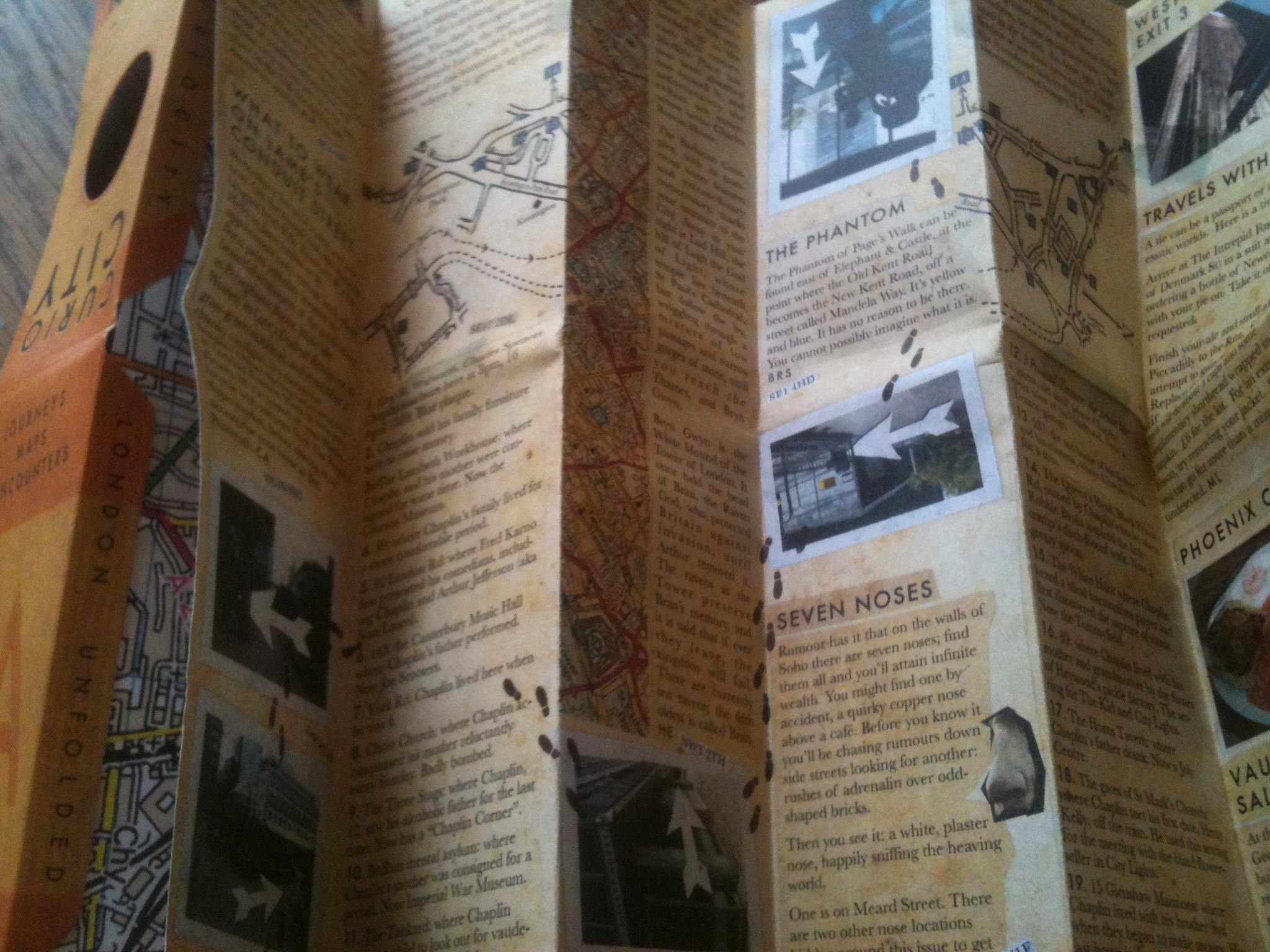
Another day, another London-themed map-related projected. Curiocity is a rather lovely tiny ‘mapazine’, that combines a magazine with a map and folds up into a cute – and curious –  little package that costs just £2.

One side features a stack of London-related trivia, including a loosely-mapped Charlie Chaplin walk around Lambeth, a ley-lines walk from Parliament Hill to Tower Hill and a ‘route’ from Hampstead tube to the mixed bathing ponds written out ransom note-style and snaking over five columns. There’s loads more, including bits on the Seven Noses of Soho and a game involving pigeons. It’s witty and it’s whimsical, both of which are obviously very good things indeed.

On the reverse is an entirely unusable but rather interesting map showing the history of London’s orbital road networks, a fascinating story which can be studied in detail here or in even more detail here.

Curiocity is available in a few choice London locations, including Stanfords, the London Review of Books Bookshop, the ICA and the Wellcome. It also has a website and is a more than welcome addition to the London publications landscape.

London’s mapping renaissance

The growth of online mapping – as seen by the excellent London Mapping website, which collects some of the best digital maps around – has not meant the end of paper maps.

I’ve mentioned Herb Lester‘s lovely themed maps before with reference to their 1960s map of London’s West End, Wish You Were There, and they continue to add new maps to their range, branching into different cities and themes while maintaining an impeccable eye for design. Untamed London, for nature-lovers, is their latest offering.

I’ve also finally got my hands on the Museum of London’s Londonium map and it is hugely impressive. This has been produced by MOLAS, the Museum of London Archeological Service, and is a huge map of the City, with the Roman topography superimposed over a plan of the contemporary city – a little like a paper version of the technology used for the Time Travel Explorer app.

Key Roman finds are listed, with an explanation of what they are and how they can be accessed, while the reverse side has a potted history of Roman London, with many illustrations. The map is printed on good thick paper so won’t tear easily (a constant problem for frequently folded paper maps), and works beautifully as both a decorative item and a practical plan for hunting down the existing remains of Londonium.

It costs just £6.25 and should it prove to be a big seller – which I imagine it will – I hope the Museum can persuade their friends at MOLA to produce more maps along the same lines.

One for the Olympic Park at around this time next year, perhaps?

London riots and football hooliganism

‘People were determined to smash and destroy. Windows were being smashed and the looters saw their chance. A road sign went straight through the middle of the window. Two people moved in with cardboard boxes and filled them with jumpers. These would be highly resaleable. [Others] were concentrating on the jewellers’ shops and a good few were looted. People who were probably  law-abiding citizens at any other time just went berserk. The faces of people as they went into a smashed shop and grabbed goods were amazing; all signs of reason had disappeared from their eyes. One guy came out of a shop with his eyes rolled up, his tongue hanging from an open mouth and breathing heavily. His trip into the shop had been a physical experience, and he was beginning to smile. He had dared and won. In a very short space of time, the streets had been transformed into a madhouse. Sirens blared out and police vans screeched around the streets.’

Was this Tottenham last Saturday? Brixton on Sunday? Battersea or Croydon on Monday? Manchester on Tuesday? Surely it must be from one of those occasions this week when England was forced to confront the reality of a ‘sub-educated, feral underclass’ in a post-Thatcher ‘something-for-nothing society’ (as Andrew Roberts so colourfully described it).

Well, actually no. This was way back in 1983, in tiny Luxembourg, where England fans went on a smashing and looting spree after failing to qualify for the European Championships. Football hooliganism was approaching its nadir after a 20 year spiral that had almost destroyed the national sport and left the authorities baffled at how to control it.

Mob looting by football supporters dates back to at least 1976, when Liverpool supporters descended in large groups to rob shops in St Etienne, where they were watching a European Cup tie. It soon became assimilated into the away trip –  usually while being escorted back to the station, away supporters would smash up city centres, fight the police and, if the opportunity arose, loot goods from shops: a jeweller here, a clothes shop there. Whatever could be easily lifted and carried back home.

In Colin Ward’s classic account of terrace culture ‘Steaming In’ (from which the above passage also came), he describes Chelsea fans after a game in Luton: ‘The trip back to the town station saw the mass destruction of the town centre. Shops were looted and a train was set on fire… It was said that one guy who didn’t like football but had a fetish about smashing shop windows went along to have a good night out. Nutters often tag along with football crowds just for the buzz.’

The past week’s violence certainly seemed unprecedented – and in some ways it was – but there are significant parallels with the way overwhelmingly young football fans routinely behaved in the 1970s and 1980s. There’s the casual disregard for other people’s property, the mania of the crowd, the opportunist thieving and violence, the loose organisation into gangs, the sheer thrill of anarchy, the speed of movement and the power of being able to catch the police wrong-footed.

The fear is that mass lootings will become a commonplace event, another part of our lives, as criminal gangs realise what they can get away with if there are enough of them around and as long as the law and lawmakers remain clueless at how to respond. It certainly took the authorities a long time to get a handle on how to police football, but the experience has now been completely transformed, partly because of tough sentences for hooligans, partly because of the disasters at Heysel and Hillsborough but also because the football establishment itself realised it had to change the way it regarded football supporters if the behaviour of fans was to improve.

When I watched a small group of 20 or 30 kids terrorise Hackney in broad daylight on Monday afternoon while the police stood and watched, my first instinct was that they would never have let a bunch of football supporters behave like that these days. There are always lessons to be learnt from the past, if you look in the right places.

London bricks

‘The bricks – laid Flemish bond, headers and stretchers alternating – were all old London stock bricks, but of many kinds and colours: rust red, beige, grey, brown, nearly black. Here and there were yellow ones – malm bricks made with an admixture of clay and chalk. The cumulative effect was pleasing – the variety gave texture, interest and warmth to the surface of the wall. The eye approved the range of colour, the uneven look, the way in which each brick differed from its neighbour and yet was in subtle harmony. But, more that that, to look at it was to see the way in which this wall arose from the ashes of many buildings. Studying it, Matthew saw in his mind’s eye warehouses and churches, factories and shops, terrace houses like this one, blasted to the ground perhaps on some furnace night of 1940. He thought of how the city lifts again and again from its own decay, thrusting up from its own detritus, from the sediment of brick dust, rubble, wood splinters, rusted iron, potsherds, coins and bones. He thought of himself, living briefly on top of this pile, inheriting its physical variety and, above all, the clamour of its references. The thought sustained him, in some curious way, as he sat at his desk in the flat which was not yet a home, or as he moved through days and through the city, from Finsbury to Docklands to Covent Garden to Lincoln’s Inn.

Penelope Lively in ‘City Of The Mind’ (1991, Andre Deutsch).

Secret London: swastikas

One of the great London rumours is that somewhere inside the Royal Society’s building on Carlton House Terrace sits a giant swastika.  This is not because these esteemed scientists and thinkers are secretly Hitler-worshipping fascists, but because their home at Nos 6-9 was the location of the German Embassy (at Nos 8-9) during the pre-war Nazi era.

Carlton House Terrace was designed by John Nash between 1827-1832 to occupy a site previously taken by Carlton House. No 9 almost immediately became the seat of the Prussian Legation, which slowly evolved into the German Embassy. In the spirit of the time, it soon expanded to occupy the house next door at No 8.

In 1936, Joachim von Ribbentrop moved in, replacing the late Ambassador Leopold von Hoesch (whose dog’s gravestone can be seen under a tree near the Duke of York steps). Von Ribbentrop demanded a complete renovation of the property, and the Nazi’s top architect, Albert Speer, was called in to do the job. Exactly what he did remains something of a mystery, but the German Embassy website claims:

‘Only the fact that the Nash Terrace was a listed building saved the facades from being included in Ribbentrop’s plan to establish a model of the Third Reich architecture in the centre of the British capital. The renovation was exhaustive, money was no object.’

It is hard to discern exactly what alterations Speer made, but one diplomat wrote that the showy renovation of No 8 and 9 Carlton House Terrace had produced a style and furniture less suitable for an embassy and more comparable to that of German luxury liners of the time like the “Bremen”.  A contemporary set of photographs are lodged at the Library of Congress. The only one currently viewable is of the very modern-looking kitchen.

This decent phot0-set shows the building now, including Speer’s striking staircase, said to be constructed by marble supplied by Mussolini.

Albert Speer designed this

Among Speer’s embellishments was said to be the inclusion of a swastika mosaic on the floor of one of the public rooms. After the war, rather than remove the offending article, the swastika was said to have been simply covered with a carpet. (And this website claims there are still visible ‘border designs of swastikas on the floor of one public room’, which seems unlikely.)

Is it true?

Well, I’ve never seen a photo to substantiate the claim and people I know who have been inside the Royal Society are also none the wiser. However, I did once receive an email at Time Out from a builder who claimed to have renovated the building in the 1990s and seen a huge swastika under one carpet. Where, presumably, it still remains. Von Ribbentrop also had a house built for him in Pinner, which was said to have swastikas carved into the staircase.

If you do have a hankering to see a swastika in London, you should head for India House, where this plaque can be seen on the wall.

It represents the swastika when it was still an intriguing sign from the east, before it was appropriated by Hitler. In the first two decades of the 20th century, the swastika was a popular symbol in the west, often used as a good luck charm and adopted by groups as varied as the Boy Scouts and the Druids. My copy of Rudyard Kipling’s Just-So Stories still has a prominent swastika featured in one illustration and the British Museum is full of the things.

Indeed, so popular was the swastika, it was even used to liven up the decor at Hounslow Bus Garage. Click on that last link and zoom in and you’ll see the border of pretty little swastikas that featured in the staff canteen. These swiftly disappeared as the truth about Hitler became impossible to ignore.


Thomas Paine’s London bridge

Thomas Paine was many things. A writer, revolutionary and political philosopher, Paine was also an inventor and engineer, who made the world’s first smokeless candle. He was also an occasional Londoner, most notably when he stayed at the Angel Inn, Islington, around the time he began writing Rights Of Man in 1791. This monument celebrates that fact.

Considerably more interesting than this, though, is the rarely discussed fact that Tom Paine built bridges. Iron bridges. And he built one of them in London.

Paine was fascinated by bridges, admiring them for their architecture as much as their metaphorical meaning. John Keane, Paine’s biographer, writes that he ‘was stuck by their double meaning. Bridges were for him combinations of architectural beauty and practicality, works of genius that could be breathtaking in their simplicity… the rising spirit of an epoch translated into space.’

Paine first tried to raise the funds to build an iron bridge over the Harlem River in New York in 1785 and then another over the Seine in Paris in 1786, but without success. Bridges of this era were still largely constructed in stone and wood, making Paine’s ideas rather unusual. Plus, he had no real background in engineering or architecture.

But he persevered. In 1788-89, he attempted to build an iron bridge over the River Don in South Yorkshire and although the project was never completed it did secure him a patent for his bridge-building scheme. Paine now decided that he needed to build his prototype bridge in London, where potential investors could see for themselves the sort of brilliant bridge he was going  to make. He told Thomas Jefferson – who himself had many ideas about how the bridge should be built – that a London bridge would soon pay for itself in tolls. Jefferson was impressed, writing to a friend: ‘Mr Paine, the author of Common Sense, has invented an iron bridge, which promises to be cheaper by a great deal than stone, and to admit of a much greater arch. He supposes it may be ventured for an arch of five hundred feet. He has obtained a patent for it in England, and is now executing the first experiment with an arch of between ninety and one hundred feet.’

Paine had originally hoped to build this experimental bridge to nowhere in Soho Square, but when he wrote to George Washington on May 1, 1790 describing his single-arch bridge of 110 feet, he still hadn’t found an appropriate location. By the end of May he could tell the no doubt anxious Washington that a site had been found – a field next to a famous tavern called the Yorkshire Stingo, on the Marylebone Road near what is now Lisson Grove. This was at least partly appropriate, given that the bridge was being constructed by a Rotherham-based ironworker called Thomas Walker.

Paine moved into the Yorkshire Stingo and began erecting his 110-foot bridge on the neighbouring bowling green. By September it was finished. Jefferson wrote to him a very nice letter saying: ‘I congratulate you sincerely on the success of your bridge. I was sure of it before from theory: yet one likes to be assured from practice also.’

However, although there were many interested visitors, none of them were impressed enough to offer to invest in Paine’s scheme to build a bridge over the Thames. By October 1791, Paine’s bridge had been started to rust and Paine had lost interest, so it was dismantled and the iron returned to Yorkshire, where some was used in a bridge built over the River Wear in Sunderland in 1796, which at the time was the longest iron bridge at the world at 240 feet.