Category Archives: History

Hippy-dilly: squatting and the London Street Commune at 144 Piccadilly

Tonight, Radio 4 will broadcast a show on squatting, called ‘From Frestonia To Belgravia‘.

Squatting as a 20th-century phenomena originated in the wake of the acute housing shortage after the Second World War. Homeless families began to occupy empty mansion blocks and hotels, including Duchess of Bedford House in Kensington.

Squatters move into Duchess of Bedford House

Some of the squatters of the 1960s took this as their inspiration. Among the most political were the London Street Commune, a group of self-declared space cadets from the streets who were turned into a minor political weapon by a Spart called Phil Cohen, aka Dr John, who had previously been involved with the British Situationist International group, King Mob. The LSC became loosely involved in the counterculture scene and even at one point managed to occupy the offices of the underground newspaper, International Times, believing it was ‘bourgeois’ and needed to be ‘liberated’. They gave up after a few days when they realised they didn’t really understand how to put a newspaper together.

The London Street Commune’s most conspicuous act came when they squatted a vast Park Lane mansion, 144 Piccadilly, at Hyde Park Corner in September 1969. This gained them massive media attention, and the building quickly came to be dubbed ‘Hippy-Dilly’ and attracted vast crowds of largely hostile onlookers. The LSC responded by barricading the front door and creating a ‘drawbridge’ out of wood from one of the ground-floor windows, and asking the Hell’s Angels to protect them.

Around 100 people were said to be living in the building, among them the odd journalist who infiltrated the squat so they could produce salacious copy about the drug-taking ne’er-do-wells. After surviving an attempt by skinheads to ‘take’ the mansion – the LSC threw carpet bowls and balloons filled with ink at the approaching skins – the police decided to take action.

The police moved in on September 21, leading to in the words of the Daily Mirror, ‘The Fall of the Hippy Castle‘. This took place the day after a free festival at Hyde Park, which many of the LSC had attended. The squat was now filled with numerous disparate groups, including Hell’s Angels and French veterans of May 1968, alongside the original Dilly drop-outs, but they were quickly moved out by police, who arrested around 70 of the squatters.

While John Lennon went on TV to offer the displaced squatters a home in the shape of an island off Scotland, the high-profile eviction was greeted with delight by the media. The Times demanded the squatting be made illegal and that hippies be arrested under the vagrancy act. This remarkable Pathe newsreel – with talk of ‘scroungers and drop-outs… snubbing the conventions of decent society… doing the real homeless a disservice’ – demonstrates the prevailing attitude. It is difficult to conceive of broadcast media speaking in such terms today.

In 1972, American film director Sam Fuller wrote a pulp novel about 144 Piccadilly, but the building itself was not to last much longer. It was knocked down in the 1970s and replaced by the ghastly Intercontinental Hotel.

Secret London: the Temple of Mithras goes back where it came from

The Temple of Mithras is one of London’s most easily viewed and best known Roman sites, but it is also one of its crappest. The temple has been in the wrong place pretty much ever since it was discovered 50 years ago and now sits unimpressively in a bed of a concrete in front of a banal office building in the City (image below from Knowledge Of London).

The Temple of Mithras: ‘crap’

All that is about to change. Next week, Museum of London Archaeology will begin a three year project that will put the Temple back where it belongs, and restore it to something closer to its original form. They will also do a little digging, to see what else they can discover.

The Temple – a shrine to an Iranian god who was said to have killed a mythical bull – was found by archaeologist WF Grimes  in 1952 on Walbrook. The cult was adopted by the Romans in 1 AD and the temple – probably built in around 250 AD – would originally have been a subterranean space where bulls were sacrificed. Archeologists had suspected there was Mithran temple in London since 1889, after the discovery in Walbrook of a relief depicting the god killing a bull but it was only uncovered after the Second World War, when the area suffered heavy bomb damage and became ripe for development.

A statue of Mithras were found buried beneath the temple, and it may well have later been used by followers of Bacchus, as Mithraism went into decline. Mithraism is sometimes seen as a precursor to Christianity, although I don’t know enough about that to possibly comment.

The temple was dismantled shortly after it was discovered so the construction of Bucklersbury House could continue. The material was put into storage and many of the statues loaned to the Museum of London. In 1962, the temple was reconstructed on Queen Victoria Street, 90 metres from its original site at ground level, embedded in the courtyard of a City office block. It was a particularly dismal and unsympathetic treatment of a genuine archaeological curiosity. Most people had no idea what it was, and even if they did, it was very hard to care.

The site is now owned by Bloomberg, and they are about to start dismantling the temple by removing it from the cement that currently encases it, and then reconstructing it on its original site in what they call ‘a purpose-built and publicly accessible interpretation space within their new building’. This will take three years, but many will rejoice that it is happening at all.

William Burroughs and the strange demise of London’s first espresso bar

In 1953, a momentous event occurred in Soho. London’s first proper coffee shop – one equipped with a Gaggia coffee machine – opened at 29 Frith Street. This was a place where teenagers too young for pubs could come and gather, and it is said by some that the introduction of this coffee bar prompted the youth culture explosion that soon changed social life in Britain forever.

Inside the Moka Bar

The Moka was an instant success, selling over a thousand cups of coffee a day. The author John Sutherland recalls, ‘the Gaggia machine, a great burbling, wheezing, spluttering monster, would grudgingly excrete some bitter caffeinated essence.  It would be swamped with steamed-milk foam and dusted with chocolate to form its ‘cappuccino’ hood… Glass cups and brown sugar (lots of it) were de rigueur.  Frankly, 50s espresso was no taste thrill.  But it felt smart as hell.’

By 1972, coffee bars where everywhere and the teenage revolution was firmly established. At this time, the author of ‘Naked Lunch’, former junkie and all-round Beat legend William S Burroughs was living in London, quietly going about his business in St James’s. He lived in Dalmeny Court, Duke Street, and loved the plush gentlemen’s shops of the area, not to mention the ‘Dilly Boys‘, young make prostitutes who hustled for clients outside the Regent Palace Hotel.

Although Burroughs was fond of the finer things in life – he got his shoes from John Lobb, hat from Locke’s and bought most of his food in Fortnum and Mason’s – he did at some point stumble into the Moka Bar, and was not impressed by what he found.

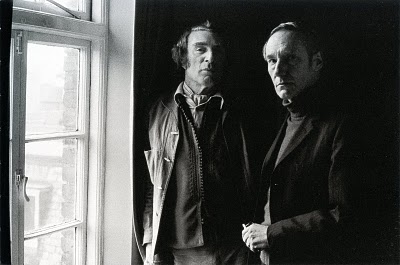
Burroughs and friend Brion Gysin in London

Burroughs at this time was getting sick of London – sick of the licensing laws, sick of the crap food and small drinks, sick of the weather, the terrible service and sexual hypocrisy. He was also sick of the Moka, which he believed responsible for an ‘outrageous and unprovoked discourtesy and poisonous cheesecake’.

The Church of Scientology, Fitzroy Street

Burroughs decided to mount a sound-and-image attack. He had previously launched one of these against the Church of Scientology, of which he had been a member, turning up at their headquarters at 37 Fitzroy Street every day, taking photographs and making sound recordings. He believed that ‘as soon as you start recording a situation and playing them back on the street, you are creating a new reality’ and that repeated exposure to such an attack would lead to ‘accidents, fires and removals’. After a few weeks, the Scientologists did indeed move, round the corner to 68 Tottenham Court Road.

Photo taken by Burroughs during the operation

On August 3, 1972, Burroughs turned his attention to the Moka. He would stand outside every day taking photos and making recordings by tape, and then return the next day to play the previous days recordings. Burroughs was convinced he was winning. ‘They are seething in there,’ he said. ‘I have them and they know it.’

On October 30, 1972, the Moka Bar closed.

Slade in London

I have a piece in the latest Uncut magazine about Slade, the glam rock bovver boys who became the most successful British group of the 1970s.

Slade were proud Black Country band – all raised in and around Wolverhampton and Walsall – and they never really took to life in  London, something that may have explained why it took them so long to break through. As Don Powell, the drummer, told me, ‘We didn’t really feel comfortable in the London scene when we could just be in the pub with our mates in Wolverhampton.’ Even today, all four remain wonderfully faithful to their roots and have the flattest vowels of any band I have ever interviewed.

But London still had an impact on their career. In 1966, beanpole producer Kim Fowley spotted the band – then called the N’Betweens – playing Tiles nightclub in Oxford Street and promptly hustled them into the recording studio. This was the result.

Tiles was a Mod club. John Peel played there once but his hippie tunes didn’t go down too well with the audience and he recalled: ‘It was certainly not the kind of place where they wanted to hear what I was doing. And there were waves of irate customers coming up over the footlights to try and persuade me to play whatever it was they wanted me to play. Which certainly wasn’t the Grateful Dead and Jefferson Airplane and Country Joe and the Fish or whatever I was playing. They didn’t like me at all.’

This terrific Pathe newsreel shows The Animals playing at Tiles, and it was ex-Animal Chas Chandler who gave Slade their next big break after he saw them performing at Rasputins on Bond Street. Noddy Holder told me, ‘Chas wanted to see us live. So we were booked to play a tiny place called Rasputins in Bond Street and we played our usual set there. People stopped dancing to watch us, which didn’t really happen at the time, and as Chas came down the stairs he said we were that good he thought it was a record being played. He thought it was fantastic and signed us the next day, no second thoughts. We started working a lot of London clubs and bigger venues around the country.’

Thereafter, Slade became regulars on the London circuit, and were the first band to book Earl’s Court (Bowie played a show before them, but had booked it after Slade). While Bowie’s show was plagued by sound problems, Slade were able t learn from his mistakes and their concert was deemed a great success.

Their favourite venue was probably the Top of the Pops studio in Elstree, where their rabble-rousing songs and remarkable outfits meant they practically became the house band.

Sadly, though, two of their greatest London moments have been lost forever. As one fan writes here, the band recorded two promo videos for Top of the Pops, one at Chessington Zoo for “Look Wot You Dun” and another at Greenwich Observatory for “Gudbuy T’Jane”. Both films have been wiped and seem to  be lost, among with many other studio Top of the Pops appearances.

Finally, here’s the band just before they made it. Still known as Ambrose Slade, this promo for their first album was filmed in Euston Station. The band had recently come out of their skinhead phase, and are nothing like the colourful eccentrics they would soon become.

Walking London: rivers and tubes

‘What a bounteous banquet of costly viands is spread before an ardent-minded, grateful-spirited Perambulator!’ Old Humphrey’s Walks In London

‘One must perambulate early and late in all weathers, to know a little about London’. The London Perambulator

London is a gift for those who wander. Sometimes you can pick a new area and just stroll wherever the whim strikes you; sometimes you can take a different route between two familiar destinations. Either way, you’ll find your appreciation of the city is inordinately increased.

There is a healthy industry in London walking – M@ recently compiled a list of his ten favourite for the Guardian – but if you need something cheaper and more challenging, you can always take a self-guided walk over a longer distance. I once walked the Thames from St Paul’s to Hampton Court on a Sunday afternoon, criss-crossing bridges and sticking as close to the river as possible. It was particularly satisfying to see how easy it is to walk on the river bank – the only place I had to take a significant detour was around the ever-weird Chelsea Harbour.

In a similar vein, a couple of books have recently come out on the theme of London walking. Walk The Lines is about Mark Mason‘s decision to walk every tube line in London, above ground, an overall distance of 403 miles that takes him everywhere from Amersham in the north-west and Epping in the far east to Morden in the deep south.

Mason enjoys discovering new parts of the city and peppers his book with brilliant London trivia but is at his best when writing about the pleasure walking can provide. As he writes, ‘Once you’ve caught the bug, you feel an urge to plan your walks, be it thematically, geographically or by some other means. There must be a raison d’être for your ramble.’ This, he thinks, taps into a similar mentality to that of a collector: ‘It’s not about studying, about observing or noting. It’s about collecting. About claiming the city’s greatness, or at least some small part of it, for yourself.’

Mason’s book is a fun read, but you couldn’t very well use it to walk the tube lines yourself, even if you were lunatic enough to want to do so. Tom Bolton’s London’s Lost Rivers, however, bills itself as ‘A Walker’s Guide’ and is a terrific mix of history, topography and practicality. It maps – astonishingly diligently – the courses of eight of London’s buried rivers, so walkers can follow them for themselves, pointing out items of interest they can see along the way while also offering some historical context about the subterranean rivers.

Along with Nicholas Barton’s The Lost Rivers of London, it’s essential for any fan of buried rivers (Diamond Geezer says much the same here). The atmospheric Polaroid photographs by SF Said are a nice touch, as is the introduction by the great Londonphile Chris Fowler. Highly recommended.

Secret London: stink pipes

There is one of these just around the corner from where I live.

Herne Hill stink pipe

It’s long, thin, green and old and thrusts straight into the air like a giant’s, er, finger. It’s not a telegraph pole – there are no wires coming off it – and it’s too tall to be a broken street lamp.

It is, in fact, a stink pipe, one of four such items of street furniture that can be found within a half-mile radius of Brixton Water Lane. These stink pipe were built around the same time as London’s Victorian sewer network in the 1860s and are basically just huge hollow pipes that allow potentially lethal gas to escape into the atmosphere, far above the rooftops.  They often seem to located near the locations of culverted rivers – these ones are found more or less on the route of the Effra or its tributaries – suggesting that when these rivers were incorporated into the sewer system, they required some sort of additional safety valve (the buried Fleet famously exploded at King’s Cross after just such a build-up of gas in 1846).

Some stinkpipes are rather elaborate, but the ones I’ve seen around Herne Hill and Brixton are pretty basic and utilitarian. If you want to find some finer examples, like the fine crowned stench pipes of Kennington Cross, you should check out the excellent London Stench Pipes blog, which is devoted to these marvellous oddities leftover from Victorian London.

Secret London: Brixton’s Windmill

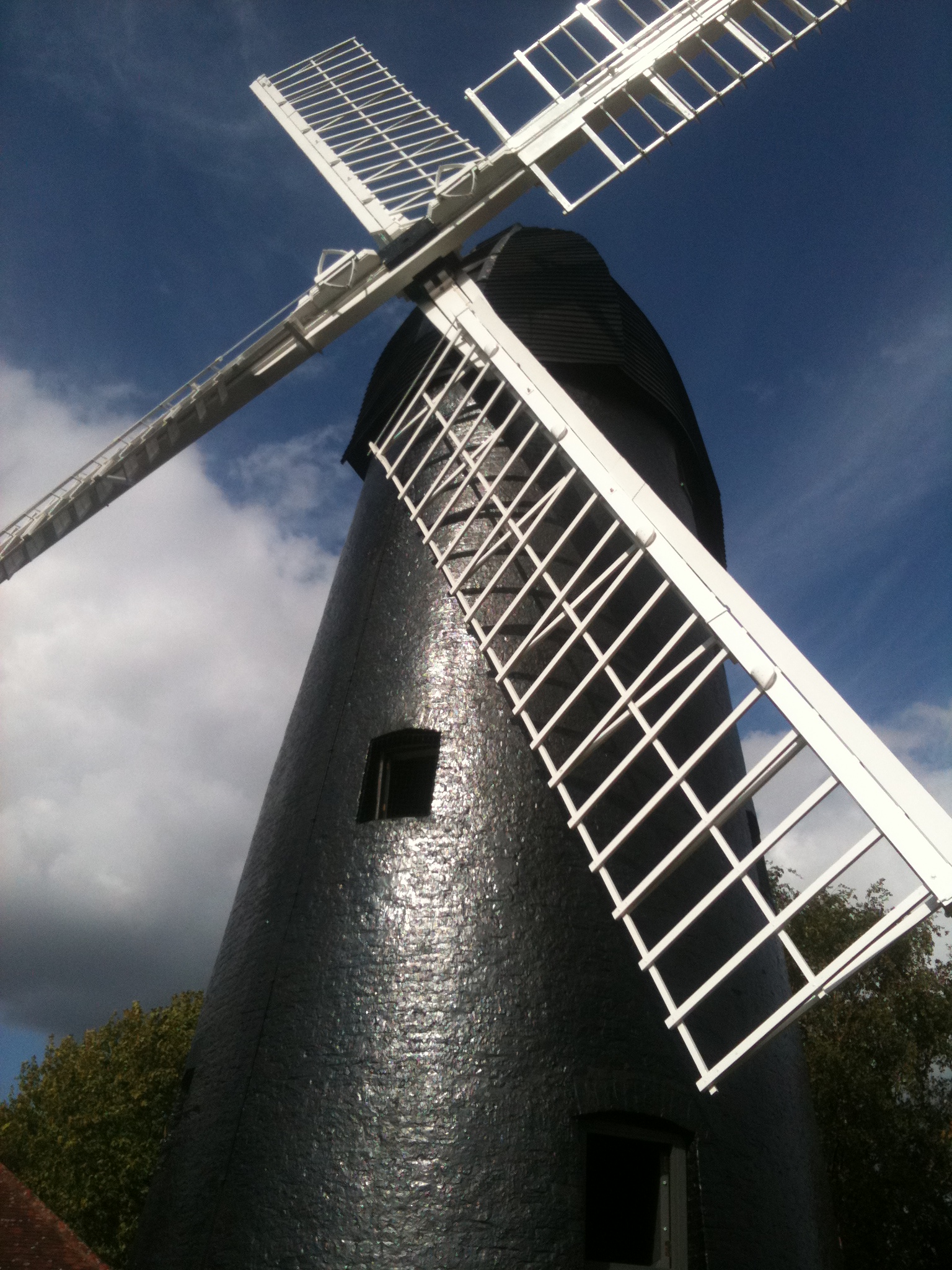
I finally got round to visiting Brixton Windmill during Open House Weekend. I first heard about the windmill ten years or so again, when I would go to gigs at the Windmill pub and pop out between acts to try to catch a glimpse of this extraordinary building in the nearby park, lost and derelict like an abandoned spaceship.

The windmill was built in 1816 and run by John Ashby of Brixton Hall. It was originally on a hill in fields, surrounded by outbuildings like a mill cottage and bake house, where bread was baked with the mill’s stone-ground wholemeal flour and sold to locals.

By the 1850s, Brixton was starting to grow and new housing blocked the wind, hampering performance. In 1862, the Ashby’s took their milling business to the Mitcham watermills along the Wandle, but the Brixton Windmill somehow remained, used for storage. The sails, though, were removed and sold for firewood.

In 1902, the windmill was returned to use, albeit as a location for a steam-powered provender mill. The mill was finally closed in 1934 and left empty until the LCC purchased it in 1957, after at least one attempt had been made to demolish it and cover the site with flats. Despite the sails being restored in 1983, the windmill, now owned by Lambeth, was allowed to run almost to ruin, which is how it appeared when I first saw it.

Since then, a major restoration project has taken place and the windmill is now open again to the public around once a month. The Friends of Windmill Gardens, a local residents association, also hope to start grinding flour again, using the provender mill that still survives on the first floor.

In celebration, here are the Fuck Buttons playing at the Brixton Windmill pub.

Curiocity: London unfolded

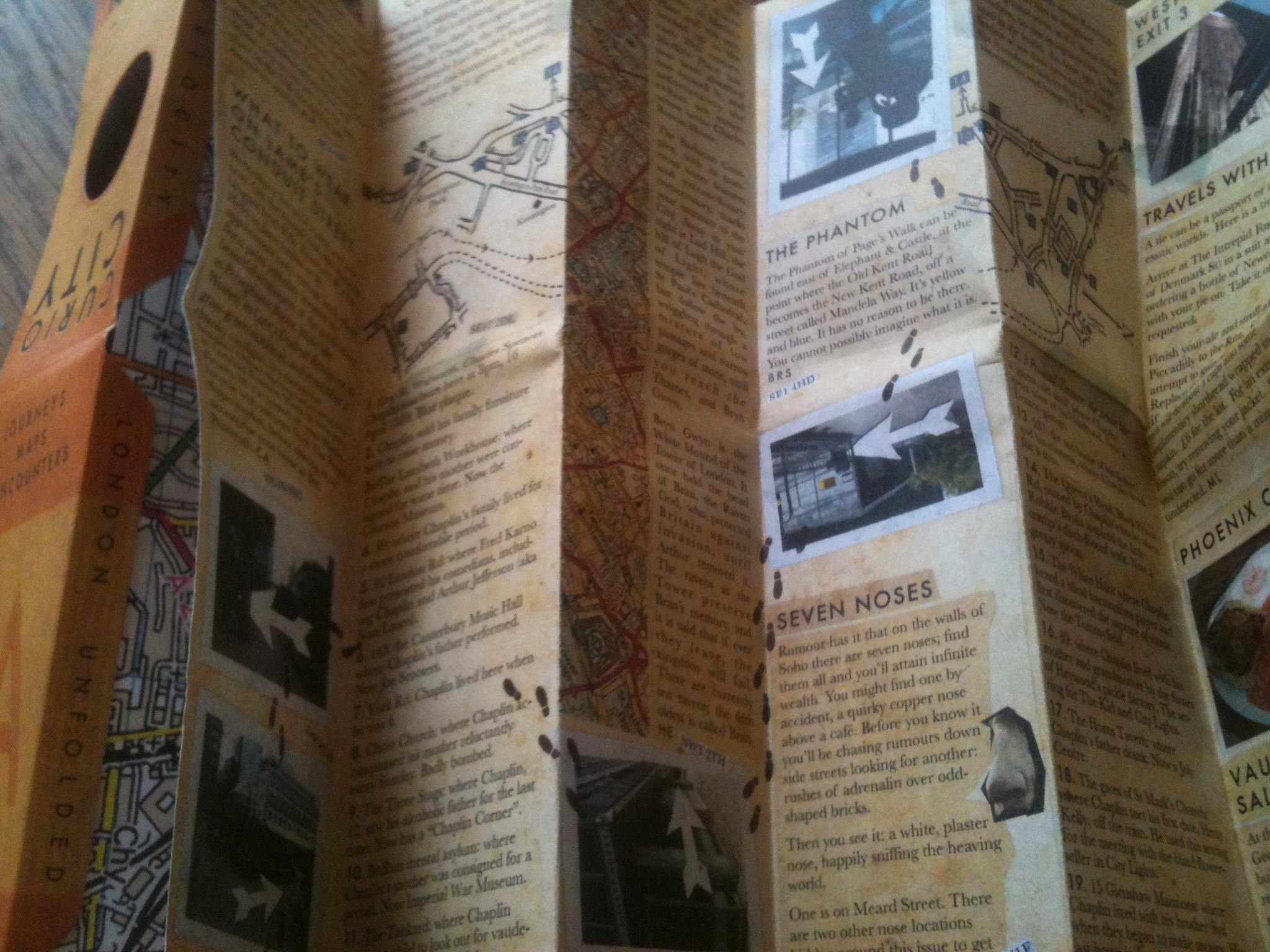
Another day, another London-themed map-related projected. Curiocity is a rather lovely tiny ‘mapazine’, that combines a magazine with a map and folds up into a cute – and curious –  little package that costs just £2.

One side features a stack of London-related trivia, including a loosely-mapped Charlie Chaplin walk around Lambeth, a ley-lines walk from Parliament Hill to Tower Hill and a ‘route’ from Hampstead tube to the mixed bathing ponds written out ransom note-style and snaking over five columns. There’s loads more, including bits on the Seven Noses of Soho and a game involving pigeons. It’s witty and it’s whimsical, both of which are obviously very good things indeed.

On the reverse is an entirely unusable but rather interesting map showing the history of London’s orbital road networks, a fascinating story which can be studied in detail here or in even more detail here.

Curiocity is available in a few choice London locations, including Stanfords, the London Review of Books Bookshop, the ICA and the Wellcome. It also has a website and is a more than welcome addition to the London publications landscape.

London’s mapping renaissance

The growth of online mapping – as seen by the excellent London Mapping website, which collects some of the best digital maps around – has not meant the end of paper maps.

Image of Untamed London

I’ve mentioned Herb Lester‘s lovely themed maps before with reference to their 1960s map of London’s West End, Wish You Were There, and they continue to add new maps to their range, branching into different cities and themes while maintaining an impeccable eye for design. Untamed London, for nature-lovers, is their latest offering.

I’ve also finally got my hands on the Museum of London’s Londonium map and it is hugely impressive. This has been produced by MOLAS, the Museum of London Archeological Service, and is a huge map of the City, with the Roman topography superimposed over a plan of the contemporary city – a little like a paper version of the technology used for the Time Travel Explorer app.

Key Roman finds are listed, with an explanation of what they are and how they can be accessed, while the reverse side has a potted history of Roman London, with many illustrations. The map is printed on good thick paper so won’t tear easily (a constant problem for frequently folded paper maps), and works beautifully as both a decorative item and a practical plan for hunting down the existing remains of Londonium.

It costs just £6.25 and should it prove to be a big seller – which I imagine it will – I hope the Museum can persuade their friends at MOLA to produce more maps along the same lines.

One for the Olympic Park at around this time next year, perhaps?

London riots and football hooliganism

‘People were determined to smash and destroy. Windows were being smashed and the looters saw their chance. A road sign went straight through the middle of the window. Two people moved in with cardboard boxes and filled them with jumpers. These would be highly resaleable. [Others] were concentrating on the jewellers’ shops and a good few were looted. People who were probably  law-abiding citizens at any other time just went berserk. The faces of people as they went into a smashed shop and grabbed goods were amazing; all signs of reason had disappeared from their eyes. One guy came out of a shop with his eyes rolled up, his tongue hanging from an open mouth and breathing heavily. His trip into the shop had been a physical experience, and he was beginning to smile. He had dared and won. In a very short space of time, the streets had been transformed into a madhouse. Sirens blared out and police vans screeched around the streets.’

Was this Tottenham last Saturday? Brixton on Sunday? Battersea or Croydon on Monday? Manchester on Tuesday? Surely it must be from one of those occasions this week when England was forced to confront the reality of a ‘sub-educated, feral underclass’ in a post-Thatcher ‘something-for-nothing society’ (as Andrew Roberts so colourfully described it).

Well, actually no. This was way back in 1983, in tiny Luxembourg, where England fans went on a smashing and looting spree after failing to qualify for the European Championships. Football hooliganism was approaching its nadir after a 20 year spiral that had almost destroyed the national sport and left the authorities baffled at how to control it.

Mob looting by football supporters dates back to at least 1976, when Liverpool supporters descended in large groups to rob shops in St Etienne, where they were watching a European Cup tie. It soon became assimilated into the away trip –  usually while being escorted back to the station, away supporters would smash up city centres, fight the police and, if the opportunity arose, loot goods from shops: a jeweller here, a clothes shop there. Whatever could be easily lifted and carried back home.

In Colin Ward’s classic account of terrace culture ‘Steaming In’ (from which the above passage also came), he describes Chelsea fans after a game in Luton: ‘The trip back to the town station saw the mass destruction of the town centre. Shops were looted and a train was set on fire… It was said that one guy who didn’t like football but had a fetish about smashing shop windows went along to have a good night out. Nutters often tag along with football crowds just for the buzz.’

The past week’s violence certainly seemed unprecedented – and in some ways it was – but there are significant parallels with the way overwhelmingly young football fans routinely behaved in the 1970s and 1980s. There’s the casual disregard for other people’s property, the mania of the crowd, the opportunist thieving and violence, the loose organisation into gangs, the sheer thrill of anarchy, the speed of movement and the power of being able to catch the police wrong-footed.

The fear is that mass lootings will become a commonplace event, another part of our lives, as criminal gangs realise what they can get away with if there are enough of them around and as long as the law and lawmakers remain clueless at how to respond. It certainly took the authorities a long time to get a handle on how to police football, but the experience has now been completely transformed, partly because of tough sentences for hooligans, partly because of the disasters at Heysel and Hillsborough but also because the football establishment itself realised it had to change the way it regarded football supporters if the behaviour of fans was to improve.

When I watched a small group of 20 or 30 kids terrorise Hackney in broad daylight on Monday afternoon while the police stood and watched, my first instinct was that they would never have let a bunch of football supporters behave like that these days. There are always lessons to be learnt from the past, if you look in the right places.