Category Archives: Fashion

Secret London: more streets beneath London streets

A fascinating, I think anyway, footnote to my previous post about the secret streets beneath London comes courtesy of reader Steve Lloyd.  Although it may raise more questions that it answers.

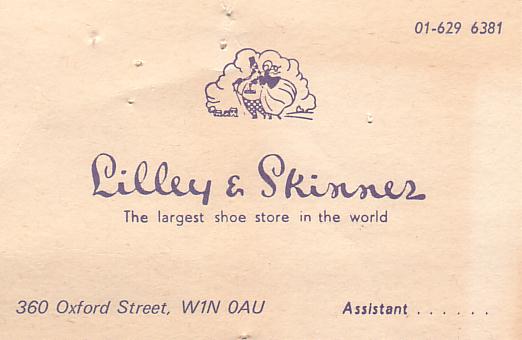
Steve worked at shoe shop Lilley & Skinner in the early 1980s and thinks the abandoned Victorian shops beneath Selfridges as seen at around 31 minutes in Malcolm McLaren’s The Ghosts of Oxford Street, may have been located in their basement. I’ll let Steve take up the story.

SAVE0010

‘In the early 80s I was manager of Lilley & Skinner at 356-360 Oxford Street (the largest shoe store in the world according to the Guinness Book of Records). The staff entrance to the store was at the rear along Barrett Street. Here was a short driveway downhill into the building where I used to park.Also situated here was the maintenance department and adjacent was a concrete staircase which led down to several lower levels that were really no more than cellars. The lads in maintenance had told me about the ‘old street’ that was down there and took me down one day to have  to have a look.

Though of course very interesting there was not a lot to see, just a bit of old shop front under some arches and some cobbled street. The lads said that the council had put a preservation order on it and that we weren’t allowed to use the space in any way.

I found some stills from The Ghosts of Oxford Street a couple of years ago after I saw it discussed on this forum and I have to say that they are exactly how I remember the site at Lilley & Skinner.

523-33904523-33905
The first is one of the arches and the second is the piece of shop front and window frame. Entering the right of the store from Oxford Street you’d go downstairs to the Mens department on the lower ground floor and then there was another department (Tall and Small) at lower lower ground floor, which was on the left hand side of the building. Our secret street was a couple of levels down from that.’
imgres
So there we go. Is this the true location of the secret street beneath Oxford Street? Does it really have a preservation order from the council? And if so, does it still exist? The site at 360 Oxford Street, incidentally, is now a branch of Forever 21.

The Clash in Soho

The Clash have opened a, wait for it, pop-up shop in Soho to promote the release of their new box set. It’s only open for a couple of weeks, and I happened to be in the West End yesterday so paid a quick visit, joining a crowd made up entirely, and unsurprisingly, of middle-aged men.

I wasn’t actually expecting a great deal, but was pleasantly surprised by what I found. While the upstairs is essentially a Clash mini-mart, flogging copies of the band’s albums as well as the Sound System box, the downstairs is more like a mini-museum of Clash memorabilia, featuring the iconic alongside pleasing ephemera.

So while the biggest draw was the buggered bass guitar that Paul Simonon is seen smashing on the cover of London Calling…

IMG_1934

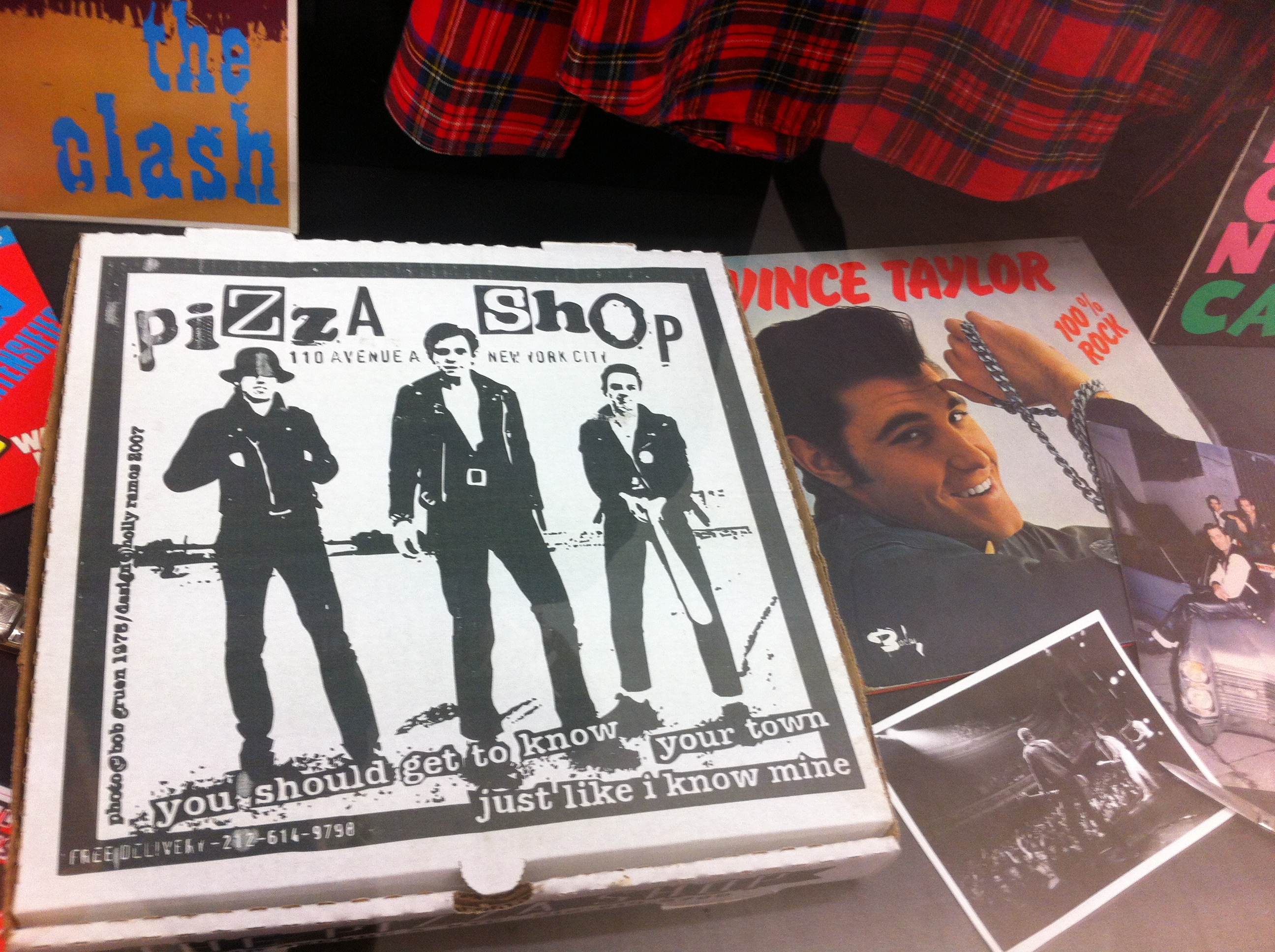
… I rather preferred witty juxtapositions like this, which places a punk-referencing pizza box alongside a Vince Taylor LP.

IMG_1930

A long cabinet acts like a timeline of the band’s history, crammed with ephemera relating to the band personally and politically, but also to the musical and literary influences they were absorbing along the way. So the section around the time of, say, Sandinista!, is full of South American political paraphernalia, lyric sheets and cassettes of the music they were discovering, while further along, at the time of Combat Rock, it’s all about cowboys and indians, and the US military. It was a bit like the Bowie V&A show in miniature with a better developed sense of humour, and ably demonstrated that the three-dimensional, technicolor world of rock and roll offers huge potential for entertaining and informative exhibitions when handled with the right blend of respect and irreverence. One day, one hopes, somebody will do a Beatles exhibition that works along similar lines.

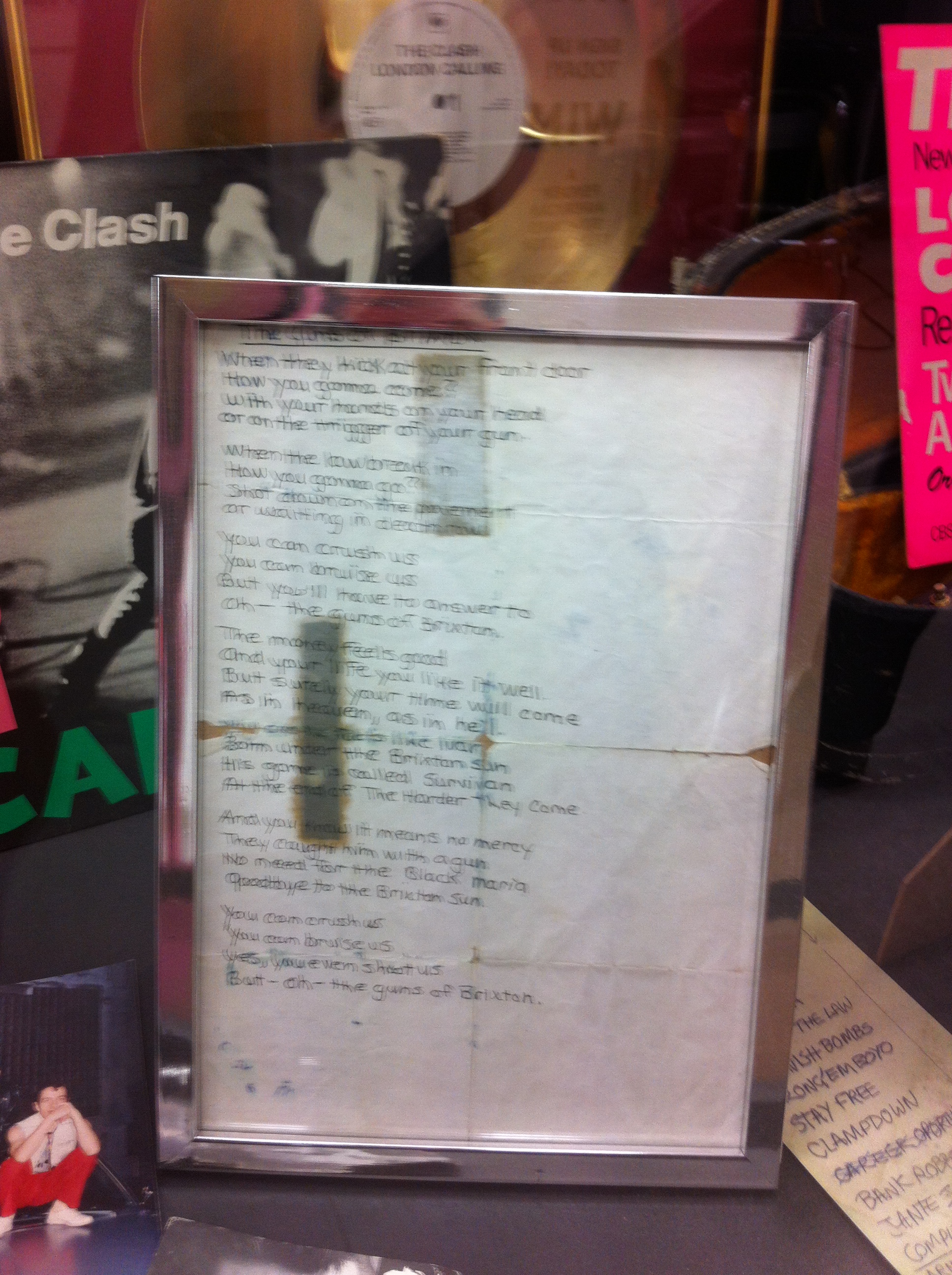
Other items of interest included the Clash’s map of the world, Paul Simonon’s certificate of appreciation from the Guardian Angels, the hand-written lyrics to “Guns Of Brixton” and an old beat box, with rather touching home-made cassettes. Everything is offered entirely without explanation, which is part of the fun. Check it out.

IMG_1933

IMG_1932

IMG_1931

IMG_1935

Black Market Clash, 75 Berwick Street, W1. Open until September 22.

Jonathan Gili, on collecting and connecting

Paul McCartney-designed wrapping paper for Indica bookshop and gallery.

Paul McCartney-designed wrapping paper for Indica bookshop and gallery.

The wonderful new catalogue by Maggs counterculture is dedicated to (a fragment) of the vast collection amassed over four decades by the film-maker Jonathan Gili. An insight into Gili’s collecting instinct comes from this article by Anthony Gardner:

Lift the lids of the boxes, and you can scarcely believe your eyes. There are bottles of Star Wars bubble bath and packets of Beatles bubblegum; fridge magnets shaped like kettles and Danish pastries; hair clips
commemorating the Queen’s coronation; Camembert boxes and plastic lizards and packets of tortilla chips. It is as if all the flotsam and jetsam of post-war consumer society had been washed up on a concrete shore and painstakingly catalogued by an tireless, obsessive beachcomber.

Although the catalogue focuses on the recognised brilliance of London’s 1960s psychedelic poster artists like Martin Sharp and Haphash And The Coloured Coat, Gili would collect anything – indeed, Gardner notes he was particularly drawn to sardine tins and even self-published a book about them. The items Maggs has for sale includes such magpie oddities as shopping bags, wrapping paper (albeit designed by Paul McCartney) and old newspaper posters, such as this one regarding Joe Orton’s murder, taken from a newstand in London in 1967.

1465_28

In 1986, Gili wrote an article about his collection asking rhetorically: ‘Who could resist records shaped like Elton John’s hat or Barry Manilow’s nose? They have poor sound and often can’t be made to play at all… but as art objects they are sublime.’

Sadly, there are no records shaped like Barry Manilow’s nose in this catalogue as much of Gili’s collection went to a private collector sympathetic to the intentions and ambitions of Gili. But what makes somebody collect stuff like this? In his short, thoughtful, introduction to the catalogue, Carl Williams – who knows much about collectors – ponders that question. Collectors are often said to be creating a bulwark against their own death, but perhaps, speculates Williams, they also wish to act as a guardian for those things that would otherwise be ‘forgotten, scorned or destroyed’ as tastes and times change?  Today’s trash is tomorrow’s museum piece; yesterday’s lunatic is the future’s visionary. Gardner touches on this, with an anecdote in which Gili ‘rescues’ a particularly revolting object from a garage forecourt. It’s a revealing story. By the very nature of his collecting this worthless item, Gili has given it value. But he’s also, clearly and very simply, enjoyed the moment, relishing both the acquisition and the reaction it will get from his co-conspirator. Why collect? Why not!

Lucinda Lambton tells a story which epitomises Gili’s passion for acquisition. ‘We were driving through the outskirts of Guildford,’ she says, ‘and he suddenly shouted “Stop!” Then he jumped out of the car while it was still moving and ran across this huge, horrible garage forecourt. When he came back, he was triumphantly waving a gold-lamé-clad Michael
Jackson doll.

Collections also gain their own momentum, and I sometimes wonder how many collections have been made almost by accident – one minute you are idly picking up old books about London from secondhand shops and markets, the next thing you know you have 250 of the things and, inadvertently, the beginnings of a minor collection. And if you’ve started, you might as well finish. What else is there to do with your time?

More obviously, collectors hoard items that carry the echo of a cherished memory, certain pieces that remind them of a special moment in their past, or of a past they wished they had. Many of the items being sold by Maggs are focused around the London underground scene of the 1960s. I’m not sure quite what relationship Gili had with the counterculture, but he was clearly an interested observer at the very least – and he edited cult London film Bronco Bullfrog, with soundtrack by 1960s Gilbert & George support act, Audience.

Gili’s 1960s collection includes a number of items from that era that have always been regarded as important and beautiful, such as these stunning posters by Martin Sharp, one of my favourite psychedelic artists and, in my view, a rival to anything that came out of the more lauded Bay Area poster scene.

Cream by Martin Sharp

Cream by Martin Sharp

Purple Dylan by Martin Sharp

Purple Dylan by Martin Sharp

Oz magazine

Oz magazine

UFO Club poster

UFO Club poster

Many of the objects are related specifically to the London scene – the shops, clubs, galleries and ‘fun palaces’ of 1960s London. Gili, then, had a close relationship with this city. One of his best-known films is the charming To The World’s End, about the No 31 bus journey from Islington to Chelsea. Interestingly, 1960s historian Jonathon Green recalls a map of this very bus route once published as a cover of IT newspaper, showing how it connected some of the key points of swinging London – ‘The hippie highway: all the way from Granny Takes a Trip to the Roundhouse’, as Green puts it.

A semi-thorough scouring of the ever-so-distracting IT archive has not turned up this delightful sounding map, so perhaps it was produced by one of the many other underground papers of the era. But it is not a massive leap to speculate that Gili, the great collector of underground London, noted this off-kilter way of observing and uniting the London villages, and later chose to make a film taking precisely that approach. Collections, like buses, are a way to make connections.

fotoflexer_photo

Selling ‘psychedelic marmite’ in Ladbroke Grove with the rock ‘n’ roll doctor


Before he met Gram Parsons and became country and western singer Hank Wangford, Sam Hutt was an avowed member of the sixties counterculture as well as a qualified doctor. Like many on the scene, he managed to combine his two lives for a brief period when he and two other doctors ran a practice prescribing marijuana to junkies. Hutt, incidentally, was one of the signatories of Steve Abrams pro-pot advert in The Times.  I spoke to him recently, and he explained how it all came about:

‘I qualified as a doctor and didn’t know what the fuck to do. I didn’t like doctors, I didn’t like medical students, I didn’t like working in hospitals and I didn’t want to do general practice. Then I heard this guy, Ian Dunbar, had a place in Ladbroke Grove. I found this out from Bernie Greenwood, who was the only doctor I really liked and was also a musician, playing saxophone and keyboards.


So we both joined in. Ian had this practice on the crest of the hill in Ladbroke Grove. There’s a church and right opposite is the church building and we had the top floor. Ian’s big thing was to help people who were on heroin. He’d discovered that doctors could still prescribe cannabis, ironically in tincture form, which means in alcoholic solution. Ian prescribed it to people who were coming off smack, not because it replaces the heroin – it doesn’t – but as a way of getting high. That’s counter to the usual treatment of heroin, which is to use methadone. The rationalisation for methadone, which can kill you if you overdose on it, is that you don’t get high. It doesn’t make you feel good, whereas heroin makes you feel good.

It seemed to me this was a Presbyterian attitude – if you like something, it must be bad for you. So they switch you on to something you don’t like. Ian went counter to that, offering them something that let them get out of it, just in a different way to heroin. People often switch between heroin and alcohol as alcohol is much closer to heroin than cannabis is. Cannabis doesn’t achieve wipe out, it doesn’t achieve oblivion, which both heroin and alcohol do.

So me, Ian and Bernie set up this hippie practice and as a political act, we prescribed cannabis. In the 60s, smoking a joint was a political act, it was you saying you were a freak, a part of an alternative society, not a straight. And you didn’t touch alcohol because it would kill you. Our ethos was that we wouldn’t prescribe speed: uppers or downers. If that’s what you wanted you had to go to the straight doctors in pin-stripe suits in Harley Street. They’ll give you bucketloads. So I’m not a grocer, but I will prescribe you cannabis. They closed that law down in 1973. We were seeing all sorts of people but when we got our first cheque from the National Health it was for £11. That’s for three doctors after six months work. Even then, £11 wasn’t much. So we had to support ourselves by making it a private prescription charging a couple of quid a time.

We got the cannabis from William Ransom & Son. They were the company in Hertfordshire that had a government license to extract cannabis from the plant. They made it into this sticky thick stuff, like a psychedelic marmite. That would then be dissolved in alcohol to make a tincture. The extract was much stronger than the tincture, you could get very, very stoned.

That practice was eventually closed by the police, because they didn’t like junkies being treated like you and me, they wanted to lock them up. I continued being a rock and roll doctor. I went on tour with Family and I shared a house with Jenny Fabian and Roger Chapman before, through Keith Richards, I met Gram Parsons and discovered country music.’


Gilbert & George and David Bowie at the Marquee, 1968/9

Should you be fortunate enough to attend the superb David Bowie exhibition at the V&A this spring, one of the first thing you will see is a video of the artists Gilbert & George performing their ‘Singing Sculpture‘. The intention, I think, is to draw a connection between Bowie and conceptual art, but there is another facet of the relationship between David Bowie and Gilbert & George that goes unmentioned: they both played gigs at the Marquee.

I have an article in the current issue of Uncut about the Marquee club. It mainly focuses on The Who, and while asking around about people who may have seen Townshend and Co perform at the Marquee I received an intriguing email from the writer Jonathon Green, who recalled a show at the Marquee in 1968. ‘They were holding auditions and some pals of mine who had a band tried their luck. Unsuccessfully. Naturally we friends tipped up to cheer. But the weird moment of the evening was when this pair of blokes appeared and, saying nothing, sat for some minutes on either side of a table that they placed centre stage. The two blokes, it transpired, though I must admit I can longer recall when I made this discovery, were Gilbert and George.’

Astonishingly, it seems London artists Gilbert & George did play the Marquee at least once – as they mention here – and possibly even twice. Because as well as the evening Green recalls they also played a show there in early 1969, when they were supported by Audience (who later played on the soundtrack to cult suedehead film Bronco Bullfrog).

I asked two members of Audience about their show with Gilbert & George. Sadly, G&G themselves did not respond to repeated queries about their Marquee days.

Trevor Williams: ‘It was an audition night for us, but I’m not sure what they were doing there unless it was to audition an act they were planning to perform later at the Marquee. It was our first live gig but their act basically consisted of them sitting at a table on two chairs facing each other. They were in suits and their faces were painted gold or silver and one told the other stories while the other said nothing. These were very macabre little stories one of which involved a dwarf committing suicide in the bath and the water getting pinker and pinker but never got red because there’s not enough blood in a dwarf.

They were really nice, pleasant, social guys. I don’t remember how they were received but it was an era when anything went and people enjoyed anything off the wall. I’ve no idea how many people were there although somebody once told me that Germaine Greer was in the audience that night.’

Howard Werth: We first encountered Gilbert & George at the back of the Marquee when these two tweed besuited gentlemen with metallic gold heads and hands, in the style of shop window dummies of a gentlemen outfitters, poked their heads into our van politely asking where the entrance to the Marquee was. We were getting ready to audition as were they. Their act consisted of them both seated with one of them (Gilbert I believe) relating a rather strange tale involving dwarves whilst the other one (George) listened intently, chin on fist. I remember Germaine Greer backstage who was trying to get members of another audition band to retrieve some of their equipment they’d left at her flat in the Pheasantry in the Kings road. We shortly after did a gig at the Lyceum with Gilbert & George, I believe they were about to leave Central St Martins art school around that time.’

So there we have it. In an alternative universe perhaps Gilbert & George gave up art and continued their life in music, while David Bowie, fed up of playing bottom of the bill at the Marquee, jacked in the pop trade and threw himself wholeheartedly into the curious world of conceptual art.

The Special London Bridge Special

This sensational slice of ham and song was made in 1972 to celebrate the purchase of London Bridge by an American theme park. It features a bizarre cast that includes Tom Jones, Rudolf Nureyev, The Carpenters, Kirk Douglas, Charlton Heston and Terry-Thomas and is basically the film the Olympic opening ceremony could have been.

It’s all here, but watch the intro especially, featuring Tom Jones singing his way round various London landmarks before engaging in a small slice of double entendre on a No 13 bus.

Time Out – logo-agogo


As has been reported elsewhere, the big glowing Time Out sign came down this week from the front of the TO office in Tottenham Court Road where it has lived since around 1993. It has gone into storage, ahead of a proposed office move and will at some point, we are promised, be restored to wherever the magazine ends up next. I hope it does. This is, after all, one of London’s few bursts of neon and probably the only one that is halfway decent to look at.

That’s because the logo is a design classic, the work of Pearce Marchbank, an art school student who drifted into the more agitated end of the counterculture after the Grosvenor Square anti-Vietnam demo. ‘The impact on me,’ he said, ‘Was blowing away all that love and peace shit which I thought was bollocks and complete pretence.’

After working on Friends, Marchbank was asked by Time Out founder Tony Elliott to redesign his shambolic magazine. ‘I hated the unadventurous way it looked,’ said Marchbank. The entire magazine was redesigned, with the logo being created at the last minute on a Sunday afternoon in November 1970. ‘It was supposed to look like an out-of-focus neon light,’ Marchbank explained. ‘It was Letraset Franklin Gothic, shot out of focus so it had a glowing fuzziness to it. I put a negative over the positive and the gap between the two made the glowing neon outline, which I shot in line then again out of focus. It was deliberately transparent, so the cover images could read through it, as if it were on the glass of a window.’

This distinctive, blurry effect was intended to be a short-term solution, but Elliott refused to change it. It was a wise decision although not everybody liked the new look. One reader wrote in asking if the magazine could include a pair of glasses with each issue as the typeface was now too small to read.

TOAllNight

Marchbank continued to work for the magazine on-and-off throughout the 1970s creating some of the best covers in the history of publishing. He was back there in 1981 when it imploded in a series of strikes, stand-offs and occupations between staff and management over wages and the historic equal-pay system. As Elliott attempted to regain control he learnt that the logo – which was now being branded all over London and which the strikers were hoping to claim as their own – actually belonged to Marchbank.

Elliott called Marchbank, saying ‘I want you to write me a letter saying you’re giving the logo to me.’ Marchbank figured it was probably worth as much as £100,000 but, strapped for cash and short of time, asked Elliott for a mere £2,000.

‘What? £2,000! How can you do this to me after all the things I’ve done for you?’

The conversation ended. Shortly afterwards, however, Marchbank was offered a job with Richard Branson’s new London magazine, Event. As his parting gift, he presented all rights to the logo to Elliott. To turn into a real piece of neon was both a no-brainer and a stroke of genius. I hope one day the sign will be back above the door in some London street – if not, I’m sure it’ll fetch more than £2,000 on eBay.

North and south: the enduring hatred of Chelsea and Leeds


It was the draw every older Chelsea fan wanted. The plastic flash of the Champions League may excite shallow newcomers, but a League Cup quarter–final at Leeds is what gets the blood pumping. This is proper football, one of the juiciest rivalries in British football, a celebration of regional differences with mutual bad memories stretching back to the mid-1960s.

That’s about how long Leeds have been singing this little ditty about shooting Chelsea scum.

In the late 1970s, Chelsea fans would reciprocate by asking their Yorkshire foes, ‘Did the Ripper get your mum?’ And they’ll always have this.

The fixture will probably have the sort of ‘toxic’ atmosphere that hysterical commentators love to condemn, but it’s also the very reason people pay to watch football in numbers that dwarf that of any other sport. It’s a game that feels more important than it really is, one steeped in tribalism, history and cultural dislike, offering momentary respite from the sterility that defines the modern football-watching experience. For many fans, this is personal, this is pride.

And Chelsea-Leeds has always been huge. The TV audience for the 1970 FA Cup final replay remains the second largest for any sporting event (after the 1966 World Cup final) and it has the sixth largest TV audience of all time – more than any Champions League or European Cup final involving the self-important Establishment clubs of English football. That’s because Chelsea and Leeds had captured a hold on the national imagination since the mid-60s, when two young, stylish, streetwise sides stormed out of the Second Division within a season of each other.

So much in common but so little alike, Chelsea and Leeds set about each other with a passion in a series of increasingly ill-tempered league and cup encounters. By the time a ferocious 1967 FA Cup semi-final was settled by an awful refereeing decision – a last-minute Leeds equaliser from a rocket-like Lorimer free kick was disallowed because the Chelsea wall had moved too early – the foundations were firmly in place. Chelsea and Leeds, they didn’t get on.

‘Hate. We hated them and they hated us,’ is how Chelsea’s Ian Hutchinson once described it, and footballers are rarely so forthcoming about such things. It was a hatred mired in misconception as much as anything else, an embodiment of all of the north and south’s prejudices about each other. This was Yorkshire v London epitomised.

Chelsea considered themselves the club a la mode, King’s Road stylists, swinging London dandies who knew as much about fashion as they did football. On the pitch, they strutted and posed, playing with flair and panache – but only when they could be bothered. Off the pitch, they dressed up, grew their sideburns, hung out with  filmstars and were photographed by celebrity photographers with famous fans. No wonder George Best said Chelsea was the only other club he’d ever consider playing for.

Raquel Welch, not in a Leeds shirt

Leeds were more hardworking, more focussed, with a Yorkshire work ethic and attention to detail. They were also masters of professionalism in all its forms. Uncompromising, indomitable, they’d only turn to showboating when the opposition were already on the canvas. To make it worse, neither respected the other’s approach: Leeds thought Chelsea were flash failures; Chelsea thought Leeds were boring and nasty.

These stereotypes weren’t entirely fair – Leeds had beautiful footballers like Gray and Lorimer, Chelsea had roughnecks like Harris and Dempsey, and both teams could be said to have underachieved – but they contained more than a grain of truth. When the teams met at the 1970 FA Cup final, fireworks ensued. It must be the most enthrallingly violent games ever seen in this country. Played today, both teams would count on at least three red cards. This tackle (unpunished) is typical. I’d love to see a You Tube compilation just showing the fouls. Paul Hayward would wet himself.

As they rose together, they sank together. From the mid-70s and through much of the 1980s, both clubs endured financial turmoil, relegation, racism and hooliganism. The rivalry remained intense. At a Second Division fixture in 1984, which Chelsea won 5-0 to secure the title, Leeds fans responded by destroying Chelsea’s new scoreboard with a scaffolding pole. This was the scene at another 1980s game at Stamford Bridge, when the fixture still attracted one of the largest crowds of the day.

For a while, things calmed down. When Chelsea won the Second Division title in 1989, the fact they were playing Leeds was almost irrelevant as both sets of supporters maintained an impeccable minute’s silence the week after Hillsborough. When Leeds won the league in 1992, Chelsea fans barely flinched.

The rivalry only really picked up in 1996, when Brian Deane’s vicious ankle-stamp on Mark Hughes signalled the rebirth of Chelsea-Leeds hostilities. For the next few years, Frank Leboeuf, Lee Bowyer, Dennis Wise, Graeme Le Saux, Alan Smith and Jonathan Woodgate produced moments of quite stunning spontaneous cruelty. This was epitomised by George Graham’s side, who arrived at the Bridge in the winter of 1997 with no intention other than to kick Chelsea to pieces. It worked. Leeds had two players sent off before half time, but secured a valuable 0-0 draw. Ruud Gullit’s beautiful but fragile side were never the same.

As Chelsea rebuilt upon experienced foreign lines and David O’Leary went with native youth, the ideology again differed. This time Chelsea came out on top, picking up cups while Leeds imploded (Chelsea even scored, above, one of their greatest ever goals against Leeds). The two sides haven’t faced each other since Leeds were relegated in 2004, in which time Chelsea escaped their own financial reckoning, instead becoming one of the biggest clubs in the world. Leeds, meanwhile, have been scraping along in the lower divisions, the pain exacerbated by the fact they are now owned by much-despised former Chelsea chairman Ken Bates.

So to Elland Road, and while the two clubs have probably never experienced such a vast divergence in fortunes, the fans have been looking forward to this one for weeks. It might be epic, it might be a damp squib, but it will matter, and if we’re really lucky, it’ll be just that little bit toxic. 

HG Wells, My White Bicycle and hygienic seats: a brief history of cycling in London

This piece is in the current issue of BMI Voyager. The photo of Herne Hill Velodrome is via Adrian Fitch. 

It’s unlikely that any of the world’s top cyclists will be thinking about London’s history with the bike when they set off from the Mall for the gruelling 250km Olympic road race on Saturday (July 28th), but if they do pause for thought, they’re starting from the right place. The route will take cyclists through Putney, Richmond and Hampton Court deep into the scenic Surrey countryside of Woking and round Box Hill, but it starts and finishes near Hyde Park, which is where cycling in the UK first really took off.

Cycling had premiered in Battersea Park in the 1880s, but it was in Hyde Park that the great Victorian cycling craze went overground in the 1890s. London was still a horse-happy city at the time, so when 2,000 cyclists – mainly women, dressed demurely with natty bonnets– formed a parade to cycle round the park in the spring of 1896, those on horseback didn’t know quite what to make of it. Bicycles were still a new thing. Penny-Farthings had been around for a while, but were about as common a sight in Victorian London as they are now, and it took the invention of the ‘safety bicycle’ – one with wheels the same size and pneumatic tyres – in the 1880s for that to change. Indeed, such was the enthusiasm with which women took up cycling, that Victorians were torn between trying to find ways to make money out of it, and trying to ensure it was morally appropriate. With typical Victorian ingenuity, they managed to do both – the Chaperon Cyclists’ Association supplied female escorts for solo women cyclists for 3s 6d an hour, while to avoid any dangerous friction you could purchase special ‘hygienic’ bike seats, which had a modest dip in the area where a lady’s genitalia would usually meet the saddle.

Hygienic seat or not, this was, almost without exception, a hobby enjoyed by the upper classes – the Lady Cyclists Association of 1895 was founded by the Countess of Malmesbury – and the Olympic road race aptly passes through some of the poshest areas of London, along the luxury-lined Knightsbridge and down through the smart streets of Chelsea to Putney Bridge. In 1896, the Countess wrote wittily in The Badminton Magazine about the dangers of cycling around these very Belgravia streets thanks to ‘a new sport’ devised by Hansom Cab driver: ‘chasing the lady who rides her bicycle in the streets of the metropolis’ excited by the ‘petticoat which “half conceals, yet half reveals”… I cannot help feeling that cycling in the streets would be nicer, to use a mild expression, if he’d not try to kill me.’

It wasn’t until 1934 that a solution to this perennial problem arrived, when the UK’s first bike lane was opened not far from where the road race course makes its progress through West London. This specialist cycle lane stretched for two-and-a-half miles alongside the Western Avenue and was a belated response to the scarcely believable statistics that recorded 1,324 deaths of cyclists on British roads the previous year. Despite these awful figures, cycling groups opposed the innovation, arguing bikes should not be forced to give up their place on the road to the new-fangled motor car. It’s not an argument they were ever likely to win.

Roads will be close to traffic on July 28, however, and as the Olympic cyclists make their way towards the river, they will pass Kensington Olympia, the huge exhibition hall built in 1883 and used for all manner of spectacular entertainment –promoters would think nothing of flooding the arena to recreate Venice In London, for instance. Anything fashionable was fair game and cycling races were held here during the 1890s. A mixed-tandem race – one male rider and one female – attracted huge crowds in January 1896. Weird events like this were common at the time –the Crystal Palace in Norwood hosted a bicycle polo international in 1901 between Ireland and England (Ireland won 10-5).

After crossing Putney Bridge, the race continues through Putney, where one of London’s many Victorian velodromes was once located, drawing crowds of 10,000. Putney also featured in one of the first cycling novels, The Wheels of Chance, by HG Wells, a writer who always had an eye for a new invention. In it, the hero, Mr Hoopdriver, leaves his dull job in Putney to go on a cycling holiday on the South Coast following a route out of London very similar to the one that will be taken by the Olympic racers. The race later passes through Woking, where Wells lived and set part of War Of The Worlds – Woking has boasted a huge statue of a tripod since 1998.

From Putney, the cyclists whizz through lovely Richmond – mind the deer! – before hitting the river at Twickenham, where they pass Eel Pie Island, nexus of London’s mid-1960s rock ‘n’ roll revolution. Numerous legendary bands played shows at the charismatic old dancehall on this tiny island in the Thames, including the Rolling Stones, the Yardbirds, Eric Clapton, Jeff Beck and Rod Stewart. Among them was Tomorrow, one of England’s first psychedelic bands (featuring Steve Howe, later of prog-monsters Yes), whose 1967 single “My White Bicycle” was a big counterculture hit in 1966. This splendid slice of trippy frippery was written in homage to the pro-cycling scheme launch by Dutch anarchist collective Provo, who left 50 unlocked white bicycles all over their home city of Amsterdam in 1965, inviting the public to enjoy ‘free communal transport’ and rid themselves from the tyranny of the automobile. The Dutch police swiftly impounded the offending bikes, but the idea finally caught on in recent years in the form of the Paris bike-sharing scheme, Vélib. This idea was appropriated by London in 2010 and came to be christened Boris Bikes after London’s mayor, Boris Johnson, who inherited the scheme from his predecessor Ken Livingstone.

Boris Bikes can be hired by anybody with a chip and pin card at around 500 docking stations in central London. The bikes come without helmet or lock and are pretty hefty, but they are a fairly common sight in London. Although there is an ‘access fee’ (£5 for a week), the first 30-minutes of any ride are free, so smart users hop between docking stations and effectively ride around London for next to nothing. It’s all part of a belated attempt to make London a more-bike friendly city – four giant bike lanes, the blue-painted Cycle Superhighways, have alsobeen created in key commuter routes, with four more planned for 2013. If you want to borrow a Boris Bike to follow the 2012 road race route be careful, as there are few docking stations outside central London and costs soon mount if you go over the initial 30 minutes – while the fines for a late return are high.

From Twickenham, the race heads through Bushy Park and passes the Tudor palace of Hampton Court, before disappearing into the Surrey countryside. After a tour of the Surrey hills, the cyclists will then make the return journey, via Kingston, to the Mall. Sadly, then, there is no time to head to south-east London, where there are a couple of other prime London cycling landmarks. The first is the Herne Hill Velodrome, tucked behind suburban houses down a quiet street near Dulwich. This is the last stadia from the 1948 London Olympics still in use today. Built in 1891, the velodrome had all but closed during the Second World War but was brought out of retirement when London was awarded the 1948 games. It’s had a few scares since then – the gorgeous Victorian grandstand has been a no-go area for years – but was recently awarded £400,000 of Olympic legacy money and plans are afoot to construct a new grandstand, cafe and gym. The venue has played its part in nurturing the latest breed of British champion – Tour de France winner Bradley Wiggins raced here.

Herne Hill Velodrome

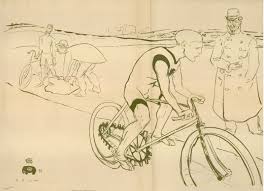
While Herne Hill lives on, the velodrome at Catford was demolished in the 1990s. Like the stadia at Putney and Herne Hill, this was built in the 1890s, when it attracted a very special guest. Absinthe-soaked dwarf artist Henri de Toulouse-Lautrec is usually associated with the Montmartre area of Paris, but in 1896 he turned up in the particularly drab suburb of Catford. Lautrec was a cycling fan, and had been asked by a company called Simpson to design a poster for their bike, which used a new type of chain. Lautrec was taken to the newly built Catford Velodrome to watch the bike in action during special races, set up by Simpson to advertise their product, and he produced a couple of images during his visit. The poster was one of the last he designed before his death in 1901, just as the Victorian bike craze was coming to an end.
Norman Mailer and Christine Keeler’s bra

Jay Landesman was an American writer and eccentric entrepreneur who arrived in London in the mid-1960s and immediately flung himself headfirst into the emerging counterculture scene, largely because the first person he met when he arrived here was Peter Cook. Landesman later became best known as the male half of a famously open marriage, much to the shame of his son Cosmo, who gained revenge by marrying Julie Burchill. (‘She hated hippies, ex-hippies, food freaks, open marriages and old people,’ wrote Jay, ‘The only thing she liked about us, was that we were Jewish.’)

In his entertaining 1992 memoir Jaywalking, Landesman’s non-ideological dalliances on the fringes of the London scene make great reading, with walk-on roles for the likes of John Lennon (‘He was uptight about Wendy Cook’s insistence he sample her salade Nicoise, a dish he was highly suspicious of and couldn’t pronounce’), Tom Driberg (‘He took us to a pub whose entire clientele consisted of lesbians, transvestites, young Danish sailors, ageing pederasts and an assortment of amputees’) and Germaine Greer (‘I watched her challenge Jimi Hendrix to an arm-wrestling match, and win’). Although it’s never entirely clear what he did – bar run the disastrous UFO rip-off the Electric Garden for a couple of minutes – Landesman was clearly good company with a penchant for meeting interesting people, and at some point was asked by The Sunday Times to write about the art of giving a party. His ideal guest list is worth repeating in full:

Minimum of three potential celebrities; at least one real celebrity (any field); a foolish couple; a serious couple (straight feed for comics); an engineer or non-speaking Czech (to point out); six swinging teenagers (girls); a bitchy girl who can generate masochism in men; a gym instructress who drinks too much; an older woman who sits and smiles (who is she?); a rune beauty (who was she?); Christine Keeler; no fat people unless Peter Ustinov; nobody jet or Court Circular; no dogs; no Peter Hall, Jonathan Miller, David Frost (or equivalents); no crew cuts; a swinging accountant; a buff (a jazz-hair or gambling buff); two attractive lesbians (to get wrong); one international drug trafficker (to point out); a beautiful flawed couple; a gay MP; Tariq Ali (not Christopher Logue); an Irish showbusiness GP; a titled person (to show you’re not snobbish); no artists’ agents, editors or publishers; no children or headshrinkers (except RD Laing); an eccentric lawyer or priest (no respecters of confessionals); an articulate tradesman (electrician, cabinet maker, house painter, bank manager); a forgotten culture hero; a reliable loudmouth who’ll come early and leave early; the ex-wife of a world celebrity; a pop singer no one recognises; a girl with buck teeth, a corrective shoe, or both; an established figure who decides that night to drop out…

Landesman was fond of Christine Keeler. He met her soon after arriving in London at the Kismet, a Soho drinking club, and the pair became friends. He also knew Norman Mailer from the mid-1950s, Mailer having interviewed Landesman while researching his pioneering essay on hipsterdom, The White Negro. In London, Landesman had an opportunity to bring the two together.

The cause was Mailer’s decision to challenge for the Democrat candidacy as Mayor of New York under the slogan ‘Vote The Rascals In’. The sizeable US expat community in London – there were frequent baseball games in Hyde Park featuring the likes of Tony Curtis, Marlon Brando, John Cassavetes and Charles Bronson with Phil Silvers as umpire – decided to hold a fundraising event.

The Friends of Norman Mailer Committee was founded by charismatic rogue Harvey Matusow, and he put on a celebrity auction, featuring myriad bizarre offerings from Yoko Ono like ‘Dirt From Central Park’, ‘Air over Greenwich Village’, ‘Vial of Genuine New York Tears’ and ‘Jar of Captured Cloud Formations over the Bronx’ as well as bottles of Robert Lowell’s sweat and a slice of raw liver from Philip Roth’s fridge. The star exhibit, however, was supplied by Landesman: Christine Keeler’s bra.

Bidding began at £100. There were no takers. The auctioneer tried again, at £50. Nobody moved. Next he tried £10 for this ‘psychosexually historical’ item, but the opening bid was a measly 10 shillings. Landesman tried to get the bidding going and raised his own hand, but nobody followed suit and he ended up winning the item back for a mere 10s 6d. Later, he discovered it wasn’t even Keeler’s. ‘Christine doesn’t wear a bra,’ a mutual friend confessed, ‘But the deception was justified in a good cause.’ The mayoral election was just as successful – Mailer came fourth, in a field of five.