Category Archives: Drugs

Secret London: eight London shrines

I wrote this for the wonderful Curiocity, London’s finest pocket-sized trivia-and-map-packing magazine. Issue E, with a pilgrimage theme, is available at all good London bookshops. 

Tyburn martyrs
On Bayswater Road at Marble Arch is a small convent, unlikely home to a ‘cloistered community of benedictine contemplatives’, aka nuns. In the basement chapel, the walls are covered with ancient relics – skin, bone, bits of fingernails – from some of the 350 Catholic martyrs who were hanged on the three-sided Tyburn Tree during the Tudor wars of religion. Behind the altar of this ghoulish Martyr’s Shrine is a replica of the Tyburn gallows itself.

Giro, The Nazi Dog
One of London’s best known ‘secret’ sites, this little stone on Carlton House Terrace marks the grave of Giro, beloved pooch of (Hitler-opposing) German ambassador Leopold von Hoesch. Giro died while the German Embassy was at No 8-9 (now the Royal Society) during the pre-war Nazi era. He wasn’t really a Nazi, incidentally, as dogs rarely express a political preference (although I did once know one that would bark like a maniac if you said ‘Labour party’).

Bolan’s Tree
A sycamore tree on Queen’s Drive in Barnes has been a shrine to Marc Bolan since 1977 when Bolan’s Mini crashed into it, killing the singer instantly. A bronze bust of Bolan stands nearby.

Spoons

Holborn’s junkie spoons
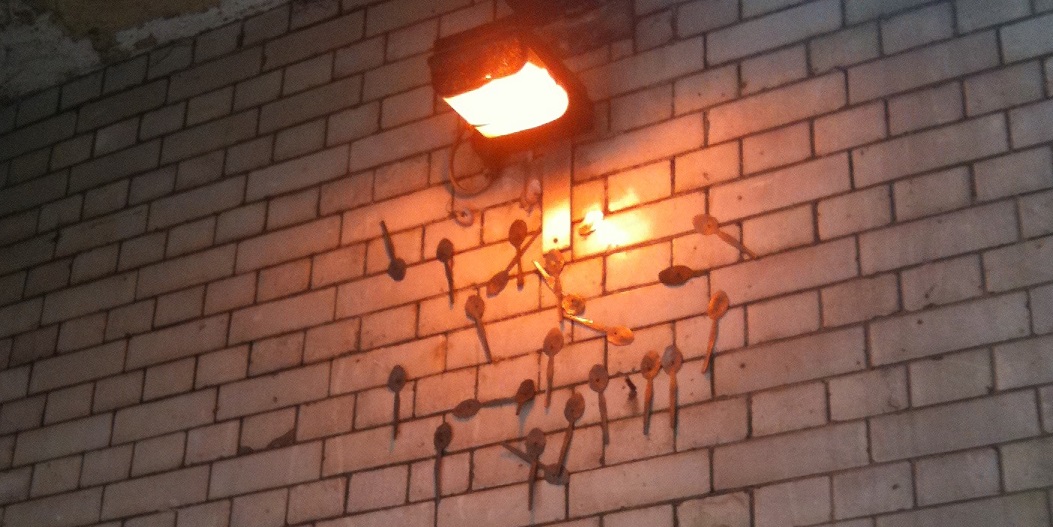
Underneath a dank stairwell in Farringdon close to Mount Pleasant sorting office you might stumble across a wall stuck with a dozen mysterious spoons. Urban legend says these were placed here by heroin users in tribute to their dead peers, each spoon marking a new death.

Cross Bones graveyard
This parcel of disused land in Borough has been claimed by locals as a shrine to prostitutes said to have been buried on unconsecrated land since the 1500s, and they come here to lay flowers for the forgotten dead. In truth, Borough had many such graveyards and Cross Bones was used to bury the poor of both sexes.

Regent’s Canal coconuts
The further west you head along Regent’s Canal towards Southall the more likely it is you will come across a coconut floating in the water, sometimes cut in half and containing candles. These are placed there by London Hindus in religious ceremonies that sees the tiny canal replace the mighty Ganges.

Skateboard graveyard
Look over the side of the Jubilee Footbridge and you’ll see dozens of broken skateboards lying on one of the concrete feet that anchor the bridge to the Thames. These are boards that have experienced one olley too many and, beyond repair, been dropped to join their kin by South Bank skateboarders.

Postman’s Park
A shrine to everyday heroes, this park features a number of ceramic tiles dedicated to Londoners who died while saving the lives of others. A remarkable, very touching little spot created by the Victorian artist GF Watts.

Jonathan Gili, on collecting and connecting

Paul McCartney-designed wrapping paper for Indica bookshop and gallery.

Paul McCartney-designed wrapping paper for Indica bookshop and gallery.

The wonderful new catalogue by Maggs counterculture is dedicated to (a fragment) of the vast collection amassed over four decades by the film-maker Jonathan Gili. An insight into Gili’s collecting instinct comes from this article by Anthony Gardner:

Lift the lids of the boxes, and you can scarcely believe your eyes. There are bottles of Star Wars bubble bath and packets of Beatles bubblegum; fridge magnets shaped like kettles and Danish pastries; hair clips
commemorating the Queen’s coronation; Camembert boxes and plastic lizards and packets of tortilla chips. It is as if all the flotsam and jetsam of post-war consumer society had been washed up on a concrete shore and painstakingly catalogued by an tireless, obsessive beachcomber.

Although the catalogue focuses on the recognised brilliance of London’s 1960s psychedelic poster artists like Martin Sharp and Haphash And The Coloured Coat, Gili would collect anything – indeed, Gardner notes he was particularly drawn to sardine tins and even self-published a book about them. The items Maggs has for sale includes such magpie oddities as shopping bags, wrapping paper (albeit designed by Paul McCartney) and old newspaper posters, such as this one regarding Joe Orton’s murder, taken from a newstand in London in 1967.

1465_28

In 1986, Gili wrote an article about his collection asking rhetorically: ‘Who could resist records shaped like Elton John’s hat or Barry Manilow’s nose? They have poor sound and often can’t be made to play at all… but as art objects they are sublime.’

Sadly, there are no records shaped like Barry Manilow’s nose in this catalogue as much of Gili’s collection went to a private collector sympathetic to the intentions and ambitions of Gili. But what makes somebody collect stuff like this? In his short, thoughtful, introduction to the catalogue, Carl Williams – who knows much about collectors – ponders that question. Collectors are often said to be creating a bulwark against their own death, but perhaps, speculates Williams, they also wish to act as a guardian for those things that would otherwise be ‘forgotten, scorned or destroyed’ as tastes and times change?  Today’s trash is tomorrow’s museum piece; yesterday’s lunatic is the future’s visionary. Gardner touches on this, with an anecdote in which Gili ‘rescues’ a particularly revolting object from a garage forecourt. It’s a revealing story. By the very nature of his collecting this worthless item, Gili has given it value. But he’s also, clearly and very simply, enjoyed the moment, relishing both the acquisition and the reaction it will get from his co-conspirator. Why collect? Why not!

Lucinda Lambton tells a story which epitomises Gili’s passion for acquisition. ‘We were driving through the outskirts of Guildford,’ she says, ‘and he suddenly shouted “Stop!” Then he jumped out of the car while it was still moving and ran across this huge, horrible garage forecourt. When he came back, he was triumphantly waving a gold-lamé-clad Michael
Jackson doll.

Collections also gain their own momentum, and I sometimes wonder how many collections have been made almost by accident – one minute you are idly picking up old books about London from secondhand shops and markets, the next thing you know you have 250 of the things and, inadvertently, the beginnings of a minor collection. And if you’ve started, you might as well finish. What else is there to do with your time?

More obviously, collectors hoard items that carry the echo of a cherished memory, certain pieces that remind them of a special moment in their past, or of a past they wished they had. Many of the items being sold by Maggs are focused around the London underground scene of the 1960s. I’m not sure quite what relationship Gili had with the counterculture, but he was clearly an interested observer at the very least – and he edited cult London film Bronco Bullfrog, with soundtrack by 1960s Gilbert & George support act, Audience.

Gili’s 1960s collection includes a number of items from that era that have always been regarded as important and beautiful, such as these stunning posters by Martin Sharp, one of my favourite psychedelic artists and, in my view, a rival to anything that came out of the more lauded Bay Area poster scene.

Cream by Martin Sharp

Cream by Martin Sharp

Purple Dylan by Martin Sharp

Purple Dylan by Martin Sharp

Oz magazine

Oz magazine

UFO Club poster

UFO Club poster

Many of the objects are related specifically to the London scene – the shops, clubs, galleries and ‘fun palaces’ of 1960s London. Gili, then, had a close relationship with this city. One of his best-known films is the charming To The World’s End, about the No 31 bus journey from Islington to Chelsea. Interestingly, 1960s historian Jonathon Green recalls a map of this very bus route once published as a cover of IT newspaper, showing how it connected some of the key points of swinging London – ‘The hippie highway: all the way from Granny Takes a Trip to the Roundhouse’, as Green puts it.

A semi-thorough scouring of the ever-so-distracting IT archive has not turned up this delightful sounding map, so perhaps it was produced by one of the many other underground papers of the era. But it is not a massive leap to speculate that Gili, the great collector of underground London, noted this off-kilter way of observing and uniting the London villages, and later chose to make a film taking precisely that approach. Collections, like buses, are a way to make connections.

fotoflexer_photo

Mick Farren: dead good Deviant

‘Sure the underground was elitist: we were an elite. We were the cutting edge of ongoing bohemianism at that point.’ Mick Farren in Days In The Life by Jonathon Green

The last time I spoke to Mick Farren (May, 2013) he was waiting for the doctor to come round. He was, he told me, in pretty poor shape but welcomed our interview as it gave him something else to think about. Farren’s ill health had been known for some years, but it didn’t stop him going on stage with his old band the Deviants every now and then. It was while performing at the Borderline last night (Saturday, July 27) that he collapsed and died.

It seems crude to say that is how Mick Farren would want to go, but it’s certainly no great surprise that this vivacious ball of hair and action, the closest thing London ever came to producing an Abbie Hoffman,  should die while giving it all to his great love rock and roll. (The following, and all subsequent quotes, are from my interviews with Farren.)

‘Essentially, from when I was in art school through to Joe Strummer the major communication medium of the counterculture certainly in the second half of the 1960s was rock and roll music. You start with that and everything else was peripheral to it.’

Farren’s Deviants were pre-punk noise terrorists whose self-distributed debut album, Ptooff! was one of the first records to come directly out of the London counterculture. When I spoke to Farren for Uncut about the Rolling Stones free gig at Hyde Park in 1969, I asked him whether the Deviants had wanted to play the show. He said,

‘We asked if we could play. We were vetoed, it was probably Jagger. Everybody said I wouldn’t behave myself and start rabble rousing, which was fair enough.’

I put this to Pete Jenner, who co-organised the gig, who responded.

‘Well, there was that and also the fact they were a rotten band. I really like Mick [Farren] but they were a rotten band who smashed instruments on stage. It wasn’t kick out the jams motherfucker, it was let’s have a joint and a buttercup sandwich.’

The Deviants weren’t really a rotten band, but Farren certainly saw them as London’s answer to the MC5. He was heavily active in the political end of the counterculture, forming the London branch of John Sinclair’s White Panther Party and leading the occasional putsch at the International Times when he felt it was getting too bourgeois and boring. Farren was a key figure in so much of what happened in the counterculture, running the door at UFO, writing for and editing alternative newspapers, organising free festivals while playing shows and really meaning it, man. He was fixer and a doer, a wit and sometimes a sage.

‘IT came out of the Beats – poetry, jazz and art with a bit of lefty politics. I told them this was fucked up, they weren’t talking about the weird changes going on with The Who, or where The Beatles were coming from. I’d say that with all respect to John Coltrane there’s this black geezer in the Bag O’ Nails who has long hair and plays guitar with his teeth, what are we going to do about THAT?’

His politics though, always came with a sense of fun – at one anti-war demo the Deviants played he annoyed the po-faced organisers by being more concerned with getting on stage without splitting his trousers than with espousing the cause. He was once described to me by a fellow traveler as being one of the three coolest men in London in 1967, and that made him one of the three coolest men in the entire world.

”We were always condemned as frivolous and philosophically disorganised, and the counter-accusation was they were just boring totalitarians who wanted to sing the Red Flag when we’d rather listen to Voodoo Child and smoke pot.’

When the alternative press disintegrated, Farren – like many from the underground – went on to write great pieces like this for the NME:

The immediate legacy of the underground papers was the NME because we all went there. They had a very profound effect on the visual effect of magazine publishing, but much more important is that the spirit of the thing is now preserved on the internet.  It’s all still there, it’s just become more specialised and you have to go looking for it.’

Farren is one of the dominant figures in Jonathon Green’s essential history of the British underground, Days In The Life, and also wrote brilliantly, if unreliably, about his own activities in Give The Anarchist a Cigarette. What resonates from those books is what an unlikely fit Farren seems in the upper-middle-class world of the counterculture, which was largely run by public schoolboys and Oxbridge graduates imbued with that remarkable confidence that comes with a good education. Farren was different, his confidence was self-generated and less polite, while his art school experiences meant he ‘learned to manage chaos’. Indeed, he relished it. Take a look at the clips below if you don’t believe me.

In his own writings and when interviewed, Farren always came across as funny and incredibly sharp but there was more to it at than that. He was fundamentally, intrinsically, decent. A man without edges. As Jonathon Green told me when hearing the news of his death: ‘Of the underground ‘stars’ he seems, and always did, to have been one of the good guys.’

RIP Mick Farren. He will be missed by many.

Farren invading The Frost Show.

Farren recollecting the Grosvenor Square anti-Vietnam riot of 1968.

Banking on Sherlock

When Abbey National opened their grand Art Deco headquarters at Nos 219-229 Baker Street in 1932, they didn’t quite know what they were getting into. Because it sat in the spot where 221b should be, the new building almost immediately began receiving letters addressed to Sherlock Holmes. When Arthur Conan Doyle chose an address for Holmes, he deliberately picked 221b because the Baker Street numbering did not go that high. But after renumbering, and with the arrival of Abbey House, Holmes’s address suddenly came into solid existence.

While many banks might have ignored this accident of geography, Abbey embraced it. Over the years, they really threw themselves into the business of celebrating the fictive biography of the world’s greatest detective. They installed a plaque (now lost), they published books and, after a while, they employed a letter writer, somebody whose job was to respond to all the letters addressed to Sherlock, acting more or less as his personal secretary.

In 1989, the New York Times interviewed Nikki Caparn, who then had that responsibility, and she described how she had received letters asking Sherlock to solve Watergate, or locate some missing homework. ‘Many people don’t ask for anything in particular,’ she said. ‘They just want to know what Mr Holmes is doing now or where he is and they hope he is well. And many people know he’s not real and write tongue in cheek. But some people haven’t worked it out. Mr Holmes would be 136 years old now, so it’s unlikely that he’d still be living here.’

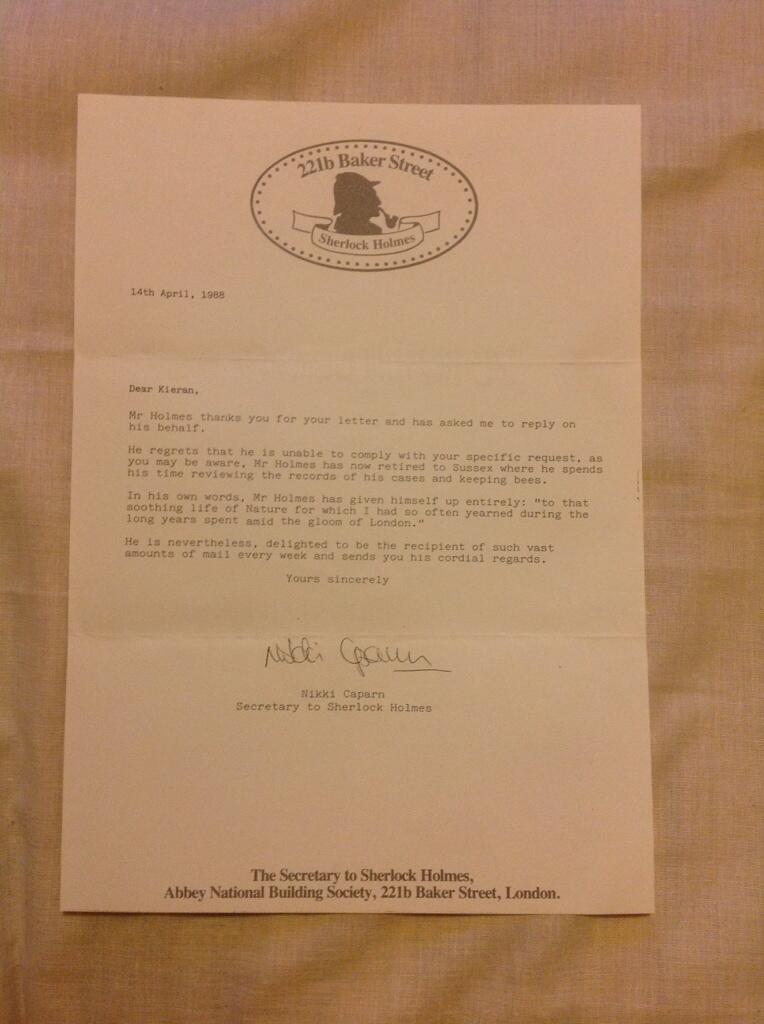
Here is one such response from around exactly that time, sent to Kieran (@hail_tothechimp on Twitter), who had written to Sherlock to ask him about his most difficult case. Ms Caparn clearly does not feel equipped to respond to such a difficult and controversial query, so plays a straight bat with her standard response.

BOb2ZThCcAAIQBZ

Abbey have since moved from Baker Street and are owned by Spanish giants Santander, and I don’t know what has happened to their vast archive of letters. However, Abbey also created something for Sherlock Holmes fans that is definitely still standing. In 1951, the bank put together a Sherlock Holmes exhibition for the Festival of Britain at Abbey House. The Spectator said the Festival ‘was unlikely to show anything nearer perfection in its way than the reconstruction by the Marylebone Public Libraries Committee of Sherlock Holmes’s room in Baker Street.’

The review continues that ‘everything is here for the student of Holmes—violin, hypodermic syringe, revolvers, handcuffs’ and provides not just ‘a shrine for the connoisseurs of Holmes but a deep pleasure for the student of the late Victorian period’. The Spectator concluded that ‘when the Festival has subsided, this charming reconstruction is preserved for the enjoyment of posterity.’

Which it was. In 1957, the brewer Whitbread purchased the entire exhibition and put it on display in a pub, the Northumberland Arms, which it renamed the Sherlock Holmes and opened as what was surely one of London’s first theme pubs. The pub is located in Charing Cross, a key location in many Holmes stories, and the exhibition is still standing exactly as it was installed, preserving to this day behind glass in an upstairs room a slice of 1950s Britain in the shape of a fictional Victorian living room.

Opium pipes in London

brochure; pamphlet - Opium Smoking Parlour

In 1899, Earl’s Court offered interested Londoners the chance to pay 6d to see a Hong Kong ‘opium smoking parlour’, filled with ‘living Chinaman’ and ‘true to every detail’. This reflected an ongoing fascination for the Chinese habit of smoking opium – a habit that had been partly encouraged by the British East India Company and then condemned by British missionaries – and merrily ignored the fact the British themselves had been consuming opium for decades.

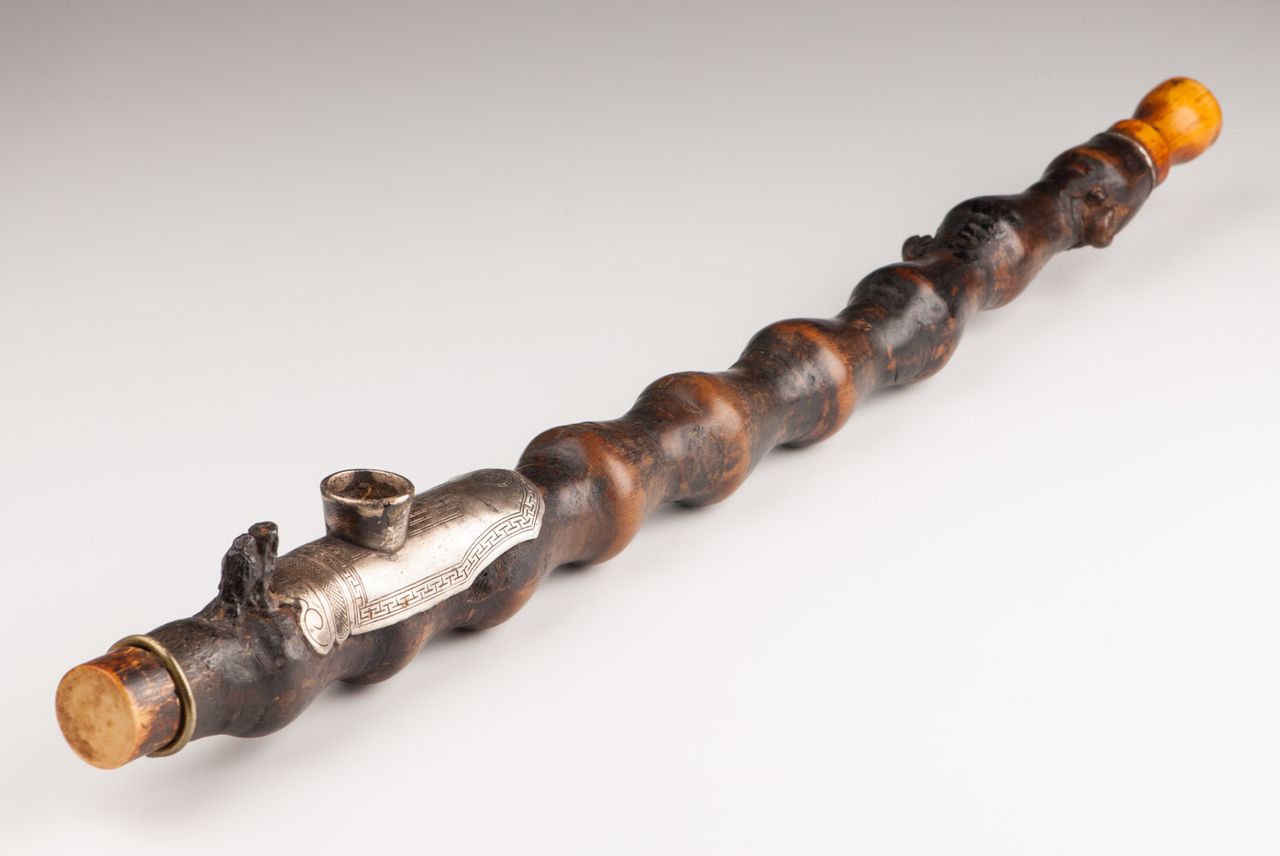
The Chinese tradition of smoking looked and felt very different though, and that’s partly because it was so deeply ingrained into society, a ritual to be enjoyed alongside tea and nicotine with a rich material culture, lavish paraphernalia and its own customs, traditions and symbolic meaning. This is explored in an extraordinary exhibition of Chinese opium pipes at Maggs Bros bookshop in Berkeley Square, which I have written about for the Independent on Sunday.

It features a unique collection of 19th-century Chinese pipes and related material that demonstrate the full complexity of the Chinese relationship with opium, as can be seen in some of the following images – and these barely scratch the surface of the incredible collection that can be seen at Berkeley Square from June 5 to the end of July.

Field of opium poppies

Field of opium poppies

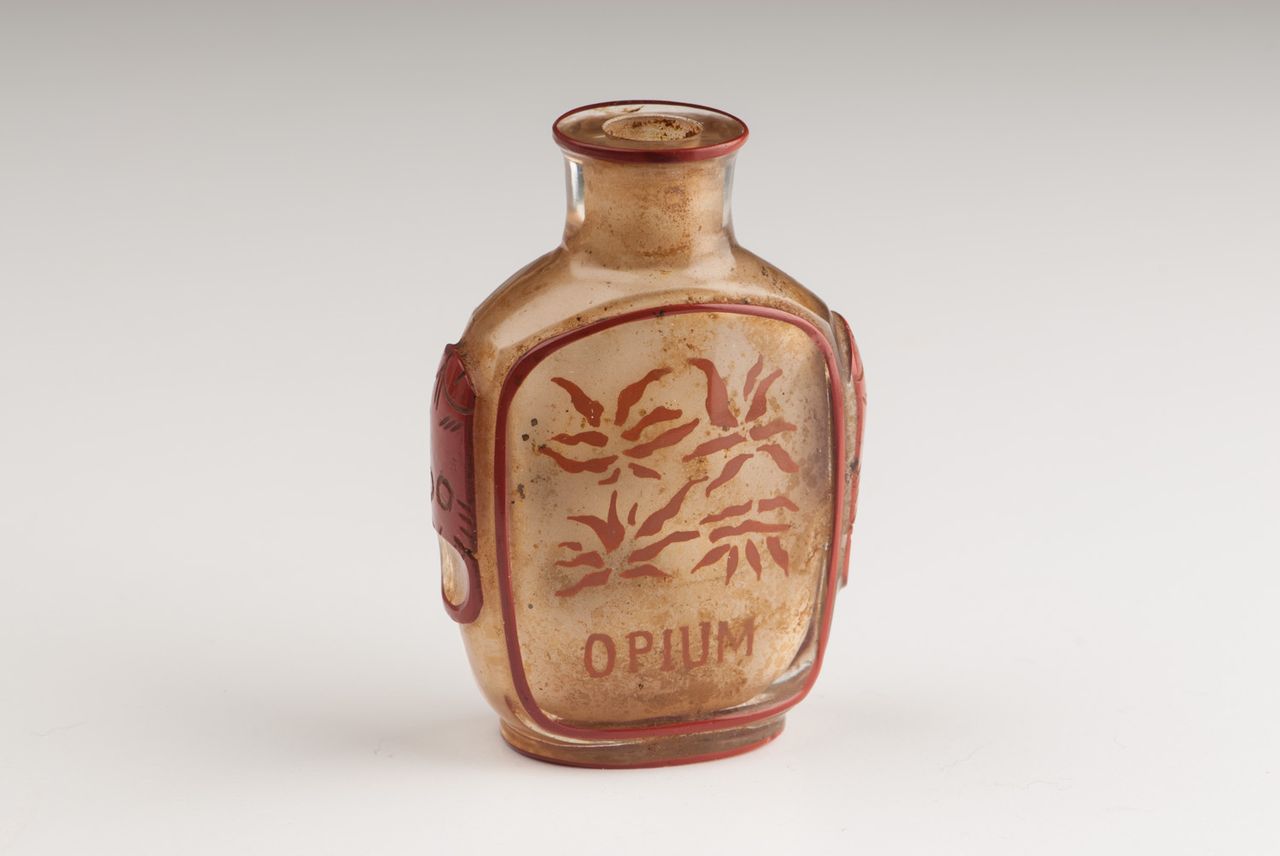
Jar for storing opium

Jar for storing opium

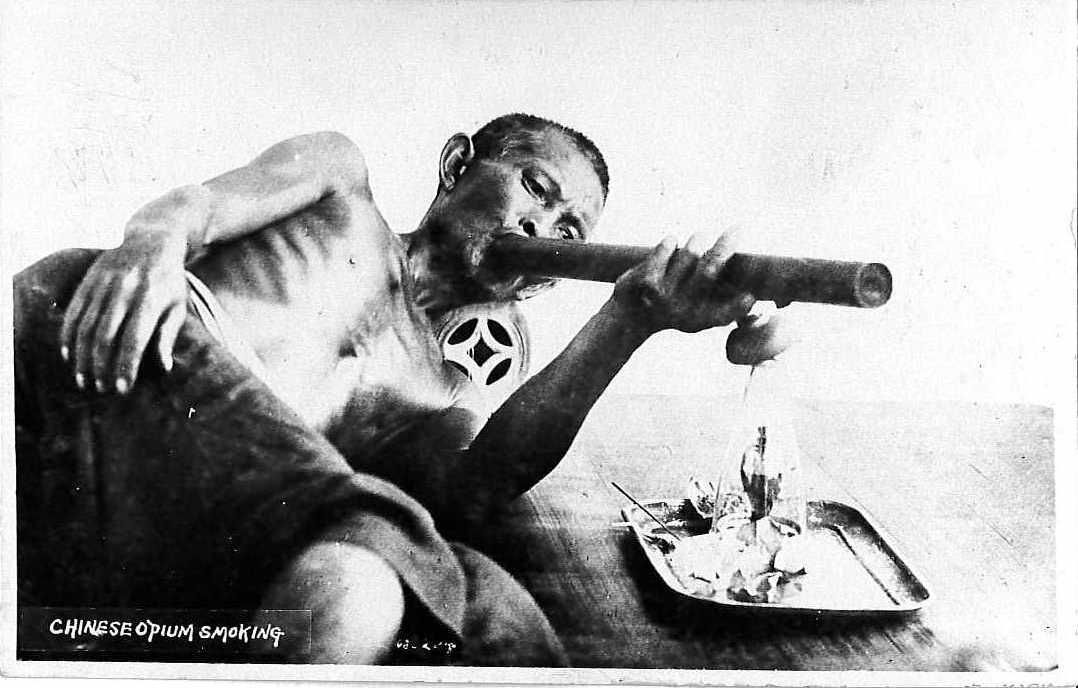
Chinese opium smoker

Chinese opium smoker

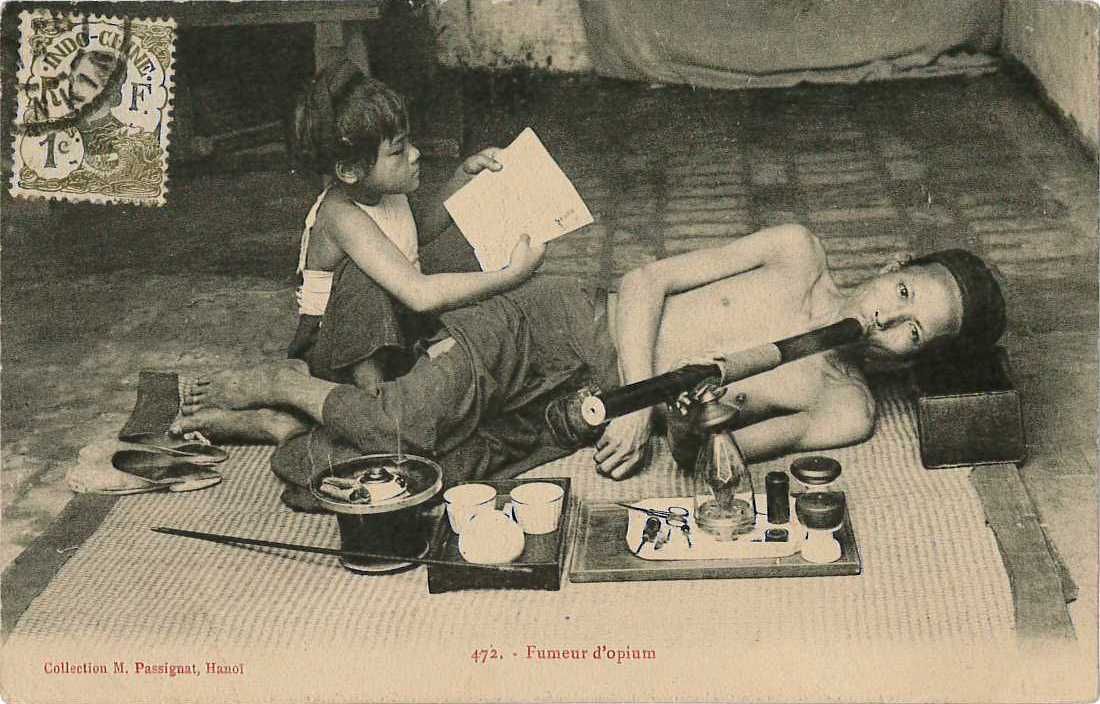
Postcard of opium smoker from Vietnam

Postcard of opium smoker from Vietnam

Bowl for smoking opium

Bowl for smoking opium

Opium pipe

Opium pipe

Smoker with pipe and tools Smoker with pipe and tools

Opium pipe

Opium pipe

Opium pipe

Opium pipe

Bowl for opium pipe

Bowl for opium pipe

aAKf2D-cSXQqOe6Mm8b4FjMt6hP1ZcWPJbFN8-TNflk

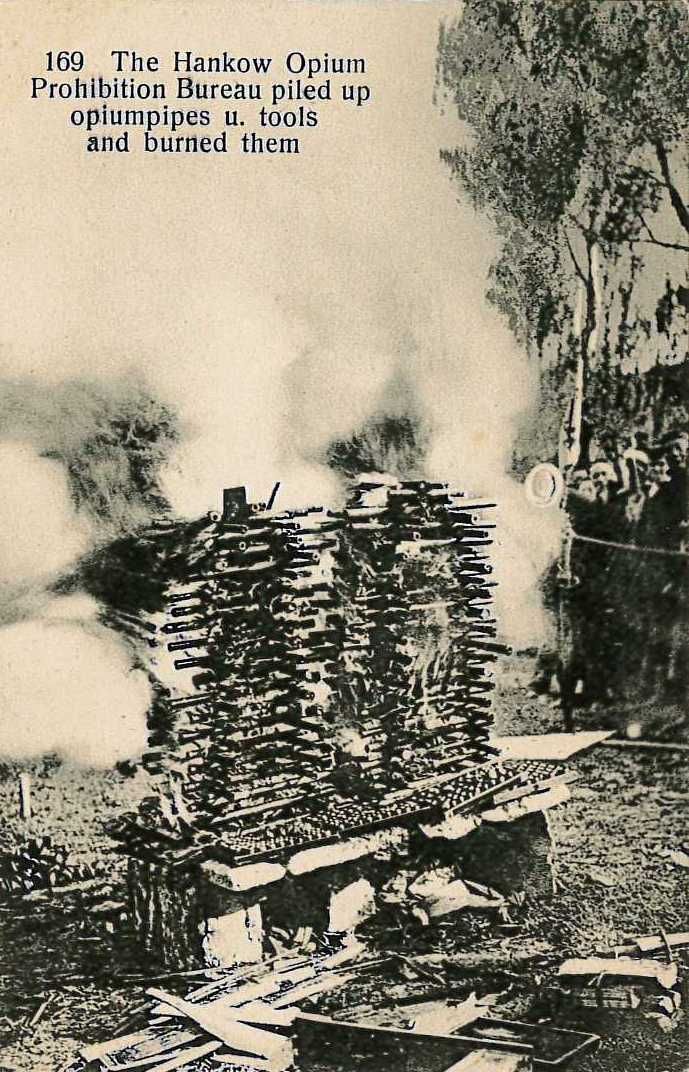
Pipes being burnt by anti-opium reformers

Bowl for opium pipe

Bowl for opium pipe

Lamp used for preparing and smoking opium

Lamp used for preparing and smoking opium

Tray for carrying opium tools

Tray for carrying opium tools

Pink pills for pale people - opium cure

Pink pills for pale people – opium cure

Box for storing opium with erotic carving - opium was seen as an aphrodisiac and was originally smoked in brothels

Box for storing opium with erotic carving – opium was seen as an aphrodisiac and was originally smoked in brothels

Bowl for smoking opium

Bowl for smoking opium

Opium pipe

Opium pipe

Preparing a pipe

Preparing a pipe

Tools for preparing opium

Tools for preparing opium

Opium pipe

Opium pipe


Opium smoker with cat - pets often became addicted to the opium fumes

Opium smoker with cat – pets often became addicted to the opium fumes

Selling ‘psychedelic marmite’ in Ladbroke Grove with the rock ‘n’ roll doctor


Before he met Gram Parsons and became country and western singer Hank Wangford, Sam Hutt was an avowed member of the sixties counterculture as well as a qualified doctor. Like many on the scene, he managed to combine his two lives for a brief period when he and two other doctors ran a practice prescribing marijuana to junkies. Hutt, incidentally, was one of the signatories of Steve Abrams pro-pot advert in The Times.  I spoke to him recently, and he explained how it all came about:

‘I qualified as a doctor and didn’t know what the fuck to do. I didn’t like doctors, I didn’t like medical students, I didn’t like working in hospitals and I didn’t want to do general practice. Then I heard this guy, Ian Dunbar, had a place in Ladbroke Grove. I found this out from Bernie Greenwood, who was the only doctor I really liked and was also a musician, playing saxophone and keyboards.


So we both joined in. Ian had this practice on the crest of the hill in Ladbroke Grove. There’s a church and right opposite is the church building and we had the top floor. Ian’s big thing was to help people who were on heroin. He’d discovered that doctors could still prescribe cannabis, ironically in tincture form, which means in alcoholic solution. Ian prescribed it to people who were coming off smack, not because it replaces the heroin – it doesn’t – but as a way of getting high. That’s counter to the usual treatment of heroin, which is to use methadone. The rationalisation for methadone, which can kill you if you overdose on it, is that you don’t get high. It doesn’t make you feel good, whereas heroin makes you feel good.

It seemed to me this was a Presbyterian attitude – if you like something, it must be bad for you. So they switch you on to something you don’t like. Ian went counter to that, offering them something that let them get out of it, just in a different way to heroin. People often switch between heroin and alcohol as alcohol is much closer to heroin than cannabis is. Cannabis doesn’t achieve wipe out, it doesn’t achieve oblivion, which both heroin and alcohol do.

So me, Ian and Bernie set up this hippie practice and as a political act, we prescribed cannabis. In the 60s, smoking a joint was a political act, it was you saying you were a freak, a part of an alternative society, not a straight. And you didn’t touch alcohol because it would kill you. Our ethos was that we wouldn’t prescribe speed: uppers or downers. If that’s what you wanted you had to go to the straight doctors in pin-stripe suits in Harley Street. They’ll give you bucketloads. So I’m not a grocer, but I will prescribe you cannabis. They closed that law down in 1973. We were seeing all sorts of people but when we got our first cheque from the National Health it was for £11. That’s for three doctors after six months work. Even then, £11 wasn’t much. So we had to support ourselves by making it a private prescription charging a couple of quid a time.

We got the cannabis from William Ransom & Son. They were the company in Hertfordshire that had a government license to extract cannabis from the plant. They made it into this sticky thick stuff, like a psychedelic marmite. That would then be dissolved in alcohol to make a tincture. The extract was much stronger than the tincture, you could get very, very stoned.

That practice was eventually closed by the police, because they didn’t like junkies being treated like you and me, they wanted to lock them up. I continued being a rock and roll doctor. I went on tour with Family and I shared a house with Jenny Fabian and Roger Chapman before, through Keith Richards, I met Gram Parsons and discovered country music.’


Secret London: the Science Museum’s palace of pills

© Science Museum/SSPL

Time Out recently asked me to contribute to a piece on London’s 10 weirdest museum exhibits (something I’ve blogged about previously). My favourite previously overlooked discovery was the above ‘Palace Of Pills’ at the Science Museum.

This extraordinary sculpture, constructed from old pills, medicine bottles and syringes, was made for a campaign run by the East London Health Project between 1978 and 1980. The ELHP was a coalition of health worker unions and local Trades Councils who were campaigning against cuts to the NHS as well as highlighting other healthcare issues facing Londoners in the late-70s. This was the first time the NHS had really come under sustained attack from any political party since it was formed in the aftermath of the Second World War.

The Palace of Pills was created by artists Peter Dunn and Loraine Leeson, who built the sculpture in their studio using old pill bottles that they acquired from the ELHP’s partners working in the health service. They then photographed it for a poster that was displayed in waiting rooms and doctor surgeries.

‘We did eight posters,’ Leeson told me. ‘The Palace of Pills was made for a poster that talked about how the drug companies were dominating what was happening in health, and for reasons of profit not health.’ The model was too big for the studio and already starting to deteriorate when the Science Museum asked if they could have it. ‘They saw it as a curiosity but I’m delighted it still exists,’ she says. Leeson and Dunn took the experience into creating posters for further pioneering campaigns against the redevelopment of Docklands.

Jimmy Page, Aleister Crowley and the curse of Eddie And The Hot Rods


For the full story of the curse of “Do Anything You Wanna Do”, see my interview with the band in this month’s issue of Uncut magazine. 

It’s easy to turn your nose up at any mention of Aleister Crowley, especially if you have little interest in the occult and esoteric world in which he thrived. But to do so means ignoring the man’s often brilliant writing – his Diary of A Drug Fiend is a superior pulp classic, for instance – and also missing out on some of the greatest anecdotes of the 20th century.

For the uninitiated, Crowley (1875–1947) was a British writer who used sex, drugs and magic –often simultaneously – to try to attain altered states of mind and who achieved such a level of notoriety for his activities that he was brandished the ‘wickedest man in the world’. If not wicked, he was certainly a character. As well as signing his letters ‘666’ and conducting numerous affairs with lovers of both sexes, he climbed mountains, wrote pornographic poetry, fraternised with novelists, artists and spies and attempted to write a new American national anthem.

To give a flavour of Crowley’s often bizarre intersections with normal society, in the early days of the Second World War he was tapped up by British intelligence officer Ian Fleming, who asked him to take part in an ‘occult disinformation plot’ against Adolf Hitler’s deputy Rudolf Hess, a fervent believer in astrology and the occult. Crowley was keen, but the plot was ultimately shelved; Fleming, however, later used Crowley as the model for villain Le Chiffre in his first James Bond novel, Casino Royale, in 1953. Another fan of Crowley was Scientology founder L Ron Hubbard. It is claimed Hubbard took part in ‘sexual magick’ (magick was a term favoured by Crowley) with a couple called Jack and Betty Parsons in an attempting to create a magical child, thus fulfilling a prophecy from Crowley’s The Book Of The Law. Crowley was not impressed, writing in one of his typically entertaining letters: ‘Apparently Parsons or Hubbard or somebody is producing a Moonchild. I get fairly frantic when I contemplate the idiocy of these louts.’

Crowley was bisexual and a heavy drug user, eventually becoming addicted to heroin. He also enjoyed peyote, handing it out at parties. On one occasion in New York he gave some to the novelist Theodore Dreiser, who became uncomfortable and asked if there was a doctor in the area. ‘I don’t know about a doctor,’ said Crowley, ‘But there’s a first-class undertaker on the corner of 33rd and 6th.’

This freeness with sex and drugs saw Crowley embraced by the rock and roll generation, particularly after he appeared on the cover of Sgt Pepper. But the story behind another of Crowley’s cover appearances is not so well known. In 1977, Essex rockers Eddie And The Hot Rod wrote a song that was partly inspired by Crowley’s famous motto: ‘Do what thou wilt is the whole of the law’. The band rewrote this as “Do Anything You Wanna Do”, a spirited ode to self-empowerment, and attached the lyrics to a perky pop tune that quickly reached the Top Ten. It was engineered by a young Steve Lillwhite, who recorded it at Island’s studio in Notting Hill.

In recognition of his contribution to the song’s genesis, the band decided to put Crowley on the cover of the single. But they also felt his glowering visage was not really in the spirit of the band, so manager Ed Hollis (brother of Talk Talk’s Mark) attached a slightly comical pair of Mickey Mouse ears to Crowley’s head.

EDDIE_AND_THE_HOT_RODS_DO+ANYTHING+YOU+WANNA+DO+-+PS-447606

Great cover, big mistake. According to rumour, this image soon came to the attention of Jimmy Page, a Crowley apostle who lived in the Crowley’s old house, had a vast collection of Crowley paraphernalia and was fascinated by the occult. Page had orchestrated the Crowley-influenced occult symbolism that adored Led Zeppelin’s fourth album, which incidentally was also record at Island Studios.

The band were told that Page placed a curse upon Eddie And The Hot Rods for their disrespectful treatment of the Great Beast. From that moment, the band were plagued by problems. They were dropped by their label, their manager became hooked on heroin and they never bothered the higher reaches of the chart again. From behind his Mickey Mouse ears and with the help of satanic rock royalty, Crowley had got his revenge. As bassist Paul Gray told me, ‘Weird shit happened after that. A lot of people said we shouldn’t have fucked about with Crowley.’

Pot in Hyde Park and the death of Stephen Abrams

Steve Abrams, a key member of the London 1960s counterculture, died last week. Abrams was principally responsible for the above advert, which ran in The Times in July 24 1967 declaring that ‘The law against marijuana is immoral in principle and unworkable in practice’.

The advert was paid for by Paul McCartney and was signed by numerous celebrities, including all four Beatles, Francis Crick, Graham Greene, David Dimbleby, Jonathan Miller, Brian Walden and many others.

Abrams told Jonathon Green in ‘Days In The Life‘ that ‘After the ad came out  a friend of mine got on the train and delighted at each stop in watching people opening their copy of The Times and their expressions of disbelief. So wonderful was this that when he got to Victoria he took another train back and did it again just to watch.’

It is less well known that Abrams was also involved in Timothy Leary’s experiments with psilocybin, taking the drug at Harvard for Leary in 1961. Abrams then described his experience as ‘very pleasant’, giving him ‘tremendous insight’ even if it was ‘somewhat alien’, and he was ‘very eager’ to try it again, which he most certainly did.

After the  The Times advert, Abrams co-organised a pro-pot rally at Hyde Park in 1967. Everybody got very high, including guest Allen Ginsberg, who wore a virulent psychedelic shirt given to him the day before McCartney and was warned by police for disturbing the peace by playing his harmonium.