I’ve just come across a treasure trove on You Tube of old Rank Look At Life newsreels, each ten-minutes long and looking at different aspects of London life. There are some real treats to be found, but here are a few I enjoyed when I should have been working, or at least making a cup of tea.
Members only, 1965 – inside London’s private clubs
Coffee bar, 1959 – the new world of Soho’s coffee shops
Goodbye, Piccadilly, 1967 – a portrait of Piccadilly Circus
In Gear, 1967 – an iconoclastic look at Swinging London
Top People, 1960 – the crazy world of highrise living
Shopping By The Ton, 1960 – Covent Garden, Smithfield and Billingsgate markets
Report on a River, 1963 – a love letter to the Thames
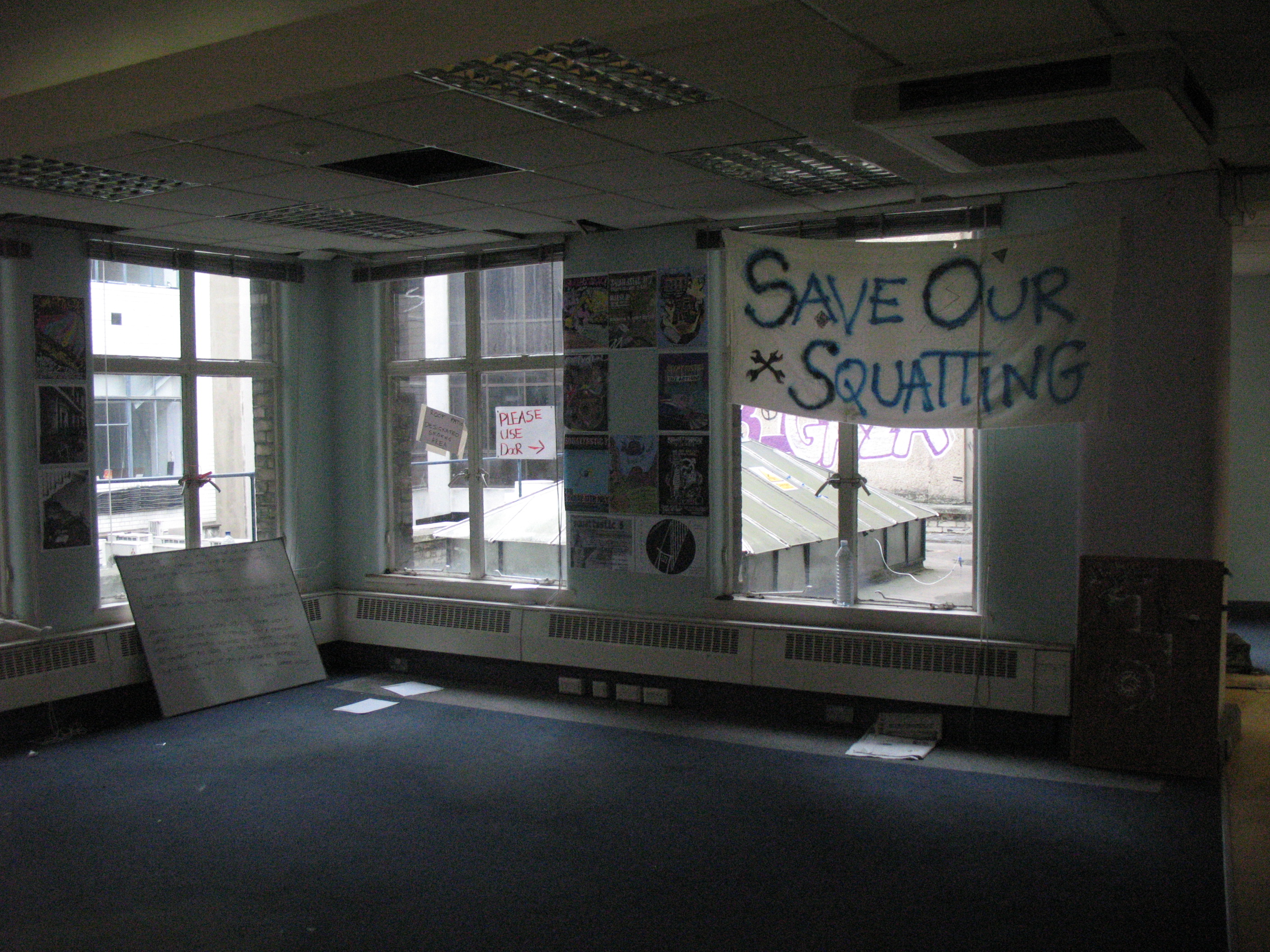
Last week, I paid a visit to the Bank of Ideas, the squat/community centre that has been set up inside an empty office building near Liverpool Street.
I didn’t know quite what to find inside, and while I expected a friendly welcome I was surprised by the depth of organisation that has gone into the enterprise, owing as much to the methods of middle management as it does the spirit of the co-operative. This is organised occupation on an impressive scale. There were flowcharts, spreadsheets and white boards full of information and advice on every surface, with people running round spreading messages and sharing news. I’ve worked in dozens of newspaper offices where communication was worse than this. It’s energetic, unifying and genuinely impressive on every level.
All members of the media are asked to visit a room next to the entrance hall to sign in and get tapped up for donations (the Bank is run a voluntary basis, with donations and skill-sharing). It was here I spoke to one of the ‘caretakers’, Bryn Phillips, an earnest youngish man in music PR who informed me that they had decided to squat the building when they ‘discovered it was owned by UBS. After researching UBS they seemed the perfect target for a Situationist critique of the finance industry’. As a fan of Situationist critiques, I thoroughly approved.
The Bank, of course, taps into a long tradition of London communes and squats that seek to serve a greater purpose than merely place a roof over peoples heads – the best example is the squatting of Centre Point in the 1970s to raise awareness of homelessness – while its educational aspects, the Free University and regular workshops, recall the London Anti-University and Notting Hill’s London Free School of the 1960s, though I’d hazard a guess that neither was as carefully organised as this.
How long the Bank of Ideas will be allowed to remain open remains to be seen, but it should be around in the early part of next week at least. If so, I recommend you pay a visit quickly, before the dead hand of corporatism crushes another lowly outlet of fun and dissent.
Maggs Bros is a posh antiquarian bookseller on Berkeley Square that has a Royal Warrant and is supposed to occupy the site of the most haunted house in Britain, but it is also home to a small contemporary art gallery, located out the back and accessed via 50 Hays Mews.
The latest show is being curated by New Artists and features photographs by Richie Culver taken of London crackhouses. These are loosely based on Gustave Dore’s engravings of Victorian opium dens.
The exhibition also features Polaroids by Shorvon & Hunter that explore the demise of the Polaroid and newspapers as forms of media. It’s definitely worth a look if you are in the area before it closes on Monday, December 5.
If you do, you should also pop upstairs to see a selection of some items that Maggs’s counterculture expert Carl Williams is currently selling. These include photographs of William Burroughs taken by Brion Gysin in Paris and an extraordinary mural taken from an American street gang club house. You could also pick up a copy of Carl’s latest catalogue to see if he has anything you fancy, whether it be items to do with Crowley, punk or the Weathermen. Last time I visited, he showed me some pictures he’d just acquired of dead Victorian babies, but don’t let that put you off.
Hollingshead was the British man who introduced LSD to Tim Leary in December 1961 on the recommendation of Aldous Huxley. Hollingshead was working in New York when he came upon a quantity of LSD. Huxley suggested he send it to Leary, who was already experimenting with administering psilocybin to patients during his psychological research at Harvard. Leary loved it. The LSD revolution began.
After working in America with Leary – he even lived in his house – Hollingshead was sent to London in September 1965 with enough Czechoslovakian lysergic acid to produce 5,000 trips, thirteen boxes of psychedelic literature – The Psychedelic Experience, The Psychedelic Review and The Psychedelic Reader – and plans for ‘a psychedelic jamboree’ at the Royal Albert Hall featuring the Stones, the Beatles and Leary himself. Although this is sometimes presented as Hollingshead playing the role of John The Baptist to Leary’s Psychedelic Christ, Barry Miles’s ‘London Calling’ suggests that Leary was just trying to get rid of the increasingly drug-addled Hollingshead and is said to have remarked upon his departure, ‘Well, that writes off the psychedelic revolution in England for at least ten years.’
Hollingshead promptly set up his base at his flat in Belgravia’s Pont Street, which he renamed the World Psychedelic Centre, and redecorated with the key elements needed for a good trip: bowls of fruit, handwoven cloth, open fire, bread, cheese, wine, candles, incense and goldfish. A chill out space, basically.
This was one of only two reliable sources for LSD in London at the time, so visitors were plentiful and Hollingshead began welcoming key figures from the scene – including Roman Polanski, Alex Trocchi, William Burroughs, Paul McCartney, Eric Clapton, Donovan and the Rolling Stones.
Guests were invited to take part in LSD sessions designed to make the most of the experience, with ‘lots of cushions, some excellent tapes and hi-fi equipment, a slide projector, and several chillums’. The LSD was dispensed after midnight inside grapes impregnated with 300 micrograms of the drug. The atmosphere was key. Hollingshead writes:
Shortly after dropping the acid, I played a tape of Buddhist Cakra music, followed by Concert Percussion by the American composer, John Cage. Next I played some music by Ravi Shankar and some bossanova. Interval of fifteen minutes. Then some music by Scriabin and part of a Bach cello suite. Interval. Some Debussy, and Indian flute music by Ghosh. Interval. Bach organ music and some John Cage ‘space’ music. Interval. The Ali Brothers and Japanese flute music. We also looked at slides projected on to the ceiling Tantric yantras, Vedic Gods, the Buddha, Tibetan mandalas.
There were also regular readings from Leary’s work
While Hollingshead dispensed LSD to his visitors in these carefully controlled conditions, he was soon self-medicating with cannabis, speed and heroin to control the fierce highs he experienced from taking strong doses of acid at least three times a week. The tabloids soon got wind of these experiments with the ‘killer drug’ and after hosting a party of 80 hippies at which two undercover police officers were dosed with acid after sampling the spiked punch, Hollingshead was busted. Naturally, he attended his trial while tripping and was sentenced to 21 months at Wormwood Scrubs. There he met spy George Blake, who promptly took a trip on some of the acid Hollingshead smuggled in to the prison, before escaping and going into exile in the Soviet Union.
Hollingshead didn’t make it quite that far himself, ending up in Cumbrae, a Scottish island, where he settled with a group of believers who treated LSD as a holy sacrament in quasi-religious services. He then went on his world travels.
Hollingshead was undoubtedly a key player in the scene. However, it’s notable that when a copy of his book, The MAn Who Turned on the World was sent to Timothy Leary in prison in the 1970s, Leary underlined only a single sentence – ‘…my taking of methedrine…’ Leary’s acquaintances believe that not everything Hollingshead said about his role in the psychedelic revolution could be trusted because of his addiction to opiates.
Squatting as a 20th-century phenomena originated in the wake of the acute housing shortage after the Second World War. Homeless families began to occupy empty mansion blocks and hotels, including Duchess of Bedford House in Kensington.
Squatters move into Duchess of Bedford House
Some of the squatters of the 1960s took this as their inspiration. Among the most political were the London Street Commune, a group of self-declared space cadets from the streets who were turned into a minor political weapon by a Spart called Phil Cohen, aka Dr John, who had previously been involved with the British Situationist International group, King Mob. The LSC became loosely involved in the counterculture scene and even at one point managed to occupy the offices of the underground newspaper, International Times, believing it was ‘bourgeois’ and needed to be ‘liberated’. They gave up after a few days when they realised they didn’t really understand how to put a newspaper together.
The London Street Commune’s most conspicuous act came when they squatted a vast Park Lane mansion, 144 Piccadilly, at Hyde Park Corner in September 1969. This gained them massive media attention, and the building quickly came to be dubbed ‘Hippy-Dilly’ and attracted vast crowds of largely hostile onlookers. The LSC responded by barricading the front door and creating a ‘drawbridge’ out of wood from one of the ground-floor windows, and asking the Hell’s Angels to protect them.
Around 100 people were said to be living in the building, among them the odd journalist who infiltrated the squat so they could produce salacious copy about the drug-taking ne’er-do-wells. After surviving an attempt by skinheads to ‘take’ the mansion – the LSC threw carpet bowls and balloons filled with ink at the approaching skins – the police decided to take action.
The police moved in on September 21, leading to in the words of the Daily Mirror, ‘The Fall of the Hippy Castle‘. This took place the day after a free festival at Hyde Park, which many of the LSC had attended. The squat was now filled with numerous disparate groups, including Hell’s Angels and French veterans of May 1968, alongside the original Dilly drop-outs, but they were quickly moved out by police, who arrested around 70 of the squatters.
While John Lennon went on TV to offer the displaced squatters a home in the shape of an island off Scotland, the high-profile eviction was greeted with delight by the media. The Times demanded the squatting be made illegal and that hippies be arrested under the vagrancy act. This remarkable Pathe newsreel – with talk of ‘scroungers and drop-outs… snubbing the conventions of decent society… doing the real homeless a disservice’ – demonstrates the prevailing attitude. It is difficult to conceive of broadcast media speaking in such terms today.
In 1972, American film director Sam Fuller wrote a pulp novel about 144 Piccadilly, but the building itself was not to last much longer. It was knocked down in the 1970s and replaced by the ghastly Intercontinental Hotel.
In 1953, a momentous event occurred in Soho. London’s first proper coffee shop – one equipped with a Gaggia coffee machine – opened at 29 Frith Street. This was a place where teenagers too young for pubs could come and gather, and it is said by some that the introduction of this coffee bar prompted the youth culture explosion that soon changed social life in Britain forever.
Inside the Moka Bar
The Moka was an instant success, selling over a thousand cups of coffee a day. The author John Sutherland recalls, ‘the Gaggia machine, a great burbling, wheezing, spluttering monster, would grudgingly excrete some bitter caffeinated essence. It would be swamped with steamed-milk foam and dusted with chocolate to form its ‘cappuccino’ hood… Glass cups and brown sugar (lots of it) were de rigueur. Frankly, 50s espresso was no taste thrill. But it felt smart as hell.’
By 1972, coffee bars where everywhere and the teenage revolution was firmly established. At this time, the author of ‘Naked Lunch’, former junkie and all-round Beat legend William S Burroughs was living in London, quietly going about his business in St James’s. He lived in Dalmeny Court, Duke Street, and loved the plush gentlemen’s shops of the area, not to mention the ‘Dilly Boys‘, young make prostitutes who hustled for clients outside the Regent Palace Hotel.
Although Burroughs was fond of the finer things in life – he got his shoes from John Lobb, hat from Locke’s and bought most of his food in Fortnum and Mason’s – he did at some point stumble into the Moka Bar, and was not impressed by what he found.
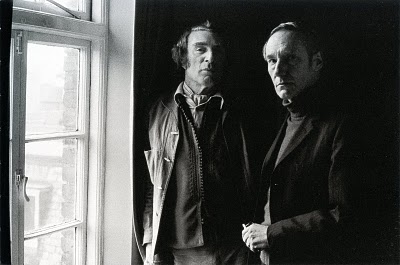
Burroughs and friend Brion Gysin in London
Burroughs at this time was getting sick of London – sick of the licensing laws, sick of the crap food and small drinks, sick of the weather, the terrible service and sexual hypocrisy. He was also sick of the Moka, which he believed responsible for an ‘outrageous and unprovoked discourtesy and poisonous cheesecake’.
The Church of Scientology, Fitzroy Street
Burroughs decided to mount a sound-and-image attack. He had previously launched one of these against the Church of Scientology, of which he had been a member, turning up at their headquarters at 37 Fitzroy Street every day, taking photographs and making sound recordings. He believed that ‘as soon as you start recording a situation and playing them back on the street, you are creating a new reality’ and that repeated exposure to such an attack would lead to ‘accidents, fires and removals’. After a few weeks, the Scientologists did indeed move, round the corner to 68 Tottenham Court Road.
Photo taken by Burroughs during the operation
On August 3, 1972, Burroughs turned his attention to the Moka. He would stand outside every day taking photos and making recordings by tape, and then return the next day to play the previous days recordings. Burroughs was convinced he was winning. ‘They are seething in there,’ he said. ‘I have them and they know it.’
I have a piece in the latest Uncut about 60s electronica pioneers Silver Apple. If you’ve never heard them before, you should. Their main instrument is The Simeon, a bank of nine oscillators mounted on plywood and played by 86 different colour-coded buttons and pedals.
Here is their amazing country-electronica jam from 68, “Ruby”, on which they also play a banjo.
After forming by accident – everybody else in the previous band left, leaving just singer and oscillator-player Simeon Coxe and drummer Danny Taylor – the band had to split in 1970 when they created an LP cover that featured the pair in a Pan Am cockpit on one side, and with a plane crash on the back. Pan Am sued and that was that.
The band reformed in the mid-90s, however, although now it’s Coxe on his own after Taylor died of a heart attack in 2005. Silver Apples play Corsica Studios in Elephant on October 27. Check them out.
Like many adolescent boys who thought they were cleverer than they really were and were scared of girls, I was obsessed with The Smiths and Morrissey.
The Smiths are a Manchester band, but by the time I became a fan, Morrissey had – like so many Northerners – fled the provinces for London where he spent the next few years revelling in the size, confusion and culture of the Big Smoke. Instead of Whalley Range and the Moors Murders, he sang about Earl’s Court and the Krays and as he entered his ‘Glam Nazi’ era he became obsessed with distinctly London aspects of working-class life such as skinheads, West Ham and the Cockney Rejects.
This was Morrissey’s London period; you could argue it began with the Smiths songs London (1987) and Half A Person (1987), and lasted until he was hounded out of the capital for going a bit crap around a decade later. Sure, London still cropped up in later songs – 2004’s Come Back To Camden, for instance – but the love was gone. He would later sound like any other tedious expat whn complaining to the NME that ‘if you walk through Knightsbridge on any bland day of the week you won’t hear an English accent. You’ll hear every accent under the sun apart from the British accent.’ But it was fun while it lasted.
Interesting Drug (1989)
Although Morrissey’s previous solo singles were very London-influenced, this was the first – rather odd – video to be clearly filmed in London. But where? The red bus glimpsed at 1:21 may tell somebody with better eyesight than I. Is it a 34, placing this somewhere between Barnet and Walthamstow? Update: Comments suggest this is Battersea, so not the 34 after all. Maybe the 37?
Our Frank (1991)
A pretty poor song, but the video marks the start of Morrissey’s skinhead obsession – it was not long after this that he took to performing before a skinhead backdrop and brandishing the Union Jack at Finsbury Park. There are lots of buses here, and also a gorgeous ghost sign at 1:47. But where is it shot? Charing Cross Road? The City? Victoria? Anybody? Update: Comments place this definitively as King’s Cross.
We Hate It When Our Friends Become Successful (1992)
I hated this when it came out, but I was wrong because it is brilliant and the video is a treat as Morrissey wanders around a still not-quite-gentrified Wapping with the gang of bequiffed young boys who have put a smile back on his own thin and youthful face. Most Morrissey fans get a kick out of seeing the old boy looking happy, which is why his recent ‘love’ album, Ringleader Of The Tormentors, got such strangely good reviews. The abandoned pub in this video is now the Turk’s Head cafe and you can also catch a glimpse of Oliver’s Wharf, which was one of the first warehouses in the area to be redeveloped into housing.
You’re The One For Me Fatty (1992)
An awful song, but an unmistakable setting as a young skin takes ‘fatty’ on a date, while Moz whines about how ‘all over Battersea’ there’s ‘some hope, and some despair’, over a shot of the power station. Interestingly, a scene from one of Morrissey’s favourite Northern kitchen sink dramas, ‘Saturday Night and Sunday Morning’ was filmed by director Karel Reisz around here, in Culvert Road, Battersea. Of Reisz, we’ll hear more later.
Boxers (1995)
From the start of Morrissey’s decline – and height of his obsession-with-male-physicality – this ho-hum single was filmed at the legendary York Hall, Bethnal Green, as can be seen in the rather elegant closing shots.
Sunny (1996)
Such a terrible song I didn’t know anything about it until now, as I had long lost interest in Morrissey at this point, but it’s filmed in Victoria Park in East London. And the cover featured this iconic Morrissey shot, outside old Kray haunt the Grave Maurice (now, I think a fried chicken shop).
There were many other London influences in Morrissey’s songs at the time, with the Kray-referencing Last Of The Famous International Playboys, the song Spring-Heeled Jim (a reference to the Victorian London monster Spring-Heeled Jack), the song titles Piccadilly Palare and Dagenham Dave, and the album titles Your Arsenal and Vauxhall & I, as Morrissey explored the seamy side of London life. He was also rumoured to be making his first acting appearance at around this time as the South London gangster Charlie Richardson, although sadly that never came to pass.
I’ll leave you with one last example. This clip is of Kennington kids discussing the infamous case of Derek Bentley, who was sentenced to death for his part in the shooting of a policeman in Croydon, and it comes from Karel Reisz’s classic London documentary ‘We Are The Lambeth Boys’. It was sampled by Morrissey for the track Spring-Heeled Jim, which featured on the Vauxhall & I album. How much more London can you get?
‘People were determined to smash and destroy. Windows were being smashed and the looters saw their chance. A road sign went straight through the middle of the window. Two people moved in with cardboard boxes and filled them with jumpers. These would be highly resaleable. [Others] were concentrating on the jewellers’ shops and a good few were looted. People who were probably law-abiding citizens at any other time just went berserk. The faces of people as they went into a smashed shop and grabbed goods were amazing; all signs of reason had disappeared from their eyes. One guy came out of a shop with his eyes rolled up, his tongue hanging from an open mouth and breathing heavily. His trip into the shop had been a physical experience, and he was beginning to smile. He had dared and won. In a very short space of time, the streets had been transformed into a madhouse. Sirens blared out and police vans screeched around the streets.’
Was this Tottenham last Saturday? Brixton on Sunday? Battersea or Croydon on Monday? Manchester on Tuesday? Surely it must be from one of those occasions this week when England was forced to confront the reality of a ‘sub-educated, feral underclass’ in a post-Thatcher ‘something-for-nothing society’ (as Andrew Roberts so colourfully described it).
Well, actually no. This was way back in 1983, in tiny Luxembourg, where England fans went on a smashing and looting spree after failing to qualify for the European Championships. Football hooliganism was approaching its nadir after a 20 year spiral that had almost destroyed the national sport and left the authorities baffled at how to control it.
Mob looting by football supporters dates back to at least 1976, when Liverpool supporters descended in large groups to rob shops in St Etienne, where they were watching a European Cup tie. It soon became assimilated into the away trip – usually while being escorted back to the station, away supporters would smash up city centres, fight the police and, if the opportunity arose, loot goods from shops: a jeweller here, a clothes shop there. Whatever could be easily lifted and carried back home.
In Colin Ward’s classic account of terrace culture ‘Steaming In’ (from which the above passage also came), he describes Chelsea fans after a game in Luton: ‘The trip back to the town station saw the mass destruction of the town centre. Shops were looted and a train was set on fire… It was said that one guy who didn’t like football but had a fetish about smashing shop windows went along to have a good night out. Nutters often tag along with football crowds just for the buzz.’
The past week’s violence certainly seemed unprecedented – and in some ways it was – but there are significant parallels with the way overwhelmingly young football fans routinely behaved in the 1970s and 1980s. There’s the casual disregard for other people’s property, the mania of the crowd, the opportunist thieving and violence, the loose organisation into gangs, the sheer thrill of anarchy, the speed of movement and the power of being able to catch the police wrong-footed.
The fear is that mass lootings will become a commonplace event, another part of our lives, as criminal gangs realise what they can get away with if there are enough of them around and as long as the law and lawmakers remain clueless at how to respond. It certainly took the authorities a long time to get a handle on how to police football, but the experience has now been completely transformed, partly because of tough sentences for hooligans, partly because of the disasters at Heysel and Hillsborough but also because the football establishment itself realised it had to change the way it regarded football supporters if the behaviour of fans was to improve.
When I watched a small group of 20 or 30 kids terrorise Hackney in broad daylight on Monday afternoon while the police stood and watched, my first instinct was that they would never have let a bunch of football supporters behave like that these days. There are always lessons to be learnt from the past, if you look in the right places.
For my recent piece in Uncut on the London underground press, I contacted Pete Townshend to ask if he had any memories of the era. His reply was long and illuminating, and is worth reproducing in full.
ME: Pete was a regular at UFO. Was it unusual for somebody so well-known and from a Mod background to go to a hippie club?
PT: I was taken hostage in a sense. My partner Karen Astley (whose pretty face was used for a few UFO posters) was working with her old friends from the Ealing Fashion School – Angela Brown and Annie Dupée. They had a company called Hem & Fringe. They made clothes for various boutiques, but in particular were designing for an adventurous new King’s Road store in the manner of Granny Takes a Trip. It was to be called Gandalf’s Garden. It was a joint effort by Barbara Allen and Michael Rainey I think.
Michael McInnerney was doing the window design, with – I believe – another artist called Dudley Edwards (who had decorated Lennon’s big Rolls Royce in psychedelic style). I had met Mike and Dudley after the Who had played Monterey Pop Festival with Jimi Hendrix in 1967, and I was interested in Meher Baba who they both followed.
The Who then went off on a very long tour supporting Herman’s Hermits, and while we were away there was a widely reported hippy wedding in Hyde Park, Michael McInnerney married Katie, and Karen was there, and in many of the photos. There is also newsreel film of Karen dancing with Barbara Allen and Hoppy. Mike McInnerney worked with Hoppy and Miles on IT. Karen was right in the centre of the hippy scene, and knew a lot of the leading faces of the time. Through her I met Joe Boyd, the producer of The Incredible String Band and Fairport Convention, and Barry Miles and his wife Sue (who was a terrific restaurateur), and Hoppy. I also got to know John Dunbar [Marianne Faithfull’s first husband] and met the other founders of the Indica Bookshop in Southampton Row at a party with the Beatles, but I never went to the shop. The way I remember it is that Paul McCartney was the chief patron of Indica from the Beatles and the pop scene at large. He was passionate about legalising marijuana, and came close to being arrested for some of the things he said. As far as I could see, marijuana and LSD were what the politics of the times revolved around. There may have been more, deeper things, but I never saw much sign of it at the time. Vietnam was big news of course, but sadly not to me. More of my myopic tendencies later.
Michael English was an old friend from Ealing Art College, and his partner was Angela Brown. When I wasn’t performing we hung out together. Michael was developing his air-brushing techniques, but also making silk-screened posters for hippy events with his colleague Nigel Weymouth. Michael and I were extremely close for about a year in 1967, and I became very fond of him. My friendship with Mike McInnerney lasted much longer, and although we don’t see much of each other today, his work on the Tommy artwork went much further than just coming up with cover art. I flew every single Tommy song past him before I played it to Kit Lambert my mentor and Who producer and manager.
I loved the UFO club. Hoppy was always on the door, smiling, welcoming, never spoke about politics although we knew he was involved in trying to get marijuana legalised. On the stairs I often found Mike McInnerney, who would never stop drawing and painting, and sometimes took his work out with him. One night Gustav Metzger who had lectured at Ealing Art College did the acid-based-light-projections for The Soft Machine. In those days Soft Machine were really very jazzy, and I seem to remember they played a few pieces by John Coltrane. I’ve always been a huge fan of Robert Wyatt, and he married one of my friends Alfreda Benge who edited The Lone Ranger, the first film for which I ever made a soundtrack. Pink Floyd were regulars, and I thought they were wonderful, and not just Syd. I’d met Syd at a few parties, and he was already pretty mad, too many trips we all thought. One Pink Floyd night at the UFO a bunch of Mod boys circled me and ridiculed my hippy coat that Karen had made me, and from then on I think I started wearing boiler suits and Doc Martens, attempting to disown both fashions. We had a lot of fun, I had about five LSD trips, one good one, the rest pretty scary. The UFO was a very friendly place, unless you happened to run into Roger Waters. I’m joking, he was friendly enough, but though handsome he was extremely scary looking, and was rather too keen on Karen for my liking, but then a lot of men were.
I am simply name-dropping here, over and over again, because I was not really a part of this scene at all. I just met all these extraordinarily glamorous and friendly people through Karen, then jumped back in the shitty old Who tour bus and went off to play in fucking Morecambe.
Was Pete’s comfort with the counterculture a result of his art school background?
I was not comfortable with it. This is where I confess my myopic nature. I never ever managed to find a sense of place in it. I think when we played Woodstock a year later, and my famous argument happened on stage with Abbie Hoffman, I suddenly realised I simply hadn’t understood how divided society had become by then. This divide was not just between young and old, but between those younger people who saw themselves as political agitators and those who simply wanted to conform, get a job and have a quiet life.
As an artist I operated within the Who as a kind of mirror or commentator, always looking at the local neighbourhood rather than the international scene, trying to give a voice to that part of our audience that seemed most disaffected, but I lost touch completely during the hippy years. Tommy was possibly only accepted from the Who because in hindsight some aspects of the hippy movement had been seen to be counterfeit and bogus. But the spiritual yearning that grew out of the LSD revolution was carried in Tommy, and made a connection somehow.
My art school work had been hugely inspiring, especially with respect to the possibilities of future technology and the way it would affect art. I have always felt I juggled art, technology and spiritual matters fairly well. But those three issues really needed from me an awareness of politics to produce balanced artistic work. That never happened for me. My mostly apolitical protests were rather sullen and sometimes resentful.
Did interviews with International Times allow musicians to reach different audiences or talk about different subjects than was possible with the mainstream press?
Oh yes. But I don’t remember my talk with Miles, I just remember Miles himself, and I adored him. Around that time (1967) I began to specialise in thought-stream interviews, just rapping really. I spoke creatively, sometimes absurdly, often moving into territory I knew little about. Occasionally this system did produce the most wonderful ideas. At other times, looking back, I just sounded out of my depth.
Why did rock stars like Pete and Paul McCartney get involved with IT, UFO and the counterculture scene? What did Pete personally do to help?
It wouldn’t surprise me to hear that Macca got taken hostage as I did, but in his case by his partner Jane Asher. I know that her brother Peter was involved in some way with John Dunbar. We were all part of what we thought would be a new London intelligentsia. In the end it was just a group of young pop stars with extremely pretty girl friends. I can remember one gathering – I think it was at an art opening for Simon and Maryka – where George Harrison was talking about Krishna, Macca about legalising marijuana and Eric Clapton and I were with the artist and lyricist Martin Sharp talking about the Oz Trial. I don’t think I helped at all, but Macca did. He gave money when Hoppy was arrested, and later for the Oz trial I believe.
Did Pete attend or have anything to do with International Times happenings at the Roundhouse or Alexandra Palace?
Yes I went to both events. Michael English and I took LSD and walked all the way to the Roundhouse from his house in Portland Road. A long, wonderful trip, one of the good ones. At the Ally Pally Rave I ‘discovered’ Arthur Brown and started recording him. Kit Lambert got thrown out of the Alexander Palace event. God knows what he did. He was rather posh, maybe he was thought to be too straight, but I got Hoppy to get him back in. The Who actually performed at one of the last IT Roundhouse events, with Elton John’s new band. By that time IT and Hoppy had lost control of the London hippy scene and it was being taken over by the old guard of promoters.






 The Great Wen